Ram 2500 Lift Kit: Best Heights, Tires & Fitment by Year
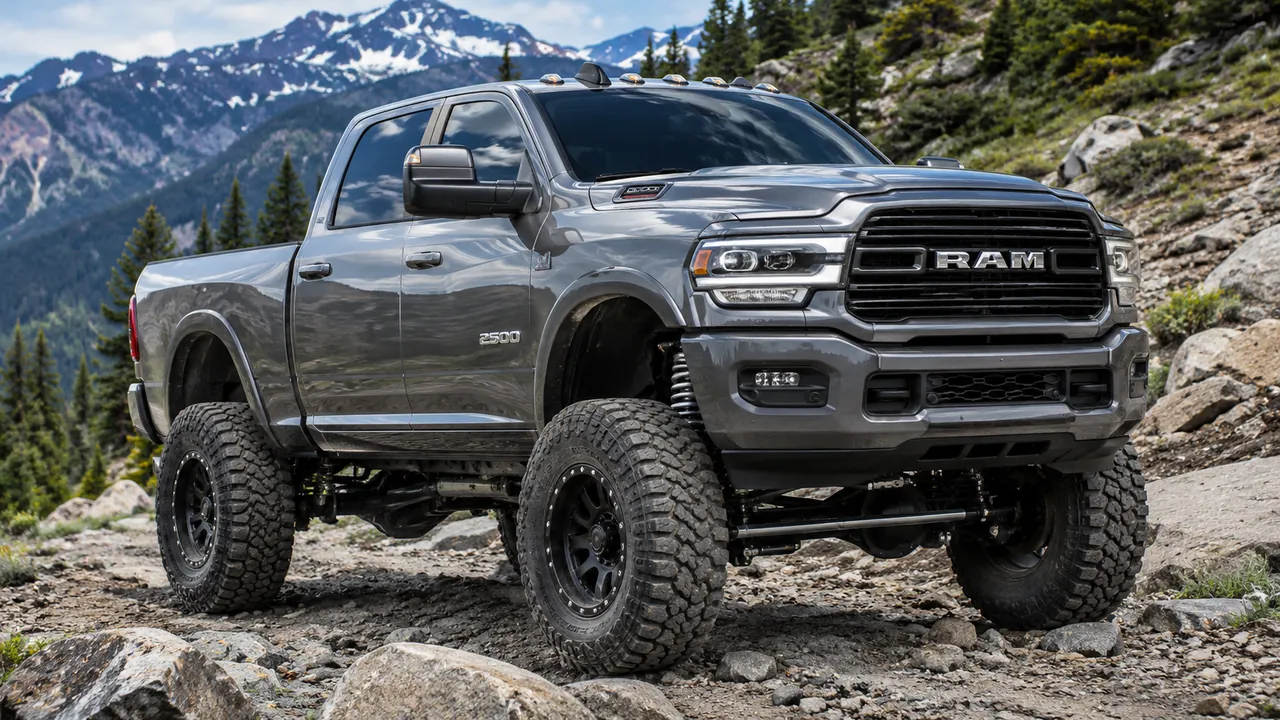
A Ram 2500 lift kit is easiest to get wrong when you shop by inches alone. For a conventional 2014–2026 4WD truck driven to work, used for towing and occasionally taken off pavement, a well-matched 2–3-inch suspension system is often the sensible place to start. Around four to five inches is a different commitment: more room for certain wheel-and-tire combinations, but also more geometry work and a taller hitch. Six inches and beyond belong to builds where you have already considered steering, driveline angles, loading height and cost.
Before choosing a brand, identify the rear suspension. A 2012 Ram 2500 with rear leaf springs, a 2022 with rear coils, and a 2022 with factory rear air suspension cannot use the same rear lift hardware. Power Wagon and Rebel models introduce their own starting heights and exclusions. The comparison below gives you a direction; the exact kit application chart and installation instructions decide fitment.
Start Here: Which Ram 2500 Lift Is Worth Buying?
Most shoppers are trying to answer two questions: how much lift will look and work right with the tires they want, and which kit is actually compatible with their truck. Treat these as planning ranges rather than clearance guarantees. Wheel width, offset, suspension trim and intended loading matter as much as the headline lift height.
| Truck and main priority | Lift range to investigate | The detail most likely to change your choice |
|---|---|---|
| Daily-driven 4WD, factory-size or modest tires | 0–2.5 in. front leveling / mild suspension | Factory rake, caster, shocks and loaded rear stance |
| 2014+ standard-height 4WD, mixed highway and trails | 2–3.25 in. engineered system | Gas vs Cummins spring, rear coils vs factory air |
| Larger tires, taller stance, still road-driven | 4–4.5 in. complete suspension | Radius arms, track bars, bump stops and wheel backspacing |
| 37-inch tire project with stronger visual height | 5–6 in. complete kit | Tested tire/wheel combination, driveline and steering |
| Power Wagon or Rebel | Trim-approved lift, not standard-kit assumption | Factory off-road suspension, sway bar and actual extra height |
| 2003–2013 4WD truck | Four-link-front / rear-leaf application | Control arms, front axle location, leaf-spring rear hardware |
| 1994–2002 or 2WD truck | Exact chassis-specific system | Actual front axle/drive layout, not generic 2500 fitment |
A 35-inch tire does not automatically need a six-inch kit. Conversely, a 37-inch tire that fits in a parking lot is not necessarily clear at full steering lock and controlled suspension compression. The best kit is the one that makes your real tire and load goals work without leaving the truck harder to steer, hitch or service than you expected.
If you regularly pull a gooseneck or haul tools, keep some useful rear-high rake when unloaded. A leveling kit that makes the truck perfectly flat with an empty bed can leave it tail-low under load. More height does not add payload or towing capacity; it only changes where the suspension sits.
The 2014 Suspension Change Is the Buying Decision Many Catalogs Miss
The Ram 2500 name has lasted far longer than any single suspension design. Before reading a list of favorite brands, compare your truck against these mechanical breakpoints. They determine which springs, arms and rear axle parts even belong on the shopping list.
1994–2002 Dodge Ram 2500: Verify the 4WD Front End and 2WD Layout
Older Dodge Ram 2500 four-wheel-drive trucks use a solid front axle located by links and coil springs, with a leaf-sprung rear axle. Lift systems for these models have to work with that combination: front control-arm and track-bar geometry, steering correction, appropriate shocks, and rear spring or block provisions. A kit advertised for a later radius-arm Ram is not a convenient substitute.
Searches such as 1998 Dodge Ram 2500 lift kit and 2001 Dodge Ram 2500 lift kit 2WD still appear because these pickups remain in service. Check the vehicle identification and front suspension physically. Two-wheel-drive applications need their own steering and suspension components; do not assume the 4WD kit fits because the cab and bed look identical. Axle swaps and previous modifications further narrow what will work.
2003–2009: Four-Link Front, Rear Leaf Springs
The 2003 redesign brought a different heavy-duty chassis, but the broad 4WD recipe remained a coil-sprung solid front axle with separate control links and a rear leaf-spring axle. The common search for a 2006 Dodge Ram 2500 lift kit therefore leads to very different parts than a 2016 Ram 2500 lift. Front control-arm length, track-bar correction, shock travel and rear spring-to-axle hardware all need to be matched.
Do not assume every 2003–2009 listing fits every engine or special edition. The transition from the 5.9L to the 6.7L Cummins in the later part of this era, along with gas-engine choices and aftermarket bumper weight, can influence front spring selection. On an older working truck, inspect ball joints, steering joints and control-arm bushings before adding lift; the new height will not repair existing play.
2010–2013: Still the Earlier Front-Link and Rear-Leaf Arrangement
A 2012 Ram 2500 lift kit is a frequent search, and it has a specific answer: for the typical 4WD 2500, shop the earlier linked-front, leaf-rear architecture, not the 2014-onward radius-arm and rear-coil arrangement. Many retailers offer 2–3-inch systems or larger complete packages in this range, often with separate notes for diesel, gasoline or Power Wagon configurations.
The 2013 model year deserves extra caution because Ram 3500 suspension changes do not automatically apply to a 2013 Ram 2500. A broad “2500/3500 2013+” product title can hide an important distinction. Check the individual part number and read how the maker deals with the front axle, not just the year filter in a retailer search form.
2014–2018: Front Radius Arms and Five-Link Rear Coils
For 2014, the Ram 2500 adopted heavy-duty front radius arms and a five-link rear coil-spring suspension on standard coil-rear versions. An optional auto-level rear air system creates another branch. This is the single most useful generation split in the whole guide. A 2017 Ram 2500 is not merely a facelifted 2012 underneath, and a four-inch kit for the older truck cannot be repurposed with different rear spacers.
The factory rear links locate the axle, and the coils provide spring force. A complete rear lift may involve different coils or engineered spacers, shock lengths and sometimes track-bar correction. On the front, look at caster and the radius-arm operating angle. A kit containing only two front spacers is a different product from a suspension package that includes those supporting parts.
2019–2024: Revised Truck, Familiar Architecture, More Trim Differences
The 2019 generation kept the general front-radius-arm and rear-coil-or-optional-air concept, but that does not mean every 2014–2018 component is approved on a 2024 truck. Some manufacturers group 2014–2026 together for particular coil and track-bar parts, while selling different complete kits or hardware for specific model years. A 2022 or 2024 Ram 2500 needs its own fitment check.
The 2023 Ram 2500 Rebel adds another off-road variant alongside the Power Wagon. Both can already have a higher factory stance and distinctive equipment, and they must not be lumped in with a standard Tradesman or Laramie. Do not use an ordinary truck’s advertised lift gain to predict how much a Rebel or Power Wagon will rise.
2025–2026: Check the Transmission and Transfer-Case Hardware Too
The updated 2025 heavy-duty lineup introduced a new Cummins/TorqueFlite HD eight-speed combination. Several suspension suppliers accordingly publish distinct 2025–2026 applications or supplemental front driveline requirements. This is a practical reason to resist a product listing that simply claims “2014 and up” without installation notes for the latest models.
For example, Rough Country lists a 2025–2026 diesel 5-inch system incorporating a front driveshaft for a 10-bolt transfer-case connection. It excludes certain transfer-case configurations and Power Wagon models. Other makers may use a transfer-case indexing kit, a different shaft solution or none at a lower lift. The point is not that every 2025 truck needs a new shaft; it is that transmission, transfer case, engine and lift architecture may affect the bill.
Rear Coils or Factory Air Ride? Buy the Right Half of the Kit
A rear suspension mismatch is especially expensive on a Ram 2500 because the rear hardware changed in 2014. Identically lifted trucks from the outside can carry completely different systems under the bed. Inspect the rear axle and spring arrangement before you add a kit to your cart.
Rear Leaf Springs: Mainly the Older 2500s
On most 1994–2013 4WD Ram 2500 applications, the rear leaf pack supports and helps locate the axle. Lift methods can include taller springs, replacement or engineered blocks, and matched shocks depending on the vehicle. Blocks are not an invitation to pile extra material between the axle and springs. Some products replace the existing block or require fresh U-bolts and specific axle locating features.
If you are working on an earlier truck, our rear lift block fitment guide explains that hardware in greater depth. The key here is to verify the original leaf pack, spring perch, existing block and what the chosen kit includes. Leaf-spring hardware for a 2012 pickup does not go on the rear of a coil-sprung 2022.
Five-Link Rear Coils: They Are More Than Two Springs
From 2014, a conventional coil-rear Ram 2500 uses separate upper and lower links plus a track bar to control the live rear axle. When it rises, the axle follows the geometry of those links and the track bar. Raising the body on longer rear springs is therefore only one part of making a complete system behave properly.
Our rear coil spring spacer guide covers the difference between moving a spring seat and improving useful suspension travel. For a Ram 2500, also check shock stroke, bump stops, rear track-bar angle, driveshaft clearance and spring retention at full droop. Spacers should be used only where the kit maker permits them for the exact rear suspension.
Auto-Level Rear Air Suspension: The Common Wrong-Order Trap
The optional Ram 2500 auto-level rear air suspension is not the same equipment as the four-corner air suspension offered on certain Ram 1500 trucks. A Ram 2500 air-ride setup retains its heavy-duty rear-axle architecture but uses a different springing and ride-height-control arrangement. A box of rear steel-coil spacers does not magically become an air-compatible lift.
Look for a kit explicitly approved for Ram 2500 factory rear air ride. It may require air-spring spacers or other designated hardware plus provisions for sensor linkage, shock length, air-line travel and system operation. Confirm how the suspension behaves with cargo and after it self-levels. If a product says “without air ride,” that exclusion is decisive regardless of whether its front coils seem to fit.
A separate guide to the Ram 1500 lift kit covers that lighter-duty truck and its four-corner air-suspension variations. Do not cross-shop 1500, 2500 and 3500 kits by brand name or diameter alone; they are distinct vehicle applications.
Power Wagon and Rebel: Factory Height Changes the Answer
These badges are not cosmetic trim names for suspension shopping. A special-edition truck can leave the factory with different ride height, articulation hardware, dampers and tires. That changes both how much more lift you need and whether a conventional kit is compatible.
Power Wagon: Electronic Sway-Bar Disconnect and Special Geometry
The Power Wagon is designed around off-road travel from the factory. Depending on model year it includes special suspension tuning, an electronic disconnecting front sway bar, axle equipment and a raised stance. Many conventional Ram 2500 kits expressly exclude Power Wagon, while some manufacturers offer Power Wagon-specific packages. Neither statement is universal; the individual model year and part number decide.
A standard-height kit that adds three inches to a normal truck may add a different amount—or fit improperly—on a Power Wagon. Ask whether the product preserves the electronic sway-bar function and whether the maker measures lift relative to a Power Wagon or an ordinary 2500. An already-modified truck adds a further complication: its installed coils and shocks may not be factory parts anymore.
Rebel: A 2.5-Inch Kit May Deliver Much Less Extra Lift
The heavy-duty Rebel, introduced for the 2023 model year, also starts with off-road-oriented suspension. Ram’s original 2023 specification included Bilstein shocks and 33-inch all-terrain tires. At least one current ICON system illustrates the issue clearly: its application note describes roughly 2.5 inches on most Ram 2500 trims but only 0.5 inch on the Rebel. That is a product-specific example, not a claim about all lifts.
For a Rebel, compare the manufacturer’s stated finished ride height, not just the number stamped on the box. Pay attention to whether the system was tested with the exact front spring and rear configuration. Factory wheel size, offset and any rear air option may matter as much as the lift itself.
6.4L HEMI vs 6.7L Cummins: Front Spring Load Is Real
Diesel engine mass can change the front spring rate needed to reach a target height. A coil marketed for a Cummins truck may sit differently when installed on a gasoline HEMI, and the reverse is also true. Permanent accessories such as a winch bumper add weight ahead of the front axle. Read the engine-specific spring notes instead of assuming every “Ram 2500 4WD” kit has the same ride height.
A 2017 gas truck, a 2024 Cummins and a 2026 High-Output diesel may appear in different sections of the same manufacturer catalog. That is normal. Record the actual engine and any front accessory weight before comparing lift heights. If the final stance is wrong, adding a random spacer to compensate may disturb the geometry and travel that the system was designed around.
Why the Front Suspension Parts Matter More Than the Lift Number
The best-looking kit photographs rarely show the pieces that stop a raised truck from wandering. Once you increase the distance between the frame and a solid front axle, you need to consider how that axle moves fore and aft, side to side and through steering travel. The correct solution changes across Ram generations.
Earlier Four-Link Front Ends: Control Arms and Axle Position
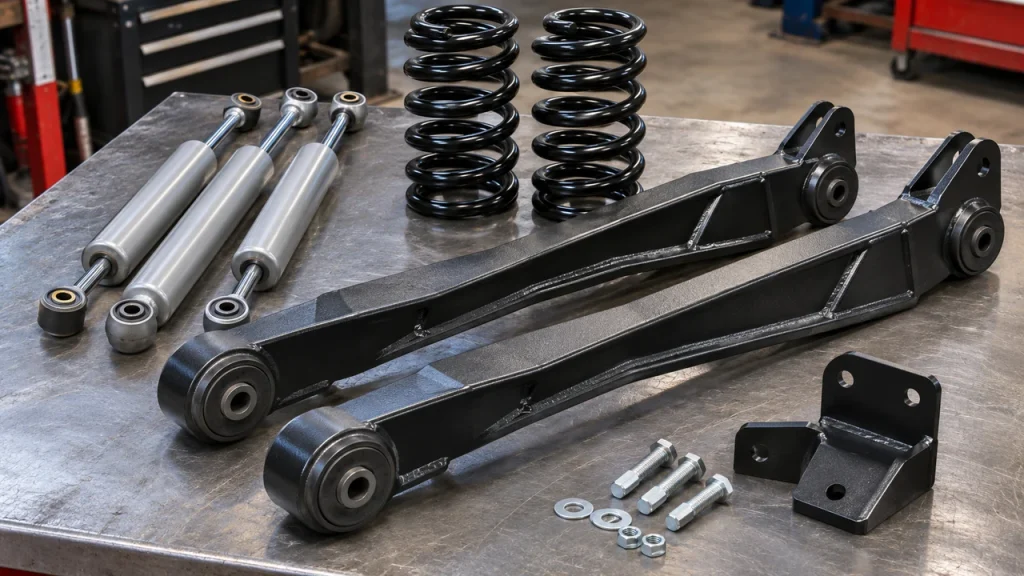
On pre-2014 4WD 2500s, multiple control links locate the front axle. As lift height grows, link operating angles and the fore-aft position of the axle may change. Some packages use longer arms or relocated mounts to restore more useful caster and wheel placement. You cannot choose those components by spring height alone.
This is also why used-truck inspections matter. An older Dodge Ram with a three-inch lift may already have non-stock arms or a relocated track bar. Installing a second correction kit over the first may create a new problem. Work out what is installed before ordering another set of components.
2014+ Radius Arms: Drop Brackets vs Replacement Arms
The later front radius-arm layout is robust and well suited to daily use, but lift changes arm angle and influences caster and front axle position. A modest matched spring-and-shock system may retain the original arms; a taller package may use engineered radius-arm drop brackets or replacement arms. A four-link conversion is another option, mainly when the designer wants different control over articulation and geometry.
Our radius arm vs 4-link comparison goes deeper into that layout choice. On the Ram 2500, match the complete front-arm design to the actual lift, year and engine. Avoid adding a generic drop bracket to a kit that already supplies its own corrected arms. More metal is not automatically more correction.
Track Bar and Drag Link: Do Not Tune Out Bump Steer With a Stabilizer
The front track bar positions the axle laterally while the steering drag link moves through its own arc. A change in ride height can affect the relationship between them, causing the steering to react as the suspension moves. Depending on the kit, an adjustable track bar, relocation bracket or specified steering correction may be needed to recenter the axle and control those arcs.
Our track bar relocation bracket guide explains what the bracket actually changes. A larger steering stabilizer may damp a symptom but cannot correct a badly chosen track-bar or drag-link angle. On a freshly lifted truck, ask for axle centering, caster and steering checks, not simply a wheel alignment receipt with no measurements.
Shocks, Bump Stops and Brake Hoses Limit Real Travel
A taller spring does not create safe usable travel by itself. At full compression, the bump stop should prevent the shock from bottoming out; at full droop, the damper, spring, brake hoses, ABS wires and driveshaft should remain within their designed limits. The correct shock is not necessarily the longest one on the shelf.
Lift kits may include brake-hose drop brackets, extended flexible hoses or model-specific routing. Our extended brake line guide explains those options. Verify all clearances through a controlled suspension range-of-motion inspection performed safely by a qualified installer. A hose that looks relaxed with the truck parked can become taut when the axle droops.
35s, 37s and 40s: Tire Clearance on a Ram 2500
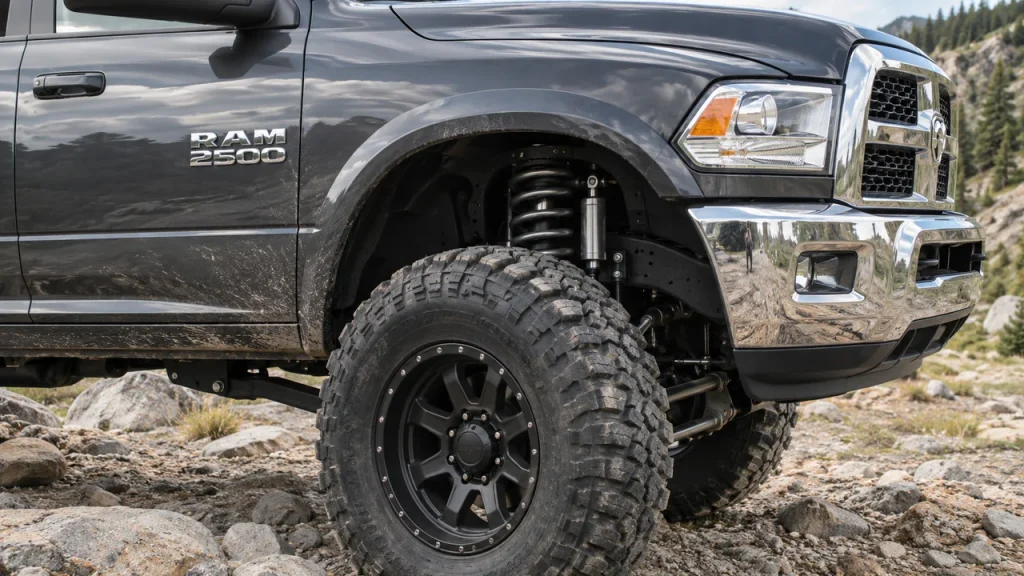
On a heavy-duty Ram, the wheel is often the deciding detail. A claimed tire size in a lift advertisement only applies under specific assumptions about wheel width, backspacing, offset, actual tire dimensions and steering clearance. Wider negative-offset wheels push the tire farther out and may cause contact where a narrower wheel clears.
33- and 35-Inch Tires: Check the Factory Starting Point
A standard-height 2500 may fit certain larger tire combinations with little or no suspension work, while others rub at the rear of the front wheel opening. The factory Rebel already comes with a substantial off-road tire package; do not assume it needs the same lift for 35s as a base work truck. Power Wagon applications deserve the same separate check.
For a common modern Cummins truck, some complete three-inch systems are documented around a specific 35×12.50 wheel and tire fitment. That is helpful evidence only for the stated configuration. Measure at full steering lock and evaluate clearance under controlled compression before treating any nominal diameter as approved.
37-Inch Tires: A Popular Goal, Not a Guaranteed 4-Inch Recipe
A 37-inch tire is a realistic target for some Ram 2500 builds, and manufacturers offer four-and-a-half-, five- and six-inch systems tested around particular 37×12.50 combinations. Certain premium 2.5-inch systems also advertise 37s with trimming and wheel restrictions. Those different claims are not contradictions: tire width, wheel location, axle position and suspension travel can make the required height very different.
For general tire trade-offs see our 37-inch tire lift guide. The Ram-specific shopping question is whether the exact tire and wheel combination has been tested on your year and suspension. Request the manufacturer’s backspacing and trimming guidance. A truck that clears a 37 while driving straight may still rub a radius arm at steering lock.
40-Inch Tires: Think Axle, Steering and Gearing Before Height
A 40-inch tire radically changes leverage, unsprung mass, effective gearing and the packaging around the front axle. The fact that eight-inch systems exist does not make this a casual street-driven choice. Examine axle and wheel ratings, braking response, spare storage, steering components and the realistic ability to use the truck for work. Confirm any required trimming or body clearance from the kit’s own documentation.
On a solid axle, the lowest point of the differential does not rise simply because you installed taller suspension springs. Taller tires increase axle-to-ground clearance through their larger radius; suspension lift raises the frame relative to the axle. Keeping those measurements separate prevents some expensive disappointment after installation.
Offset and Backspacing: Why Two 37s Behave Differently
Wheel offset is often missing from a quick tire question, yet it may be the detail that decides whether the tire touches the radius arm or swings into the fender. A wheel placed farther outward can improve inner clearance but increase outer fender and bumper contact. Wheel diameter may also be limited by brakes or lift components; a kit may specify a minimum compatible rim.
Check the exact wheel model, width, diameter, offset and backspacing alongside the tire’s measured size. Load rating matters on a three-quarter-ton pickup. Do not take a photo of someone else’s Ram with a similar tire as proof of safe fitment on yours.
2025–2026 Driveline Details That Can Change a Lift Quote
The newest Ram 2500s deserve a separate driveline conversation, especially when a shop is quoting a lift above roughly four inches. A modern eight-speed transmission does not dictate a single suspension kit, but the associated transfer-case and driveshaft configurations can affect the supporting parts manufacturers specify.
Front Driveshaft and Transfer-Case Connection
Some 2025–2026 diesel lifts specify a replacement front CV driveshaft matched to a 10-bolt transfer-case flange. A current Rough Country five-inch application is an example; it is diesel-only and excludes manual-transfer-case versions and Power Wagon. Other kits may approach driveline angles differently and may not require that same part. The exact requirement belongs to the specific installation instructions.
Before buying, identify the transmission, transfer case, driveshaft flange pattern and existing modifications. For a taller kit, ask whether front driveshaft operating angle, transfer-case indexing, length and joint travel were checked. A vague “it worked on a 2024” is not enough to establish fitment on a 2026 truck.
Why a 2019–2024 Kit May Not Be a 2025 Kit
Some spring and track-bar components continue across many model years. Complete kits can nevertheless have a narrower application because of bracket geometry, driveline parts or changed equipment. Manufacturers may divide a product family into 2019–2024 and 2025–2026 even when both share the same advertised lift height. The split is about the whole installation, not just the color or height of the springs.
Ask for the manufacturer’s current installation PDF, not an undated reseller description. Make sure the kit revision covers the engine, transmission and any rear air-ride or special off-road equipment. If a shop recommends mixing parts from two different systems, ask for documented manufacturer approval of that combination.
Compare the Kit, Not the Badge on the Box
Rough Country, BDS, Carli, Thuren, ICON, ReadyLIFT, Fabtech and other suppliers all sell Ram heavy-duty suspension products, but they do not all solve the same problem. A budget front spacer, a complete radius-arm lift and a premium travel-and-damping package should never be compared solely on advertised inches.
Spacer-First Leveling vs New Coils and Shocks
A simple leveling spacer changes ride height with relatively little hardware. It may be enough for a healthy truck that only needs modest stance correction and uses its suspension lightly. It does not automatically improve spring rate, shock quality or available travel. If the truck pounds over washboard roads every weekend, a matched coil-and-damper system may be the more useful purchase even when the height is similar.
Look for published front and rear lift measurements, the exact shock models included and any required supporting geometry parts. A “3-inch lift kit” with no new shocks cannot be assumed equal to a suspension system that has been developed and tested as an assembly. Both can have a place, but the truck’s actual use should decide.
Work Truck, Highway Commuter or Rough-Road Truck?
A diesel used daily on interstate pavement and hooked to a trailer wants predictable steering, stable loaded stance and reliable damping. A trail-oriented pickup may place more value on wheel control and repeated bump absorption. Long-travel or premium shocks can help in harsh conditions, but a stiff spring chosen for permanent weight can ride poorly when the bed is empty.
Be wary of buying a package because it has the most aggressive name. Ask how it behaves with your actual cargo, whether the springs are specified for that weight and whether the shock design can be serviced. The more specialized the system, the more useful it is to speak with an installer who has built the same chassis.
The Installation PDF Tells You What the Product Card Leaves Out
Parts listings often lead with tire size and lift height. Installation documents reveal required brake-line provisions, fastener sizes, cutting or drilling, driveshaft work, sensor considerations and whether original parts must be discarded. Some kits require a particular wheel diameter or backspacing, or say clearly that Power Wagon, Rebel or factory air ride are excluded. Certain current ICON applications also specify post-install ADAS recalibration; ask what electronic inspection or calibration the exact system requires rather than assuming a mechanical alignment is sufficient.
Write down the exact part number and the manufacturer’s current fitment notes. A product that lists your year but excludes your rear air system is not compatible. If the information is contradictory, get written clarification before buying. Being told that it “should bolt up” is not a substitute for a tested application.
What a Lift Does to Towing, Payload and Daily Life
The Ram 2500 is often purchased for work that a lighter pickup would struggle with. Lifting it changes entry height, hitch geometry, brake and steering demand with heavier tires, and the way the suspension sits under load. None of those issues goes away just because the finished truck sits level in an empty parking lot.
A Lift Does Not Raise GVWR, GAWR or Tow Ratings
Longer coils, taller tires and air helpers do not increase the manufacturer’s gross vehicle weight rating, axle ratings or approved tow capacity. Heavier wheels and tires can consume some payload and change effective axle gearing. A suspension modification may also affect trailer attitude or require hitch adjustments to maintain a suitable setup.
Ram’s official 2500 capability information describes the current truck’s available auto-level rear air option and powertrain configurations, but ratings still depend on the exact vehicle. Check the door-label limits and the relevant owner’s towing guidance, not the largest figure in a marketing chart.
Fifth-Wheel, Gooseneck and Bed Access
A five-inch lift can make a tall pickup uncomfortable to climb into and the bed harder to reach. For fifth-wheel or gooseneck use, higher bed rails and hitch position can complicate trailer-to-truck clearance. The truck may settle at the rear under pin weight even if it looks perfectly flat while empty. Those are practical fitment questions, not just cosmetic concerns.
Measure current unloaded and typical loaded hub-to-fender height at all four corners before ordering. Note hitch position, trailer level and bed-rail clearance. Plan the finished stance around the load the truck regularly carries rather than copying a photo of an unloaded show truck.
Realistic Parts, Labor and Tire Costs
Budget systems built mainly around spacers can cost a fraction of a fully engineered four- or six-inch kit. Premium radius arms, track bars, reservoir shocks, coilover conversions and rear air-ride hardware can take the parts bill into the thousands. Larger tires, rated wheels and any additional front driveshaft or steering components may add substantially more. Pricing varies too much by year and equipment to promise a universal installed figure.
Our lift kit installation cost guide explains the wider labor and parts factors. For a Ram 2500 quote, ask whether it includes alignment, steering centering, suspension travel inspection, air-system checks when fitted, driveline work and a scheduled fastener recheck. An estimate without those items is not a quote for a finished truck.
Post-Install Checks and Road Legality
A responsible installation includes the manufacturer’s torque sequence, ride-height measurements, alignment, steering lock-to-lock and controlled bump/droop checks. Brake hoses, electrical lines, spring seating, bump-stop engagement and driveshaft clearances all deserve attention. Follow the kit’s re-torque interval and check for new vibration or wandering during a cautious road test.
Equipment rules vary across US states and may cover bumper height, lighting, wheel coverage or inspection requirements. Check the law where the truck is registered and the terms of any applicable warranty or insurance. Modifications do not automatically cancel every vehicle warranty, but failures attributable to altered suspension parts may be treated differently under the applicable coverage.
The Information a Good Lift-Kit Supplier Will Ask For
A real fitment conversation should get more specific than “it is a 2022 Ram 2500.” Collect these details before requesting a quote or comparing packages. It avoids ordering a kit that arrives with the right front springs and the wrong rear hardware.
- Platform and front suspension: VIN, year, 2WD/4WD, and whether the truck has early front control links or the later radius-arm layout.
- Rear suspension: leaf pack, five-link coils, or factory auto-level air system, plus any helper equipment or previous modifications.
- Powertrain and trim: HEMI/Cummins engine, transmission, transfer case, Power Wagon/Rebel identification and permanent winch or bumper weight.
- Wheel and tire plan: exact tire model and size, wheel diameter/width, offset and backspacing, load rating and tolerance for trimming.
- Real work schedule: normal trailer, pin or tongue weight, permanent bed equipment and unloaded versus loaded ride-height measurements.
- Complete installation: kit part number and PDF revision, steering and track-bar correction, shocks, driveshaft work, alignment and post-install checks.
Make a note of any unanswered fitment question and ask the kit manufacturer directly. Written approval for an unusual factory package is far more useful than a reseller’s generic “fits 2014–2026” label.
Ram 2500 Lift Kit Questions That Come Up After the First Search
These short answers cover the remaining practical decisions. No tire size or lift height below should be treated as universal approval for every engine, wheel or trim package.
What Is the Best Lift Height for a Daily-Driven Ram 2500?
For many standard-height 4WD trucks, a complete 2–3-inch system is a sensible place to compare ride, geometry and tire fitment. The right result may be lower if the truck already runs the tire you want or regularly tows. A higher lift makes sense only when the extra height solves an actual fitment or use requirement.
Can a 2012 Ram 2500 Lift Kit Fit a 2017?
No, not as a complete bolt-on suspension system. The 2012 truck uses the earlier front-link and rear-leaf configuration, while the 2017 truck has the later radius-arm front and standard five-link coil rear or optional air setup. Shop each generation by exact fitment rather than assuming the same advertised lift height means interchangeable parts.
Will a Standard Lift Kit Work on a Power Wagon?
Only when the manufacturer explicitly lists the Power Wagon for that year. Many standard 2500 kits exclude it because its factory suspension, stance and electronic sway-bar equipment differ. A Power Wagon-specific kit may be available from the same brand, but the correct product and added height must be confirmed independently.
Does Rear Air Ride Mean I Cannot Lift a Ram 2500?
No. Air-compatible systems exist. The important part is buying one designed for the factory rear air arrangement, with the specified air-spring, sensor and shock provisions. A conventional rear coil-spring kit marked “without air ride” is not an approved substitute.
Do I Need Five or Six Inches to Run 37-Inch Tires?
Not always. Some manufacturers list 37-inch combinations with lower lifts and particular trimming or wheel specifications, while others design five- or six-inch packages around them. Your year, wheel backspacing, actual tire width and available steering and suspension travel decide whether the fitment is realistic.
Why Are 2025–2026 Ram 2500 Kits Sometimes Sold Separately?
The updated powertrain and front driveline configurations can change supporting hardware, particularly for taller lifts. Some 2025–2026 diesel applications specify a different front driveshaft or transfer-case arrangement. That does not mean every 2024 suspension component became obsolete; it means the complete kit needs fresh manufacturer approval.
Are Dodge Ram 2500 and Ram 2500 Lift Kits the Same Thing?
The naming changed over time, and retailers use both terms. A “Dodge Ram 2500 lift kit” may refer to an older 1990s or 2000s truck, but the badge wording does not establish compatibility. The model year, chassis, drivetrain and suspension arrangement always take priority over the marketing name.
Can I Keep the Stock Wheels After Lifting My Ram 2500?
Sometimes, but larger lift systems may require a specific wheel diameter or backspacing to clear steering and suspension hardware. Confirm the approved wheel-and-tire combination on the actual kit, including brake clearance and load rating. A tire fitting under the fender does not prove the wheel clears the new brackets.
Three Ram 2500 Builds That Deserve Different Answers
The same tire size can lead to very different suspension purchases. These examples show how the truck’s original hardware and regular work change the answer; they are planning cases, not recommended part numbers or universal tire-fitment approvals.
A 2008 Cummins 4WD on 35s: Restore the Old Front End First
Imagine an older 2500 that already sits a little low at the front, wanders over expansion joints and has worn shocks. The tempting purchase is a cheap three-inch kit and a fresh set of 35s. The sensible first step is to inspect front control-arm bushings, steering linkage, track-bar joints and ball joints. Raising the frame will not improve steering that already has play, and oversized tires can make it more noticeable.
Once the chassis is sound, shop the 2003–2009 four-link-front, leaf-rear application. Check the actual tire width and wheel backspacing, then compare a complete matched system with a modest leveling option. If the truck still tows a trailer regularly, preserve the rear loaded stance. A 2014-onward radius-arm or rear-coil package is the wrong place to look, no matter how similar the product photos appear.
A 2022 Cummins With Factory Rear Air: Keep the Leveling System Working
Here the owner wants a slightly taller stance and comfortable driving with cargo in the bed. A front lift may be easy to find, but the rear is the deciding component. Many attractive complete kits are specifically labeled “without air ride.” Buying one and trying to improvise the rear installation risks interfering with the factory self-leveling function.
A more useful quote starts with an air-compatible application, clear information about how much height is gained front and rear, and checks for air-spring travel, sensors and shock limits. Then compare the truck with its normal cargo aboard. A dramatic six-inch conversion may be unnecessary if the real objective is a little front tire clearance and dependable towing behavior.
A 2026 Diesel 4WD Planning 37s: Ask About the Front Driveshaft
For a newer truck built around 37-inch tires and a noticeable five-inch stance, the wheel-and-tire specification must be chosen with the suspension, not afterward. It is worth asking the installer for a documented 37-inch combination, steering-lock clearance, expected trimming and acceptable wheel backspacing before choosing the kit. Diesel spring fitment is only the beginning.
The latest powertrain and transfer-case options make the front driveline part of the discussion. Some current tall-lift applications include a replacement shaft for a specific transfer-case flange; others take another approach. Request the exact 2026 application and a written list of all required supporting parts. A well-defined complete quote is more useful than a low entry price that grows every time the shop discovers another incompatible component.