Camber Bolts: Sizes, Fitment & Choosing the Right Kit
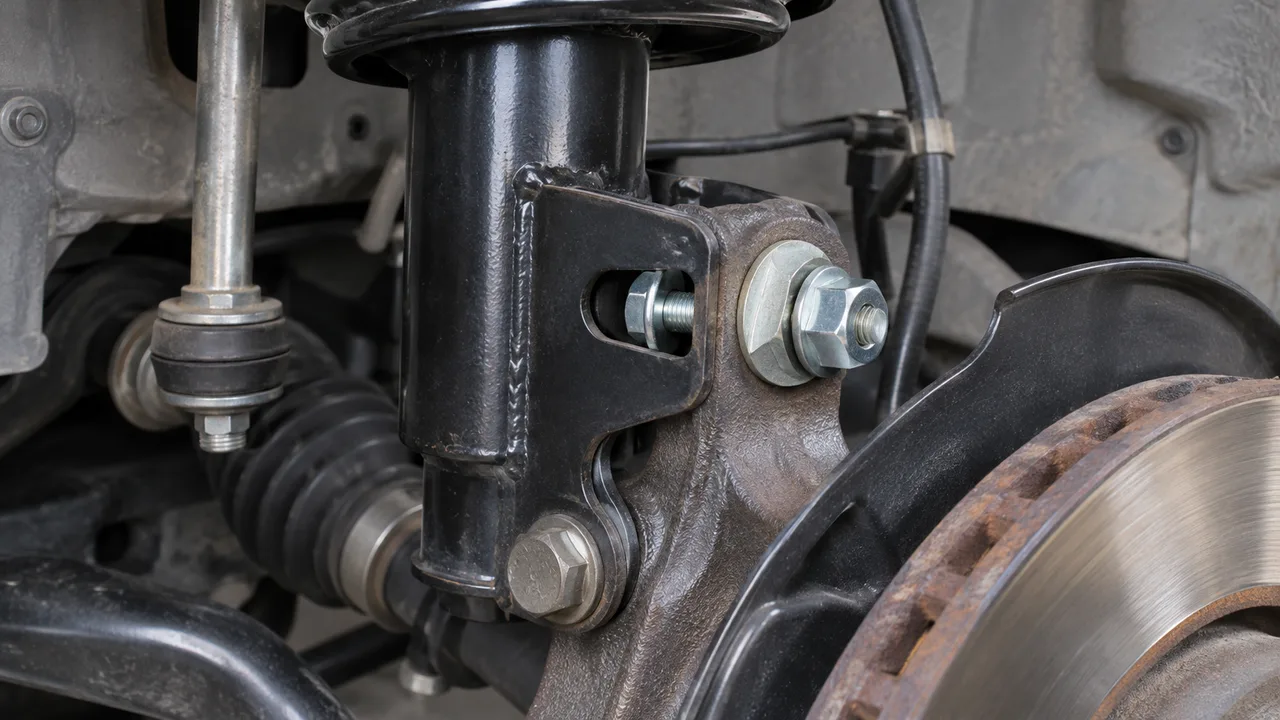
If you’re shopping for camber bolts, don’t start with the biggest adjustment range or the cheapest 14 mm kit. Start with the suspension connection you actually have. A camber bolt for a two-bolt MacPherson strut is a different part from the eccentric control-arm hardware used on many trucks. Even two bolts sold for the same nominal diameter may use different washers, threads, mounting positions, and installation instructions.
The short answer: buy a kit listed for your exact vehicle and adjustment point, confirm the original fastener size and the required correction from an alignment measurement, and check whether the car already has factory camber adjustment. For a compatible two-bolt strut, a replacement eccentric bolt can add a useful adjustment range without changing the complete strut. It won’t straighten bent parts or cure every alignment problem.
The shopping question is not simply “will this bolt fit through the hole?” It’s whether the bolt and its locking hardware can clamp that particular suspension joint safely while allowing the intended correction. That’s the distinction worth getting right before clicking Buy.
Which Camber Bolts Do You Actually Need?
A search for camber bolt kits brings together several kinds of alignment hardware. Some listings show a narrow, offset-looking replacement bolt with a tabbed washer. Others show a large bolt with an eccentric cam washer on each side of a control-arm mount. Those are not interchangeable systems.
Use the suspension location first to narrow the product category. This table is a buying map, not a universal fitment chart.
| What you see on the car | Likely product category | Main check before buying |
|---|---|---|
| Strut clamped to steering knuckle with two substantial bolts | Strut-to-knuckle eccentric camber bolt | Vehicle application, replacement bolt size, upper/lower position and washers |
| Lower or upper control-arm inner pivot with large offset cam washers | Control-arm cam bolt or alignment cam kit | Bracket shape, eccentric washers, sleeve/bushing fit and caster/camber interaction |
| Rear suspension arm with a factory eccentric adjuster | Rear camber alignment bolt or repair kit | Exact arm, mounting location and OEM-style cam hardware |
| Upper ball-joint sleeve on certain trucks | Caster/camber alignment bushing | Axle/suspension family and degree range; not a strut bolt |
| No approved adjustment point, or a damaged component | Diagnosis or a different correction part | Service information and a measured alignment report |
Two-Bolt Strut-to-Knuckle Camber Bolts
This is what many shoppers mean by a camber bolt: a high-strength replacement fastener with an eccentric profile and purpose-made washer. It fits a specified position in the joint where a strut clevis attaches to the steering knuckle. As the eccentric turns during alignment, it changes the relative position of the strut and knuckle within the designed range.
Two-bolt struts are common, but seeing two bolts is only the first clue. The fastener size, strut hole geometry, and permitted adjustment position still need confirmation. Some cars already have a factory eccentric in that joint. Replacing it with a random aftermarket design can remove, duplicate, or interfere with the adjustment the manufacturer intended.
Control-Arm Alignment Cams on Cars and Trucks
A pickup or SUV with independent front suspension may have eccentric bolts at the inner pivots of an upper or lower control arm. Often the bolt works together with one or more shaped cam washers that bear against tabs on the frame bracket. Moving these cams shifts the arm’s mounting point, sometimes changing both camber and caster.
A strut kit marketed as “universal 14 mm camber bolts” is not a substitute for that hardware. Control-arm cam kits can include longer bolts, specialized washers, nuts, or brackets. When the original cam is seized, a complete repair kit may be necessary rather than just a replacement nut. Our caster camber bushing guide covers another similarly named, but mechanically different, correction part used on certain truck steering pivots.
Rear Camber Bolts Are Not One Standard Design
The rear axle may use a strut, a multilink suspension, or a torsion beam. Where rear camber is adjustable, the eccentric could be at a control arm or another designated link—not necessarily at a rear shock absorber. A shock mount that carries damper loads isn’t automatically a wheel-locating adjustment point.
For a concrete example, SPC sells a rear 12 mm EZ Cam XR kit for selected Ford Focus and Volvo applications that replaces an outer rear upper-control-arm bolt. That’s not the same mounting arrangement as its front two-bolt-strut products. The word rear in a listing is no substitute for checking the actual part diagram.
Camber Bolt Sizes: 10 mm to 18 mm Explained
Bolt diameter is one of the most searched specifications, yet it’s also one of the easiest to misread. Product lines such as SPC EZ Cam XR include nominal replacements for several original strut bolts. The diameter in the product name identifies the application size; it does not tell you that every portion of an eccentric replacement has the same diameter or thread as the original.
SPC’s current catalog includes the following EZ Cam XR pairs for compatible two-bolt struts. These are examples of a specific manufacturer’s range—not a list of parts that fit every car with a matching number.
| OEM bolt size category | SPC EZ Cam XR pair | Buying note |
|---|---|---|
| 10 mm | 81240 | Smallest size in this range; verify the application |
| 12 mm | 81250 | Match original strut hardware and approved position |
| 14 mm | 81260 | Common listing size; not automatically correct for every 14 mm-looking bolt |
| 15 mm | 81270 | Don’t substitute 14 mm because the two look similar |
| 16 mm | 81280 | Some slotted aftermarket struts require a compatible adapter arrangement |
| 17 mm | 81290 | Verify shaft, washer and nut details for the vehicle |
| 18 mm | 81295 | Confirm exact fitment; higher size doesn’t mean more adjustment |
The manufacturer’s SPC EZ Cam XR product information identifies these part numbers and the stated adjustment capability. Whiteline and Pedders also offer multiple bolt sizes, but their part numbers and supplied hardware are different. Never match one brand’s number to another brand’s kit by diameter alone.
Measure the Bolt, Not the Wrench Size
A 17 mm socket doesn’t mean the bolt has a 17 mm shank. The hex head, threaded section, unthreaded shank, and eccentric lobe are separate dimensions. Listings that omit the relevant measurements leave too much room for guesswork.
The dependable route is a vehicle-specific catalog lookup followed by verification against the OEM fastener or service information. If the existing hardware has already been replaced, measure and identify what’s on the car rather than assuming it still matches the factory illustration. Don’t dismantle a suspension joint merely to take measurements without the proper support and procedure.
Why the Washer and Thread Matter Just as Much
Many strut-camber kits depend on a specially formed or tabbed washer that reacts against the strut bracket. If the tab does not seat where the manufacturer expects, the adjustment may not hold correctly under load. A lookalike nut from a hardware bin may also have the wrong locking feature, grade, or thread pitch.
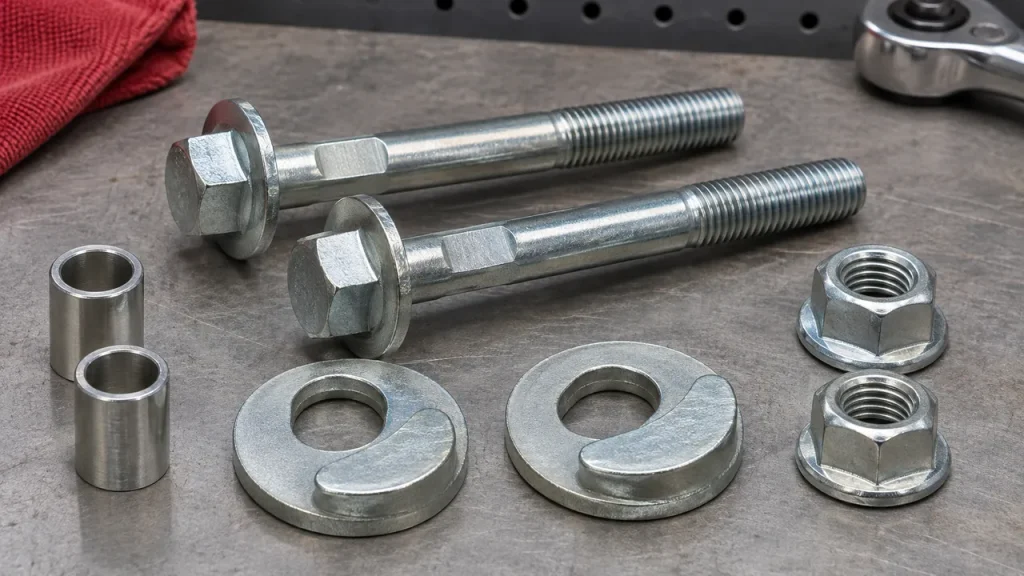
Read the kit contents. “Two bolts” doesn’t necessarily mean “everything required” unless the listing specifies the eccentric washers, nuts and any adapters. The manufacturer may prohibit reusing certain nuts. You want the complete approved fastening system, not just a shaft that fits through a hole.
What If the Catalog Calls It a Universal Camber Bolt?
Universal usually describes a component intended for a broad family of compatible joints, with dimensional and vehicle-specific limits. It doesn’t mean it can be installed in any suspension with a similar-looking bolt. Even within one model generation, an engine, trim, factory suspension package, or aftermarket strut may change what fits.
This matters especially for used cars. Someone may already have fitted an aftermarket strut with slotted holes, factory-style eccentric hardware, or a prior alignment kit. A seller’s fitment selector is useful; a photograph of your actual joint and a current alignment printout are useful too.
How Much Camber Correction Can a Bolt Kit Provide?
A replacement eccentric isn’t a promise that you can dial in any camber angle you want. SPC describes up to ±1.75° of adjustment for compatible EZ Cam XR two-bolt-strut applications, while some Whiteline and Pedders products advertise ±1.5°. These are product-specific maximum claims, not vehicle-independent guarantees.
The result depends on the strut bracket, mounting hole, knuckle, original geometry and position of the hardware. A wheel that starts far outside specification because an arm is bent may remain outside specification after a kit reaches the end of its permitted travel.
Does ±1.5° Mean Three Degrees of Adjustment?
A stated positive/negative range describes movement available around a reference position under the conditions defined by that manufacturer. It shouldn’t be added to another product’s claim or treated as a guaranteed three-degree improvement on your car. One kit’s language may refer to change from nominal, while another document may describe total range or a specific correction limit.
Ask for the catalog’s exact definition when comparing products. The sensible buying target is the correction your alignment technician says the car needs, with enough usable range to reach the specified setting—not the most dramatic number on the listing.
How Much Negative Camber Do You Really Need?
A modest correction to return a road car to its factory range is a different purchase from a track-focused setup seeking a more aggressive angle. A negative-camber setting is not automatically a performance upgrade, and too much for the intended use can reduce tire life or braking consistency.
If you’re unsure whether the wheel’s inward tilt is acceptable in the first place, our camber angle explanation covers positive versus negative camber and the effects on handling and tire contact. This guide stays focused on choosing the hardware.
A Before-and-After Reading Is More Valuable Than a Guess
Suppose an alignment sheet shows one front wheel slightly beyond the vehicle’s permitted camber limit. That reading tells you how much correction is needed; the measured condition of the suspension tells you whether a bolt kit is an appropriate way to get it. Without both, you’re shopping blind.
If one side is dramatically different after a curb impact, check for a bent knuckle, shifted subframe, or damaged strut before ordering. An eccentric bolt can change a displayed alignment number without repairing the reason it moved.
Eccentric Camber Bolts vs. Factory Adjustment Hardware
Two listings can both say “eccentric camber bolt” while describing very different functions. The critical questions are where the eccentric acts and whether it replaces a fixed or already adjustable fastener.
Aftermarket Strut Camber Bolts
These introduce adjustment at an approved strut-to-knuckle connection on a compatible car. They commonly replace one of the ordinary clamping bolts with a purpose-built eccentric assembly. The other bolt, bracket, and washer arrangement influence how the correction works and stays locked.
Some product families use the upper strut bolt. An exception worth knowing: SPC’s vehicle-specific 81305 for a group of Subaru and related applications specifically calls for the lower position of a two-bolt front strut. A general internet rule saying “always replace the upper bolt” or “always replace the lower bolt” is therefore unreliable.
Factory Control-Arm Eccentric Bolts
Many trucks arrive with alignment cams designed into their suspension. The technician moves the control-arm pivot using those cams, rather than substituting a thin eccentric bolt in a strut clevis. If a cam washer is seized, bent, or missing, the correct repair may be an OEM-style cam kit for that chassis.
This is also why searches such as Tacoma camber bolts, Nissan Frontier cam bolts, and F-150 camber bolts need vehicle-specific answers. They may refer to control-arm alignment hardware, and the adjustment can affect caster too. Compare the parts diagram before treating them as alternatives to a strut bolt kit.
Camber Bolts vs. Camber Plates
Camber plates act near the top of a compatible strut assembly; strut camber bolts act down at the strut-to-knuckle joint. The mechanisms, available travel, and compatibility requirements differ. Some coilovers come with camber-adjustable upper mounts, but others use fixed top hats.
Our coilover top hats guide identifies the upper-mount hardware, including adjustable plate designs. Don’t assume a coilover with camber plates can also accept any aftermarket camber bolt, or that combining adjustments is safe without the equipment maker’s approval.
Camber Bolts vs. Slotted Strut Holes
Some replacement struts use elongated mounting holes to provide camber movement. Their fastening system may require particular bolts, adapter plates, or washers so the assembly clamps securely after alignment. A regular eccentric kit designed for round holes may not seat correctly against that bracket.
SPC lists special cam-and-bolt solutions for some aftermarket slotted struts. That is a fitment detail to verify in the actual catalog—not an invitation to grind a strut hole longer or improvise a washer. Changing a structural mounting slot without approved instructions is a different and potentially unsafe modification.
Front and Rear Camber Bolts: Where Do They Go?
Front camber bolts are often discussed alongside MacPherson struts because many front-wheel-drive cars use a two-bolt strut-to-knuckle joint. Rear camber bolts may attach to very different suspension links. The word “front” or “rear” on a product page isn’t enough to identify the intended joint.
Upper or Lower Strut Bolt?
Check the installation sheet for the exact part number. Some kits replace the upper bolt; some specialized applications specify the lower one. If the car already has a factory eccentric, the instructions may restrict which bolt can be changed. Using the opposite location because a forum photo looks convincing can put the eccentric or washer in the wrong geometry.
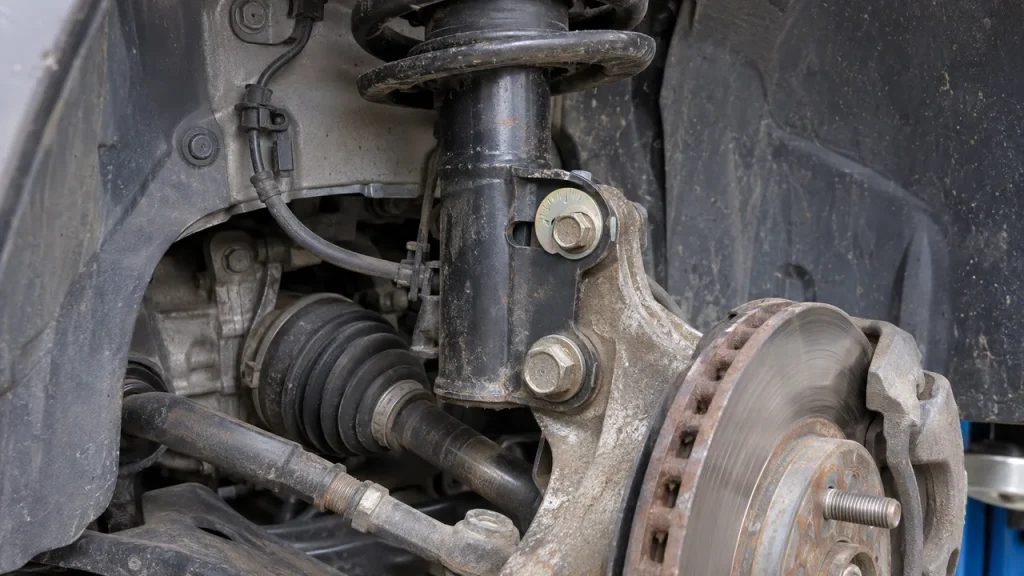
The bracket must have the form and contact area needed by the kit. You should also verify that the steering knuckle, brake hose, ABS wiring, and wheel have adequate clearance throughout the relevant steering and suspension movement.
When a Rear Kit Adjusts a Suspension Arm
A rear multilink setup might use an eccentric at an inboard arm pivot or an outboard mount rather than the damper attachment. On another car, camber may be fixed without approved correction hardware. The same retail category can therefore contain rear link bolts, rear strut bolts, and model-specific hardware packages.
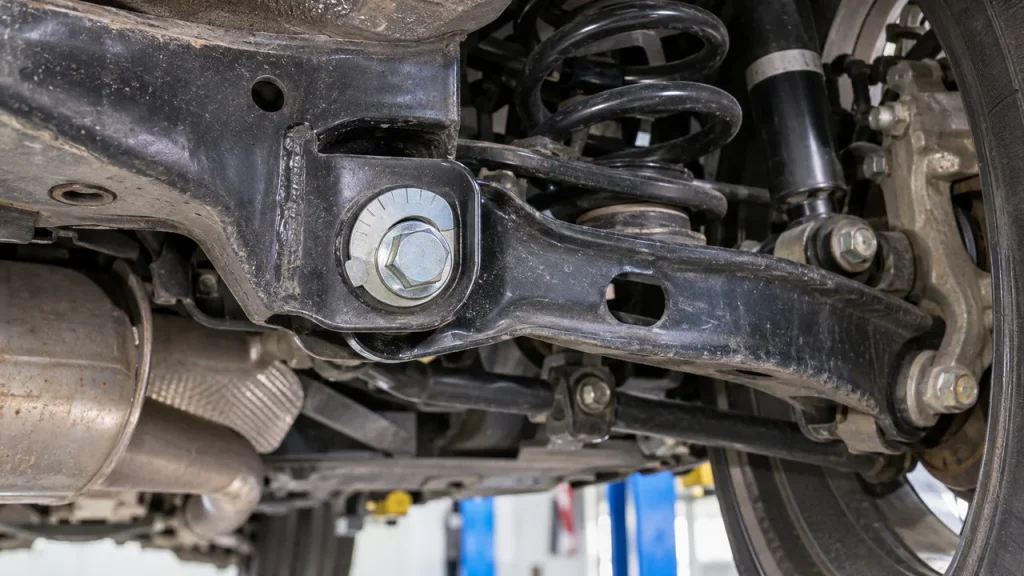
Always select the axle and exact suspension version. A sedan’s rear suspension can differ from a related hatchback or performance trim. If the catalog doesn’t name the mounting point, ask for the illustrated instructions before purchasing.
Should You Install Bolts on Both Sides?
Many front strut kits come as a pair, typically enough for one specified camber adjustment point on each side of an axle. That does not mean both wheels will necessarily need an equal correction. The alignment readings determine the setting on each side.
Do not fit two aftermarket eccentrics into the same strut-to-knuckle connection to double the advertised range unless the part manufacturer explicitly approves that combination. And don’t assume that a kit for one axle can be transferred to the other.
Which Brand and Kit Should You Buy?
The useful distinction isn’t budget versus premium; it’s traceable fitment versus a vague listing. An inexpensive part with a documented application, complete hardware, and correct instructions is a better choice than an expensive bolt sold only by a broad diameter range.
SPC, Whiteline, Pedders, MOOG, and Eibach
These names appear frequently in U.S. camber-bolt and wheel-alignment searches, but their catalogs don’t all describe the same product. SPC EZ Cam XR is a recognizable family for compatible two-bolt struts. Whiteline and Pedders list multiple diameters. MOOG alignment products include application-specific cam hardware and other correction components. Eibach also offers alignment parts for selected platforms.
Compare the part number and the intended joint. A MOOG control-arm alignment kit should not be judged against a Whiteline strut-bolt pair as if they were substitutes. Similarly, a performance-specific kit for a Subaru or a GR86 may have a mounting position that differs from a universal-looking product.
The Package Should Include More Than a Familiar Brand Name
Before ordering, look for a current fitment list, a clear picture of every supplied component, hardware specifications, and a downloadable installation sheet. Good documentation will distinguish a replacement bolt from any additional bracket or adapter needed for the particular strut.
A listing can say “pair” but still leave the buyer unsure whether the hardware is for two wheels or a complete suspension adjustment procedure. Check the quantity required per axle, and avoid mixing different manufacturers’ washers and bolts. Those small pieces are part of the clamping design.
What About OEM Camber Bolts?
Some vehicles have an adjustable bolt from the factory. If it is corroded or damaged, the sensible starting point is often the correct OEM part number or an explicitly approved replacement. Subaru owners, for example, may encounter both factory adjustable upper bolts and aftermarket lower-position correction products, depending on the exact chassis and kit.
More adjustment is not inherently safer or better. If the factory system has the range needed and the hardware is sound, you might only need a conventional alignment. An aftermarket kit should solve a real fitment or range limitation.
Camber Bolts After Lowering, Coilovers, or a Suspension Repair
Changes to ride height and hardware can change where the wheel sits relative to the body. That creates demand for correction kits, but it doesn’t establish that a camber bolt is the right fix on every modified vehicle.
Lowered Cars: Correcting an Alignment, Not Just Adding Tilt
Lowering changes suspension operating position. The resulting static camber can become more negative, but the amount and direction vary by suspension. A compatible camber bolt may recover some alignment range on a two-bolt strut. It won’t correct a compromised steering-arm position, interference problem, or worn joint elsewhere.
When the car is substantially lowered, consider bump travel, tire clearance, rear suspension behavior, and toe as a package. A bolt that brings one number into range doesn’t guarantee the modified suspension works correctly across its travel.
Replacement Struts and Coilovers May Change Bolt Fitment
Aftermarket strut ears can have different hole shapes or thicknesses. One kit may be intended for round factory holes, another for a slotted aftermarket strut with an adapter. The bolt and washer need to engage the correct surfaces, not simply pass through them.
For coilover conversions, identify whether the kit retains the original strut-to-knuckle bracket and whether its maker approves eccentric correction bolts. If it already provides camber adjustment elsewhere, review the overall setup rather than stacking unrelated hardware in pursuit of a larger number.
Lifted Trucks Usually Need a Different Conversation
A lifted independent-front-suspension truck can need camber and caster correction, but its adjustment mechanism may be in the control arms. Look for OEM-style alignment cams or a compatible aftermarket control-arm adjustment solution before assuming a small strut camber bolt will fix it.
A seized control-arm eccentric can be a significant repair job. It is not solved by ordering a pair of bolts for a passenger-car strut. When ride height exceeds the factory alignment range, the cause may involve suspension geometry rather than inadequate eccentric bolt length.
If the Vehicle Was Hit or the Reading Changed Suddenly
Check for structural or mechanical damage first. A bent strut, distorted knuckle, displaced subframe, or deteriorated bushing can produce a camber error that an eccentric can partly conceal. Installing alignment hardware before finding the fault may leave the car with unsafe geometry or an unstable joint.
A proper pre-alignment inspection is often cheaper than replacing one incorrect kit after another. Keep the original alignment readings; they help establish whether a correction part is needed at all.
Camber Bolt Installation: What Buyers Must Verify
The installation procedure belongs in the manufacturer’s instructions and vehicle service information. This section is a purchasing and safety check—not a second step-by-step camber-adjustment tutorial. If you need the actual measurement-and-adjustment workflow, use our how to adjust camber angle guide.
The Correct Hole and Washer Orientation
A tabbed washer is not decorative. Depending on the kit, its orientation and engagement with the strut ear are essential for controlled adjustment. The large tab, small locating feature, and eccentric lobe have particular relationships defined by the maker. A washer that looks nearly flush but is caught on an edge is not correctly installed.
This also explains why a bolt can appear to rotate while achieving little useful correction: the intended cam contact may not be occurring. The installer should confirm the designated location and that the hardware seats correctly before a final alignment reading is accepted.
Never Guess a Torque Number
Torque depends on the specific kit and vehicle connection. Eccentric replacement bolts may require tightening instructions different from the original full-size suspension bolt, and some have explicit maximum limits. Applying a random factory torque from another model can damage the replacement fastener or fail to secure the joint correctly.
Use the manufacturer’s specified tightening procedure and any required new locking nuts. A wheel-locating connection that slips afterward is a safety issue, not just an inconvenience that makes a tire wear unevenly.
Don’t Replace a Factory Adjustable Bolt Without Approval
A car may already have an OEM eccentric at the upper strut bolt, a control-arm cam, or another approved correction point. Some aftermarket instructions expressly distinguish the stock adjustable hardware from the fixed bolt they’re meant to replace. Removing the wrong component can compromise the existing adjustment.
If the catalog and the hardware on the car don’t agree, stop and identify the joint before dismantling it. Drilling, widening a mounting hole, stacking extra cams, or filing a washer should never be the workaround for an uncertain fit.
Alignment Is Part of the Job
After installation, the technician needs to measure and set the relevant camber angles and verify related alignment values. Strut-to-knuckle changes can alter toe, so a car should not leave the shop on the assumption that toe stayed where it was. Tightening the cam at a guessed angle in the driveway isn’t a substitute for confirming the final readings.
The toe-in vs. toe-out guide explains why a seemingly small toe error can scrub tires quickly. It’s especially worth remembering when someone installs camber bolts to address inner-edge wear and then neglects the rest of the alignment.
Common Camber Bolt Buying Mistakes
Most wasted purchases come from assumptions that sound reasonable on a product page. Here are the checks that tend to catch them before the packaging is opened:
- Choosing by head size: a socket dimension is not the shank, thread, or OEM replacement category.
- Confusing strut bolts with control-arm cams: both can alter camber, but they use different hardware and load paths.
- Ignoring upper-versus-lower position: the approved location varies by kit and platform.
- Assuming the advertised degrees are guaranteed: the achievable correction depends on the vehicle and the existing error.
- Buying only the visible bolt: the special washer, lock nut and adapter can be essential.
- Treating a seized or bent assembly as an alignment-only problem: damaged hardware and distorted parts need repair before correction.
- Skipping the final alignment: an eccentric set by eye may leave both camber and toe wrong.
The easiest way to avoid most of these mistakes is to buy from a listing that shows a proper part number and current application chart. If a seller can’t tell you which joint the kit replaces, keep looking.
How Much Do Camber Bolts Cost?
For many passenger-car strut applications, the parts themselves are relatively inexpensive compared with replacing major suspension components. But advertised kit prices only tell part of the story. A pair of eccentric strut bolts, a replacement truck alignment cam kit, and a vehicle-specific rear adjustment assembly can have very different totals.
Parts, Labor, and Alignment Are Separate Costs
A pair of camber bolts is often sold as a small kit, while labor depends on access, corrosion, and the suspension design. A clean two-bolt-strut installation can be relatively straightforward for an equipped shop. A seized control-arm cam on an older truck may involve cutting hardware or replacing other parts, making the same generic search term a very different repair.
Ask whether an estimate includes the correct kit, any specified one-time-use hardware, installation, a complete alignment and taxes. Don’t compare a bare online bolt price with a shop quote that includes all those services.
Are Camber Bolts Worth Buying Instead of New Parts?
If the suspension is undamaged and the manufacturer provides a valid correction method, an appropriate bolt kit may be a cost-effective solution. If a strut is bent, a control-arm bushing is worn, or a subframe has moved, buying a camber bolt instead of repairing the fault is false economy.
Pay for the diagnosis before buying hardware to compensate for an unexplained large error. It is far easier to judge the kit once you know the exact mounting arrangement and how many degrees must be corrected.
Camber Bolt FAQ
A few questions come up repeatedly when comparing kits. The answers depend on whether you’re looking at strut hardware or an original control-arm adjustment system.
Are aftermarket camber bolts safe?
They can be safe when the kit is designed for the exact suspension joint, installed with its specified washers and locking hardware, tightened as instructed, and followed by a verified alignment. A wrong-size bolt, poorly seated eccentric washer, or improvised mounting slot is not an acceptable substitute.
How many camber bolts do I need?
Many two-bolt-strut camber kits contain two bolts intended for one designated replacement position on each side of one axle. Other kits serve one wheel or a different type of suspension joint. Check the manufacturer’s quantity-required field and the alignment plan, not just the product photo.
Can I install two camber bolts in one strut to get more adjustment?
Not as a general rule. Fitting two aftermarket eccentric bolts in the same strut-to-knuckle joint can affect how the assembly clamps and locates the knuckle. Only use that combination if the exact kit and vehicle manufacturer approve it. More adjustment range isn’t worth compromising the connection.
Do camber bolts work on a car with stock suspension?
Sometimes. Compatible kits can provide correction on an otherwise stock two-bolt-strut vehicle when the factory arrangement lacks enough adjustment. If the car already aligns within specification with its original hardware, the added kit may offer no useful benefit.
Will camber bolts stop uneven tire wear?
Only if an actual camber error contributes to the wear and the correction brings the geometry into the appropriate range. Incorrect toe, tire pressure, worn bushings, or damaged parts can still wear tires. A complete alignment and mechanical inspection matter more than the existence of an eccentric bolt.
Can camber bolts loosen or slip?
Like other suspension fasteners, they can fail to hold properly if the wrong hardware is used, the mounting surfaces are damaged, or installation requirements aren’t followed. New steering behavior, knocking, or a sudden change in alignment after installation warrants inspection rather than simply turning the eccentric farther.
Are camber bolts and caster camber bolts the same?
Not necessarily. A strut camber bolt typically changes camber at the strut-to-knuckle connection. Some control-arm eccentric systems affect both camber and caster, while specialized caster/camber bushings act elsewhere. Always identify the actual joint before using the names interchangeably.
Do I need a wheel alignment after replacing camber bolts?
Yes. These fasteners alter or secure wheel-location geometry, so the final camber and relevant toe readings must be verified using a suitable alignment method. Do not assume that returning an old bolt to a paint mark recreates the original setting precisely.
Which is better: camber bolts or camber plates?
Neither is inherently better. The right option depends on suspension design, required adjustment, approved hardware, available clearance, and intended use. A strut camber bolt may be the simpler solution for a modest correction, while a compatible adjustable top mount addresses the problem at a different point.
When a Camber Bolt Kit Is the Wrong Purchase
If an alignment shop cannot bring camber within specification, the answer is not always a stronger eccentric or another bolt in the second hole. Find out whether the limit is caused by missing adjustment range, incorrectly identified hardware, ride-height changes, or an actual bent or worn component.
Request the before-and-after alignment readings and the exact kit part number if a correction bolt is recommended. Confirm the suspension joint, installed washer arrangement, and any remaining clearance or adjustment limits. If the car still can’t reach specification with a properly matched kit, inspect the underlying geometry rather than stacking unapproved fixes.
A camber bolt is a useful small part when it addresses a defined, measurable need. Bought blindly, it is just another fastener whose fit and locking behavior matter far too much to guess.