What Is Camber Angle? Positive vs. Negative Camber Explained

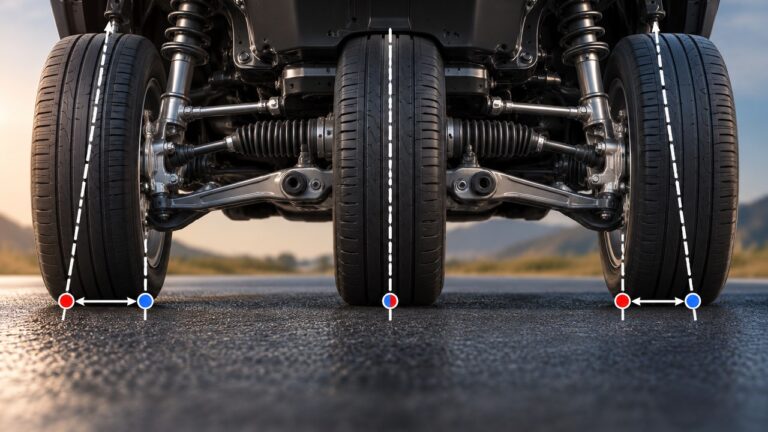
Camber angle is the inward or outward tilt of a wheel when viewed from the front or rear of the vehicle. Negative camber means the top of the wheel leans inward toward the car, positive camber means it leans outward, and zero camber means the wheel is approximately vertical.
A small amount of negative camber is common because it can help keep the outside tire better aligned with the road during cornering. Too much negative camber, however, can overload the inner part of the tread and reduce straight-line braking and traction. Excessive positive camber does the opposite, concentrating more load toward the outer shoulder.
The correct camber angle is therefore a compromise between cornering grip, tire contact patch, straight-line performance and tire wear. For a street vehicle, the manufacturer’s alignment specification—not the most aggressive-looking wheel angle—is the correct starting point.
Camber Angle at a Glance
| Camber | Viewed from the front | Main tendency | If excessive |
|---|---|---|---|
| Negative camber | Top of wheel tilts inward | Can improve outside-tire contact during cornering | Inner-shoulder loading and reduced straight-line contact |
| Zero camber | Wheel approximately vertical | Large contact patch on a flat road in a straight line | Not necessarily ideal once the body rolls in a corner |
| Positive camber | Top of wheel tilts outward | Used in some specialized suspension designs | Outer-shoulder loading and generally poorer cornering behavior on modern road cars |
Camber values are normally small. A wheel can appear almost vertical to the eye while still being measurably outside its specified range.
What Does Negative Camber Mean?
Negative camber means the top of the tire leans toward the center of the vehicle. Viewed head-on, the two wheels appear slightly closer together at the top than at the road.
This geometry is common on modern passenger cars and especially relevant to performance suspension because the body and suspension do not remain perfectly upright during a corner.
When a vehicle turns, weight transfers toward the outside tires and the body rolls. Without suitable suspension geometry, the outside wheel can move toward positive camber relative to the road, loading the outer part of the tread and reducing the useful contact patch.
Starting with some negative camber can help compensate for that movement so the heavily loaded outside tire works more evenly across its tread during cornering.
Why Negative Camber Can Improve Cornering Grip
A tire generates the most useful cornering force when its tread is loaded appropriately against the road. That does not necessarily mean the wheel should sit perfectly vertical while the car is parked.
During a hard turn, several things happen at once:
- the body rolls toward the outside of the corner;
- the outside suspension compresses;
- the outside tires carry more vertical load;
- the wheel’s camber can change as the suspension moves;
- the tire itself deflects under cornering force.
Negative static camber can place the outside tire in a more favorable orientation once those forces develop.

This is why performance cars and race cars often use more negative camber than comfort-oriented street vehicles. The goal is not simply to tilt the wheel inward—it is to produce a useful tire contact patch under the conditions where the vehicle needs cornering grip.
What Is Positive Camber?
Positive camber is the opposite arrangement: the top of the wheel leans outward away from the center of the vehicle.
Large positive camber is unusual on modern passenger cars because it tends to move load toward the outer shoulder of the tire and generally works against the camber behavior desired during hard cornering.
Positive camber can still appear in specialized vehicles or suspension applications where cornering performance is not the only design priority. It can also appear unintentionally because of suspension damage, incorrect ride height or displaced components.
If a modern road car that should have neutral or slightly negative camber suddenly shows obvious positive camber on one wheel, it makes more sense to investigate the suspension than to treat the visible angle as a normal setup choice.
Is Zero Camber Better for Tire Contact?
On a perfectly flat road with the vehicle traveling straight ahead, zero camber can provide a very even-looking tire contact patch.
But a car does not spend all of its time in that simplified condition.
The suspension moves, the body rolls, the tire deforms and steering geometry changes wheel orientation. A wheel that is perfectly vertical while parked may therefore move into an unfavorable angle when cornering.
That is why zero camber is not automatically the ideal alignment target. Manufacturers choose static camber partly according to what happens to the wheel after the suspension is loaded.
Static Camber vs. Dynamic Camber
The camber value measured while a vehicle sits on an alignment rack is its static camber under the specified measurement conditions.
Dynamic camber is the wheel angle that actually exists while the vehicle is moving, steering, rolling and compressing its suspension.
The distinction matters because the angle seen on an alignment printout is only the starting position.
During a corner, dynamic camber can be influenced by:
- suspension compression and rebound;
- body roll;
- control-arm geometry;
- steering angle;
- caster;
- bushing compliance;
- tire and wheel deflection.
This is one reason two cars with the same static camber number can behave differently on the road or track.
What Is Camber Gain?
Camber gain describes how camber changes as the suspension moves through its travel.
For example, a suspension may be designed so that a wheel gains negative camber as it moves upward into compression. During cornering, that can help counteract body roll and keep the outside tire in a more useful orientation relative to the road.
The exact camber curve depends on suspension geometry. Double-wishbone, multi-link, MacPherson-strut and solid-axle arrangements do not all produce the same behavior.
Static camber and camber gain therefore describe different things: one is the wheel’s starting angle, while the other describes how that angle changes as the suspension moves.
Caster Can Also Create Camber While Steering
Suspension travel is not the only way camber changes dynamically. Steering angle can change it too.
Positive caster causes the front wheels to gain opposite camber as they steer: the outside front wheel generally moves toward more negative camber while the inside wheel moves toward positive camber.
That relationship is covered in more detail in our caster angle guide.
This interaction helps explain why alignment settings cannot be optimized independently. Static camber, caster and suspension motion all influence the angle the tire eventually presents to the road during a corner.
What Is Camber Thrust?
A cambered rolling tire can generate a lateral force even without being steered directly toward that side. This effect is commonly called camber thrust.
The concept is easy to visualize with a rolling cone: because one side effectively follows a different radius than the other, it naturally tends to follow a curved path.
A pneumatic tire is much more complex than a rigid cone, but camber can still contribute lateral force as the tread and carcass deform against the road.
On a properly aligned axle, left and right effects are designed to work together. When camber differs significantly from side to side, however, those forces can contribute to directional behavior.
How Camber Angle Affects Tire Wear
Excessive negative camber tends to increase loading and wear toward the inner shoulder of the tire, while excessive positive camber tends to increase wear toward the outer shoulder.
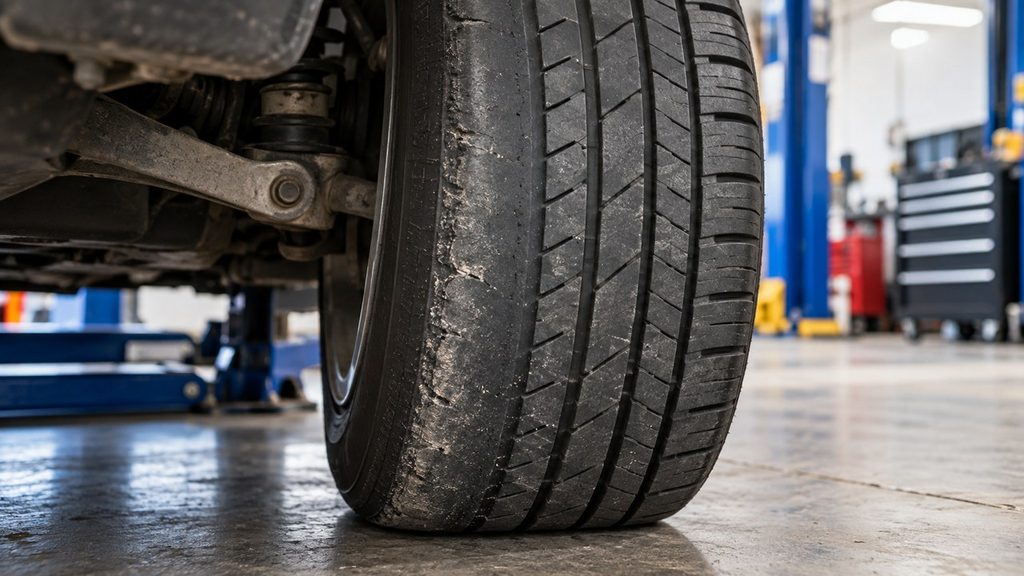
That sounds straightforward, but tire wear should not be diagnosed from camber alone.
Actual tread wear also depends on:
- toe setting;
- tire pressure;
- vehicle load;
- driving style;
- road crown;
- suspension condition;
- tire construction;
- how frequently tires are rotated.
A tire running substantial negative camber but correctly controlled toe may wear very differently from a tire that combines negative camber with excessive toe-out.
That distinction matters because incorrect toe adds lateral scrub on every revolution. Our toe-in vs. toe-out guide explains the feathering and scrub patterns associated with toe error.
Camber Wear vs. Toe Wear
Camber and toe can both produce uneven-looking tires, but their typical wear mechanisms are different.
| Alignment issue | Typical tire clue | Main mechanism |
|---|---|---|
| Excessive negative camber | Greater inner-shoulder loading or wear | Tire operates tilted inward |
| Excessive positive camber | Greater outer-shoulder loading or wear | Tire operates tilted outward |
| Excessive toe | Feathering or sawtooth tread | Tire continually scrubs sideways |
| Camber plus toe error | Potentially rapid uneven wear | Uneven loading combined with lateral scrub |
A heavily worn inner edge therefore does not automatically prove that negative camber is the only problem. Toe should be measured at the same time.
Can Camber Cause a Car to Pull?
Yes. A meaningful difference in camber between the left and right sides can contribute to a directional pull.
The side-to-side difference is commonly called cross-camber.
As a general alignment tendency, a vehicle can pull toward the side with the more positive camber. But road crown and the complete alignment specification matter, and manufacturers may intentionally allow small side-to-side differences.
A pull should therefore not be diagnosed by camber alone. Other causes can include:
- cross-caster;
- tire conicity or radial pull;
- unequal tire pressure;
- brake drag;
- rear thrust-angle problems;
- damaged suspension;
- road crown.
The alignment printout, tire condition and mechanical inspection need to be interpreted together.
Front Camber vs. Rear Camber
The front and rear axles do not necessarily need identical camber.
Front camber strongly influences how the outside front tire carries load while the vehicle turns, while rear camber affects the lateral grip and behavior of the rear axle.
Vehicle engineers may therefore use different front and rear targets according to:
- weight distribution;
- drivetrain layout;
- suspension design;
- roll stiffness;
- tire sizes;
- desired understeer or oversteer balance;
- expected passenger and cargo loads.
This is why copying a front camber value to the rear—or copying another vehicle’s alignment numbers—is not a reliable setup method.
Street Camber and Performance Camber Solve Different Problems
A daily-driven car spends much of its time traveling relatively straight, braking, accelerating and operating on uneven public roads. A track car may spend a much larger proportion of its useful driving time generating high lateral loads.
That changes the compromise.
| Priority | Street setup | Performance / track setup |
|---|---|---|
| Tire life | High priority | Can be traded for cornering performance |
| Straight-line braking | High priority | Still important, but balanced against cornering |
| Cornering load | Moderate in normal use | Much higher and repeated |
| Camber target | Usually within OEM street specification | May use additional negative camber after testing |
| Best evidence | Manufacturer specification and tire wear | Lap behavior, tire temperatures and wear data |
Track alignment is therefore not simply “street alignment with more negative camber.” The useful setting depends on the tire, suspension, track, driving style and how the tire behaves under load.
Why Tire Temperatures Matter on a Track Car
Performance setups can use tire-temperature measurements across the inner, center and outer portions of the tread as one clue to how effectively the tire is being loaded.
If one part of the tire consistently runs much hotter than the rest, the setup may not be using the tread evenly under the relevant driving conditions.
Temperature is not a standalone camber calculator. Pressure, toe, track direction, braking, tire construction and driving style also affect the readings. But combined with tire wear and vehicle behavior, it gives a race engineer far more useful information than choosing a visually aggressive camber angle.
How Much Negative Camber Is Too Much?
There is no universal number at which negative camber suddenly becomes excessive for every vehicle.
Too much means the angle has moved beyond what is useful for the vehicle’s suspension, tires and intended use.
Signs that a street setup may have an inappropriate amount include:
- accelerated inner-shoulder wear;
- poor straight-line tire contact;
- reduced braking or traction performance;
- alignment measurements outside specification;
- an angle introduced unintentionally after lowering, damage or worn suspension parts.
The important comparison is not against a generic internet value. It is against the specification and real tire behavior of the particular vehicle.
Does Lowering a Car Change Camber?
It often can, but the direction and amount depend on suspension geometry.
Lowering moves the suspension away from its original static position. On many independent suspension designs, that changes control-arm angles and can increase negative camber as the wheels move upward relative to the body.
The result is not identical on every vehicle. Different suspension layouts have different camber curves, and the amount of ride-height change matters.
A lift can also alter alignment geometry. Whenever ride height or components that locate the wheel have been changed, it makes sense to check the resulting alignment rather than assume the original values remain intact.
Our guide to alignment after replacing suspension parts covers which types of suspension work are most likely to require a new alignment.
How Camber Angle Is Measured
Camber is measured in degrees relative to vertical when the vehicle is positioned according to the alignment procedure.

A wheel leaning inward at the top has negative camber; a wheel leaning outward has positive camber.
Modern alignment equipment measures each wheel independently, allowing a technician to compare:
- left-front and right-front camber;
- left-rear and right-rear camber;
- each value against its permitted range;
- left-to-right differences such as cross-camber.
Because acceptable values can be fractions of a degree, judging alignment from appearance alone is unreliable unless the angle is extreme.
Can Camber Angle Be Adjusted?
Camber is adjustable on some vehicles and not directly adjustable on others.
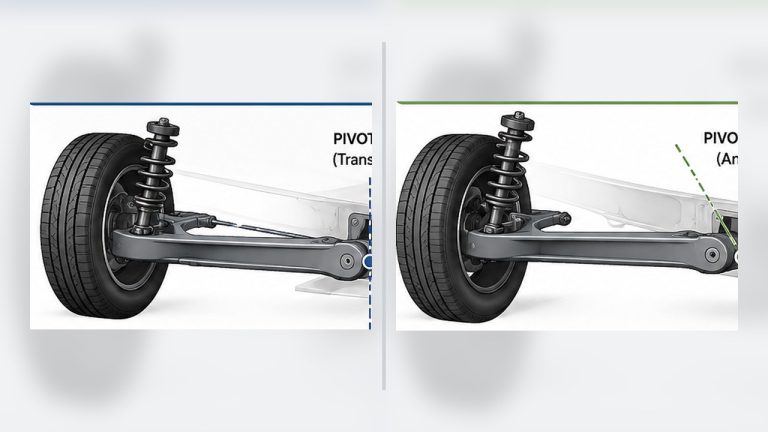
Depending on the suspension design, adjustment may be provided through factory eccentric hardware, slotted mounting points or other alignment provisions. Modified vehicles may use components specifically designed to provide additional alignment range. For the actual procedure, see our guide to adjusting camber angle, which covers camber bolts, plates and control-arm adjustment methods.
Other vehicles have no normal factory camber adjustment. When one of those vehicles shows a large camber error, possible causes include incorrect ride height, worn bushings, a weak spring, displaced subframe, bent control arm, damaged steering knuckle or another structural problem.
In that situation, simply finding a way to move the wheel angle can hide the real fault. The cause of the incorrect measurement should be identified first.
Camber vs. Caster vs. Toe
Camber, caster and toe all appear on a wheel-alignment report, but they describe three different orientations.
| Angle | View | What is measured | Strongest everyday effect |
|---|---|---|---|
| Camber | Front or rear | Inward or outward wheel tilt | Contact-patch loading, cornering and shoulder wear |
| Caster | Side | Fore-aft steering-axis tilt | Stability and steering return-to-center |
| Toe | Above | Direction the wheels point relative to each other | Tracking, steering response and lateral tire scrub |
Changing one measurement does not make the others irrelevant. A car can have ideal camber but destroy its tires because toe is wrong, or have correct toe while a large cross-camber or caster difference contributes to a pull.
What Can Put Camber Out of Specification?
Camber can move outside its intended range because the wheel is no longer sitting where the suspension designer expected it to sit.
Common reasons include:
- lowered or raised ride height;
- weak or broken springs;
- worn control-arm bushings;
- bent control arms;
- damaged steering knuckles;
- subframe displacement;
- collision or curb damage;
- incorrectly installed suspension parts;
- aftermarket suspension components with different geometry.
A sudden camber change on one corner of a previously normal vehicle deserves mechanical inspection, particularly when accompanied by tire wear, steering pull or an obvious difference in ride height.
Camber Questions That Matter in the Real World
Is negative camber bad?
No. A small amount of negative camber is normal on many modern vehicles and can improve the orientation of the outside tire during cornering. It becomes a problem when the angle is inappropriate for the vehicle or produces unacceptable tire wear or straight-line compromises.
Does negative camber improve grip?
It can improve cornering grip by helping the outside tire maintain a useful contact patch under body roll and suspension load. Too much negative camber can reduce straight-line contact and does not automatically produce more overall grip.
Does negative camber always wear the inside of tires?
Negative camber increases loading toward the inner side of the tread, so excessive negative camber can contribute to inner-shoulder wear. The actual wear rate depends heavily on toe, pressure, load, tire construction and driving conditions.
Why do race cars have so much negative camber?
Race cars experience much higher and more frequent lateral loads than normal street cars. Additional negative camber can help the outside tires work more effectively during hard cornering, where lap performance may matter more than maximizing road-tire life.
Can camber cause tramlining?
Aggressive negative camber can contribute to a vehicle feeling more sensitive to road grooves, although tire width, construction, toe, steering geometry and road surface also influence tramlining.
Can you see bad camber by looking at the car?
Only large camber angles are obvious visually. Normal alignment specifications can involve small fractions of a degree, so a wheel that looks straight can still be outside specification.
Is camber the same as wheel tilt?
Camber specifically describes wheel tilt from vertical when viewed from the front or rear of the vehicle. It does not describe whether the wheels point inward or outward when viewed from above—that is toe.
Should both sides have exactly the same camber?
Not necessarily. Manufacturers specify acceptable values and side-to-side tolerances for each vehicle, and some designs may intentionally account for road crown or other behavior. Both sides should be evaluated against the correct specification rather than forced to an arbitrary identical number.
The Best Camber Angle Is the One the Tire Can Actually Use
Camber angle is not simply a choice between straight wheels and tilted wheels. It determines how the tire is loaded in combination with body roll, suspension movement, steering geometry and road forces.
Negative camber can improve cornering by helping the outside tire maintain a useful contact patch. Positive camber tilts the wheel the opposite way, while zero camber provides a neutral static position that is not automatically ideal once the vehicle starts cornering.
For a road car, the safest baseline is the manufacturer’s alignment specification. If camber is outside that range, especially on only one side, the important question is not merely how to change the number—it is why the wheel is sitting at the wrong angle in the first place.