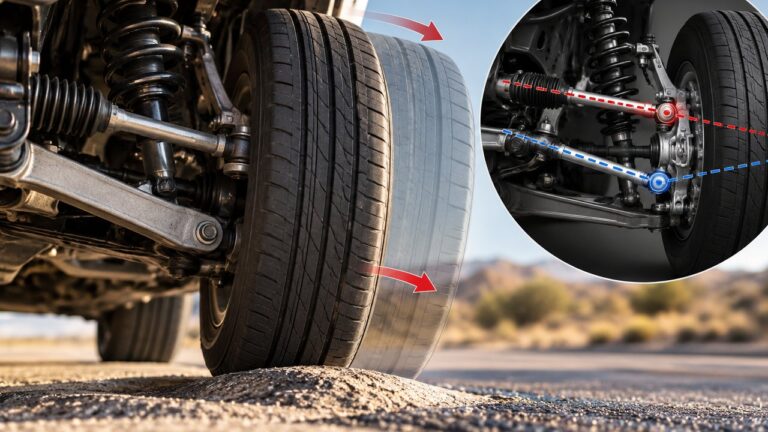
What Is Caster Angle? Positive vs. Negative Caster Explained
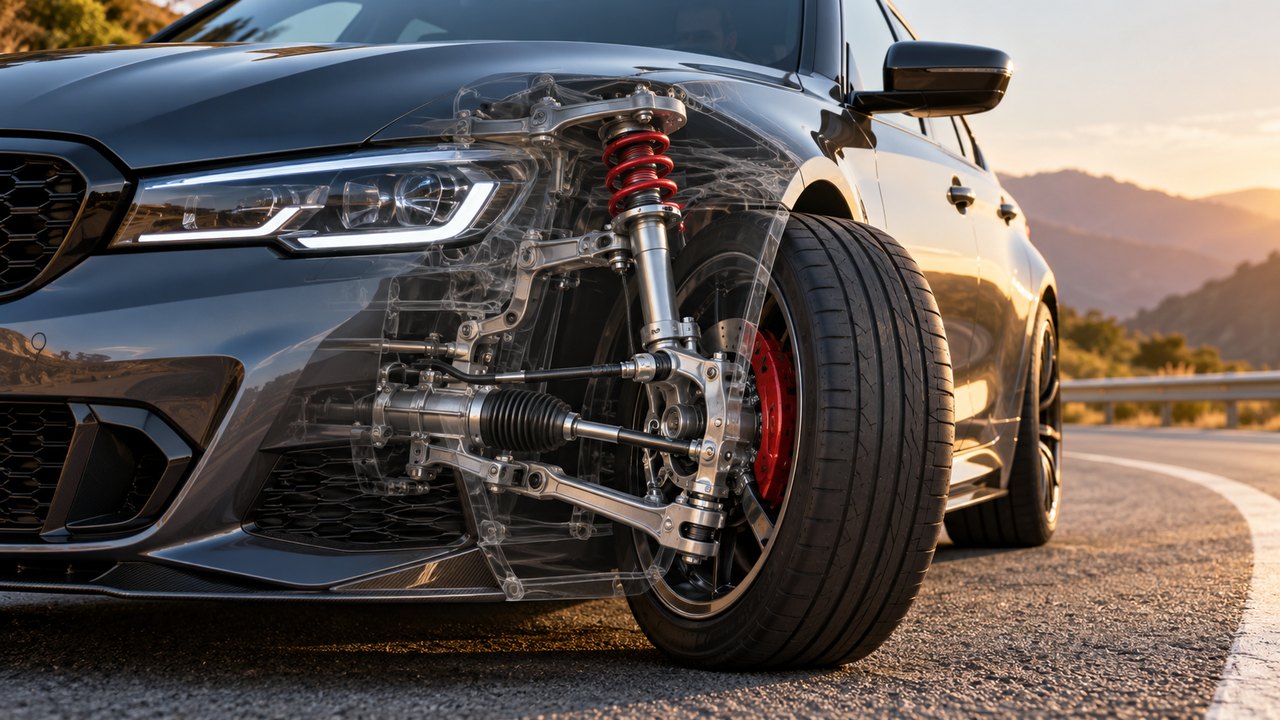
Caster angle is the forward or rearward tilt of the steering axis when a front wheel is viewed from the side of the vehicle. Positive caster means the top of that steering axis tilts toward the rear of the car; negative caster means it tilts toward the front.
Most modern road vehicles use positive caster because it helps the front wheels track straight, improves steering return-to-center and makes the vehicle feel more stable at speed. Increasing positive caster can also add useful negative camber to the outside front wheel while cornering, but too much can increase steering effort and alter steering feel.
Caster is therefore primarily a steering stability and handling angle. Unlike excessive toe or camber, incorrect caster is not usually a direct cause of rapid tire wear.
Caster Angle Explained From the Side of the Car
To understand caster, ignore the visible angle of the tire for a moment and look instead at the imaginary axis around which the front wheel steers.
That steering axis is defined differently depending on the suspension design:
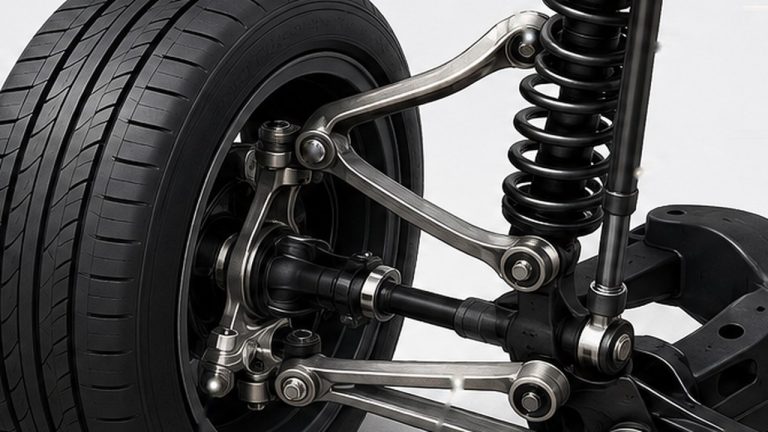
- On a double-wishbone or SLA suspension, it normally passes through the upper and lower steering-knuckle pivots or ball joints.
- On a MacPherson-strut suspension, it generally runs through the upper strut mount and the lower ball joint.
Viewed from the side, compare that line with true vertical. The angle between them is the caster angle.
This side-view definition is important because caster is often confused with other wheel-alignment geometry. Camber is viewed from the front, while toe is viewed from above. Caster is measured from the side.
Positive vs. Negative Caster
The direction of the steering-axis tilt determines whether caster is positive, zero or negative.
Positive Caster
Positive caster occurs when the top of the steering axis is farther toward the rear of the vehicle than the bottom.
If you extend that steering axis downward toward the road, it typically reaches the ground ahead of the effective tire contact area. This creates a trailing relationship that helps the wheel follow the direction of travel.
Positive caster generally provides:
- stronger straight-line stability;
- better steering return-to-center;
- more resistance to wandering;
- greater steering effort or steering weight;
- more dynamic camber change as the wheels steer.
This is why positive caster is the normal arrangement on modern passenger cars, trucks and performance vehicles.
Zero Caster
Zero caster means the steering axis is vertical when viewed from the side.
That reduces the geometric self-centering effect associated with positive caster. Steering can feel lighter, but the vehicle also loses some of the directional stability and steering return that positive caster provides.
Negative Caster
Negative caster occurs when the top of the steering axis tilts toward the front of the vehicle.
It generally reduces steering effort but also reduces the natural tendency of the wheels to track straight and return to center. For that reason, substantial negative caster is uncommon on modern road vehicles.
| Caster setting | Steering-axis direction | Typical effect |
|---|---|---|
| Positive caster | Top tilts rearward | More stability and stronger return-to-center |
| Zero caster | Axis approximately vertical | Less self-centering effect |
| Negative caster | Top tilts forward | Lighter steering but reduced directional stability |
Why Positive Caster Makes the Steering Return to Center
The self-centering effect of positive caster is closely related to a geometric quantity called mechanical trail, sometimes called caster trail.
Viewed from the side of the vehicle, extend the steering axis until it reaches the road. With typical positive-caster geometry, that intersection is ahead of the effective tire contact patch.
The distance between those points creates a lever arm. As the tire generates forces against the road, those forces create a torque around the steering axis that tends to line the wheel back up with the vehicle’s direction of travel.
That contributes to the steering wheel naturally moving back toward center after a corner and helps the vehicle resist wandering during straight-line driving.
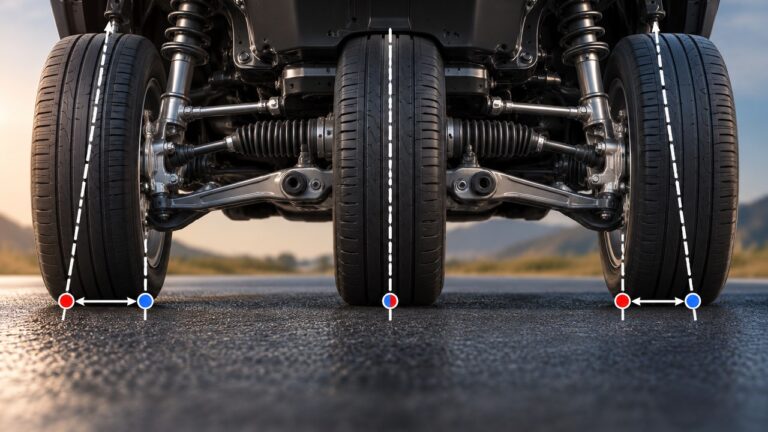
Mechanical trail should not be confused with scrub radius. Both involve the steering axis and tire contact patch, but trail is measured fore-and-aft in side view, while scrub radius is the lateral distance measured at road level in front view.
How Caster Angle Affects Steering and Handling
Caster does more than help the steering wheel return to center. Changing it alters several characteristics at the same time.

Straight-Line Stability
More positive caster generally strengthens the wheel’s tendency to follow the direction of travel.
That can make a vehicle feel more settled at highway speeds and less willing to wander in response to small disturbances.
Too little positive caster can produce the opposite sensation: steering that feels light but requires more frequent small corrections to keep the vehicle tracking straight.
Steering Returnability
Returnability describes how naturally the steering moves back toward the straight-ahead position after a turn.
Increasing positive caster normally increases this self-centering tendency. If caster is too low, the driver may have to help unwind the steering wheel after a corner rather than feeling it naturally return toward center.
Steering Effort and Feedback
The same geometry that increases stability also resists steering movement.
More positive caster can therefore make steering feel heavier and increase the force fed back through the steering system. Power steering reduces the effort felt by the driver, but the underlying geometric forces still exist.
This is one reason there is no rule that says maximum positive caster is always best.
Caster Also Changes Camber When You Turn
One of caster’s most useful—and less obvious—effects appears only after the steering wheel is turned.
Because the wheel rotates around a steering axis that is tilted rearward, positive caster creates a dynamic camber change during steering.
In a corner, positive caster generally causes:
- the outside front wheel to gain negative camber;
- the inside front wheel to move toward positive camber.
The outside tire normally carries much more cornering load. Giving that wheel additional negative camber as steering angle increases can help compensate for body roll and maintain a more useful tire contact patch.
This is particularly valuable in performance suspension design because some cornering camber can be generated dynamically instead of relying entirely on aggressive static negative camber.
More caster does not automatically mean more grip, however. The useful amount depends on the complete suspension geometry, tire, steering system and vehicle setup.
What Is the Caster Jacking Effect?
Positive caster also produces a small vertical movement as the steering turns.
Because the steering axis is tilted rather than vertical, rotating the knuckle around that axis does not simply point the tire left or right. It also moves parts of the front suspension slightly upward or downward.
This is commonly described as a jacking effect.
The effect interacts with steering-axis inclination, suspension stiffness, track width and the rest of the chassis geometry. In performance applications, caster is therefore treated as one part of a complete suspension setup rather than an isolated number.
Does Caster Angle Cause Tire Wear?
Caster is generally not considered a direct tire-wear angle.
With the wheels pointed straight ahead, caster changes the orientation of the steering axis rather than forcing the tire to lean continuously onto one shoulder or scrub sideways across the road.
That is different from:
- excessive camber, which can concentrate loading toward one side of the tread;
- excessive toe, which can make the tires scrub laterally as they roll.
If your tires show obvious feathering or rapid scrub-related wear, the toe-in vs. toe-out guide explains why toe is often a more important measurement to investigate.
A severely incorrect caster setting can still affect handling enough to contribute indirectly to abnormal use of the tires, but caster itself is not usually the first alignment angle blamed for a distinct tread-wear pattern.
Can Wrong Caster Make a Car Pull to One Side?
Yes. A vehicle can pull or lead to one side when left and right caster differ significantly.
The difference between the caster angles on the two sides is often called cross-caster or caster split.
As a general diagnostic tendency, a vehicle tends to pull toward the side with less positive caster.
For example, if the left front has substantially more positive caster than the right front, caster imbalance can contribute to a pull toward the right.
But caster should not be diagnosed from pull direction alone. Other possible causes include:
- cross-camber;
- tire conicity or radial pull;
- unequal tire pressure;
- brake drag;
- rear thrust-angle problems;
- road crown;
- bent or displaced suspension components.
A complete alignment report is therefore more useful than assuming every steering pull is a caster problem.
Caster and Road Crown
Roads are often built with a slight crown so water drains toward the edges. That slope can encourage a vehicle to drift toward the lower side of the road.
Some manufacturers account for this behavior through the complete alignment specification, which can include a deliberate small difference between left and right caster or camber.
This is another reason both sides should not automatically be forced to an identical number if the vehicle manufacturer specifies otherwise.
The correct comparison is always against the alignment specification for that specific vehicle, suspension and market—not a generic target copied from another chassis.
What Happens With Too Much Positive Caster?
If positive caster improves stability and self-centering, it is tempting to assume that adding as much as possible must improve the vehicle.
It does not.
Excessive positive caster can increase:
- steering effort;
- self-centering force;
- dynamic camber change at larger steering angles;
- steering feedback and kickback;
- caster-related jacking effects.
Whether those changes are desirable depends on the vehicle. A race-oriented car with power steering and stiff suspension has different requirements from a daily-driven SUV, classic car or pickup truck.
The goal is therefore not maximum caster. It is the amount of caster that works with the suspension design and intended use.
What Happens With Too Little Positive Caster?
Too little positive caster can make the steering feel easier to turn but less settled.
Possible symptoms include:
- weak steering return-to-center;
- reduced straight-line stability;
- wandering at highway speed;
- a lighter or less planted steering feel;
- greater sensitivity to left-to-right caster imbalance.
Those symptoms are not exclusive to caster, so steering linkage, tires, toe and other suspension geometry still need to be considered.
Caster Angle on Lifted and Lowered Vehicles
Changing ride height can move suspension components away from the positions for which the original alignment geometry was designed.
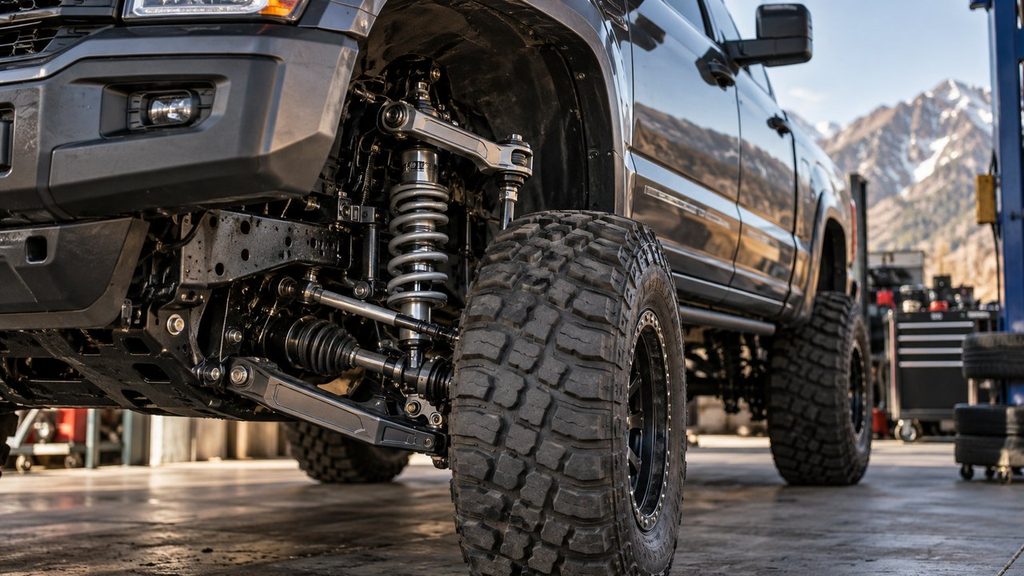
Whether caster changes—and by how much—depends on the suspension layout.
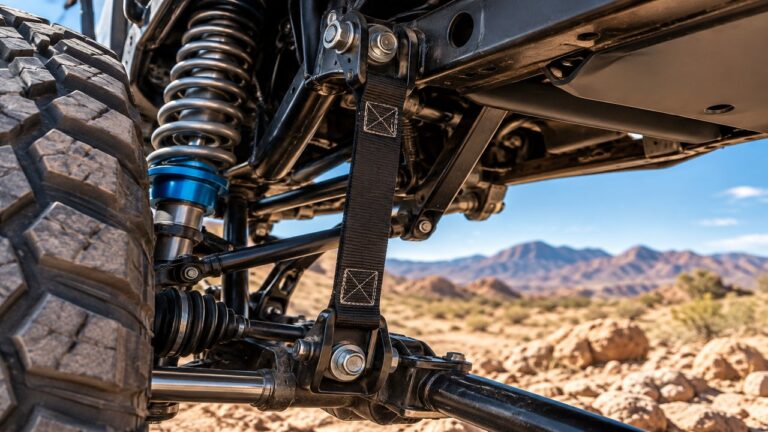
On control-arm suspension, altering ride height changes the working position and angles of the arms. On modified trucks, aftermarket upper control arms are sometimes designed with revised geometry partly to recover alignment range or improve the position of suspension components after a lift.
Lowering a car can similarly place the suspension at a different point in its travel and alter the relationship between its mounting points.
That does not mean every lift or lowering spring produces the same caster change. Suspension design determines the result.
If components affecting wheel position or ride height have been changed, our guide to alignment after suspension work explains when the geometry should be measured afterward.
How Is Caster Angle Measured During a Wheel Alignment?
Caster is expressed in degrees, but unlike camber it cannot simply be read from how much the wheel visually leans while pointing straight ahead.
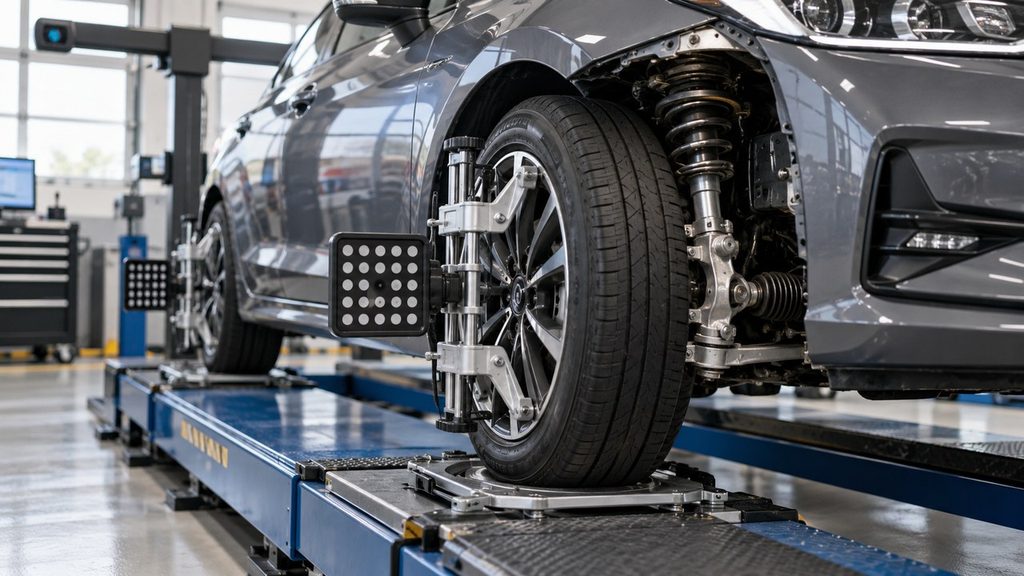
Professional alignment equipment typically determines caster while the front wheels are steered through a controlled angle. The system measures the resulting geometry and calculates the caster value for each side.
An alignment report can then show:
- left caster;
- right caster;
- whether each side is inside the specified range;
- the difference between the two sides.
That side-to-side difference can matter almost as much as the individual values when diagnosing a steering pull.
Measuring caster accurately is a separate task from physically changing it. The adjustment method, where adjustment exists, depends heavily on the suspension design.
Can Caster Angle Be Adjusted?
Sometimes. Caster is adjustable on some vehicles and effectively fixed on others.
Depending on the suspension, an adjustable system may use components such as:
- eccentric control-arm cams;
- shims;
- adjustable control arms;
- strut rods or radius arms;
- adjustable upper mounts or caster/camber plates;
- other vehicle-specific mounting arrangements.
Other vehicles provide little or no factory caster adjustment. If caster is substantially outside specification on one of those vehicles, the reading can indicate worn, bent, incorrectly positioned or damaged components rather than simply an angle that needs to be dialed back into place.
That distinction matters: a bad alignment reading is sometimes a symptom of a mechanical problem, not the problem itself.
Caster vs. Camber vs. Toe
Caster, camber and toe are often grouped together because all three appear on wheel-alignment reports, but they describe different geometry.
| Alignment angle | Viewpoint | What it describes | Main influence |
|---|---|---|---|
| Caster | Side | Fore-aft tilt of steering axis | Stability, steering return and dynamic camber |
| Camber | Front | Inward or outward wheel tilt | Contact patch, cornering and tire loading |
| Toe | Above | Whether wheels point toward or away from each other | Steering response, tracking and tire scrub |
A vehicle can therefore have caster within specification while toe is badly incorrect, or good toe while one side has a caster problem. An alignment should be interpreted as a set of related measurements rather than one universal “alignment angle.”
How Much Caster Angle Is Best?
There is no single caster angle that is best for every car or truck.
The correct amount depends on factors such as:
- suspension design;
- steering system;
- vehicle weight;
- tire size and construction;
- ride height;
- intended handling behavior;
- power-steering assistance;
- manufacturer cross-caster strategy.
Most modern road vehicles use positive caster, but that does not mean a generic positive number should be substituted for the factory specification.
A value that is normal on one performance car could be outside the acceptable range on another vehicle.
For street use, the manufacturer’s vehicle-specific alignment specification remains the correct baseline.
Common Symptoms of Incorrect Caster
Caster problems are more likely to show up through steering behavior than through a unique tire-wear pattern.
Possible signs include:
- poor steering return after a turn;
- wandering or weak straight-line tracking;
- unusually heavy steering;
- a persistent pull when left and right caster differ;
- a steering feel that changed after suspension damage or modification;
- caster measurements outside specification during an alignment.
None of those symptoms proves caster is the cause by itself. Tires, toe, camber, steering components, ride height and suspension damage can create similar complaints.
Caster Angle FAQ
What is caster angle on a car?
Caster angle is the forward or backward inclination of the front steering axis relative to vertical when viewed from the side of the car. A rearward tilt at the top is positive caster; a forward tilt is negative caster.
Is positive or negative caster better?
Modern road vehicles generally use positive caster because it improves straight-line stability and steering return-to-center. Negative caster usually reduces those effects and is uncommon in modern passenger vehicles.
Does more positive caster improve handling?
More positive caster can improve directional stability, steering feedback and dynamic negative camber on the outside wheel during cornering. However, excessive caster can increase steering effort and alter jacking and steering behavior, so more is not automatically better.
Does caster affect steering return?
Yes. Positive caster contributes to the self-aligning torque that encourages the wheels and steering wheel to return toward the straight-ahead position after a turn.
Does caster cause uneven tire wear?
Not usually by itself. Caster primarily affects steering stability and returnability. Camber and especially incorrect toe are more direct causes of recognizable uneven or scrub-related tire wear.
Does caster change camber?
Positive caster changes camber dynamically as the wheels steer. During a turn, the outside front wheel generally gains negative camber while the inside front wheel moves toward positive camber.
Can different caster angles make a car pull?
Yes. A meaningful left-to-right caster difference can contribute to a pull, generally toward the side with less positive caster. Road crown, tires, camber and braking problems should also be ruled out.
Is caster adjusted during every wheel alignment?
No. Caster is normally measured as part of a full alignment, but many vehicles provide limited or no factory caster adjustment. Whether it can be changed depends on the suspension design.
Can lifting a truck change caster?
It can. A suspension lift changes control-arm or axle geometry on many designs, which can move caster away from its original range. The amount and correction method depend on the specific suspension system.
Read Caster as a Steering Geometry Number
Caster angle makes more sense once it is treated as a steering-axis measurement rather than as another visible tire angle.
Positive caster tilts the steering axis rearward at the top and gives the front wheels a stronger tendency to track straight and return toward center. It also changes camber dynamically as the wheels steer, which is one reason caster matters to performance handling as well as everyday stability.
Negative or insufficient positive caster reduces those stabilizing effects, while excessive positive caster can make the steering heavier and produce more aggressive geometric effects than the vehicle needs.
The useful question is therefore not simply whether positive caster is “good.” It is whether both front wheels have the caster specified for that particular vehicle and whether the side-to-side relationship matches the intended suspension geometry.