What Is Trailing Arm Suspension? How It Works, Types, Pros and Cons
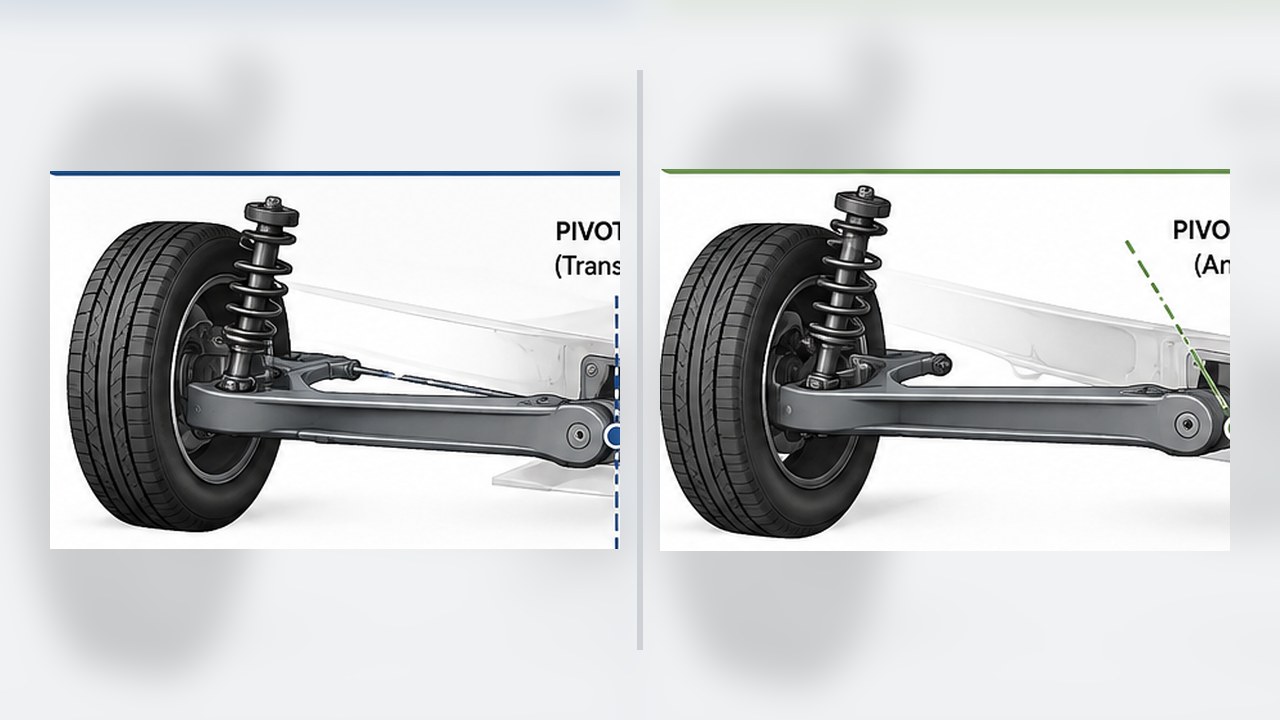
Trailing arm suspension uses one or more arms that pivot from the vehicle structure ahead of the wheel, allowing the wheel to move through an arc as the suspension compresses and rebounds. It is most commonly associated with rear suspension, although trailing-arm principles can appear in several different suspension layouts.
The basic design is mechanically simple, compact, and capable of handling substantial longitudinal loads from braking and acceleration. However, the exact behavior depends heavily on whether the vehicle uses pure trailing arms, semi-trailing arms, a twist-beam arrangement, or trailing links as part of a more complex suspension.
That distinction matters because “trailing arm suspension” describes a family of related layouts rather than one universal design.
What Is a Trailing Arm Suspension?
A trailing arm is a suspension member that connects the wheel or axle to a pivot point located farther forward on the chassis or body.
Viewed from the side of the vehicle, the arm extends rearward from its chassis mounting point toward the wheel. As the wheel rises over a bump, the arm rotates around that forward pivot.
Because the arm swings rather than sliding vertically, the wheel follows an arc through its suspension travel. Arm length, pivot-axis position, bushings, spring location, damper location, and surrounding suspension geometry all influence how that movement affects the vehicle.
Trailing arms may locate an independently suspended wheel, help locate a solid axle, or form part of a semi-independent rear suspension. The name therefore tells you how an important suspension member is oriented, but not necessarily whether the complete axle is independent.
How Trailing Arm Suspension Works
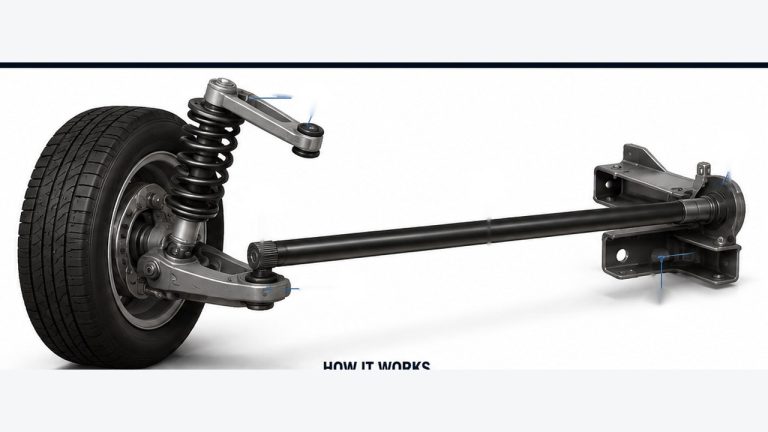
Imagine an arm hinged to the vehicle at its front end with the wheel attached near its rear end. When the wheel hits a bump, the arm rotates upward around that hinge.
This creates a controlled path for the wheel while the spring supports the vehicle and the damper controls how quickly the suspension moves.
The trailing arm also has to transmit forces generated when the tire accelerates, brakes, corners, or strikes an obstacle. Its bushings and mounting points therefore do much more than simply allow vertical suspension movement.
In a driven independent rear suspension, a driveshaft or half-shaft must also accommodate the wheel’s movement relative to the differential as the trailing arm rotates.
What a Trailing Arm Suspension Diagram Shows
A basic trailing arm suspension diagram is easiest to understand from the side of the vehicle.
- Chassis pivot: the forward mounting point around which the arm rotates.
- Trailing arm: the structural member extending rearward from the pivot.
- Wheel hub or carrier: mounted at or near the rear of the arm.
- Spring: supports vehicle weight and may act directly on the arm or near the wheel.
- Damper: controls suspension motion and may be mounted separately from the spring.
When the wheel moves upward, the trailing arm rotates around the chassis pivot. From the side, the wheel center therefore follows part of a circular path rather than traveling in a perfectly straight vertical line.
The geometry becomes more complicated when the pivot axis is angled across the vehicle, which leads to the semi-trailing-arm design.
Pure Trailing Arm vs. Semi-Trailing Arm Suspension
The position of the pivot axis is one of the most important differences within the trailing-arm family.
Pure Trailing Arm
In a pure trailing-arm independent suspension, the pivot axis runs approximately across the vehicle, perpendicular to its direction of travel.
As the arm rotates in bump and rebound, the wheel remains at essentially the same camber and toe relative to the vehicle structure if compliance and other effects are ignored.
That simple wheel path is one of the design’s attractions, but it also gives engineers relatively little opportunity to deliberately change camber as the suspension compresses.
Semi-Trailing Arm
A semi-trailing arm uses a pivot axis that is angled rather than running directly across the vehicle.
Because the arm now swings around an inclined axis, vertical wheel movement also produces changes in wheel geometry. Camber and toe can change as the suspension moves, giving engineers more control than a pure trailing-arm layout but also creating more complex behavior.
The amount and direction of those changes depend on the exact pivot angle, arm geometry, bushings, wheel travel, and vehicle design.
Trailing Arm vs. Semi-Trailing Arm at a Glance
| Characteristic | Pure Trailing Arm | Semi-Trailing Arm |
|---|---|---|
| Pivot axis | Approximately transverse to vehicle | Angled relative to vehicle |
| Camber change in basic bump motion | Very limited relative to body | Can change noticeably |
| Toe change | Very limited geometrically | Can change through travel |
| Geometry complexity | Relatively simple | More complex |
| Tuning freedom | Limited | Greater |
| Typical use | Simple independent or related rear layouts | Independent rear suspension |
Neither design should be judged from this table alone. Bushing compliance, springs, dampers, tires, anti-roll bars, wheel alignment, and the rest of the chassis can substantially change how a vehicle behaves.
Rear Trailing Arm Suspension
Trailing arms are particularly well suited to rear suspension because rear wheels usually do not need the large steering angles required at the front.
The arms can transfer acceleration and braking forces between the wheel and body while allowing controlled vertical movement. Their longitudinal orientation can also package efficiently beneath the rear floor.
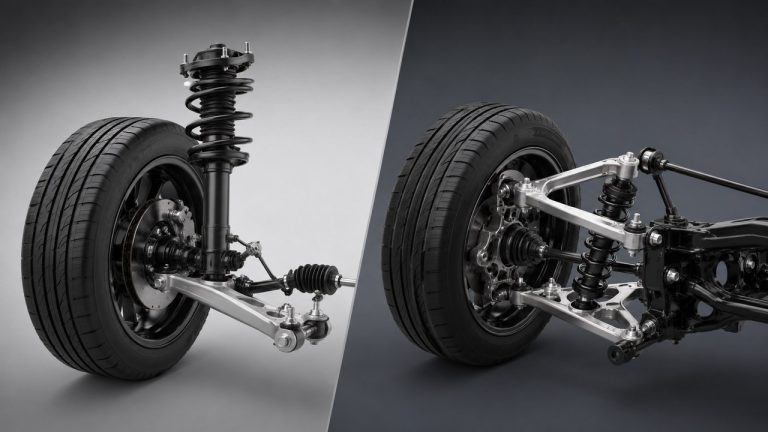
Rear trailing arms appear in several very different systems. A vehicle may have one large independent arm per wheel, semi-trailing arms, longitudinal links working with other lateral links, or trailing arms connected by a torsion beam.
This is why seeing the words “rear trailing arm” in a parts catalog does not necessarily reveal the complete suspension architecture.
Is Trailing Arm Suspension Independent?
It can be, but not always.
In a pure independent trailing-arm system, each wheel has its own arm and can move without a rigid axle connecting it to the wheel on the opposite side.
Semi-trailing-arm suspension is also normally an independent rear suspension design.
However, longitudinal trailing arms can also help locate a solid axle, and a torsion-beam suspension connects left and right trailing arms through a twistable cross beam.
For the broader distinction between connected and independently moving wheels, our solid axle vs. independent suspension comparison explains the different axle architectures.
How Trailing Arm Suspension Relates to Torsion Beam
A torsion-beam rear suspension uses a trailing arm on each side, but the two arms are connected by a transverse beam.
That beam twists when one wheel moves differently from the other. The result is a semi-independent system: the wheels have some freedom to move separately, but the two sides remain mechanically linked.
A pure independent trailing-arm system does not use that twistable beam to connect the two wheel movements.
If you are comparing the beam layout with a fully independent multi-link rear suspension, see our torsion beam vs. multi-link suspension guide. That comparison has different search intent from the general trailing-arm architecture explained here.
Front Trailing Arm Suspension
Trailing-arm layouts are far less common at the front of modern passenger cars, but the concept is not limited to rear wheels.
A true trailing arm has its chassis pivot ahead of the wheel so the arm trails behind that pivot. If the pivot is behind the wheel and the arm extends forward toward it, the arrangement is normally called a leading arm instead.
Front suspension also has to accommodate steering, which makes packaging, steering-axis geometry, braking forces, and wheel movement more complicated. Modern passenger vehicles therefore more commonly use MacPherson strut, double wishbone, or multi-link front architectures.
That does not make front trailing or leading arms inherently wrong. Suspension architecture is selected around the requirements of the particular vehicle.
Trailing Arm Suspension Geometry
The simplest way to understand trailing-arm geometry is to think of the wheel rotating around the arm’s chassis pivot.
A longer arm produces a larger-radius arc. For the same amount of vertical wheel travel, a longer arm generally produces less fore-and-aft displacement than a shorter arm.
The pivot-axis orientation then determines whether that arc also creates camber and toe changes.
- Pure transverse pivot axis: keeps the basic geometry relatively simple.
- Angled semi-trailing pivot: introduces camber and toe change as the arm rotates.
- Bushing compliance: can allow additional movement under braking, acceleration, and cornering forces.
- Spring and damper position: influences motion ratio and therefore the relationship between wheel movement and spring or damper movement.
These relationships are why two trailing-arm suspensions can behave very differently even if their basic layouts appear similar.
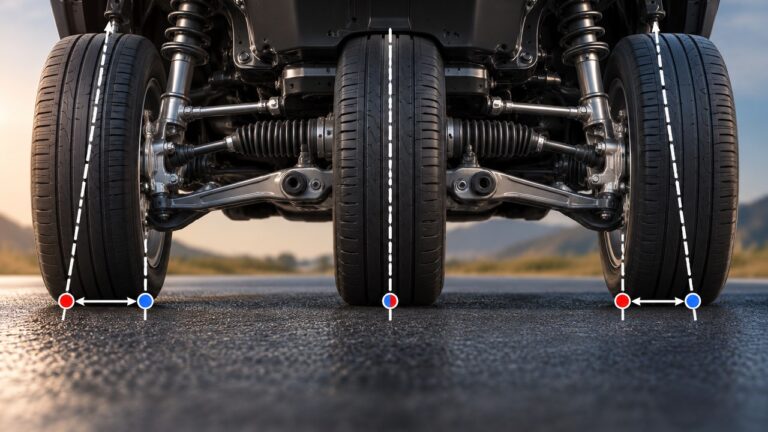
What Happens to Camber With a Trailing Arm?
In an ideal pure trailing-arm layout, vertical suspension movement creates very little geometric camber change relative to the vehicle body because the wheel carrier rotates around a transverse pivot axis.
That does not mean the tire remains at the same angle to the road during body roll. If the body rolls while the wheel maintains its relationship to the body, the tire’s camber relative to the road changes with that body movement.
A semi-trailing arm behaves differently because its angled pivot axis intentionally couples vertical wheel movement with camber change.
Depending on the geometry, that can provide useful camber behavior during suspension compression, but it also introduces additional variables that engineers must control.
What Happens to Toe?
Pure trailing-arm geometry creates little inherent toe change from vertical movement when the components are treated as rigid.
Real suspension parts are not perfectly rigid, however. Rubber bushings deflect under braking, acceleration, and cornering forces, so compliance can still alter toe.
Semi-trailing-arm geometry can produce toe change directly through suspension travel because the wheel swings around an angled axis.
This is one reason alignment and bushing condition are particularly important on older semi-trailing-arm vehicles. Unwanted toe changes can affect tire wear and rear-end stability.
Ride Quality
A trailing-arm suspension can provide good ride quality because the wheel follows an arc that includes some fore-and-aft movement as it rises.
That wheel recession can help the tire move away from the leading edge of certain bumps rather than reacting through a purely vertical path.
However, the arm layout itself does not determine whether a car rides comfortably.
Spring rate, damper tuning, tire stiffness, unsprung mass, bushings, suspension travel, anti-roll bars, seats, and body structure all influence what occupants feel.
A suspension with excellent geometry can still ride poorly if its springs and dampers are badly matched.
Handling Characteristics
Pure trailing arms offer simple and predictable kinematics, but their limited camber control can become a disadvantage when high cornering loads are a major design priority.
As the vehicle rolls, the outside tire does not automatically gain the same favorable camber behavior that engineers can design into more geometrically flexible independent suspensions.
Semi-trailing arms add more control by using their angled pivot axes to generate camber and toe changes, but those changes are coupled together. Adjusting the geometry to improve one behavior can influence another.
More complex architectures such as multi-link suspension give engineers more individual links with which to separate and tune those functions.
That does not mean trailing-arm cars necessarily handle poorly. Tires, damping, springs, bushings, alignment, anti-roll bars, chassis stiffness, and overall tuning remain crucial.
Why Manufacturers Use Trailing Arms
The basic trailing-arm concept has several practical engineering advantages.
Simple Load Path
A substantial longitudinal arm can transmit acceleration and braking forces directly between the wheel and vehicle structure.
Relatively Simple Construction
A pure trailing-arm independent suspension can locate a wheel with fewer major locating members than a typical multi-link layout.
Useful Packaging
Longitudinal arms can be arranged beneath the floor without requiring several lateral links around each wheel. The exact space advantage depends on the complete vehicle design.
Durability
Large trailing arms can be structurally robust, although their bushings, mounts, wheel bearings, springs, dampers, and other components still wear like those in any suspension.
Trailing Arm Suspension Advantages
- Relatively simple basic geometry
- Strong longitudinal load control
- Can use relatively few major locating components
- Suitable for independent, semi-independent, and axle-locating applications
- Can package efficiently beneath the rear of a vehicle
- Wheel recession can help with some bump impacts
- Robust arms can work well in demanding applications
Trailing Arm Suspension Disadvantages
- Pure trailing arms offer limited camber control through wheel travel
- Semi-trailing geometry couples camber and toe changes
- Large arms require strong chassis mounting points
- Bushing wear can alter wheel position and alignment
- More sophisticated layouts provide greater geometry-tuning freedom
- The term “trailing arm” alone does not clearly identify the complete suspension architecture
Trailing Arm vs. Multi-Link Suspension
A pure trailing-arm system uses one principal arm to control much of each wheel’s location, while multi-link divides wheel-location duties among several separate links.
The trailing-arm approach is simpler. Multi-link provides more independent variables that engineers can use to control camber, toe, compliance, and wheel path.
That additional freedom generally gives multi-link a higher geometry-tuning potential, but it also requires more components, joints, bushings, mounting points, and development complexity.
Suspension type alone still cannot determine which finished vehicle will ride or handle better.
Trailing Arms on Solid Axles
Trailing arms are not limited to independent suspension.
A coil-sprung solid axle needs links to prevent the axle housing from simply moving forward and backward under the vehicle. Longitudinal trailing or control arms can perform that job while other components control lateral axle movement.
For example, a solid axle may use upper and lower longitudinal links together with a Panhard bar, Watts linkage, or another lateral locating device. On solid-front-axle trucks, those longitudinal links may instead be arranged as radius arms or as separate upper and lower links; our radius arm vs 4-link suspension guide compares how those two layouts control axle movement, caster and articulation.
In that case the vehicle has trailing or longitudinal suspension arms, but it does not have independent trailing-arm suspension because both wheels remain connected by the rigid axle housing.
What Parts Wear in a Trailing Arm Suspension?
The arm itself is normally a substantial structural component, but the joints and components surrounding it can deteriorate with age, mileage, corrosion, impacts, and load.
- Trailing-arm bushings
- Ball joints or spherical joints where fitted
- Wheel bearings
- Springs
- Shock absorbers
- Subframe or body mounting points
- Fasteners and alignment hardware
- CV joints and boots on driven independent systems
Some vehicles use replaceable bushings, while others require replacement of a larger arm assembly. Service procedures and available parts vary considerably by model.
Symptoms of Worn Trailing Arm Bushings
A worn trailing-arm bushing can allow the arm to move farther than intended under acceleration, braking, cornering, or road impacts.
Possible symptoms include:
- Clunking or knocking from the rear suspension
- Rear-end movement that feels loose or delayed
- Uneven tire wear
- Changes in rear toe or alignment
- Vehicle instability during braking or cornering
- Visible cracking, tearing, or separation of the bushing
Those symptoms are not unique to trailing-arm bushings. Wheel bearings, tires, shocks, springs, other suspension joints, alignment problems, and damaged components can produce similar behavior, so inspection should come before replacement.
Can a Bent Trailing Arm Affect Alignment?
Yes. The trailing arm is one of the components that establishes the wheel’s position relative to the chassis.
Impact damage, corrosion, failed mounting points, or severely deteriorated bushings can alter that position and produce abnormal camber, toe, wheelbase, or thrust-angle measurements depending on the suspension design.
If rear alignment cannot be brought within specification, the problem should not automatically be treated as an adjustment issue. The suspension and body mounting points should be inspected for wear or damage.
Can Trailing Arms Be Adjusted?
Some factory trailing-arm systems have little or no direct arm adjustment, while others use eccentric bolts, shims, adjustable links, or other alignment hardware.
Aftermarket adjustable trailing arms also exist for certain vehicles, particularly modified, performance, and off-road applications.
However, changing arm length or mounting position alters suspension geometry and should not be done simply because an adjustable component is available. Driveshaft angles, wheel position, toe, pinion angle on solid axles, tire clearance, and other geometry may be affected.
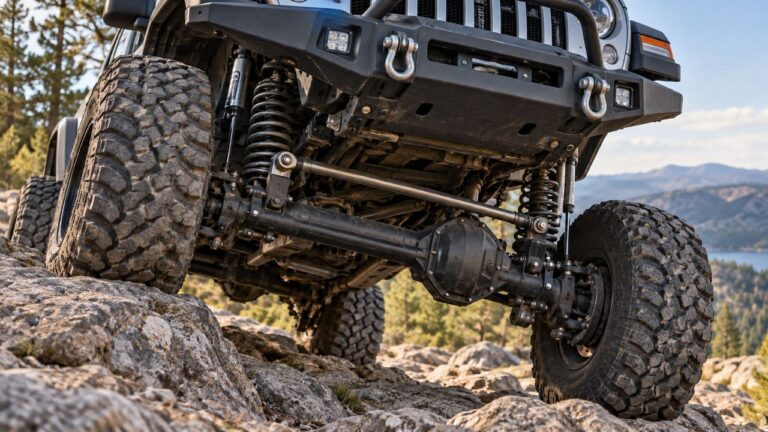
Trailing Arm Suspension in Off-Road Vehicles
Long trailing arms can be useful in off-road suspension because they provide a strong way to control fore-and-aft axle or wheel movement while allowing substantial vertical travel.
A longer arm also reduces the angular change required for a given amount of vertical travel compared with a shorter arm.
That does not make a trailing-arm system automatically suitable for extreme travel. Driveshafts, CV joints, brake hoses, shocks, springs, bump stops, tire clearance, arm joints, and chassis mounts must all operate safely through the full range.
Off-road trailing-arm kits and fabricated systems are a separate vehicle-specific modification topic; this article focuses on the suspension architecture rather than choosing or installing aftermarket kits.
Trailing Arm vs. Leading Arm
The names describe the position of the arm relative to its pivot.
With a trailing arm, the chassis pivot is ahead of the wheel and the arm extends rearward toward it.
With a leading arm, the pivot is behind the wheel and the arm extends forward.
Both allow the wheel to move around an arm pivot, but loads, packaging, anti-dive or anti-squat behavior, and the way forces enter the chassis can differ according to the exact geometry.
Is Trailing Arm Suspension Good?
Yes. Trailing-arm suspension can be an effective, durable, and relatively simple architecture when its characteristics match the vehicle’s requirements.
Pure trailing arms provide straightforward geometry and strong longitudinal control. Semi-trailing arms add camber and toe behavior that can improve chassis tuning flexibility. Trailing links can also form part of solid-axle and more complex independent systems.
The main limitation is that more sophisticated architectures give engineers greater freedom to control wheel geometry independently.
As with every suspension design, the quality of the final result depends more on how the complete system is engineered and maintained than on the name of the architecture alone.
Frequently Asked Questions
What is a trailing arm suspension?
A trailing arm suspension uses an arm that pivots from a point ahead of the wheel and extends rearward toward the wheel or axle. As the suspension moves, the arm rotates around that chassis pivot and guides the wheel through an arc.
Is trailing arm suspension independent?
It can be. Pure trailing-arm and semi-trailing-arm layouts can provide independent movement for each wheel. Trailing arms can also be used to locate a solid axle or form part of a torsion-beam system, so the presence of a trailing arm alone does not prove the suspension is independent.
What is semi-trailing arm suspension?
Semi-trailing arm suspension uses an arm whose chassis pivot axis is angled relative to the vehicle. That angled axis causes camber and toe to change as the wheel moves, giving engineers more geometry control than a pure trailing arm but creating more complex kinematics.
Is a torsion beam a trailing arm suspension?
A torsion-beam suspension uses two trailing arms connected by a transverse beam that twists when the wheels move differently. It is therefore closely related to trailing-arm architecture, but the connecting beam makes it a semi-independent system rather than two fully independent pure trailing arms.
What does a trailing arm do?
A trailing arm controls the fore-and-aft position and movement path of a wheel or axle while transmitting forces from acceleration, braking, cornering, and road impacts into the vehicle structure.
Do trailing arms affect alignment?
Yes. The arm, its bushings, mounting points, and surrounding geometry help determine wheel position. Wear, damage, incorrect adjustment, or bent components can therefore change rear alignment depending on the design.
Are trailing arms used on the front suspension?
They can be, but trailing-arm layouts are much more commonly associated with rear suspension. Modern passenger-car front suspensions more often use MacPherson struts, double wishbones, or multi-link layouts because the front wheels also need to steer through substantial angles.
Understanding the Name Matters More Than It Seems
“Trailing arm suspension” does not identify one exact arrangement. A pure trailing arm, semi-trailing arm, torsion beam, and a solid axle located by longitudinal links can all contain suspension members that trail behind their chassis pivots while behaving very differently.
The useful questions are whether the wheels move independently, where the arm pivots, how that pivot affects camber and toe, what other links locate the wheel or axle, and how the complete suspension is tuned. Once those details are known, the advantages and limitations of the particular trailing-arm system become much easier to understand.