Adjustable Sway Bar End Links: Length, Fitment & Preload
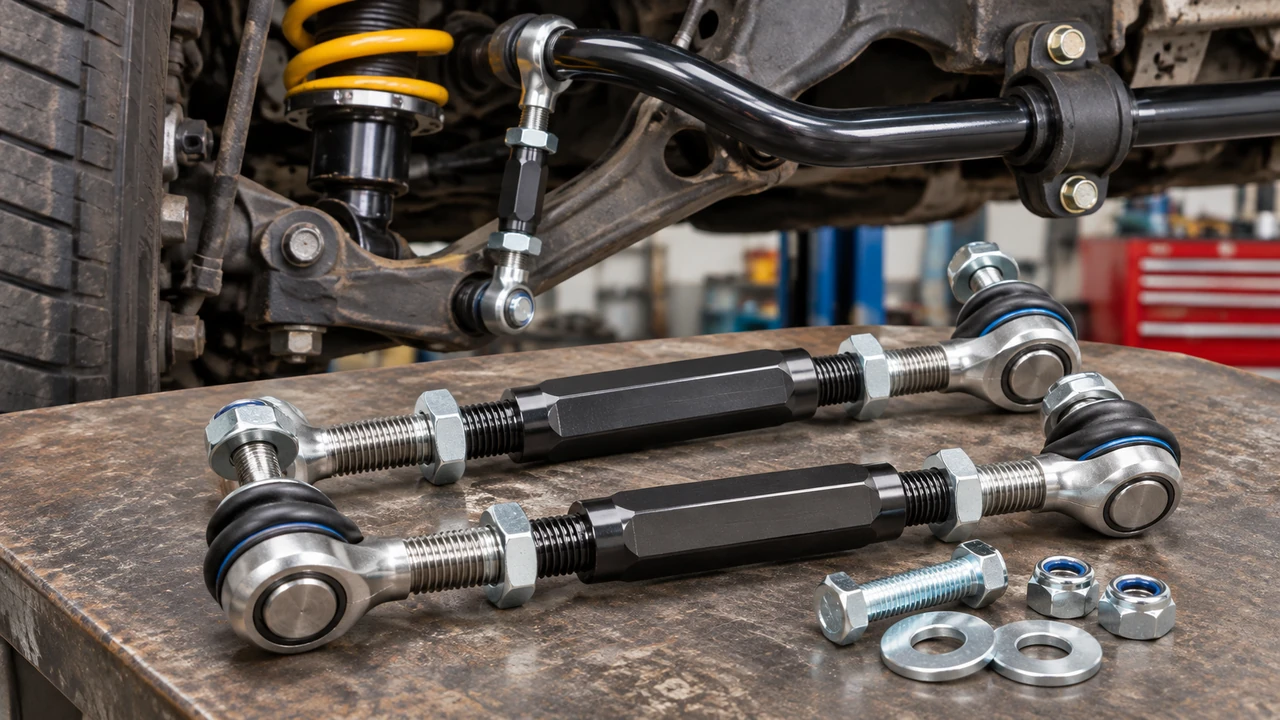
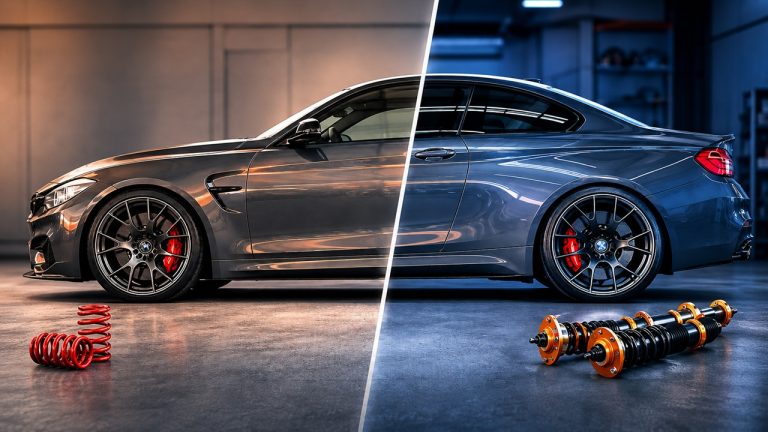
Adjustable sway bar end links let you set the distance between a sway bar arm and its suspension mounting point. They are useful when a lowered car, coilover setup, aftermarket sway bar, or altered mounting position needs a different link length or better joint clearance. Choose by the working center-to-center length, mounting hardware, and available adjustment range—not simply because a listing says “adjustable” or “universal.”
For a street car, the goal is usually a bar that sits in its intended position without being twisted at normal ride height. Measure the actual mounting points with the suspension loaded, check both ends of the link, and leave room to adjust in either direction. A link that reaches the holes only at the very end of its threads is the wrong size, even if the brand sells it for your chassis.
Which Adjustable Sway Bar End Links Should You Buy?
Start with the modification you actually made. A low sedan with short front links, a coilover-equipped track car, and a lifted Jeep may all need different hardware for entirely different reasons. This table separates the buying decision from the marketing language.
| Your setup | What to look for | What not to assume |
|---|---|---|
| Lowered car or coilovers | Vehicle-specific or correctly sized adjustable links that restore usable sway bar angle and clearance | Every lowered car needs shorter links or has sway bar preload |
| Aftermarket sway bar with multiple holes | Compatible stud or eye ends, clearance at every selected bar hole, sufficient articulation | The original end-link hardware fits every adjustment hole |
| Corner-balanced track car | Links with precise adjustment, dependable locknuts and joints suitable for the duty cycle | Preloading the bar is always an upgrade for street driving |
| Lifted truck or SUV | Manufacturer-approved longer or adjustable links that suit the full suspension travel | Any long universal link is suitable for an off-road axle |
| Stock-height daily driver with worn links | Correct OE-style replacement, unless adjustment solves a documented fitment issue | A metal adjustable link automatically reduces roll or fixes a clunk |
If the original link is loose, broken, or noisy, first establish whether the problem is wear rather than geometry. The checks in our bad sway bar link symptoms guide are useful before spending more on an adjustable pair.
How to Measure Adjustable Sway Bar End-Link Length
The most common ordering mistake is measuring a link while the wheels hang in the air, then buying a rod that fits that drooped position. A sway bar is anchored to the body or subframe, while the other end link mount may follow a strut, control arm, or axle. Their separation changes as the suspension moves.
Use Center-to-Center Length at Normal Ride Height
Park on level ground with correct tire pressures and the normal vehicle load. A drive-on lift is helpful because the suspension stays supported by the wheels. With the sway bar at the angle specified for the kit, measure between the centers of the two intended attachment points; do not measure from the end of one threaded stud to the end of the other.
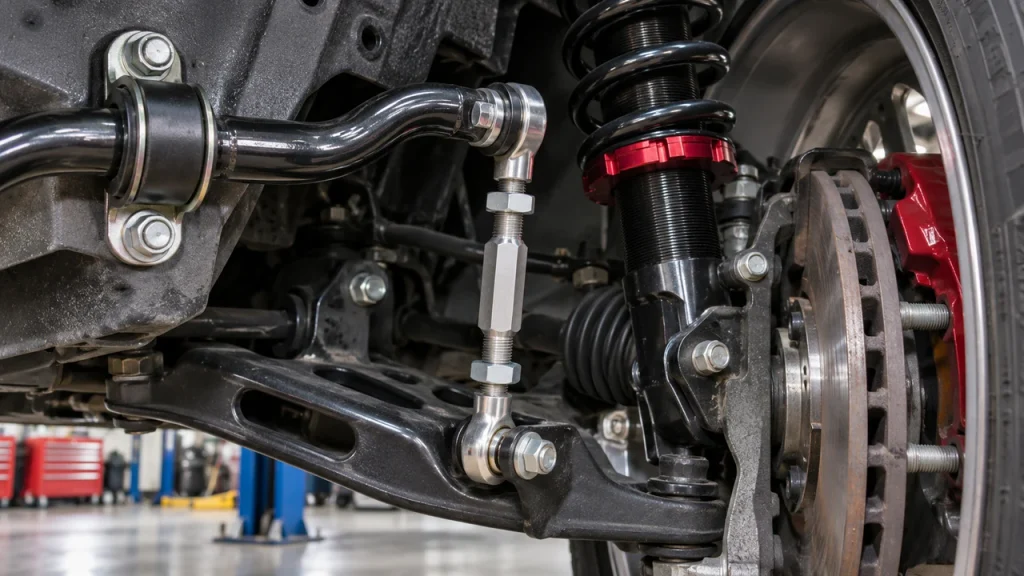
For an existing link, record its center-to-center dimension as a baseline, then check whether the new bar or suspension places the holes differently. SPL Parts specifically calls for measurements between joint centers and also asks for stud diameters and lengths. Eibach likewise uses eye-to-eye dimensions when selecting its end-link components. That is more useful than a listing that says “fits lowered cars.”
Check the Full Adjustment Range, Not Just the Advertised Length
Suppose your measured working length is 285 mm. A candidate listed as adjustable from 280 to 300 mm may reach it, but you still need to check required thread engagement, the maker’s setting procedure and clearance through suspension travel. A different link whose normal setting sits comfortably within its adjustment range can be a better choice.
Some links adjust by turning a central sleeve; others use individually threaded joints or even a cut-to-length rod. These are not equivalent. With a cut-to-length product, the manufacturer may give separate instructions for trimming the shaft and setting the finished center-to-center distance. Cutting a threaded section before confirming the geometry can ruin the kit.
Measure Both Mounts: Stud Diameter, Orientation, and Spacing
Check the sway-bar hole and the strut, arm, or axle-side hole separately. Record stud or bolt diameter, usable shank length, mounting-face width, and whether the original ends point the same way, opposite ways, or at an angle to each other. A part with the right length but the wrong 10 mm or 12 mm attachment is not a fit.
Also check whether the bar accepts a ball-joint stud, a through-bolt with an eye, or a spherical rod end with spacers. On universal kits, “misalignment spacers” are small mounting pieces that let a spherical bearing articulate and clear adjacent metal. They do not mean the car’s wheel alignment is being adjusted.
What Link Length Changes—and What It Does Not
Adjustability is often sold as a handling upgrade, but the link is only one part of the anti-roll-bar system. It changes where the bar arm rests and whether the mounting points can be connected without forcing the bar. It does not change the bar’s torsional stiffness, wheel-alignment angles, or basic suspension layout by itself.
Sway Bar Preload at Ride Height
Preload means the anti-roll bar is already being twisted when the car is sitting still. On a level, symmetric street setup, the practical goal is to connect the second link without levering the bar arm into place. If the mounting holes do not align freely with the suspension loaded, the lengths or surrounding setup need checking.
A useful distinction: simply lowering a vehicle does not prove that a same-length pair of factory links is preloading the bar. Both sides may move together while the bar rotates to a new resting angle. The problem may instead be poor clearance, an awkward bar-arm angle or insufficient travel. Adjustable links are valuable when they correct one of those measurable conditions.
Bar Angle and Clearance Are Vehicle-Specific
A bar arm that is close to horizontal may be desirable in many designs, but “always horizontal” is not a universal specification. Some lifted-Jeep kits publish a slight downward angle for the rear bar; other performance kits have different target positions. Follow the intended bar geometry and check that neither the bar nor link contacts the axle, driveshaft, control arm, brake hose or body.
The correct position must also work at full steering lock where applicable, full compression, and permitted droop. A link that clears the tire on the workshop floor can still bind when the outside front wheel compresses in a turn. Nothing about a static length measurement replaces a proper travel check.
Coilover Spring Preload Is a Different Adjustment
The words “preload adjustment” cause confusion when a vehicle has coilovers. Winding a coilover spring perch changes spring preload or related spring seating on that damper; lengthening a sway bar link changes a separate anti-roll-bar connection. They should not be used as substitutes for each other.
Our coilover preload setup guide covers the spring-perch side of the job. Here the goal is to select and set the link so the sway bar works as intended at the final ride height.
Ball-Joint Ends, Spherical Rod Ends, and Link Construction
Two adjustable links can have identical dimensions yet feel and age differently. The joint at each end matters at least as much as the aluminum or steel center tube. Inspect how the chosen product handles water, grit, articulation and noise.
| End-link joint style | Why it may fit your build | Main trade-off |
|---|---|---|
| Booted ball-joint ends | Practical street option when the right mounting geometry is available | Boot condition, stud size and available joint travel still matter |
| Spherical rod ends / Heim joints | Precise articulation for purpose-built performance setups | Potentially more noise and more frequent inspection in exposed road use |
| Bushed eye or mixed-end design | Matches applications using through-bolt eyes or dissimilar ends | Must match mounting-face width, bolts and suspension movement |
Sealed Ball Joints for Daily Driving
A ball joint with a protective boot is often the more practical street option when a suitable vehicle-specific product is available. The boot helps keep road spray and grit out, and the design may be quieter than an exposed motorsport joint. “Heavy duty” is not enough information on its own: look for actual stud geometry, load suitability and replacement-parts availability.
Some adjustable links use conventional steel ball joints with an aluminum turnbuckle. Others use a ball joint at one end and a different eye or bushing mount at the other. Both layouts can be legitimate, but they must match the two original mounting points—not a product photograph of a similar car.
Heim Joints and Spherical Bearings for Performance Use
Spherical rod ends, often called Heim joints, allow precise movement and can provide generous articulation in tightly packaged performance suspensions. They can also transmit more noise and may need more frequent inspection than a sealed joint used on a daily commuter. Race hardware is not automatically the best choice for winter salt, potholes and years of road grime.
Eibach offers rod-end and misalignment-spacer options, while SPL Parts lets customers configure end-link hardware around the actual suspension measurements. These choices are useful for custom builds, but they make thread engagement and spacer selection even more important. The wrong spacer stack can side-load a bearing.
Turnbuckles, Left-Hand Threads, and Locknuts
A turnbuckle can change length without detaching both ends when it uses opposing thread directions. That does not mean every nut turns the same way: some products mark the left-hand threaded side with grooves or other identifiers. Do not force a jam nut because it appears stuck; check which direction its thread runs.
Use the maker’s specified minimum engagement and locknut procedure. Threads exposed beyond the approved range can bend or pull out, and a loose locknut can let the link change length in service. Eibach specifically warns against extending an end link beyond its rated maximum even when it still appears to have threads engaged.
Front and Rear Fitment: What Parts Catalogs Often Miss
In U.S. search results you will find adjustable links for lowered hatchbacks, sports cars, German sedans and lifted 4x4s on the same page. They do not form one interchangeable product category. The car’s suspension generation and the mounting hardware still decide what fits.
BMW, VW/Audi, and Lowered Street Cars
On many independent-suspension cars, the front link runs between the sway bar and a tab on the strut. Front and rear may have very different lengths or connections. A BMW E46 product should not be assumed to fit an E90 or F30; a Golf Mk7 or Audi platform listing needs the exact chassis and drivetrain notes.
This is also where adjustable links marketed for coilovers can make sense, particularly when a lowered stance leaves little room near a halfshaft or control arm. Compare the actual on-car clearance with the maker’s illustrated range rather than treating “lowered” as a universal fitment promise.
BRZ/GR86, Miata, and Track-Oriented Applications
Sports-car listings are especially likely to include exposed spherical bearings, specific front/rear lengths and an instruction to set the car on a level surface before the final adjustment. A Mazda MX-5 NA, NB, NC or ND may use a different end link; Toyota 86/BRZ generations also need their own part-number check.
If the car has been corner-balanced, set the bar only after the ride heights and corner weights are finalized. Specialized racing setups may deliberately use other adjustments, but for an ordinary road car a neutral bar is the sensible baseline. Do not copy someone else’s right-side length from a track forum.
Lifted Jeeps and Trucks: Extended Is Not the Same as Adjustable
A lifted solid-axle vehicle may need longer sway bar links to keep an appropriate bar angle through travel. That requirement can be met by a fixed-length extended link or a manufacturer-approved adjustable one; the two product categories overlap, but they are not synonyms. Confirm the lift kit’s intended bar angle and whether other brackets have moved.
An adjustable sway bar link is also not a quick-disconnect system. If you want to disconnect the bar for trail articulation, the hardware and safety considerations are different; see our sway bar disconnect guide. Don’t improvise a disconnect by removing a nut from a normal adjustable link.
A “Universal” Pair Still Has Limits
Universal generally means the vendor offers a broad size range or configurable hardware, not that the mounting points are interchangeable. A cut-to-length product with 10 mm ball studs can be wrong for an arm drilled for another fastener size. So can a rod end with the correct bolt diameter but insufficient angular travel once the wheel turns.
As a final screen, check front versus rear position, left/right orientation if specified, bar hole choices, and whether the catalog lists stock or modified suspension geometry. A generic marketplace filter cannot see an aftermarket control arm, sway bar or relocated bracket already fitted to the car.
How to Set a Neutral Sway Bar Link at Ride Height
Setting length correctly is part of choosing the kit, not a reason to guess at torque or dismantle a loaded suspension. The following is a setup check, not a substitute for the vehicle’s link-replacement procedure or the exact manufacturer instructions.
Use a Level Surface and Keep Both Sides Supported
For a normal street setup, the vehicle should sit at its settled operating height on a flat, level surface, with the intended load and tire pressures. A drive-on lift is usually the easiest way for a workshop to access the links without hanging the wheels. Never work beneath a car supported only by a jack.
After the sway bar position is verified and one link is secured according to the manufacturer’s sequence, the second link should reach its mounting holes without prying the bar against its torsion. Adjust only within the permitted range and keep the joint bodies at the intended orientation. If the holes refuse to meet, investigate the setup rather than forcing in a long bolt.
Tighten, Check Articulation, and Reinspect
Once the correct length is established, the installer must tighten the appropriate fasteners and jam nuts to the specific kit’s torque requirements. Check the joint’s angle, thread engagement and clearance at steering lock and both suspension travel limits. Follow the manufacturer’s post-installation inspection interval, especially on a vehicle used hard or off road.
The full removal and replacement process—including stuck fasteners and access around the strut—is covered separately in our guide to replacing a sway bar link. This article deliberately stops at the selection and adjustment details that determine whether the aftermarket link is right for the job.
A Zero-Preload Check Is Not a Corner-Balance Procedure
Race setup can involve scales, spring adjustments and an intentional tuning strategy. For a street-driven vehicle, a link that attaches freely with the car level and evenly loaded is the more appropriate starting point. If one corner sits low or the chassis is twisted, chasing a link length to make the bolt fit may hide the real problem.
What to Check Before Ordering a Pair
Manufacturers sometimes sell links as individual pieces, axle pairs, or larger kits with alternative studs. Before checkout, compare the actual kit contents with this checklist. A price comparison is meaningless if you still need rod ends, spacers or replacement hardware.
- Working length: measured center-to-center at the intended ride height, plus the product’s usable minimum and maximum
- Mounting style: ball-joint stud versus through-bolt eye; front and rear can differ
- Hardware dimensions: stud or bolt diameter, thread pitch, usable stud length and mounting-face width
- Orientation and articulation: both joint angles, stud direction and full-travel movement
- Clearance: bar arm, strut, CV axle, brake hoses, tire, chassis and other nearby parts
- Thread engagement: minimum safe insertion and whether trimming is explicitly allowed
- Kit quantity: single side or pair, locknuts, spacers, washers and any replacement fittings
- Documentation: exact part number, vehicle-specific setup instructions and torque specifications
For a useful manufacturer example, Eibach’s official end-link selection guide asks for the original eye-to-eye length, bolt diameter, minimum adjusted length and clearance for misalignment spacers. It also warns against exceeding a listed maximum length. Those are practical buying checks, not an endorsement of a universal fit.
Are Adjustable Sway Bar End Links Worth It for a Daily Driver?
If the factory suspension geometry is intact and the original links fit without interference, an adjustable pair may add cost, exposed threads and maintenance without fixing a real problem. A correctly sized factory-style link is often the better street repair. The main reason to upgrade is a confirmed length, angle, clearance or tuning requirement.
Where the Upgrade Pays Off
A car with a new aftermarket sway bar and coilovers may finally have room for the bar arm to move without hitting a nearby component. An adjustable link can also let a shop remove unwanted static bar twist after setting ride height, or accommodate a manufacturer-approved bar-hole change. Those are specific, observable benefits—not claims that a shiny turnbuckle creates more grip by itself.
Where an OE-Style Link Makes More Sense
If you simply need a worn link replaced, compare costs and durability first. Our sway bar link replacement cost guide addresses the ordinary repair purchase. A premium spherical rod-end kit can be harder to justify if the car spends its life commuting in rain, road salt and stop-and-go traffic.
Also consider what you can maintain. Some motorsport links use serviceable rod ends and exposed bearings; other street-oriented links use sealed ball joints. Inspect the care instructions, replacement bearing availability and corrosion protection before choosing by color or advertised strength.
Adjustable Sway Bar End Link FAQs
These are the final fitment questions worth resolving before ordering adjustable links rather than a standard replacement or an extended fixed-length part.
Do adjustable sway bar end links improve handling?
They can help when the existing links place the bar at a poor angle, cause interference or leave unwanted preload at rest. They do not independently increase the stiffness of the sway bar. The benefit depends on correcting a real setup issue.
Should I use shorter end links after lowering my car?
Not automatically. Measure the mounting-point separation at settled ride height and check the bar’s intended position and full-travel clearance. Some lowered cars need shorter links; others keep a suitable original length or use a different mounting arrangement.
How do I measure adjustable sway bar end links?
Use the center of each ball joint or mounting eye—not the exposed end of a threaded stud. Measure with the suspension at normal ride height and compare that number with the maker’s approved adjustment range, joint type and mounting hardware.
Do both adjustable end links have to be the same length?
Many symmetrical street applications are designed around matching left and right lengths, but the exact requirement comes from the suspension and link manufacturer. Set the bar in its intended position and remove unintended preload rather than forcing identical measurements on an asymmetric or specialized racing setup.
Can I set sway bar links with the wheels hanging?
You may be able to assemble parts while the suspension is unloaded if the service instructions allow it, but the final neutral-length check generally requires normal ride height. A measurement taken at full droop can put the bar at the wrong working angle when the car returns to the ground.
Are adjustable end links the same as quick disconnects?
No. An adjustable link changes installed length. A quick-disconnect link is built to release an end of the stabilizer bar in an approved off-road application. Some specialized products may combine functions, but never assume ordinary adjustable joints can be disconnected safely.
Do I need an alignment after changing sway bar end links?
A link change alone generally does not set toe, camber or caster, so it does not automatically require a wheel alignment. If ride height, control arms, struts or other geometry were also changed, follow those components’ alignment requirements. Inspect the final sway bar clearance regardless.