33 vs 35 vs 37 Tires: Which Size Is Best for Your Truck?
For most daily-driven trucks and SUVs, 33-inch tires are the easiest size to live with, 35s are the strongest middle ground for mixed street and trail use, and 37s make the most sense when difficult terrain—not appearance—is driving the build.
The important question in a 33 vs 35 vs 37 tires comparison is not simply which tire is biggest. It is which is the smallest size that solves the limitation you actually have. Every step upward can improve axle clearance and obstacle rollover, but it can also reduce fitment margin, make effective gearing taller and increase the amount of supporting work the vehicle may need.
That does not mean every truck on 37s is difficult to drive or every truck on 33s is simple. Factory packages designed around large tires behave very differently from vehicles modified to accept them. The exact tire, wheel, suspension and drivetrain matter more than the number stamped on the sidewall.
33 vs 35 vs 37 Tires at a Glance
| Factor | 33-Inch Tires | 35-Inch Tires | 37-Inch Tires |
|---|---|---|---|
| Best suited to | Daily driving and mild-to-moderate trails | Mixed street use and more demanding trails | Terrain-focused builds that use the extra size |
| Road drivability | Usually easiest to preserve | More noticeable change | Most dependent on supporting setup |
| Axle clearance vs a true 33 | Baseline | About +1″ if diameter is exactly 2″ greater | About +2″ if diameter is exactly 4″ greater |
| Obstacle rollover | Good | Better | Best of the three geometrically |
| Wheel-well clearance demand | Lowest | Higher | Highest |
| Effective gearing change | Closest to a smaller factory setup | More change | Largest change for the same starting vehicle |
| Supporting modifications | Often fewer | More vehicle-dependent | Most likely to become a complete build |
| Best reason to choose it | You do not need more tire | You regularly use the extra capability | 35s are genuinely limiting the vehicle |
The table shows the progression, not a universal fitment recipe. A factory-engineered vehicle on 37s can require fewer compromises than a different platform struggling to clear 35s.
The Best Tire Size Is the First One That Does the Job
It is easy to treat 33, 35 and 37 inches as three levels where the highest number is automatically the final goal. That approach can lead to spending money solving problems you did not have.
If 33s clear the terrain you drive, maintain the road behavior you want and fit the vehicle cleanly, going larger may add more compromises than useful capability.
If 33s regularly leave the differential, chassis or tire struggling with rocks and deep ruts, 35s become easier to justify. If a properly configured vehicle on 35s is still routinely limited by axle clearance and obstacle size, then 37s start solving a real problem rather than simply creating a larger stance.
This is why there is no universally correct winner. The correct size depends on where your current tire becomes the limiting part of the vehicle.
What Actually Changes From 33 to 35 to 37 Inches?
Each step is nominally two inches in overall diameter, but only part of that increase appears beneath the axle. The rest affects the tire’s path through the wheel well, its circumference and the leverage it creates through the drivetrain.
33 to 35 inches
If the tires actually measure exactly 33 and 35 inches, radius increases by one inch. That can add approximately one inch beneath an axle-dependent low point while also making the tire sweep one inch farther outward from the hub in every direction.
The diameter increase is about 6.1%, so the tire also travels about 6.1% farther per revolution. That affects effective gearing and can affect speedometer calibration if the vehicle is not recalibrated.
For the detailed two-size decision, see our 33 vs 35 tires comparison.
35 to 37 inches
The next jump adds another nominal inch of radius. Geometrically, that means another potential inch of axle-dependent clearance and a larger rolling radius over rocks, ledges and ruts.
But this second step often matters differently because the vehicle may already have been modified to accommodate 35s. Moving to 37s can expose a new set of limits involving full steering lock, suspension compression, gearing, spare-tire storage and component strength.
If those are the two sizes you are choosing between, our dedicated 35 vs 37 tires guide goes deeper into that specific transition.
33 to 37 inches
Skipping directly from a true 33 to a true 37 is a four-inch increase in diameter and a two-inch increase in radius. Circumference increases by roughly 12.1%.
That is large enough that the change should be treated as a complete vehicle decision rather than only a tire purchase. Fitment, gearing, calibration, steering clearance and the additional mass of the chosen tire all deserve attention before parts are ordered.
Real Tire Dimensions: A 33, 35 and 37 From the Same Family
Nominal tire size can hide useful details. A 33 is not guaranteed to measure exactly 33 inches, and the same applies to 35s and 37s.
A useful way to remove some of the noise is to compare three sizes from the same tire family. Current published specifications for the Nitto Ridge Grappler in 17-inch flotation sizes show:
| Nitto Ridge Grappler | 33×12.50R17LT | 35×12.50R17LT | 37×12.50R17LT |
|---|---|---|---|
| Published overall diameter | 32.76″ | 34.76″ | 36.77″ |
| Published overall width | 12.52″ | 12.52″ | 12.52″ |
| Published tire weight | 69.32 lb | 75.45 lb | 81.48 lb |
| Diameter increase vs 33 | — | +2.00″ | +4.01″ |
| Weight increase vs 33 | — | +6.13 lb | +12.16 lb |
Those figures come from Nitto’s published Ridge Grappler specifications. The 33 and 35 shown here use Load Range E constructions, while the listed 37×12.50R17 is Load Range D, so this should not be treated as a universal weight formula.
What it does demonstrate is more useful: even within one product family, the actual specification sheet matters. Another tire model can have different diameters, widths, load ranges and weight gaps.
To compare a metric size such as 315/70R17 with a flotation size like 35×12.50R17, try our tire size comparison charts and calculator. It shows the nominal diameter, width and speedometer difference side by side. For actual fitment, the manufacturer’s published measurements still take priority.
33-Inch Tires: The Low-Compromise Choice
33s make the strongest case when the vehicle still spends substantial time on pavement and the terrain does not consistently demand a larger tire.
Compared with larger alternatives of similar construction, a 33 generally leaves more wheel-well clearance, changes effective gearing less and gives steering and braking systems less additional tire to manage.
That makes 33s especially attractive for daily drivers, tow vehicles, camping rigs and trucks that see forest roads or moderate trails without repeatedly contacting axle housings or struggling to climb obstacles.
The mistake is assuming that choosing 33s means giving up serious usefulness. A well-chosen 33-inch all-terrain tire can provide substantial trail capability while keeping the rest of the build relatively restrained.
35-Inch Tires: The Middle Ground Has to Earn Its Place
35s are often described as the automatic “sweet spot,” but that phrase can hide the real decision. They are only the sweet spot when the extra radius is useful often enough to justify the additional fitment and drivetrain considerations.
For a mixed-use truck, that can happen quickly. One more inch of tire radius over a true 33 can matter around differential housings and on ledges, while the jump is still smaller than moving directly to a 37.
At the same time, 35s are large enough that wheel position, steering clearance and suspension compression should be checked rather than assumed. Whether lift is needed—and how much—depends heavily on the platform.
If this is your target size, our guide to how much lift 35-inch tires may need covers fitment without pretending one lift height works for every truck.
37-Inch Tires: Choose Them Because the Terrain Requires Them
A 37 makes the most convincing argument when a well-sorted vehicle on smaller tires is still being limited by the terrain it encounters.
Compared with a true 35, a true 37 offers roughly one additional inch of tire radius. Compared with a true 33, the difference is about two inches. That extra radius can be valuable around large ledges, deep ruts and axle-dependent low points.
What changes is that fitting the tire becomes only one part of the project. The larger envelope must clear at steering lock and suspension compression, and the complete wheel-and-tire assembly may place greater demands on gearing, brakes, steering and driveline components depending on the vehicle and how it is used.
Some vehicles are engineered around 37-inch tires from the factory, so it would be wrong to say that every 37-inch setup requires the same modifications. For a vehicle that was not designed around them, however, investigate the complete build rather than asking only whether the tire can physically fit.
Our separate guide to lift requirements for 37-inch tires covers that fitment question in more detail.
33 vs 37 Tires: Is It Worth Skipping 35s?
Moving directly from 33s to 37s can make sense, but only when you already know that 35s will not meet the goal of the finished vehicle.
For example, a truck being built specifically around large technical obstacles may benefit from planning suspension, wheel clearance, gearing and drivetrain changes around the final tire size from the beginning rather than purchasing 35s as an intermediate step.
For a mixed-use vehicle, the calculation is different. A true 37 adds only about two inches of axle-dependent clearance over a true 33—not four inches—and reaching that gain may require a substantially different overall setup.
If you cannot identify where a 33 is limiting you and why a 37 would solve that problem, skipping the middle size is difficult to justify on capability alone.
Which Size Is Best for Daily Driving?
For an otherwise comparable setup, 33s usually create the fewest changes for a daily-driven vehicle. That does not automatically make them smoother or quieter, because tire construction and tread pattern matter enormously, but the smaller diameter generally creates less gearing change and more fitment margin.
35s can remain perfectly practical on-road when the vehicle is correctly configured. The decision becomes less about whether they can be daily driven and more about whether you regularly use the capability they add.
37s can also be street driven, particularly on platforms designed for them, but choosing them solely for appearance can mean accepting additional size and mass without gaining anything you need during normal driving.
Which Size Is Best Off-Road?
37s have the geometric advantage when tire diameter itself is the limiting factor. Their larger radius gives them the easiest path over a given ledge and the most axle-dependent clearance of these three nominal sizes.
That does not mean 37s automatically create the best off-road vehicle. A poorly matched 37-inch setup can be less useful than a well-sorted truck on 33s or 35s.
Forest roads and mild trails
33s may already provide all the clearance required. In this environment, tire construction, puncture resistance, pressure and tread suitability can matter more than adding another two or four inches of nominal diameter.
Rocky and deeply rutted trails
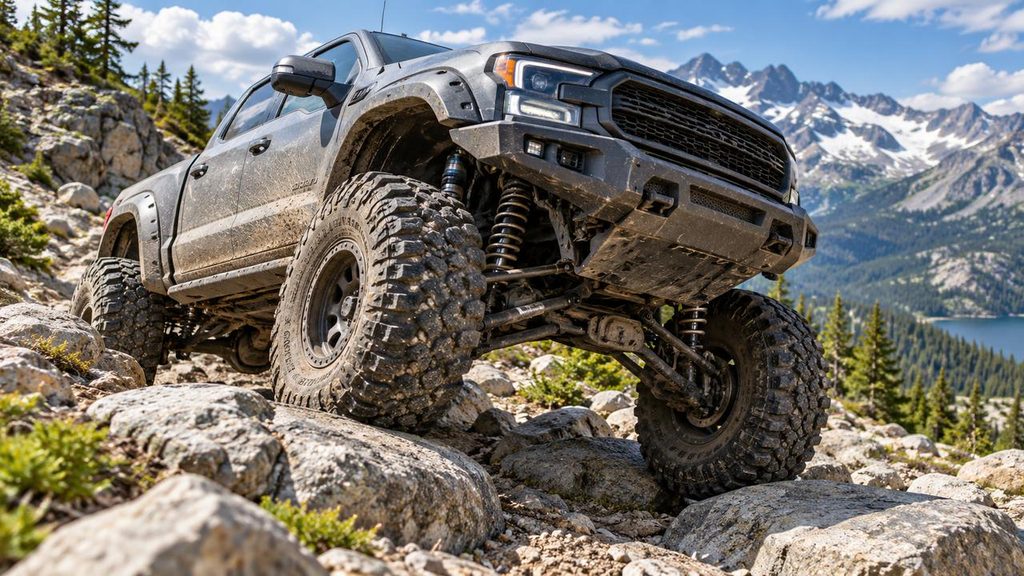
As obstacles become larger relative to the tire, the additional radius of 35s and 37s becomes easier to use. More tire radius can reduce how abruptly the tire has to climb a ledge while adding clearance beneath axle-dependent components.
Mud and sand
Diameter is only part of the equation. Width, tread design, casing, vehicle weight and tire pressure strongly affect flotation and traction. Choosing a 37 solely because it is larger does not guarantee better performance in either surface.
Bigger Tires Change Effective Gearing Before You Change Any Gears
A taller tire covers more distance per revolution. If nothing else changes, that makes the drivetrain’s effective final gearing taller.
The important part is that this is a ratio change, not a rule that says a particular tire size requires a particular axle gear.
Using nominal diameter, moving from 33 to 35 inches increases tire circumference by about 6.1%. Moving from 35 to 37 adds about another 5.7%. Going directly from 33 to 37 changes circumference by about 12.1%.
Whether that feels acceptable depends on the original axle ratio, transmission ratios, engine torque, vehicle weight, towing load, altitude and intended use. This is why statements such as “37s always need 4.88 gears” are not reliable across every platform.
Do Bigger Tires Always Hurt Acceleration, Braking and Fuel Economy?
Larger tires can increase the demands placed on the vehicle, but tire diameter cannot predict a fixed performance or MPG loss by itself.
The complete wheel-and-tire package matters. Tire weight, wheel weight, rotational inertia, tread compound, rolling resistance, tire width, inflation pressure, gearing and vehicle aerodynamics can all change at the same time.
That is why a published claim such as “37s lose exactly X MPG” is not transferable from one truck to another. Even two 37-inch tires can differ meaningfully in construction and weight.
The same caution applies to braking. Increasing tire radius changes leverage at the wheel, and a heavier rotating assembly can require more energy to slow, but brake size, tire grip, ABS behavior, vehicle mass and road surface all affect the actual stopping result.
Fitment Gets Harder Because the Tire Moves, Not Just Because It Is Taller
A tire that clears while the vehicle is parked is not necessarily a tire that fits.
The front tire must remain clear while steering from lock to lock and while the suspension moves through usable compression. As diameter increases, the leading and trailing edges of the tire sweep a larger path through the wheel opening.
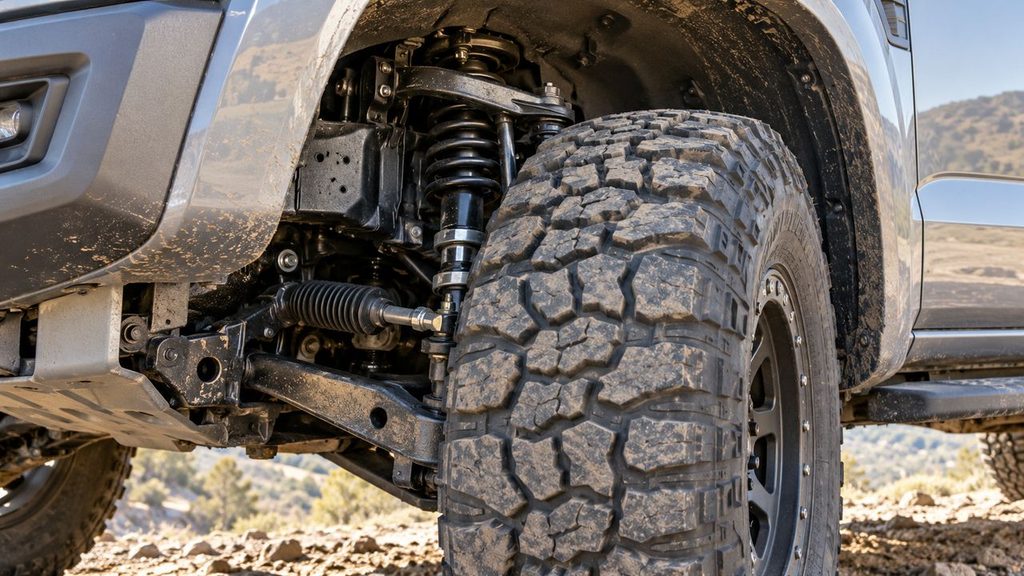
Wheel width, offset and backspacing then determine where that larger circle sits laterally. Moving the wheel outward may improve clearance from one suspension component while making fender or body-mount contact worse.
If those measurements are unfamiliar, start with our wheel offset vs backspacing guide. If you already know both wheel setups, our wheel offset and backspacing calculator can compare inner clearance and outer position before you buy.
Do 33s, 35s or 37s Need More Lift?
There is no reliable universal lift chart that can answer this for every truck, SUV or Jeep.
A vehicle with large factory wheel openings can clear a much larger tire with less lift than another platform. Tire width, wheel offset, suspension design, bump-stop position, fender shape and acceptable trimming can be just as important as ride height.
Lift can create body and chassis clearance, but it does not magically make every interference point disappear. On a solid axle, suspension lift also does not increase differential-to-ground clearance; tire radius does that.
Choose the tire and wheel combination for the actual vehicle first, then determine what suspension changes are required to clear it through steering and compression.
The Spare Tire Is Part of the Decision Too
Moving to a larger tire also means finding space for a matching full-size spare.
An under-bed carrier, factory rear mount or interior storage location that accepts a 33 may not accept a 35 or 37 with the same ease. A larger spare also adds weight to whatever structure carries it.
This is easy to overlook because the spare does not affect fitment at the driven wheels, but it can change the practicality and total cost of the finished build.
33, 35 or 37: Choose 33s If…
- Your truck spends most of its time on pavement.
- Your trails do not routinely expose a clearance problem with 33s.
- You want to preserve as much factory-like acceleration, steering and fitment margin as practical.
- You tow or haul regularly and do not need the additional radius of a larger tire.
- You want the build to remain relatively simple.
Choose 35s If…
- You use the truck both on-road and on terrain where 33s are beginning to become limiting.
- An extra nominal inch of tire radius provides useful clearance for the trails you drive.
- You are willing to verify wheel fitment, steering clearance and suspension compression rather than relying on appearance alone.
- You accept some additional gearing and rotating-mass considerations in exchange for greater trail capability.
- You do not yet have a clear terrain-based reason to move to 37s.
Choose 37s If…
- You regularly encounter obstacles where additional tire radius solves a real limitation.
- Your finished build is being designed around 37s rather than trying to squeeze them into a setup intended for smaller tires.
- You are prepared to evaluate gearing, brakes, steering, suspension and drivetrain behavior as a complete system.
- You have verified clearance at full steering and usable suspension compression.
- The extra off-road capability matters more to you than preserving the simplest possible road-oriented setup.
What to Check Before Buying Any of the Three Sizes
- Actual overall diameter. Compare the manufacturer’s specification, not only the nominal size.
- Actual section width. A taller tire is not necessarily the same width as another tire with a similar label.
- Tire weight and load construction. Do not assume every 35 or 37 weighs the same.
- Approved rim-width range. Confirm that your wheel is approved for the specific tire.
- Wheel offset and backspacing. Verify both inner and outer clearance.
- Steering clearance. Check both directions at full lock.
- Suspension compression. Parked clearance is not proof of dynamic fitment.
- Effective gearing. Estimate how the diameter change affects the existing drivetrain.
- Electronic calibration. Determine whether the vehicle needs tire-size recalibration for accurate speed and distance information.
- Full-size spare fitment. Verify where the larger spare will be carried.
- Your actual terrain. Identify the problem the bigger tire is expected to solve.
Frequently Asked Questions
Are 35s better than 33s?
35s provide more tire radius, which can improve axle-dependent clearance and obstacle rollover. They are not automatically better for every truck because they can also require more fitment work and create a larger gearing change. If 33s already handle your terrain, the extra size may provide little practical benefit.
Are 37s much bigger than 35s?
Nominally, a 37 is two inches larger in diameter than a 35, which means approximately one additional inch of radius. Actual dimensions vary by tire model, and the practical impact can extend beyond that inch because gearing, tire weight and wheel-well clearance may also change.
How much taller are 37s than 33s?
If both tires measure exactly as labeled, a 37 is four inches larger in overall diameter than a 33. The hub and axle therefore sit approximately two inches higher relative to the ground. Actual manufacturer dimensions should be used for a real comparison.
Are 35-inch tires the best all-around size?
They can be an excellent middle ground for a truck that genuinely uses more off-road clearance than a 33 provides but does not need the additional size of a 37. They are not automatically the best choice for a pavement-focused vehicle or for a platform where fitting them requires disproportionate modification.
Are 37-inch tires too big for daily driving?
Not inherently. Some factory vehicles are engineered around very large tires. On a vehicle being modified from a much smaller factory size, however, 37s can require more attention to fitment, gearing, braking, steering and calibration than smaller alternatives.
Do 35s or 37s require regearing?
Not according to tire diameter alone. Larger tires make effective gearing taller, but whether an axle-ratio change is worthwhile depends on the original gearing, transmission, engine, vehicle weight, towing demands and intended use. There is no single mandatory ratio for every truck on 35s or 37s.
Do bigger tires increase ground clearance?
Yes, where clearance is directly tied to tire radius. If actual diameter increases by two inches, an axle-dependent low point can gain approximately one inch of clearance. Suspension and underbody geometry mean that not every point beneath the vehicle necessarily changes by the same amount.
Do I need to recalibrate the speedometer for bigger tires?
A meaningful change in rolling circumference can make the speedometer and odometer inaccurate if the vehicle remains calibrated for the old tire size. Whether and how recalibration is performed depends on the vehicle, so use the actual tire diameter rather than assuming the nominal label is exact.
Which Tire Size Makes the Most Sense?
Choose 33s when they already do everything your terrain requires. Choose 35s when the extra inch of nominal radius solves a limitation you encounter often enough to justify a more involved setup. Choose 37s when a properly configured vehicle on smaller tires is genuinely being held back by tire diameter.
The progression from 33 to 35 to 37 is not a ranking from worst to best. It is a progression from less tire to more tire, with both the benefits and the consequences increasing as the diameter grows.
The smartest build is therefore not the one with the largest tire. It is the one that reaches the required clearance and obstacle capability without adding size, weight and supporting modifications that the vehicle never actually uses.