35 vs 37 Tires: Which Size Is Better for Your Truck?
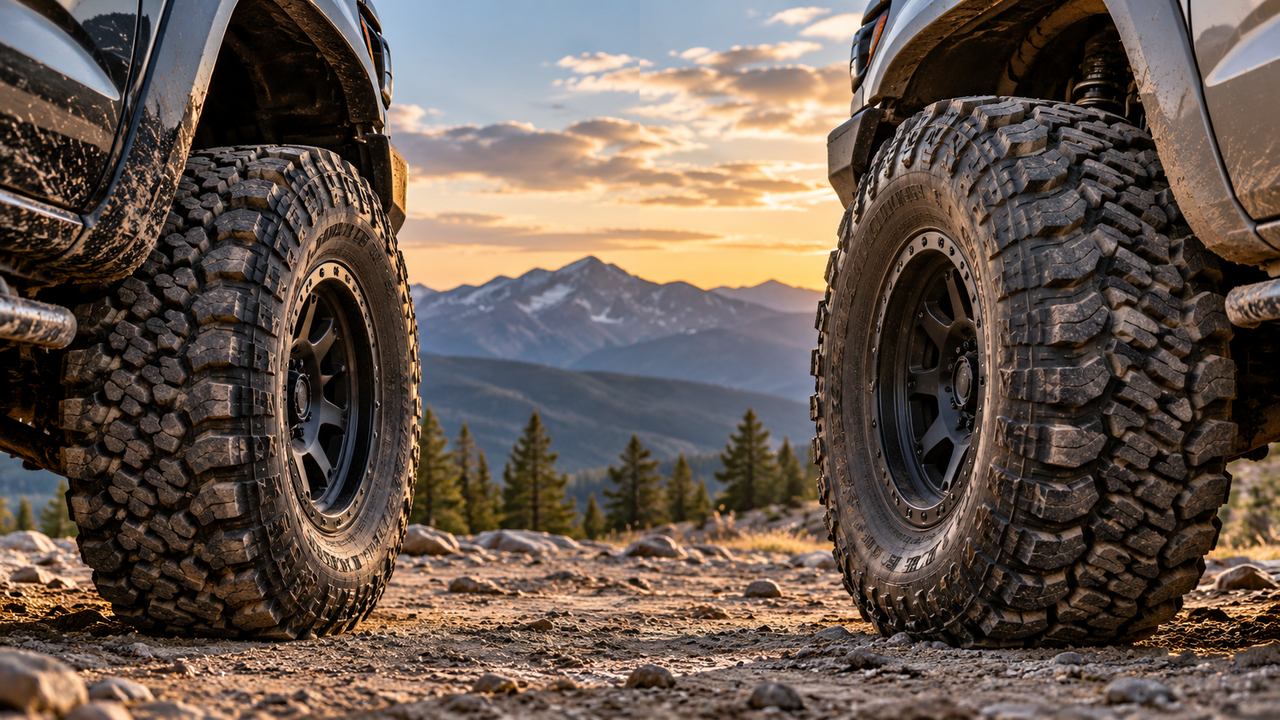
For most daily-driven trucks that also see trails, 35-inch tires are the better all-around choice. They deliver substantial ground clearance and off-road capability while usually requiring less fitment work, adding less rotating mass and placing fewer demands on gearing, steering and brakes. Choose 37-inch tires when the extra clearance and obstacle rollover genuinely matter enough to justify a more involved build.
The important part is that 35 vs 37 tires is not really a two-inch decision. If two tires actually differ by a full two inches in diameter, the 37 gives you only about one additional inch of radius and potential axle clearance. At the same time, moving from a true 35-inch diameter to a true 37 changes effective gearing by about 5.4% before tire weight, wheel weight, tread design or aerodynamics are considered.
That extra inch can be extremely valuable on difficult trails. But if your truck spends most of its life commuting, towing, overlanding on moderate terrain or running forest roads, 35s often deliver more benefit per dollar with fewer compromises.
35 vs 37 Tires Side by Side: Quick Comparison
| Comparison | 35-Inch Tires | 37-Inch Tires |
|---|---|---|
| Best overall use | Daily driving, overlanding, moderate-to-serious trails | Harder trails, rock crawling and builds prioritizing maximum clearance |
| Daily drivability | Usually easier to preserve | More likely to affect acceleration, braking and steering feel |
| Axle clearance | Baseline | About 1 inch more if actual diameter is exactly 2 inches greater |
| Obstacle rollover | Very good | Better due to larger rolling radius |
| Fitment difficulty | Lower | Higher |
| Trimming risk | Vehicle-specific | Generally greater |
| Rotating mass | Usually lower | Usually higher, but exact tire matters |
| Gearing impact | Significant compared with smaller stock tires | About 5.4% taller than 35s when comparing true 35 vs true 37 diameters |
| Braking demand | Usually lower | Usually greater |
| Towing / hauling | Often the more practical choice | Requires closer attention to gearing, brakes, tire ratings and total setup |
| Total build cost | Usually lower | Usually higher because supporting modifications may be needed |
Short version: choose 35s when you want a capable truck that still behaves reasonably like a truck. Choose 37s when you can identify a real off-road reason for needing the extra tire radius and are willing to build the rest of the vehicle around them.
The Biggest Difference Is Not Two Inches
A 37-inch tire sounds dramatically taller than a 35, but tire diameter is measured from one side of the tire to the other through the center of the wheel. Only half of that increase exists below the hub.
If a 35 really measures 35 inches and a 37 really measures 37 inches, their radii are 17.5 and 18.5 inches. That means the larger tire raises the wheel hub—and an axle-mounted differential—by approximately one inch.
One inch does not sound revolutionary on paper. On a rocky trail, however, one inch at a differential housing can be the difference between sliding across an obstacle and striking it. A larger tire also meets a ledge at a shallower angle, helping it roll over obstacles that require more effort from a smaller tire.
The question is therefore not whether 37s are better at clearing obstacles. They are. The real question is whether your terrain benefits enough from that additional radius to justify everything else that changes with it.
A “35” and a “37” Do Not Always Measure 35 and 37 Inches
Nominal tire size is only the starting point. Actual overall diameter, section width and weight vary between tire models even when the sidewall shows the same nominal size.
For example, Nitto’s published Ridge Grappler specifications list the 35×12.50R17 at approximately 34.76 inches in overall diameter and 75.45 pounds, while the 37×12.50R17 is approximately 36.77 inches and 81.48 pounds. In this particular same-model comparison, the 37 is about 2.01 inches taller but only about 6 pounds heavier per tire.
Another tire family, load range or tread construction can produce a different weight gap. That is why claims such as “37s always weigh 15 or 20 percent more” should not be treated as universal rules.
Always compare the actual tire models you intend to buy, not just the numbers 35 and 37.
35 vs 37 Tire Weight: Why the Difference Matters
A heavier tire affects the vehicle differently from adding the same amount of cargo in the bed. The wheel-and-tire assembly is unsprung rotating mass, so the suspension, steering and brakes all have to control it while it is also being accelerated and decelerated.
The rotational effect matters because mass located farther from the hub requires more energy to change speed. A 37 can therefore feel more sluggish than its additional scale weight alone suggests.
But tire diameter is not enough to predict weight. A heavy-duty mud-terrain 35 may weigh more than a lighter-construction all-terrain 37. Wheel diameter, wheel material, load range and tread construction also change total assembly weight.
When comparing two candidates, look up the published tire weight and add the wheel weight. Comparing the complete wheel-and-tire assemblies is more useful than assuming every 37 is a fixed number of pounds heavier than every 35.
35 vs 37 Tires for Daily Driving
For a truck that spends most of its time on pavement, 35s are usually the better choice.
The smaller diameter generally makes it easier to retain acceptable acceleration, braking, steering response and transmission behavior. Fitment is also usually easier, which means the truck may need less trimming, less suspension height and fewer supporting modifications.
That does not mean a properly engineered truck on 37s cannot be an excellent daily driver. It can. The difference is that the margin for getting the build wrong becomes smaller.
- A heavy tire and wheel can make steering feel slower.
- Taller effective gearing can make acceleration softer or cause more frequent downshifts.
- Additional rotating inertia can increase braking demand.
- More aggressive fitment may create rubbing, noise or vibration if clearance is marginal.
- A taller vehicle may also have a higher center of gravity if additional suspension lift was required to fit the tires.
If highway manners, easy parking, predictable braking and lower modification cost are high priorities, that usually pushes the decision toward 35s.
35 vs 37 Tires Off-Road
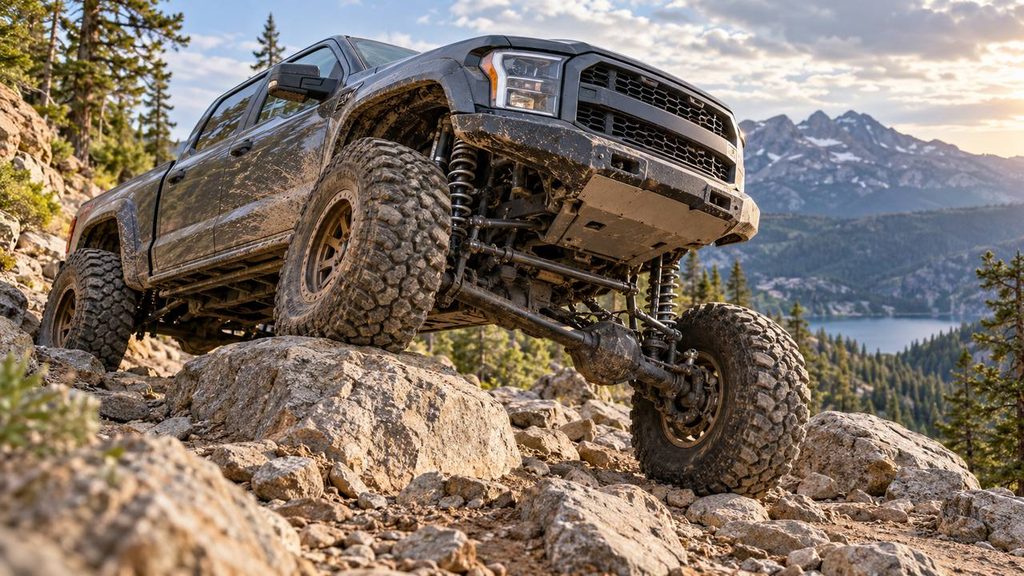
This is where 37s earn their place.
The larger radius provides more clearance beneath low components and improves the tire’s ability to roll over rocks, ledges, roots and deep trail irregularities. The taller casing can also provide more usable deformation when pressures are reduced appropriately for off-road use.
For technical rock crawling or trails where axle clearance repeatedly limits progress, the extra inch of radius can be meaningful. A truck that regularly drags its differential, suspension mounts or underbody on terrain may have a real performance reason to move from 35s to 37s.
For forest roads, mild trails, camping access and general overlanding, however, 35s already provide considerable capability. If you are still deciding whether you need that much tire, our 33 vs 35 tires comparison covers the smaller step in detail. In this type of use, the added fitment complexity of 37s may deliver little practical benefit.
What about sand and mud?
Do not assume a 37 automatically creates a dramatically larger contact patch simply because it has a larger diameter. Tire load, inflation pressure, casing construction and width strongly influence the footprint.
A larger-volume tire can provide useful flotation when appropriately aired down, but a 37×12.50 is not automatically wider than a 35×12.50. In fact, some same-family tires publish virtually identical section widths for those two nominal sizes.
If flotation is your priority, compare actual section width, casing design, allowed wheel widths and safe off-road inflation characteristics rather than using diameter alone.
35 vs 37 Ground Clearance: How Much Do You Really Gain?
Assuming a true two-inch difference in overall diameter, a 37 gives roughly one inch more clearance than a 35 because ground clearance follows tire radius, not full diameter.
That extra radius can raise:
- the wheel hub;
- a solid axle and differential housing;
- the frame and body relative to the ground;
- other components whose height follows the wheel center.
The exact benefit depends on the actual measured diameters. A short 37 compared with a tall 35 may gain slightly less than one inch. A full-size 37 compared with a short 35 may gain slightly more.
This is one reason manufacturer specifications matter more than the number molded into the sidewall.
35 vs 37 Gearing: The 5.4% Difference Most Comparisons Miss
Moving from a true 35-inch tire to a true 37-inch tire makes the effective gearing approximately 5.4% taller.
You can estimate the change with this simple relationship:
New effective ratio = axle ratio × old tire diameter ÷ new tire diameter
Using nominal 35- and 37-inch diameters, the same axle ratios would feel approximately like this after moving to 37s:
| Actual Axle Ratio | Approx. Effective Ratio After 35 → 37 |
|---|---|
| 4.10 | 3.88 |
| 4.56 | 4.31 |
| 4.88 | 4.62 |
| 5.13 | 4.85 |
This table is not a gear-ratio recommendation. It simply shows why 37s reduce the torque multiplication seen at the tire compared with 35s.
Whether you should regear depends on the engine, transmission ratios, factory axle ratio, vehicle weight, altitude, towing load, terrain and the diameter of the tires the truck originally used. There is no universal rule that every vehicle on 35s needs one ratio and every vehicle on 37s needs another.
A diesel heavy-duty truck with a low factory axle ratio and abundant torque may react very differently from a gasoline Jeep or midsize pickup using the same nominal tire diameter.
Speedometer Difference Between 35s and 37s
Tire circumference increases with diameter, so changing tire size without recalibrating the vehicle changes the relationship between wheel speed and road speed.
For a simple nominal example, if a vehicle were perfectly calibrated for true 35-inch tires and then switched to true 37-inch tires without recalibration, actual road speed would be approximately 5.7% higher than indicated. An indicated 60 mph would correspond to roughly 63.4 mph.
Real error depends on actual rolling circumference, not the nominal number on the tire. Modern trucks may also use tire-size information for transmission shifting, stability-control logic and other vehicle systems, so proper recalibration is preferable to simply remembering that the speedometer is wrong.
Do 37s Need More Lift Than 35s?
Usually, but not by a universal amount. A 37 has a larger turning radius and occupies more space as the suspension compresses, so a vehicle that barely clears 35s is unlikely to clear 37s under the same conditions without some combination of additional room, different wheel position, trimming or suspension changes.
We deliberately do not give one generic lift number here because the answer changes dramatically between solid-axle 4x4s, independent-front-suspension trucks, factory high-clearance packages and different wheel offsets. If fitment is the part of the decision you are working on, use our separate guides to lift requirements for 35-inch tires and lift requirements for 37-inch tires.
The key point for this comparison is simpler: 35s are normally easier to package; 37s normally require more clearance planning.
Tire Width, Offset and Backspacing Can Change the Decision
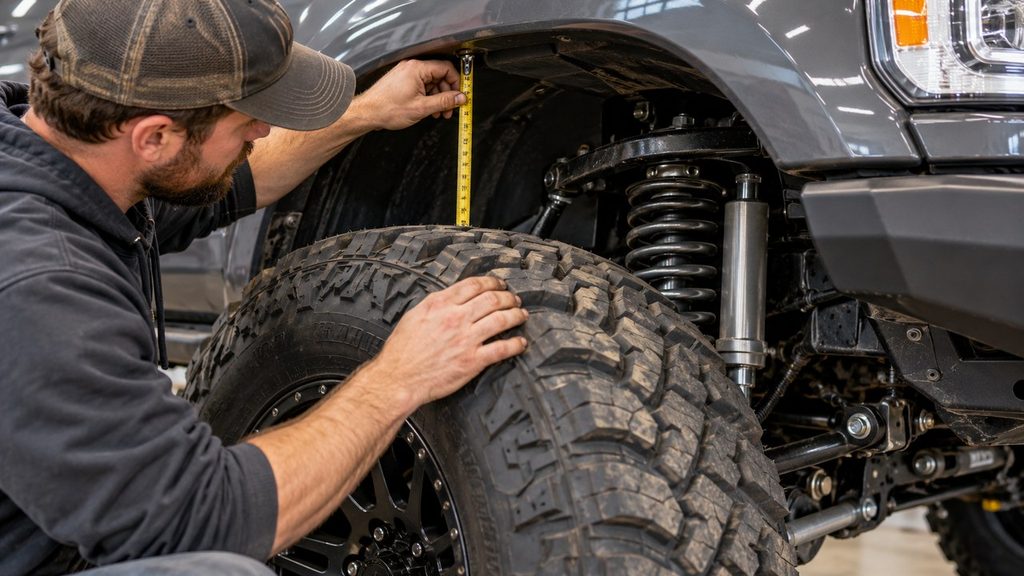
Diameter gets most of the attention, but width and wheel position often decide whether a large tire actually fits.
A 37×12.50 may package more easily than a much wider 37×13.50 on the same vehicle. Likewise, moving a wheel outward can improve clearance from a control arm while simultaneously moving the tire closer to the outer fender or bumper as it turns.
That is why a forum post saying “37s fit on my truck” is not enough information. To reproduce the fitment you would also need to know:
- exact tire model and published dimensions;
- wheel diameter and width;
- wheel offset or backspacing;
- actual suspension height;
- alignment settings;
- trimming or body-clearance modifications;
- clearance at steering lock and suspension compression.
35 vs 37 Ride Quality: Bigger Does Not Automatically Ride Better
It is tempting to assume that a 37 rides softer because it has more sidewall when both tires use the same wheel diameter. In practice, ride quality depends on much more than tire diameter.
A tire’s load range, casing stiffness, tread construction, inflation pressure, wheel weight and the vehicle’s suspension tuning can overwhelm the small difference in nominal diameter.
A correctly inflated 35 with a compliant casing may ride better than an unnecessarily stiff 37. The reverse can also be true.
Compare the exact tire construction and choose pressures appropriate for the vehicle’s actual axle loads rather than assuming 35s are harsh or 37s are soft.
Acceleration, Steering and Braking
Changing from 35s to 37s affects more than gearing. The larger tire places its tread farther from the hub, and most 37-inch off-road tires are also heavier than equivalent 35s.
Acceleration
Taller effective gearing and greater rotational inertia can make the truck feel slower to accelerate. The effect may be mild on a powerful full-size truck and far more obvious on a heavier or lower-powered vehicle.
Steering
Large, heavy wheel-and-tire assemblies place more demand on steering components. Aggressive wheel offset can add further leverage at wheel bearings, ball joints and steering joints. Tire size and wheel geometry therefore need to be considered together.
Braking
The brakes have to remove the rotational energy stored in the wheel-and-tire assemblies in addition to slowing the vehicle itself. Heavier and larger-diameter assemblies can therefore increase braking demand.
That does not mean every truck on 37s automatically needs a big-brake kit. It means braking performance should be evaluated as part of the complete build rather than assuming that physical tire clearance is the only requirement.
35 vs 37 Tires for Towing and Hauling
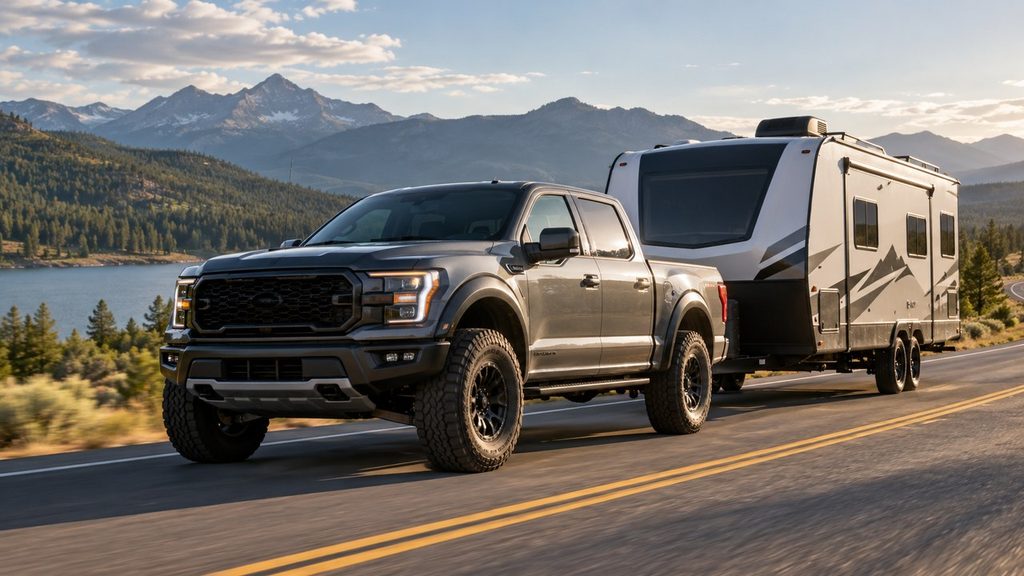
If towing or hauling is a major part of the truck’s job, 35s are usually the easier size to live with.
The 35 reduces the gearing and rotating-mass penalty relative to an equivalent 37, which can help preserve acceleration, grade performance, transmission behavior and braking margin.
However, tire diameter alone does not determine towing suitability. Check the exact tire’s load index, inflation requirements and wheel load rating. A larger tire does not increase the truck’s GVWR, GAWR, payload or tow rating.
If moving to 37s on a truck that regularly tows, pay particular attention to effective gearing, transmission temperatures, brake performance, spare-tire capacity and whether the tire’s load and speed ratings remain appropriate for the job.
35 vs 37 Tires and Fuel Economy
There is no honest universal answer such as “35s lose X MPG and 37s lose Y MPG.” Too many variables change at the same time.
Fuel economy can be affected by:
- tire weight;
- wheel weight;
- tread pattern and rolling resistance;
- tire pressure;
- effective gearing;
- vehicle lift and aerodynamic drag;
- driving speed;
- engine and transmission behavior.
All else being reasonably comparable, the 37 generally has the disadvantage because it tends to be larger and heavier. But a heavy mud-terrain 35 and a lighter all-terrain 37 can narrow or even complicate that comparison.
35 vs 37 Tire Cost: Price the Entire Build, Not Just Four Tires
The purchase price of the tires is only one part of the 35 vs 37 cost difference.
Moving to 37s may also change the budget for:
- wheels with the required dimensions and load rating;
- suspension or lift components;
- trimming or body-clearance work;
- axle gearing;
- steering components;
- braking upgrades where necessary;
- electronic recalibration;
- a full-size spare and spare-tire carrier.
This is why a modest difference in tire price can turn into a much larger difference in total build cost.
Do 37s Put More Stress on Axles and Suspension?
Generally yes, but the amount of additional stress depends heavily on the vehicle and how it is driven.
A larger tire increases leverage between the contact patch and driveline components. Additional rotating mass can also increase loads during acceleration, braking and sudden traction events.
Hard rock crawling on high-traction surfaces is very different from highway driving. A factory axle that lives comfortably with 37s on a street-oriented heavy-duty truck cannot automatically be treated as equivalent to a lighter axle exposed to aggressive throttle and tire bind on rocks.
Components worth inspecting or evaluating include wheel bearings, ball joints, tie rods, steering links, axle shafts, U-joints or CV joints and brakes. If suspension height is also being changed, verify alignment afterward; our guide to alignment after suspension work explains why ride-height changes can alter camber, caster and toe.
Why Vehicle Type Changes the 35 vs 37 Answer
The same tire can be a mild upgrade on one vehicle and a major fabrication project on another.
Full-size and heavy-duty trucks
Larger wheel openings, stronger driveline components and higher torque can make big tires easier to support, particularly on heavy-duty platforms. But IFS geometry, radius arms, crash bars, body mounts and wheel offset can still create fitment restrictions.
A heavy-duty truck also does not get a free pass on braking or gearing simply because its axles are stronger. Towing and payload use make those factors especially important.
Solid-axle 4x4s
Solid-axle platforms can sometimes package large tires with less suspension height than an IFS truck, but fender clearance, steering, bump stops, axle strength and articulation still matter. A setup that clears while driving straight may rub heavily when one wheel stuffs into the fender on a trail.
Half-ton and midsize IFS trucks
Control arms, body mounts, frame clearance and the path the tire follows while steering can make 37s substantially more involved than 35s. Wheel offset becomes particularly important because moving the tire outward solves some inside-clearance problems while creating new outer-clearance problems.
For any platform, manufacturer-specific fitment information should outrank a generic internet recommendation.
If You Already Have 35s, Are 37s Worth the Upgrade?
If your truck already performs well on 35s, do not move to 37s simply because they are the next number.
Ask what problem the larger tire will solve.
- Are you repeatedly hitting the differential or other low components? The extra tire radius may help.
- Do difficult ledges stop the truck because the tires struggle to climb them? A larger rolling radius can help.
- Do your current 35s already clear every trail you drive? The 37 may add more cost and compromise than useful performance.
- Is the truck mostly a daily driver? The benefits of 37s may be difficult to justify.
- Are you already planning gears, stronger steering, suspension work or other supporting upgrades? The jump to 37s may fit naturally into that larger build.
The best reason to install 37s is that your actual use benefits from 37s—not simply that they fit.
Choose 35-Inch Tires If…
- Your truck is a daily driver first and trail vehicle second.
- You want substantial off-road capability without maximizing build complexity.
- You tow or haul regularly.
- You want to preserve acceleration and braking as much as practical.
- You would rather avoid extensive trimming or clearance work.
- Your current terrain does not regularly demand more axle clearance than 35s provide.
Choose 37-Inch Tires If…
- You regularly drive technical trails where one additional inch of axle clearance matters.
- Obstacle rollover is more important than maximizing highway efficiency.
- You are willing to address fitment rather than forcing the tire into insufficient space.
- You are prepared to evaluate gearing, steering and braking rather than treating the tires as a stand-alone modification.
- Your axles and driveline are appropriate for the way you intend to use the larger tires.
- You accept the likelihood of higher tire and total build costs.
Before Buying 35s or 37s: Check These 10 Things
- Actual overall diameter. Do not rely only on the nominal size.
- Actual section width. Width can create clearance problems that lift height cannot solve.
- Tire weight. Compare the exact model and load range.
- Approved wheel-width range. The tire manufacturer specifies what wheel widths are acceptable.
- Wheel offset and backspacing. Confirm both inner suspension and outer body clearance.
- Full steering lock. Check both directions.
- Suspension compression. Parked clearance does not prove trail clearance.
- Effective gearing. Decide whether the new diameter still works with your engine, transmission and axle ratio.
- Brakes and steering. Evaluate the complete wheel-and-tire assembly rather than diameter alone.
- Full-size spare. Make sure you have somewhere safe to carry it.
If the tire change is part of a larger suspension build rather than a tire-only decision, our guide to off-road suspension kits for trucks and 4x4s covers that separate choice.
Frequently Asked Questions
Are 35 or 37 tires better for daily driving?
For most daily-driven trucks, 35-inch tires are the better compromise. They generally require less fitment work, weigh less than comparable 37s and have a smaller effect on effective gearing, acceleration and braking. A properly engineered truck can daily-drive 37s successfully, but the larger size usually requires more compromises.
How much taller are 37-inch tires than 35-inch tires?
Nominally, a 37 is two inches larger in overall diameter than a 35. Actual tire dimensions vary by manufacturer and model, so compare published overall diameter rather than assuming every 35 and 37 differs by exactly two inches.
How much more ground clearance do 37s give than 35s?
If actual diameter increases by exactly two inches, ground clearance at components that rise with the wheel center increases by approximately one inch because radius increases by one inch.
Are 37-inch tires always wider than 35s?
No. Diameter and width are separate dimensions. A 35×12.50 and 37×12.50 are nominally the same width even though the 37 is taller. Actual published section width can still vary between tire models and wheel widths.
Do 37s require regearing if 35s do not?
Not automatically. Moving from a true 35 to a true 37 makes effective gearing about 5.4% taller, but whether that justifies new axle gears depends on the vehicle’s existing ratio, engine, transmission, weight, terrain and use. Some vehicles tolerate the change well; others benefit significantly from deeper gearing.
Do 37s ride better than 35s?
Not necessarily. Tire pressure, load range, casing stiffness, tread construction, wheel weight and suspension tuning all affect ride quality. Diameter alone cannot tell you which tire will ride more comfortably.
Are 37s better off-road than 35s?
On difficult terrain, 37s have a real advantage in ground clearance and obstacle rollover. Whether that makes them better overall depends on the trail. For moderate trails and overlanding, 35s may already provide all the clearance required while preserving better daily drivability.
Are 37s worth it over 35s?
They are worth it when the additional tire radius solves an actual off-road limitation and the vehicle can support the larger tire correctly. If the truck already clears its normal terrain on 35s, upgrading to 37s may add cost, weight and fitment work without providing a meaningful benefit.
Can 35s and 37s use the same wheels?
Sometimes. For example, both tires may be available for a 17-inch wheel, but wheel diameter alone is not enough. The wheel width must fall within the exact tire manufacturer’s approved range, and offset, backspacing, load rating and vehicle clearance must also work with the new tire.
Should You Choose 35s or 37s?
Choose 35-inch tires for the best balance of daily drivability, off-road capability, easier fitment and lower total build complexity. Choose 37-inch tires when maximum trail clearance and obstacle rollover are important enough to justify the extra demands on fitment, gearing, steering, braking and budget.
The jump from 35 to 37 gives roughly one additional inch of tire radius when the real diameters differ by two inches. That one inch can be valuable, but it should solve a problem your truck actually has.
Do not choose between 35s and 37s from appearance alone. Compare the exact tire dimensions and weight, verify wheel and suspension clearance, consider how the diameter changes effective gearing, and decide whether your normal terrain truly benefits from the larger tire.
For most mixed street-and-trail builds, that calculation points to 35s. For a truck built around difficult terrain where clearance is routinely the limiting factor, 37s can be worth every additional modification. If 33s are still part of the decision, our 33 vs 35 vs 37 tires comparison puts all three sizes into the same decision.