Differential Drop Kit: Do You Need One? Fitment & CV Angles
A differential drop kit lowers or repositions the front differential on certain lifted 4WD trucks and SUVs to reduce the operating angle of the front CV axles. Do you need one? Not automatically. If your lift-kit instructions require it, or the CV angles and boot condition show a problem that the specified drop can meaningfully improve, it deserves consideration. With a mild lift and healthy, freely articulating axles, buying one simply because a forum calls it mandatory can be unnecessary.
For a Tacoma or 4Runner, the first questions are the model year, drivetrain and type of front differential mount. Many inexpensive kits use roughly 1-inch spacers at the front mounts, but a 1-inch spacer is not proof that the CV axle centerline drops a full inch. Some designs rotate the housing around another mount. That difference, plus skid-plate clearance, matters more than the word “drop” on the package.
This guide covers front differential drop kits for independent-front-suspension (IFS) vehicles—not lowering a solid rear axle, correcting rear driveshaft pinion angle or choosing a full lift kit. It focuses on whether the part is worthwhile, which styles fit, and the checks to make before buying.
Differential Drop Kit: When It Helps—and When It Does Not
A diff drop can be a sensible supporting modification, but only for the geometry it is designed to change. Use the scenarios below to narrow the decision before searching by brand name.
| Your situation | Should you consider a diff drop? | Main check |
|---|---|---|
| Stock-height 4WD with healthy front axles | Usually not needed | No lift-related CV angle to correct |
| Mild front lift, no binding or boot issues | Not automatically | Lift manufacturer guidance and measured axle position |
| Lifted IFS with steep CV angles | Possibly useful | Approved kit, actual axle-centerline movement and full droop |
| Lift package specifies diff relocation | Use the specified components | Exact part number and relationship to crossmembers |
| Torn boots or CV clicking already present | Diagnosis first | Condition of joints, boots, clamps and mounts |
| 2WD truck without a front drive differential | No | A front diff drop has nothing to reposition |
| Custom long-travel 4WD system | Only as engineered for that system | CV length, plunge, articulation and packaging |
A differential drop is not a lift, not a stronger CV axle and not a guaranteed cure for front-end vibration. Treat it as one tool for managing an altered driveline angle. If the suspension itself has not been selected yet, our leveling kit vs. lift kit comparison explains which front-end components change with the different approaches.
What a Front Differential Drop Actually Changes
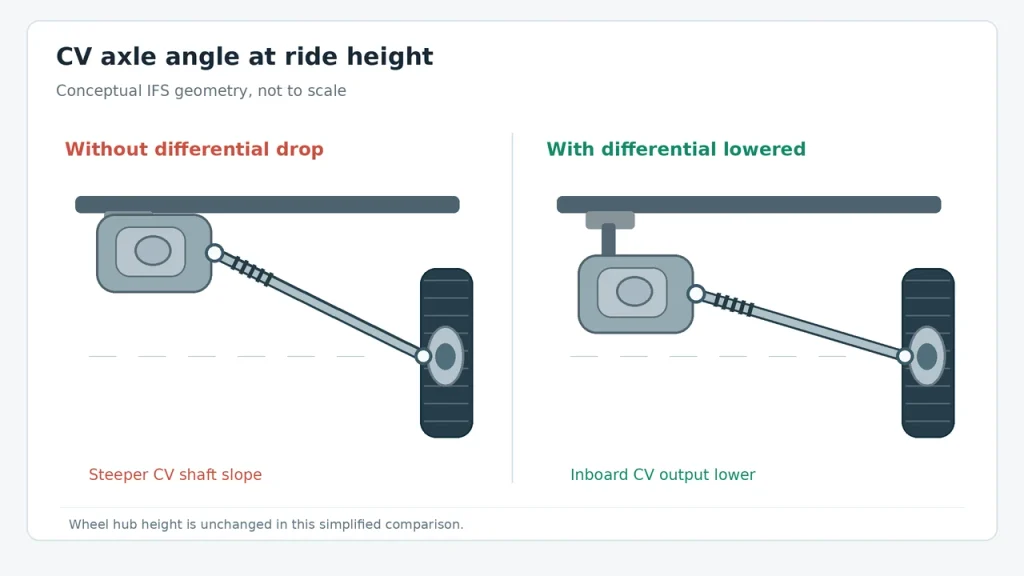
The front differential sits in the chassis while the left and right front hubs move with the suspension. When a conventional IFS truck is raised using its springs or coilovers, the hubs typically rest farther below the differential outputs. The CV shafts then operate at a steeper angle at normal ride height.
CV Joint Angle and Boot Stress After a Lift
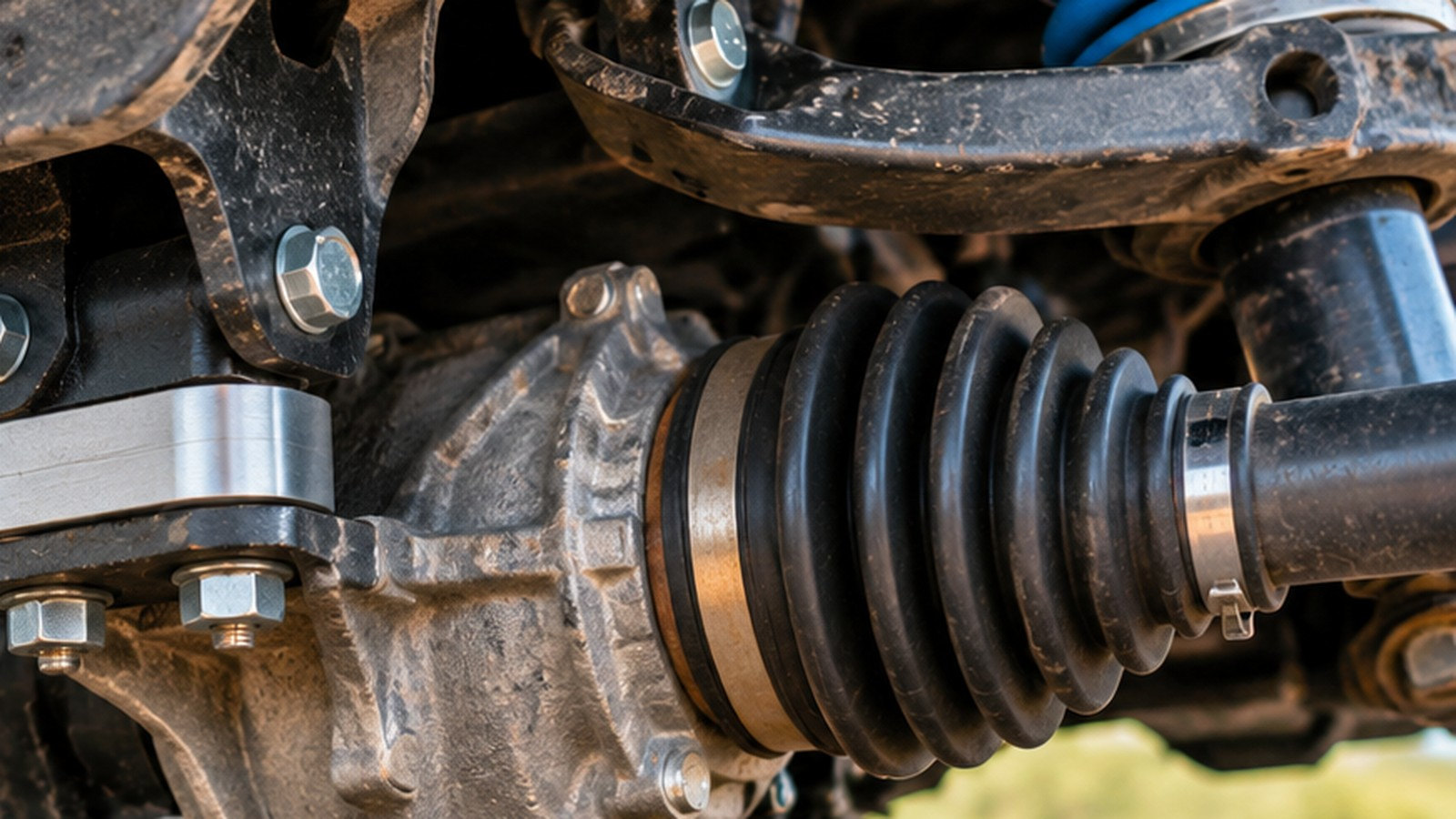
A CV axle needs enough articulation for steering and suspension movement, as well as the correct ability to slide in and out—often called plunge—as geometry changes. More static operating angle can increase movement and distortion in the rubber boots and change loads inside the joints. Lowering the differential can reduce part of that angle by moving the inboard joint closer to the height of the wheel-side joint.
That does not guarantee a fixed increase in CV lifespan. Boot material, age, joint condition, axle design, wheel travel, temperature and maintenance still matter. If a boot was already torn and contaminated, changing the angle does not put the grease back or repair the joint.
Why “1-Inch Diff Drop” Can Be a Misleading Description
There are two different measurements: the thickness of a spacer placed at a mounting point and the vertical change at the differential output shaft. In some popular Toyota-style spacer installations, the front mounts move while another mount restrains the housing. The differential tilts, and its axle centerline may move less than the spacer thickness suggests.
A manufacturer offering a redesigned relocation system, Marlin Crawler, specifically distinguishes spacer thickness from true axle-centerline drop. Its figures relate to its Toyota/Lexus mounting geometry, so do not copy them to every truck. The useful question for any seller is: How far do the inner CV joints actually move, and does the entire housing translate or mostly rotate?
Ride Height, Full Droop and Pinion Position Are Separate Checks
A slightly flatter shaft while parked does not prove safe travel. At full droop the outer joint may still exceed its permitted angle, and at full compression the axle must retain enough plunge and clearance. Some layouts also change the differential input-flange position or angle, potentially affecting the front driveshaft and its nearby clearances.
A drop also does not lengthen the CV shaft or correct a steering or control-arm problem. On a widened 4WD long-travel build, axle length and joint range can be more important than a small differential spacer. Our long-travel suspension guide covers those wider-system demands separately.
Do You Need a Diff Drop With a 2-Inch or 3-Inch Lift?
There is no universal lift-height cutoff. A 2-inch lift on one vehicle may leave the axles in a reasonable working range, while a differently designed or worn suspension can become marginal at a similar advertised height. Actual front ride-height gain matters more than the box saying “2-inch” or “3-inch.”
Around 1–2 Inches: Often Optional, Not Automatically Pointless
For a mild front lift, begin with the lift maker’s directions and an inspection of the axle slopes, boots and available suspension movement. A diff drop may add little measurable benefit on some setups. On others, the manufacturer of a particular suspension package may call for a matching drop part even at a modest height; that takes priority over a general rule found online.
Some owners install a spacer proactively because it is inexpensive. Others prefer to preserve skid-plate clearance and avoid changing healthy factory mounts. Both choices have trade-offs, and neither can be judged correctly without knowing the platform.
Around 2–3 Inches: The Most Common Shopping Scenario
This is where Toyota Tacoma and 4Runner owners often encounter diff-drop recommendations. After raising the front on an IFS 4WD vehicle, a kit can reduce the static CV angle, but the amount depends on the suspension and drop design. Some manufacturers recommend it above a particular front lift; other suspension specialists say a properly set-up mid-travel system may not require it.
Look beyond a photograph of the lifted truck. Ask how the system behaves at normal loading, full steering lock and the intended droop limit. A correctly engineered suspension should have enough safe joint movement even after the vehicle is fully articulated.
Larger Lifts: A Small Spacer May Not Solve the Geometry
At greater lift heights, the solution may involve relocated crossmembers, steering knuckles, dedicated differential brackets and other designed components. Simply stacking taller differential spacers is not a sound substitute for a lift architecture intended to keep the suspension and drivetrain in a suitable operating range.
A tall crossmember-drop lift may already include differential relocation, making a generic add-on unnecessary or incompatible. Always compare the exact installed lift parts with the differential-drop instructions before buying another set of spacers.
Tacoma Differential Drop Kit: Check the Generation First
“Fits Tacoma” covers too many different front-end designs to be useful. A manufacturer may list one inexpensive spacer kit for 2005–2023 trucks and a completely different bracket assembly for the redesigned 2024-and-newer generation. The drivetrain also matters: many listings specify 4WD and exclude particular 2WD or five-lug versions.
1995–2004 Tacoma: First-Generation Hardware
Older Tacoma applications frequently have their own spacer hardware and mounting arrangement. Trail-Gear, for example, separately catalogs a kit for 1995–2004 Tacoma 4WD and certain older 4Runner and Tundra applications. That is not permission to transfer it to a 2018 Tacoma simply because both vehicles have front CV shafts.
When researching an older truck, verify the front differential mounting points, previous repairs, skid-plate setup and exact drivetrain. After decades of use, a rusty bracket or non-original bushing can change the practical installation situation.
2005–2023 Tacoma: Common Spacer-Kit Applications
This is a popular fitment range in brands such as Ironman 4×4 and Dirt King. Many listings describe machined spacers with longer mounting bolts and additional hardware for the factory skid plate. Specific exceptions still appear, including factory special editions, non-standard skid plates and some drivetrain configurations.
The safest shopping method is to match the truck’s year, 4WD system, current lift and skid plate to the supplier’s actual application document. If you have a third-party lift with its own diff-drop brackets, check with that lift manufacturer before combining hardware.
2024-and-Newer Tacoma: Do Not Reuse a 2005–2023 Fitment Claim
Toyota redesigned the Tacoma for 2024. Companies now sell distinct front differential drop parts for the newer truck; Ironman 4×4, for example, has a separate 2024+ Tacoma product rather than extending its older spacer-kit listing. Later-model systems can use different brackets or bushings, and some suspension makers pair a specific drop with their coilover package.
The fact that an online headline says “Tacoma 2005–2025” is not enough when the detailed fitment table or installation sheet ends earlier. Favor the exact part number and current manufacturer instructions over an automatically expanded retailer title.
4Runner, FJ Cruiser and Lexus GX Fitment
Toyota-family platforms share some design themes, but shared badges do not create universal interchangeability. Several suppliers group 2003–2024 4Runner, FJ Cruiser and certain Lexus GX applications with later Tacoma kits. Others divide them by generation, special suspension equipment or skid-plate fitment.
4Runner 1996–2002 vs. 2003–2024
The older 1996–2002 4Runner commonly appears in product groups alongside first-generation Tacoma. Many later kits instead list the 2003–2024 4Runner. These are not interchangeable shopping ranges. Match the generation and inspect whether factory or aftermarket chassis pieces alter the differential mounting area.
The redesigned 2025-and-newer 4Runner also deserves its own fitment verification. Do not assume a part advertised for the 2024 model carries over. Confirm a current application chart, regardless of how similar the replacement looks in the photographs.
FJ Cruiser, GX470 and GX460: Similar Purpose, Different Details
Dirt King publishes a single listed kit for several applications, including 2007–2014 FJ Cruiser, 2003–2009 GX470 and 2010–2023 GX460, as well as specified 4Runner and Tacoma years. That is evidence of the applications for that kit, not a general rule that every differential spacer will fit all those vehicles.
Check front drivetrain type and any factory or aftermarket armor. The differential may be physically similar while the skid, mounting bolt length, exhaust clearance or existing suspension package changes the actual installation.
What About a Differential Drop Kit for Silverado or Sierra?
GM trucks also generate searches for diff-drop spacers, but Toyota fitment advice should not be imported into the Silverado catalog. A Silverado 1500, an HD truck and a different model generation may have distinct differential mounts, front suspension parts and included hardware.
Check 1500 vs. 2500HD/3500HD and the Actual Differential
Some aftermarket manufacturers list a 2014–2018 Silverado/Sierra 1500 4WD six-lug spacer kit, while offering a separate part for certain eight-lug HD models. Another listing may span a wider year range but exclude specific later differential families or trims. Treat a broad “2007–2021 Silverado” headline as a starting point only.
Verify the front differential housing, mounting configuration, chassis year, existing lift and whether the vehicle is actually four-wheel drive. Six-lug or eight-lug wheel count is not a complete fitment test by itself.
A Full Crossmember-Drop Lift May Already Relocate the Differential
Some large GM IFS lifts include structural crossmembers and their own differential drop brackets. Adding a separate generic spacer package to that installation could double up a correction or create interference. Before ordering, identify the kit already on the truck and check which differential brackets the lift was engineered to use.
This is also where an attractive inexpensive add-on stops being the same job as a complete suspension conversion. The latter can involve structural changes, steering geometry and substantial labor, not merely two longer bolts.
Spacer Kits vs. Full Differential Relocation Systems
The term diff drop kit describes several different products. The budget version is usually a simple spacer arrangement that changes the housing’s installed position. More involved packages use replacement brackets or engineered differential mounts, sometimes allowing a more controlled change at the axle output centerline.
Basic Spacers: Cheap and Simple, With Limited Correction
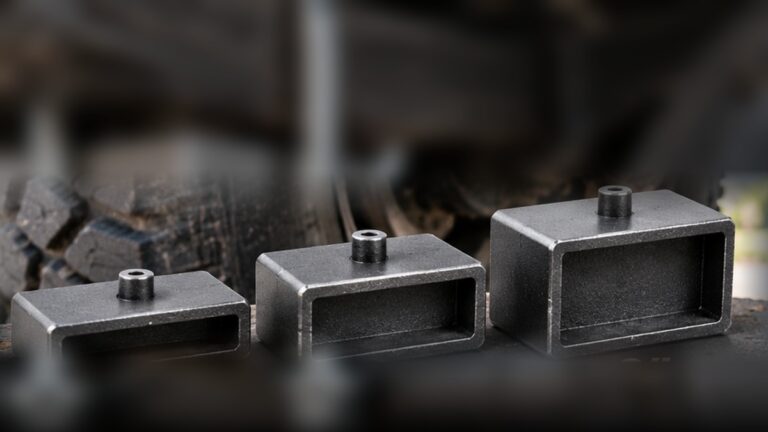
For an application where the manufacturer approves them, machined spacers and correct fasteners can be a practical solution. Their limitations are the housing’s existing pivot points, mount geometry and available clearance. Spacers can also require the skid plate to move and may change loads at the remaining factory mount.
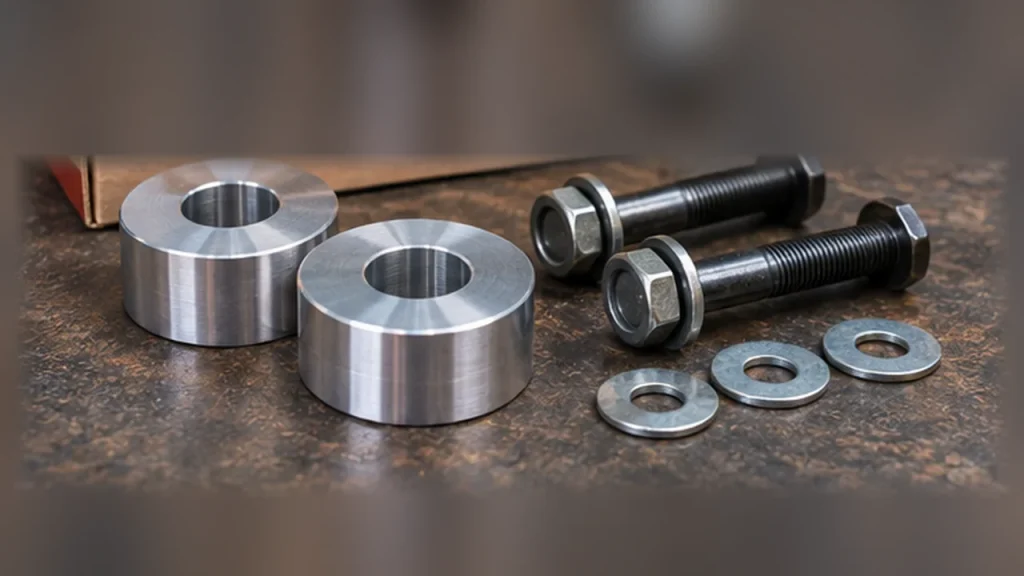
Do not interpret a forged, billet or aircraft-grade material claim as proof that the CV shafts are now nearly level. Materials describe the components; suspension geometry describes the actual benefit. If the seller cannot explain the resulting housing position, look for clearer documentation.
Redesigned Brackets: Check the Whole System, Not Just Drop Distance
Replacement-mount systems may aim to lower the actual axle-output centerline while maintaining more appropriate support and alignment at the housing. They can be far more involved than basic spacers, with dedicated bushings, mount brackets or matched skid plates. An engineered replacement is not automatically appropriate for a stock truck or a different lift design.
Marlin Crawler’s heavy-duty IFS system is an example of why these products should be compared by measured axle position rather than the nominal spacer height. It also has specific steering-hardware and skid-plate conditions. Those restrictions can matter just as much as its advertised geometry improvement.
Skid Plates and Ground Clearance: The Hidden Trade-Off
Lowering part of a 4WD drivetrain can move its lowest exposed surfaces closer to rocks and trail obstacles. On an everyday road truck this may barely matter. For a vehicle that regularly drags its skid plate over ledges, the loss of belly clearance can outweigh a modest reduction in CV angle.
Factory Skid Plate vs. TRD or Aftermarket Armor
Many budget kits provide small skid-plate spacers and longer fasteners, but not all plates share the same mounting geometry. Ironman’s older Tacoma and 4Runner spacer listings, for example, warn about TRD skid-plate incompatibility. Other companies specifically provide clearance solutions for certain factory plates. “Includes skid spacers” is not a promise that your aftermarket armor will fit.
Before ordering, identify the plate brand, its thickness, how it attaches and its clearance to the front differential. If the kit instructions require cutting or removing a protection plate, that is part of the buying decision—not a surprise to discover with the truck on jack stands.
Protecting the Differential Without Losing the Whole Belly
An aftermarket low-profile skid system might distribute loads differently or integrate with a purpose-built differential relocation setup. That can solve a packaging problem that a generic spacer cannot. Conversely, simply taking off the skid plate to make room for the lower differential is not a satisfactory long-term plan for a regularly driven off-road truck.
Look for the installed clearance at the differential, crossmember and skid, not only the vertical position of one mounting bolt. The lowest obstacle-contact point is what counts on the trail.
What to Check Before Buying a Front Differential Drop Kit
A good supplier should make it possible to check the kit against your actual truck before you remove anything. Save a photo of the product label and instructions, especially for a vehicle that already has non-original suspension or armor.
- Exact application: year, model, generation, 4WD/AWD system, differential type and excluded trims.
- Lift compatibility: suspension brand, actual front ride-height increase and any existing drop brackets.
- Real geometry: specified spacer thickness versus measured movement at the axle-output centerline.
- Kit contents: mounts or spacers, correct bolts, washers, nuts, bushings and skid-plate provisions.
- Clearances: front driveshaft, steering rack, crossmembers, exhaust, belly armor and full suspension travel.
- Manufacturer documents: torque sequence, mounting orientation, reuse restrictions and installation limitations.
- Vehicle condition: sound differential brackets, undamaged bushings, intact CV boots and no existing cracks.
If the product page offers only a picture of two aluminum pucks and a generic “fits all 4×4” claim, there is not enough information for a careful fitment decision. Ask for the exact part number and current install sheet before paying.
Hardware Length, Grade and Mounting Design Matter
Longer fasteners must engage properly without bottoming, binding or leaving too little thread. Strength rating, washer placement and bushing sleeves should follow the supplied documentation. Do not substitute a random hardware-store bolt merely because it has the same approximate diameter. Differential mounts transmit changing drivetrain and road loads into the chassis.
Any instructions that call for new locking nuts or single-use fasteners should be followed. If an existing mount is cracked or a captive thread is damaged, repair the underlying problem first; a spacer is not a structural reinforcement.
Check With the Lift-Kit Manufacturer Before Mixing Brands
It is easy to end up with three companies involved: the suspension lift maker, the differential-drop supplier and the skid-plate manufacturer. Each may assume a factory mounting arrangement that the other two changed. When their instructions conflict, do not invent a hybrid installation. Ask the relevant manufacturers or an experienced 4WD specialist to confirm an approved combination.
Installation: A Bolt-On Part Still Supports a Heavy Drivetrain
Most simple kits are sold as bolt-on modifications, but the differential must be supported while its mounting hardware is disturbed. Access often involves removing the front protection plate and working around tight chassis spaces. The relevant factory service information and the kit instructions control the procedure, not a universal torque number from another model year.
Supporting the Housing and Keeping the Mounts Aligned
Use vehicle-approved lifting and support points, then support the differential itself with suitable equipment before loosening structural mounts. There may be little room to reposition the housing, and the front propeller shaft or rear differential support can limit movement. Never use bolts to pull a misaligned housing into place or let the assembly hang from a remaining mount in a way the procedure does not allow.
A correct installation seats the specified spacers or brackets evenly and keeps all fasteners in their intended load paths. A mount that requires stacked washers, forced holes or an improvised spacer is a warning that the kit or the existing vehicle configuration is not right.
Clearance and Drivetrain Checks After Installation
Once the hardware is installed and torqued to the applicable instructions, verify clearance to the front driveshaft, steering linkage, rack, exhaust, crossmember and skid plate. Check that the CV boots do not rub at the vehicle’s intended steering and suspension limits, and inspect for leaks or mount movement after the initial drive according to the kit’s follow-up schedule.
Do not assume the differential’s new static position means its joints can safely articulate to any angle. If a modified truck needs a full travel check, that should be carried out by someone familiar with the system and its droop-limiting components.
Does a Differential Drop Require an Alignment?
Moving only the differential housing normally does not set toe, camber or caster because it does not locate the wheel. But the lift that created the CV angle generally deserves an alignment check, and installation methods that disturb control arms or crossmembers may change wheel geometry. Our alignment after suspension work guide explains the difference.
If you are budgeting a complete lift rather than just a small differential-drop accessory, our lift kit installation cost guide covers labor, alignment and supporting geometry-correction expenses. A front diff drop is only one possible line in that larger parts list.
Will a Differential Drop Fix CV Boot Tears, Binding or Vibration?
These symptoms are common reasons to start searching for a diff-drop kit. They are also the easiest way to buy the wrong part: the same noise or failed boot can have several unrelated causes.
Repeatedly Torn Inner CV Boots
A steep static axle angle can place a boot in a more distorted position and may contribute to accelerated wear. However, an old boot can also crack from age, heat or debris, and a replacement axle may have a boot with a different shape. Inspect where the tear occurs, whether the folds contact each other and whether the joint itself has been contaminated.
A compatible drop may reduce one source of stress if the lift has placed the axle at an unfavorable angle. It will not rescue a split boot or replace the need to clean and service a damaged joint.
Clicking, Clunking or Binding at Steering and Droop
A click while turning can come from a worn CV joint, but that diagnosis must be confirmed rather than assumed. Severe joint angle or inadequate plunge at full droop can be another concern on modified trucks. Neither is automatically solved by a small mount spacer, especially if the axle is already the wrong length or another suspension component restricts movement.
Stop using a setup that binds or contacts itself and have its full range inspected. A diff drop should be selected after the cause is known, not used as a test to see whether a concerning noise disappears.
Front-End Vibration and Driveline Noise
A vibration that began after a lift may involve tires, wheel balance, alignment, a worn CV axle, mounting bushings, propeller-shaft geometry or another drivetrain issue. Lowering the front differential changes one set of angles; it cannot reliably diagnose all those possibilities. On some Toyota-family trucks, owners also investigate model-specific differential support or bearing issues—but that is a separate diagnosis.
If a retailer promises that its spacer kit will “eliminate all vibrations,” treat that as marketing. Confirm the source of the vibration before changing more hardware. There is no single drop dimension that fixes every lifted truck.
Differential Drop Kit Questions Buyers Ask
Before ordering, these are the distinctions worth settling when product descriptions use “diff drop,” “front differential spacer” and “differential relocation” as though they all mean the same thing.
Is a differential drop kit necessary for a 3-inch lift?
Not on every vehicle. Some manufacturers recommend or specify one around that front lift height, while others approve their properly designed suspension without an added drop. Check the exact platform, actual ride-height gain, CV operating range and lift instructions instead of applying a universal rule.
Does a diff drop kit lift or lower the truck?
It generally changes the position of the front differential, not the truck’s spring-supported ride height. It should not be purchased to gain tire-to-fender clearance or correct the stance of a truck. The lowest drivetrain or skid-plate point may move downward.
Does a 1-inch differential spacer lower the CV axle by 1 inch?
Not necessarily. In a mounting system that pivots around another attachment, a 1-inch spacer at the front mount can mostly tilt the differential. Ask for the actual axle-output centerline change rather than inferring it from spacer thickness.
Will a front diff drop increase CV axle life?
It may reduce operating angles in a lifted IFS vehicle, which can help reduce some wear factors. It is not a guaranteed lifespan increase, and it does not replace an already damaged boot or joint. Correct axle length, clearance, articulation and maintenance still apply.
Can I use a 2005–2023 Tacoma diff drop kit on a 2024 Tacoma?
Do not assume so. The 2024 Tacoma is a new generation, and manufacturers sell distinct application-specific differential drop designs for it. Buy only when the exact part number lists your model year and drivetrain.
Will a differential drop fit with a TRD skid plate?
That depends on the specific plate and kit. Several older Toyota-style spacer kits exclude certain TRD plates, even when they include spacers for the ordinary factory skid. Verify the skid-plate model and installation drawings before buying.
Is a diff drop the same as a transfer-case drop?
No. A front differential drop changes the front final-drive housing’s position on certain IFS 4WD or AWD vehicles. A transfer-case or carrier-bearing drop changes a different part of the driveline, often for different joint-angle reasons. The parts and geometry are not interchangeable.
Does a front differential drop affect wheel alignment?
Repositioning only the differential ordinarily does not directly change alignment settings. However, a suspension lift typically does, and some larger kits require work on wheel-locating components. Check alignment requirements for the entire job rather than the diff-drop accessory alone.
Can I install a universal front differential drop kit?
A kit may fit several vehicles, but that is not the same as being universal. You still need approved mounting points, proper hardware, differential and drivetrain clearance, and skid-plate fitment. Without those, the safest choice is an application-specific kit or a qualified shop.
The practical buying rule is simple: match the front differential drop to the actual truck and lift, then verify what moves and what loses clearance. A correctly chosen kit can help with one aspect of CV geometry. A spacer with an impressive name but unverified fitment is not a shortcut to a properly engineered front suspension.