Bilstein 4600 vs 5100: Which Shocks Are Better?
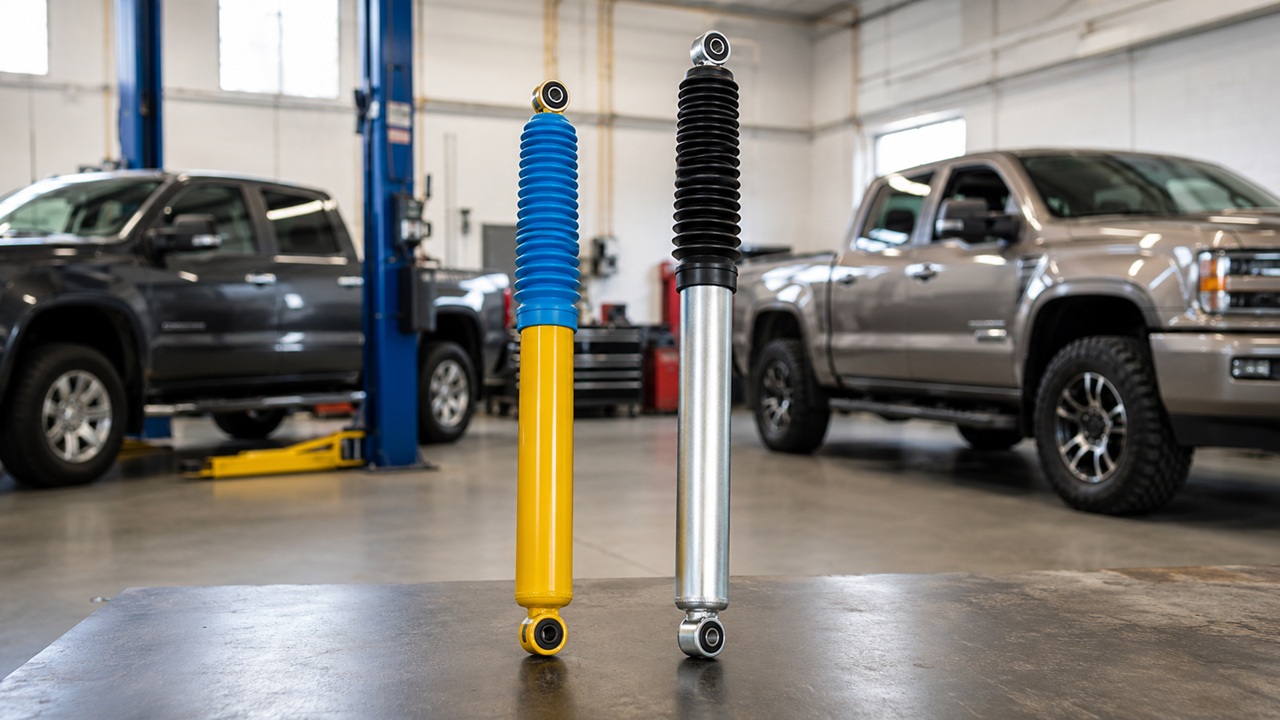
Choose the BILSTEIN B6 4600 if your truck or SUV remains at factory ride height. Choose the BILSTEIN B8 5100 if the vehicle is lifted, or if a vehicle-specific 5100 Ride Height Adjustable application is available and you want to level the front. The 5100 is not automatically the better shock. Correct fitment and ride height matter more than series number.
Both families use BILSTEIN monotube gas-pressure technology and digressive valving, but their dimensions and vehicle-specific tuning serve different applications. BILSTEIN itself recommends the 4600 for stock-height vehicles and the 5100 for lifted applications.
The Quick Decision
- Stock ride height: B6 4600.
- Existing suspension lift: B8 5100 in the correct lift range.
- Want to level an eligible truck or SUV: B8 5100 Ride Height Adjustable front application.
- Heavy towing at stock height: Usually B6 4600, unless the vehicle requires a different application.
- Frequent, fast off-road use: Consider a reservoir shock such as the B8 5160 rather than choosing between these two solely by price.
BILSTEIN 4600 vs 5100 at a Glance
| Feature | B6 4600 | B8 5100 |
|---|---|---|
| Primary application | Stock ride-height trucks and SUVs | Lifted applications; selected front applications can also level the vehicle |
| Construction | 46 mm monotube, high gas pressure | 46 mm monotube, high gas pressure |
| Valving | Digressive and vehicle-specific | Digressive and vehicle-specific |
| Typical finish | Yellow painted body with blue boot | Zinc-plated body with black boot |
| Best ride-height match | Factory height | Application-specific lift or level |
| Can the shock lift the vehicle? | No | Only a compatible 5100 Ride Height Adjustable front unit can change height through its spring-perch positions |
| Towing | Strong choice at stock height | Strong choice on a correctly lifted vehicle |
| Price | Often lower, depending on fitment | Often modestly higher, depending on fitment |
The table is a selection guide, not a substitute for checking the exact part number. Year, model, drivetrain, axle, suspension package, and measured lift height can all change which shock fits.
What Is the BILSTEIN B6 4600?
The BILSTEIN B6 4600 is a direct-fit performance replacement for trucks and SUVs that retain their factory suspension height. It is designed to work with the original spring arrangement while providing more controlled damping than a typical worn original-equipment shock.
Its 46 mm monotube design separates the oil and pressurized gas with a floating piston. This helps the shock maintain consistent damping as temperatures and driving conditions change. BILSTEIN also uses digressive valving, which provides strong low-speed body control while allowing the suspension to respond when wheel movement becomes faster over rough surfaces.
The 4600 is a sensible choice for daily driving, highway use, towing, gravel roads, and occasional light off-road travel when the vehicle is not lifted. It does not raise the truck, increase spring capacity, or correct worn suspension components.
What Is the BILSTEIN B8 5100?
The BILSTEIN B8 5100 is a vehicle-specific monotube shock family intended primarily for lifted trucks and SUVs. BILSTEIN offers different part numbers for different lift ranges, so the correct 5100 is selected according to the vehicle and its suspension height.
Like the 4600, the 5100 uses a 46 mm monotube design and digressive valving. However, that does not mean every 4600 and 5100 has identical internals or ride characteristics. Shock length, travel, mounting, and valving are matched to the listed application.
The zinc-plated body gives the 5100 its familiar silver appearance and helps resist harsh elements. Its main practical advantage is not color or status; it is availability for modified ride heights.
Standard 5100 vs 5100 Ride Height Adjustable
This distinction prevents one of the most common buying mistakes. A standard rear or conventional B8 5100 shock does not hold up the vehicle and does not create lift. It only controls suspension movement within its designed travel range.
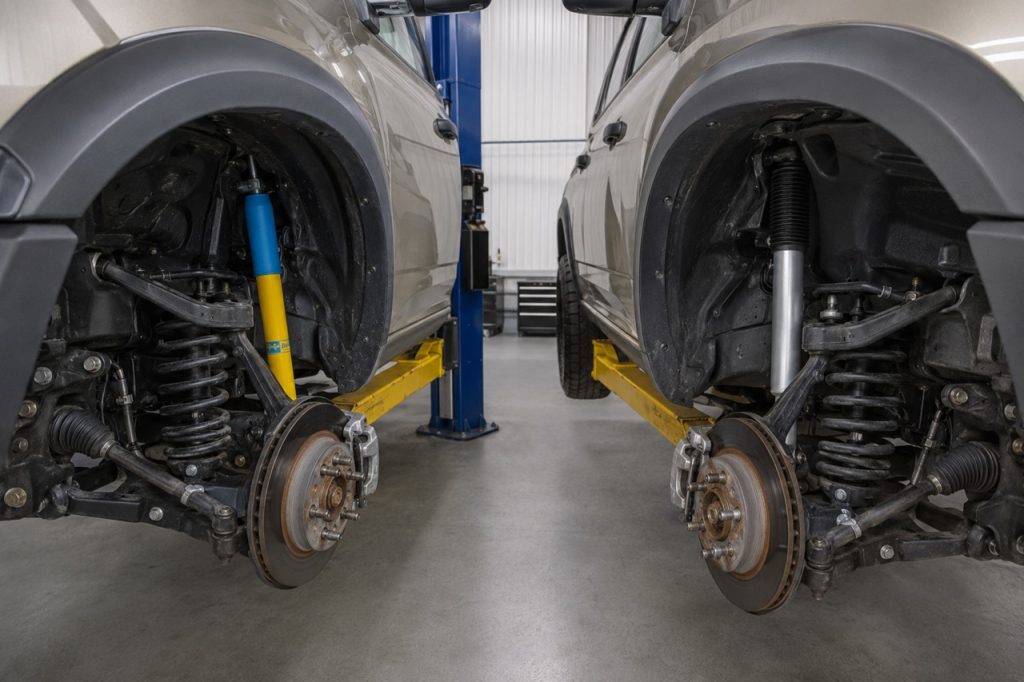
A B8 5100 Ride Height Adjustable front unit is different. On compatible OE coilover-style applications, snap-ring grooves reposition the spring seat and preload the original coil spring to provide an application-specific amount of front lift. BILSTEIN lists a range of up to approximately 2.75 inches on some applications, but the available settings vary by vehicle and part number.
Key Differences Between the 4600 and 5100
1. Stock Height vs Lifted Height
Ride height is the deciding factor. BILSTEIN states in its official 4600-versus-5100 guidance that the B6 4600 is for factory height, while the B8 5100 is longer and tuned for lifted applications. If an eligible vehicle needs front leveling, the Ride Height Adjustable 5100 is the relevant version.
A shock that is too short may limit droop travel or reach full extension prematurely. One that is too long can bottom internally before the suspension reaches its bump stop. Either situation can reduce control and damage components, which is why choosing by appearance alone is unsafe.
2. Ride Quality
There is no universal rule that the 5100 always rides firmer or that the 4600 is always softer. Ride quality depends on the exact part number, spring rate, spring preload, tire construction and pressure, vehicle load, and road surface.
For a stock-height truck, BILSTEIN recommends the 4600 and says it will ride better than a Ride Height Adjustable 5100 installed at its lowest position. The adjustable 5100 is tuned around the added spring preload used for leveling. On a lifted truck, the correct 5100 can provide the travel and tuning the modified suspension requires.
3. Towing and Hauling
Both series can improve control over worn shocks, but neither one increases the truck’s payload, axle rating, gross vehicle weight rating, or spring capacity. A shock controls movement; it does not carry the load in the same way a spring or air helper system does.
For a stock-height tow vehicle, the B6 4600 is normally the appropriate choice. For a lifted tow vehicle, use the 5100 that matches the lift range. If the rear sags under tongue weight, address load distribution, spring condition, and an appropriate load-support solution rather than expecting a different shock alone to level the truck.
4. Off-Road Use and Heat Management
The 4600 can handle gravel roads and occasional off-road use at factory height. The 5100 is the more relevant option when suspension lift and additional application-specific travel are required. Both use monotube construction intended to provide consistent damping.
For repeated fast travel over rough terrain, a remote-reservoir shock may be a more meaningful upgrade. BILSTEIN positions the B8 5160 for harder, faster off-road cycling because its reservoir adds oil capacity and helps manage heat. That does not make a reservoir necessary for ordinary commuting, towing, or slow trail use.
5. Finish and Appearance
The 4600 is recognized by its yellow body and blue boot, while the 5100 normally uses a zinc-plated silver body and black boot. The 5100’s zinc plating is designed to resist exposure to harsh conditions, but finish should remain secondary to correct fitment.
6. Cost
Prices vary significantly by vehicle, axle, seller, and whether the listing includes one shock, a pair, or a complete set. The 5100 often costs somewhat more, especially for Ride Height Adjustable front applications, but compare exact part numbers rather than generic series prices.
BILSTEIN 4600 vs 5100 Ride Quality
If comfort is your main concern, match the shock to the current suspension rather than assuming the more expensive series will ride better. A stock-height daily driver is usually best served by the B6 4600. It is tuned for the factory geometry and does not add front spring preload.
A leveled truck can feel firmer after installing a Ride Height Adjustable 5100 at a higher perch because raising the spring seat adds preload and changes available droop. Tire pressure and heavier all-terrain tires can affect perceived harshness as much as the shocks, so evaluate the whole setup.
On a truck already lifted with springs or another complete system, a correctly sized 5100 can feel more composed than a stock-length shock because it operates in the travel range for which it was designed.
BILSTEIN 4600 vs 5100 for Towing
Choose the B6 4600 for a stock-height tow rig and the B8 5100 for a lifted tow rig. Do not choose the 5100 simply because the trailer is heavy. BILSTEIN notes that neither series is inherently more durable or better at hauling heavier loads than the other.
- Keep tire pressures appropriate for the load and within the vehicle and tire specifications.
- Confirm tongue weight and axle loads rather than judging only by visible squat.
- Inspect springs, bump stops, bushings, and mounting hardware before blaming the shocks.
- Use a weight-distribution hitch or load-support equipment only when suitable for the vehicle and trailer.
Which One Is Better for a Stock-Height Truck?
The B6 4600 is the better match for a truck or SUV that remains at factory ride height. Installing a height-adjustable 5100 at its lowest perch does not turn it into a 4600. BILSTEIN explains that the adjustable shock is tuned for a preloaded coil spring and recommends the 4600 when no level is wanted.
There can be vehicle-specific exceptions or catalog changes, so always enter the full vehicle details in the current BILSTEIN catalog. Do not order based solely on a forum post for a similar trim.
Vehicle-Specific Fitment Notes
The same selection principle applies across popular trucks and SUVs, but the available parts and adjustment ranges are not identical.
- Toyota Tacoma and 4Runner: Some front 5100 applications use an adjustable spring seat for leveling. The matching rear 5100 shocks control movement but do not raise the rear by themselves.
- Toyota Tundra: Confirm the generation, drivetrain, suspension package, and desired front setting. Do not assume Tacoma perch positions or lift amounts apply.
- Chevrolet Silverado and GMC Sierra HD/Duramax: Select for the actual front and rear suspension height. Torsion-bar adjustments or lift components can change the required shock range.
- Ram 1500: Verify whether the truck has conventional coils or factory air suspension. A conventional-suspension 4600 or 5100 listing should not be assumed to fit a factory air-suspension model.
- Ford Super Duty: Account for model year, 4WD or 2WD, factory packages, and measured lift. For model-specific choices, see our F-250 front-shock guide and broader F-350 suspension upgrade guide.
4600 vs 5100 vs 5160 vs 6112
| Series | Best suited to | Main distinction |
|---|---|---|
| B6 4600 | Stock-height trucks and SUVs | Factory-height performance replacement |
| B8 5100 | Lifted applications and selected leveling applications | Lift-specific lengths; some front units have adjustable spring perches |
| B8 5160 | More demanding off-road use | Remote reservoir for greater oil capacity and heat management |
| B8 6112 | Drivers wanting a more substantial front suspension upgrade | Large 60 mm front coilover kit with application-specific springs and adjustable spring seat |
A 6112 front kit is not simply a premium 5100. It uses a larger shock body and includes matched front springs on supported applications. A common combination is a 6112 kit in front with compatible 5100 or 5160 shocks at the rear, but fitment must be checked as a complete system.
What to Check Before Buying
- Confirm the exact vehicle: Enter the year, make, model, drivetrain, trim, and suspension package.
- Measure the suspension lift: Tire diameter does not equal suspension lift. Identify the springs, spacers, torsion adjustment, or lift kit already installed.
- Read the listed lift range: A 5100 designed for one lift range may be wrong for another, even if the mounting eyes look similar.
- Check front and rear separately: The two axles may use different series, lengths, or adjustment methods.
- Confirm the quantity: Some listings show one shock; others include a pair or a four-shock set.
- Inspect related parts: Replace damaged mounts, bushings, bump stops, or springs instead of expecting new shocks to mask the problem.
- Verify alignment needs: Changing front ride height alters suspension geometry. Read our guide to alignment after suspension work.
Installation and Alignment
A conventional rear shock replacement is usually more straightforward than installing a front Ride Height Adjustable unit, which may require safely compressing and transferring the coil spring. A spring compressor stores substantial energy, so use the correct equipment and professional help if you are not trained for that work.
Tighten all hardware to the vehicle or shock manufacturer’s specification, with rubber-bushed mounts positioned as instructed. After changing front ride height, arrange a wheel alignment and recheck clearances, brake hoses, ABS wiring, sway-bar links, and fasteners.
Frequently Asked Questions
Are BILSTEIN 5100 shocks better than 4600 shocks?
Not universally. The 4600 is the better fit at factory ride height, while the 5100 is intended for lifted applications or compatible front leveling setups. BILSTEIN states that neither series is inherently more durable or better than the other.
Do BILSTEIN 5100 shocks lift a truck?
Only certain B8 5100 Ride Height Adjustable front applications can raise the front by repositioning the coil-spring seat. Standard 5100 shocks, including typical rear units, do not create lift by themselves.
Can I use BILSTEIN 5100 shocks at stock height?
Use only a part number whose catalog fitment explicitly permits the vehicle’s current height. If the truck is staying at factory height and a B6 4600 is offered, BILSTEIN recommends the 4600 rather than a Ride Height Adjustable 5100 set at its lowest position.
Are the 4600 or 5100 better for towing?
Use the 4600 at stock height and the correct 5100 on a lifted vehicle. Neither shock raises the vehicle’s legal load ratings or replaces the need for adequate springs and proper trailer setup.
Which one provides the smoother ride?
At stock height, the B6 4600 is generally the better ride-quality match. On a lifted vehicle, the correctly sized and tuned 5100 is the appropriate comparison. Tires, pressure, spring rate, preload, and load can change the result.
How long do BILSTEIN 4600 and 5100 shocks last?
There is no reliable universal mileage because road conditions, corrosion, temperature, vehicle weight, installation, and off-road use vary. Inspect them for oil leakage, damaged shafts or mounts, loss of damping, excessive bouncing, and changes in handling rather than replacing them solely at an arbitrary mileage.
Which BILSTEIN Shock Should You Buy?
Buy the B6 4600 when the vehicle retains factory ride height and you want a controlled direct-fit upgrade for commuting, towing, and occasional rough-road use. Buy the B8 5100 when the truck or SUV is already lifted within the shock’s listed range, or when a compatible Ride Height Adjustable front application matches your leveling goal.
The best choice is the shock engineered for your exact vehicle and suspension geometry. Verify the current BILSTEIN catalog listing before ordering, especially if the vehicle has a factory off-road package, aftermarket springs, spacers, torsion-bar adjustment, or air suspension.