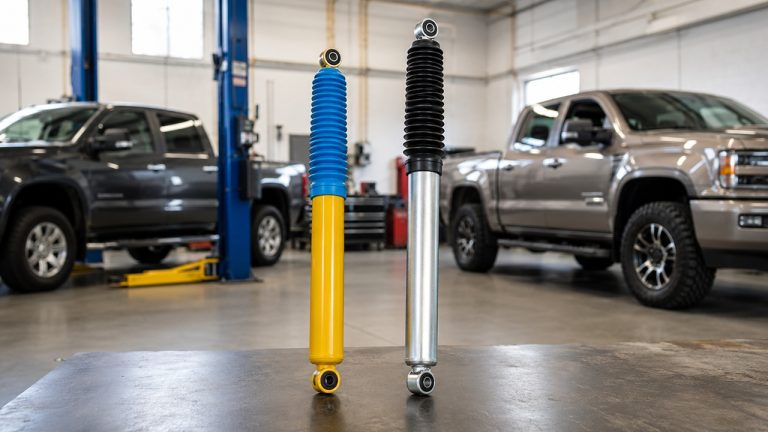
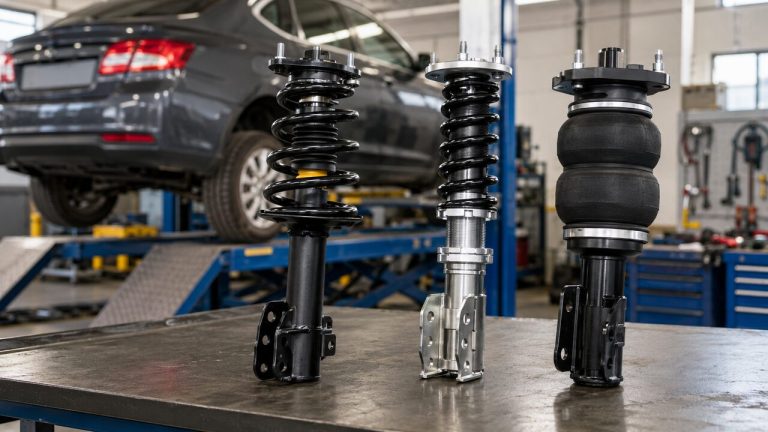
Best Front Shocks for Ford F-250 Super Duty (2017–2026)
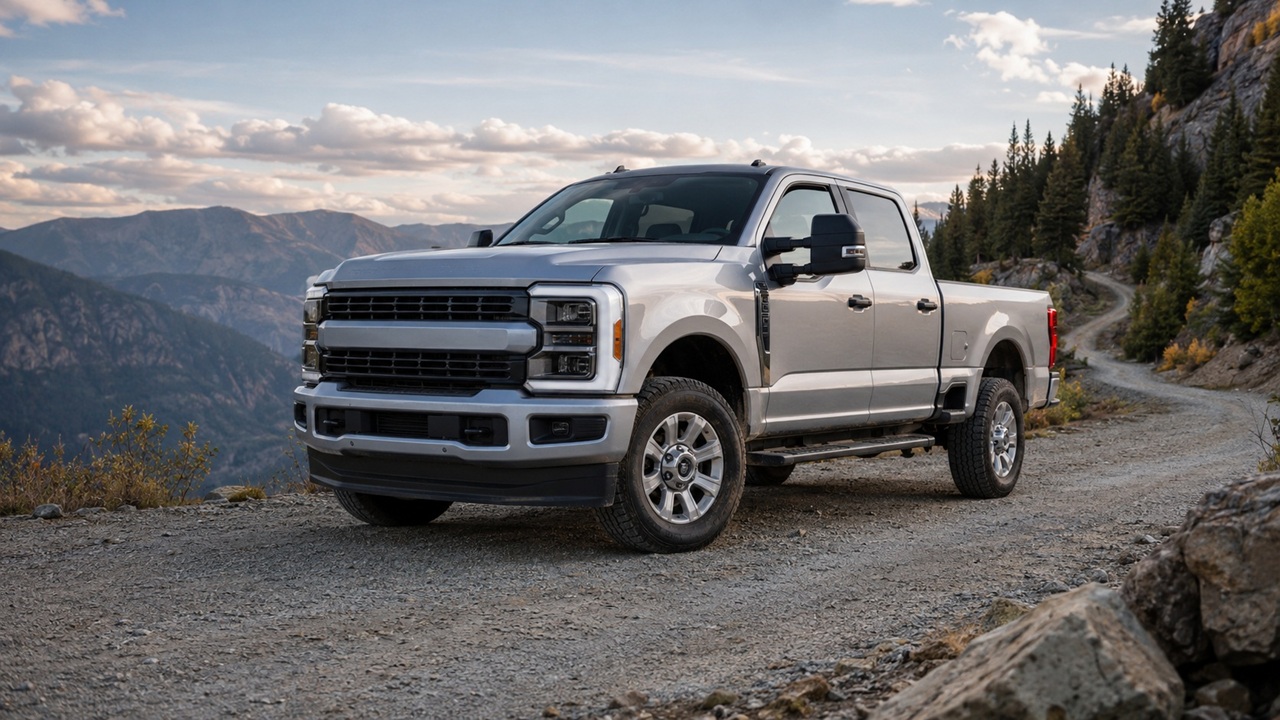
For a stock-height 2017–2026 Ford F-250 Super Duty 4WD without the Tremor package, the Bilstein B6 4600 is the best all-around front-shock upgrade. For a truck with roughly 2 to 2.5 inches of front lift, the Bilstein B8 5100 is the better match. Choose the Rancho RS9000XL if you want adjustable damping for unloaded driving and towing, or the FOX 2.0 Performance Series IFP if rough-road control matters more than price.
Fitment matters more than brand. Before ordering, confirm the model year, 2WD or 4WD, Tremor or non-Tremor suspension, current front ride height, and whether the listing contains one shock or a pair. A highly rated shock in the wrong length can top out, bottom out, or limit suspension travel.
Best F-250 Front Shocks at a Glance
For a stock-height work truck, a leveled daily driver, and a truck regularly driven on rough roads, the best front shock may not be the same. This table narrows the options by suspension setup; the listed part number still needs a fitment check for your specific F-250.
| Truck setup | Best choice | Why it stands out | Key fitment note |
|---|---|---|---|
| Stock-height 4WD | Bilstein B6 4600 | Controlled everyday ride, towing stability, direct-fit design | Part 24-274937 is a common front application for 2017–2026 non-Tremor 4WD trucks |
| Stock height with changing loads | Rancho RS9000XL | Nine manual damping settings | RS994042 replaces RS999042 for stock-height front applications; verify year and configuration |
| About 2–2.5 inches of front lift | Bilstein B8 5100 | Extended length matched to leveled trucks | 24-274951 is commonly listed for non-Tremor 4WD applications in this lift range |
| Rough roads and light off-road use | FOX 2.0 Performance Series IFP | Greater cooling capacity and predictable control | 985-24-154 has year- and package-dependent fitment notes; confirm the exact front lift and Tremor status with FOX |
| Original factory behavior | Motorcraft/OE replacement | Closest match to the original calibration | Order by VIN because part numbers vary by year, package, and axle configuration |
Important: the part numbers above are useful starting points, not substitutes for a current vehicle-fitment check. Manufacturers can revise catalogs, and Tremor, chassis-cab, dual-rear-wheel, 2WD, and modified trucks may require different shocks.
What to Check Before Buying Front Shocks
Two F-250s from the same model year can have different shock requirements. Before comparing brands or prices, check these details on your own truck:
- Model year: the 2017–2022 and 2023–2026 Super Duty generations share some aftermarket applications, but not every product carries across every year.
- Drivetrain: a shock listed for a 4WD F-250 should not be assumed to fit a 2WD truck.
- Actual lift height: measure the suspension setup rather than relying on tire size or the previous owner’s description. Larger tires do not prove that the suspension is lifted.
- Tremor package: Tremor trucks have a different factory stance and can use a different lift range for the same shock family.
- Truck configuration: verify single- or dual-rear-wheel, pickup or chassis cab, and any snowplow or heavy front-accessory requirements.
- Package quantity: many shock listings are for one unit. Replace front shocks as a pair even if only one appears worn.
Best Front Shocks for a Ford F-250 Super Duty
These five options cover most of the common stock-height and lightly leveled 4WD setups. The product numbers below are useful references, but they are not interchangeable across every suspension package or model year.
1. Bilstein B6 4600: Best for a Stock-Height F-250
The Bilstein B6 4600 is the strongest default choice for a stock-height, non-Tremor F-250 Super Duty 4WD. Bilstein positions the B6 4600 as a stock-height replacement that uses a monotube design and velocity-sensitive digressive valving. In practical terms, it aims to control large body movements without requiring a spring change.
Part number 24-274937 is commonly cataloged as the front shock for stock-height 2017–2026 F-250 Super Duty 4WD trucks without the Tremor package. It is a good fit for daily driving, highway use, towing, and gravel roads when you want tighter control than a tired original shock.
- Best for: stock-height 4WD trucks, daily use, towing, and general-purpose driving
- Main advantage: predictable control without external adjustments
- Possible drawback: some drivers may perceive its low-speed response as firmer than the original shock on an unloaded truck
2. Rancho RS9000XL: Best Adjustable Option
The Rancho RS9000XL suits an F-250 that behaves very differently when empty and when towing or carrying equipment. Rancho’s RS9000XL family provides nine manually selected damping positions. The adjustment knob is on the shock body, so no electronic controller is required.
RS994042 supersedes the earlier RS999042 for stock-height front applications on many F-250 Super Duty 4WD trucks, according to Rancho. Confirm the current fitment listing before ordering. Start near the softer end, test the truck on a familiar road, and increase damping gradually. Do not assume the firmest position is automatically safest or best; excessive damping can make an unloaded truck feel harsh and reduce the suspension’s ability to follow broken pavement.
- Best for: drivers who alternate between empty commuting, towing, and hauling
- Main advantage: meaningful control over ride firmness
- Possible drawback: the settings require manual experimentation and should be kept equal on both front shocks
3. Bilstein B8 5100: Best for a Leveled F-250
Use the Bilstein B8 5100 when the truck’s front suspension is raised beyond the range intended for a stock-length shock. Bilstein describes the B8 5100 as a vehicle-tuned shock for lifted truck applications, combining on-road manners with added off-road durability.
Part number 24-274951 is commonly listed as a front shock for 2017–2026 F-250 Super Duty 4WD models with approximately 2 to 2.5 inches of front lift and without the Tremor package. Tremor applications have different starting ride height, so confirm their listed range separately. The 5100 is not the correct choice merely because it appears more performance-oriented; a stock-height truck should normally use a shock designed for stock travel.
- Best for: leveled 4WD trucks in the shock’s stated lift range
- Main advantage: suitable extended length with application-specific valving
- Possible drawback: it is easy to order the wrong version when the true lift height is unknown
4. FOX 2.0 Performance Series IFP: Best Premium Rough-Road Choice
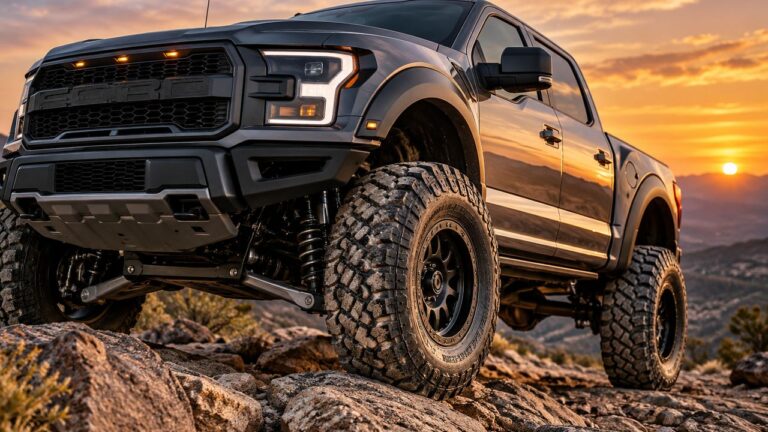
The FOX 2.0 Performance Series IFP is worth considering when the truck regularly sees washboard roads, job-site access roads, or moderate off-road use. Its aluminum body dissipates heat and resists rust, while the internal floating piston separates the oil from the nitrogen charge. FOX says its application-specific valving is intended to balance on-road comfort with predictable off-road handling.
The FOX listing for part 985-24-154 includes year- and package-specific lift notes, so the headline lift range should not be treated as universal. Check the exact model year, front lift height, and Tremor status in FOX’s current fitment information, especially for 2024–2026 trucks.
- Best for: rough roads, repeated high-speed damping events, and light off-road travel
- Main advantage: greater heat management and controlled response over repeated bumps
- Possible drawback: substantially higher cost than a basic direct-fit replacement
5. Motorcraft or OE Shocks: Best for Preserving the Factory Feel
An original-equipment replacement is the sensible choice when you liked the truck’s ride before the factory shocks wore out. It also avoids paying for features you will not use. Order by VIN through a Ford parts catalog or dealer because the correct part can vary with model year, drivetrain, suspension package, and truck configuration.
OE shocks are not automatically softer than every aftermarket option, but they provide the most defensible route back to the behavior Ford intended for that exact build.
Stock Height vs. Leveled: Why Shock Length Matters
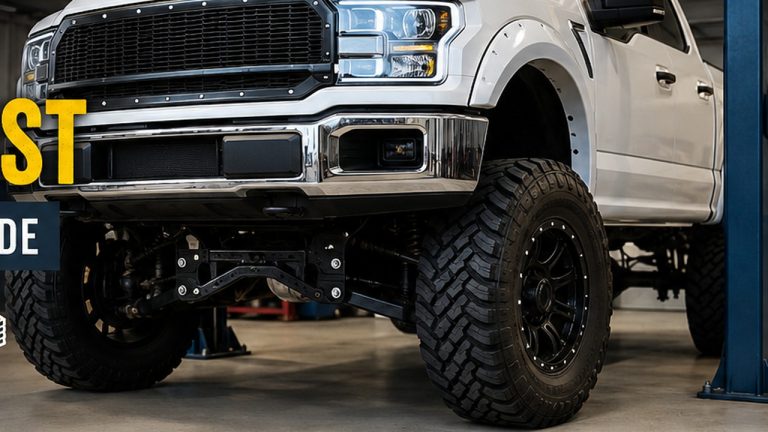
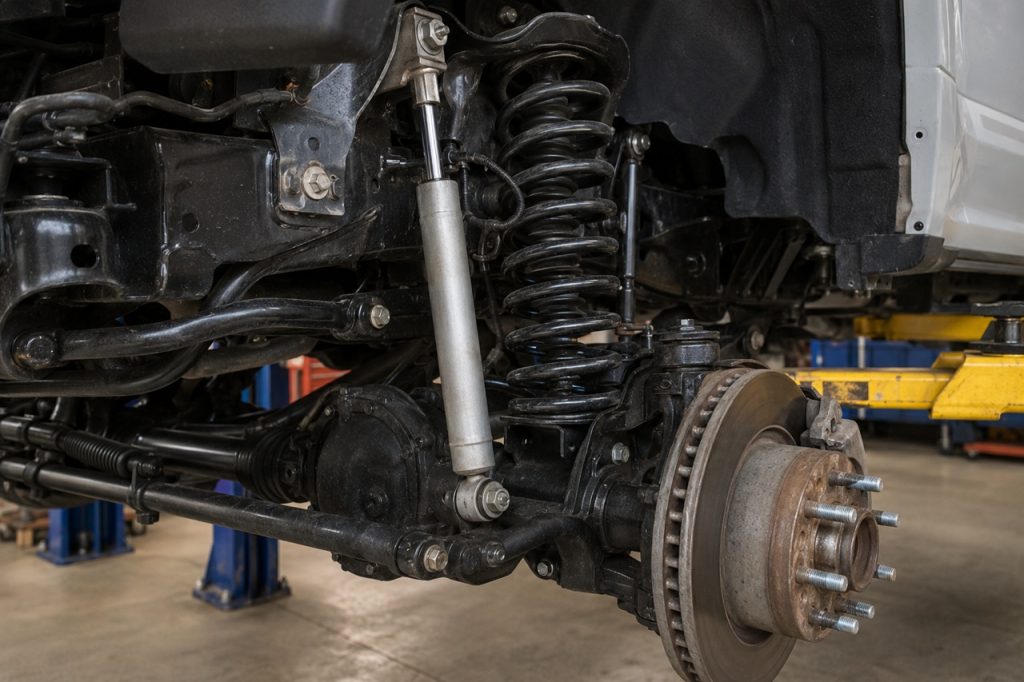
A shock controls suspension movement; it does not establish the truck’s normal ride height. The coil spring supports the front of the truck, while the shock adds resistance in compression and rebound. A leveling spring or spacer changes the suspension’s resting position and may require a shock with a different extended and compressed length.
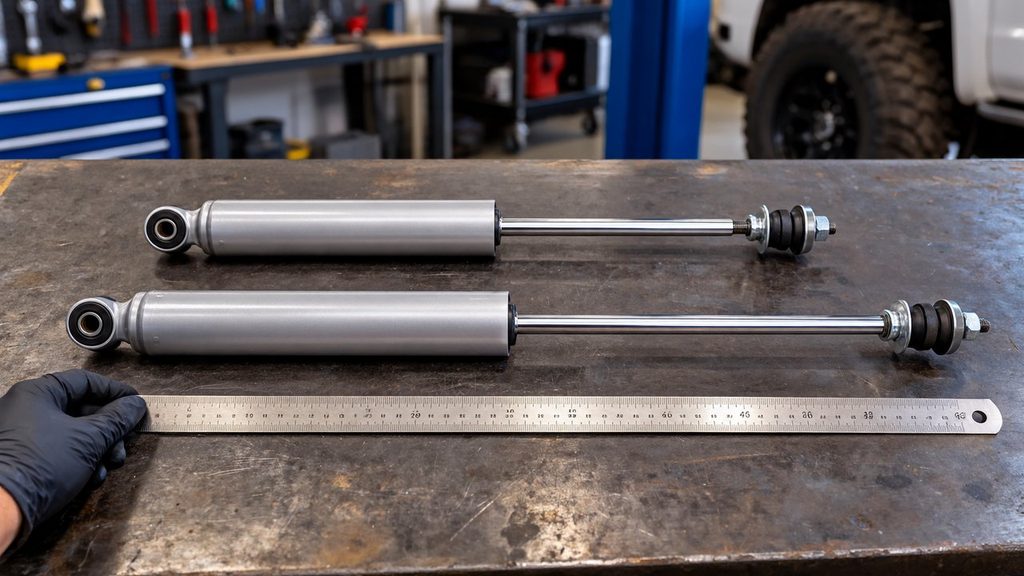
A shock that is too short can top out before the suspension reaches full droop. A shock that is too long can bottom internally before the axle reaches its bump stop. Either condition can damage mounts, reduce usable travel, and produce a harsh impact. Match the shock to the measured lift and confirm that bump stops, brake hoses, and other components remain within their intended range.
What New Front Shocks Can—and Cannot—Fix
Fresh, correctly valved front shocks can reduce repeated bouncing, brake dive, float after dips, and uncontrolled body movement. They may also make the steering feel more settled because the front tires spend less time oscillating after a bump.
Shocks will not repair worn ball joints, track-bar bushings, tie-rod ends, wheel bearings, incorrect alignment, damaged springs, or unsuitable tire pressure. They also do not increase the F-250’s payload or towing ratings. If the truck wanders, clunks, shakes violently, or wears tires unevenly, inspect the rest of the suspension before treating the shocks as the sole cause.
A steering stabilizer is another damper, but it is not a cure for loose steering or so-called death wobble. Those symptoms require a complete inspection of the steering linkage, track bar, joints, tires, wheels, and alignment.
How to Choose Based on How You Use the Truck
A truck that spends most of its time empty on pavement needs a different compromise from one that regularly pulls a trailer or works on washboard roads. Start with the setup closest to how your F-250 is actually used:
- Mostly commuting at stock height: choose Motorcraft/OE for factory-like behavior or Bilstein B6 4600 for firmer control.
- Frequent towing with an otherwise stock truck: Bilstein B6 4600 is the simple set-and-forget option; Rancho RS9000XL offers more flexibility between loaded and unloaded use.
- Two-inch leveling setup: use a shock specifically cataloged for that lift, such as the appropriate Bilstein B8 5100 application.
- Rough gravel and job-site roads: FOX 2.0 IFP provides greater heat capacity, while the less expensive B8 5100 remains a strong option when its lift range matches.
- Heavy off-road use: consider a rebuildable reservoir shock from a reputable manufacturer, but choose the complete suspension system around travel, springs, bump stops, and axle control—not the shock brand alone.
Should You Replace Only the Front Shocks?
You can replace only the front pair if the rear shocks are still healthy and the front units are the confirmed problem. However, a high-mileage truck with four original shocks may feel unbalanced when the front damping is renewed and the rear remains weak. Inspect all four and consider a matched set when wear is similar.
Never replace only one front shock unless a manufacturer or repair procedure explicitly calls for it. Unequal damping across the axle can produce inconsistent response during braking, cornering, and bumps.
Installation and Alignment
A direct-fit front shock replacement normally does not alter camber, caster, or toe by itself, so an alignment is not automatically required solely because the shocks were changed. An alignment check is appropriate if the truck already pulls, the steering wheel is off-center, tires wear unevenly, or the work also changes springs, ride height, radius arms, track-bar position, or steering components. See our guide to alignment after suspension repairs for the component-by-component distinction.
Support the vehicle safely, follow Ford’s service information for the exact model, and torque all fasteners to the correct specification. Do not work under a truck supported only by a jack. If the shock hardware, mounts, brake hoses, or nearby steering parts show damage, stop and have the system inspected professionally.
Frequently Asked Questions
A few questions come up repeatedly when F-250 owners compare front-shock upgrades, especially around ride quality and which products actually fit.
What are the best shocks for a stock F-250 Super Duty?
For a stock-height 2017–2026 F-250 Super Duty 4WD without Tremor, the Bilstein B6 4600 is the best general-purpose aftermarket choice. Motorcraft/OE is better if preserving the original factory feel is the priority. Always verify the exact application before ordering.
Will better shocks make an F-250 ride like a half-ton truck?
No. Better shocks can control bounce and harsh secondary motions, but the F-250’s springs, axles, tires, wheelbase, load capacity, and tire pressure still shape the ride. A heavy-duty truck will not become a soft half-ton simply by changing dampers.
Are Bilstein 5100 shocks better than 4600 shocks for an F-250?
Not universally. The B6 4600 is intended for stock-height applications, while the relevant B8 5100 is designed for a specified lifted-height range. The better shock is the one that matches the truck’s actual suspension height and intended use.
How long do F-250 front shocks last?
There is no fixed replacement interval that fits every truck. Potholes, washboard roads, towing, heavy accessories, corrosion, heat, and tire condition all affect service life. Replace shocks based on leakage, damage, loss of damping, repeated bounce, and verified poor performance rather than mileage alone.
Do F-250 and F-350 trucks use the same front shocks?
Some aftermarket part numbers overlap, but you should never assume interchangeability. Verify the exact year, drive type, ride height, suspension package, and chassis configuration. F-350 owners looking beyond the front dampers can use our separate F-350 suspension upgrade guide.
Which Front Shock Should You Buy?
Choose the Bilstein B6 4600 for the best all-around result on a stock-height, non-Tremor 4WD F-250. Choose the Rancho RS9000XL when adjustable firmness is useful for changing loads. Use the correctly sized Bilstein B8 5100 on a leveled truck, and consider the FOX 2.0 IFP when repeated rough-road use justifies the added cost.
Before buying, run the exact part number through the manufacturer’s current vehicle selector and confirm what is included in the box. Correct fitment, balanced left-to-right damping, and a healthy steering and suspension system matter more than choosing the most expensive shock.