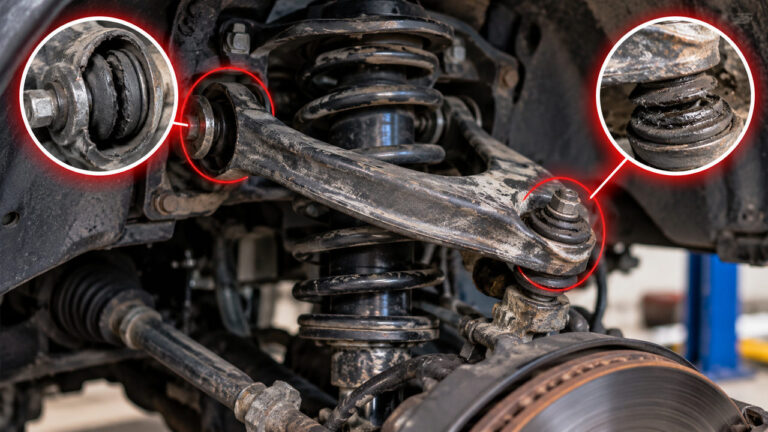
Track Bar Bushings: Fitment, Types & Wear Signs
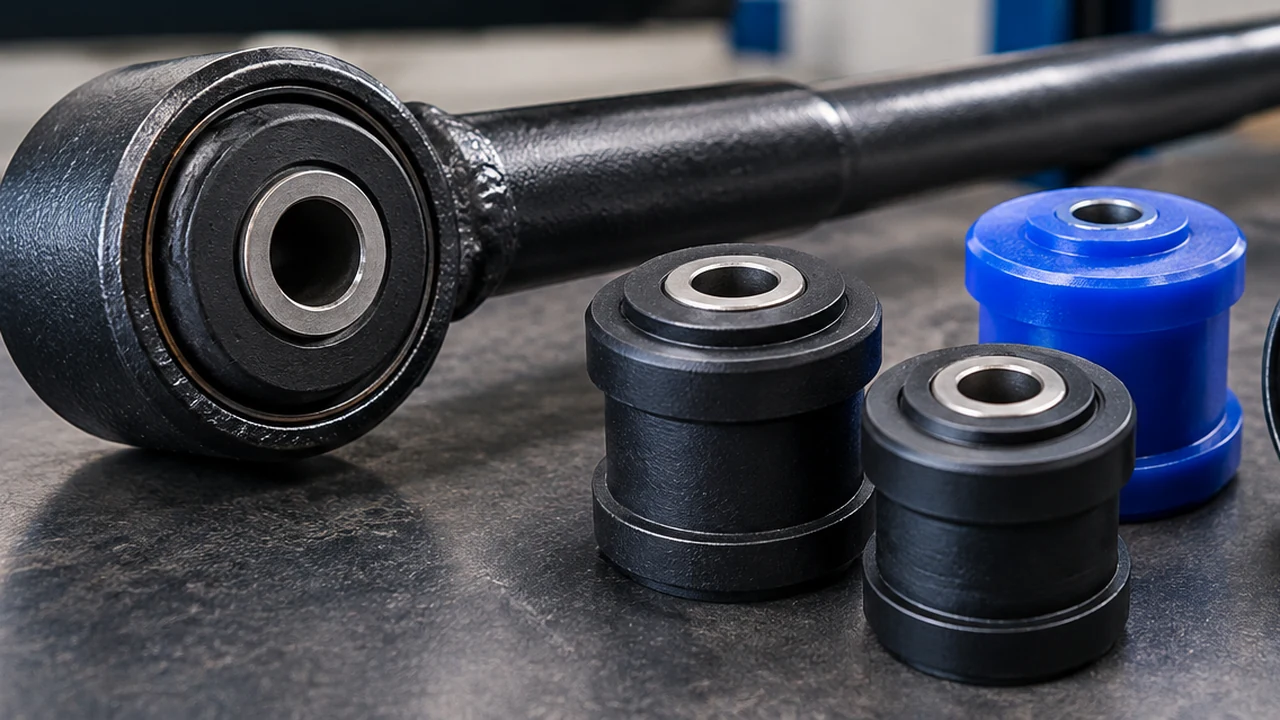
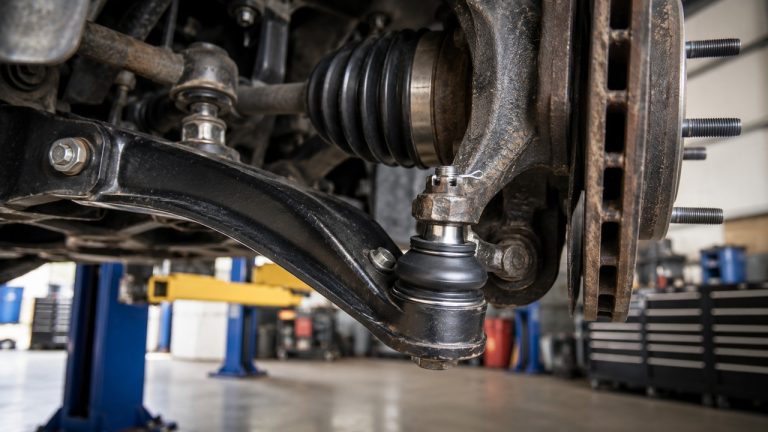
Track bar bushings are the rubber or polyurethane inserts that support a track bar (Panhard rod) at its mounting points. If you are buying replacements, the first question is not which material is best. It is whether the bushing fits the actual bar on your vehicle—front or rear, factory or aftermarket—and includes the correct sleeve for the mounting bolt. A “Jeep JK track bar bushing” is not automatically a match for every JK track bar.
For a stock daily driver, a vehicle-correct OE-style rubber bushing is a sensible starting point. Polyurethane kits can work well in the applications they were designed for. But a lifted Jeep with an aftermarket adjustable bar may need a brand-specific rebuild kit rather than a generic bushing listed under the vehicle year.
If you are still identifying the suspension link itself, our guide to what a track bar does explains axle location, steering geometry and why this link is different from a sway bar. Here, the focus is on choosing and assessing its bushings.
Find the Correct Track Bar Bushings Before You Order
Parts catalogs put several kinds of suspension hardware under “track bar.” Some listings use Panhard rod bushing, others say track arm bushing. Those names can describe the same kind of component, but they do not establish that the dimensions or mounting design are interchangeable.
Identify the Bar, Not Just the Vehicle
Start by looking at what is fitted today. Is it an original fixed-length track bar, a replacement made to original specifications, or an adjustable bar from a lift-kit manufacturer? If the bar has an aftermarket logo, part number, threaded adjuster, or rebuildable flex joint, record those details before using a vehicle-based parts search.
This distinction catches plenty of wrong orders. A bushing kit sold for a 2007–2018 Wrangler JK may be intended for a specific aftermarket track bar, not the stock Jeep part. For example, BDS lists its BDS074104 as a service kit for its own JK track bar. Conversely, a factory-style bushing can have the right outside diameter yet use the wrong inner sleeve for an aftermarket bolt arrangement.
Confirm Front or Rear, Then Check Each End
On a vehicle with two track bars, the front and rear are separate assemblies. A kit for the rear bar is not necessarily suitable for the front. The frame-side and axle-side ends may also differ—or one end may use a bushing while the other uses a ball-stud joint or specialty flex end. Never assume you need two identical bushings simply because the bar has two mounting points.
A useful listing should answer all of the following. If it does not, find a manufacturer diagram or contact the parts supplier before purchasing.
| Verify | What to look for |
|---|---|
| Vehicle and axle | Year, make, model, exact generation, front or rear track bar |
| Bar manufacturer | OE/factory-style or the actual aftermarket track-bar part number |
| Mounting position | Frame end, axle end, or both; any different joint at the opposite end |
| Bushing design | Bonded rubber shell, two-piece polyurethane, or manufacturer-specific rebuildable joint |
| Sleeve and bolt | Correct inner diameter, sleeve length and specified fastener size |
| Kit quantity | One end, one complete bar, or separately ordered front and rear kits |
When a manufacturer describes a kit as “4 bushings and 2 tubes,” those four pieces may be two halves at each of two pivots. It does not automatically mean four separate mounting points are covered. And do not round a metric sleeve size into a nearby inch measurement: 14 mm and 9/16 inch, for example, are not identical. Read the bill of materials rather than the headline quantity.
Track Bar Bushing Fitment: Jeep, Ford, and Ram
Jeep accounts for many of the U.S. searches, but there is no single Jeep bushing specification. Heavy-duty Ford and Ram trucks create a similar trap: parts searches may mix factory bars, aftermarket replacements and rebuild kits for particular products.
Wrangler TJ, JK, JL and Gladiator JT Are Different Applications
The Wrangler TJ/LJ, JK and JL generations, along with the Gladiator JT, should be treated as distinct fitment groups. A front kit can also differ from a rear kit on the same generation. Cherokee XJ and Grand Cherokee models add more possibilities; a familiar-looking round insert is not a substitute for a verified application.
Production changes inside a model line matter, too. As one concrete example, Whiteline lists front track-bar bushing kit W83397 for certain Wrangler JK applications built through June 2008. Its product specifications identify the front location and two shell bushings with two tubes. That is a useful reminder to check build-date restrictions—not a recommendation that this kit fits every early JK. See the manufacturer’s W83397 fitment and specifications.
F-250/F-350 and Ram 2500/3500: Check the Actual Assembly
On Ford Super Duty and heavy-duty Ram trucks, an online result for “track bar bushings F250” or “Ram 2500 track bar bushings” may point to a standard replacement or to a service kit for a heavy-duty adjustable bar. The same vehicle can have very different bushings after a suspension upgrade. Match the front track-bar design and its part number first; then check the mounting hardware and production year.
Do not use suspension lift height by itself to choose bushings. Lift height may help identify the installed aftermarket bar, but the bar manufacturer’s service parts list is what determines whether a particular insert or joint is compatible.
Rubber vs. Polyurethane Track Bar Bushings
Material changes how the mount deflects and transmits vibration, but correct fit comes first. Replacing a worn bushing with a tighter one can restore precision; putting a very hard bushing into an unsuitable design can add noise without fixing an underlying loose bolt or damaged bracket.
Here is the practical trade-off, before you compare brands or kit colors.
| Design | Good reason to choose it | Important limitation |
|---|---|---|
| OE-style bonded rubber | Restores intended compliance and noise isolation on a stock setup | Must match the shell, orientation and original mount |
| Application-specific polyurethane | Can reduce unwanted deflection in a compatible performance or off-road setup | May increase noise; some designs require the supplied grease |
| Rebuildable flex joint or bearing | Services a track bar originally designed around that joint | Requires the exact manufacturer’s service kit, not an ordinary rubber insert |
OE Rubber for a Stock Bar
Rubber bushings typically include a metal inner sleeve and may be bonded into an outer shell. The rubber can flex as the bar moves while keeping road vibration out of the chassis. Matching the OE construction is usually the least surprising choice for a stock daily driver.
Look beyond surface color. Shell shape, rubber voids, offset centers, overall width and any installation marks can be intentional. An inexpensive universal bushing may fit the hole but still behave differently from the engineered original.
Polyurethane for a Compatible Kit
Polyurethane bushings are often sold as two-piece inserts with a separate metal tube. Some have grooves or flutes for a specified lubricant. Different formulations and hardness ratings exist, so “poly” alone tells you little about ride comfort or joint movement. It also does not mean the part fits any track bar with a similar eyelet diameter.
If the kit calls for grease, use the lubricant and application points specified by its manufacturer. A bonded-rubber bushing and a sliding polyurethane insert do not share one universal lubrication procedure. A squeak is a reason to identify the joint and investigate—not to spray oil blindly at the mount.
Flex Ends, Bearings and Rebuild Kits
Some aftermarket track bars use proprietary joints rather than a conventional serviceable bushing at one or both ends. The replacement may be called a flex-joint rebuild kit, cartridge, spherical bearing, or bushing half. These are not interchangeable categories. Order by the track bar’s own part number and its approved rebuild components, even if the retailer’s catalog also shows your vehicle as a match.
Signs of Worn Track Bar Bushings
A failing bushing can let the axle move sideways in relation to the chassis when steering or cornering loads change. The most useful clue is movement at the mount itself, not a particular noise. Several other steering and suspension faults can produce the same driving complaints.
Clunks or a Loose, Delayed Steering Feel
A dull knock during a steering correction, braking transition, or bump can come from a track-bar pivot taking up unwanted clearance. The vehicle may also feel as if the body reacts a beat later than the front axle. On a rear track bar, excessive play may feel like the back of the vehicle makes a small sideways step over a bump.
Neither sensation is unique to these bushings. Loose fasteners, other steering joints, tires and suspension mounts belong on the inspection list. For a wider noise diagnosis, see our suspension clunks and rattles guide.
Torn Rubber, an Off-Center Sleeve, or Visible Play
Deep tears through a loaded rubber section, separation from the metal sleeve, a sleeve sitting visibly out of position, or bright contact marks around a mount are stronger evidence. Small superficial cracks in otherwise stable rubber do not always mean the bushing has failed. Likewise, a heavily compressed but intact-looking insert may still have excess movement under load.
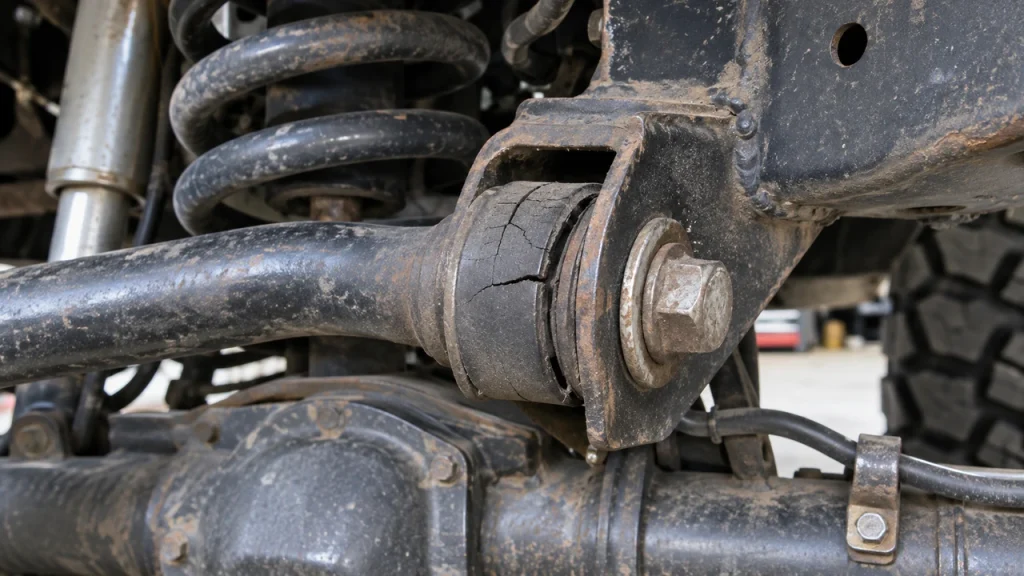
On some lifted solid-front-axle vehicles, a loose track-bar connection can contribute to severe steering oscillation, often called death wobble. That does not make every shaking steering wheel a track-bar problem, and replacing bushings alone is not a universal cure. If steering is violently unstable or a mount is visibly loose, stop driving and arrange professional inspection.
How to Check Whether the Bushing Is Really the Problem
The question is whether the bar pivots as designed or whether the bushing, fastener, or bracket slips relative to its mating part. Looking at the assembly together matters; a perfectly good replacement bushing cannot compensate for an enlarged hole in the chassis bracket.
Watch the Mount Under Light Steering Load
A technician may observe the front track-bar ends while a helper gently rocks the steering wheel with the vehicle stationary and correctly supported as required. The bar and axle will react to the steering input; the mounting bolt should not be shifting inside its bracket. Movement between the sleeve, bolt and bracket, or obvious delay before the bar follows, deserves closer diagnosis.
This is not a reason to reach between loaded steering components or crawl beneath a vehicle supported only by a jack. The inspection requires a safe position, appropriate support and knowledge of the vehicle’s system.
Rule Out the Bolt, Bracket and Other End of the Bar
A loose bolt can make a healthy bushing appear defective. So can an ovaled mounting hole, cracked weld, distorted bracket or worn ball-stud joint on the opposite end. Inspect both sides of each attachment, not just the most visible piece of rubber.
One telltale sign is a polished crescent around the bolt hole or a shiny witness mark where parts have been sliding. Another is a sleeve that moves with the bolt instead of remaining securely clamped. Those findings may call for bracket or hardware repair, not merely a fresh set of inserts.
Bushing-Only Repair or a Complete Track Bar?
Replacing just the bushings makes sense when the bar is straight, its mounting eyes are sound, the joints are designed to be serviced, and the correct replacement parts are available. That may be economical on an original track bar—or the intended maintenance route for a rebuildable aftermarket one.
A complete assembly is more plausible when the eye is worn or distorted, the bar is bent, its integral joint cannot be serviced, or bushing removal would damage the housing. Corroded or stretched mounting hardware and damaged brackets still have to be addressed separately, whichever option is chosen.
For a quote covering the complete link rather than a small insert kit, our track bar replacement cost guide handles U.S. parts and labor estimates. This page deliberately does not mix those whole-bar estimates with bushing kit prices.
Checks to Make Before Installation
Even an exact-fit bushing can be damaged by an incorrect installation method. A workshop should work from the vehicle and bushing manufacturer’s instructions, not assume that every track bar uses the same press, grease, or tightening procedure.
Before work begins, confirm these details with the mechanic or the instructions supplied with the parts:
- Press or insert design: a bonded outer shell may need proper support and pressing; split inserts may use a different method
- Orientation: arrows, voids or offset centers must be positioned as specified
- Inner sleeve: it must suit the actual bolt diameter and clamped bracket width; never improvise with loose washers
- Lubrication: apply only the compound specified for that bushing and only where the design requires it
- Final tightening: follow the required suspension position and torque procedure; many bonded-rubber pivots must not be locked at full droop
- Post-repair inspection: verify tight mounting hardware, clearances, axle position and steering behavior
Some vehicles or replacement manufacturers specify an alignment check afterward, especially if the bar is adjustable or axle position has changed. The check is not identical to resetting the length of an adjustable bar. Our alignment-after-suspension-work guide explains that distinction without treating every bushing job as a full wheel-alignment adjustment.
Track Bar Bushing FAQs
These answers cover the questions that usually come up while comparing parts listings.
Are track bar bushings and Panhard rod bushings the same thing?
Often, yes: “track bar” and “Panhard rod” are common names for the lateral link that locates a solid axle. But a matching name does not prove matching dimensions. In some markets “track rod” can refer to a steering tie rod, so confirm the component in the diagram.
Do I need one kit or two for a Jeep?
Check whether the kit services one end, one complete front or rear bar, or both bars. For example, a kit containing two bushing assemblies may be enough for one bar with two bushed ends. A Jeep equipped with separate front and rear track bars may require two different kits—or only one, if the other bar is fine.
Can I replace track bar bushings on an adjustable aftermarket bar?
Only if that bar is designed to be serviced and its manufacturer supplies compatible parts. Many are rebuildable, but the kit is often specific to the bar brand and joint design. Do not assume a factory-style replacement insert will fit an adjustable bar just because both are listed for the same truck.
Will new bushings re-center an axle after a suspension lift?
No, not by themselves. New bushings can remove unwanted play. An axle sitting off-center because ride height changed is a track-bar length or mounting-geometry issue, not proof of worn bushings. Changing a link’s effective length or bracket position requires a vehicle-specific solution.
Can bad track bar bushings cause death wobble?
They can contribute if they allow unwanted movement in the front axle’s lateral locating link. Other loose joints, mounting damage, tires and steering geometry may also be involved. Confirm the source of play instead of treating a bushing swap—or a steering stabilizer—as a guaranteed fix.