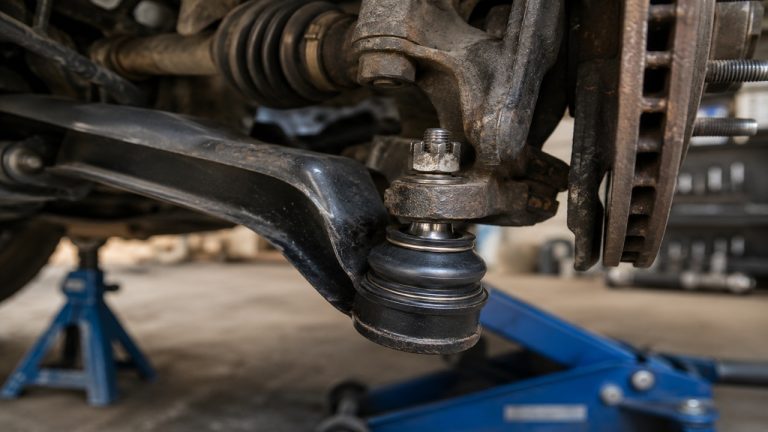
Symptoms of a Bad Lower Control Arm: Noises, Wear & Tests
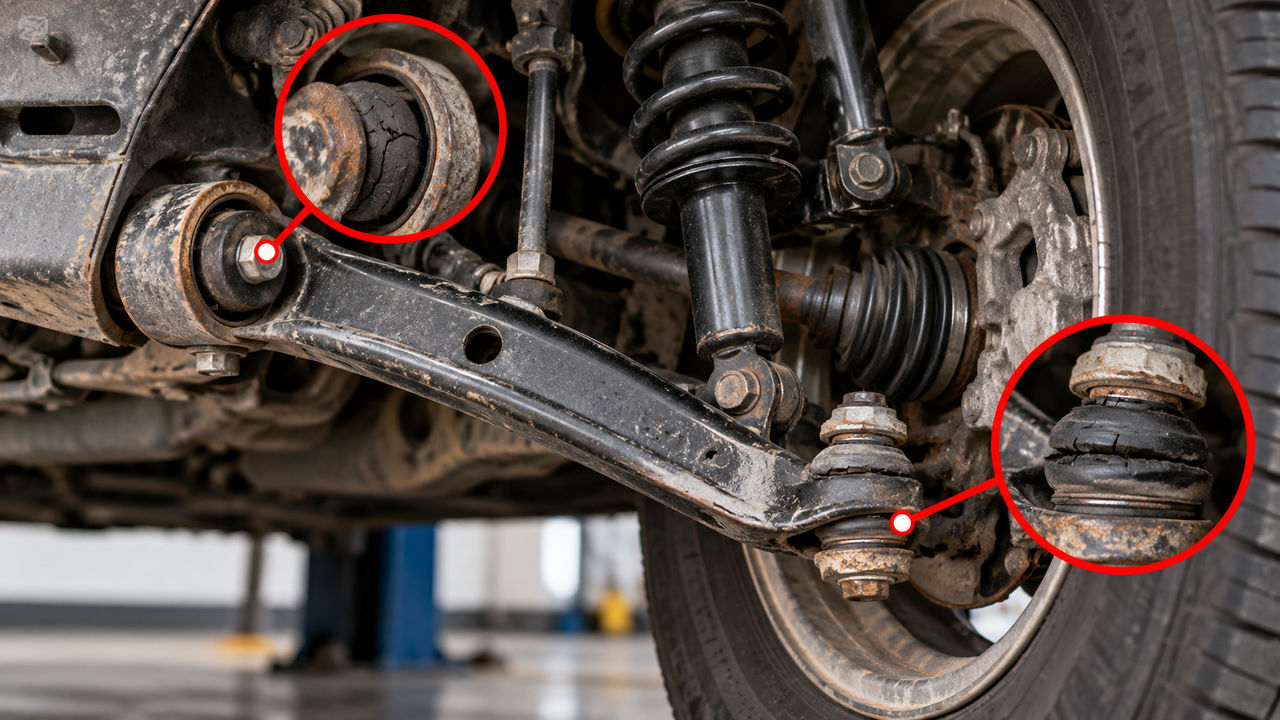
The most common symptoms of a bad lower control arm include clunking over bumps, knocking when braking or accelerating, wandering steering, uneven front tire wear, vibration, and a wheel that no longer seems to track correctly. You may also find torn control arm bushings, excessive lower ball joint movement, or damage to the metal arm itself.
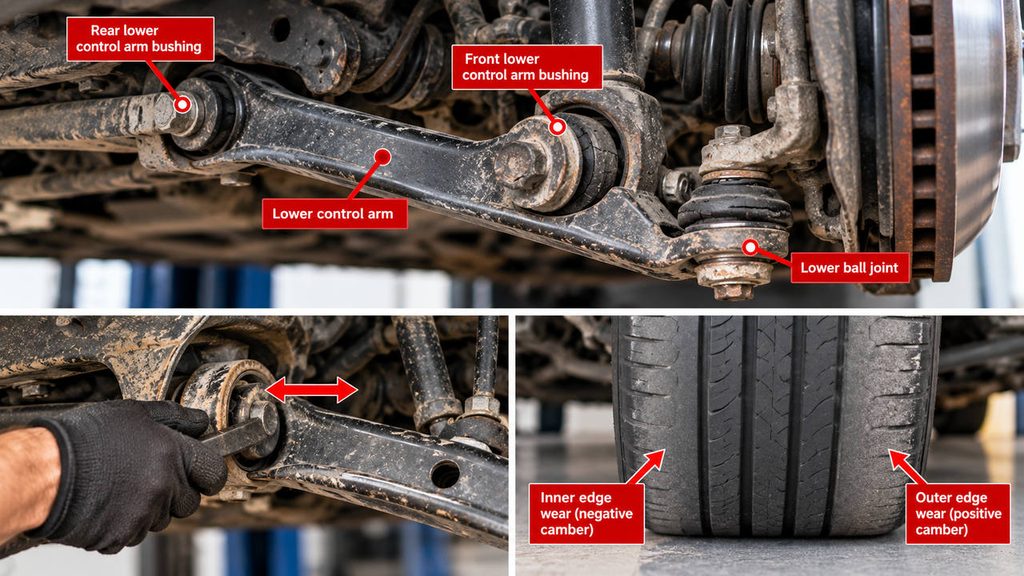
Here’s the important distinction: most lower control arm problems begin in the bushings or ball joint, not the metal arm. A worn bushing can let the wheel move slightly forward or backward under load. A failing ball joint can allow unwanted movement between the control arm and steering knuckle. A bent arm, usually following an impact, can change wheel geometry even when its joints are still tight.
If your car has started making a front-end noise or feels less stable than it used to, the timing of the symptom can help narrow down the problem. It won’t identify a bad part by itself, but it can tell you where to begin looking.
Safety: A severely worn lower ball joint, cracked control arm, or damaged mounting point can compromise wheel control. If a wheel is visibly displaced, the steering changes suddenly, or a joint appears close to separating, stop driving and arrange professional inspection or towing.
Bad Lower Control Arm Symptoms at a Glance
The same control arm can behave quite differently depending on which part has deteriorated. Use this comparison to connect what you’re noticing with the components a technician should inspect first.
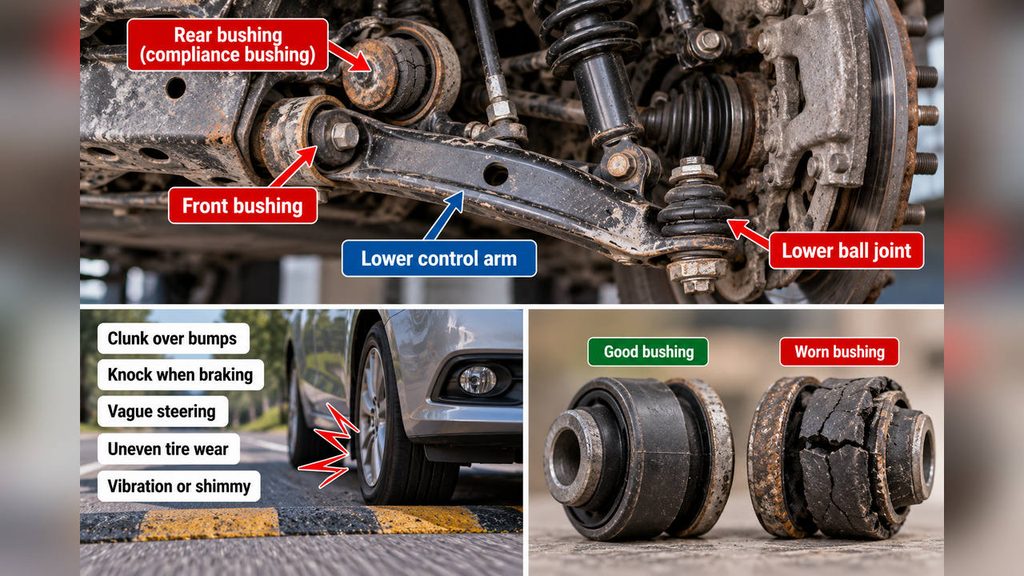
| Symptom | Possible lower control arm problem | What else could cause it? |
|---|---|---|
| Clunk over potholes or speed bumps | Loose bushing, worn lower ball joint, or mounting movement | Sway bar link, strut mount, loose suspension hardware |
| Knock when braking or accelerating | Excessive fore-and-aft movement at a control arm bushing | Brake hardware, engine mount, other suspension mounts |
| Wandering or vague steering | Bushing deflection or lower ball joint looseness | Tires, tie rods, steering gear, alignment |
| Inner- or outer-edge tire wear | Changed suspension geometry or unwanted joint movement | Incorrect camber or toe, tire-related issues |
| Steering wheel shimmy or vibration | Loose joint or deteriorated bushing contributing to instability | Wheel balance, tire damage, brake or bearing problems |
| Wheel looks incorrectly positioned | Bent arm, displaced mount, or severe joint failure | Other impact damage or suspension geometry problems |
| Visible torn rubber or fluid leakage | Damaged conventional or hydraulic control arm bushing | Other nearby fluid leaks or unrelated rubber deterioration |
One symptom deserves extra attention: a clunk that happens as the vehicle transitions from braking to accelerating. That’s a useful reason to inspect the lower control arm’s inner bushings, because those mountings help control the wheel’s movement under longitudinal forces.
It still isn’t proof. A sound traveling through the subframe can easily appear to come from a control arm when the actual problem is somewhere else.
Why Lower Control Arms Develop These Problems
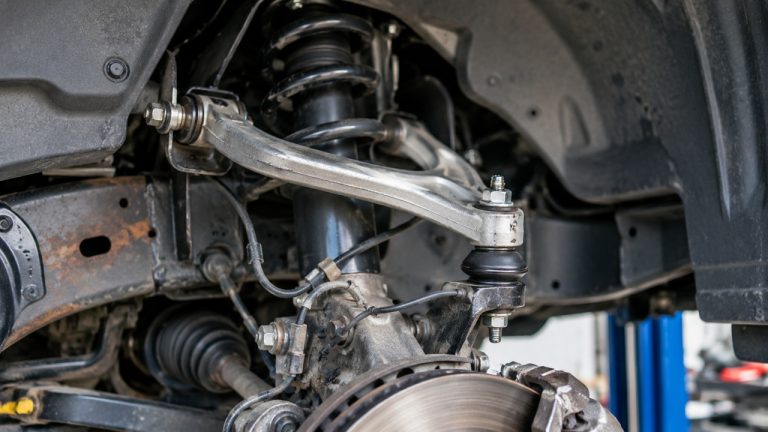
A front lower control arm connects the lower portion of the wheel assembly to the vehicle’s body, frame, or subframe. It allows the wheel to move with the suspension while helping maintain its position relative to the chassis.
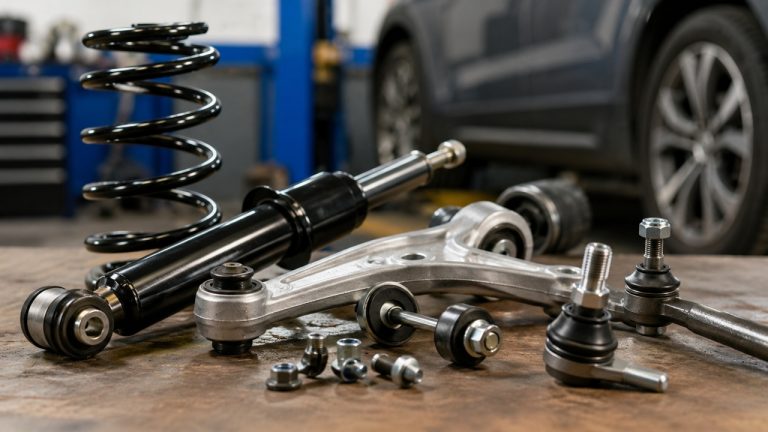
On many cars, the arm is roughly triangular or L-shaped. One or more inner bushings connect it to the vehicle, while an outer ball joint connects it to the steering knuckle. Other designs use separate links or different mounting arrangements.
The metal arm itself is generally durable. Unless it has been bent in a collision, damaged by a hard curb strike, or affected by severe corrosion, the parts most likely to cause trouble are the connections at either end.
Worn Lower Control Arm Bushings
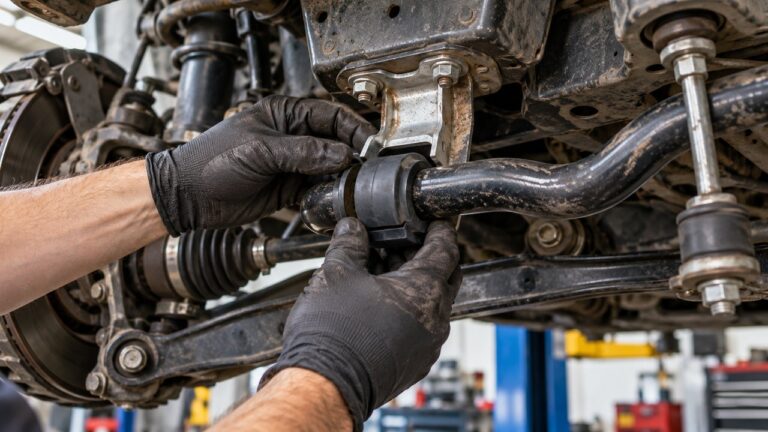
Most factory control arm bushings use rubber bonded to one or more metal sleeves. The rubber flexes as the suspension travels and helps isolate road vibration from the vehicle body.
It also limits how much the arm can move under braking, acceleration, and cornering forces. That controlled flexibility is important: a healthy bushing isn’t supposed to be completely rigid.
As the material deteriorates, the rubber can tear, separate from its sleeve, or lose the ability to hold the arm in its intended position. The resulting movement may be enough to create a dull knock, change steering response, or affect wheel alignment dynamically.
Some vehicles use a particularly large rear bushing on the front lower control arm. Often called a compliance bushing, it is designed to absorb some longitudinal movement while controlling how the wheel reacts to braking and road impacts.
If that bushing tears or separates, the wheel assembly may move more than intended under braking loads. The driver may notice a knock or a momentary change in steering feel.
Certain applications use fluid-filled hydraulic bushings for improved vibration isolation. A damaged hydraulic bushing can sometimes leak its internal fluid, providing a useful visual clue that an ordinary solid-rubber bushing wouldn’t show.
A Worn Lower Ball Joint
The lower ball joint allows movement between the lower control arm and steering knuckle. Its ball-and-socket construction accommodates suspension travel and, on front steering wheels, changes in steering angle.
When the joint develops excessive internal clearance, the knuckle may move relative to the arm in a way the suspension wasn’t designed to permit.
Possible consequences include knocking, loose steering, abnormal wheel movement, and irregular tire wear. A torn dust boot can allow moisture and grit to enter the joint, accelerating deterioration.
Unlike an ordinary deteriorated rubber bushing, a severely worn ball joint can present an immediate safety concern because it is part of the connection that keeps the wheel assembly located.
Not all lower ball joints carry the vehicle’s weight, however. Their loading and inspection requirements depend on the suspension design, which we’ll address below.
A Bent or Structurally Damaged Control Arm
A damaged metal arm is a different diagnosis altogether.
After a significant impact, the arm may bend, crack, or become displaced at its mounting points. Even a relatively small geometric change can affect how the wheel sits and steers.
For example, a car that begins pulling immediately after hitting a curb might have a bent lower control arm, damaged steering knuckle, or shifted mounting point. Replacing a bushing won’t correct a structurally distorted suspension component.
Never assume the arm is straight merely because there isn’t an obvious crack. Some damage requires comparison with the opposite side, measurements, or an inspection of the complete suspension geometry.
What a Bad Lower Control Arm Feels Like While Driving
Driving conditions often reveal more than the sound itself. A noise that appears under braking loads deserves a different inspection from a vibration that occurs only at one highway speed.
A Heavy Clunk When Crossing a Bump
Picture pulling into a parking lot where the entrance has a raised concrete lip. As the front wheel climbs over it, you hear a single knock from underneath the car.
A worn lower control arm bushing might allow the arm to shift as the suspension compresses. A lower ball joint with excessive play can also knock when its loading direction changes.
The frequency of the noise can help. A single heavy knock under a particular load is different from a rapid rattle over every small road imperfection. The latter may justify checking sway bar links, brake components, or other nearby hardware.
A low-pitched thud may suggest substantial movement at a mounting point, but don’t use sound alone to decide whether the bushing or ball joint needs replacement. Both can produce similar noises.
Knocking When You Brake or Accelerate
This pattern can be particularly useful with lower control arm bushings.
When you brake, longitudinal forces act on the tire and steering knuckle. The control arm and its mountings help resist the resulting movement. When you accelerate, the direction and distribution of those forces change.
A deteriorated compliance bushing may permit excessive fore-and-aft movement during those transitions. You could hear a clunk or feel the front suspension settle abruptly as the load reverses.
On some vehicles, the driver also notices a subtle steering correction during braking. The wheel’s position can change under load even though the static alignment looks reasonable when the vehicle is parked.
But brake caliper hardware, engine or transmission mounts, and other suspension components can also create knocks during acceleration or deceleration. The noise needs to be traced to its source.
A Car That Wanders or Needs Constant Correction
Some drivers describe it as the front end feeling disconnected from the steering wheel. Others say the car follows grooves in the pavement more than it used to.
Lower control arm bushings help determine how consistently the wheel remains positioned under changing road forces. If excessive bushing movement changes caster, camber, or toe behavior during driving, the car may become less predictable.
The key word is may. A vehicle can wander because of tire construction, tire pressure, road crown, wheel alignment, steering linkage wear, or several other causes.
One useful distinction is whether the problem feels constant or load-dependent. A car that pulls steadily on a level road may have a different issue from one that changes direction slightly when the brakes are applied or a wheel encounters a bump.
Neither pattern is diagnostic by itself. Both deserve a complete steering and suspension inspection.
Unexpected Front Tire Wear
A worn lower control arm can allow the wheel alignment to change, but tire wear is a surprisingly poor way to identify which suspension component has failed.
Inner-edge wear might be associated with negative camber or incorrect toe. Outer-edge wear can arise from other alignment conditions, tire pressure, or driving habits. Feathered tread can also be associated with toe-related scrub.
These patterns do not identify the lower control arm automatically.
What makes a worn arm or bushing worth investigating is the combination of abnormal tire wear and physical evidence that the wheel isn’t being held consistently in position.
If an alignment adjustment repeatedly fails to deliver stable handling, inspect the suspension for movement or damage before paying for another adjustment. Sometimes the problem is not where the wheels point while stationary, but how their position changes once forces are applied.
Steering Wheel Vibration or a Front-End Shimmy
A loose joint or deteriorated bushing can contribute to front-end vibration, particularly when the suspension encounters an uneven surface.
Still, a steering wheel that shakes at a particular highway speed is more likely to send a technician toward the wheels and tires first. Wheel imbalance, damaged tires, wheel runout, and certain bearing faults are common possibilities.
Likewise, vibration that occurs primarily while braking requires inspection of the brake system. A lower control arm problem can contribute to how that vibration is transmitted or how the wheel responds, but it isn’t proof that the arm itself has failed.
If you’re dealing with vibration and clunking together, identifying which component has measurable looseness becomes much more important than describing how hard the steering wheel shakes.
Lower Control Arm Bushing vs. Ball Joint: Which Is Bad?
This is usually the most useful question once a lower control arm problem is suspected. The bushings and ball joint are connected by the same arm, but a technician can often distinguish them by observing exactly where unwanted movement occurs.
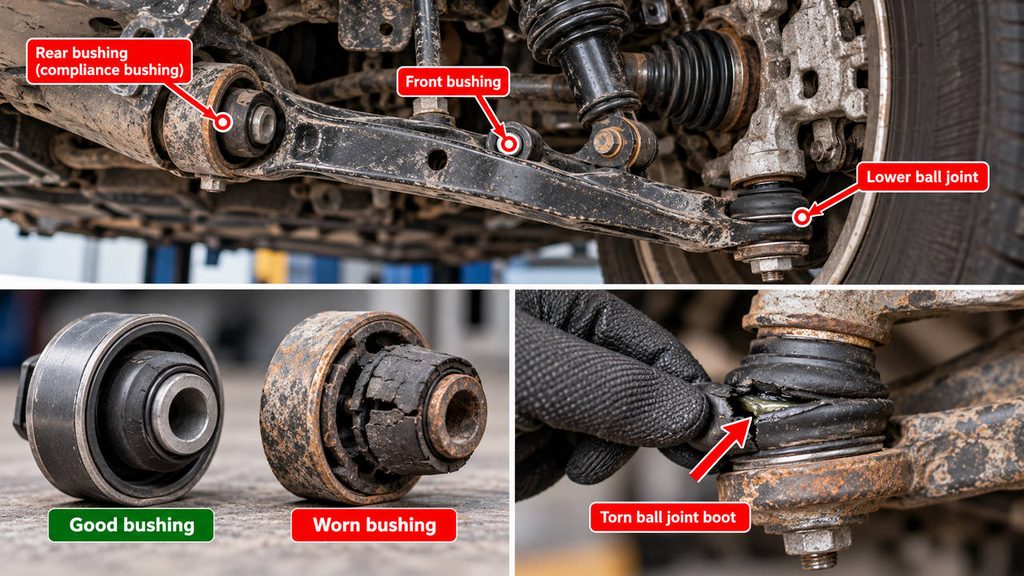
| Clue | Lower control arm bushing | Lower ball joint |
|---|---|---|
| Where to inspect | Inner mounting points at the frame or subframe | Outer connection to the steering knuckle |
| Typical deterioration | Rubber tearing, separation, collapse, or hydraulic-fluid leakage | Internal joint wear, excessive clearance, boot damage, contamination |
| Potential noise | Dull knock during braking, acceleration, or suspension movement | Knock, pop, or squeak as steering and suspension loads change |
| Most useful evidence | Abnormal movement between the arm, bushing, and mounting sleeve | Excessive movement between the ball stud and joint housing |
| Safety concern | Loss of precise wheel location when severely deteriorated | Potential loss of knuckle connection if the joint fails |
| Possible repair | Bushing replacement or complete arm assembly | Ball joint replacement or complete arm assembly |
Consider a front control arm with two inner bushings and an outer ball joint. If the rubber surrounding the rear bushing has separated from its sleeve, braking forces may move the arm excessively at that mount. The ball joint at the other end could still be perfectly serviceable.
Now imagine the bushings are intact but the steering knuckle moves relative to the lower ball joint housing. That points toward a different failure, with different repair and safety implications.
A torn dust boot is an important warning sign, but it doesn’t automatically reveal the amount of internal joint wear. Similarly, small surface cracks in an aging rubber bushing don’t necessarily mean the bushing has completely failed.
The condition and movement of the actual component should determine the diagnosis.
How to Check a Lower Control Arm for Damage or Wear
You can collect useful evidence with a flashlight and a careful visual inspection. Testing ball joint clearance or bushing movement is more complicated because suspension loading and the vehicle’s service procedure matter.
Before inspecting: Park on a stable, level surface, secure the vehicle as directed by its manufacturer, and never place yourself underneath a vehicle supported only by a jack. Do not loosen control arm bolts, ball joint fasteners, or spring-related hardware to perform a basic inspection. If access requires lifting the vehicle or working near a loaded suspension joint, use the correct service information and equipment or have a professional do the work.
Start With the Symptom, Not a Replacement Part
Before taking anything apart, write down when the problem occurs. Does it knock while braking? Only on sharp bumps? Does the car drift constantly, or does its direction change with road loading?
Also note whether the issue began gradually or immediately after hitting a pothole or curb. A sudden steering change after an impact raises different concerns from a bushing that has slowly deteriorated over years.
If braking or steering control is compromised, don’t perform further driving tests to gather more clues.
Identify the Lower Control Arm and Its Mountings
Look behind the front wheel to identify the control arm’s inner mounting points and its outer connection to the steering knuckle. Many vehicles have a front and rear bushing on each lower arm, although layouts vary.
Use a flashlight to look for displaced rubber, damaged mounting brackets, abnormal gaps, corrosion, or evidence of metal components striking one another.
Do not mistake every opening in a bushing for damage. Some factory bushings have molded voids or asymmetric shapes designed to control compliance. A correctly shaped void isn’t the same as torn rubber.
Where practical, compare the mounting arrangement with the opposite side and the vehicle’s parts documentation.
Look for Torn Bushings and Hydraulic-Fluid Leakage
Signs worth investigating include rubber completely separating from a sleeve, missing pieces, unusual displacement, or polished contact marks showing that the arm has been moving against surrounding metal.
If the vehicle uses a hydraulic bushing, fluid residue around the bushing may indicate that its internal chamber has ruptured. Check carefully before assuming the liquid came from the bushing; engine oil, power steering fluid, or other nearby leaks can reach the same area.
Surface aging by itself does not establish how much movement the bushing permits. A proper assessment considers the material condition together with the suspension’s actual behavior under an appropriate test.
Inspect the Lower Ball Joint and Dust Boot
Find the joint connecting the lower arm to the steering knuckle. Look for a torn or missing boot, unusual corrosion, grease escaping from the housing, and damaged retaining hardware.
These observations can justify further inspection, but a ball joint with an intact boot can still have internal wear. The reverse is also true: a damaged boot doesn’t tell you precisely how much clearance exists inside the joint.
Do not attempt to inject grease through a sealed boot as a way to diagnose looseness or restore a worn joint. Follow the component manufacturer’s approved service procedure.
Have Excessive Joint Movement Measured Correctly
This is where many home diagnoses go wrong.
You may have seen the familiar advice to raise a wheel, grip the tire at the 12 and 6 o’clock positions, and rock it. That can help reveal looseness somewhere in the assembly, but it doesn’t prove the lower ball joint is bad.
The wheel bearing, upper ball joint on applicable designs, and other suspension components can influence what you feel. Just as importantly, the joint must be inspected under the correct loading conditions.
Some lower ball joints are load-carrying; others act primarily as follower joints. The suspension spring’s position, the type of strut or control-arm system, and the joint’s design affect how the inspection must be performed.
A technician may use controlled movement of the wheel, observation at the joint, and a dial indicator to measure axial or radial clearance. The results should be assessed against the vehicle or joint manufacturer’s specifications—not a universal amount of acceptable play.
A joint tested with the wrong support method may appear tighter or looser than it really is. That’s a good reason to leave the physical play measurement to someone with the correct service information if you’re unfamiliar with the suspension.
Check for Impact Damage and Loose Mountings
If symptoms appeared after hitting something, inspect beyond the rubber and ball joint.
A bent control arm, distorted bracket, shifted subframe, or damaged steering knuckle can change the wheel’s position. Look for fresh scrapes, buckled metal, cracks, or asymmetry between the left and right sides.
Also check whether the mounting hardware is secure according to the service procedure. Do not attempt to compensate for visible deformation by adjusting the alignment or tightening unrelated components.
A qualified shop may need to measure suspension geometry before determining which part was damaged.
MacPherson Strut vs. Double-Wishbone: Why the Diagnosis Changes
One reason lower control arm advice can be confusing is that the same component name is used on different suspension layouts.
A conventional MacPherson-strut suspension usually has a lower control arm and lower ball joint, but no separate upper control arm. The strut itself helps locate the upper portion of the steering knuckle.
In many conventional strut layouts, the suspension spring’s vertical load travels through the strut assembly, while the lower ball joint guides the knuckle. That lower joint is commonly described as a follower joint.
A double-wishbone or short-long-arm suspension generally uses upper and lower arms. Depending on where the spring or torsion bar loads the suspension, one of its ball joints may carry substantial spring load while the other serves a different role.
The distinction matters because a ball joint can be held against one side of its internal bearing surface by the forces acting on it. An inspection performed without accounting for that load may fail to reveal the actual clearance.
There are also modified strut systems and unusual suspension configurations, so avoid identifying the correct test solely by whether the vehicle is a sedan or pickup.
If your vehicle has both an upper and a lower arm, the upper arm may produce overlapping symptoms. Our guide to bad upper control arm symptoms explains the upper assembly’s common failure points and diagnostic differences.
What Else Can Feel Like a Bad Lower Control Arm?
A lower arm sits among several components that react to the same road forces. It’s common to hear a knock from the front corner and assume the largest visible suspension part must be responsible.
Before replacing anything, compare the suspected lower arm problem with other faults that produce similar complaints.
| Possible fault | Common complaint | Useful distinguishing evidence |
|---|---|---|
| Sway bar end link | Repeated clunking or rattling over small bumps | Movement or wear at the stabilizer link joints |
| Tie rod end | Steering looseness, wandering, or a knock during steering changes | Excessive play isolated to the steering linkage |
| Wheel bearing | Humming or growling, sometimes with wheel looseness | Hub-bearing inspection and noise characteristics |
| Strut mount or bearing | Popping, creaking, or noise near the strut tower | Abnormal upper mount movement or bearing behavior |
| Brake hardware | Clunk or vibration during braking | Loose or damaged caliper, pads, hardware, or brake-related faults |
| Tire or wheel problem | Pulling, shimmy, speed-related vibration, irregular wear | Tire pressure, condition, balance, or wheel runout |
| Lower control arm assembly | Clunk, load-dependent movement, steering inconsistency | Confirmed abnormal motion or damage at the lower arm, bushings, or joint |
For example, loose steering combined with tire wear can point toward a tie rod problem rather than the control arm. Our bad tie rod symptoms guide explains the warning signs and how excessive play is identified at the inner and outer steering joints.
And don’t overlook the tires. A damaged tire can cause pulling and vibration even when every control arm and ball joint is in good condition.
Do Front and Rear Lower Control Arms Have the Same Symptoms?
Not exactly.
Front lower control arms help locate the steering knuckles on many vehicles. Wear can therefore affect steering precision, front-wheel alignment, and how the vehicle responds to braking.
Some independent rear suspensions also use lower control arms or lower links. Those components locate the rear wheel carriers and react to forces from bumps, cornering, and acceleration.
A damaged rear lower arm or bushing may cause knocking from the rear suspension, abnormal rear tire wear, or a sensation that the back of the vehicle shifts under load.
Rear multilink systems can use separate toe links, camber links, trailing arms, and lower links. Their functions overlap, but they aren’t interchangeable. A rear-end handling problem should be traced to the actual worn component using the specific suspension diagram.
This article focuses mainly on front lower control arms because that’s the most common context for searches about steering looseness and lower ball joint wear.
Can You Drive With a Bad Lower Control Arm?
The answer depends on what is damaged and how seriously the lower arm’s ability to locate the wheel has been affected.
Light surface cracking in an otherwise secure rubber bushing isn’t the same as a bushing that has separated completely. Neither is equivalent to a severely loose lower ball joint or a control arm that has bent after a collision.
With substantial wear, the wheel may not remain in its intended position when subjected to steering, braking, or road forces. A severely compromised ball joint or mounting connection can present a much more serious risk, including loss of wheel control.
When You Should Not Continue Driving
Stop driving and arrange professional assistance or towing if you notice any of the following:
- A wheel looks significantly tilted, displaced, or positioned unusually far forward or backward in its opening.
- Steering suddenly becomes loose, unpredictable, or difficult to control.
- A lower ball joint has confirmed severe looseness or shows signs of separation.
- The control arm, subframe mounting point, or associated bracket is visibly cracked or structurally damaged.
- A major impact is followed by severe pulling, instability, or obvious suspension displacement.
- A technician identifies a safety-critical suspension defect requiring the vehicle to be taken out of service.
For milder unexplained symptoms, arrange an inspection promptly. There is no reliable number of days or miles you can safely continue driving with a suspected lower control arm problem.
Also be careful with online advice suggesting that a particular clunk or torn boot guarantees a specific amount of remaining service life. Neither provides that information.
What Happens After a Lower Control Arm Problem Is Confirmed?
A correct repair begins with identifying the failed part. A new complete control arm may be appropriate, but it’s not the only possible solution on every vehicle.
If the Lower Control Arm Bushings Are Worn
Some vehicles allow individual bushings to be removed and replaced while retaining the original metal arm. Others are more practical to repair with a complete replacement control arm that already contains new bushings.
The decision depends on whether the bushings are independently serviceable, whether the arm remains structurally sound, and what other components are worn.
Our lower control arm bushing replacement cost guide compares bushing-only repair with replacing the complete assembly, including the effect of press labor and alignment.
If the Lower Ball Joint Is Worn
Some lower ball joints are available as separate replacement parts, while others are integrated into the control arm or are normally serviced as part of a complete assembly.
The condition of the joint housing and mounting bore also matters. If the control arm cannot securely retain a replacement ball joint, installing another joint into the same damaged arm isn’t an appropriate solution.
For differences between replacing the joint and replacing the entire arm, see our lower ball joint replacement cost guide.
If the Metal Arm Is Bent or Damaged
A bent, cracked, severely corroded, or otherwise structurally damaged lower control arm generally requires replacement according to the manufacturer’s repair procedure.
The technician should also check adjacent components for impact damage rather than assuming the visible arm was the only part affected.
If you’re comparing estimates for a complete assembly, our lower control arm replacement cost guide covers parts, labor, and factors that influence the final bill.
Does the Vehicle Need an Alignment Afterward?
Lower control arm replacement or bushing service commonly warrants checking the wheel alignment. The arm helps locate the wheel, and removing or replacing its mounting points can change suspension geometry.
Some vehicles also have alignment adjustment hardware located at or near the lower control arm mounts.
Before performing final alignment measurements, the shop should confirm that the suspension is mechanically sound and that the replacement parts and fasteners have been installed according to the manufacturer’s specifications.
On bonded-rubber bushings, some designs require final pivot-fastener tightening at the specified ride position to prevent unwanted bushing preload. The correct procedure varies by vehicle.
Wheel alignment cannot compensate for a loose ball joint, separated bushing, or damaged mounting point that still allows the wheel to move abnormally.
Frequently Asked Questions
What are the first signs of a bad lower control arm?
Common early complaints include a clunk over bumps, a knock during braking or acceleration, or a change in steering feel. However, there is no universal first symptom. Some deteriorating bushings are discovered during routine inspection before the driver notices anything unusual.
What does a bad lower control arm sound like?
A bad lower control arm assembly may cause a dull thud, knock, clunk, creak, or pop. Worn bushings can knock when the arm shifts under braking or over bumps, while a worn ball joint can make noise during suspension or steering movement. Sound alone cannot distinguish these faults reliably.
How can I tell if my lower control arm bushings are bad?
Look for rubber separating from its metal sleeve, missing material, abnormal displacement, or fluid leakage from a hydraulic bushing. A technician should check whether the mounting allows excessive movement. Minor surface cracks or intentional molded voids do not necessarily indicate failure.
Can a bad lower control arm cause shaking when braking?
Yes, deteriorated bushings or excessive joint movement can contribute to instability when braking forces act on the front suspension. However, brake disc issues, caliper problems, tires, and other suspension faults can also cause shaking. The braking system and suspension should both be inspected before replacing the arm.
Can bad lower control arms cause uneven tire wear?
Yes. Excessive movement or structural damage can affect how consistently the wheel maintains its intended alignment. But inner-edge, outer-edge, or feathered tire wear is not specific to a bad lower control arm. Tire condition, toe, camber, and other suspension components must also be evaluated.
Will an alignment fix bad lower control arm symptoms?
No, not if the underlying problem is a loose ball joint, failed bushing, bent arm, or damaged mounting point. An alignment adjusts wheel geometry; it does not restore mechanical integrity. Worn or damaged components should be addressed before final alignment measurements.
Can I drive with a bad lower control arm bushing?
It depends on the severity of the deterioration and whether the bushing still controls the arm properly. Mild surface aging is different from severe separation or uncontrolled movement. Because driving symptoms alone cannot establish the remaining safety margin, arrange an inspection promptly and do not continue driving if the vehicle becomes unstable.
Do lower control arms need to be replaced in pairs?
Not automatically. Both sides should be inspected, especially on a high-mileage vehicle, but a sound control arm generally doesn’t need replacement solely because the opposite side is worn. The decision should be based on component condition, vehicle-specific service recommendations, and the actual repair required.
How do I know if the lower ball joint or control arm is bad?
A lower ball joint problem is identified by excessive movement or damage at the connection to the steering knuckle. A bushing problem is identified at the control arm’s inner mounting points. The metal arm itself should be inspected for bending, cracks, corrosion, or impact damage. The appropriate ball joint test depends on the suspension design and manufacturer’s specifications.
Don’t Replace the Arm Until You Know What Moved
Lower control arm symptoms are frustrating because they rarely point to one unmistakable part. A clunk can sound like a worn bushing, a ball joint, or something completely unrelated. Wandering steering might involve the control arm, but it could just as easily begin with the tires or steering linkage.
Focus on what happens when the symptom appears. A knock as braking force changes makes the arm’s bushings worth inspecting. Excessive movement at the knuckle connection puts the lower ball joint under suspicion. An immediate alignment change after an impact raises concern about structural damage.
The next step is to confirm the physical fault, not to order a replacement based on a familiar noise. Once you know whether the problem is the bushing, ball joint, arm, or something nearby, the repair decision becomes a lot more straightforward.