Ram 1500 Lift Kit: Heights, Fitment & Air Ride Options
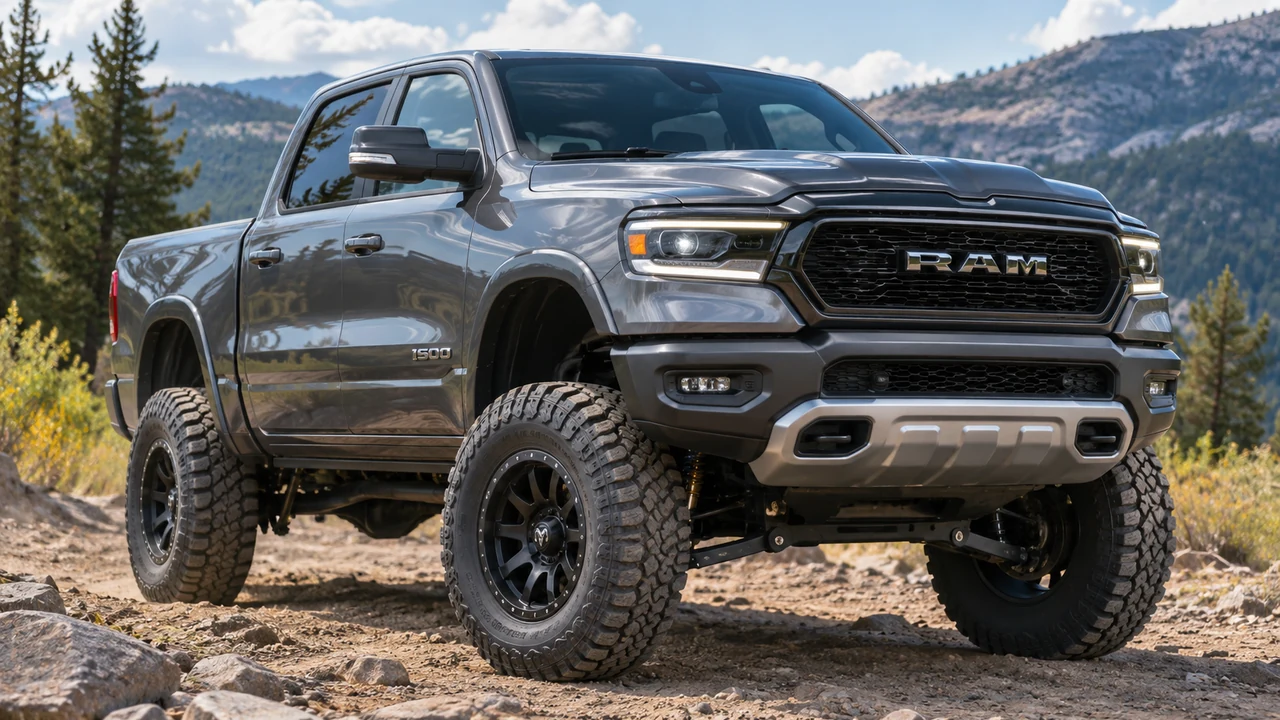
For a daily-driven pickup on stock-size or mildly larger tires, a Ram 1500 lift kit in the 2–3.5-inch range is usually a more manageable starting point than a 6-inch system. The useful question is not “How tall can I make it?” but “Which kit fits this exact Ram, and what will it change?” A small front level can tidy up the stance; a properly matched suspension package can support a more capable build; a tall crossmember lift brings a much longer parts and labor bill.
Before comparing prices, settle two questions that can invalidate an entire shopping cart: Is the truck the older Ram 1500 Classic (DS) or the redesigned 1500 (DT)? And does it have factory four-corner air suspension or conventional coil springs? Two pickups registered in 2019 can need different lift hardware, while a kit intended for rear coils may not work on an air-suspension truck at all. Start with those answers, then choose the height.
Which Ram 1500 Lift Kit Should You Choose?
For most buyers, these are sensible starting points rather than universal tire-fitment promises. The figures refer to advertised suspension-height changes; the actual gain at the front and rear may differ. Your engine, trim, added equipment and factory ride height matter.
| What you want | Starting point | Check before ordering |
|---|---|---|
| Less front rake, mostly pavement, near-stock tires | Approximately 1–2-inch front level or matched struts | Coil versus air ride; factory off-road height; alignment |
| Daily driver with a stronger stance and modest trail use | Well-engineered 2–3-inch setup | Front upper control arms, rear height, shock travel, tire clearance |
| Frequent trail use or a carefully planned 35-inch tire build | Complete 3–3.5-inch system, where applicable | Trim exclusions, wheel offset, bump stops and intended off-road rating |
| Large tires and a high-stance custom build | Purpose-built 4–6-inch suspension system | Crossmembers, knuckles, driveline, steering, cutting and installed cost |
The best value is often a shorter kit that keeps the truck pleasant to steer and leaves money for the tires, shocks and installation checks you actually need. Do not assume that a product labeled “3.5-inch lift” adds 3.5 inches at both axles. Some use a taller front change and a smaller rear change to reduce factory rake.
Also separate a front-only leveling job from a full suspension lift. If you are deciding between those two goals rather than shopping for a Ram-specific system, our leveling kit vs lift kit guide explains the broader trade-offs. Here, the focus is what fits a Ram 1500 and why.
Ram 1500 Lift Kit Fitment: Classic, DT and Older Generations
A generic “Dodge Ram 1500 lift kit” search returns products for trucks that share a name but not a chassis. This is particularly risky with 2019 model-year listings, when the carried-over Classic and new-body Ram were sold side by side. Identify the truck before using the retailer year filter.
| Truck family | Model-year guide | Main thing to verify |
|---|---|---|
| Older Dodge Ram 1500 | 1994–2008 | Front suspension layout, axle and drivetrain; no later coil-rear assumptions |
| Ram 1500 DS | 2009–2018 | 2WD/4WD parts and conventional coils versus optional air equipment |
| Ram 1500 Classic (DS) | 2019–2024 | Older-body kit family; not the redesigned DT package |
| Ram 1500 DT | 2019 onward | New-body suspension, six-lug wheel pattern and trim-specific exclusions |
These are US-market shopping ranges, not a replacement for the manufacturer’s application chart. Previous repairs or modified suspension pieces can complicate an otherwise straightforward fitment.
Older Dodge Ram 1500: Do Not Shop by Name Alone
An older Dodge-badged 1500 is a different project from a fifth-generation Ram. The steering, front axle or control-arm design, rear suspension and mounting locations vary across the earlier trucks. Even if a catalog offers a familiar 2- or 4-inch height, it may use completely different components from the kits shown for 2019+ pickups.
Verify the exact year, 2WD or 4WD setup, front suspension layout and existing axle equipment. On an aging truck, worn ball joints, leaf-spring bushings, steering joints or corroded mounts deserve attention before any height increase. A lift kit will not cure loose or deteriorated original hardware.
2009–2018 Ram 1500: The DS Family and Rear Coils
The 2009 redesign moved the Ram 1500 to a coil-sprung rear suspension. That matters because a rear coil spacer or replacement spring is not the same part as a leaf-spring lift block. On four-wheel-drive versions, the front independent suspension and CV-axle angles also limit how much lift can be achieved with basic strut parts alone.
Many popular 2012–2018 4WD systems are listed separately from earlier 2009–2011 applications, so “DS” alone is still not a part number. Check the engine, drivetrain, shock package and whether factory air suspension is installed. If the truck already has adjustable shocks, replacement control arms or a factory-raised trim, record those before choosing a new package.
2019–2024 Ram 1500 Classic: The Old Body Continued
The Classic kept the earlier DS architecture while the redesigned Ram 1500 entered the market. In many US catalogs, a Classic uses the older 2009–2018-style kit family, but only if the individual part maker explicitly lists the Classic application. A retailer’s broad “fits 2019 Ram 1500” heading can mask two different trucks.
One fast visual clue is the wheel pattern: the DS/Classic uses five lugs per wheel, while the new DT uses six. That helps identify which truck you are looking at, but it is not a substitute for VIN-based chassis identification or an exact suspension fitment check. An aftermarket wheel or previous modification can also mislead a casual glance.
2019-Onward Ram 1500 DT: Different Kit, Different Details
The newer-body DT uses its own front and rear suspension arrangement. Coil-spring DT lifts are widely sold as front strut spacers, loaded strut packages, upper-control-arm systems and taller bracket lifts, but they are not automatically interchangeable with Classic parts. A specific 2WD kit may fit the same general body style as a 4WD kit without sharing all of the hardware.
For newer model years, verify the exact application year range. Some manufacturer catalogs divide six-inch systems into 2019–2024 and 2025-and-newer versions. Do not stretch a 2024 cutoff to cover a 2025 or 2026 truck, even if the model name and advertised height are unchanged. Use the latest instructions for the individual part number.
Factory Air Ride or Coil Springs? This Changes the Shopping List
The available four-corner air suspension is one of the biggest reasons a Ram 1500 lift kit can look right online and still be wrong for the truck. A coil-spring lift changes mechanical spring and damper locations. An air-ride application must account for air springs, ride-height sensing and the vehicle’s electronically controlled height behavior.
Conventional Coil-Spring Ram 1500: What a Typical Kit Changes
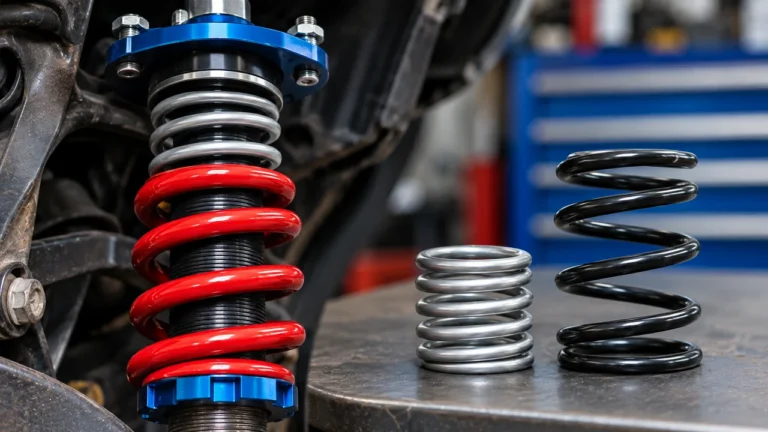
A coil-spring DT generally pairs front strut or coilover assemblies with a rear coil-spring arrangement and separate rear dampers. A small lift may reuse parts of that equipment; a more complete system may add front upper control arms, rear spacers, matched shocks and revised bump-stop provisions. The original springs and struts are not always suitable at every advertised height.
The rear is worth checking independently. A product advertised as 3.5 inches may supply about two inches at the rear rather than matching the front number. That changes both the stance and the loaded rake. Rear coil spacers are one possible component, but they cannot add spring load capacity or shock travel by themselves; our rear coil spring spacer guide covers those limits separately.
Ram 1500 Air Suspension Lift Kits Must Say Air Ride
A standard coil-spring kit should not be installed on an air-equipped Ram just because the front ride-height increase sounds reasonable. Some makers sell air-ride-specific leveling parts and taller lift systems, but those are separate engineered applications with their own year and drivetrain restrictions. A kit may support the factory air system on one truck yet be explicitly excluded on another.
There is a useful example in Rough Country’s 5-inch air-ride system for selected 2019–2024 DT 4WD trucks. Its application notes exclude the Classic and Rebel, specify factory four-corner air suspension, and require 20-inch-or-larger non-factory wheels. The advertised height alone would not reveal any of those limitations. It is a reminder to read the wheel requirements and trim restrictions even when a product is clearly labeled “Air Ride.”
Air suspension also changes ride height automatically under certain conditions. A setting that looks taller when parked is not proof that every wheel clears at highway height, under compression or with the trailer connected. Follow the air-kit manufacturer’s specified testing and calibration procedure, including sensor links and electronic behavior where applicable; avoid improvising around factory safety functions.
Check the Air Suspension’s Condition Before Modifying It
If the truck leans, takes a long time to rise, displays a service message or cannot reach its normal height, establish what is wrong before using spacers or sensor changes to chase a new stance. An unhealthy compressor or leaking air spring is not a fitment problem that a lift will solve. Our Ram 1500 air suspension reset and troubleshooting guide deals with those symptoms; this article is about selecting compatible upgrades.
When in doubt, ask the seller for an answer tied to the truck’s VIN, factory suspension option and exact kit number. “Works with 2019+ Rams” is not specific enough for an air-suspension purchase.
Ram 1500 Lift Height: 2, 3, 3.5, 4 or 6 Inches?
There is no magic number that fits every Ram, and the differences between sizes are not just cosmetic. Moving the truck higher changes where the front control arms, ball joints, CV joints on 4WD models and steering parts sit in their normal operating range. Greater lift also raises questions about shock length, bump stops and the amount of suspension travel that remains usable.
1–2 Inches: A Level Stance Without a Major Build
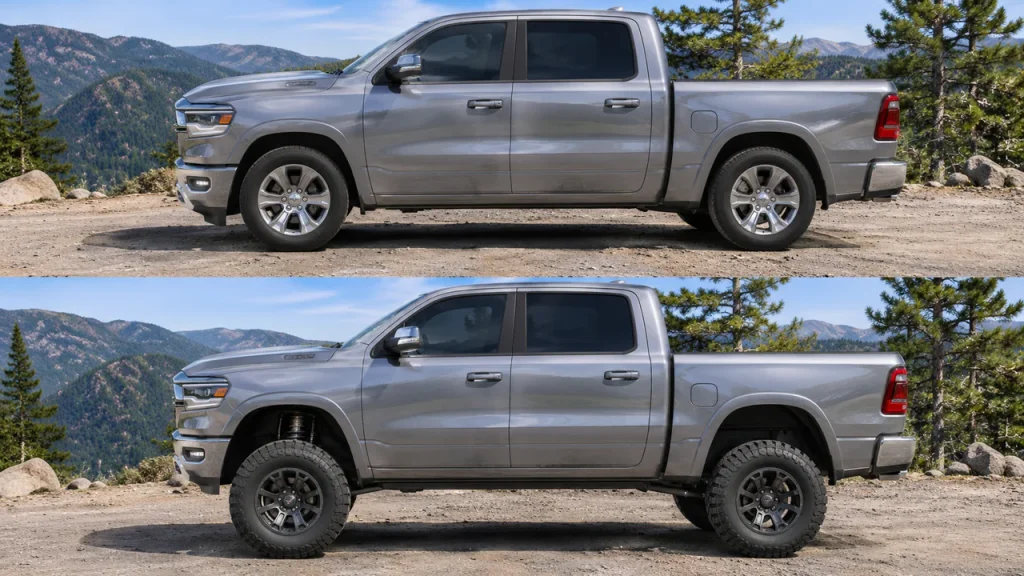
A one- or two-inch front change often addresses factory rake on a truck that mainly commutes, carries a light load and stays close to its original tire size. An application-specific leveling spacer can be economical if the original suspension is in good shape. Replacement loaded struts may be a better investment if the current shocks are worn or the owner wants different damping.
Front-only leveling can also reduce the rake that Ram engineers left for carrying weight. Before buying, measure the truck with its usual passengers, tools or towing gear aboard. A pickup that sits beautifully level when empty can appear rear-low with a trailer’s tongue weight or a full bed. That may make a modest full-vehicle setup more appropriate than eliminating all the front-to-rear difference.
2–3 Inches: Practical Height, With Geometry Checks
This range offers more visible tire room while remaining a relatively modest project on properly supported applications. It is popular for the owner who wants a tougher stance without making the truck awkward in parking garages or on the highway. The kit should state whether the original upper control arms are approved, and whether its front strut arrangement preserves the required travel.
Do not assume that an adjustable strut set to the highest perch gives the same ride and droop as a purpose-designed coilover lift. Raising the static position can leave less extension travel before topping out, depending on the shock design. Ball-joint angle and front alignment can become more important than the height printed in the product name.
3–3.5 Inches: Read the Control-Arm and Bump-Stop Notes
Around 3.5 inches, one maker may supply corrected upper control arms and rear bump-stop hardware; another may have a very different installation approach. A kit missing those parts is not necessarily incomplete, but its instructions must explain how the required movement and alignment are managed. If the truck sees frequent rough trails, verify the system is actually rated for that use rather than assuming an aggressive stance means trail durability.
On a truck with 35-inch tires in mind, the geometry and wheel package matter as much as the height. Wider tires can rub an upper control arm even when the wheel arch looks generous. A wheel that clears the arm may instead place the tire closer to the bumper or fender at steering lock. There is no one-offset answer that works across all tires and Rams.
4–6 Inches: Crossmembers, Knuckles and a Different Budget
Taller Ram 1500 suspension systems often require repositioned suspension mounting points, replacement steering knuckles, revised crossmembers or a front differential relocation strategy on 4WD trucks. That keeps joints and steering geometry within the system designer’s target range, but it is a considerably larger job than adding spacers above factory struts. Cutting, drilling, skid-plate work or non-reversible modifications may be required on particular kits.
A tall suspension lift is also not automatically the most capable off-road choice. Some low-hanging brackets reduce local clearance, heavy tires change braking and acceleration, and a raised center of gravity affects handling. If the goal is highway comfort with slightly larger tires, six inches may be an expensive way to solve a problem that a shorter system could address.
Why a “3.5-Inch Kit” May Lift the Rear Only Two Inches
Many trucks leave the factory with their rear end higher than the front. A kit can deliberately raise the front more than the rear to reduce that rake while preserving a useful loaded stance. A manufacturer might advertise front lift in the headline and specify a smaller rear increase deep in the parts list. That is not deceptive if the details are clear—but it is easy to overlook.
Measure the vehicle before the installation from the wheel-hub center to the same fender reference at all four corners, on level ground, with a repeatable fuel and cargo load. Repeat those measurements after the truck settles and is aligned. Unlike a ground-to-fender measurement, hub-to-fender distance does not count taller tires as suspension lift.
Rebel, Off-Road Package, TRX and RHO: Special Fitment Rules
A factory off-road trim is not just a normal Ram with different stickers. Ride height, dampers, tires, steering and suspension calibration can be different before you touch anything. Some aftermarket kits are intentionally limited to standard-height trucks; others explicitly exclude particular performance trims.
Rebel and Factory Off-Road Packages Can Start Higher
A Rebel may already have a raised factory stance, off-road shocks and larger tires, depending on year and configuration. That affects both the actual lift you will gain and the control-arm or shock travel available at a new setting. Some manufacturer instructions exclude factory-lifted or off-road-package trucks altogether. Do not assume a 3.5-inch kit for a regular Big Horn gives a Rebel another 3.5 inches.
Look for a Rebel-specific or factory-off-road-approved listing and compare its baseline ride height with the instructions. If the product maker gives a maximum hub-to-fender measurement, take the number seriously; a truck that starts too high may sit outside the kit’s intended range even with the correct model-year label.
TRX and RHO Are Not Standard Ram 1500 Applications
The Ram 1500 TRX and the later RHO were built around high-performance off-road suspension packages rather than the normal half-ton street setup. Their factory shocks, suspension travel, control-arm designs and wheel-and-tire packages require separate fitment analysis. Most ordinary Ram 1500 leveling and lift kits should be considered unconfirmed or excluded unless the maker specifically approves the performance model.
In particular, the RHO already uses a significantly raised factory off-road configuration with 35-inch-class tires. Ordering a regular DT lift to get the stance shown in a RHO photo makes little sense. If you own one of these trucks, shop by the exact trim and suspension specification rather than treating “1500” as the complete vehicle description.
Do Not Confuse a Ram 1500 With a 2500 or 3500
Heavy-duty Ram pickups use different axles, spring and suspension layouts. A kit for a 2500 Power Wagon, a 3500 dually or a leaf-spring heavy-duty rear axle is not a substitute for a Ram 1500 kit. The similar grille and familiar trim names do not make the parts interchangeable.
Can a Lifted Ram 1500 Fit 33-, 35- or 37-Inch Tires?
Tire clearance is one reason people buy a lift, but nominal diameter is not enough information. Tire casing dimensions, tread width, wheel offset, backspacing, bump-stop limits, fender shape and the exact truck can all change the result. One truck may fit a particular 35 with minimal changes; another may rub with the same advertised lift height.
33-Inch-Class Tires: Usually the Easier Starting Point
A mild lift or level is often paired with tires around 33 inches, especially on a daily driver. That can keep the overall build comparatively simple, but it is not permission to ignore wheel width and tire section width. A “33” can be wider and measure differently from another “33,” and the contact point may be a control arm rather than the fender.
Check the clearance when the steering is turned in both directions, and again through the safe compression range. The front air dam, liner and nearby suspension parts can matter more than the visual gap above the tire in a parked photo. A truck used to tow or carry equipment also needs its loaded clearance checked.
35-Inch Tires: Match the Exact Wheel, Not Just the Lift Height
Many buyers target 35-inch-class tires with a complete 3–3.5-inch Ram 1500 lift, but there is no universal fit guarantee. An actual tire may be closer to or farther from the stated diameter, and section width changes the room needed at full lock. Some manufacturer examples list a very particular wheel size and offset that the test fit relied on.
For the full tire clearance and wheel-position discussion, see our 35-inch tire lift-height guide. On this page, the priority is the Ram-specific suspension, whether its instructions support the tire, and what else must change to make that combination safe.
37-Inch Tires: Think Beyond a Suspension Kit
A 37-inch Ram 1500 setup can involve much more than installing taller front hardware. Large tire mass and radius affect the braking system, effective gearing, turning feel, spare-tire storage and driveline load. Full-compression clearance may require different wheels, bump-stop provisions or body work. The truck may also become harder to use in tight spaces or with a trailer.
Our 37-inch tire lift guide goes through those general dimensions in more depth. It is better to decide the complete tire, wheel and gearing plan first than to purchase a six-inch kit and hope the rest fits afterward.
Offset and Backspacing Can Undo the Clearance You Thought You Bought
Moving the wheel outward may improve clearance between the tire and an upper control arm, but it can also bring the tread into the fender or bumper as the steering turns. Moving it inward can do the opposite. That is why both a product listing and an experienced installer will ask for the wheel width and offset—not just “20-inch rims.”
Check any manufacturer tire-fitment example as a matched set: truck, trim, lift setting, tire dimensions, wheel dimensions and expected use. If the product says a specific 35×12.50 tire requires a certain wheel offset, do not treat that one test as approval for every tire carrying the same size label.
What Should a Complete Ram 1500 Lift Kit Include?
Two boxes marked “3-inch Ram lift” may offer very different outcomes. One could contain front spacers and rear spring pieces; another could supply complete dampers, upper control arms and geometry correction. Compare the list of parts with the manufacturer’s actual installation requirements, not with the number of pieces in the product photo.
Before making a price comparison, confirm how the chosen system handles each of the following functions. Not every height or truck needs every component, but any required item should be identified in the instructions.
- Front height and damping: correct strut spacers, loaded struts or complete coilovers for the chassis and existing suspension.
- Rear ride height: suitable coil-spring hardware or a dedicated factory-air application, with shock length and load taken into account.
- Upper control arms: factory-arm approval, revised joint angles or new arms where needed to retain acceptable clearance and alignment.
- Travel protection: bump-stop extensions and shock travel checks that prevent damage at full compression or droop.
- Steering and 4WD geometry: knuckles, brackets, differential provisions or other correction specified for taller systems.
- Wheels and tires: approved width, offset, backspacing and tire dimensions for the exact truck and advertised height.
- Hardware and installation: correct fasteners, torque instructions, trim exclusions and post-install alignment or calibration requirements.
The list should leave you with fewer unknowns, not just more things to buy. If the kit relies on original shocks, ask whether those shocks have enough compression and extension travel in the new position. If it includes aftermarket shocks, check the actual model and lengths instead of assuming every brand’s “premium” label means the same damping performance.
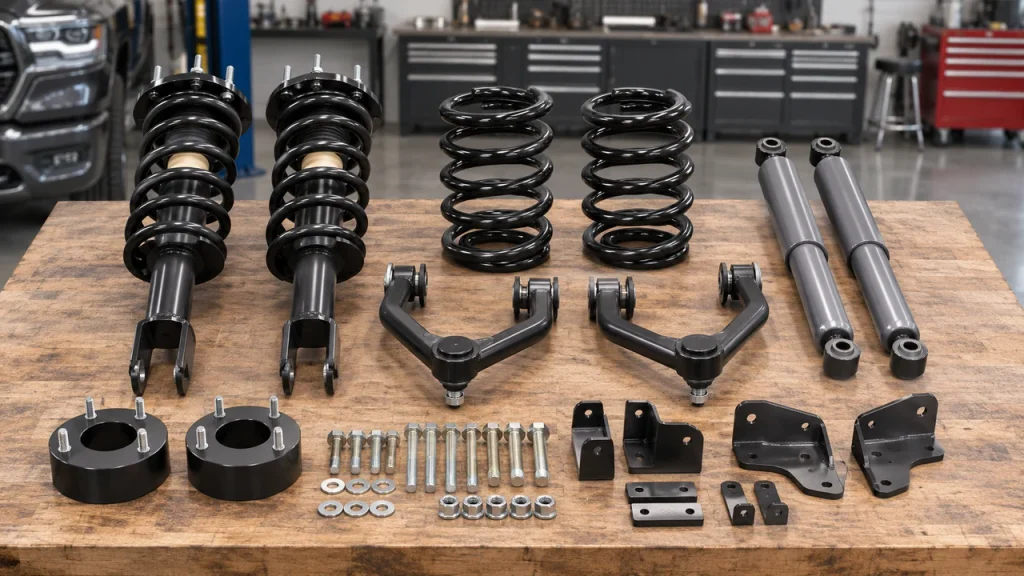
Upper Control Arms Are a Geometry Choice, Not a Fashion Upgrade
Independent-front-suspension Ram 1500 trucks depend on control arms to locate the wheels. A taller operating position can change caster, the working angle of a ball joint and clearance around the strut or tire. Some kits use revised upper control arms with the correct ball-joint cup angle; others are designed to work with factory arms in a limited height range.
Neither “always upgrade the UCAs” nor “stock arms are fine until six inches” is a sound universal rule. The deciding facts are the chosen kit, actual ride height, alignment range and joint clearance under controlled movement. Ask the installer how those were verified rather than relying on an unmeasured photo.
Shocks, Bump Stops and Droop Limits Must Agree
A longer shock is not automatically better. The axle or suspension arm must reach its intended compression stop before the shock mechanically bottoms out. At extension, brake hoses, wheel-speed wiring, joints and spring retention all need to remain within their limits. A kit that ignores those relationships may feel acceptable on pavement and become a problem on rough ground.
This deserves extra attention if the pickup will be driven on washboard roads, used for towing or fitted with heavier tires. Controlled full-bump and droop checks are part of a proper installation, not an optional upgrade package.
Why 2WD and 4WD Listings Sometimes Differ
A 4WD Ram has front driven axle and differential components that a 2WD truck does not. On higher lifts, some systems address the differential and front shaft geometry with dedicated hardware. A 2WD package may use a different crossmember or knuckle arrangement, even when the truck looks identical from the side.
Choose the exact drivetrain in the manufacturer application list. It is entirely possible for a modest kit to carry a 2WD/4WD approval while a taller suspension system splits into different part numbers. Neither pattern should be assumed for another product.
Spacer, Loaded Strut or Full Suspension System?
These products can all change ride height, but they are not equivalent ways to control travel, load or wheel position. When comparing them, ask what each replaces, what it leaves untouched and what its limitations are for your specific Ram.
Strut Spacers and Basic Leveling Kits
A bolt-on spacer can be a reasonable approach for a mild front level when the factory hardware is healthy and the maker approves that application. It retains much of the original suspension hardware, which helps explain the lower entry price. It does not change a worn damper into a new one, and the altered suspension position still has to stay within acceptable joint and shock limits.
Spacer location also matters. A top-mount spacer is not always mechanically equivalent to a spring preload spacer, so two kits with seemingly similar hardware can produce different ride-height changes. Follow the specified measurements and installation sequence, especially when a kit stacks more than one type of spacer.
Replacement Struts and Coilovers
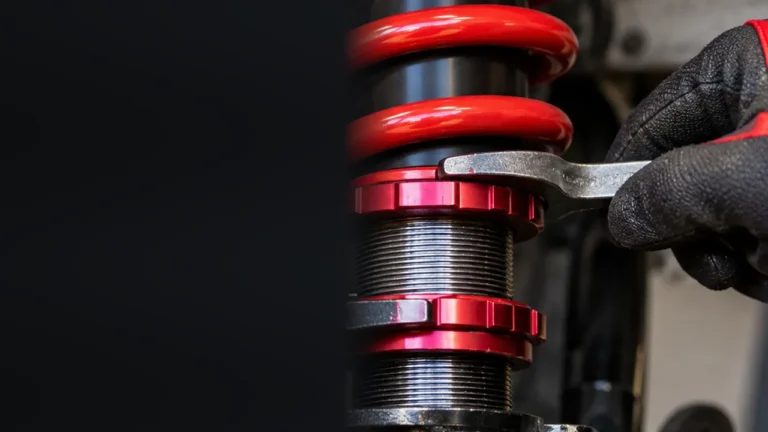
Loaded strut assemblies are often attractive on a truck whose original front dampers have already covered substantial mileage. Depending on the product, they can include a matched spring, new upper mounting hardware and a preset or adjustable ride-height range. More expensive coilovers may be designed around better damping control, reservoir capacity or heavier constant loads.
The benefit should show up in the actual specifications: compression and rebound behavior, spring load range, usable travel and serviceability. A reservoir does not automatically produce a smoother ride, and maxing out an adjustable strut is not necessarily the best setting for it. Match the suspension to the way you drive, not the most dramatic product photo.
Full Bracket and Crossmember Systems
For 4–6-inch projects, the components usually do more than raise the front spring seat. Depending on the design, a complete lift can relocate lower control-arm mounts, replace knuckles, revise differential positioning and provide corresponding rear suspension hardware. The upside is that the kit can address geometry that a simple tall spacer cannot. The downside is expense, labor and possible loss of reversibility.
Read the installation PDF before buying a tall system. A requirement to cut factory crossmembers, replace steering components or use particular wheels may be an acceptable trade for a dedicated off-road build, but it should never be discovered after the shop has already disassembled the truck.
How to Compare Ram 1500 Lift Kit Brands and Fitment Claims
Rough Country, ReadyLIFT, BDS, ICON Vehicle Dynamics, Eibach, Fabtech and other manufacturers sell very different Ram 1500 solutions. A low-cost spacer, a complete daily-driver strut package and a long-travel-focused suspension system are different categories of purchase, so a single “best brand” answer can mislead more than it helps.
A useful comparison starts with six details: exact truck fitment, the intended driving conditions, front and rear height changes, included geometry parts, shock specifications and the required wheel setup. Warranty and replacement-part availability matter as well. A manufacturer with a strong reputation still sells individual kits with specific exclusions.
A Real-World Fitment Example: ReadyLIFT 69-1935
The ReadyLIFT 69-1935 manufacturer listing illustrates why the part number matters more than a generic product title. Its published 2019–2026 DT application describes 3.5 inches at the front and two inches at the rear, with front upper control arms, rear coil spacers and bump-stop hardware. It specifically excludes factory air suspension, pre-lifted or off-road-package applications and TRX trucks.
The listing also gives a wheel-and-tire test specification and says the kit is not intended for off-road use or abuse. That last detail is easy to miss when shopping from a search result showing a lifted truck in rough terrain. The example is not a product endorsement; it shows why fitment, use restrictions and tire requirements need to be read together.
Beware of Broad “2019–2026 Fits All Rams” Labels
Even when a product covers several model years, a retailer’s shortened title may omit Classic versus DT, air ride, engine or trim exclusions. Sometimes a listing has newer model years in its headline while the manufacturer’s detailed application table stops earlier. Trust the maker’s current part-specific instructions and clarify disagreements before ordering.
If you are choosing between two kits at different prices, ask the shop to compare the complete installed setup: shocks, arms, rear components, alignment, wheel requirements and any necessary electronic calibration. An apparently cheaper kit may need a second parts order to reach the same functional result.
Ram 1500 Lift Kit Cost: What Is the Real Total?
A simple leveling package can start at well under a few hundred dollars in parts, while complete strut-and-arm kits often move into the high hundreds or thousands. A tall system with crossmembers, knuckles and more involved labor can cost several thousand dollars before tires or wheels. These are broad US budgeting bands rather than live product quotations, and the actual year, drivetrain, shock choice and region can change the total substantially.
The expensive surprise is often what the original product price does not include: extra upper control arms, longer or matched shocks, alignment, larger tires, wheels with the correct offset, labor on seized factory bolts and any driver-assistance system inspection. The rear load and towing setup may also need attention when changing the original ride-height relationship.
Installation and Alignment Are Part of the Purchase
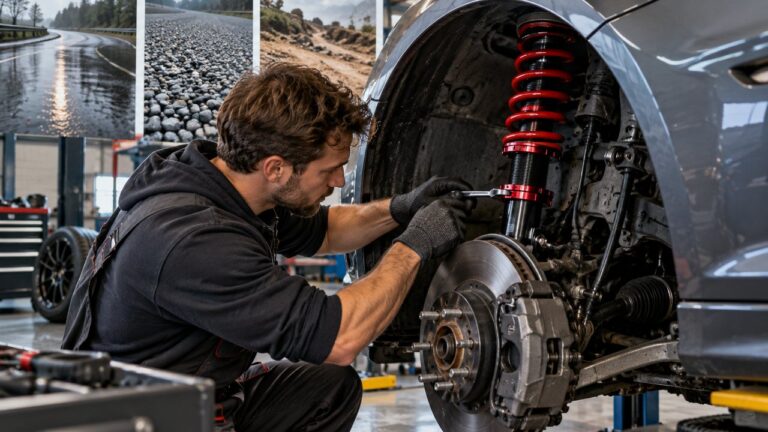
Ask for a written quote showing parts, labor, new fasteners, wheel alignment and any after-install checks. A modest front leveling job is much smaller than a high lift requiring bracket work and a more extensive steering and driveline inspection. The shop also needs a plan to check for rubbing, brake-hose tension and shock travel rather than handing back a truck that simply looks taller.
Our lift kit installation cost guide goes into general labor and price ranges. For the Ram 1500, the main additional cost variable is fitment complexity: new-body versus Classic, coil versus air suspension, standard versus specialty trim and the actual front-end hardware the kit requires.
Towing, Payload and Driver-Assistance Checks
A suspension lift does not automatically increase the manufacturer’s payload or towing ratings. Raising the nose can reduce the original rake that helps when a trailer loads the hitch, and heavier wheels or tires may use up some of the truck’s available carrying capacity. The modified setup still has to work within the published vehicle and hitch ratings.
Changes in ride height, tire size and vehicle pitch may also affect headlight aim and some camera- or radar-based driver-assistance functions. Check the manufacturer’s requirements for inspection or calibration instead of assuming an alignment printout proves every system is properly configured. A shop familiar with the exact Ram generation is preferable to one quoting a generic truck-lift flat rate.
Budget for the First Inspection After Installation
Even with a quality kit, new suspension parts need a sensible post-install process. Follow the maker’s fastener-torque and recheck schedule; monitor unusual noises, steering feel, air-system warnings if equipped, CV boots and tire wear. A new vibration or a truck that pulls after the lift deserves diagnosis, not a steering stabilizer purchased to hide the symptom.
Six Checks Before You Order a Ram 1500 Lift Kit
If you have narrowed the search to one or two products, record these details before paying. A short worksheet catches many fitment mistakes that broad retail filters miss, especially on trucks whose factory suspension is no longer completely stock.
- Confirm the platform: identify Classic/DS versus DT (or the exact earlier Dodge Ram generation), model year, VIN and trim.
- Check the suspension: conventional coils or factory four-corner air ride; note any existing strut, arm or ride-height modifications.
- Record drivetrain and factory options: 2WD/4WD, Rebel or other raised package, TRX/RHO and engine or off-road equipment exclusions.
- Write down wheel and tire dimensions: current and planned tire width/diameter, wheel width, offset and backspacing.
- Read the complete maker instructions: included parts, required extra purchases, bump-stop and joint travel, cutting/welding, fitment cutoffs and intended vehicle use.
- Compare installed totals: the kit plus shocks, arms, wheels/tires, shop work, alignment, calibration and follow-up checks.
If the retailer and the manufacturer disagree about fitment, stop there. Do not use a headline, an owner’s photo or the fact that another truck has the same grille as proof. A couple of minutes spent identifying the correct chassis can prevent a costly return—or a poorly matched suspension.
Ram 1500 Lift Kit FAQ
These questions come up when a buyer has picked a likely lift height but is still unsure whether the kit will work on the exact truck. The safest answers depend on the application details, not on a fixed rule based on inches alone.
What Is the Best Lift Kit Height for a Daily-Driven Ram 1500?
A mild level or properly engineered 2–3-inch lift is a reasonable starting point for many daily drivers that will retain practical tire sizes. Some owners may prefer a complete 3.5-inch package, provided it suits their truck and driving conditions. Ride quality depends on spring and shock tuning, not just the number of inches.
Will a 3.5-Inch Ram 1500 Lift Fit 35s?
Some 3.5-inch kits are designed around particular 35-inch wheel-and-tire combinations, but clearance is never universal. The actual tire width, wheel offset, truck trim, bumper, fenders and full-compression movement decide whether it rubs. Use the exact fitment example and instructions for the kit you are buying.
Is a 2019 Ram 1500 Classic Lift Kit the Same as a 2019 Ram 1500 Lift Kit?
No. The Classic retains the older DS platform, while the redesigned Ram 1500 uses the DT platform. Their suspension and many wheel components differ. Check the chassis and the manufacturer’s model-specific fitment instead of shopping solely by model year.
Can I Install a Regular Lift Kit on a Ram 1500 With Air Suspension?
Not unless the product maker specifically approves the factory four-corner air system. Most coil-spring kits are not direct substitutes for air-ride hardware. Look for a dedicated air-compatible application and instructions for ride-height sensing, compression and calibration where required.
Do Ram 1500 Lift Kits Work on 2WD and 4WD Trucks?
Some do, and some have separate part numbers. The 4WD truck has front driven CV axles and differential components that can change the requirements of a taller lift. Read the precise drivetrain application line for the product and your year.
Does a Lift Kit Increase Ram 1500 Payload or Towing Capacity?
No. A lift changes ride height and suspension geometry, not the truck’s published ratings. It can affect hitch height, rake, handling and how the vehicle behaves under load. Account for any heavier wheels and tires and stay within the original vehicle and hitch limits.
Should I Buy a 6-Inch Ram 1500 Lift Kit for 35-Inch Tires?
Not automatically. Some builds can clear a suitable 35-inch tire with a lower, properly matched suspension and wheel setup. A six-inch kit may bring crossmember or knuckle changes and extra expense without solving an offset or full-compression contact problem. Choose the tire and functional goal first.
Will a 2024 Ram 1500 Lift Kit Fit a 2025 or 2026 Ram 1500?
Only when the manufacturer explicitly includes the newer year and your exact configuration. Some tall-kit catalogs separate 2019–2024 products from 2025-and-newer kits. Similar styling and the same advertised lift height are not adequate compatibility evidence.