Off-Road Suspension Types: Which Setup Is Best?
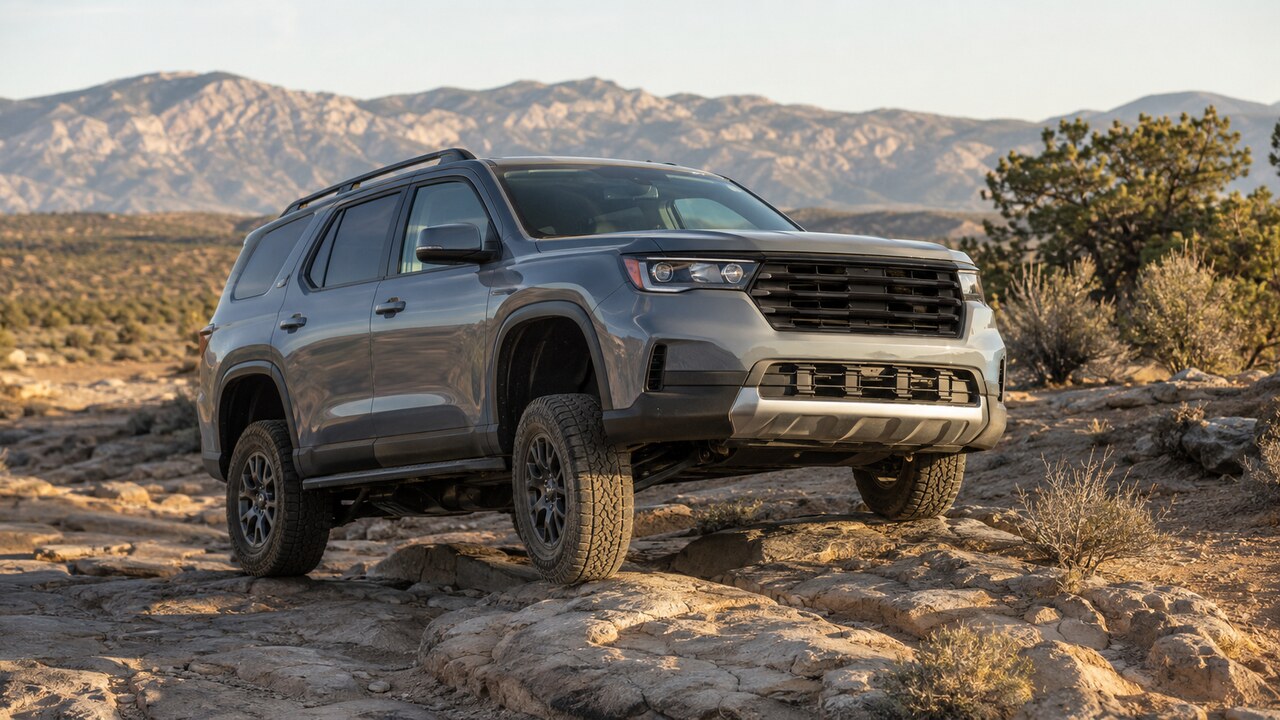
The best off-road suspension type depends on how and where you drive. Solid axles are usually the simplest choice for low-speed rock crawling, heavy impacts, and maximum articulation. Independent suspension gives each wheel more freedom to react and usually delivers better steering, comfort, and control over faster, uneven terrain. For a street-driven truck or SUV, independent front suspension with a solid rear axle is often the most practical compromise.
Quick answer: Choose the vehicle and suspension architecture for the hardest job it must do regularly—not for the most extreme trail you might drive once. Tires, ground clearance, gearing, traction aids, spring rates, damping, and driver technique can matter as much as the axle layout.
The Three Main Off-Road Suspension Layouts
Suspension terminology becomes confusing because axle layout, spring type, linkage design, and shock type are often mixed together. They describe different parts of the system. A solid axle can use leaf springs or coil springs. An independent suspension can use coilovers, separate coils and shocks, torsion bars, or air springs.
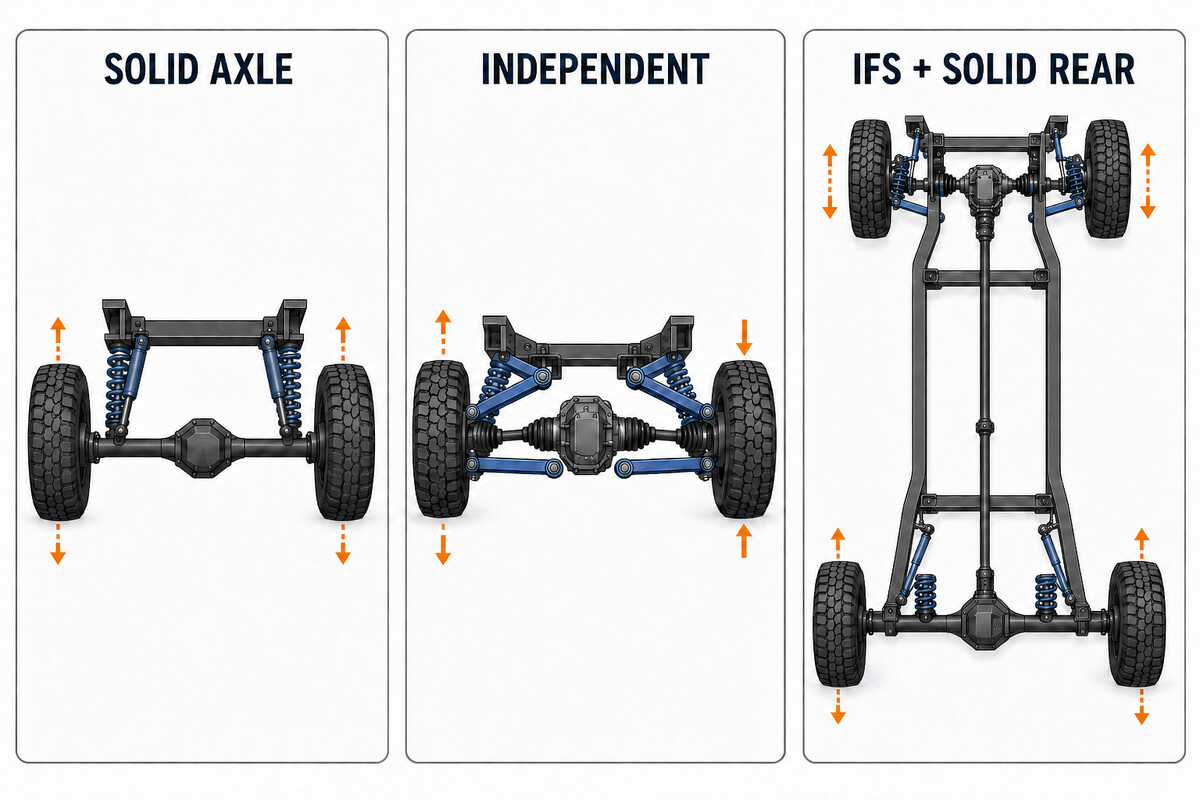
1. Solid Axle Suspension
A solid axle, also called a live axle when it drives the wheels, connects the left and right wheels through one rigid housing. When one wheel rises, the axle’s movement affects the opposite side. A vehicle may have solid axles at both ends or only at the rear.
This layout is valued off-road because the axle housing is mechanically straightforward, both wheels maintain a consistent relationship to each other, and substantial articulation can be achieved with the right links, springs, shocks, and clearances. It is also well suited to vehicles that carry heavy loads or use large tires—provided the entire axle, steering, brakes, bearings, and driveline are sized for them.
- Best suited to: slow rock crawling, difficult trails, heavy-duty use, and builds where durability and articulation take priority.
- Main advantages: robust construction, predictable wheel camber, strong aftermarket support on popular platforms, and comparatively simple trail inspection.
- Main trade-offs: more unsprung mass and greater left-to-right interaction, which can reduce ride isolation and precision on rough roads at speed.
A solid axle is not automatically better merely because a trail is difficult. Geometry, track width, differential clearance, shock control, anti-roll-bar behavior, and tire contact still determine how well the vehicle uses its available travel.
2. Fully Independent Suspension
With independent suspension, one wheel can move vertically with less direct effect on the wheel across from it. A vehicle may have independent front suspension (IFS), independent rear suspension (IRS), or independent suspension at both ends.
The lower unsprung mass and reduced side-to-side disturbance can improve steering response, comfort, and tire control over washboard roads, ruts, and repeated bumps. Fully independent layouts also avoid a differential housing spanning the center of a solid axle, although the control arms and other low points still determine usable clearance.
- Best suited to: mixed road and trail use, higher-speed desert terrain, overlanding routes with many graded roads, and drivers who prioritize ride isolation.
- Main advantages: less cross-axle disturbance, generally more precise handling, and good wheel control across frequent small and medium impacts.
- Main trade-offs: more joints and boots, changing camber through travel, limited CV-joint operating angles on driven axles, and potentially higher repair or modification complexity.
Independent suspension does not mean fragile, and a solid axle does not mean indestructible. Component size, travel, bump-stop placement, tire leverage, vehicle weight, speed, and maintenance matter more than the label alone.
3. IFS With a Solid Rear Axle
This mixed layout combines independent front suspension with a solid rear axle. It is common in modern pickups and body-on-frame SUVs because it can provide accurate steering and a more settled front end while retaining a durable rear axle for payload, towing, and trail use.
It is the strongest all-around choice for many owners who commute, carry camping gear, tow, and still drive moderate or difficult trails. Toyota’s official Tacoma specifications illustrate how one vehicle family can combine an independent double-wishbone front end with either a leaf-spring or coil-spring rear arrangement, depending on configuration. If you want to understand how that front-end design differs from the simpler strut layout used on many vehicles, see our MacPherson strut vs. double wishbone comparison. The exact hardware therefore matters more than simply saying a truck has “off-road suspension.”
- Best suited to: daily-driven trucks, towing and hauling, overlanding, mixed-speed trails, and owners who need one vehicle for several jobs.
- Main advantages: balanced road manners, strong rear load capability, broad parts availability, and fewer compromises than choosing purely for one terrain.
- Main trade-offs: the front and rear respond differently over obstacles, while front CV angles and rear-axle movement must both be considered when lifting the vehicle.
Solid Axle or Independent Suspension?
Solid axles generally favor rugged simplicity, articulation, heavy-duty use, and straightforward modification, while independent suspension usually provides better wheel isolation, ride comfort, and control over repeated bumps at speed. An IFS vehicle with a solid rear axle combines characteristics of both layouts.
Those differences deserve more than a quick table because terrain, speed, ground clearance, unsprung mass, durability, and front-versus-rear use can change the answer. See our complete solid axle vs. independent suspension comparison for the detailed trade-offs and which design fits each type of driving.
Which Suspension Type Is Best for Each Terrain?
| Terrain or use | Best starting point | Why |
|---|---|---|
| Rock crawling | Solid axles, or IFS with solid rear | Durability, articulation potential, and predictable axle behavior at low speed |
| Desert and high-speed trails | Independent suspension | Better wheel isolation and steering control over repeated impacts |
| Overlanding | IFS with solid rear | Balances highway comfort, payload, serviceability, and trail ability |
| Mud | Any robust layout | Tires, clearance, gearing, recovery points, and sealing often matter more |
| Sand | Independent or mixed layout | Stable control and reduced disturbance help, but tire pressure and momentum are critical |
| Work truck and towing | IFS with solid rear | Front-end control plus a rear axle designed around load capacity |
| Daily driving with weekend trails | Independent or mixed layout | Fewer road-comfort compromises without giving up useful trail capability |
Do not choose from this table without checking the vehicle’s gross axle weight ratings, payload, towing limits, wheel and tire fitment, and manufacturer instructions. Suspension modifications do not increase the ratings printed for the vehicle.
Spring and Link Types Are a Separate Decision
Spring type is separate from axle architecture. Leaf springs can support the vehicle while also helping locate a solid axle, whereas coil-sprung solid axles normally use separate links to control axle movement. Each approach has different trade-offs for ride, load carrying, towing, articulation, packaging, and complexity; see our leaf spring vs. coil spring comparison for the detailed differences.
Coilovers
A coilover places a coil spring around a damper as one assembly. It is not an axle architecture: coilovers can be used with independent control arms or in custom solid-axle systems. Their value comes from packaging and, on appropriate units, spring preload, ride-height, and damping adjustment—not from the name itself.
Air Springs
Air springs can change height or help manage changing loads, but they do not determine whether the wheels are linked by a solid axle. Factory systems can work well off-road when operated within the manufacturer’s limits. They also add compressors, valves, lines, sensors, and control logic. See our guide to air suspension for off-roading for the separate reliability and clearance trade-offs.
What Actually Makes an Off-Road Suspension Work?
Axle layout is only the foundation. The following factors decide whether the complete vehicle remains controlled and keeps its tires usefully loaded:
- Usable wheel travel: Travel must be controlled without the tire, spring, shock, brake hose, driveshaft, or steering component reaching an unsafe limit.
- Damping: Springs support weight; dampers control how quickly the suspension moves. Learn how compression and rebound damping affect control before assuming a stiffer spring is the answer.
- Spring rate and load: Added bumpers, winches, armor, drawers, rooftop tents, and tongue weight can make the original setup sit low or move poorly. Springs should match the vehicle’s real constant load.
- Bump stops and droop limits: These protect shocks, joints, tires, and bodywork at the ends of travel. More travel is not useful if another component binds first.
- Anti-roll bars: They reduce body roll on the road but can restrict cross-axle articulation. Vehicle-specific disconnect systems must be used only as the manufacturer directs.
- Tires and traction: Correct tires, sensible trail pressure, differential behavior, and electronic traction control can change capability more dramatically than axle terminology.
- Geometry after a lift: Alignment, caster, camber, toe, roll center, track-bar position, control-arm angles, CV angles, driveshaft angles, and brake-line length may all be affected.
If your current setup feels harsh, do not remove safety-critical parts or simply install softer springs. Start with tire pressure, payload, spring suitability, shock condition, and the vehicle’s intended ratings. Our guide to making a truck ride smoother covers that diagnosis without changing this page into a ride-comfort guide.
How to Choose Without Rebuilding the Whole Vehicle
- Define the real use split. Estimate road miles, trail speed, obstacle size, payload, towing, and how far you travel from parts support.
- Identify the factory architecture. Check the owner information and specifications for the exact model, year, trim, wheelbase, cab, and drivetrain.
- Fix maintenance problems first. Worn bushings, ball joints, wheel bearings, steering parts, shocks, springs, and tires can make a sound design feel inadequate.
- Measure the loaded vehicle. Record actual axle weights and ride height with the passengers, cargo, accessories, and trailer tongue load normally carried.
- Choose a vehicle-specific, load-matched system. A reputable kit should state fitment, intended load, lift range, required supporting parts, and alignment requirements. ARB’s official suspension selection guidance likewise emphasizes vehicle weight, fitted accessories, load, and driving style rather than a universal “best” kit.
- Plan the complete installation. Include tires, wheels, brake hoses, bump stops, control arms, track bars, CV or driveshaft limits, alignment, calibration, and local legal requirements where applicable.
Once the architecture and use case are clear, compare the off-road suspension brands that actually support your vehicle. Brand reputation cannot correct the wrong spring rate, missing supporting parts, or unsuitable fitment.
If you are ready to move from suspension layout to a vehicle-specific package, compare our guide to off-road suspension kits for trucks and 4x4s, including fitment, included components, load requirements, geometry hardware, and installation needs.
Common Mistakes to Avoid
- Buying the tallest lift instead of the smallest lift that provides the required clearance.
- Calling coilovers, bypass shocks, or long-travel kits separate axle architectures.
- Assuming a stiffer suspension is automatically better off-road.
- Choosing springs before accounting for constant accessory weight and trailer tongue load.
- Ignoring alignment, CV, driveshaft, steering, brake-hose, and electronic-system limits after changing ride height.
- Comparing advertised travel numbers without checking where they were measured and what limits usable travel.
Frequently Asked Questions
What is off-road suspension?
Off-road suspension is a complete spring, damper, linkage, axle, joint, and bump-stop system selected or tuned to keep the tires controlled over uneven terrain while protecting the vehicle. It is not defined by lift height alone.
Is off-road suspension stiffer?
Not necessarily. A vehicle carrying armor and gear may need a higher spring rate, while a lightweight trail vehicle may use compliant springs with carefully tuned damping and bump stops. “Stiffer” can refer to springs, dampers, anti-roll bars, bushings, or tires, and those changes do not produce the same result.
Is a solid axle always best for off-roading?
No. Solid axles are attractive for low-speed articulation, durability, and heavy-duty use. Independent suspension often provides better isolation, steering, and control on faster rough terrain. The best choice depends on the terrain, speed, load, vehicle, and acceptable road-driving compromise.
What suspension is best for overlanding?
For most overlanders, the factory architecture with load-matched springs, quality dampers, appropriate tires, and a modest lift is safer and more practical than an axle conversion. IFS with a solid rear axle is common because it balances highway comfort, steering, payload, and trail durability.
Does a lift kit improve suspension travel?
Not automatically. Some lifts mainly change static ride height and reduce droop unless longer, correctly matched components are added. Usable travel is limited by shocks, joints, control arms, CV angles, driveshafts, brake hoses, bump stops, steering, tires, and body clearance.
Choose the Complete System, Not Just the Label
Solid axles remain a strong starting point for slow technical terrain and heavy-duty simplicity. Fully independent suspension favors ride isolation, steering precision, and repeated bumps at speed. IFS with a solid rear axle offers the most useful balance for many daily-driven trucks and overland vehicles.
The better choice is the one engineered for your exact vehicle, normal load, terrain, and speed. Preserve safe geometry, match springs and dampers to the real weight, and verify every change against vehicle-specific instructions before chasing more lift or travel.