Jeep Grand Cherokee Air Suspension Problems: A Symptom-First Guide

Jeep Grand Cherokee air suspension problems are easiest to diagnose by watching where the vehicle sits, when the height changes, and what the compressor does. A single corner that drops after parking points first toward pressure loss at that corner. A Jeep that stays low and will not rise needs checks for operating conditions, stored faults, electrical supply, system pressure, and compressor operation. An uneven or over-raised corner can point toward a height-sensor, linkage, calibration, valve, or control problem.
Quick answer: Do not replace the compressor or repeatedly attempt a reset based on stance alone. Record the exact warning, measure all four corners on level ground, make one controlled height request, and read the Air Suspension Control Module before clearing codes. Stop driving if a tire rubs, the body is severely tilted or collapsed, handling is affected, or the display calls for immediate service.
Does Every Jeep Grand Cherokee Have Air Suspension?
No. Quadra-Lift was offered only on certain Grand Cherokee trims and equipment packages. Do not assume that a Limited, Overland, Summit, Trailhawk, 4xe, or Grand Cherokee L has air suspension without checking the individual vehicle.
A Quadra-Lift-equipped vehicle has selectable ride-height controls and air-suspension settings or messages in the instrument cluster or Uconnect system. The build sheet, VIN-specific equipment record, and exact owner’s manual provide better confirmation than the trim badge alone. Jeep describes Quadra-Lift as an available height-adjustable system, not standard equipment on every Grand Cherokee.
| Vehicle family | Important diagnostic distinction |
|---|---|
| 2011–2021 two-row Grand Cherokee, plus the 2022 Grand Cherokee WK carryover | These WK/WK2 vehicles use earlier Quadra-Lift hardware and controls. Exact menus, messages, fuse assignments, and service procedures vary by model year. |
| 2021 and newer Grand Cherokee L, plus 2022 and newer current-generation two-row Grand Cherokee | These WL-family vehicles use a newer electrical and control architecture. Do not apply a WK2 fuse chart, calibration, or module procedure to them. |
This guide covers symptom-first diagnosis for both families when equipped with Quadra-Lift. Always select the exact year and model in the official Mopar owner’s manual portal before using a fuse location, lifting mode, or service procedure.
Jeep Grand Cherokee Air Suspension Problems by Symptom
| Symptom | More likely fault branches | Best first check |
|---|---|---|
| One corner drops after several hours or overnight | Air spring or strut, line, fitting, solenoid seal, or an internal valve leak | Measure all four corners before and after parking; investigate pressure loss before condemning the compressor |
| Both front or both rear corners sit low | Shared pneumatic or valve issue, two aging springs, sensor data, or insufficient system pressure | Compare both sides and scan the suspension module; stance alone cannot identify the failed part |
| Entire vehicle stays low and will not rise | Request conditions not met, thermal protection, low voltage, fuse/relay/power fault, large leak, compressor, pressure, or control fault | Confirm the correct operating conditions, record the message, and read suspension-specific codes |
| Vehicle rises slowly or the compressor runs for a long time | Leak, weak compressor, restricted airflow, pressure problem, or low supply voltage | Check for height loss while parked before testing compressor output |
| One corner is too high or the Jeep sits unevenly | Height-sensor linkage, sensor signal, calibration, valve, wiring, or control problem | Inspect accessible linkages and compare actual sensor values with requested height |
| Suspension will not lower | Open door or liftgate, speed or mode restriction, sensor data, valve, or control fault | Park safely, run the engine, close every door and the liftgate, then make one request |
| Warning appears mainly in cold weather | Marginal battery voltage, a leak exposed by cold seals, moisture or pressure behavior, sensor performance, wiring, or model-year-specific software | Record temperature and codes before the vehicle warms up or the warning is cleared |
| System operates briefly after shutdown | Normal automatic leveling may be occurring | Observe whether it stops normally; repeated cycling or continued height loss needs diagnosis |
Safe First Checks Before Replacing Parts
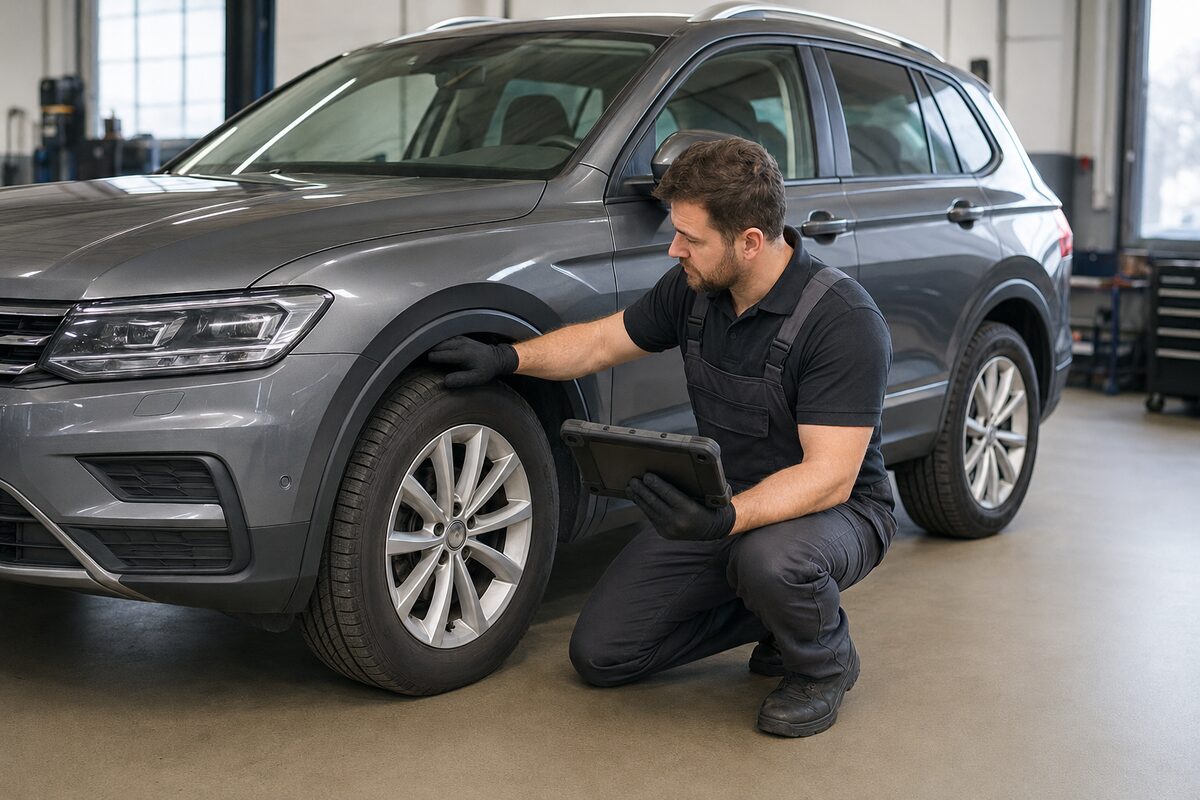
- Start on firm, level ground. Apply the parking brake, select Park, start the engine, and close all doors and the liftgate. Remove unusual cargo and check that the vehicle is not resting on an obstacle.
- Record the exact message and indicator behavior. Photograph the warning and note whether it appeared at startup, after parking, during a height request, at highway speed, or in cold weather. Do this before clearing any codes.
- Measure all four corners. Measure vertically from the center of each wheel to a repeatable point on the wheel arch. Repeat the measurements after several hours or overnight. This is more useful than judging the stance by eye.
- Make only one controlled height request. Watch which end moves first, whether the indicator keeps flashing, and whether the compressor starts. Stop requesting changes if the system reports that it is cooling down or requires service.
- Listen without opening the pneumatic system. Note a hiss, grinding sound, unusually loud compressor, repeated compressor cycling, or complete silence. Keep clear of moving suspension parts because the vehicle can change height automatically.
- Check the 12-volt electrical supply. A weak battery, charging fault, poor connection, blown fuse, or damaged relay circuit can imitate a mechanical failure. Use only the fuse information for the exact model year; do not pull random fuses as a reset attempt.
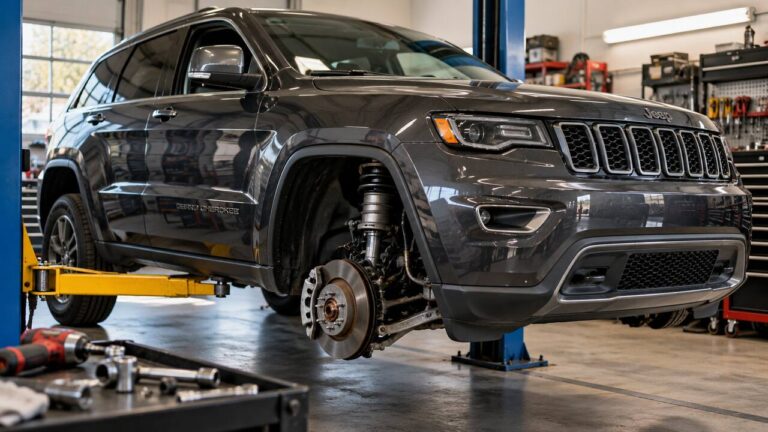
- Inspect only safely accessible sensors and wiring. Look for a disconnected or bent height-sensor linkage, damaged connector, corrosion, or wiring abrasion. If the vehicle must be raised, first follow the correct procedure to disable automatic leveling before lifting a Grand Cherokee.
- Scan the air suspension module. Use a tool that explicitly supports the Jeep Air Suspension Control Module for the exact year. Record diagnostic trouble codes, actual and requested heights, sensor values, supply voltage, pressure data when available, and compressor status before erasing anything.
A basic engine-code reader may communicate with the powertrain but show no chassis or air-suspension faults. Verify enhanced Chrysler/Jeep coverage before buying a scanner; “all-system” marketing does not guarantee Quadra-Lift access on every model year.
What Usually Causes Quadra-Lift Problems?
Air Spring, Strut, Line, or Fitting Leaks
Pressure loss is the first branch to investigate when a corner or axle drops while parked but rises again after startup. The leak can be external and visible, or internal to a valve or check valve. A sagging corner identifies the affected circuit more reliably than the exact failed component.
Do not use tire sealant, glue, or an improvised patch on an air spring that supports vehicle weight. Our separate air suspension leak diagnosis and repair guide explains the detailed measurement and leak-testing process.
Compressor Overwork or Failure
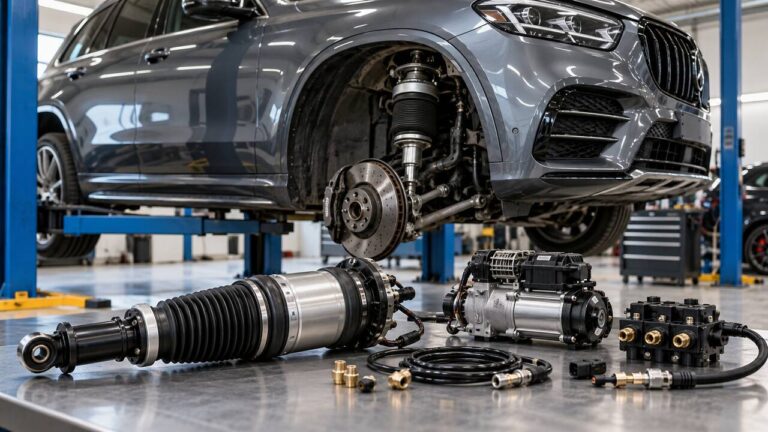
A compressor that runs loudly, takes too long, repeatedly enters thermal protection, or does not run at all needs testing—but those symptoms do not prove the compressor is the original fault. A leak can force a healthy compressor to work until it overheats and eventually fails.
Check codes, leaks, electrical supply, control command, and pressure performance in that order. Use our dedicated guide to test an air suspension compressor rather than replacing it from sound alone.
Height Sensor, Linkage, or Calibration Fault
Each sensor reports body position to the suspension controller. A detached or bent linkage, implausible sensor signal, damaged connector, or incorrect calibration can make the controller raise or lower the wrong corner. Suspect this branch when one corner is too high, height changes are erratic, or the problem began after suspension, alignment, sensor, or control-module work.
Replacing a sensor does not necessarily complete the repair. Some procedures require initialization or ride-height calibration with a capable scan tool and model-specific reference measurements.
Valve, Pressure, or Pneumatic-Control Fault
The valve assembly directs pressure between the compressor or stored supply and the individual suspension circuits. An internal valve problem can imitate a leaking spring, make an axle sit unevenly, or prevent a commanded height change without producing visible bubbles. Circuit isolation and scan data are normally required before replacing a valve assembly.
Battery Voltage, Wiring, Module, or Software
Quadra-Lift depends on stable voltage and communication among several modules. Low voltage during startup, a high-resistance power connection, damaged wiring, a poor ground, an incompatible replacement module, or outdated calibration can set warnings and disable height changes.
Do not disconnect the battery or pull suspension fuses repeatedly. Power cycling cannot seal a leak or repair a sensor, compressor, valve, or wire, and it can erase useful evidence. If you only need to understand the controls and what a restart can legitimately do, use the separate Jeep Grand Cherokee air suspension reset guide.
Why Cold Weather Can Trigger Air Suspension Warnings
Cold weather can expose a marginal system rather than create one universal failure. Rubber seals contract, battery output falls, existing leaks become more obvious, and moisture or pressure behavior can affect pneumatic operation. A warning that disappears after warming up is still diagnostic evidence—especially if the Jeep also loses height, raises slowly, or repeats the fault on the next cold start.
- Record the outside temperature, parked duration, exact warning, and ride height.
- Test battery and charging condition instead of assuming every cold-weather warning is pneumatic.
- Read the suspension codes while the fault is active when possible.
- Ask a Jeep dealer or qualified specialist to check current model-year software updates and technical service information before replacing parts.
A temperature change may alter pressure and ride height slightly, but a repeatedly collapsed corner, persistent warning, or compressor that continually tries to recover height is not something to dismiss as normal winter behavior.
Can You Drive With a Grand Cherokee Air Suspension Fault?
Do not drive if the body is close to a tire, a tire rubs, one corner is severely collapsed, the vehicle leans dramatically, steering or braking feels abnormal, the suspension appears to be on its bump stops, or the display directs immediate service. Arrange a flatbed tow or professional assistance.
If the Jeep remains stable at normal ride height, there is no tire contact, the compressor is not cycling continuously, and the warning does not prohibit driving, a short cautious trip to a qualified shop may be possible. The exact owner’s-manual warning takes priority over general advice. Avoid towing, heavy cargo, high speeds, rough roads, and repeated height requests until the fault is identified.
Repair the Confirmed Cause, Not the Most Expensive Part
A correct estimate should identify the stored faults, failed circuit or component, diagnostic evidence, required calibration, and any secondary compressor damage caused by a leak. The price changes substantially between a linkage or wiring repair, an air spring, a compressor, a valve assembly, and a control or calibration issue.
For component-level planning ranges, labor factors, and questions to ask a shop, see the separate air suspension replacement cost guide. Diagnosis should come before a parts quote.
Frequently Asked Questions
Why does my Jeep Grand Cherokee air suspension sag overnight?
Pressure may be escaping through an air spring or strut, line, fitting, solenoid seal, valve assembly, or check valve. The corner or axle that drops helps identify the affected circuit, but it does not prove which component has failed.
Why will my Grand Cherokee not raise?
First confirm that the engine is running and the request is allowed by the current speed and mode. Persistent failure can result from thermal protection, low voltage, a power or control fault, large leak, insufficient pressure, sensor data, valve operation, or a weak compressor. Read suspension-module codes before choosing a part.
Does a Jeep Grand Cherokee Limited have air suspension?
Not necessarily. Equipment varies by model year, market, drivetrain, package, and individual build. Confirm Quadra-Lift through the vehicle’s ride-height controls, build sheet, VIN-specific equipment record, or exact owner’s manual.
Can cold weather cause a Service Air Suspension message?
Yes, cold conditions can expose low battery voltage, shrinking seals, existing leaks, moisture-related behavior, sensor issues, or model-year-specific software sensitivity. A repeat warning or visible height loss still requires codes and diagnosis; warming the vehicle does not prove the system is healthy.
How long does Jeep Grand Cherokee air suspension last?
There is no reliable universal mileage. Climate, road salt, contamination, load, suspension movement, storage, rubber condition, voltage, and how quickly leaks are repaired all affect component life. Diagnose the current symptoms instead of replacing parts at an arbitrary mileage.
Will resetting Quadra-Lift fix a sagging Jeep?
No reset can seal a leak, restore a worn compressor, reconnect a sensor linkage, repair wiring, or calibrate a replacement component. A normal restart may clear a temporary operating interruption, but a returning warning or physical height loss needs diagnosis.
Start With the Pattern, Then Confirm It With Data
The most useful evidence is the pattern: one corner or the whole vehicle, parked or running, cold or warm, silent or repeatedly operating. Combine that pattern with four ride-height measurements, the exact dashboard message, suspension-module codes, and one controlled function test. That sequence is far more reliable than guessing between an air spring, compressor, sensor, valve, or module—and it helps prevent one unresolved fault from damaging another component.
For safety information that may apply to the individual vehicle, check the exact Mopar owner’s manual and search the VIN in the official NHTSA recall database. Technical service bulletins and software updates are model-year and VIN dependent, so confirm them with Jeep or a qualified repair facility.