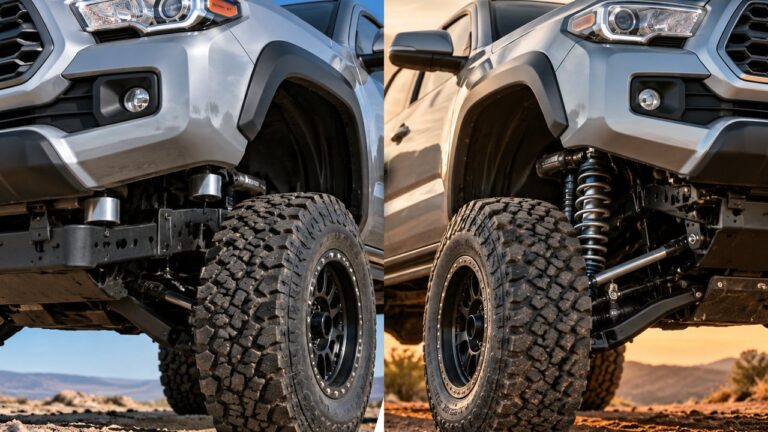
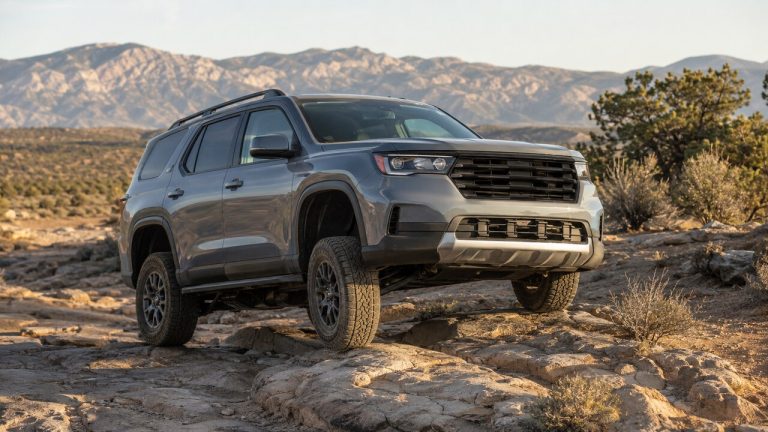
Bilstein 5100 vs FOX 2.0: Which Shocks Are Better?
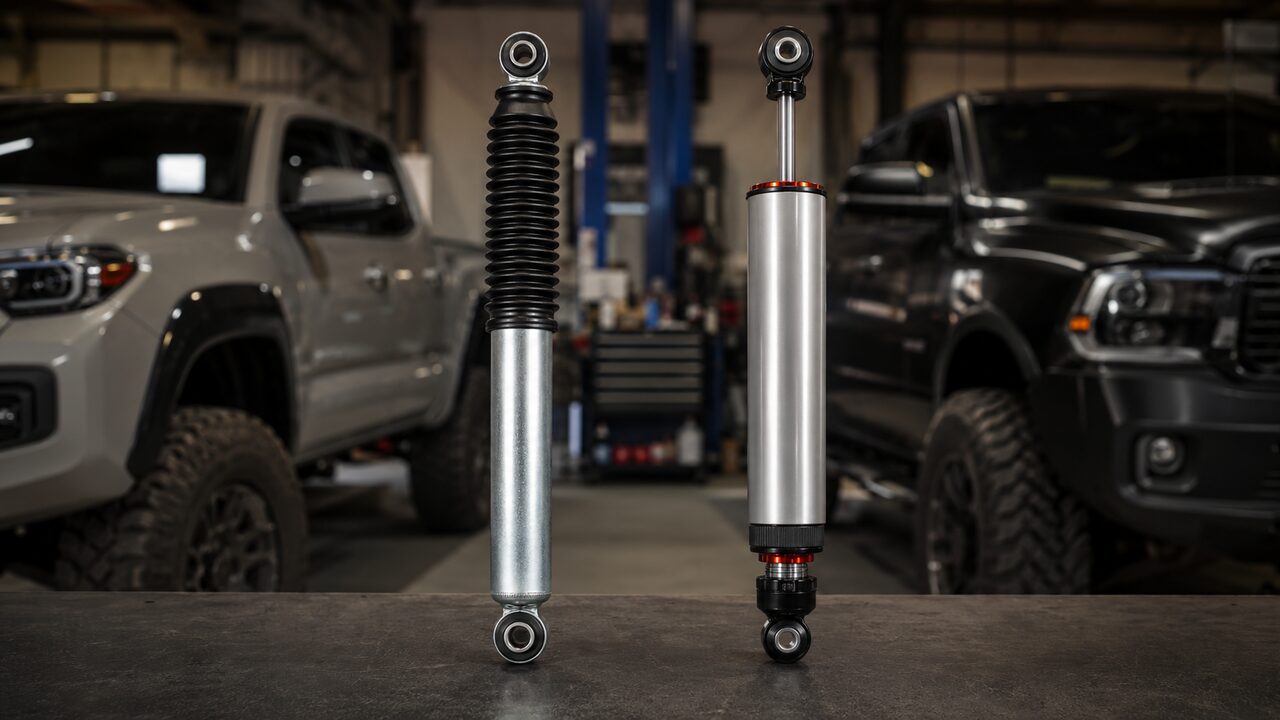
For most daily-driven, leveled, or mildly lifted trucks, the BILSTEIN 5100 is the better value. It delivers controlled handling, vehicle-specific tuning, and solid performance for commuting, towing, and occasional trail use. The FOX 2.0 Performance Series IFP is the stronger premium choice for drivers who spend more time on rough roads or trails and value its larger aluminum body and additional heat-dissipation capacity.
Neither shock is automatically smoother or better on every truck. Ride quality depends on the exact part number, vehicle, spring rate, preload, tire construction, tire pressure, load, and lift height. The correct fitment matters more than the logo on the shock.
Quick Decision
- Choose BILSTEIN 5100 for strong value, a controlled daily ride, towing stability, mild off-road use, or a compatible lifted application.
- Choose FOX 2.0 Performance Series IFP when rough-road comfort, repeated trail use, corrosion-resistant aluminum construction, and heat management justify the higher price.
- Do not order by vehicle name alone. Confirm the year, model, drivetrain, suspension type, lift height, front or rear position, and manufacturer part number.
BILSTEIN 5100 vs FOX 2.0 at a Glance
| Feature | BILSTEIN B8 5100 | FOX 2.0 Performance Series IFP |
|---|---|---|
| Construction | 46 mm monotube shock | 2.0-inch monotube IFP shock |
| Body material | Zinc-plated steel | Clear-anodized 6061-T6 aluminum on the standard 2.0 IFP design |
| Valving | Digressive, application-specific tuning | High-flow piston with application-specific tuning |
| Typical buyer | Daily driver, towing, mild trails, value-focused upgrade | Frequent rough roads, trail use, premium ride-performance upgrade |
| Ride-height options | Standard lifted-fitment shocks plus separate ride-height-adjustable front applications | Smooth-body and vehicle-specific coil-over options vary by application |
| Heat and corrosion | Zinc plating resists harsh elements | Aluminum body improves cooling capacity and does not rust |
| Price tier | Usually lower | Usually higher |
| Best overall value | Yes, for most street-driven trucks | Best when its off-road-focused advantages will be used |
This is a comparison of the BILSTEIN B8 5100 family and the standard FOX 2.0 Performance Series IFP category. It does not treat a FOX remote-reservoir shock, FOX coil-over, or a larger BILSTEIN reservoir shock as if it were the same product.
What Is the BILSTEIN 5100?
The BILSTEIN B8 5100 is a 46 mm monotube shock designed primarily as a performance upgrade for lifted trucks and SUVs. According to BILSTEIN’s 5100 specifications, it uses patented digressive valving, a zinc-plated body, and tuning developed for the specific vehicle application. BILSTEIN also states that its tuning accounts for factors such as loaded versus unloaded use, towing, and tire pressure.
Digressive valving produces relatively strong damping at lower shaft speeds and then changes its rate as shaft speed increases. In practical terms, the goal is to control body movement during steering, braking, and load changes while still allowing the suspension to react to road impacts. The exact result varies by vehicle and part number.
- Good fit for: commuting, highway driving, towing, loaded trucks, forest roads, and mild trails.
- Main advantage: a strong balance of control, durability, direct fitment, and cost.
- Important limitation: a standard 5100 smooth-body shock does not create lift. Only compatible ride-height-adjustable front applications can change front spring-perch height.
What Is the FOX 2.0 Performance Series IFP?
The FOX 2.0 Performance Series IFP is a premium monotube shock for trucks and SUVs. The standard smooth-body version uses an internal floating piston to separate the shock oil from the high-pressure nitrogen chamber. This reduces oil aeration so the valving can remain more consistent as the shock works.
FOX lists a 2.0-inch impact-extruded and CNC-machined 6061-T6 clear-anodized aluminum body, a high-flow piston, and application-specific valving in its Performance Series 2.0 IFP specifications. Aluminum resists rust and transfers heat effectively, which becomes useful when repeated suspension movement generates heat on washboard roads or trails.
- Good fit for: rough roads, regular trail driving, overlanding, and drivers willing to pay more for premium construction.
- Main advantage: a larger aluminum body that supports cooling and resists corrosion.
- Important limitation: the standard 2.0 IFP is not a remote-reservoir race shock. Severe high-speed off-road use may call for a different product class.
Key Differences Between BILSTEIN 5100 and FOX 2.0
Body Size, Material, and Cooling
The BILSTEIN uses a 46 mm monotube body made from zinc-plated steel. The FOX uses a nominal 2.0-inch aluminum body. Both designs keep the oil and gas controlled within a monotube architecture, but the FOX body is larger and aluminum transfers heat efficiently. If you want to understand why that construction matters, our guide to monotube and twin-tube shock designs compares their internal layout, heat management, ride characteristics and ideal uses.
That cooling advantage matters most when the shocks cycle repeatedly for a sustained period. A daily commute or occasional pothole will not automatically make the FOX perform better. On long washboard roads, repeated trail impacts, or faster rough-road travel, heat capacity becomes a more meaningful reason to choose it.
Valving and Vehicle Control
BILSTEIN emphasizes digressive valving and stable control, while FOX emphasizes a high-flow piston and predictable performance on and off the road. Both manufacturers use application-specific tuning, so a universal statement such as “FOX is always softer” or “BILSTEIN is always firmer” is unreliable.
A shock that feels composed on one Tacoma may not feel identical on an F-150 or Ram. Spring rate, front preload, rear load, wheelbase, tires, and even tire pressure can change what the driver feels.
Price and Long-Term Value
BILSTEIN 5100 shocks normally occupy the more affordable tier, while FOX 2.0 shocks usually cost more. Live prices vary by vehicle, axle position, seller, and whether the product is a smooth-body shock or a complete front coil-over assembly, so compare matched parts rather than two listings with different contents.
The BILSTEIN is the value winner when the truck spends most of its time on pavement and only sees occasional trails. The FOX premium makes more sense when the vehicle regularly encounters rough surfaces where its body construction and cooling capacity are useful.
BILSTEIN 5100 vs FOX 2.0 Ride Quality
Ride quality is not simply “soft” versus “stiff.” A good shock must control the spring after a bump without transmitting unnecessary harshness into the cab. Too little damping can make a truck float, bounce, or wallow; too much can make sharp impacts feel abrupt.
The BILSTEIN 5100 is a sensible choice for drivers who want their truck to feel more settled during braking, cornering, highway lane changes, and load transitions. The FOX 2.0 is attractive to drivers who prioritize compliance over broken pavement, gravel, and repeated trail chatter. However, the exact tuning can reverse expectations on a particular application.
Before blaming a new shock for a harsh ride, check tire pressure, load-range rating, wheel size, spring preload, bump-stop contact, and worn suspension bushings. Heavy-duty tires inflated to their maximum sidewall pressure can dominate ride quality even when the shocks are working correctly.
Which Is Better for Towing?
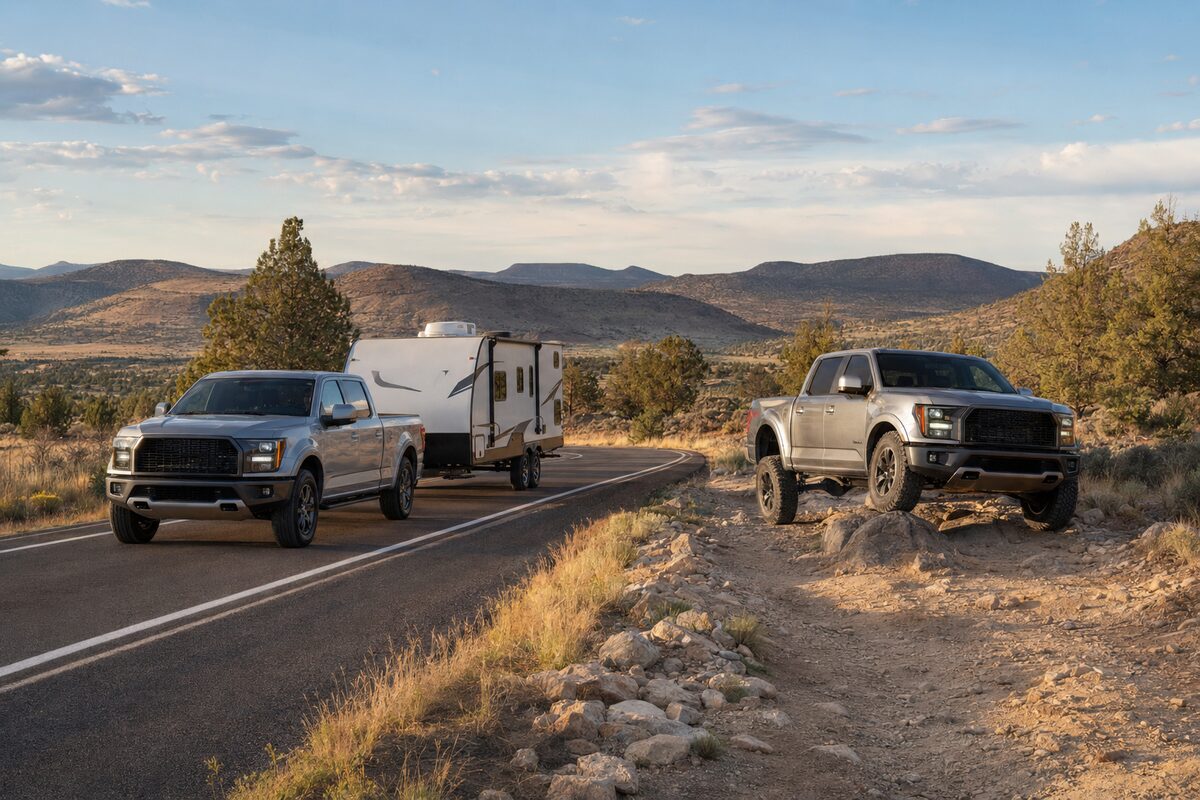
The BILSTEIN 5100 is usually the more practical towing choice for a compatible application because it offers controlled body motion at a lower typical cost, and BILSTEIN specifically includes towing and loaded use in its application-tuning considerations. A correctly matched FOX 2.0 can also tow well, especially when the truck travels on rough access roads.
A shock absorber does not increase payload, rear-axle, hitch, or trailer-weight ratings. It controls suspension movement; it does not carry the load like a spring. If the rear of the truck sags, address weight distribution and verify the load against the door-jamb and owner-manual ratings. Depending on the vehicle and use, the real solution may involve correct tongue weight, a weight-distribution hitch, appropriate springs, or properly selected air-helper springs.
- Choose the shock listed for the truck’s actual ride height.
- Do not use a longer shock as a substitute for correct load support.
- Replace worn shocks in axle pairs unless the manufacturer specifies otherwise.
- Check tires, bushings, sway-bar links, and alignment before expecting shocks to solve every handling problem.
Which Is Better for Off-Road Driving?
FOX 2.0 Performance Series IFP has the edge for frequent rough-road and trail use. Its larger aluminum body is designed to increase cooling capacity, and the IFP separates oil from the nitrogen charge. Those features support consistent damping when the suspension cycles repeatedly.
The BILSTEIN 5100 remains a capable choice for forest roads, mild trails, overland travel at sensible speeds, and weekend use. Paying more for FOX is difficult to justify if the truck rarely leaves pavement. Conversely, drivers who repeatedly cross washboard roads or rocky trails are more likely to benefit from the FOX design.
For sustained high-speed desert travel, large whoops, racing, or heavily modified long-travel suspension, neither basic comparison should decide the purchase. A remote-reservoir or larger-body system designed for that duty offers more oil volume and heat capacity.
Can BILSTEIN 5100 or FOX 2.0 Shocks Lift a Truck?
A conventional shock absorber does not support the vehicle’s weight and does not create lift. Lift comes from the spring, torsion-bar setting, spacer, air spring, or a front coil-over assembly that changes spring position.
Some ride-height-adjustable B8 5100 applications use multiple spring-perch positions and the vehicle’s original front coil spring to provide up to approximately 2.75 inches of adjustment, depending on the application. Some vehicle-specific FOX 2.0 front coil-over products also offer leveling adjustment. That does not mean every 5100 or FOX 2.0 listing can raise a truck.
If your vehicle remains at factory ride height, review how BILSTEIN 4600 and 5100 serve different ride heights before buying. Choosing a shock with the wrong extended and compressed lengths can reduce travel or damage suspension components.
Is the BILSTEIN 5100 Worth It?
Yes, the BILSTEIN 5100 is worth the money when it matches a leveled or lifted application and the goal is better control without entering the premium price tier. It is especially compelling for a daily-driven truck that tows, carries varying loads, or handles occasional unpaved roads.
It is less compelling when the truck is at stock ride height and a stock-height performance shock is the proper fit, or when the vehicle needs the greater oil capacity of a reservoir system for demanding off-road use. Buy for the job and dimensions—not because 5100 is the most familiar number in the product name.
Vehicle-Specific Fitment Notes
Toyota Tacoma and 4Runner
For a BILSTEIN 5100 vs FOX 2.0 Tacoma comparison, first identify the generation, drivetrain, current front height, rear lift, and whether the listing is a front adjustable unit, rear shock, or complete coil-over. A front leveling setting changes spring preload and can affect ride height and feel, so compare equivalent configurations.
Ford F-150 and Super Duty
An F-150 daily driver and an F-250 used with a heavy trailer impose different demands. Confirm cab, bed, drivetrain, axle position, and lift range. Super Duty owners can also use our model-specific F-250 shock guide to narrow the choice by use case.
Chevrolet Silverado and GMC Sierra
Do not assume 1500, 2500HD, and 3500HD shocks interchange. Suspension packages, control-arm designs, factory lift packages, and current aftermarket lift height can change the required part.
Ram Trucks
Verify whether the Ram uses conventional coils, leaf springs, or factory air suspension. A shock listed for a conventional-suspension Ram is not automatically appropriate for a truck with factory air suspension, even when the model year and engine appear to match.
Standard IFP, Coil-Over, and Reservoir Shocks Are Not the Same
Product names can be confusing because “FOX 2.0” describes a family rather than one universal shock. A smooth-body 2.0 IFP, a front 2.0 coil-over IFP, and a 2.0 remote-reservoir shock can have different mounts, dimensions, adjustment methods, service requirements, and prices.
The BILSTEIN 5100 family also includes standard lifted-application shocks and separate ride-height-adjustable front versions for certain OE coilover-style suspensions. Compare complete product descriptions and manufacturer part numbers—not just “5100” and “2.0” in a seller’s title.
Buying Checklist
- Identify the vehicle precisely: year, make, model, trim, drivetrain, and factory suspension package.
- Measure the actual lift: do not rely only on what a previous owner or marketplace listing says.
- Confirm the axle position: front and rear shocks are not interchangeable.
- Match the use: daily driving, towing, washboard roads, slow trails, or sustained high-speed off-road travel.
- Compare equivalent packages: a pair of smooth-body shocks is not equivalent to assembled coil-overs.
- Verify what is included: bushings, sleeves, mounting hardware, springs, and dust boots vary by listing.
- Use the manufacturer catalog: confirm the exact part number before ordering from any retailer.
Installation and Alignment
Rear shock replacement is often straightforward for an experienced DIYer with proper support equipment. Front spring-and-shock assemblies can store dangerous energy and may require a suitable spring compressor, torque specifications, and model-specific procedures. If you are not equipped for that work, use a qualified installer.
Replacing a conventional shock without changing ride height does not always require an alignment. Changing front spring-perch position, installing a coil-over, or altering ride height can change suspension geometry; in those cases, follow the manufacturer’s procedure and read when you may need a wheel alignment after suspension work.
Frequently Asked Questions
Are FOX 2.0 shocks better than BILSTEIN 5100 shocks?
FOX 2.0 shocks are the stronger choice for frequent rough-road and trail use, while BILSTEIN 5100 shocks usually offer better value for daily driving, towing, and occasional off-road use. The correct answer depends on the vehicle-specific part and how the truck is used.
Which shock gives a smoother ride?
There is no universal winner. FOX 2.0 is often chosen when compliance over rough surfaces is a priority, while BILSTEIN 5100 is often chosen for a controlled, planted feel. Application-specific valving, springs, tires, pressure, preload, and load can change the result.
Is BILSTEIN 5100 or FOX 2.0 better for towing?
The BILSTEIN 5100 is usually the value-focused towing choice, provided it matches the vehicle and ride height. Neither shock increases the manufacturer’s payload or towing ratings, and neither should be used to mask an overloaded or poorly balanced trailer.
Are FOX 2.0 shocks worth the extra money?
They can be worth it for regular trail use, repeated rough-road driving, or buyers who value a large aluminum body and its cooling and corrosion advantages. For mostly paved driving with occasional trails, the less expensive BILSTEIN 5100 is often the smarter purchase.
Will either shock level my truck?
Only specific front ride-height-adjustable or coil-over applications can change front height. Standard smooth-body shocks, including most rear shocks, do not lift or level the vehicle.
How long do BILSTEIN 5100 and FOX 2.0 shocks last?
There is no reliable universal mileage. Service life depends on road conditions, heat, contamination, corrosion, vehicle weight, installation, and usage. Inspect the shocks if you notice leakage, damaged bushings, excessive bouncing, reduced control, unusual noises, or uneven tire behavior, and follow the manufacturer’s warranty and service guidance for the exact product.
Which One Should You Buy?
Buy the BILSTEIN 5100 if your priority is a cost-effective upgrade for a daily-driven, properly leveled or lifted truck that may tow and occasionally leave pavement. Buy the FOX 2.0 Performance Series IFP if rough roads and trails are a regular part of your driving and its aluminum construction and additional cooling capacity justify the premium. If neither option clearly matches your setup, our guide to the best shocks for lifted trucks compares additional choices for daily driving, towing, budget builds and harder off-road use.
Whichever you choose, verify the exact manufacturer part number against the truck’s suspension type and measured ride height. Correct fitment will do more for ride quality, safety, and shock life than choosing one brand based on a general reputation.