33 vs 35 Tires: Which Size Is Better for Your Truck?
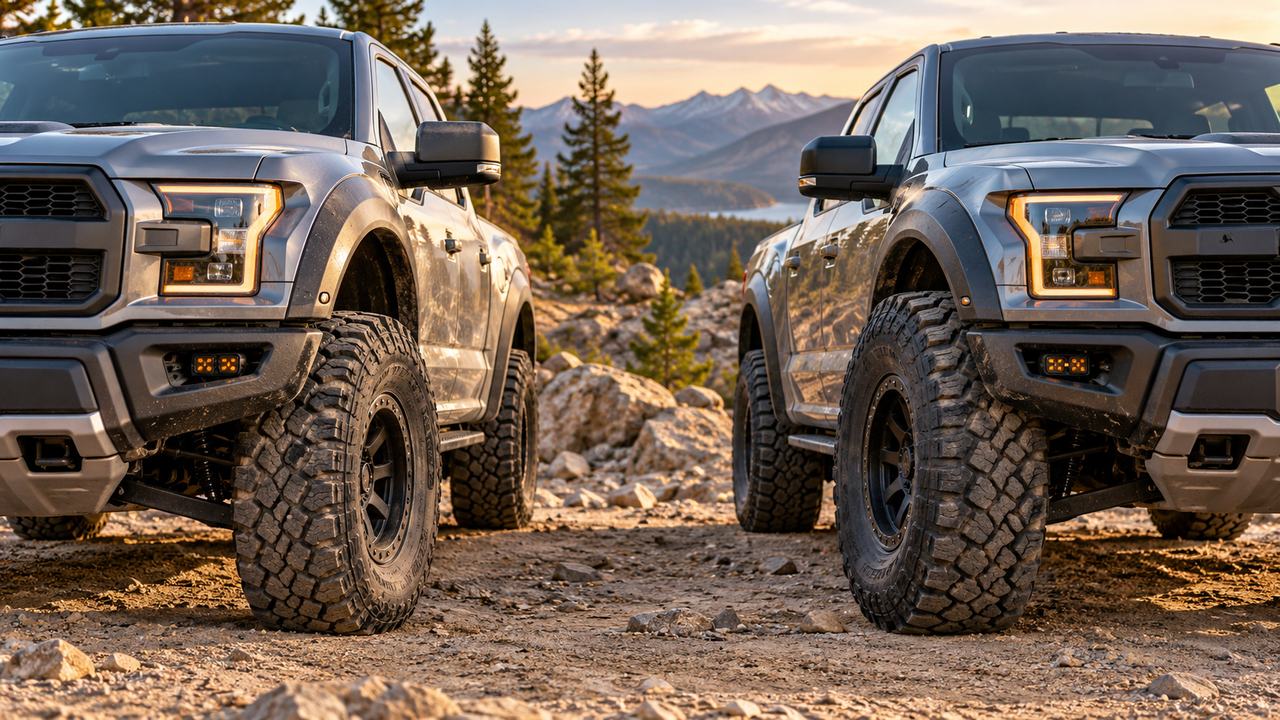
For most daily-driven trucks and SUVs that also see weekend trails, 33-inch tires are the better all-around choice. They usually preserve more of the vehicle’s original acceleration, braking response and fitment margin while still adding useful off-road capability.
Choose 35-inch tires when the extra ground clearance and larger obstacle-rolling diameter are worth a more demanding build. The jump from 33s to 35s can require more attention to wheel fitment, trimming, gearing, steering clearance and drivetrain load—but exactly how much depends on the vehicle.
The surprising part is that the decision is not really about “two more inches.” A true 35 only raises an axle about one inch higher than a true 33, yet that extra diameter changes effective gearing by roughly 6%, adds rotating mass in many tire lines and sweeps a larger path through the wheel well. That is where the choice becomes more interesting.
33 vs 35 Tires Side by Side
| Factor | 33-Inch Tires | 35-Inch Tires |
|---|---|---|
| Daily drivability | Usually easier to preserve | More likely to feel the size change |
| Axle ground clearance | Baseline for this comparison | About 1″ more if actual diameter is exactly 2″ larger |
| Obstacle rollover | Good | Better due to larger radius |
| Fitment difficulty | Generally lower | Generally higher |
| Wheel-well clearance | More margin | Less margin at steering lock and compression |
| Effective gearing | Closer to stock | Taller gearing than the same vehicle on 33s |
| Rotating mass | Usually lower for comparable tires | Usually higher for comparable tires |
| Off-road priority | Balanced road/trail use | Greater emphasis on clearance and obstacles |
| Supporting modifications | Often fewer | More likely to be required |
| Best fit | Daily driver + weekend trail truck | Build where off-road gains justify extra compromises |
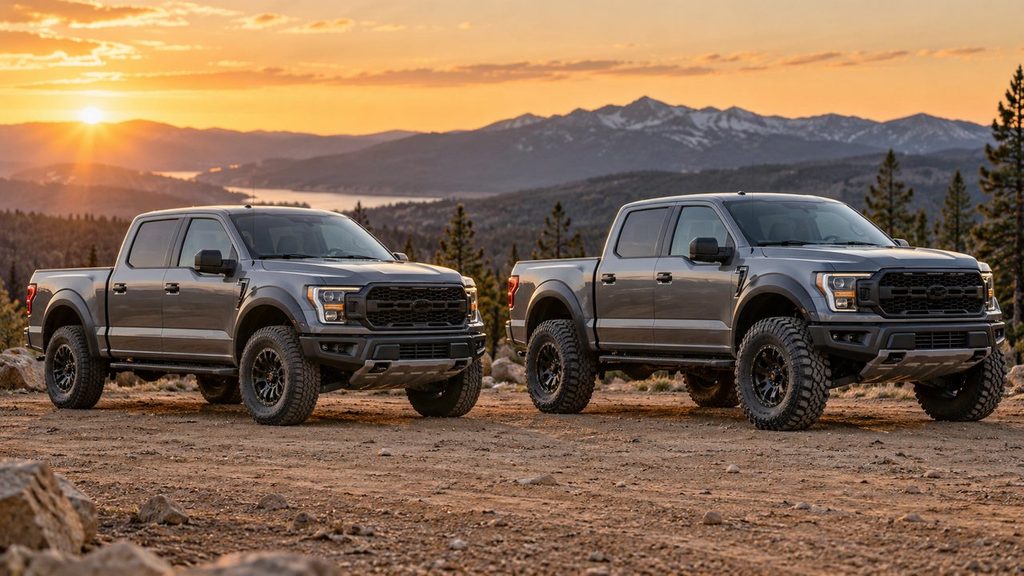
Those are tendencies, not fitment guarantees. A factory-designed truck on 35s can be easier to live with than an older vehicle heavily modified to fit 33s. Always compare the exact platform and tire—not only the number molded into the sidewall.
The Two-Inch Label Hides the Real Difference
A “33-inch” tire is not guaranteed to measure exactly 33 inches tall, and a “35-inch” tire is not guaranteed to measure exactly 35 inches.
Actual inflated diameter varies by tire model, size designation, load construction and measuring rim. Metric sizes commonly treated as 33s or 35s can also differ noticeably from flotation sizes such as 33×12.50R17 or 35×12.50R17.
That means the correct comparison starts with the manufacturer’s specification sheet for the exact two tires you are considering.
A real same-model example
Nitto’s current Ridge Grappler specifications make the point clearly. Comparing the same tire family and wheel diameter removes some of the noise created by comparing completely different tire designs:
| Nitto Ridge Grappler | 33×12.50R17LT | 35×12.50R17LT |
|---|---|---|
| Published overall diameter | 32.76″ | 34.76″ |
| Published overall width | 12.52″ | 12.52″ |
| Published tire weight | 69.32 lb | 75.45 lb |
| Diameter difference | — | +2.00″ |
| Weight difference per tire | — | +6.13 lb |
In this example, moving to the 35 adds exactly two inches of published diameter and a little over six pounds per tire while keeping published width the same. Another brand, tread pattern or load range can produce a very different weight difference, which is why universal claims such as “35s add X pounds” are unreliable.
How Much More Ground Clearance Do 35s Actually Give You?
If one tire is exactly 33 inches tall and the other is exactly 35 inches tall, the larger tire adds one inch of radius.
That means approximately one additional inch of clearance beneath components whose height is directly tied to tire radius, such as a solid axle differential housing.
The full two-inch diameter increase does not produce two inches of under-axle clearance because half of the added diameter is above the hub and half is below it.
That single inch can still matter off-road. Differential clearance is difficult to improve with suspension lift alone because lifting the body or chassis does not move a solid axle housing farther from the ground. Larger tires do.
But not every low point on every suspension moves one-for-one with tire radius. Independent suspension geometry and other underbody components make total vehicle clearance more complicated than one number.
Why 35s Roll Over Obstacles More Easily
The second off-road advantage is not vertical clearance—it is radius.
A larger tire meets a ledge, rock or rut at a shallower approach angle. In simple terms, the obstacle is smaller relative to the tire, so the wheel has an easier geometric path up and over it.
This is one reason a relatively small numerical increase in diameter can feel more meaningful on rocks, ledges and deeply rutted trails than it appears on a specification sheet.
However, diameter alone does not determine traction. Tire compound, tread design, construction, pressure, terrain, differential behavior and suspension articulation can matter just as much—or more.
Where 33s Usually Feel Better on the Street
A daily driver repeatedly pays for every change you make to the wheel-and-tire package: pulling away from a stop, braking, steering into a parking space and accelerating back to highway speed.
That is where 33s generally have the easier job.
Acceleration
A taller tire travels farther with each wheel revolution. Without a gearing change, that makes the overall gearing taller.
If actual diameter increases from exactly 33 to 35 inches, the change is about 6.1%. Combined with any increase in tire mass and rotational inertia, the vehicle may feel less responsive when accelerating.
How noticeable that becomes depends heavily on engine torque, transmission ratios, axle gearing, vehicle weight and the actual tires fitted.
Steering feel
A larger and often heavier tire can make steering feel slower or heavier, particularly at low speed. Wheel offset can amplify the change by altering where the tire contact patch sits relative to the steering axis.
That is why two trucks on the same 35-inch tire can steer differently when their wheel widths and offsets are different.
Braking
Larger tires can increase the rotational energy the brakes must control, but there is no defensible universal rule such as “35s increase stopping distance by X percent.” Tire grip, brake size, ABS calibration, wheel weight, road surface and vehicle mass all influence the result.
If braking already feels marginal before the tire upgrade, treat that as a problem to solve rather than assuming the larger tires will be harmless.
33 vs 35 Tires for Ride Quality and Road Noise
Tire diameter by itself does not tell you which setup will ride softer or make less noise.
A 35-inch all-terrain with a relatively compliant construction can behave very differently from a heavy-duty 33-inch mud-terrain. Load range, casing stiffness, tread pattern, inflation pressure, wheel diameter and vehicle load all matter.
If both tires are otherwise closely comparable, the 33 usually gives the vehicle less mass and gearing change to manage. But do not choose a 33 solely because someone says “33s ride better.” Compare the exact tire specifications.
What Happens to Effective Gearing?
This is one of the biggest differences that gets oversimplified in 33 vs 35 tire comparisons.
Moving to a taller tire effectively makes the axle gearing taller because the tire covers more ground per revolution.
You can estimate the change with:
New effective axle ratio = current axle ratio × old tire diameter ÷ new tire diameter
For example, if a vehicle has 4.10 axle gears and moves from a true 33-inch tire to a true 35:
4.10 × 33 ÷ 35 ≈ 3.87
So, from the engine’s perspective, the vehicle behaves approximately as though the final gearing became taller—from 4.10 to about 3.87—before considering tire weight or other changes.
This does not mean every truck moving to 35s needs a particular axle ratio. Transmission gearing, engine output, original axle ratio, altitude, towing load and intended use all determine whether regearing is worthwhile.
Do You Need to Regear for 35-Inch Tires?
Not automatically. There is no single axle ratio that every vehicle running 35s should use.
A modern truck with a torque-rich engine, deep first gear and suitable factory axle ratio may tolerate the change much better than an older vehicle with less torque or taller factory gearing.
Consider regearing when the larger tires cause symptoms such as:
- noticeably sluggish acceleration;
- excessive transmission hunting between gears;
- difficulty holding the desired gear on grades;
- poor low-speed crawl control;
- unacceptable towing behavior;
- a gearing mismatch for the way the vehicle is actually used.
Choose axle gearing from the complete drivetrain and use case, not from an internet rule that assigns one ratio to every 35-inch tire.
What About the Speedometer?
Larger tires cover more distance per wheel revolution, so changing tire diameter without recalibration can make the speedometer and odometer inaccurate.
Using nominal sizes only, moving from 33 to 35 inches increases circumference by about 6.1%. If a vehicle were calibrated perfectly for a true 33 and then fitted with a true 35 without recalibration, an indicated 60 mph would correspond to roughly 63.6 mph of road speed.
Real tires rarely measure exactly their nominal size, so calculate from the manufacturer’s actual diameter whenever possible. Many modern vehicles can be recalibrated electronically for a different tire size.
Fuel Economy: There Is No Honest Fixed MPG Penalty
You will often see claims that 33s cost a specific number of MPG and 35s cost another. That is too simplistic.
Changing to 35s can affect fuel consumption through several mechanisms at once:
- taller effective gearing;
- greater tire mass and rotational inertia;
- different rolling resistance;
- different tread pattern and compound;
- possible increase in tire width;
- changes to vehicle height and aerodynamic drag;
- changes in driving behavior after the modification.
A lightweight 35-inch all-terrain and a very heavy 35-inch mud-terrain will not impose the same penalty. Neither will two different trucks using the same tire.
If fuel economy matters, compare the published weight, diameter and width of the exact 33 and 35 you are considering rather than relying on a generic MPG estimate.
Where 35s Earn Their Keep Off-Road
The case for 35s gets stronger when the terrain regularly exposes the limitations of 33s.
The larger tire can provide:
- more clearance beneath axle-dependent low points;
- a larger rolling radius over ledges and rocks;
- greater ability to bridge some holes and ruts;
- potential for a larger footprint when tire construction, width, load and pressure support it;
- a larger overall tire envelope for vehicles built around demanding trail use.
If your truck spends nearly all of its time commuting and the trails you use do not challenge a 33-inch tire, you may pay the compromises of 35s without regularly using their biggest advantages.
33 vs 35 Tires in Rocks, Mud and Sand
Rocky terrain
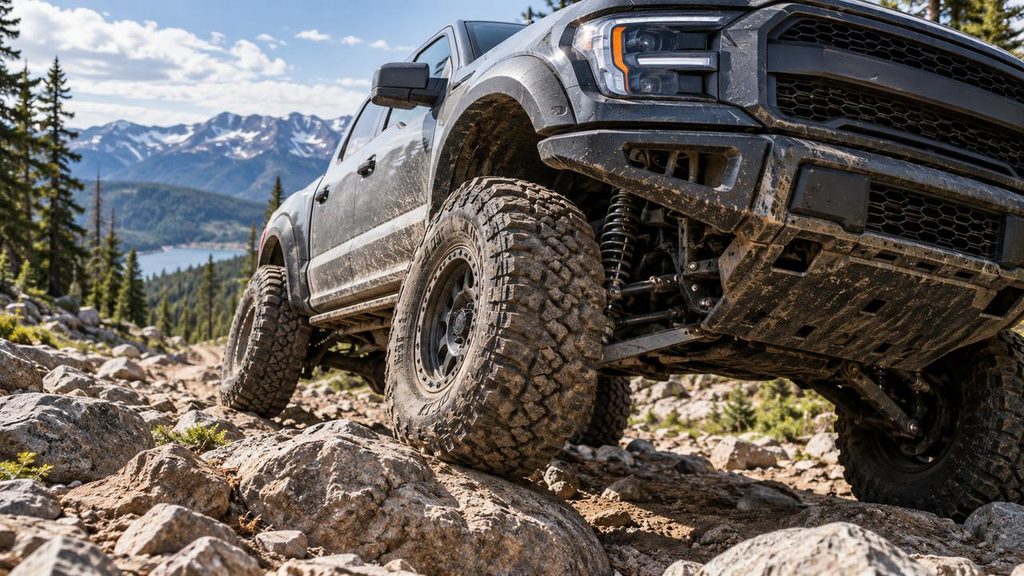
This is where the larger diameter has one of its clearest geometric advantages. The extra radius helps the tire approach ledges and rocks, while additional under-axle clearance reduces the chance of hanging a differential on an obstacle.
Mud
Tire diameter can help maintain clearance in deep ruts, but mud performance depends heavily on tread design, self-cleaning ability, compound and how the vehicle distributes torque. A larger tire with an inappropriate tread is not automatically better than a smaller tire designed for the conditions.
Sand
Flotation depends on more than diameter. Vehicle weight, tire width, casing construction and appropriate pressure all affect how well the tire stays on top of soft sand. Do not assume that moving from 33 to 35 alone guarantees better flotation.
Fitment Is Where 35s Become a Bigger Project
The question is not simply whether a 35 physically fits inside the wheel opening while the truck is parked.
The complete tire must clear while:
- steering from lock to lock;
- the suspension compresses;
- the vehicle carries its normal load;
- the axle articulates off-road;
- the tire flexes under real driving conditions.
Because the 35 has a larger radius, its leading and trailing edges sweep a larger path through the wheel well during steering. This is why a tire can appear to fit perfectly with the wheels straight and still contact the liner, bumper, body mount or fender at full lock.
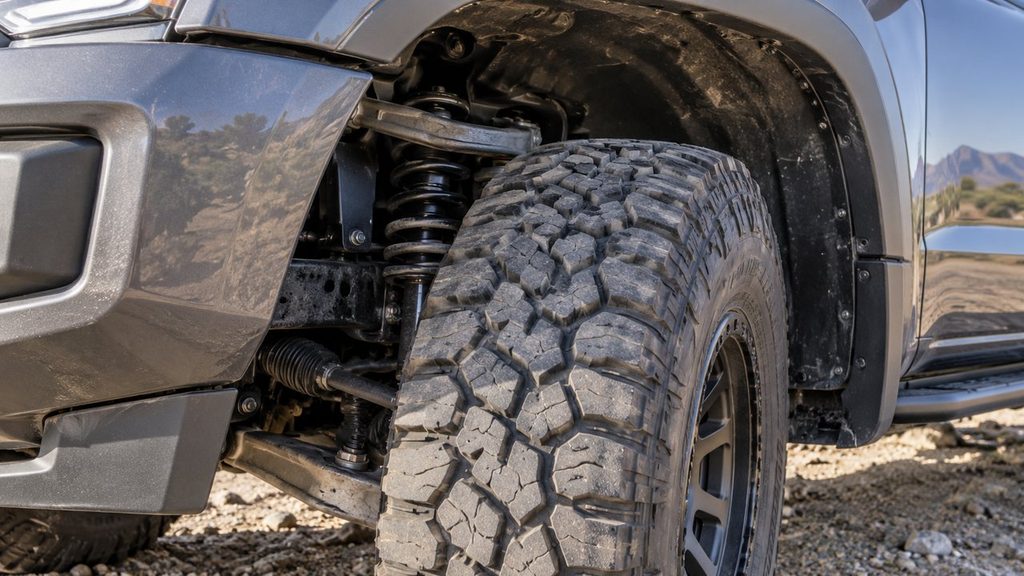
If 35s are your target, see our dedicated guide to how much lift 35-inch tires may need. Lift requirements are intentionally not reduced to one universal number here because they depend on the exact vehicle and wheel/tire package.
Wheel Offset Can Change the Answer
Wheel width, offset and backspacing determine where the tire sits laterally relative to the suspension and body.
Moving a tire outward can improve clearance from an upper control arm or frame while making contact with the fender or body mount worse. Moving it inward can do the opposite.
That is why “35s fit my truck” is incomplete information unless the wheel specifications are included. Two trucks with the same tire size but different wheel offsets can have very different rubbing behavior.
If you need to understand those measurements first, see our guide to wheel offset vs backspacing. If you already know your current and proposed wheel specs, the wheel offset and backspacing calculator can show how inner clearance and outer wheel position change.
Do 35s Put More Stress on Suspension and Drivetrain Parts?
They can, particularly when the new setup is heavier, farther from the hub or used aggressively off-road.
Potentially affected components include:
- wheel bearings;
- ball joints and steering joints;
- CV joints or axle shafts;
- differential and axle components;
- brakes;
- transmission and clutch components under some operating conditions.
But diameter is not acting alone. A lightweight wheel and tire placed close to the factory scrub radius can create a different load picture from a much heavier setup with aggressive negative offset.
Again, compare the whole package rather than treating “35-inch tire” as a single standardized mechanical load.
33 vs 35 Tires for Towing and Hauling
If the vehicle regularly tows or carries substantial loads, preserving useful gearing and braking response becomes more important.
The taller effective gearing created by 35s can make the powertrain work harder to maintain speed on grades, especially if the original axle ratio was already relatively tall. A heavier wheel-and-tire package can also add more work during acceleration and braking.
None of this changes the manufacturer’s GVWR, GAWR, payload or towing ratings. Larger tires do not increase those limits.
For a tow vehicle that only occasionally needs additional trail capability, 33s can therefore be the more practical compromise. A properly configured truck can still tow on 35s, but the drivetrain, tire load capacity, pressures and gearing should be evaluated as a system.
The Cost Difference Is Bigger Than the Tire Price
The purchase price of the tires is only the first line in the budget.
A 35-inch build may also involve some combination of:
- different wheels;
- suspension or ride-height changes;
- trimming or clearance work;
- alignment;
- speedometer calibration;
- regearing when justified;
- steering, axle or brake upgrades on more demanding builds;
- a full-size spare and a way to carry its additional size and weight.
This is one reason 33s often deliver a strong capability-per-dollar result: they may achieve the driver’s actual goal before the build crosses into a chain of supporting modifications.
Choose 33-Inch Tires If…
- Your truck is primarily a daily driver.
- You want useful trail capability without building around maximum tire size.
- You want to minimize changes to gearing, braking feel and acceleration.
- You want more wheel-well clearance margin.
- You tow or haul and want to stay closer to the vehicle’s original effective gearing.
- You would rather spend the budget on quality tires, shocks, recovery equipment or other useful upgrades.
Choose 35-Inch Tires If…
- You regularly encounter terrain where 33s limit differential clearance or obstacle rollover.
- You accept that fitment may require more than simply installing a taller tire.
- You are prepared to check gearing, steering clearance and drivetrain behavior after the change.
- You prioritize off-road capability more heavily than preserving factory-like response.
- Your vehicle platform has a well-understood and properly engineered path to 35s.
- You have checked the actual dimensions and weight of the specific tire—not just the advertised size.
What to Check Before Buying Either Size
- Actual tire diameter. Do not assume the sidewall label equals measured diameter.
- Actual section width. Width can matter as much as diameter for rubbing.
- Tire weight. Compare the exact construction and load range.
- Approved wheel-width range. Make sure the wheel suits the tire manufacturer’s specification.
- Wheel offset and backspacing. These determine where the tire sits laterally.
- Inner clearance. Check control arms, frame, struts, shocks and steering components.
- Outer clearance. Check fenders, liners, bumpers, mud flaps and body mounts.
- Full steering lock. Check both directions rather than only straight ahead.
- Suspension compression. Static parking clearance does not prove dynamic fitment.
- Gearing and calibration. Decide whether the diameter change warrants drivetrain or electronic changes.
- Spare-tire fitment. A matching spare also has to fit somewhere.
- Load and pressure requirements. Select the tire for the actual vehicle and use, not appearance alone.
Frequently Asked Questions
Are 35-inch tires much bigger than 33s?
Nominally, a 35 is two inches larger in diameter than a 33, which means about one inch more radius. Actual tire dimensions vary, so compare manufacturer specifications for the exact tires. The practical difference can feel larger than two inches because the change also affects gearing, rotating mass and wheel-well clearance.
How much taller are 35s than 33s?
If both sizes measure exactly as advertised, a 35-inch tire is two inches taller overall and raises the hub approximately one inch relative to the ground. Real-world diameter differences may be smaller or larger depending on the tire.
How much more ground clearance do 35s give over 33s?
A true 35 provides approximately one inch more tire radius than a true 33, so axle-dependent low points can gain about one inch of clearance. The entire vehicle does not necessarily gain exactly one inch at every underbody component.
Are 33s better for daily driving than 35s?
For many daily-driven trucks, yes. A comparable 33 usually creates less change in effective gearing, rotating mass and fitment than a 35. However, tread design, tire construction, wheel choice and vehicle setup can matter more than diameter alone for comfort and noise.
Are 35s noticeably better off-road than 33s?
They can be when terrain makes use of the extra radius. A 35 can provide additional under-axle clearance and better obstacle rollover geometry. On mild trails where a 33 already has sufficient clearance, the practical gain may be less important.
Do 35s always need a lift?
No universal lift height applies to every vehicle. Factory wheel-well size, suspension design, wheel offset, tire width, intended articulation and willingness to trim all affect fitment. Some platforms are designed around very large tires, while others require significant work.
Do 33s require a lift?
Not always. Some trucks and SUVs can fit a tire near 33 inches at stock height, while others require additional clearance or different wheel specifications. Check fitment for the exact model, generation and tire dimensions.
Do you have to regear for 35s?
No. Moving to 35s makes the effective gearing taller, but whether regearing is worthwhile depends on the original axle ratio, transmission, engine, vehicle weight, towing load and intended use. Avoid choosing a gear ratio solely from tire diameter.
Do 35s use more gas than 33s?
They often can, but there is no fixed MPG difference. Actual fuel use depends on tire weight, width, rolling resistance, tread, gearing, vehicle aerodynamics and driving conditions. Compare exact tire specifications instead of relying on a universal MPG penalty.
Can I keep my current wheels when moving from 33s to 35s?
Possibly. Check the new tire manufacturer’s approved rim-width range first, then verify wheel offset, backspacing and vehicle clearance. A wheel that is technically approved for the tire can still position it incorrectly for your vehicle.
Where 33s Stop Making Sense—and 35s Start To
If a 33 already clears the terrain you drive, fits without compromising steering or suspension travel and keeps the truck pleasant on the road, moving to 35s may add complexity without solving a real problem.
The argument for 35s becomes stronger when you are actually using the extra radius: dragging axle housings, struggling over ledges, dropping deeply into ruts or building the vehicle around more demanding trail work.
For most mixed-use trucks, that makes 33s the easier stopping point and 35s the more capability-focused choice. Neither is inherently better. The right size is the smallest tire that reliably does what you need without forcing compromises you do not need. If 37s are also part of the decision, our 33 vs 35 vs 37 tires comparison puts all three sizes side by side.
If 35s already feel like the minimum for your intended terrain, the next question may be whether going larger is worthwhile. Our 35 vs 37 tires comparison covers that next step without expanding this article into a three-size comparison.