Wheel Offset & Backspacing Calculator
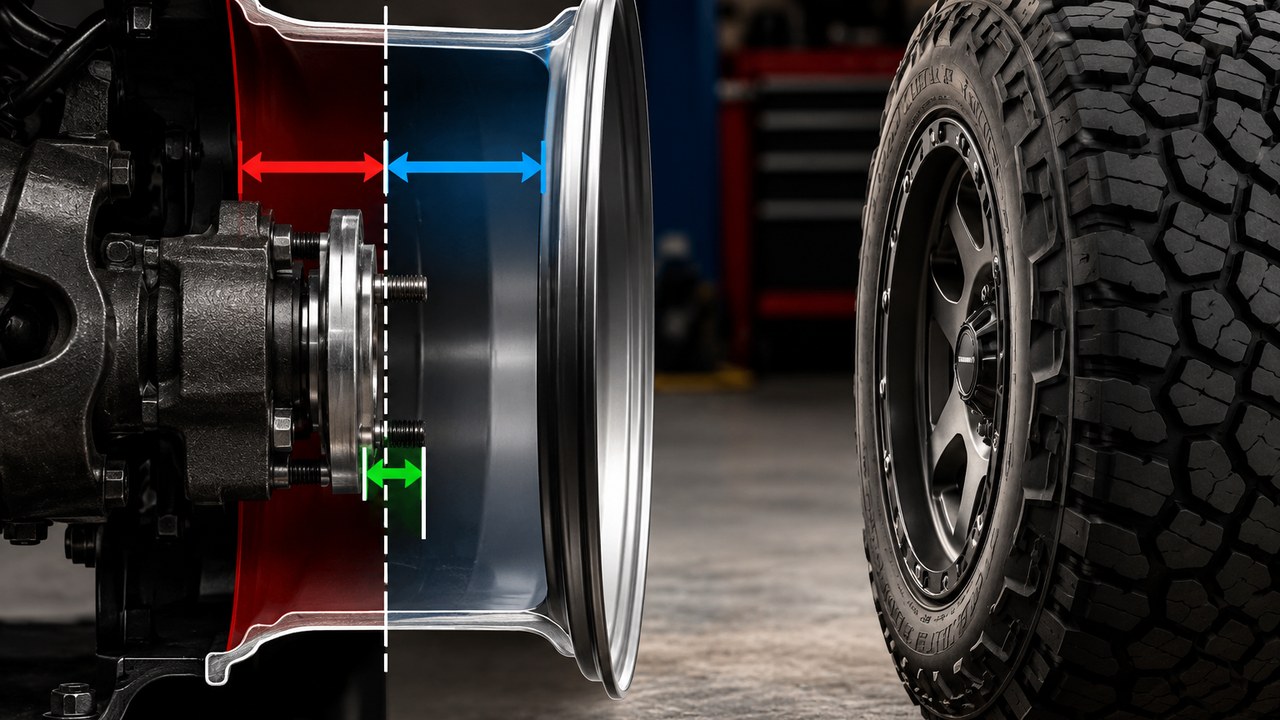
Use the wheel offset and backspacing calculator below to convert ET to backspacing, convert backspacing to offset, or compare your current wheels with a new setup. If you are shopping for new wheels, the comparison mode also shows how much farther the new wheel moves toward the fender or suspension.
Choose the calculation that matches the numbers you already have. For the most accurate backspacing conversion, use a measured overall wheel width when available; stamped wheel width is measured between the bead seats and does not include the outer rim flanges.
Wheel Offset & Backspacing Calculator
The comparison result tells you how the wheel itself moves relative to your current setup. A positive outer-poke result means the new wheel extends farther toward the fender. “Less inner clearance” means the new wheel extends farther toward the suspension.
If you want the underlying geometry explained in detail before interpreting the numbers, read our guide to wheel offset vs backspacing. This page is intentionally focused on calculation and fitment comparison rather than repeating that explanation.
Which Calculator Mode Should You Use?
You do not need every wheel specification to get a useful result. Start with whichever measurement you already know:
- Offset → Backspacing: use this when the wheel is listed by width and ET offset but a suspension or lift manufacturer specifies backspacing.
- Backspacing → Offset: use this when you measured an existing wheel or found an older wheel listing that gives backspacing but not ET.
- Compare Wheels: use this before replacing your current wheels. It estimates the change in outer poke, inner clearance, backspacing and track width.
The third mode is usually the most useful when buying aftermarket wheels because a new wheel can change width and offset at the same time. Looking only at the ET number misses half of the fitment equation.
What the Wheel Comparison Results Mean
Outer Wheel Position
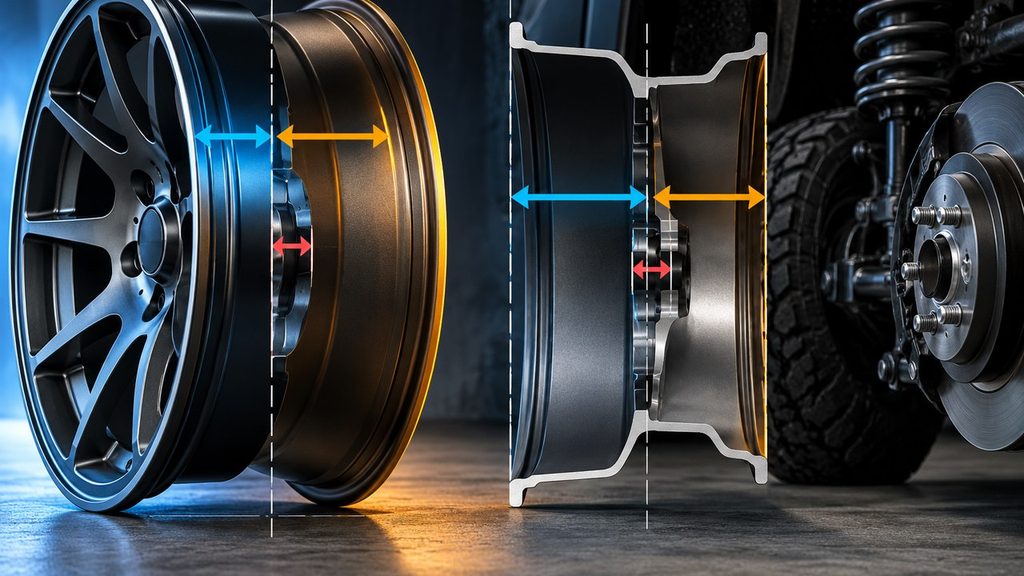
This is the calculated movement of the new wheel’s outer edge relative to your current wheel. A result of 18 mm more outward means the new wheel extends approximately 18 mm farther toward the fender on each side of the vehicle.
It does not mean you have 18 mm of tire poke beyond the fender. Tire section width, sidewall shape and the current wheel’s position relative to the body still matter.
Inner Clearance
Inner clearance compares how far the wheel extends from the hub toward components such as a strut, shock, control arm or frame.
If the calculator says 12 mm less inner clearance, the new wheel edge sits approximately 12 mm closer to the suspension than the current wheel edge. It does not mean 12 mm of clearance remains—you need to measure the space available on the vehicle to know that.
Track-Width Change
Track width refers to the lateral distance between the wheel centerlines on opposite sides of an axle. The calculator reports the approximate change across both sides when offset or spacer thickness changes.
Wheel width by itself changes inner and outer edge position but does not move the wheel centerline. Offset and spacers do.
Effective Offset With a Spacer
A wheel spacer moves the installed wheel outward. For position calculations, subtract spacer thickness from the wheel’s manufactured offset.
For example, a +30 mm wheel installed with a 10 mm spacer has an effective offset of approximately +20 mm. The wheel itself is still manufactured as +30 mm ET; the calculator is describing its installed position.
The calculator can show how a spacer changes wheel position, but it cannot determine whether that spacer is appropriate for the vehicle. For the mechanical side of the decision, see when wheel spacers are safe and when they can cause problems.
Nominal Wheel Width vs Measured Overall Width
This is the most important input to understand if you want an accurate offset-to-backspacing conversion.
A wheel sold as 17×9 has a nominal width of 9 inches measured between its tire bead seats. Its physical width from the outer edge of one rim flange to the other is greater than 9 inches.
Because backspacing is measured to the inner wheel lip, the converter needs that physical width. When you select Nominal / stamped width, this calculator adds 1.00 inch to the entered width as a practical flange estimate—approximately 0.5 inch per side.
That extra inch is an estimate, not a universal manufacturing dimension. Wheel flange geometry varies. If the wheel manufacturer publishes actual overall width, or you can measure it yourself, select Measured overall width for the more precise conversion.
Wheel Offset to Backspacing Formula
When actual overall wheel width is known, backspacing can be calculated as:
Backspacing (in) = overall wheel width ÷ 2 + offset (mm) ÷ 25.4
If you only know the nominal bead-seat width, this calculator estimates:
Backspacing (in) ≈ (nominal width + 1) ÷ 2 + offset (mm) ÷ 25.4
The 25.4 converts millimeters to inches.
Backspacing to Offset Formula
To work in the opposite direction:
Offset (mm) = [backspacing − overall wheel width ÷ 2] × 25.4
Using nominal width and the same 1-inch total flange estimate:
Offset (mm) ≈ [backspacing − (nominal width + 1) ÷ 2] × 25.4
The calculator performs these conversions automatically, so the formulas are mainly useful when checking a result or understanding why changing wheel width changes the equivalent backspacing.
Quick Offset-to-Backspacing Example
Take a nominal 9-inch-wide wheel with +18 mm offset.
- Estimate overall width as 10 inches.
- Half of that overall width is 5 inches.
- Convert +18 mm to inches: 18 ÷ 25.4 ≈ 0.71 inch.
- Add the offset distance: 5 + 0.71 ≈ 5.71 inches of backspacing.
If the manufacturer’s measured overall width is different from the estimated 10 inches, the real backspacing will change accordingly.
Quick Wheel Offset and Backspacing Chart
This reference uses a 9-inch nominal wheel and assumes approximately 10 inches of total lip-to-lip width. Use the calculator for other widths or a measured overall dimension.
| Offset | Estimated Backspacing | General Position |
|---|---|---|
| -12 mm | 4.53″ | Farther outward |
| 0 mm | 5.00″ | Mounting face at centerline |
| +12 mm | 5.47″ | Farther inward |
| +18 mm | 5.71″ | Farther inward |
| +25 mm | 5.98″ | Farther inward |
| +35 mm | 6.38″ | Farther inward |
The directional descriptions assume the same wheel width. A different width changes both inner and outer edge position even if offset stays identical.
A Real Wheel-Swap Comparison
Suppose your truck currently has an 8.5-inch wheel at +30 mm and you are considering a 9-inch wheel at +12 mm.
The new wheel is half an inch wider, but it also has 18 mm less positive offset. Those two changes do not affect each side of the wheel equally.
- Outer edge: approximately 24.4 mm farther outward.
- Inner side: approximately 11.7 mm more geometric clearance.
- Track width: approximately 36 mm wider across the axle centerlines.
- Estimated backspacing: approximately 5.93″ current versus 5.47″ new, using the 1-inch flange estimate.
This is why saying only that the new wheel is “half an inch wider” is not enough. Offset determines where that additional width ends up relative to the hub.
The Calculator Cannot Tell You Whether a Wheel Fits
The numbers can eliminate obviously poor choices and show how one wheel compares with another, but they cannot guarantee vehicle fitment.
A mathematically acceptable wheel can still contact something the calculator cannot see, including:
- brake calipers or caliper brackets;
- upper control arms;
- struts, shocks or springs;
- steering components;
- frame rails or body mounts;
- fender liners, bumpers or mud flaps;
- the outer fender during suspension compression.
Spoke design is another important limitation. Two wheels with identical width and offset can have different spoke profiles, so one may clear a large brake caliper while the other does not.
Wheel Position Is Not Tire Clearance
This tool calculates wheel position. Your tire may extend farther inward and outward than the wheel itself.
Actual tire section width depends on tire size, tire model and the wheel width on which the tire is mounted. Aggressive all-terrain and mud-terrain tires may also have shoulder blocks or sidewall features that become the first point of contact.
That distinction matters especially when clearance is already tight. Gaining 8 mm at the wheel barrel does not guarantee 8 mm of clearance at the tire sidewall.
If you’re changing tire sizes as well as wheels, use our tire size comparison tool to calculate the nominal diameter and section-width differences. You can then consider those changes alongside the wheel-position results, although actual clearance still needs to be checked on the vehicle.
Measure the Vehicle Before Trusting a Clearance Number
The comparison calculator tells you the change in position. To estimate what will actually remain, first measure your existing clearance.
For example, if your current wheel-and-tire assembly has 20 mm between the tire and an upper control arm and the proposed setup calculates 12 mm less inner clearance, the simple static estimate leaves about 8 mm.
But 8 mm on paper is not automatically sufficient. Tire flex, steering movement, suspension travel, bearing play, manufacturing tolerances and accumulated load can all reduce real clearance.
Check the New Setup in More Than One Position
Do not judge fitment only with the vehicle parked, unloaded and pointing straight ahead.
- Check inner clearance with the wheels straight.
- Turn the steering fully in both directions.
- Check front and rear portions of the wheel well.
- Consider suspension compression over bumps and driveway transitions.
- Account for passengers, cargo or towing load when relevant.
- Verify brake-caliper and spoke clearance separately.
If clearances are close, a physical test fit is more valuable than adding extra decimal places to the calculator.
Common Wheel Calculator Mistakes
- Entering tire width instead of wheel width. A 285 mm tire is not the number required in the wheel-width field.
- Treating a stamped 9-inch wheel as 9 inches overall. Nominal wheel width excludes the rim flanges.
- Comparing offset without width. The same ET on a wider wheel changes both inner and outer position.
- Reading “less inner clearance” as remaining clearance. It is the change relative to the current wheel, not the gap left on the vehicle.
- Ignoring spacers already installed. A spacer changes the wheel’s effective installed position.
- Assuming poke predicts tire fitment. Tire section width can extend beyond the wheel lip.
- Assuming identical numbers guarantee brake clearance. Spoke shape and barrel design matter independently of ET and backspacing.
Frequently Asked Questions
How do I calculate backspacing from wheel offset?
Enter the wheel width and offset in the Offset → Backspacing mode above. If you use nominal stamped width, the calculator adds approximately 1 inch for both rim flanges before calculating the distance from the hub mounting face to the inner lip.
How do I convert backspacing to offset?
Enter wheel width and backspacing in the Backspacing → Offset mode. Offset equals the difference between backspacing and half the physical wheel width, converted from inches to millimeters.
What offset is 4.5 inches of backspacing?
It depends on wheel width. Using the common 1-inch total flange estimate, 4.5 inches of backspacing is approximately 0 mm offset on an 8-inch nominal wheel, but approximately -13 mm on a 9-inch nominal wheel. Backspacing cannot be converted to offset without knowing width.
What backspacing is zero offset?
At zero offset, the mounting face sits at the wheel centerline. Backspacing is therefore approximately half of the wheel’s physical overall width. An 8-inch nominal wheel is roughly 9 inches overall using the standard estimate, giving approximately 4.5 inches of backspacing.
Does a lower offset make the wheel stick out farther?
With the same wheel width, yes. Reducing offset moves the wheel outward. If width changes too, use the comparison calculator because the width change also affects inner and outer position.
How much does a half-inch wider wheel change clearance?
If offset stays exactly the same, adding 0.5 inch of wheel width adds approximately 0.25 inch—or 6.35 mm—to each side of the wheel. The inner edge moves about 6.35 mm closer to the suspension and the outer edge moves about 6.35 mm farther toward the fender.
Do wheel spacers change offset?
They do not change the offset manufactured into the wheel, but they change its effective installed position. A 10 mm spacer makes a +30 mm wheel sit approximately like a +20 mm wheel of the same width.
Is calculated backspacing exact?
It can be very accurate when you enter a measured overall wheel width. When calculated from nominal stamped width, the result uses an estimated 1-inch total flange allowance. Actual rim-flange dimensions vary, so manufacturer specifications or a physical measurement take priority.
Can this wheel fitment calculator tell me if my new wheels will rub?
No. It tells you how wheel position changes. Rubbing also depends on tire width and shape, suspension design, steering angle, ride height, alignment, bodywork and suspension compression. Use the calculated movement to narrow your options, then verify the actual vehicle.
Calculate First, Then Verify the Real Truck or Car
The useful question is not simply whether one wheel has “more offset” than another. It is where the new inner and outer edges will sit compared with the setup already on the vehicle.
Use the converter when a wheel manufacturer and suspension manufacturer speak in different measurements. Use the comparison mode when changing wheel width, ET or spacers. Then take those calculated movements back to the vehicle and confirm that the tire, suspension, brakes and bodywork still have enough room through steering and suspension travel.
That combination—calculation first, physical verification second—is much more reliable than choosing wheels from offset alone.