What Is Ackermann Steering Geometry? How It Works
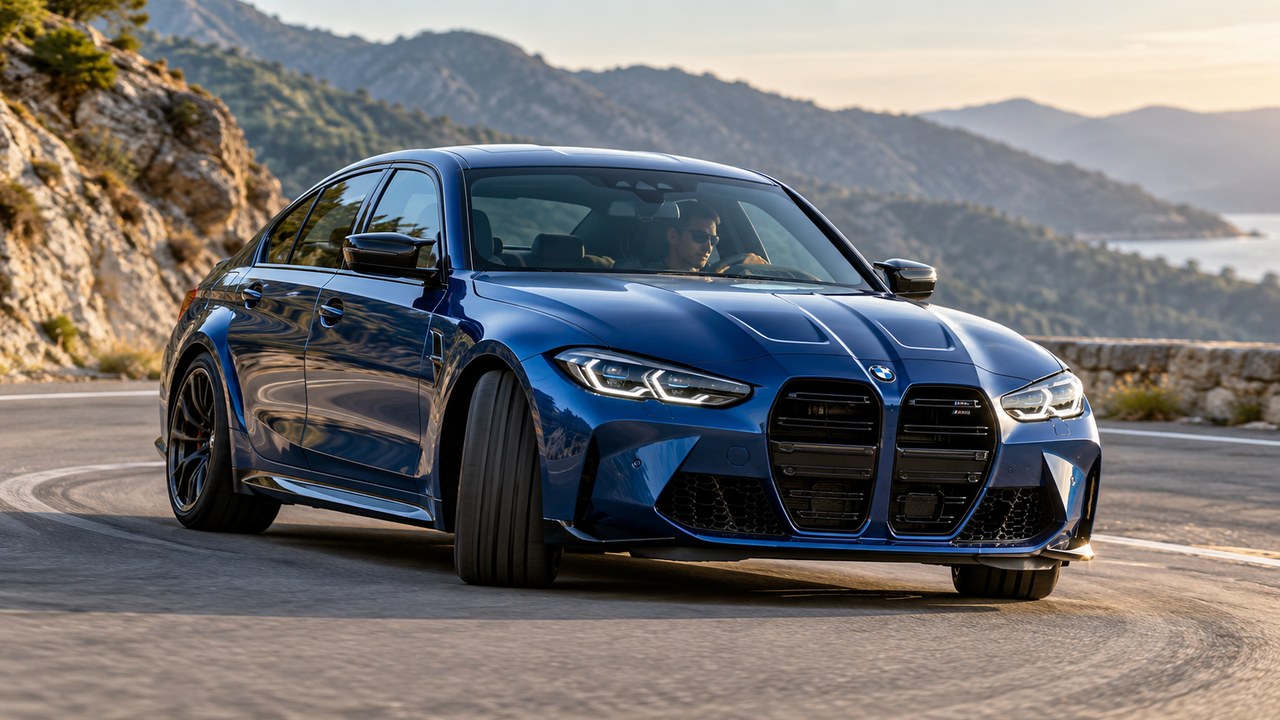
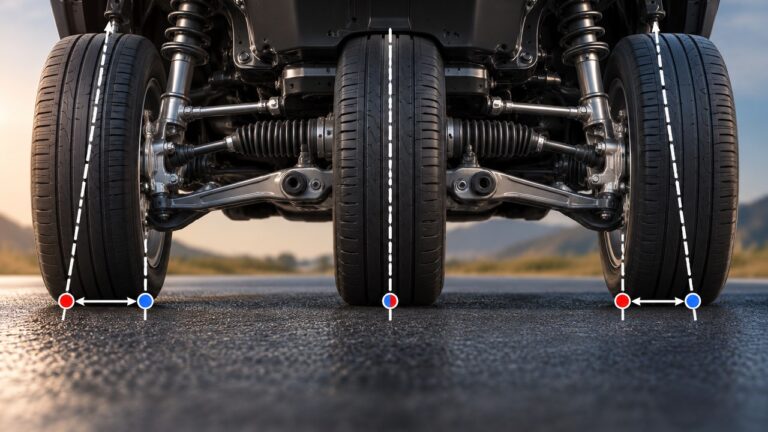
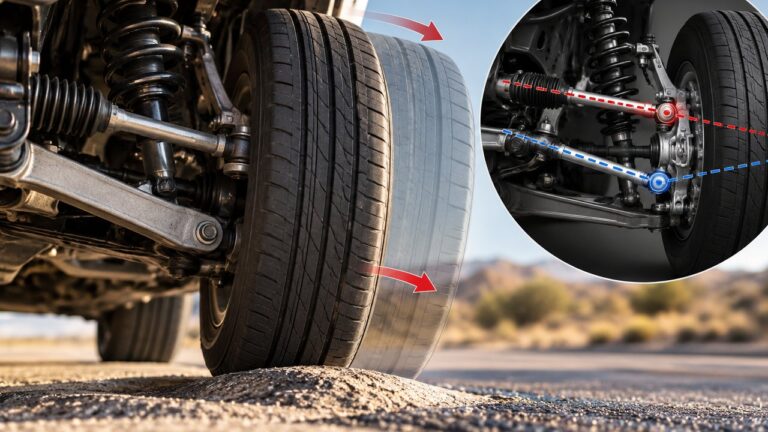
Ackermann steering geometry makes the inside front wheel turn more sharply than the outside front wheel during a corner. The reason is simple: the inside tire follows a smaller-radius path, so both front wheels cannot point at the same angle without one of them scrubbing sideways across the road.
In ideal Ackermann geometry, the projected axes of the wheels meet at a common turning center. This lets each tire roll around the corner with less lateral scrub at low speed.
Real cars do not necessarily use perfect 100% Ackermann through the entire steering range. Manufacturers can use partial Ackermann, and race cars may deliberately use less Ackermann or even anti-Ackermann because tire slip angles and cornering loads change what the tires need at higher speeds.
How Ackermann Steering Works
When a vehicle turns, all four tires follow different paths around the corner.
The front inside tire travels around the tightest circle. The front outside tire travels around a larger circle. The rear tires follow their own radii as well.
For the tires to roll without unnecessary lateral scrub, their wheel axes need to point toward approximately the same instantaneous center of rotation.
| Wheel | Path through a turn | Required steering angle |
|---|---|---|
| Inside front | Smallest radius | Largest steering angle |
| Outside front | Larger radius | Smaller steering angle |
| Inside rear | Smaller rear radius | Normally fixed straight ahead |
| Outside rear | Largest rear radius | Normally fixed straight ahead |
That difference between the two front steering angles is the heart of Ackermann steering geometry.
Why Does the Inside Wheel Turn More Than the Outside Wheel?
Imagine drawing a top-down view of a car making a tight left turn.
The left-front tire is closer to the center of the turn than the right-front tire. Because it travels around a smaller circle, it must point at a sharper angle.
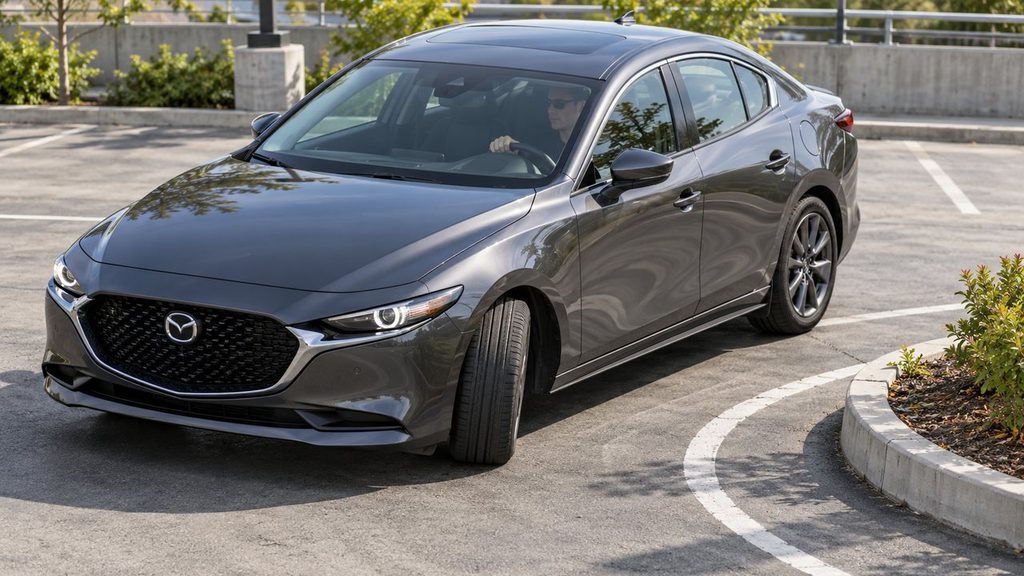
If both front wheels turned exactly 25 degrees, for example, they would be trying to follow incompatible paths. At least one tire would have to distort or slide laterally instead of rolling cleanly along its natural arc.
Ackermann geometry introduces steering-angle difference: perhaps the inside wheel turns 30 degrees while the outside wheel turns only 25 degrees. The exact numbers depend on wheelbase, track width and steering position.
This steering-angle difference is sometimes called toe-out on turns, but it should not be confused with static toe-out measured with the vehicle pointing straight ahead.
What Is the Purpose of Ackermann Steering Geometry?
The original geometric goal is to let all four tires follow compatible circular paths through a low-speed turn with as little lateral tire scrub as practical.
That can improve:
- low-speed maneuverability;
- tight-turn smoothness;
- tire behavior during parking and U-turns;
- steering consistency;
- tire wear caused by excessive scrub during steering;
- the relationship between turning radius and steering angle.
It does not mean that 100% theoretical Ackermann is automatically the fastest or best configuration in every dynamic situation. The ideal pure-rolling model becomes less representative as cornering speed, tire load and slip angle increase.
What Creates Ackermann Geometry in a Car?
Ackermann is produced by the layout of the steering linkage—not by an electronic command telling one wheel to turn farther than the other on a conventional mechanical system.
The important components typically include:
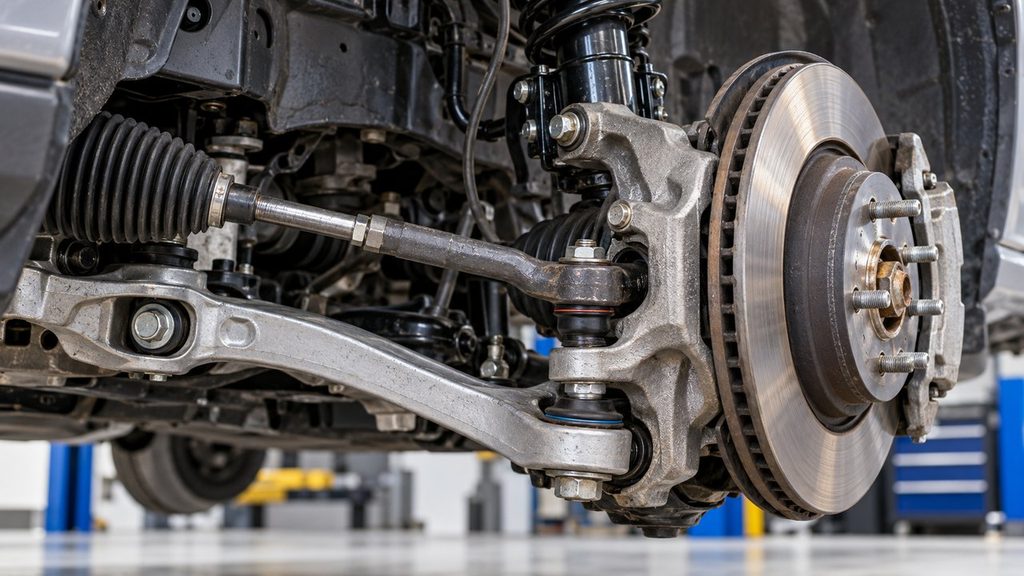
- the steering rack or steering linkage;
- tie rods;
- steering arms;
- steering knuckles;
- kingpin or steering-axis locations;
- front track width;
- wheelbase.
As the steering linkage moves, the geometry of the steering arms causes the inside and outside knuckles to rotate through different angles.
A classic simplified Ackermann layout can be visualized by drawing lines through the steering-arm pivots toward the center of the rear axle. Modern rack-and-pinion systems can be more complex, and manufacturers optimize steering-arm length, rack position and tie-rod pickup points to create the desired steering-angle curve.
100% Ackermann vs. Partial Ackermann vs. Parallel Steering
Ackermann geometry is not simply an on-or-off feature. Steering systems can produce different amounts of steering-angle difference.
| Geometry | Inside vs. outside wheel | Basic idea |
|---|---|---|
| 100% Ackermann | Inside turns more by the theoretical ideal amount | Wheel axes converge on the geometric turning center |
| Partial Ackermann | Inside turns more, but by less than the theoretical ideal | Common compromise in real vehicles |
| Parallel steering / 0% Ackermann | Both front wheels turn by the same angle | No Ackermann angle difference |
| Anti-Ackermann | Difference moves opposite the normal Ackermann direction | Used selectively for tire behavior at high lateral loads |
ISO terminology defines 100% Ackermann as steering geometry where the steerable wheel axes intersect at the vehicle’s center of rotation under the relevant low-lateral-acceleration condition. Parallel steer, where both steerable wheels have equal angles, represents 0% Ackermann.
A real steering linkage can also produce a percentage that changes as steering lock increases. In other words, a car does not necessarily have one fixed Ackermann percentage at every steering-wheel position.
What Is Anti-Ackermann Steering?
Anti-Ackermann, also called reverse Ackermann, reduces or reverses the conventional difference between the inner and outer front steering angles.
That sounds wrong if you consider only low-speed geometric rolling. But racing tires do not corner in a pure no-slip condition.

At higher lateral acceleration, the outside front tire usually carries substantially more load than the inside tire. Tires also generate cornering force at a slip angle: the direction the tire is pointing differs slightly from the direction it is actually traveling.
Because the heavily loaded outside tire and lightly loaded inside tire may need different slip angles for optimum performance, the best dynamic steering-angle relationship can differ from theoretical low-speed Ackermann.
That is why some race cars use reduced Ackermann or anti-Ackermann geometry. It is a tire-performance decision, not evidence that the basic Ackermann principle is incorrect.
Racecar Engineering discusses this distinction in the context of tire slip angle, cornering load and racing applications.
Why Road Cars Usually Use Ackermann Steering
Road cars spend a significant amount of time making low- and moderate-speed turns where minimizing unnecessary tire scrub is useful.
Examples include:
- parking;
- tight intersections;
- roundabouts;
- U-turns;
- driveways;
- urban maneuvering.
A steering system that makes both front wheels turn at the same angle would force the tires to fight each other more during these maneuvers.
Production vehicles therefore normally use some Ackermann effect, although tire behavior, steering packaging, suspension movement and manufacturer handling targets mean the actual geometry may not equal the textbook ideal at every steering angle.
Ackermann Steering Geometry Formula
The basic Ackermann relationship connects the inside steering angle, outside steering angle, track width and wheelbase.
A common form of the ideal low-speed Ackermann condition is:
cot(outer angle) − cot(inner angle) = track width ÷ wheelbase
Where:
- inner angle = steering angle of the inside front wheel;
- outer angle = steering angle of the outside front wheel;
- track width = lateral distance between the relevant left and right wheel or steering-center references;
- wheelbase = distance between front and rear axle reference lines.
Another useful way to express the geometry is to define a turning radius R from the midpoint of the rear axle to the instantaneous turning center:
inner angle = arctan[wheelbase ÷ (R − track width/2)]
outer angle = arctan[wheelbase ÷ (R + track width/2)]
The important takeaway is more useful than memorizing the equation: the tighter the turn, the greater the required difference between inner and outer wheel angles.
How Wheelbase and Track Width Affect Ackermann
Wheelbase and track width determine the basic geometric relationship between the two front steering angles.
Wheelbase
A longer wheelbase changes the radius relationship between the front and rear axles. For a given track width and turning radius, wheelbase influences how much the front wheels need to steer.
This is one reason a long-wheelbase truck and a short sports car cannot simply use the same steering geometry and produce the same turning behavior.
Track Width
A wider front track increases the distance between the inner and outer front wheel paths.
At a given wheelbase and turning radius, that generally increases the difference required between the inner and outer steering angles for ideal Ackermann geometry.
This is why Ackermann calculations use both wheelbase and track width rather than steering angle alone.
What Is Toe-Out on Turns?
Toe-out on turns is the difference between the inner and outer front wheel steering angles while the vehicle is turning.
Because the inside wheel turns more sharply under normal Ackermann geometry, the front wheels appear increasingly toe-out relative to each other as steering lock increases.
This is different from static toe.
| Measurement | When it is evaluated | What it describes |
|---|---|---|
| Static toe | Wheels near straight ahead | Whether the fronts of the tires point inward or outward relative to each other |
| Toe-out on turns | Wheels steered into a turn | Difference between inside and outside steering angles |
| Bump steer | Suspension moving through bump/droop | Unintended toe change caused by suspension travel |
An alignment technician can use turn plates and manufacturer specifications to compare steering angles at a specified amount of lock. An incorrect reading can point toward bent steering arms, damaged knuckles, incorrect parts or displaced suspension/steering components.
Ackermann Steering vs. Bump Steer
Ackermann and bump steer both involve changes in wheel direction, but they describe completely different events.
Ackermann steering is the intentional difference between inner and outer steering angles as the driver turns the steering system.
Bump steer is an unintended change in toe caused by suspension movement.
A car can have excellent Ackermann geometry and still suffer from poor bump steer if its tie rods and suspension arms follow incompatible arcs through vertical wheel travel.
Our guide explaining what bump steer is covers that dynamic toe-change problem separately.
Ackermann Steering vs. Scrub Radius
Ackermann geometry should also not be confused with scrub radius.
Ackermann compares the steering angles of the inside and outside wheels during a turn.
Scrub radius measures the horizontal distance at road level between the tire contact-patch center and the steering-axis intersection.
Both influence steering behavior, but through different mechanisms. If wheel offset, spacers or suspension geometry have changed the position of the tire relative to the steering axis, our scrub radius guide explains that relationship separately.
Is Ackermann the Same as Wheel Alignment?
No. A conventional wheel alignment and Ackermann geometry are related to wheel direction, but they measure different things.
A normal alignment focuses primarily on static:
- toe;
- camber;
- caster;
- rear thrust angle where applicable.
Ackermann describes how the relationship between the two front steering angles changes as the steering system turns.
Setting straight-ahead toe correctly does not automatically repair incorrect toe-out-on-turns geometry caused by a bent steering arm, wrong knuckle or incorrectly positioned steering component.
Likewise, changing a tie rod during an ordinary toe adjustment does not normally give you a free choice of Ackermann percentage because the steering-arm and rack geometry largely establish the steering curve.
Can Wheel Offset or Spacers Change Ackermann?
Changing wheel offset or adding a spacer does not normally change the mechanical steering-angle relationship created by the steering arms and tie rods.
The inner and outer knuckles can still rotate through essentially the same angular relationship.
However, changing wheel position can alter other steering characteristics, including scrub radius, steering leverage, clearance and the path followed by the tire contact patch.
This distinction is important: two modifications can both affect how a car feels in a corner without changing the same piece of geometry.
If the modification involves moving the wheel inward or outward, our wheel offset vs. backspacing guide explains that separate fitment geometry.
What Happens If Ackermann Geometry Is Wrong?
If the inner and outer wheels do not have an appropriate steering-angle relationship, the tires cannot both follow their preferred paths through a turn.
Possible symptoms include:
- tire scrub during tight turns;
- binding or dragging sensations in parking-lot maneuvers;
- unexpected tire squeal at low speeds;
- a larger turning circle than expected;
- inconsistent steering behavior left to right;
- abnormal steering-angle readings on alignment turn plates;
- unusual tire temperature or grip behavior in competition use.
These symptoms are not unique to Ackermann errors. Incorrect toe, mismatched tire sizes, locked differentials, driveline bind, damaged steering components and other faults can create similar complaints.
What Can Change Ackermann Geometry?
Ackermann is mainly established by the hard geometry of the steering linkage, so significant changes normally involve components or pickup points rather than ordinary alignment adjustments.
Potential causes of altered Ackermann include:
- bent steering arms;
- incorrect steering knuckles;
- aftermarket knuckles with different steering-arm locations;
- relocated steering-rack position;
- different tie-rod pickup points;
- custom steering conversions;
- damaged or displaced subframes;
- incorrectly matched suspension and steering components;
- purpose-built race geometry.
Replacing a normal tie-rod end with the correct equivalent part should not intentionally redesign Ackermann geometry. Installing components with different pivot locations can.
How Is Ackermann Geometry Checked?
The practical workshop method is to compare the steering angles of the inside and outside wheels while the steering is turned through a specified angle.
A typical check involves:
- Verify tire pressures and basic front-end condition. Loose steering or suspension parts can invalidate measurements.
- Place the vehicle on suitable turn plates or alignment equipment.
- Center the steering and establish the straight-ahead position.
- Turn one wheel to the manufacturer-specified reference angle.
- Measure the angle of the opposite wheel.
- Compare the result with the vehicle specification.
- Repeat in the opposite direction. Significant left-right differences can help identify damaged or incorrectly installed parts.
This test is often described as checking turning angle or toe-out on turns.
If steering or suspension parts have recently been replaced, a conventional alignment may still be required afterward. Our guide to alignment after suspension and steering work explains when that check is appropriate.
Can You Adjust Ackermann on a Street Car?
On most production street cars, Ackermann is not a routine user adjustment.
The steering-arm geometry, knuckles and steering-rack location were designed as a system. Ordinary alignment adjustments normally change toe, camber or caster—not the fundamental relationship between inner and outer wheel angles.
Changing Ackermann intentionally may require:
- different steering arms or knuckles;
- adjustable steering pickup points;
- rack relocation;
- custom tie-rod geometry;
- motorsport-specific suspension components.
Those changes can also influence bump steer, steering ratio, component clearance and strength, so Ackermann should not be tuned in isolation.
Does More Ackermann Mean a Tighter Turning Radius?
Not automatically.
Turning radius depends on factors including:
- maximum available steering angle;
- wheelbase;
- track width;
- tire and wheel clearance;
- steering stops;
- the inner-to-outer wheel angle relationship.
Ackermann helps the two front tires point appropriately for their different turning radii. Simply increasing Ackermann percentage does not necessarily let the inside tire turn farther or reduce the physical steering lock of the vehicle.
A vehicle can therefore have correct Ackermann geometry and still have a relatively large turning circle because of a long wheelbase or limited maximum steering angle.
Is 100% Ackermann Always Best?
No. Perfect theoretical Ackermann is primarily a low-speed pure-rolling solution.
It works extremely well for explaining why the inside wheel needs more steering angle, but real tires deform and operate at slip angles during cornering.
At higher speed:
- the outside tire carries more vertical load;
- inside and outside tires may require different slip angles;
- tire load sensitivity changes available cornering force;
- suspension compliance changes actual wheel angles under load;
- camber, caster and body roll also influence tire behavior.
A manufacturer or race engineer may therefore choose less than 100% Ackermann through part of the steering range to achieve the desired dynamic behavior.
For normal road use, that does not mean owners should randomly alter steering geometry. Factory Ackermann is one part of a much larger steering and suspension design.
Ackermann Steering Geometry FAQ
What is Ackermann steering geometry in simple terms?
It is steering geometry that makes the inside front wheel turn more than the outside front wheel because the inside tire follows a tighter-radius path through a corner.
Which wheel turns more in Ackermann steering?
The inside front wheel turns through the larger angle. The outside front wheel follows a wider-radius path and therefore requires less steering angle.
What is 100% Ackermann?
100% Ackermann describes the theoretical condition where the steered wheel axes point toward the common center of rotation for the vehicle under the defined low-speed geometry.
What is 0% Ackermann?
0% Ackermann is parallel steering: the inside and outside front wheels steer by the same angle.
What is reverse Ackermann?
Reverse or anti-Ackermann shifts the steering-angle relationship away from normal Ackermann. It can be used in racing where tire slip angles and unequal tire loads make the theoretical low-speed geometry less desirable.
Does Ackermann affect tire wear?
Incorrect steering-angle relationships can increase lateral tire scrub during turns, particularly at low speeds and high steering angles. Tire wear also depends heavily on static alignment, inflation, suspension condition and driving use.
Is Ackermann the same as toe-out?
No. Ackermann creates a difference between inner and outer steering angles during a turn, sometimes called toe-out on turns. Static toe-out describes the relationship between the wheels near the straight-ahead position.
Can bad Ackermann cause tire squeal in parking lots?
It can contribute if the front tires are being forced to follow incompatible paths during tight turns. However, tire compound, pavement, tire pressure, differentials and ordinary alignment problems can also cause low-speed tire scrub or squeal.
Do all cars use perfect Ackermann?
No. Most road vehicles use steering geometry based on the Ackermann principle, but the actual percentage can differ from theoretical 100% Ackermann and can change throughout the steering range.
The Geometry to Check When a Car Scrubs Through Tight Turns
If a vehicle has normal tire pressures and reasonable static alignment but one or both front tires scrub heavily during tight turns, the inner-to-outer steering-angle relationship is worth considering.
Start by checking for bent or incorrect steering components rather than assuming the car needs a custom Ackermann setup. Steering arms, knuckles, rack position and tie-rod pickup points all influence the geometry.
The key principle remains straightforward: the inside front wheel follows a tighter path, so it needs to turn more than the outside front wheel. Ackermann steering geometry creates that difference while allowing both tires to follow the corner with less unnecessary scrub.