Radius Arm vs 4-Link Suspension: Which Is Better?
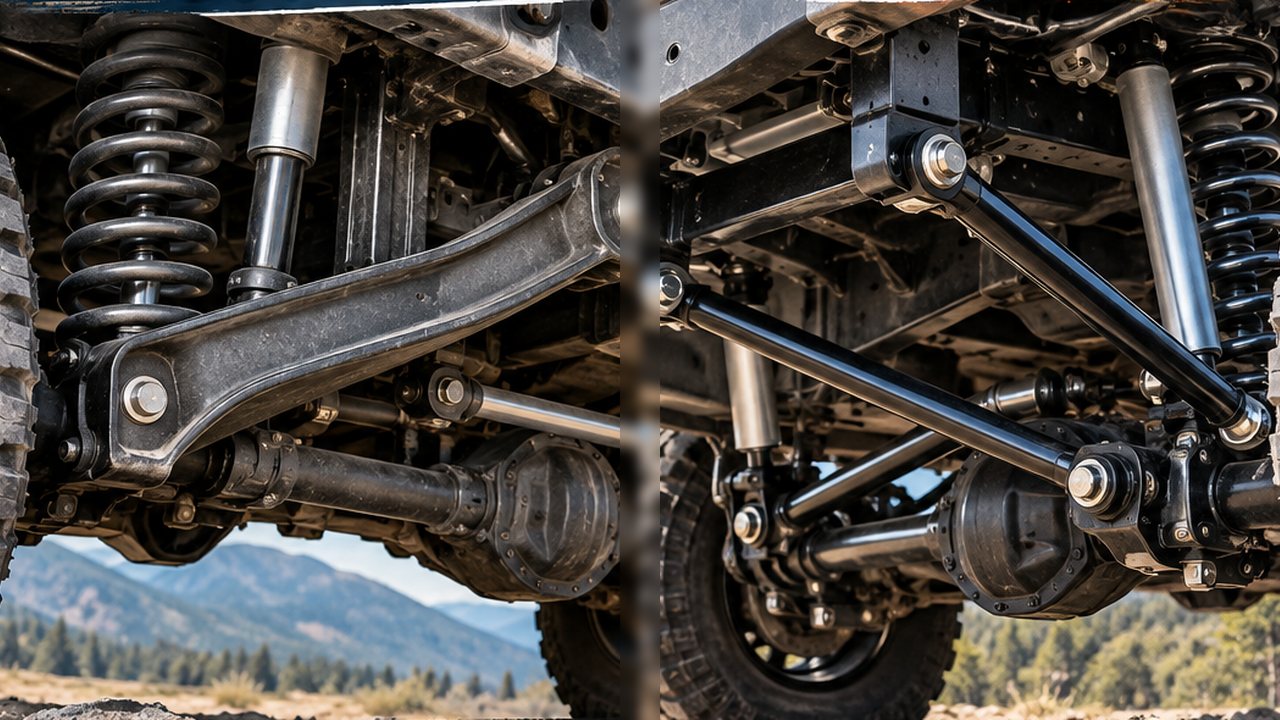
For most daily-driven, towing and moderately lifted solid-axle trucks, a radius arm setup is usually the simpler and more practical choice. A well-designed 4-link becomes more attractive when you want greater control over caster and axle rotation through suspension travel, more geometry adjustability, or you are building a taller or more off-road-focused suspension.
Neither layout is automatically better at everything. Radius arms use fewer links, package cleanly and can provide excellent strength and ground clearance. A 4-link separates the upper and lower axle-locating functions, giving suspension designers more freedom to control axle movement—but with additional brackets, joints, cost and setup complexity.
This comparison focuses on coil-sprung solid front axles such as those found on many Ford Super Duty and Ram HD 4×4 trucks. It is not a comparison of the triangulated rear 4-link systems commonly used in custom rear suspensions.
Radius Arm vs 4-Link: Quick Comparison
| Feature | Radius Arm | 4-Link |
|---|---|---|
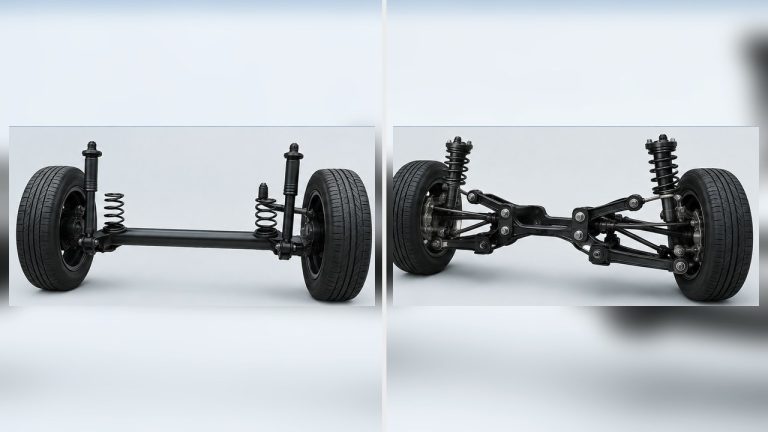
| Basic layout | One rigid arm per side with two axle mounts and one frame pivot | Separate upper and lower link on each side |
| Parts count | Lower | Higher |
| Caster through travel | Changes as the radius arm swings through its arc | Can be designed for much more consistent caster |
| Articulation potential | Very capable, but joint/bushing compliance is important | Excellent when link geometry and joints are designed correctly |
| Ground clearance | Often very good | Conversion brackets can hang lower |
| Geometry adjustability | More limited | Greater tuning freedom |
| Maintenance | Fewer joints and bushings | More links, pivots and brackets to inspect |
| Cost | Usually lower | Usually higher |
| Daily driving | Excellent when correctly aligned | Excellent when properly designed and aligned |
| Tall suspension lifts | Can work well with corrected geometry | Often attractive because axle rotation can be controlled more precisely |
| Best fit | Street, towing, moderate off-road and simpler builds | Performance-oriented, highly modified and geometry-focused builds |
If you simply want a strong, predictable lifted truck, do not assume you need to convert a factory radius-arm suspension to 4-link. A properly corrected radius-arm setup may already do everything you need. The 4-link becomes valuable when its additional geometry control solves a specific limitation.
What Is the Actual Difference?
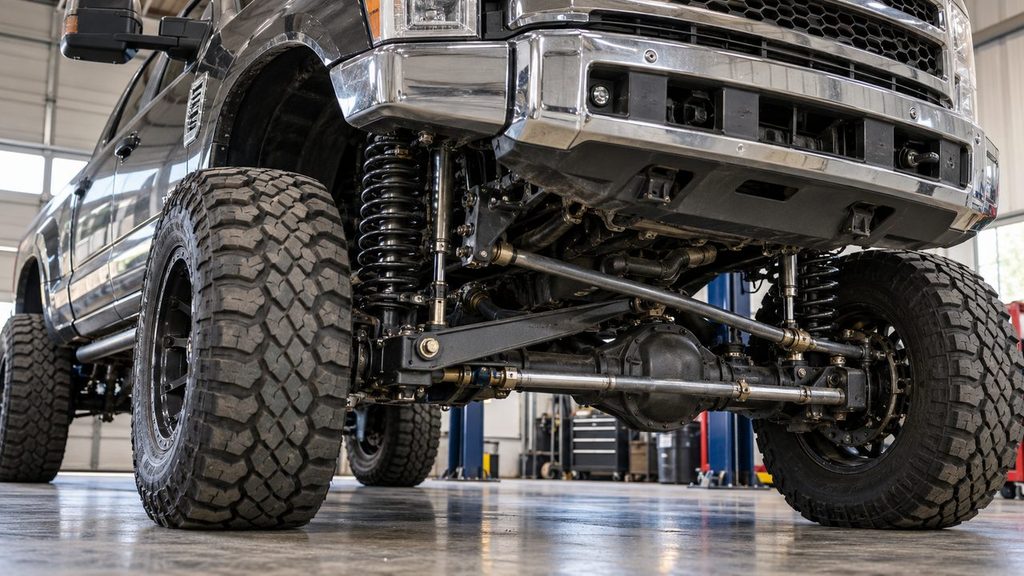
Both systems perform the same basic job: they locate a solid axle longitudinally beneath the chassis and control how that axle rotates as the suspension compresses and extends.
The major difference is how many independent links perform that job.
How a Radius Arm Locates the Axle
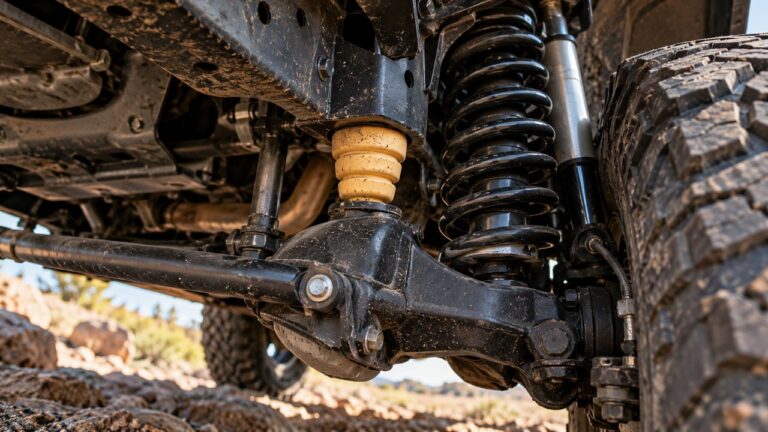
A radius-arm front suspension normally has one substantial arm on each side of the vehicle. Each arm attaches to the axle at two vertically separated points and pivots from one primary chassis-side connection.
Because both axle attachment points are part of one rigid arm, the arm controls both the fore-aft location of the axle and its rotation.
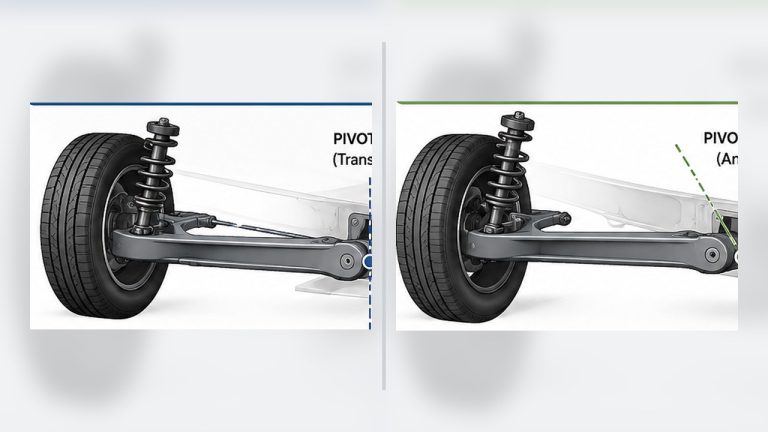
As the suspension moves, the frame-side pivot makes the axle follow an arc. Axle rotation—and therefore caster and pinion angle—changes as part of that movement.
The basic chassis-pivot concept is related to the broader trailing-arm suspension family, but a radius arm’s two axle-side attachments allow it to control the rotation of a solid axle rather than simply locating one wheel or hub.
How a 4-Link Locates the Axle
A 4-link replaces each rigid radius arm with two separate links: an upper and a lower. Across the axle, that creates four longitudinal links in total.
Because those links pivot independently at both ends, the relationship between upper-link length, lower-link length, mounting height and link angle determines how the axle rotates through its travel.
That gives the suspension designer much more freedom. A properly designed 4-link can minimize caster change, control pinion-angle movement and tune other geometric characteristics that are largely dictated by the radius-arm arc in a radius-arm system.
A Front 4-Link Still Usually Needs a Track Bar
One common source of confusion is the assumption that four longitudinal links automatically locate the axle in every direction.
On the type of front 4-link used in many solid-axle trucks, the upper and lower links primarily control fore-aft position and axle rotation. A separate track bar—also called a Panhard bar—controls lateral movement and keeps the axle centered under the chassis. Our guide to what a track bar does explains how that lateral location works and why track-bar geometry becomes especially important after a suspension lift.
The factory radius-arm layout also normally uses a track bar for the same reason.
Some suspension terminology counts that track bar as another link, which is why similar arrangements may occasionally be called a five-link suspension. In the truck aftermarket, however, “4-link conversion” commonly refers specifically to the four longitudinal control arms while retaining a separate track bar.
A triangulated rear 4-link is different because angled links can provide lateral location without a track bar. That is not the layout being compared here.
Caster Control Is One of the Biggest Differences
Caster is the forward or rearward tilt of the steering axis when viewed from the side of the vehicle. On a solid front axle, it has a major influence on straight-line stability, steering return-to-center and overall steering feel.
Caster Change With Radius Arms
Because a radius arm moves around a single chassis pivot, the axle rotates as it travels through bump and droop.
This means caster is not fixed throughout the suspension cycle. The amount of change depends on radius-arm length, mounting position, ride height and total suspension movement.
That does not make radius arms unsuitable for lifted trucks. Factory engineers already design around this movement, and quality aftermarket radius arms or relocation brackets can restore appropriate geometry at a new ride height.
Caster Control With a 4-Link
A 4-link gives the designer independent upper and lower link arcs. By selecting their lengths and mounting positions, axle rotation through bump and droop can be controlled much more deliberately.
A well-engineered setup can therefore maintain a more consistent caster angle over a larger portion of suspension travel.
This is one of the strongest reasons to consider a 4-link on a highly modified truck: not because four links automatically ride better, but because they provide more freedom to manage axle geometry.
Which Articulates Better?
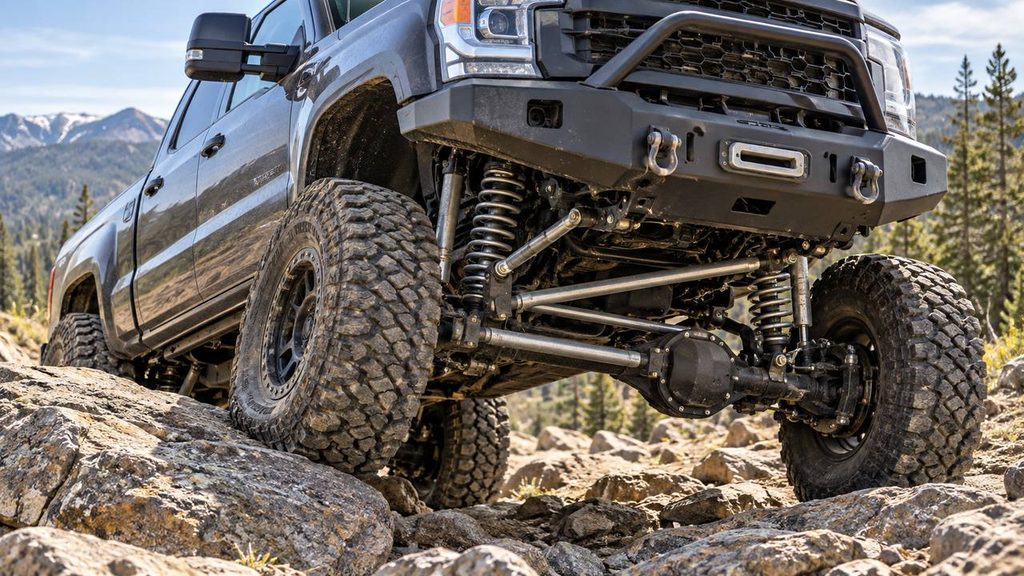
A well-designed 4-link generally has greater freedom to articulate without forcing axle rotation through a rigid radius-arm arc, but the real answer depends heavily on the joints, bushings and link geometry.
This comparison is frequently oversimplified.
Why Radius Arms Can Bind
Each radius arm attaches to the axle in two places. During cross-axle articulation—one wheel moving upward while the other moves downward—the left and right arms can try to rotate the axle through slightly different paths.
The system needs compliance somewhere to accommodate that difference. Rubber bushings, flex joints and the arms themselves can provide some of it.
A radius-arm suspension with appropriate compliant joints can therefore articulate extremely well. A system with very stiff bushings and little angular freedom may resist articulation much more noticeably.
Why a 4-Link Can Reduce That Constraint
In a 4-link, each upper and lower arm pivots independently. The axle is not rigidly tied to two attachment points on one long arm on each side.
That can allow the axle to articulate more freely while still controlling fore-aft movement and rotation.
But a 4-link can also bind if link angles, joint misalignment or bracket placement are wrong. Four links do not magically guarantee unrestricted articulation.
Do 4-Link Suspensions Have Less Bump Steer?
Not automatically. Bump steer on a solid-front-axle truck is influenced primarily by the relationship between the steering drag link and the track bar.
As the axle moves vertically, both components follow arcs. If their effective lengths and angles differ significantly, the axle and steering linkage can move through incompatible paths and steer the wheels without deliberate input from the driver.
Changing from radius arms to four links can change caster behavior and steering feel, but simply adding two more longitudinal links does not correct poor drag-link/track-bar geometry.
When diagnosing steering behavior after a lift, evaluate the complete system: track-bar angle, drag-link angle, axle centering, caster, toe, steering joints and tire characteristics—not just the type of control arms.
Radius Arm vs 4-Link for On-Road Driving
A factory-style radius-arm suspension is difficult to criticize for normal road use. Manufacturers use the design on heavy-duty pickups because it combines strength, predictable geometry, relatively few wear points and straightforward packaging.
Rubber-bushed radius arms can also isolate noise, vibration and harshness effectively while requiring little routine attention beyond inspection.
A properly engineered 4-link can drive equally well—or provide more consistent steering geometry through larger suspension movements—but the result depends on bracket location, joint type and alignment.
Replacing compliant factory bushings with spherical joints or very firm aftermarket joints can increase steering precision while also transmitting more vibration or mechanical noise into the chassis.
For a truck that spends nearly all its life on pavement, converting to a 4-link solely because it sounds more advanced rarely makes sense.
Which Is Better Off Road?
The answer changes with the kind of off-roading involved.
Moderate Trails and Rough Roads
A radius-arm truck can be extremely capable on normal trails, forest roads and uneven terrain. Good joints, appropriate shock travel and sensible anti-roll-bar behavior matter more than converting the suspension simply to gain another pair of links. When cross-axle articulation becomes the limitation, our guide to disconnecting the sway bar for off-road use explains why reducing left-to-right roll resistance can help the suspension follow uneven terrain more freely.
High-Articulation Terrain
When large cross-axle articulation is a primary goal, a well-designed 4-link offers more freedom to manage axle rotation and joint movement without relying as heavily on bushing compliance.
That advantage becomes more useful as suspension travel and modification increase.
High-Speed Rough Terrain
At higher speeds, caster consistency and predictable axle control become increasingly important, but link layout is only one part of the equation.
Shock damping, spring rate, tire mass, track-bar geometry, steering, bump stops and usable travel all influence how stable a solid-axle truck feels across repeated rough terrain.
Ground Clearance and Packaging
Radius arms often have a practical packaging advantage.
One substantial arm can run rearward from each side of the axle to a relatively high chassis pivot. Quality aftermarket versions can also be shaped for additional tire and obstacle clearance.
A 4-link needs separate upper and lower frame mounts with enough vertical separation to create useful geometry. On a conversion, those brackets may extend below the frame farther than a high-clearance radius-arm mount.
This does not mean every radius-arm system has more clearance than every 4-link. Bracket design and lift height determine where the actual low points sit.
Before choosing a system for rock use, look at the physical brackets themselves rather than relying on the suspension name.
Radius Arms, 4-Links and Lifted Trucks
Lifting a solid-front-axle truck changes the operating angles of the components that locate the axle. That is why lift height often triggers the radius-arm vs 4-link decision.
Option 1: Keep the Factory Radius Arms With Drop Brackets
A radius-arm drop bracket lowers the chassis-side pivot after a suspension lift so the arm operates closer to its original angle.
This can be an effective and relatively affordable way to correct geometry, but the bracket hangs farther below the frame and the factory arm itself receives no strength or clearance upgrade.
Option 2: Install Aftermarket Radius Arms
Heavy-duty replacement radius arms can combine additional strength, tire clearance and provisions for restoring caster at lifted ride heights while retaining the simplicity of the original suspension architecture.
For many daily-driven and tow-oriented lifted trucks, this is the sensible middle ground between stock components and a full 4-link conversion.
Option 3: Convert to a 4-Link
A 4-link conversion adds separate upper and lower links plus the necessary chassis brackets. It gives the designer greater control over caster change, axle rotation and anti-dive characteristics.
The tradeoff is more components, more pivot points and generally higher purchase and installation cost.
Whichever geometry you choose, the dampers still need to match the new ride height and usable travel. Our guide to the best shocks for lifted trucks covers that part of the setup separately.
Caster and Pinion Angle Can Pull in Different Directions
A driven solid front axle has another complication: rotating the entire axle housing affects both steering caster and the angle of the pinion toward the front driveshaft.
With radius arms, those relationships are strongly tied to the arm’s geometry. Correcting one angle through axle rotation can affect the other.
A 4-link offers more freedom to design how axle rotation changes as the suspension cycles, but it does not eliminate the fundamental need for suitable caster and driveshaft operating angles.
This becomes particularly important on taller lifts, where the front driveshaft may already be operating at a steeper angle.
Full-droop clearance should also be checked. A driveshaft or universal/CV joint must not become the mechanical limit of suspension extension.
What About Anti-Dive?
A 4-link gives the designer more freedom to tune anti-dive, but simply having four links does not automatically produce better braking behavior.
Anti-dive describes how suspension geometry reacts to braking forces and influences how much the front of the vehicle tends to compress under braking.
The result depends on link angles, mounting heights, vehicle center of gravity, wheelbase and braking-force paths.
Separate upper and lower links provide more variables to work with than a radius arm, so a custom or engineered 4-link offers greater tuning freedom.
But a poorly designed 4-link can have undesirable anti-dive just as easily as a good one can improve it. This is a geometry calculation, not a benefit automatically created by the number of links.
Radius Arm vs 4-Link for Towing
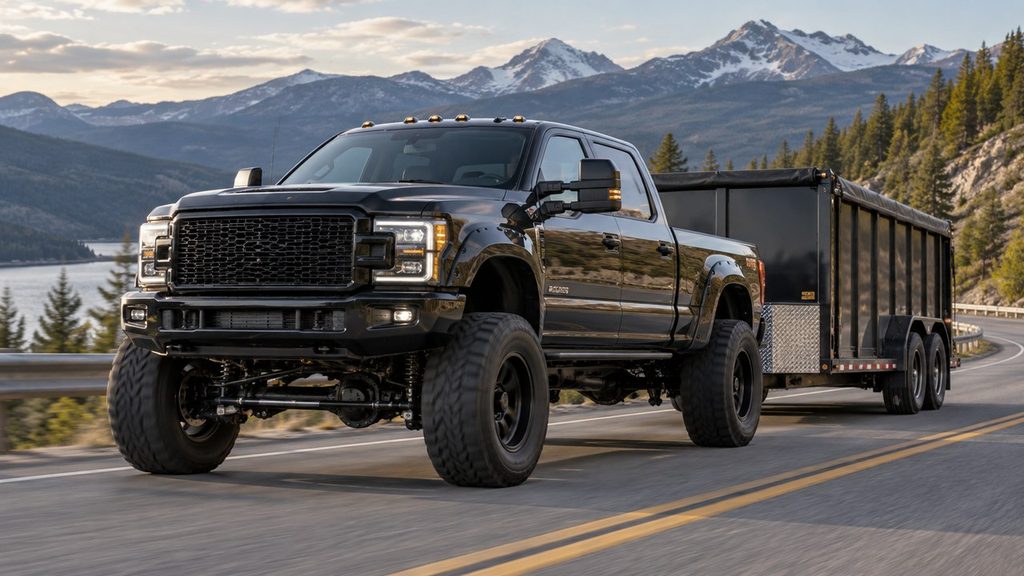
For a truck primarily used for towing, there is usually no compelling reason to replace a properly functioning radius-arm suspension solely to gain a 4-link.
Factory radius-arm systems are already engineered for heavy-duty pickup use and can provide stable, predictable road behavior with relatively few joints and wear points.
A correctly designed 4-link can also tow perfectly well, but its main advantages are geometry control and adjustability—not an increase in towing capacity.
Neither a radius-arm upgrade nor a 4-link conversion increases the manufacturer’s GVWR, GAWR, payload or tow rating.
If towing is the priority, correct caster, toe, track-bar geometry, springs, shocks, tires and load distribution matter more than choosing the more complicated link arrangement.
Maintenance, Bushings and NVH
A radius-arm system wins on simplicity because there are fewer longitudinal suspension pivots to inspect.
Factory-style rubber bushings can also isolate noise, vibration and harshness very effectively. They deform to allow normal suspension movement and require little maintenance.
A 4-link adds another pair of longitudinal links and their associated joints. Depending on the design, those joints may use rubber, polyurethane, rebuildable flex joints, spherical bearings or other hardware.
More sophisticated joints can provide greater angular freedom and steering precision, but may also require lubrication, inspection or eventual rebuilding.
For a work truck expected to cover large highway mileage with minimal maintenance, that difference can matter more than maximum articulation.
Ford Super Duty and Ram HD Considerations
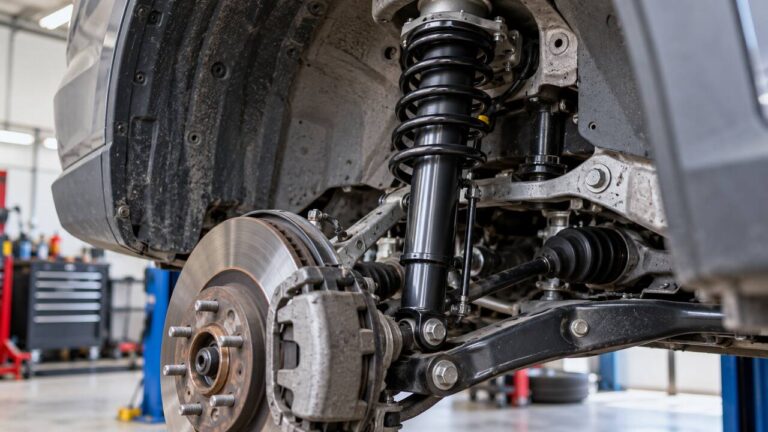
The radius arm vs 4-link debate commonly appears around coil-sprung solid-front-axle heavy-duty pickups, particularly 4×4 Ford Super Duty and later-model Ram HD trucks.
But do not buy suspension parts based only on the truck badge. Model year, drivetrain, axle, engine, factory suspension package and lift height can change bracket and component compatibility.
Ram also used different front suspension architectures across different HD generations, so a part intended for a separate-link truck cannot simply replace a radius arm—or vice versa.
Visually identify the existing suspension and verify the manufacturer’s exact fitment before ordering a radius-arm upgrade or 4-link conversion.
How Radius Arm and 4-Link Fit Into Solid-Axle Suspension
Radius arms and four links do not change the fact that the left and right wheels remain connected by a rigid axle housing. They only change how that axle is located relative to the chassis.
That means both retain the characteristic strengths and compromises of a solid axle: high unsprung mass, robust packaging, strong articulation potential and a direct mechanical connection between the two sides.
If you are deciding between the axle architectures themselves rather than the links that locate a solid axle, our solid axle vs independent suspension comparison covers that broader question.
Is a Radius Arm to 4-Link Conversion Worth It?
It is worth considering when the factory radius-arm geometry is becoming a real limitation—not simply because a 4-link is marketed as the premium option.
A conversion becomes easier to justify when you need greater control over caster throughout substantial suspension travel, want more freedom to tune axle rotation and anti-dive, or are building a tall and heavily modified suspension where the factory geometry is no longer ideal.
It is harder to justify when the truck is a daily driver, tow rig or moderate trail vehicle whose radius arms already provide good clearance, correct alignment and enough articulation.
Replacing a properly working radius-arm system with four links will not automatically transform ride quality. Springs, shocks, tires, alignment, track-bar geometry and bushings may be much more important to the problem you are actually trying to solve.
Which Setup Makes More Sense for Your Truck?
| Your priority | Better starting point | Why |
|---|---|---|
| Stock or mildly lifted daily driver | Radius arm | Simple, proven and economical |
| Towing and highway mileage | Radius arm | Low maintenance and predictable road manners |
| Moderate trail use | Radius arm | Capable without unnecessary complexity |
| Maximum geometry adjustability | 4-link | Independent upper/lower link geometry |
| Large suspension travel | 4-link often advantageous | More control over axle rotation through travel |
| Tall performance-oriented lift | Depends; 4-link increasingly attractive | Caster and link geometry become more critical |
| Maximum ground clearance around frame brackets | Radius arm often advantageous | Fewer frame-side link brackets |
| Custom rock-crawling build | 4-link or another purpose-built link system | Greater geometry and joint-placement freedom |
| Lowest cost and parts count | Radius arm | Fewer links and pivots |
This table assumes both systems are properly engineered. A good radius-arm setup is better than a poorly designed 4-link, and a carefully engineered 4-link can outperform a radius-arm system when its additional geometric freedom is actually needed.
Frequently Asked Questions
Does a radius arm suspension need a track bar?
On the coil-sprung solid-front-axle truck layouts discussed here, yes. Radius arms locate the axle longitudinally and control its rotation, while the track bar controls lateral movement and keeps the axle positioned beneath the chassis.
Does a front 4-link need a track bar?
Most parallel front 4-link conversions used on Ford Super Duty and Ram-style solid axles retain a track bar. The four longitudinal links control fore-aft position and axle rotation, while the track bar provides lateral location. A triangulated 4-link can locate an axle laterally without one, but that is a different layout.
Does a 4-link ride smoother than radius arms?
Not automatically. Ride quality depends heavily on springs, shock valving, bushings, tires, vehicle weight and alignment. A 4-link offers greater geometry freedom, but replacing radius arms by itself does not guarantee a softer ride.
Which is better for a 6-inch lift?
Both can work when designed for that lift height. A heavy-duty radius-arm system can restore caster and maintain a relatively simple layout, while a 4-link gives designers greater control over caster and axle rotation. At taller lift heights, that additional geometry control can become more valuable.
Do radius arms limit articulation?
They can create more torsional constraint during cross-axle articulation because each rigid arm controls two axle mounting points. However, compliant bushings or flex joints can allow substantial articulation. The actual limit depends on the complete suspension rather than the radius-arm name alone.
Is a 4-link stronger than radius arms?
Not inherently. Strength depends on material, tube or plate dimensions, bracket construction, weld quality, joint size and mounting design. Four links can distribute loads differently and aftermarket conversions may use extremely heavy-duty components, but link count alone does not determine strength.
Can you tow with a 4-link conversion?
Yes, provided the system is correctly engineered, installed and aligned for the truck. A 4-link conversion does not increase the manufacturer’s payload or towing ratings, and towing performance still depends on the complete chassis, springs, shocks, tires, brakes and load distribution.
Why do manufacturers use radius arms on heavy-duty trucks?
Radius arms provide a strong and comparatively simple way to locate a coil-sprung solid axle. They package well, use relatively few pivots and can deliver predictable road behavior, durability and low maintenance—qualities that suit heavy-duty trucks very well.
Choose the Layout That Solves the Actual Problem
A radius arm is not simply the cheaper version of a 4-link, and a 4-link is not an automatic upgrade for every truck. They are different ways of controlling the same solid axle, each with useful strengths.
Radius arms make a strong case when simplicity, ground clearance, road manners, towing and low maintenance matter. A correctly designed setup can also provide plenty of articulation for serious recreational off-road use.
A 4-link earns its additional complexity when you need more control over caster, axle rotation, anti-dive and link geometry through a larger range of suspension travel. That makes it increasingly attractive on highly modified, tall-lift and performance-oriented builds.
Before converting anything, identify what your current suspension is actually failing to do. If the problem is poor shocks, incorrect caster, a badly positioned track bar or worn bushings, changing the entire link architecture may be an expensive solution to the wrong problem.