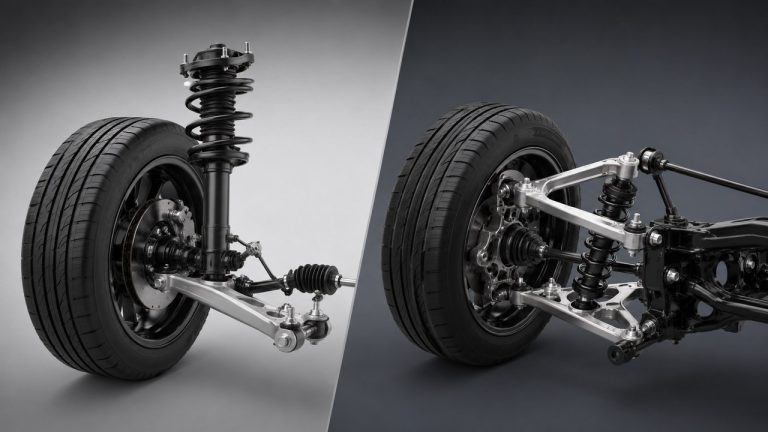
What Is Anti-Squat Suspension? How It Works
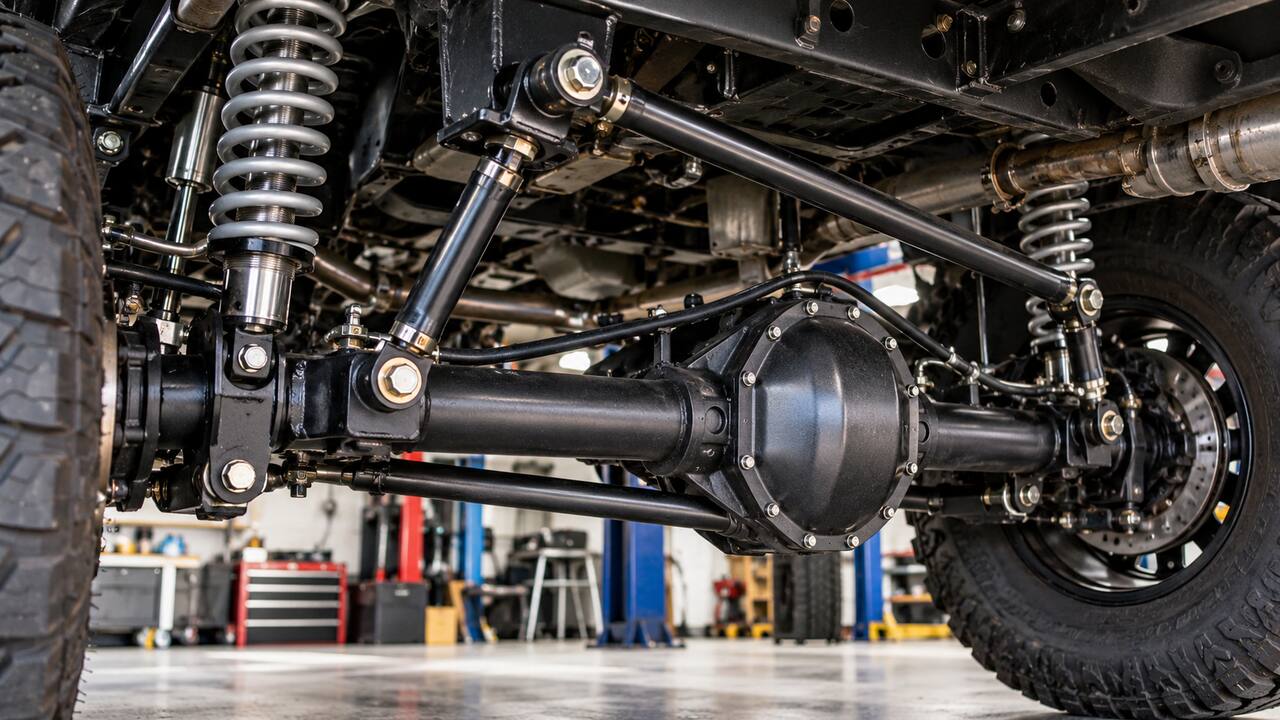
Anti-squat is a suspension geometry characteristic that resists rear suspension compression during acceleration. It uses the position and angle of the suspension links to route part of the driving force through the chassis, helping control how much the rear of the vehicle squats when torque reaches the driven wheels.
Anti-squat is not a separate type of suspension, an electronic setting, or a component that simply prevents weight from moving rearward. It is designed into—or adjusted through—the suspension geometry. It is especially relevant to rear-wheel-drive race cars, performance vehicles, trucks, and off-road vehicles with linked rear suspension.
What Does Squat Mean in Suspension?
When a vehicle accelerates, inertia creates a rearward load transfer. The front becomes lighter and the rear tires carry more vertical load. At the same time, the rear suspension may compress, making the body appear to sit lower at the back. That visible suspension movement is called squat.
Two related effects are often confused:
- Longitudinal load transfer: the change in vertical load carried by the front and rear tires during acceleration.
- Suspension squat: the rear suspension’s compression and the resulting change in body attitude.
Anti-squat geometry can reduce suspension compression, but it does not repeal the physics that cause load transfer. Vehicle acceleration, wheelbase, center-of-gravity height, and mass still determine the overall longitudinal load transfer.
How Anti-Squat Geometry Works
During acceleration, the tires push backward against the road and the road pushes the vehicle forward. In a linked rear suspension, that driving force travels from the axle or wheel carrier through the control arms into the chassis.
The angles of those links determine whether the force tends to compress the rear suspension, support the body, or lift it. Engineers use a side view of the suspension to study this behavior.
The Instant Center
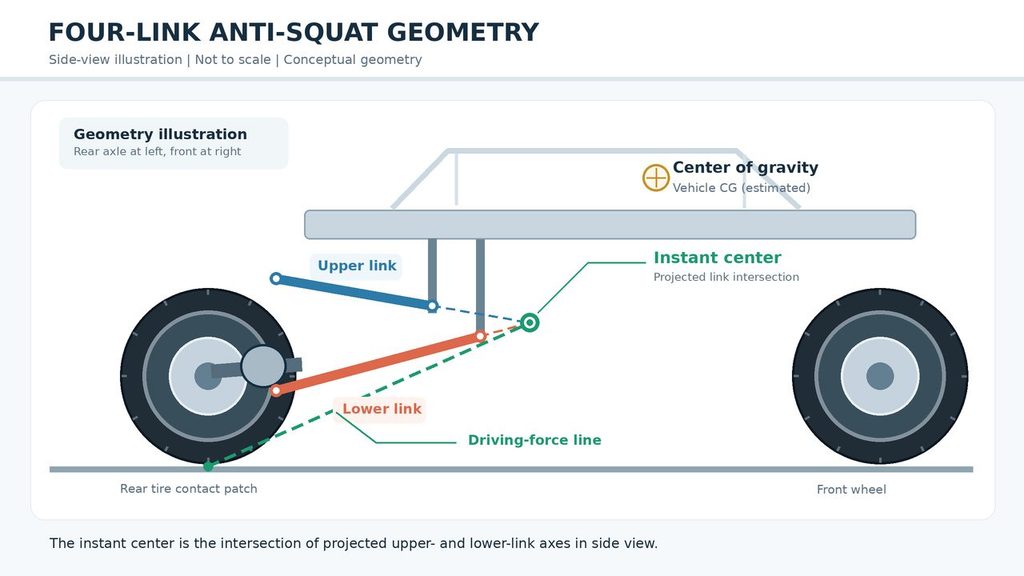
On a typical four-link suspension, imaginary lines are extended through the upper and lower links when viewed from the side. The point where those projected lines intersect is called the side-view instant center.
A line between the rear tire contact patch and this instant center describes how driving force is directed into the chassis. Its position relative to the vehicle’s center of gravity helps determine the anti-squat percentage.
Why Link Angles Matter
Changing the height or angle of an upper or lower link moves the instant center. That changes the amount of geometric force opposing rear suspension compression.
This does not mean that one steep link automatically creates the correct setup. Wheelbase, center-of-gravity height, driven-wheel layout, instant-center position, suspension travel, tire behavior, torque delivery, and link separation all affect the result.
What Does Anti-Squat Percentage Mean?
Anti-squat percentage describes how strongly suspension geometry opposes the forces that would otherwise compress the rear suspension during acceleration. The values below explain the theoretical behavior of a linked rear suspension, assuming idealized geometry and rigid components:
| Anti-Squat Value | Theoretical Response Under Acceleration | Possible Effect |
|---|---|---|
| 0% | No geometric resistance to acceleration-induced squat | Rear suspension is free to compress according to springs, dampers, and other forces |
| Below 100% | Geometry resists only part of the tendency to squat | Some rear compression normally remains |
| 100% | Geometric reaction theoretically balances the acceleration-induced squat force | No squat caused by acceleration in an ideal rigid model |
| Above 100% | Geometric reaction exceeds the force tending to compress the rear suspension | Rear suspension may extend or separate under power |
The percentage is a theoretical geometric value, not a guarantee of what the body will do in the real world. Bushings flex, tires deform, dampers resist motion, springs compress, links move through changing angles, the chassis twists, and the center of gravity may not be known precisely.
Anti-squat also changes as the suspension moves through its travel because the instant center and link angles do not necessarily remain fixed. A vehicle may therefore have one anti-squat value at normal ride height and a different value in compression or extension.
Does Anti-Squat Stop Weight Transfer?
No. This is one of the most common misconceptions. Anti-squat changes the path through which forces enter the chassis and controls suspension displacement. It does not eliminate the rearward load transfer created when the vehicle accelerates.
A vehicle with 100% anti-squat can remain visually level while the rear tires still gain vertical load and the front tires lose vertical load. The body attitude and the tire loads are related, but they are not the same measurement.
Benefits of Anti-Squat Geometry
Properly designed anti-squat geometry can improve how a vehicle responds when power is applied. Its advantages depend on the suspension layout and intended use, particularly whether the priority is road handling, drag racing or off-road traction.
Controls Body Pitch During Acceleration
Reducing excessive rear compression can keep the body more level and prevent large, slow suspension movements when power is applied. This may make the vehicle feel more responsive during acceleration.
Maintains Suspension Geometry
When a suspension moves through its travel, wheel alignment, driveshaft angle, roll-steer characteristics, and other geometric values may change. Controlling squat can help keep the suspension closer to the region in which it was designed to operate.
Helps Tune a Drag-Racing Launch
In a drag car, anti-squat and instant-center placement are used with springs, dampers, tires, power delivery, and weight distribution to tune how the rear suspension reacts at launch. A setup above 100% may cause the rear body and axle to separate, helping apply force to the tire in some combinations.
More anti-squat does not automatically mean more grip or a faster launch. Too much separation, overly rapid motion, or an unsuitable instant center can unload the tire after the initial hit and reduce consistency.
Can Improve Clearance Under Power Off-Road
On a linked off-road suspension, suitable anti-squat can resist the rear of the chassis dropping when climbing or accelerating. This can help maintain ground clearance and influence how the tires load against the terrain.
However, traction on rocks, mud, sand, or loose climbs also depends on tires, differential behavior, gearing, damping, spring rates, articulation, terrain, and driver input. Anti-squat is only one part of the complete setup.
Disadvantages of Too Much Anti-Squat
Increasing anti-squat beyond what the vehicle needs can introduce new handling and traction problems. A setup that works well on a smooth drag strip may behave poorly on rough pavement or uneven off-road terrain. These are the main disadvantages of excessive anti-squat:
- Harshness under power: more driving force can be transmitted directly through the links and chassis rather than being absorbed through suspension movement.
- Rear suspension separation: values above 100% can make the body rise relative to the axle during acceleration.
- Wheel hop: an unsuitable combination of geometry, tire compliance, damping, and bushing flex can contribute to oscillation.
- Loss of grip on uneven surfaces: excessive geometric stiffness can make it harder for the suspension to follow bumps while power is applied.
- Unpredictable changes through travel: poor link design can produce large variations in anti-squat as the suspension compresses or extends.
- Additional loads: link brackets, joints, axle housings, and chassis mounts must withstand the forces created by the geometry.
The correct amount is therefore a compromise. A road car normally needs predictable ride and grip over imperfect surfaces. A drag car prioritizes launch behavior, while an off-road vehicle may prioritize traction, articulation, clearance, and climbing stability.
Anti-Squat vs. Stiff Springs and Dampers
Anti-squat geometry, springs and dampers all influence how a vehicle responds to acceleration, but they work in different ways. The comparison below explains why reducing rear squat through suspension geometry is not the same as simply installing stiffer springs or shocks:
| Feature | Anti-Squat Geometry | Springs | Dampers |
|---|---|---|---|
| Main role | Uses link geometry to oppose squat under driving force | Support vehicle weight and resist displacement | Control the speed of suspension movement |
| Depends on acceleration force | Yes | No | Depends on movement speed |
| Changes ride over bumps | Can influence it, especially under power | Directly | Directly |
| Stops weight transfer | No | No | No |
Stiffer rear springs may reduce visible squat, but they also affect every bump and load condition. Dampers can slow the rate at which squat occurs, but they do not provide a permanent force once suspension movement stops. Anti-squat produces a geometric reaction specifically when driving force passes through the suspension. Our suspension spring rate calculator can help estimate spring stiffness separately, but it does not calculate anti-squat geometry.
For a deeper explanation of damper behavior, see what damping does in a suspension system.
Anti-Squat vs. Anti-Dive and Anti-Lift
These terms describe different pitch-control characteristics:
- Anti-squat: resists rear suspension compression during acceleration.
- Anti-lift: can resist front suspension extension during acceleration or rear lift during braking, depending on the axle and context.
- Anti-dive: resists front suspension compression during braking.
Anti-squat does not directly improve braking by preventing the nose from diving. That function belongs to front anti-dive geometry. A vehicle can have different percentages of anti-squat, anti-dive, and anti-lift because each is produced by the geometry and forces at the relevant axle.
Is Anti-Squat Only for Four-Link Suspension?
No. Four-link systems make the concept easy to visualize because the upper and lower links create a clear side-view instant center, but other suspension layouts can also have anti-squat characteristics.
Independent multi-link, trailing-arm suspension, semi-trailing-arm, double-wishbone, solid-axle, and other designs can route acceleration forces in ways that resist or promote squat. The method used to locate the effective instant center depends on the suspension type.
How Is Anti-Squat Adjusted?
On an adjustable race or off-road four-link, anti-squat can be changed by moving the chassis-side or axle-side mounting points of the upper and lower links. This changes link angles and moves the side-view instant center.
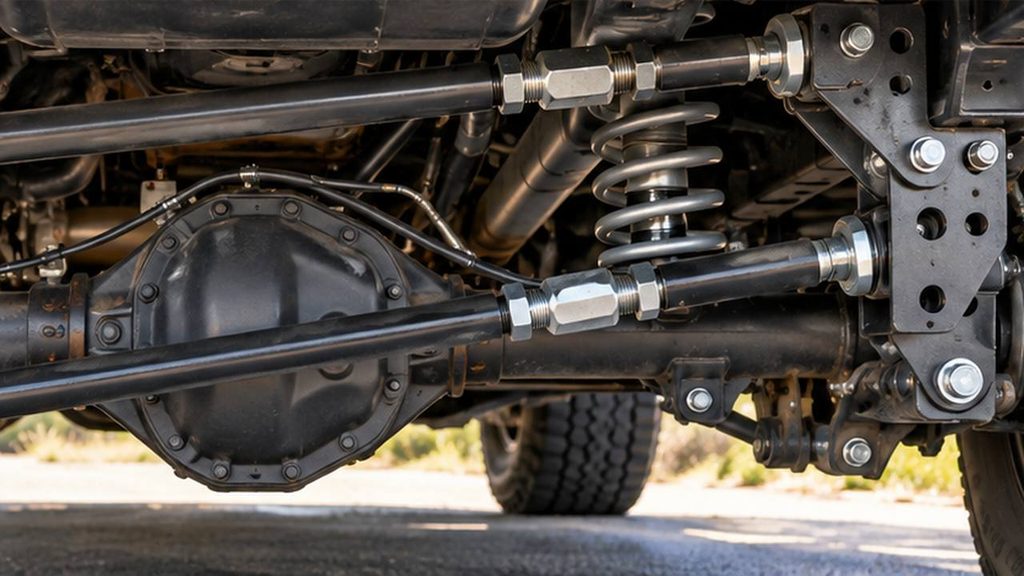
Before changing a link position, the complete geometry should be measured at actual ride height. Important inputs include:
- Wheelbase
- Center-of-gravity height and approximate location
- Rear tire radius and contact patch
- Upper and lower link mounting coordinates
- Instant-center height and length
- Ride height and available suspension travel
- Driven axle or torque-distribution arrangement
- Driveshaft, joint, and axle-housing angles
Moving one bracket can also change pinion angle, roll steer, link clearance, joint travel, driveshaft behavior, and structural loads. Adjustable holes should never be used by trial and error without understanding these secondary effects and the manufacturer’s instructions.
What Is a Good Anti-Squat Percentage?
There is no universal ideal percentage. The correct value depends on the vehicle, tires, surface, suspension type, power delivery, center of gravity, and intended use.
| Vehicle Use | General Priority | Why One Number Does Not Fit All |
|---|---|---|
| Street driving | Predictable grip, comfort, and stability on uneven roads | Very high values may increase harshness or reduce compliance |
| Drag racing | Repeatable launch and controlled tire loading | Ideal geometry changes with tire, track, power, and damper setup |
| Road racing | Balanced pitch control and traction during corner exit | Excessive anti-squat may hurt grip over bumps |
| Rock crawling | Climbing traction, articulation, and chassis control | Terrain and link travel can cause large dynamic changes |
| High-speed off-road | Suspension compliance and stability under power | The system must still absorb repeated bumps effectively |
Even two similar vehicles may need different settings because of tire construction, vehicle weight, link placement, torque, spring rate, and damping. The best result is established through accurate geometry calculations followed by controlled testing.
Can Anti-Squat Be Added to Any Vehicle?
Not as a simple bolt-on product. Every suspension already has some geometric behavior under acceleration, but changing it may require relocating structural mounting points or installing a properly engineered suspension system.
On a production street car, the geometry is constrained by crash structures, passenger space, exhaust routing, fuel tank position, driveshafts, bushings, ride comfort, and manufacturing requirements. Altering mounting points can affect safety and legality.
Adjustable four-link systems make tuning more practical on purpose-built race and off-road vehicles, but the brackets, welds, joints, and chassis must be designed for the resulting loads. This work should be performed or reviewed by an experienced suspension fabricator or vehicle-dynamics specialist.
Frequently Asked Questions
Is more anti-squat always better?
No. More anti-squat can reduce rear compression, but excessive values may cause separation, harshness, wheel hop, or loss of grip over uneven surfaces. The geometry must match the complete vehicle and its intended use.
What happens at 100% anti-squat?
In an ideal rigid geometric model, the anti-squat force balances the acceleration-induced force trying to compress the rear suspension. Real vehicles may still move because tires, bushings, springs, dampers, and structures are compliant.
What happens above 100% anti-squat?
The geometric reaction can exceed the tendency to compress the rear suspension, causing the rear body and axle to separate under acceleration. Whether that improves traction depends on how quickly and consistently the tire is loaded.
Does anti-squat improve traction?
It can help tune tire loading and suspension movement, but it does not guarantee more traction. Grip also depends on tires, surface, differential, power delivery, springs, dampers, alignment, and suspension compliance.
Does anti-squat make suspension stiffer?
It can make the suspension resist compression more strongly while acceleration force is present, even without changing the spring rate. It does not make the physical spring permanently stiffer.
Is anti-squat the same as anti-dive?
No. Anti-squat primarily controls rear suspension compression during acceleration. Anti-dive controls front suspension compression during braking.
What Anti-Squat Means for Rear Suspension Behavior
Anti-squat describes how rear suspension geometry generates forces that oppose suspension compression during acceleration. Its percentage expresses the theoretical geometric resistance relative to the forces responsible for squat, not a reduction in weight transfer or a guaranteed change in ride height. The right setup depends on the vehicle, tires, surface and intended use.