Tesla Suspension Guide: Model S, 3, X & Y Compared

Which Teslas have air suspension? The short answer is that recent Tesla Model S and Model X vehicles use adaptive air suspension with adjustable ride height. The Model 3 and Model Y use coil springs and do not have factory air suspension or driver-adjustable ride height. Supported Model 3 Performance vehicles, along with newer Model Y Performance and 6-Seater configurations, also offer adaptive damping without factory ride-height adjustment.
This distinction matters because air suspension and adaptive suspension do not mean the same thing. This guide compares the suspension type, settings, and ride-height controls available across the Tesla Model S, Model 3, Model X, and Model Y.
This guide reflects Tesla’s North American owner and service manuals reviewed in October 2026. Features and touchscreen menus can vary by model year, trim, configuration, region, and software version. The manual displayed inside the vehicle is the final reference for a specific Tesla.
If you are troubleshooting worn components or planning a repair rather than comparing factory systems, see our Tesla suspension repair cost guide for Model S, 3, X and Y for component and service price estimates.
Tesla Suspension Comparison: Model S vs 3 vs X vs Y
Tesla’s four main vehicle families do not use the same suspension hardware. The table below compares their factory spring types, adaptive damping availability and ride-height adjustment, with important differences between model years and configurations.
| Tesla model | Factory spring type | Adaptive damping | Adjustable ride height |
|---|---|---|---|
| Model S | Air on recent versions; some earlier cars used coil springs | Yes on current air-suspension system | Yes |
| Model 3 | Coil springs | Supported newer Performance versions only | No |
| Model X | Adaptive air suspension | Yes | Yes |
| Model Y | Coil springs | Supported newer Performance and 6-Seater configurations | No |
Air Suspension vs Adaptive Suspension
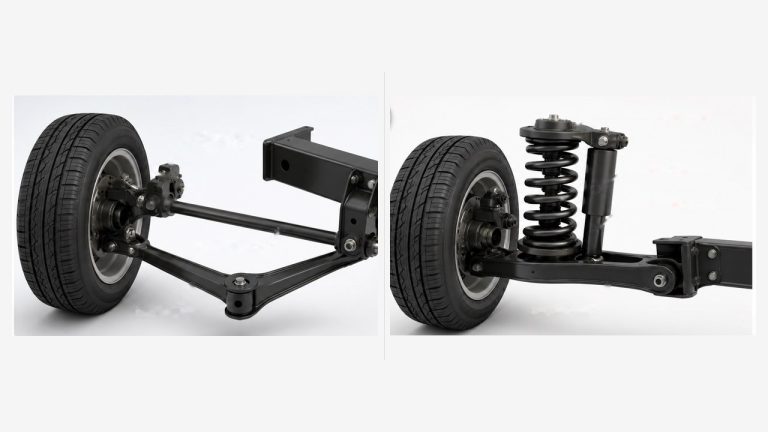
An air suspension uses pressurized air springs to support the vehicle. By adding or releasing air, the system can change ride height and keep the vehicle level as its load changes.
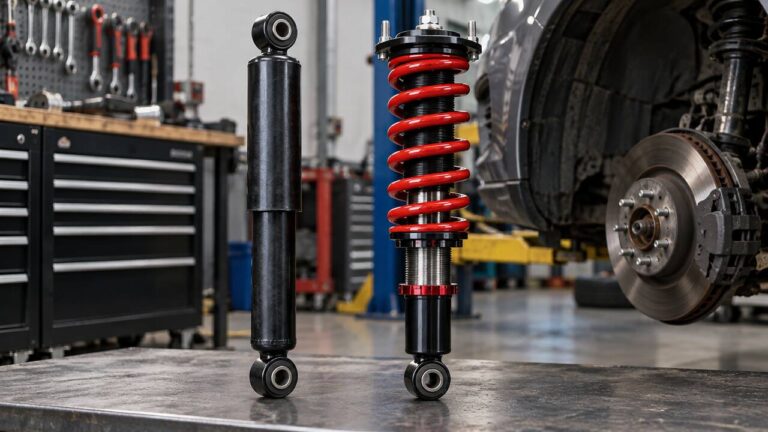
Adaptive damping changes how firmly the shock absorbers control suspension movement. It can make the ride softer or firmer, but adaptive dampers do not necessarily change ride height. You can learn more in our guide to what damping does in a suspension system.
- Model S and Model X: combine air springs, adjustable height, self-leveling, and adaptive damping on the systems described in their current manuals.
- Model 3 and Model Y: use steel coil springs rather than factory air suspension. Supported Model 3 Performance vehicles and newer Model Y Performance and 6-Seater configurations offer adaptive damping, but not factory ride-height adjustment.
Tesla Model S Suspension
The suspension described in Tesla’s current Model S Owner’s Manual is an Adaptive Air Suspension system. It provides adjustable ride height, automatic self-leveling, and real-time damping adjustments.
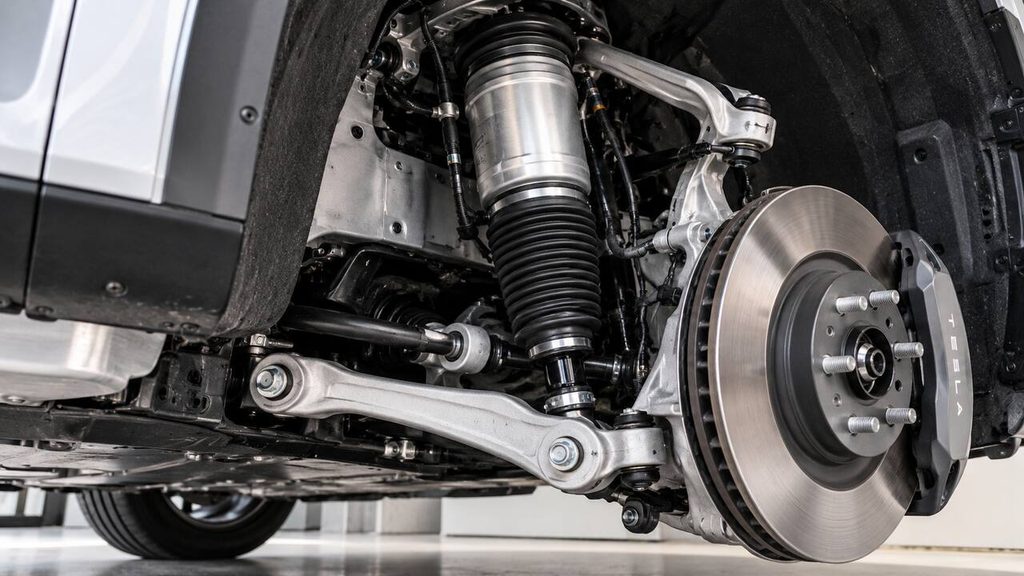
The system can keep the front and rear level as the load changes. Drivers can also raise the vehicle for a steep driveway, ramp, deep snow, large speed bump, or parking curb. High settings are intended for low-speed clearance, not aggressive driving.
Tesla Model S suspension height settings
The Model S offers several ride-height positions for different driving conditions. Each setting changes ground clearance, but the system may automatically return to a lower position depending on vehicle speed and distance traveled:
- Very High: provides maximum temporary clearance. According to Tesla’s current U.S. manual, it normally returns to the default height after approximately 100 feet or at 15 mph unless the available persistence option is selected.
- High: provides additional clearance and normally returns to the default height after approximately 100 feet or at 35 mph.
- Medium: is intended to balance comfort and handling under normal loading conditions.
- Low: can improve aerodynamics, ease passenger or cargo loading, and provide a lower handling position.
Tesla can change menu labels through software or between vehicle generations. In the current interface, ride height is accessed through Controls, while damping preferences are grouped under Controls > Dynamics > Ride & Handling.
Model S Ride & Handling settings
In addition to changing ride height, the Model S lets drivers select how the adaptive dampers respond to road conditions. These settings affect ride comfort and body control rather than simply raising or lowering the vehicle:
- Comfort: prioritizes a gentler ride.
- Standard: balances control and comfort across a range of roads.
- Sport: provides firmer body control and a more connected response.
When Comfort or Standard is selected, supported U.S. vehicles may raise the suspension over mapped rough-road sections. This depends on current map data and is different from detecting an off-road trail.
Does every Tesla Model S have air suspension?
No. Some earlier Model S vehicles were built with conventional coil-spring suspension, while others had Tesla’s earlier Smart Air Suspension. Tesla’s service documentation includes specific coil-suspension service procedures for these older vehicles.
Do not assume an older used Model S has air suspension based only on its model name. Check its original configuration, service information, and whether the touchscreen has ride-height controls.
Model S saved ride-height locations
When the driver raises a supported Model S to High or Very High, the car can save that GPS location. When it returns at an appropriate speed, the suspension can automatically raise again. The saved location can be removed from the suspension or ride-height controls.
Tesla Model X Suspension
The current Tesla Model X Owner’s Manual describes an Adaptive Air Suspension system with self-leveling, adjustable ride height, and Comfort, Standard, and Sport damping settings.

Like the Model S, the Model X can be raised manually for additional low-speed clearance. It can also remember locations where High or Very High was selected.
Tesla Model X suspension height settings
The Model X provides multiple suspension height settings for everyday driving, improved aerodynamics and temporary obstacle clearance. The vehicle can also lower itself automatically as speed increases:
- Very High: maximum temporary clearance, with a 15 mph speed threshold in the current U.S. manual.
- High: extra clearance, with a 35 mph speed threshold.
- Medium: normal comfort and handling height. The current manual states that it automatically lowers to Low above 55 mph.
- Low: lower position for aerodynamics, handling, or easier entry and loading.
- Very Low: available manually or automatically at very high speeds on supported configurations.
The Model X should not be described as automatically recognizing off-road terrain. The driver can manually raise it for obstacles, and supported U.S. versions may react to mapped rough-road information in Comfort or Standard mode. It remains a road-focused SUV rather than a dedicated off-road vehicle.
Tesla Model 3 Suspension
The Model 3 does not use factory air suspension. Tesla’s official specifications describe an independent front and rear suspension with coil springs and telescopic dampers.
Standard Model 3 configurations have a fixed factory ride height. There is no touchscreen command that raises the car for a steep driveway, and the suspension cannot save automatic raising locations.
Tesla Model 3 suspension settings
Supported newer Model 3 Performance vehicles have adaptive damping. Tesla’s current manual places these settings under Controls > Dynamics > Ride & Handling:
- Standard: balances ride comfort and body control for different roads and driving styles.
- Sport: provides firmer damping and greater driver engagement.
These settings adjust the dampers, not the spring height. If a Model 3 does not show Ride & Handling in the Dynamics menu, it may not be equipped with adaptive suspension. Availability depends on trim, production date, market, and software.
When Track Mode is active on an equipped Model 3 Performance, Tesla states that the car automatically optimizes adaptive damping for closed-course driving.
Tesla Model Y Suspension
The Model Y also uses coil springs rather than factory air suspension. Tesla’s 2025+ service documentation describes independent front and rear suspension with coil springs and telescopic dampers.
Consequently, a factory Model Y cannot raise or lower its ride height from the touchscreen. Claims that every Model Y has adjustable or air suspension confuse adaptive damping with adjustable air springs.
Tesla Model Y suspension settings
According to Tesla’s current North American owner’s manual, supported Model Y Performance and 6-Seater configurations have adaptive suspension settings under Controls > Dynamics. The available controls depend on the configuration.
Model Y Performance: Ride & Handling offers Standard and Sport damping settings. Model Y 6-Seater: Ride & Handling Priority offers Balanced and Rear Comfort, with Rear Comfort prioritizing ride quality for second- and third-row passengers. Earlier and other Model Y configurations may not have these controls. None of these settings provides factory ride-height adjustment.
Model 3 vs Model Y Suspension
The Model 3 and Model Y both use independent, coil-spring suspension, but their components and tuning should not be assumed to be identical or interchangeable. The Model Y’s crossover body, vehicle mass, wheel choices, tires, and intended use require different calibration.
| Feature | Model 3 | Model Y |
|---|---|---|
| Factory air suspension | No | No |
| Factory ride-height adjustment | No | No |
| Coil springs | Yes | Yes |
| Adaptive damping | Supported newer Performance versions | Supported newer Performance and 6-Seater configurations |
| Ride & Handling settings | Standard and Sport when equipped | Standard/Sport on Performance; Balanced/Rear Comfort on 6-Seater |
Ride comfort cannot be judged from the model name alone. Trim, production date, suspension revisions, wheel diameter, tire design, and tire pressure can all influence how a specific Tesla feels.
Why Are My Tesla Suspension Settings Missing?
If instructions found online do not match the menus in your Tesla, the vehicle may have a different suspension system or software interface.
- Model 3 Ride & Handling settings require a supported Performance configuration. Model Y adaptive suspension controls are available on supported Performance and 6-Seater configurations, with different settings for each.
- An early Model S may have coil springs instead of air suspension.
- Older Model S and Model X interfaces may use a dedicated Suspension screen, while newer software can place controls under Ride Height and Dynamics.
- Features can vary by model year, factory configuration, region, and installed software.
Use the Owner’s Manual displayed on the car’s touchscreen because Tesla customizes it to the vehicle’s equipment and software more precisely than a general online guide can.
Jacking a Tesla With Air Suspension
A Model S or Model X equipped with air suspension can self-level even when switched off. Before jacking or lifting it, Tesla requires Jack Mode to disable self-leveling. In current manuals, press the brake pedal and select Controls > Service > Jack Mode.
Failing to use the correct lifting mode and designated lift points can damage the vehicle. Never work beneath a car supported only by a jack, and do not open or depressurize an air-suspension system without the correct service equipment and training.
Model 3 and Model Y do not require an air-suspension Jack Mode, but their specified lifting points and Tesla’s jacking instructions must still be followed.
Tesla Air Suspension Warning Lights
On the Model S and Model X, a yellow air-suspension indicator means a fault has reduced system performance. Tesla advises contacting service if the warning persists. A red indicator means the adaptive air suspension has been disabled, and Tesla says to contact service.
Uneven ride height, repeated compressor operation, failure to raise, abnormal noises, or a suspension warning should be diagnosed rather than treated as a settings problem. Learn more about whether air suspension is suitable for daily driving.
If an inspection confirms worn or failed components, request a vehicle-specific diagnosis and written estimate covering the affected control arms, dampers, air struts, compressors or related parts.
Frequently Asked Questions
Do Teslas have air suspension?
Recent Model S and Model X vehicles have factory adaptive air suspension. Model 3 and Model Y use coil springs and do not have factory air suspension.
Does the Tesla Model S have air suspension?
Recent versions do, but not every older Model S was built with air suspension. Some early vehicles have conventional coil springs, so check the individual car’s configuration and touchscreen controls.
Does the Tesla Model X have air suspension?
The Model X covered by Tesla’s current North American manual has Adaptive Air Suspension with adjustable height, self-leveling, adaptive damping, and saved raising locations.
Does the Tesla Model 3 have air suspension?
No. The Model 3 uses coil springs. Newer supported Performance versions have adaptive dampers, but this does not turn them into air-suspension vehicles or provide ride-height adjustment.
Does the Tesla Model Y have air suspension?
No. The Model Y uses coil springs rather than factory air suspension. Supported Performance versions offer Standard and Sport adaptive damping, while newer 6-Seater configurations offer Balanced and Rear Comfort settings. Neither system provides factory ride-height adjustment.
Can a Tesla Model 3 or Model Y be raised from the touchscreen?
No. Neither model offers factory ride-height control. When equipped, their adaptive suspension settings change damping behavior rather than ground clearance.
Why does a Model S or Model X lower at speed?
Tesla limits the higher suspension positions to lower speeds and can lower the vehicle for aerodynamics, handling, and stability. The exact thresholds depend on the model, height selection, and configuration.
Which Tesla Models Have Adjustable Suspension?
The Model S and Model X offer Tesla’s factory adjustable ride-height experience, combining adaptive damping with self-leveling air suspension. The Model 3 and Model Y use coil springs without factory ride-height controls. Supported Model 3 Performance, Model Y Performance and newer Model Y 6-Seater configurations offer adaptive damping settings, but those settings do not raise or lower the vehicle.
The key takeaway is simple: adaptive damping does not always mean air suspension. If a Tesla needs exact operating instructions or service, identify its model year and configuration and use the Owner’s Manual shown inside that specific vehicle.