What Is Bump Steer? Causes, Symptoms & How to Fix It
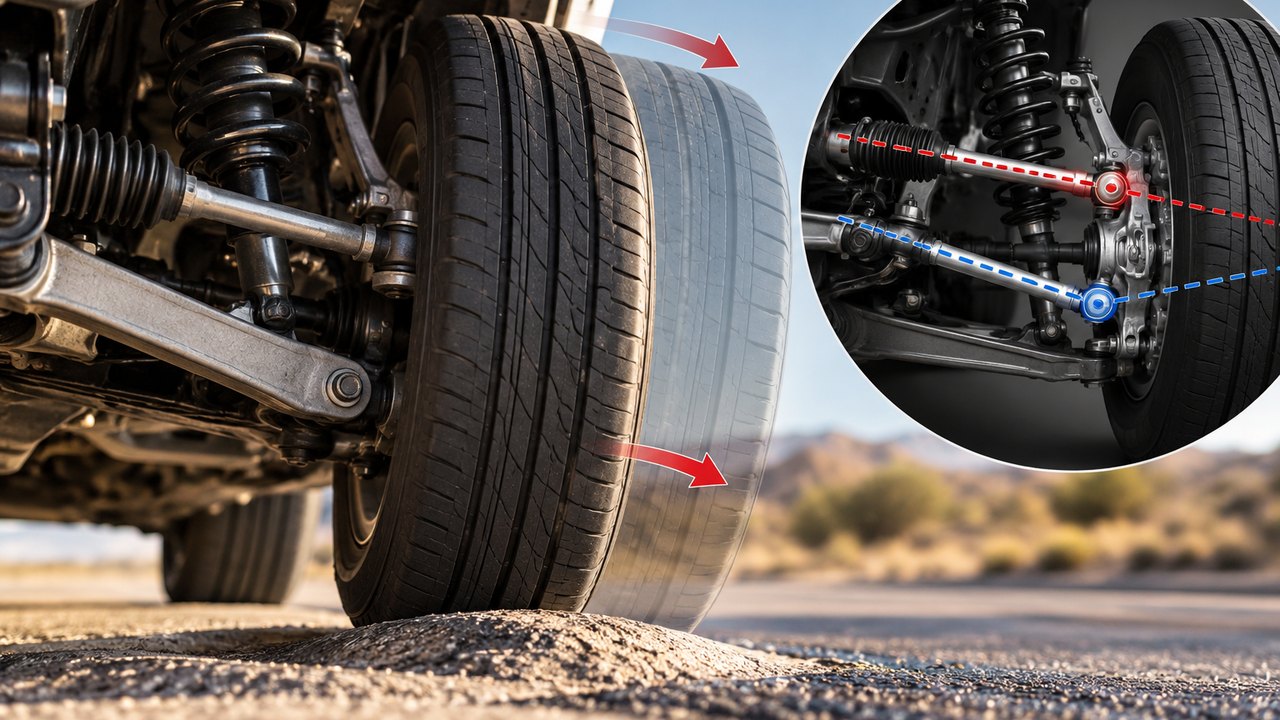
Bump steer is an unintended change in a wheel’s toe angle as the suspension moves up or down. Instead of the wheels continuing to point where the driver commanded, suspension movement causes one or both wheels to steer slightly on their own. On the road, that can make a car or truck dart, twitch or require a steering correction immediately after hitting a bump, dip or rough patch.
The important detail is that bump steer is a dynamic geometry problem. A vehicle can have acceptable toe while sitting on an alignment rack and still change toe as the suspension moves through bump and droop.
Excessive bump steer often appears after ride-height or steering-geometry changes, including lowering, lift kits, relocated steering components or poorly matched aftermarket suspension parts. Worn or bent parts can also create similar symptoms, so the goal is to diagnose the actual cause before installing a correction kit.
What Is Bump Steer?
Bump steer is the change in steering angle or toe that occurs because the suspension travels vertically, not because the driver turns the steering wheel.
That distinction separates bump steer from the intentional steering-angle difference created during a corner. When the driver turns, Ackermann steering geometry makes the inside front wheel turn more sharply than the outside wheel so both tires can follow different-radius paths.
Imagine the right-front tire hitting a bump. The suspension compresses, moving the wheel upward relative to the chassis. At the same time, the control arms and steering linkage move through their own arcs.
If those arcs are not sufficiently compatible, the tie rod or steering linkage effectively becomes too long or too short relative to the wheel’s new position. It then pushes or pulls the steering knuckle, changing toe.
The result may be toe-in during compression, toe-out during compression, or a more complex toe curve that changes direction at different points in suspension travel.
| What changes? | What it means |
|---|---|
| Suspension position | The wheel moves through bump or droop |
| Steering-link position | Tie rods or drag links travel through their own arcs |
| Toe angle | The wheel points slightly farther inward or outward |
| Driver input | No steering-wheel movement is required to create the change |
| Road behavior | The vehicle may dart, twitch or need correction over uneven pavement |
Small amounts of engineered toe change can exist in production suspension designs, so “absolutely zero toe change at every point” is not a universal requirement. The practical problem is excessive or poorly controlled bump steer that makes the vehicle unpredictable.
What Does Bump Steer Feel Like?
The most recognizable bump steer symptom is a vehicle that changes direction when the suspension reacts to the road.
You may notice:
- the car darts left or right after one wheel hits a bump;
- the steering wheel kicks or moves as the suspension compresses;
- the vehicle feels nervous on broken or undulating pavement;
- you make repeated small corrections on a rough highway;
- the vehicle changes line unexpectedly in a bumpy corner;
- steering behavior became worse after lowering or lifting the vehicle;
- a truck feels less predictable as the front axle moves through larger suspension travel.
A useful clue is when the steering problem occurs. Bump steer is linked to suspension movement. If the vehicle constantly pulls in the same direction on a smooth, flat road, static alignment, tire condition or another steering issue may be more likely.
What Causes Bump Steer?
The underlying cause is usually a mismatch between the path followed by the wheel and the path followed by the steering linkage.
The exact components depend on the suspension design, but several causes appear repeatedly.
Tie-Rod and Control-Arm Geometry
On many independent front suspensions, the control arms determine how the wheel and steering knuckle move through suspension travel while the tie rod connects the steering rack to the knuckle.
Both follow arcs rather than moving in perfectly straight lines.
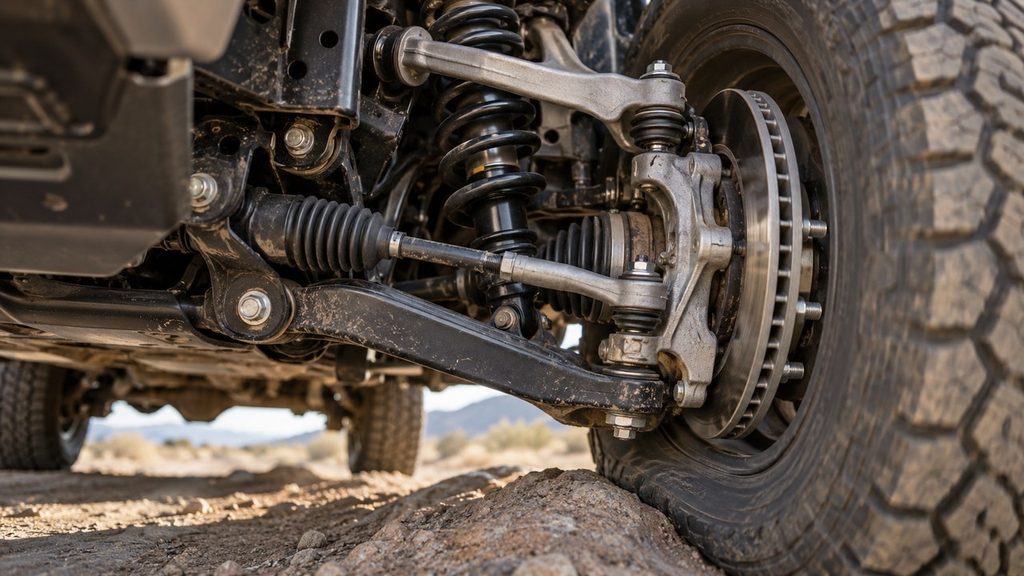
If the tie rod’s effective length, angle or pivot locations do not work correctly with the suspension geometry, its arc can push or pull the steering arm as the wheel rises or falls. That creates dynamic toe change.
This is why simply looking at static toe does not reveal the whole problem.
Changing Ride Height
Lowering or lifting a vehicle rotates suspension and steering links away from their original ride-height positions.
That does not guarantee severe bump steer, because different suspension designs respond differently. But a substantial ride-height change can place the steering linkage in a part of its travel where its arc no longer matches the suspension as well as it did at factory height.
This is one reason modified vehicles should not be judged only by whether a conventional alignment can bring static toe back into specification.
Incorrect Steering-Rack or Tie-Rod Position
Moving the steering rack, changing steering arms, using different knuckles or relocating an outer tie-rod end can change the linkage arc.
These modifications may be necessary on a purpose-built suspension, but their effect needs to be considered through the suspension’s usable travel rather than only at ride height.
Drag-Link and Track-Bar Geometry on Solid Axles
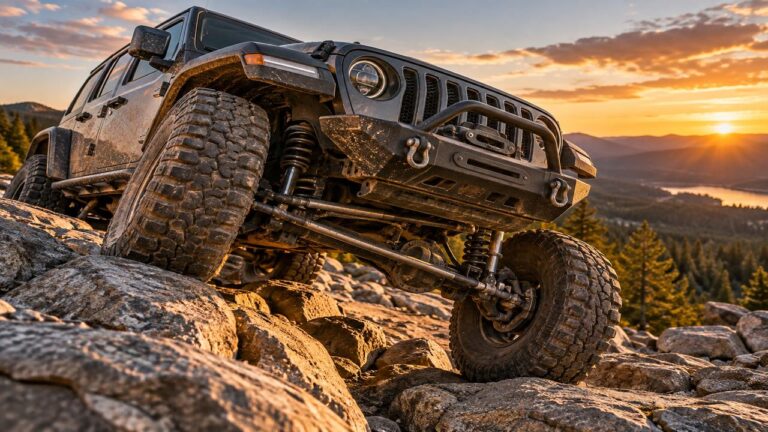
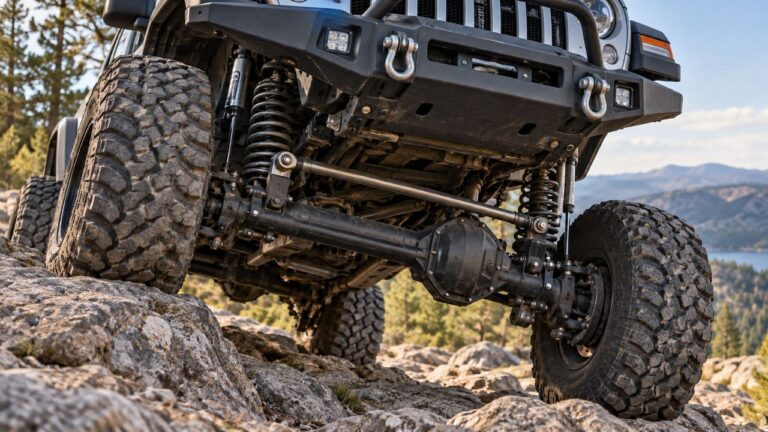
Many solid-front-axle trucks use a track bar to locate the axle laterally and a drag link as part of the steering system.
As the axle rises and falls, both links move through arcs. If their effective lengths, angles and pivot locations create substantially different paths, axle movement can feed into the steering linkage and turn the wheels without deliberate steering input.
Our guide to what a track bar does explains that relationship in more detail, including why simply making the track bar and drag link look parallel is not the whole geometry calculation.
Incorrectly Matched Aftermarket Parts
Extended control arms, different steering knuckles, tie-rod relocation hardware, steering-rack spacers and other geometry-changing parts can improve a suspension when they are engineered as a system.
Mixing components that move steering or suspension pickup points independently can also create unwanted toe change through travel.
This becomes especially important on suspensions with significantly more travel than stock, where small geometry errors are exposed across a larger range of motion. Our long-travel suspension guide explains why steering geometry has to be considered alongside control arms, shocks, CV axles and wheel travel.
Bump Steer vs. Bad Wheel Alignment
Bump steer and incorrect alignment can both make a vehicle handle poorly, but they are not the same problem.
| Symptom | Bump steer | Static alignment problem |
|---|---|---|
| Vehicle pulls on a smooth road | Possible, but not the classic symptom | More likely |
| Vehicle darts when hitting a bump | Strong clue | Possible but less specific |
| Toe changes as suspension moves | Defining characteristic | Not established by a static alignment reading |
| Steering issue follows suspension movement | Yes | Not necessarily |
| Correcting static toe fixes the root cause | Not always | Often, if toe was the actual problem |
An alignment machine measures the vehicle at a particular ride height. Bump steer describes what happens when the suspension moves away from that position.
That said, ride-height and steering changes frequently require a conventional alignment too. If suspension or steering components have been replaced or ride height has changed, see our guide to alignment after suspension work.
Bump Steer vs. Tramlining
Tramlining is another reason a vehicle may seem to follow the road instead of the driver’s intended path, but its mechanism is different.
A vehicle that tramlines tends to follow grooves, ruts or longitudinal features in the pavement. Tire width, tread design, wheel alignment and road surface can all influence that behavior.
Bump steer is specifically tied to toe change caused by suspension travel.
If the car follows a groove even when the suspension is moving very little, tramlining may be the better description. If one wheel hits a bump and the car immediately changes direction as that corner compresses, bump steer becomes more suspicious.
Can Worn Steering Parts Cause Bump-Steer Symptoms?
Yes—although not every steering reaction over a bump is true kinematic bump steer.
Play in tie-rod ends, ball joints, control-arm bushings, wheel bearings, steering-rack mounts or solid-axle track-bar joints can allow the wheel or axle to move in ways the original geometry did not intend.
That movement can produce darting, steering kick or wandering that feels similar from the driver’s seat.
This distinction matters because changing tie-rod geometry will not repair a worn ball joint, loose rack mount or damaged control-arm bushing.
Before modifying geometry, verify that the existing steering and suspension components are tight, undamaged and appropriate for the vehicle.
Does Lowering a Car Cause Bump Steer?
Lowering can increase bump steer if the new ride height moves the control arms and tie rods into a less favorable geometric relationship. It does not mean every lowered car automatically has excessive bump steer.
When ride height changes, the suspension begins its normal road travel from a different point in the linkage arcs.
Depending on the design, this may:
- change tie-rod angle;
- move control arms away from their original operating position;
- change static toe;
- alter the toe curve during compression and rebound;
- reduce available bump travel, exposing the suspension to a different portion of its geometry more often.
A car that becomes twitchy only after coilovers or lowering springs were installed should therefore be checked for more than static alignment alone.
Bump Steer on Lifted Trucks
Lifted trucks can develop bump-steer problems for the same fundamental reason: ride height changes the working angles of the steering and suspension links.
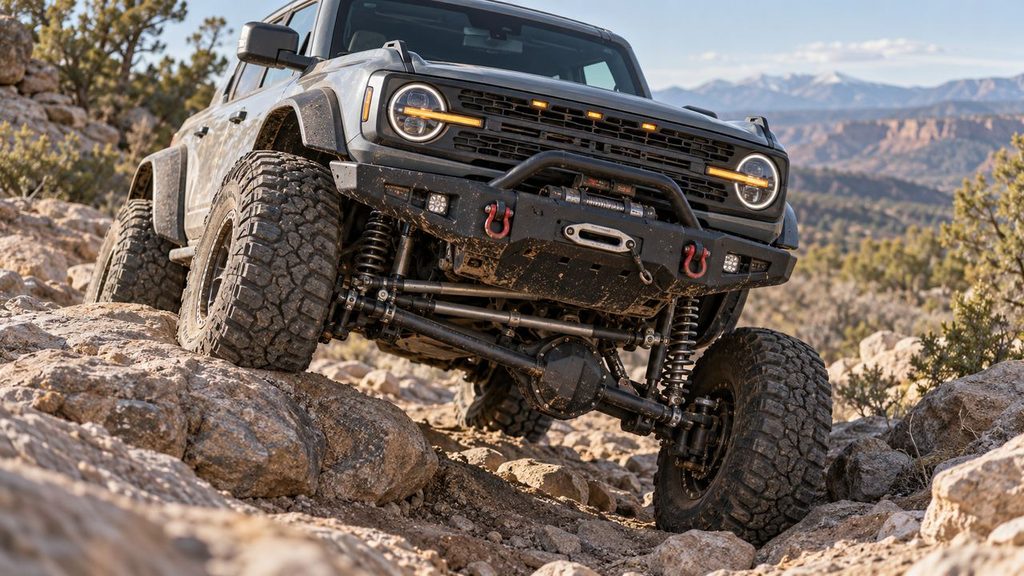
The exact mechanism depends heavily on suspension type.
On independent front suspension, tie-rod position relative to the control arms and steering rack is important. On a solid front axle with a track bar and drag link, the compatibility between those two linkage paths becomes especially important.
A common mistake is to treat one visual measurement—such as whether two bars appear parallel—as proof that the steering geometry is correct. Their effective lengths and pivot locations determine the arcs too.
A lifted truck that suddenly steers when the front axle crosses a pothole, expansion joint or uneven trail obstacle needs the complete front-end geometry inspected rather than automatically receiving another steering stabilizer.
Bump Steer in IFS vs. Solid-Axle Suspension
| Suspension | Main geometry to investigate | Common modification that can affect it |
|---|---|---|
| Independent front suspension | Tie rods, steering rack, control-arm arcs and steering knuckle | Lowering, lift kits, extended arms, relocated tie-rod ends or rack position changes |
| Solid front axle with track bar | Drag-link and track-bar arcs, effective lengths and pivot locations | Lift kits, drop pitman arms, track-bar brackets and steering conversions |
| Other steering/suspension designs | Wheel path relative to steering-link path | Any change to ride height or steering/suspension pickup points |
The visible hardware is different, but the underlying question is the same: does suspension movement force an unintended steering change?
Can Rear Suspension Have Bump Steer?
Yes. Bump steer is usually discussed as a front-steering problem, but independent rear suspension can also produce toe change as the wheels move through bump and rebound.
Some rear suspensions deliberately use controlled toe characteristics as part of the vehicle’s handling strategy. Excessive, asymmetric or unintended rear toe change, however, can make the rear of the vehicle feel unstable as it moves through travel.
This is another reason the term should not be reduced to “the steering wheel moves when I hit a bump.” Bump-steer behavior is fundamentally about the wheel’s steering or toe response to suspension movement.
How to Measure Bump Steer
The reliable way to diagnose bump steer is to measure how toe changes as the suspension moves through a controlled range of bump and rebound.
A professional or race-style measurement typically uses a bump-steer plate or gauge attached to the hub and dial indicators or another precise measuring system.
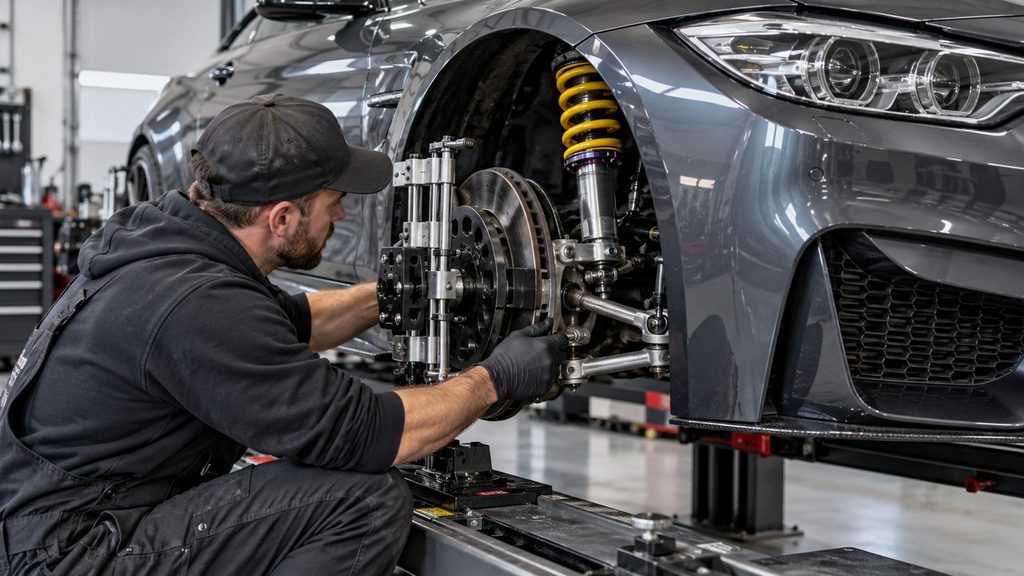
The general process is:
- Establish the true operating ride height. Tire size, pressure and vehicle setup should represent the condition being diagnosed.
- Center and secure the steering. Unwanted steering-rack movement would contaminate the measurement.
- Measure toe at ride height. This becomes the reference point.
- Move the suspension through controlled increments. Measurements are taken in compression and rebound.
- Record toe change at each position. The result is a curve rather than one alignment number.
- Compare both sides and the usable travel range. The pattern helps identify where the steering and suspension paths diverge.
Longacre Racing’s bump-steer measurement guidance similarly starts with the vehicle at its intended ride height, steering centered and normal alignment settings established before cycling the suspension and recording movement.
For a street vehicle, this is usually more useful than trying to diagnose the problem by watching the tire from outside while someone moves the suspension.
Supporting and cycling a suspension safely can require removal or disconnection of loaded components depending on the design. If you do not have suitable equipment and experience, have a suspension or alignment specialist perform the measurement.
How Much Bump Steer Is Acceptable?
There is no single universal toe-change number that should be applied to every street car, truck, race car and suspension design.
Race-car setup guides sometimes publish very small target values because those cars are measured with specific equipment, suspension travel, tire setup and handling goals. Those figures should not automatically be treated as the factory specification for an unrelated road vehicle.
For a street vehicle, the useful questions are:
- Is toe change excessive through the suspension’s normal operating range?
- Is the curve smooth and predictable?
- Do the left and right sides behave as intended?
- Did the behavior change substantially after a modification or impact?
- Does measured geometry match the steering symptoms on the road?
The correct target comes from the suspension design, manufacturer information where available, or an experienced chassis specialist—not from one generic number found online.
How to Fix Bump Steer
The correct bump-steer fix is the one that restores compatible steering and suspension geometry. That is why measuring first is more important than buying a particular part first.
1. Repair Loose, Worn or Bent Parts First
Check tie rods, steering joints, ball joints, bushings, wheel bearings, steering-rack mounts and relevant axle-location components before modifying pickup points.
If a component is moving because it is worn, correcting theoretical geometry will not make the front end precise.
2. Verify Ride Height and Static Alignment
Make sure the vehicle is sitting at the ride height it will actually use.
Sagged springs, incorrect coilover height, an improperly installed lift or uneven ride height can shift the suspension away from its intended operating position.
Static toe, caster and camber should also be measured before interpreting dynamic behavior.
3. Correct Tie-Rod Geometry on Independent Suspension
Depending on the suspension, correction can involve changing the vertical position of the outer tie-rod end, changing rack position or using properly engineered steering components that alter the tie-rod path.
The goal is not simply to make the tie rod “look level.” It is to create a steering-link path that works with the actual wheel path through suspension travel.
4. Correct Drag-Link and Track-Bar Geometry on Solid Axles
Lifted solid-front-axle vehicles may require changes to drag-link or track-bar geometry, depending on what the lift altered.
Possible solutions can include correctly engineered relocation brackets, steering-link changes or matched components intended for the specific suspension height.
Changing only one link can make the relationship worse, so the steering and axle-location system should be evaluated together.
5. Measure Again After the Correction
A part labeled as a bump-steer correction does not prove the problem is fixed.
Cycle the suspension again and compare the new toe curve with the original measurement. That confirms whether the change actually reduced the unwanted steering response through the range that matters.
Can a Wheel Alignment Fix Bump Steer?
A normal wheel alignment can correct static toe, but it cannot necessarily correct the geometry that makes toe change as the suspension moves.
This is an important distinction.
Adjusting tie-rod length may place the wheels at the correct toe setting at ride height. If the tie rod still follows an incompatible arc during compression and rebound, the vehicle can have correct static toe and excessive bump steer at the same time.
After any geometry correction, however, a conventional alignment is normally necessary because tie rods, steering components or ride height may have changed.
What Is a Bump Steer Kit?
A bump steer kit is an aftermarket solution designed to provide adjustment of a steering-link pivot point—commonly the outer tie-rod position—so the steering arc can be better matched to the suspension geometry.
The exact design varies by vehicle. Some systems use adjustable tie-rod ends with spacers, while other suspension layouts require completely different components.
A kit is therefore not a universal cure for any vehicle that feels nervous over bumps.
Before installing one, determine:
- whether true bump steer has actually been measured;
- whether the vehicle has worn or loose parts;
- which direction the toe changes through bump and droop;
- which steering or suspension pivot needs correction;
- whether the proposed kit provides the adjustment the geometry actually requires.
This keeps the informational question “what is bump steer?” separate from the product question of which correction hardware fits a particular vehicle.
Is Bump Steer Dangerous?
Excessive bump steer can be a safety concern because the vehicle can change direction in response to road inputs rather than steering-wheel input.
The risk depends on severity, speed, road conditions and vehicle design. A small engineered toe change is not the same as a truck that abruptly moves across its lane after hitting an expansion joint.
Have the vehicle inspected promptly if it:
- makes abrupt steering movements over ordinary bumps;
- requires large corrections to remain in its lane;
- became unstable immediately after suspension or steering modifications;
- has visible looseness or damage in steering components;
- behaves unpredictably during braking or cornering on uneven pavement.
Do not assume the diagnosis is bump steer until worn parts, tires and conventional alignment have also been checked.
Does Bump Steer Cause Tire Wear?
Excessive dynamic toe can contribute to tire wear because the tire repeatedly operates at a steering angle different from the intended direction of travel.
However, unusual tire wear alone does not prove bump steer. Incorrect static toe, camber, tire pressure, worn joints and other suspension problems are much more common causes.
The combination of abnormal wear plus a vehicle that darts specifically as the suspension moves gives a technician more reason to investigate dynamic toe change.
Bump Steer FAQ
Is bump steer the same as torque steer?
No. Bump steer is steering caused by suspension movement. Torque steer is a steering reaction associated with drivetrain torque, most commonly discussed in powerful front-wheel-drive vehicles. They can both pull at the steering wheel, but the trigger is different.
Can bad tie rods cause bump steer?
Incorrect tie-rod geometry can create true bump steer, while worn tie-rod ends can create looseness and unwanted steering movement that feels similar. Inspect condition and geometry separately.
Can bump steer happen without hitting a bump?
Yes. A road bump is only one way to move the suspension. Braking, acceleration, body roll and dips in the road can also move a suspension through travel and expose an unfavorable toe curve.
Does a lift kit always cause bump steer?
No. A lift changes geometry, but whether that creates excessive bump steer depends on suspension design, lift height and any steering or track-bar corrections included with the system.
Do lowering springs cause bump steer?
They can increase it if the lower ride height moves the tie rods and suspension arms into a less favorable geometric relationship. The amount varies considerably by vehicle.
Can you see bump steer during a normal alignment?
Not from one static alignment reading. Bump steer requires measuring or evaluating toe while the suspension moves through a range of compression and rebound.
Should a car have zero bump steer?
Not necessarily in the literal sense of zero toe change at every possible suspension position. Manufacturers can design controlled toe behavior into a suspension. The concern is excessive or undesirable dynamic toe that makes steering unpredictable.
What to Check First If Your Vehicle Darts Over Bumps
If a car or truck suddenly changes direction whenever the suspension moves, start with the basics rather than immediately buying a bump steer kit.
- Inspect tires and confirm correct pressures.
- Check steering and suspension joints for looseness or damage.
- Verify ride height and identify any recent lift, lowering or steering changes.
- Measure normal wheel alignment.
- If the symptom remains linked specifically to suspension travel, measure dynamic toe through bump and rebound.
- Correct the geometry that the measurement identifies, then verify it again.
The key distinction is simple: bump steer is not merely a car that wanders—it is steering caused by suspension movement. Once that relationship is measured instead of guessed, the correct repair becomes much easier to identify.