Track Bar Relocation Bracket: When You Need One & What Fits
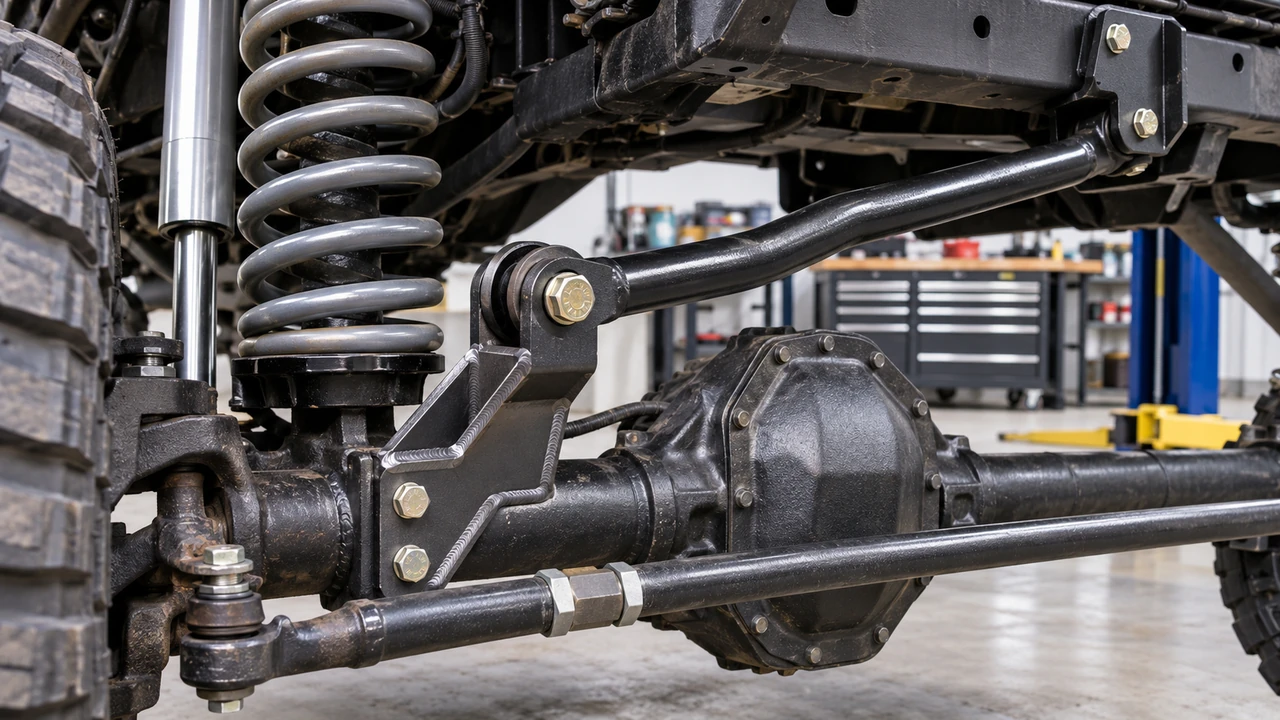
A track bar relocation bracket moves one mounting point of a solid-axle vehicle’s track bar (Panhard bar), usually after a suspension lift. It changes the bar’s working angle and can help correct lateral axle position or suspension geometry. But front and rear brackets do different jobs, and a bracket that is right for a lifted Jeep may be completely wrong for a Ford Super Duty or another Jeep generation.
Start here: if the axle simply sits off-center after a modest lift, an adjustable track bar may be the right purchase. If the lift kit calls for a raised axle-side mount or a lowered frame-side mount, use the bracket specified for that suspension system. On a steering axle, never relocate the track bar without checking the drag link geometry and the manufacturer’s required companion parts.
Which Track Bar Relocation Bracket Do You Actually Need?
Parts listings often bury the most useful information beneath a vehicle name and an advertised lift range. Before comparing brands, identify the axle, the end of the track bar being moved, and the problem the kit is designed to solve.
| Your situation | What to investigate | Important warning |
|---|---|---|
| Lifted Jeep with a rear track bar at a steep angle | Vehicle-specific raised rear axle bracket | Check rear bump-stop clearance and exact lift range |
| Lifted Jeep with a front drag-link flip or high-steer kit | Matching raised front axle-side track bar bracket | Front steering geometry must be corrected as a system |
| Ford Super Duty with a lift that requires front geometry correction | Approved front frame-side drop or replacement bracket | Do not substitute a Jeep-style raised axle bracket |
| Axle off-center but otherwise acceptable link geometry | Adjustable track bar, or the complete correction specified by the lift manufacturer | Bar length and bracket position solve different problems |
| Clunk, loose mount, or suspected death wobble | Inspect bolts, holes, joints, bushings, and bracket welds first | A relocation bracket is not a repair for worn or damaged hardware |
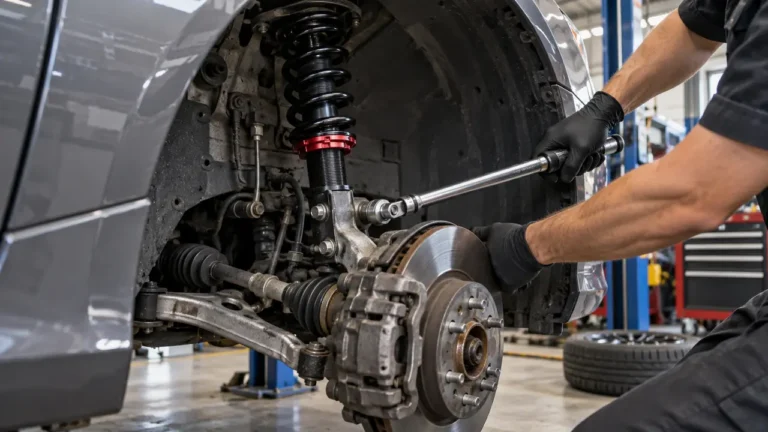
A track bar runs between the axle and the chassis to limit sideways axle movement. For the broader explanation of its arc and mounting points, see what a track bar does. Here, the decision is narrower: which mounting point, if any, needs to move after a lift?
Read the Axle Position and Mounting Location, Not Just the Product Name
“Track bar drop bracket,” “Panhard relocation bracket,” and “raised track bar mount” can appear in the same search results. They are not interchangeable instructions. Some lower the frame-side pivot; others lift the axle-side pivot. The same physical change can have a different consequence at the front and rear of a vehicle.
Look for a manufacturer drawing showing both original and new holes. A picture of a black steel bracket on a white background tells you very little about where the bar ends up once it is installed.
Raised Axle Bracket vs. Frame-Side Drop Bracket
A suspension lift increases the vertical distance between the chassis and axle at normal ride height. The track bar now sits at a different angle and follows a different portion of its arc. A relocation bracket changes the pivot position to suit the new height, but the direction of that move depends on the suspension design.
Raised Rear Axle Brackets on Jeep Suspensions
On many lifted Wranglers, the rear relocation bracket raises the axle-side end of the track bar. This can flatten the bar’s operating angle and move the rear roll center toward a position intended by the suspension designer. It may reduce the side-to-side feeling that comes from a steep rear Panhard angle.
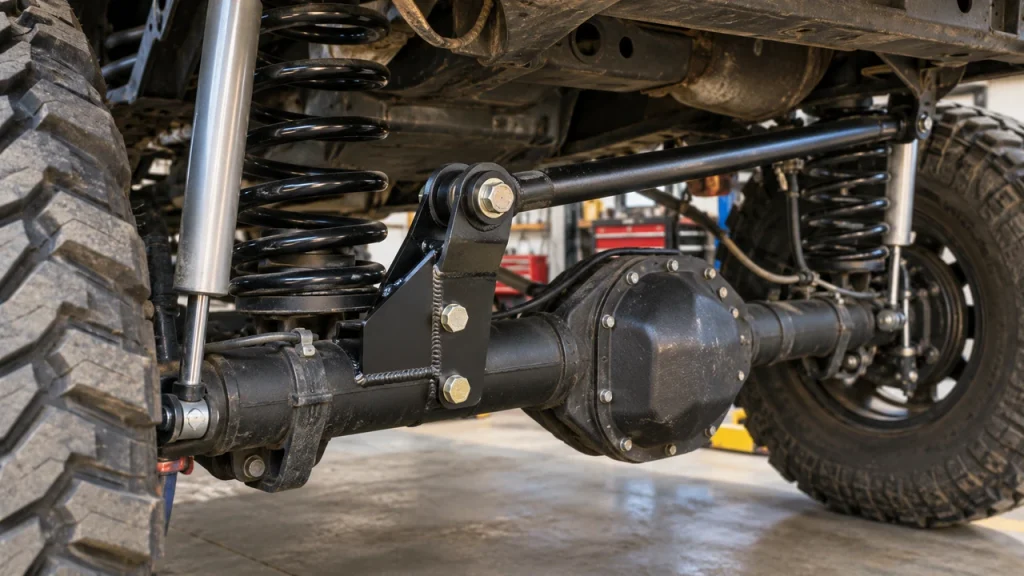
That does not make every raised bracket an improvement. The new mount needs enough room beneath the body at full compression, and its height must suit the actual lift and rear axle arrangement. A kit that works at three inches of lift may not clear the chassis on a nearly stock vehicle.
Raised Front Axle Brackets on Jeeps With High-Steer Kits
At the front, the track bar and drag link both influence how the axle and steering respond as the suspension moves. Some Jeep steering-correction packages raise the axle-side track bar mount while moving the drag link above the steering knuckle. Those changes are designed together; fitting only half the system can introduce or worsen bump steer.
For instance, Synergy’s JL/JLU/JT front relocation bracket 8855-11 raises the track bar mount by a stated 3.125 inches. Its instructions also call for a high-steer drag-link arrangement and a minimum amount of front bump-stop spacing. That is a product-specific package requirement, not a universal specification for Jeep brackets.
Frame-Side Track Bar Drop Brackets on Heavy-Duty Trucks
Ford F-250/F-350 and some Ram heavy-duty lift systems use a different correction: a bracket at the frame-side front track bar mount. Lowering that pivot can bring the track bar’s angle closer to the steering linkage geometry specified by the complete lift kit.
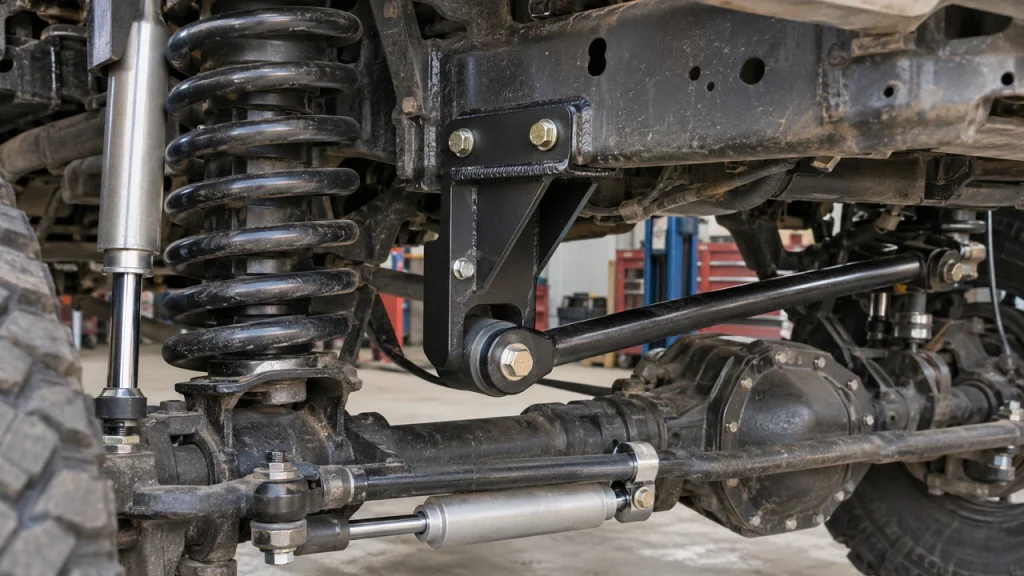
The word “drop” does not mean these parts share a design with radius arm drop brackets. Radius arm brackets move a longitudinal suspension-arm pivot and affect a different set of angles. A truck may need both, neither, or only one, according to the actual lift package.
Track Bar Relocation Bracket vs. Adjustable Track Bar
These parts get presented as either-or alternatives, but that isn’t always true. A bracket changes a mounting location; an adjustable track bar changes the effective length between its pivots. Both influence lateral axle position, yet they do it in different ways.
When an Adjustable Track Bar May Be Enough
If a mild lift leaves the axle a little to one side but the suspension manufacturer does not call for a geometry bracket, an adjustable bar can bring the axle back toward center at ride height. It does not move the mounting points or automatically fix the bar’s steepened angle.
Check the suspension kit’s instructions before buying anything. Some kits include a bracket designed to re-center the axle with the original bar; others use an adjustable bar and no relocation. Mixing the two approaches without checking the resulting length and angles can create another problem.
When a Bracket and Adjustable Bar Work Together
A raised rear track bar bracket may improve the operating geometry while an adjustable bar provides the last bit of axle centering. For example, Synergy’s JL rear bracket is designed around a stated lift range and recommends an adjustable rear bar on taller setups. The manufacturer also specifies bump-stop and equipment-clearance requirements.
One detail often missed: moving a pivot can change the bar length needed to center the axle. Don’t buy an adjustable track bar just because it fits the model year; confirm its adjustment range works with the intended bracket.
Jeep Track Bar Relocation Bracket Fitment: TJ, JK, JL, and JT
Jeep listings account for much of this search, but “fits Wrangler” is not enough. Axle position, generation, drive configuration, spring lift, pinion setup, and the original mounting bracket all matter.
TJ and LJ: Rear Brackets, Pinion Rotation, and CV Driveshafts
Some 1997–2006 Wrangler TJ/LJ rear kits aren’t just about lifting a pivot straight upward. Clayton Off Road’s COR-4500500, for example, is intended for a defined lifted TJ/LJ setup with a slip-yoke eliminator and CV-style rear driveshaft. Its revised mounting position accounts for the rear pinion’s changed angle.
The longer LJ wheelbase changes driveshaft geometry, so even within this family an adjustable rear bar may be recommended. Don’t order a TJ rear bracket simply because an online photo matches the shape of your axle perch. Match the driveshaft arrangement and required lift range too.
JK: Rear Relocation and Front Steering Correction Are Separate Purchases
For the 2007–2018 Wrangler JK, a rear axle-side relocation bracket is a common option on lifted suspension packages. JKS offers a rear JK bracket that moves the mount higher and addresses track bar angle with its particular rear-axle geometry. That doesn’t tell you anything about what is needed at the front.
A front JK raised bracket may be part of a matched drag-link flip system. Synergy’s 8055 front bracket, for example, specifies a corresponding flipped drag link and bump-stop extension. Buying the bracket as if it were a standalone steering fix would ignore the most important requirement in its own documentation.
JL and Gladiator JT: Verify the Actual Axle and Package
The JL Wrangler and JT Gladiator are not the same application as a JK. Even a 2018 Wrangler needs careful identification because both JK and JL versions existed that model year. Check the exact front or rear axle, suspension travel, and whether the kit is compatible with a factory or aftermarket track bar.
Synergy’s JL/JLU rear bracket, for instance, raises the rear axle-side mounting point and has specific minimum bump-stop spacing. Its equipment notes also describe a different installation approach for some EcoDiesel configurations. Check the official Synergy JL/JLU rear bracket specifications rather than transferring those requirements to a JT or an older JK.
XJ, ZJ, and YJ: Older Jeep Search Results Need Extra Care
Older Jeep searches mix front track bar brackets, rear axle applications, and hardware for vehicles with different spring and axle layouts. An XJ front bracket is not automatically a match for a TJ, and a YJ’s leaf-spring arrangement changes what the suspension needs. Verify that the vehicle actually uses a track bar at the specified location and that the bracket suits its suspension configuration.
Ford F-250/F-350, Ram 2500, and Bronco Fitment
A search for “track bar drop bracket” often returns trucks rather than Jeeps. That matters: the hardware location, frame design, and steering layout can change significantly across generations, even when the truck carries the same model badge.
Ford Super Duty: Match the Frame Bracket to the Lift System
On solid-front-axle F-250 and F-350 4WD pickups, lift-kit makers offer front track bar drop or replacement brackets to correct the front bar position after lifting. Some attach using the original frame-side mounting area; others replace factory bracketry. A listing for a 2005–2007 truck is not evidence of fit on a 2017–2022 or newer Super Duty.
Check whether the manufacturer designs the bracket for the exact lift height and the steering changes supplied with that kit. Also inspect the factory bracket and fastener holes. A strong new extension is no help if it is fastened to a cracked or ovaled mounting point.
Ram 2500/3500: Track Bar Drop Is Not Radius Arm Drop
Ram heavy-duty trucks also appear in front track bar drop-bracket catalogs. Be particularly careful when a lift kit includes multiple “drop brackets”: the track bar, radius arms, and brake-line brackets serve separate purposes. Their parts lists should identify each component, its original mounting location, and the matching lift system.
Don’t treat a product approved for one Ram 2500 generation as universal for a 3500 or for a truck with a different suspension package. Confirm the axle and frame configuration with the kit maker before ordering.
2021-Up Bronco: Rear Relocation Is a Different Application
The modern full-size Ford Bronco uses an independent front suspension and a track-bar-located solid rear axle. Rear track bar relocation brackets exist for lifted Broncos, but a front solid-axle Jeep or Super Duty bracket is not relevant to that factory front layout.
RockJock’s RJ-181400-101 rear axle bracket is an example of how specific these products get: its lift requirements differ by Bronco trim and Sasquatch package, it excludes certain models, and it specifies minimum compressed rear shock length for clearance. The Bronco Sport is a separate vehicle; don’t use a full-size Bronco listing to select its parts.
Lift Height, Roll Center, and Bump Steer: What the Bracket Changes
There’s a temptation to buy whatever bracket advertises the same number of inches as the lift. That shortcut misses the point. The bracket moves a pivot, while the rest of the vehicle still dictates the available travel and how the axle and steering move together.
A Front Track Bar Bracket Cannot Correct the Drag Link by Itself
On a solid front axle with linkage steering, the track bar and drag link follow their own arcs. A poorly matched change to one can cause the wheels to steer as the axle moves over bumps. Keeping the links’ working angles and geometry compatible is the reason manufacturers sell matched front bracket and steering-correction kits.
A steering stabilizer can damp some motion; it cannot correct a geometry mismatch. If you’re trying to diagnose the symptom rather than choose a bracket, our separate guide explains bump steer and its causes.
Rear Roll Center and Side-to-Side Movement
Raising the rear axle-side track bar pivot can increase the rear roll-center height in a compatible Panhard suspension. Depending on the whole setup, that may reduce some body roll or the sensation of the rear moving sideways over uneven pavement. It isn’t a universal handling upgrade, and it won’t cure loose bushings or weak dampers.
Geometry changes can also affect lateral axle movement through travel, not just where the axle sits when parked. The best bracket is the one engineered for the full suspension package rather than the one advertising the largest vertical relocation.
Full Compression Clearance Can Be the Deal-Breaker
A raised bracket places steel closer to the frame, body, exhaust, or another moving part. Several Jeep kits specify bump-stop extensions for exactly that reason. The required amount is tied to a particular kit; never copy a number from a different bracket or assume that more suspension droop means more room at full bump.
The installer’s clearance check must include the bracket, track bar, brake hoses, ABS wiring, sway-bar components, steering links, and the full compression and droop positions allowed by the suspension design.
What to Verify Before Ordering a Track Bar Relocation Kit
A bracket can look simple and still have a long list of compatibility conditions. Use the exact manufacturer part number to check these items before you place an order.
- Vehicle: model, generation, model year, 2WD/4WD where relevant, axle, and excluded trim or suspension package.
- Position: front or rear, axle-side raise or frame-side drop, and left/right orientation where applicable.
- Lift range: the kit’s approved suspension height, not a lift number borrowed from another brand.
- Steering: matching drag-link flip, high-steer components, drop pitman arm, or other required corrections on a front axle.
- Track bar: factory or aftermarket compatibility, joint width, bolt diameter, and required adjustment range.
- Clearance: bump-stop spacing, shocks at full compression, sway bar, exhaust, brake lines, and axle-breather routing.
- Mount: intact bolt holes and welds, specified reinforcement, and whether installation involves drilling or welding.
- Kit contents: bolts, crush sleeves, braces, brackets, spacers, and the correct instructions for the actual part number.
Two boxes labeled “track bar bracket” may not contain equivalent hardware. A heavy-duty part designed around a factory mounting hole can be incompatible with an aftermarket axle housing, and some kits require an additional brace to support the new load path.
Installation Checks That Prevent a Bad Geometry Fix
Follow the vehicle and bracket manufacturer’s instructions. Steering and axle-locating components carry substantial loads, and a loose track bar bolt or damaged mount can be dangerous. If the kit needs welding, cutting, or structural mount repair, it belongs with someone qualified for that work.
Inspect the Original Bracket Before Covering It
Look for elongated bolt holes, cracks beside welds, rusted mounting surfaces, missing sleeves, and signs that the old bolt has been moving. A new bracket should not be used to hide damage. Check both ends of the track bar too: deteriorated joints and worn track bar bushings need diagnosis independently of lift geometry.
Check Ride Height, Axle Center, and Full Travel
Once installed according to the kit manual, verify axle location with the vehicle at its normal loaded ride height. Inspect clearances at the designed compression and droop limits, and check that the track bar and steering components don’t contact other hardware. Use only the torque and recheck intervals specified for the exact vehicle and kit.
After a front-axle geometry change, verify steering-wheel centering and alignment as appropriate. A relocation bracket does not directly adjust toe or caster, but the overall lift and steering work may require checks. Our alignment after suspension work guide covers that distinction.
Track Bar Relocation Bracket FAQs
These are the questions that matter when a parts listing looks promising but doesn’t show the entire suspension setup.
Do I need a track bar relocation bracket for a 2-inch lift?
Not automatically. Some mild lifts work with the factory mounts or an adjustable bar; other vehicle-specific kits include a relocation bracket. Follow the suspension manufacturer’s approved configuration rather than treating two inches as a universal cutoff.
Is a track bar drop bracket the same as a relocation bracket?
A drop bracket is one type of relocation bracket, usually moving a pivot downward. Other kits raise the axle-side mount instead. The correct direction and location depend on the axle and steering arrangement.
Can I use a bracket with an adjustable track bar?
Yes, when the parts are approved together and the bar has enough adjustment range at the relocated mount. Some rear systems use both; others are designed for the original bar. Always confirm the finished axle position.
Will a track bar relocation bracket fix death wobble?
Not by itself. Death wobble has multiple possible contributors, including loose bolts, damaged brackets, worn joints, tire or wheel issues, and incorrect steering or suspension geometry. Identify and repair the cause before treating a relocation bracket as a cure.
Does a rear track bar bracket improve steering?
It doesn’t move a steering link directly. A correctly matched rear bracket can change rear axle lateral behavior and roll geometry, which may improve how the vehicle feels. A front bracket has additional steering-linkage requirements that a rear one does not.
Can I install a front track bar bracket without a drag link flip?
Only when the specific engineered kit permits it. Many raised front Jeep brackets explicitly require a matched high-steer or drag-link-flip setup. Changing only the track bar pivot can create a dangerous mismatch in steering arcs.
Will any bracket fit a Jeep JK, JL, or Gladiator JT?
No. Those vehicles have different suspension generations and mounting details. Match the exact part number to the model, axle, lift range, steering setup, and any listed exclusions. A product’s general “Jeep” label is not a fitment guarantee.