Best Off-Road Suspension Kits for Trucks & 4x4s
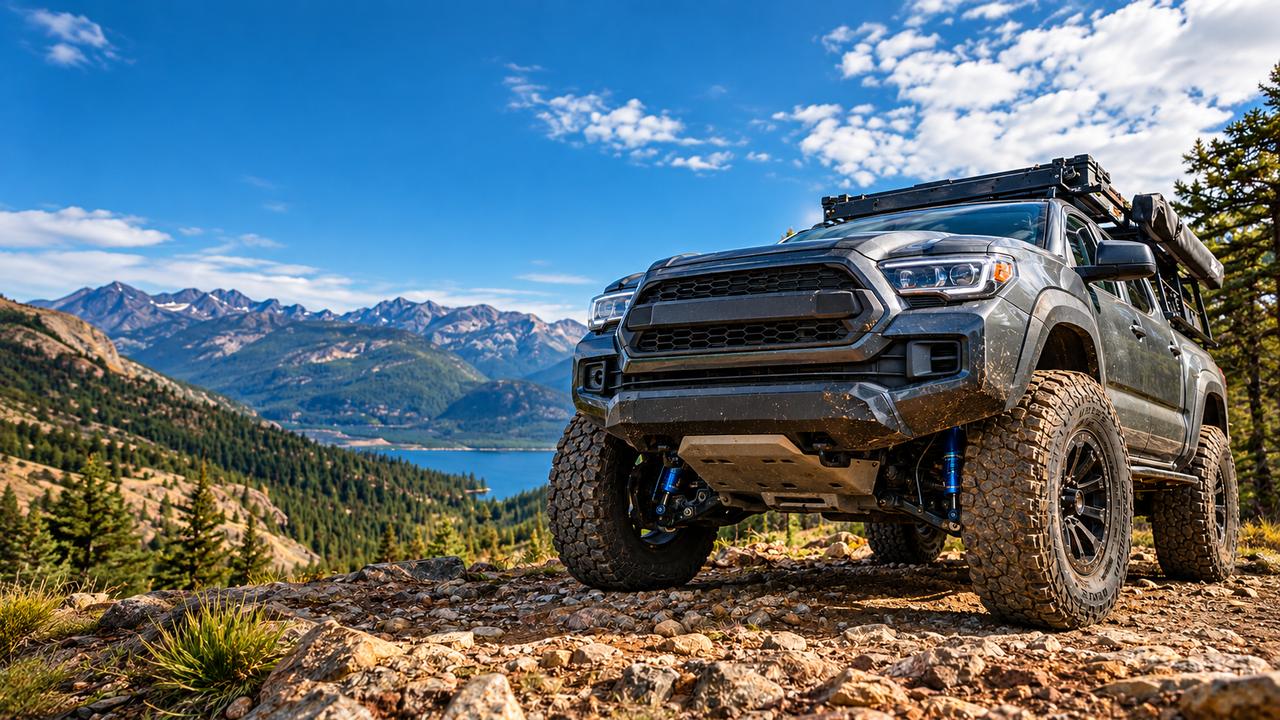
Choosing the best off-road suspension kit is not about buying the tallest lift or the most expensive shocks. The right kit must fit your exact truck or 4×4, keep the suspension geometry within a workable range, match the weight you carry, and include the components needed for the way you actually drive.
For most owners, the best choice is a vehicle-specific system that combines properly matched shocks or coilovers, springs and any required control arms, brackets or geometry-correction parts. A cheaper kit can make sense for mild trails and daily driving, while harder off-road use may justify serviceable shocks, remote reservoirs, stronger control arms and more complete front-to-rear integration.
Best Off-Road Suspension Kits: Quick Picks
| Kit or system | Best for | Why it stands out |
|---|---|---|
| Rough Country 2.5-Inch F-150 Kit | Budget truck upgrade | Loaded front struts and rear shocks in a straightforward vehicle-specific package |
| Rough Country 3.5-Inch Tacoma Kit | Affordable newer Tacoma build | Adds upper control arms and supporting geometry hardware rather than relying on simple spacers alone |
| ICON Stage 2 Tacoma System | Premium trail and daily-driver performance | Vehicle-tuned coilovers, upper control arms and matched rear components with greater focus on wheel travel and damping |
| Old Man Emu Vehicle-Specific Kits | Overlanding and added vehicle weight | Spring and suspension selection can account for front and rear accessory loads as well as desired ride height |
| BDS 4-Inch Bronco Package | Complete Bronco upgrade | Addresses suspension height and supporting geometry rather than treating lift as an isolated change |
| BDS KOH Bronco Package | Hard off-road use | High-end coilovers, control arms, steering reinforcement and protection components form a much more comprehensive system |
Important: these are examples of strong current kit approaches, not interchangeable products. Suspension kits are extremely vehicle-specific. Always confirm model year, drivetrain, trim, factory suspension options and every manufacturer exclusion before ordering.
What Makes a Good Off-Road Suspension Kit?
A good off-road suspension kit improves more than ride height. It should control the wheels over rough terrain, maintain predictable steering and alignment, cope with the vehicle’s real operating weight and avoid forcing other suspension or driveline parts outside their intended range.
That is why two boxes both advertised as a “3-inch suspension kit” can be very different products. One may contain little more than spacers and basic rear hardware, while another may include tuned coilovers, rear shocks, springs, upper control arms and correction parts designed to work together.
If you are still deciding between the underlying layouts rather than choosing an aftermarket kit, our guide to off-road suspension types and setups covers that separate question in detail.
What Should an Off-Road Suspension Kit Include?
There is no universal list because trucks use different suspension designs, but a serious kit may combine several of the following components:
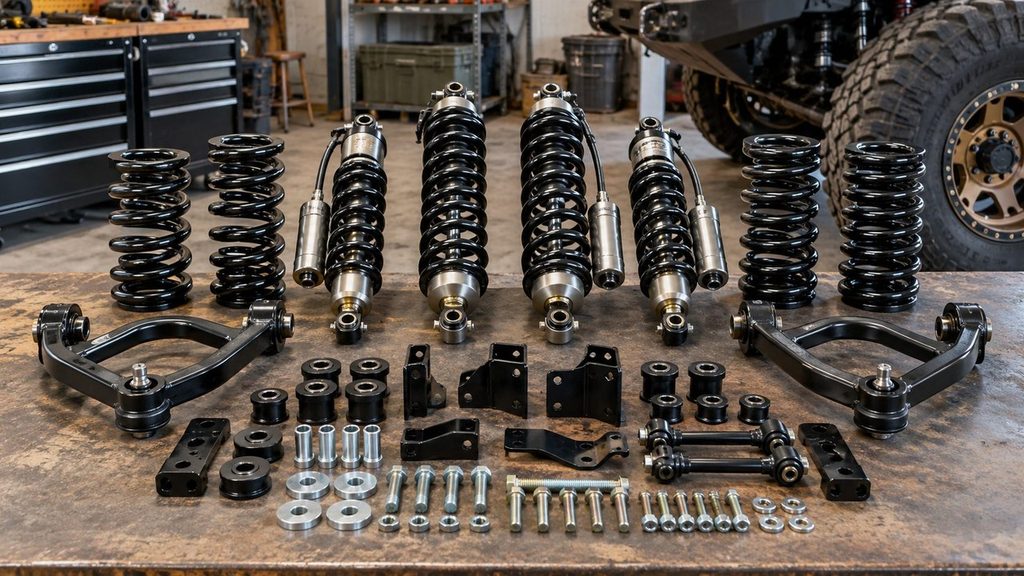
- Front shocks, struts or coilovers
- Rear shocks
- Front or rear coil springs or leaf-spring components
- Upper control arms
- Track-bar or axle-centering hardware where required
- Differential-drop or driveline-correction hardware on applicable 4WD vehicles
- Bump-stop extensions or replacements
- Sway-bar relocation or correction parts
- Brackets, U-bolts and installation hardware
Do not assume the word complete means the same thing across manufacturers. Check the component list. A kit that includes springs but no shocks may be perfectly valid for one buyer and incomplete for another. Likewise, a high-quality shock package is not automatically a complete suspension system if it leaves geometry changes unaddressed.
How to Choose the Right Off-Road Suspension Kit
1. Start With Exact Vehicle Fitment
Fitment is the first filter, not the last. Year and model are only the beginning. A kit may also depend on 2WD versus 4WD, cab or body configuration, factory suspension package, rear spring design, payload package or electronically controlled suspension.
Current Tacoma systems provide a good example: some aftermarket kits explicitly exclude certain AVS-equipped trucks, TRD Pro or Trailhunter configurations, while others distinguish between coil-spring and leaf-spring rear suspensions. A kit can therefore be correct for one 2024 Tacoma and wrong for another 2024 Tacoma.
2. Look Beyond Lift Height
Ground clearance and tire clearance matter off road, but lift height alone says very little about suspension quality. Increasing height can also change control-arm position, CV angles, caster, camber, axle location and available droop.
A better comparison asks what the kit does to preserve usable suspension travel and geometry. Upper control arms, track-bar correction, differential-drop hardware and other application-specific pieces can matter more than an extra inch of advertised lift.
3. Match Shock Performance to the Terrain
Shock valving has a major effect on how an upgraded truck actually feels. A basic twin-tube or monotube shock may be enough for forest roads and occasional trail use. Faster rough-road driving, repeated impacts and heavier off-road use put more heat into the dampers and can justify larger shock bodies or remote reservoirs.
Premium systems increasingly use vehicle-specific tuning rather than treating the shock as a generic accessory. That can improve body control and consistency without assuming that a stiffer ride is automatically better. If you already have the lift and only need to choose the dampers, our lifted-truck shock comparison covers options for street driving, towing, trail use and more demanding off-road conditions.
4. Account for Bumpers, Winches and Overland Weight
Accessory weight changes suspension behavior. A steel bumper, winch, drawer system, rooftop equipment and permanent camping load can alter ride height and how much spring rate the vehicle needs.
This is one reason load-specific systems can be a better choice for overland builds than buying a kit based only on advertised lift. Some current 4×4 suspension selectors explicitly ask for front and rear accessory load before recommending springs and ride height.
5. Decide How Much Street Comfort You Are Willing to Trade
Most off-road trucks still spend substantial time on pavement. A setup that works well at speed in rough terrain may be unnecessary for a daily-driven truck that sees moderate trails a few weekends a year.
If comfort is a priority, avoid assuming that maximum spring rate, maximum lift or the most aggressive shock tune is automatically an upgrade. Our guide on making a truck ride smoother explains the other side of that tradeoff.
Our Off-Road Suspension Kit Shortlist
Rough Country 2.5-Inch F-150 Kit: Best Budget Complete Upgrade
For 2004–2008 F-150 4WD applications, Rough Country’s 2.5-inch package is a useful example of what a budget-oriented kit can do better than a simple spacer. Available configurations use loaded front struts and matching rear shocks, so the buyer is replacing damping components rather than merely changing stance.
Its appeal is simplicity: moderate height, bolt-on installation and a much lower complexity level than a full long-travel suspension system or high-end coilover setup. The limitation is equally important—fitment exclusions include certain payload and Heritage configurations, illustrating why vehicle verification matters even with seemingly simple kits.
Rough Country 3.5-Inch Tacoma Kit: Best Affordable Newer-Truck Package
For the current-generation Tacoma, Rough Country offers 3.5-inch configurations that go beyond basic lift spacers by adding upper control arms and supporting hardware. That makes this type of package more relevant to buyers who want larger tires and trail clearance without immediately moving into premium multi-thousand-dollar suspension systems.
The catch is configuration sensitivity. Current fitment notes distinguish factory suspension packages and specifically exclude some trims or suspension options. This is exactly why shopping by “2024 Tacoma lift” alone is not enough.
ICON Stage 2 Tacoma System: Best Premium Daily/Trail Balance
ICON’s Stage 2 system for newer Tacomas illustrates the next level of completeness. Depending on configuration, the system combines vehicle-tuned 2.5-inch coilovers, upper control arms, a front differential drop and matched rear shocks, with versions that also add rear springs.
The benefit is not simply added height. The package is designed around wheel travel, shock control and suspension geometry as a coordinated system. Current application notes also call out details such as accessory weight affecting advertised lift and, on applicable vehicles, post-install ADAS recalibration. Those are the kinds of details that separate a serious suspension purchase from a cosmetic lift.
Old Man Emu Kits: Best for Overlanding and Added Weight
Old Man Emu’s vehicle-specific approach is particularly useful for trucks and 4x4s carrying permanent accessories. Rather than selecting suspension solely by lift height, its current kit selector can account for desired front and rear lift as well as additional front and rear load.
That matters for overland vehicles because a winch, bumper, drawers and camping gear can change the suspension’s operating point before the truck even reaches the trail. Matching springs and dampers to that real weight is more useful than buying the tallest kit available.
BDS 4-Inch Bronco Package: Best Complete Bronco Upgrade
BDS’s current 4-inch package for the 2021–2026 Bronco is a good example of an integrated lift intended to address more than height. The package includes suspension and supporting components aimed at maintaining workable angles and adding tire clearance rather than relying on a single spacer change.
For a Bronco owner who wants a substantial but still conventional upgrade, this type of kit sits between low-cost leveling solutions and race-oriented coilover packages. As always, the exact factory configuration and tire/wheel combination still need to be checked before ordering.
BDS KOH Bronco Package: Best for Serious Off-Road Use
At the other end of the spectrum, the BDS King of the Hammers-oriented Bronco package shows what a genuinely comprehensive hard-use system looks like. It combines premium remote-reservoir coilovers with upper and rear control-arm upgrades, steering reinforcement, an adjustable rear track bar and underbody protection components.
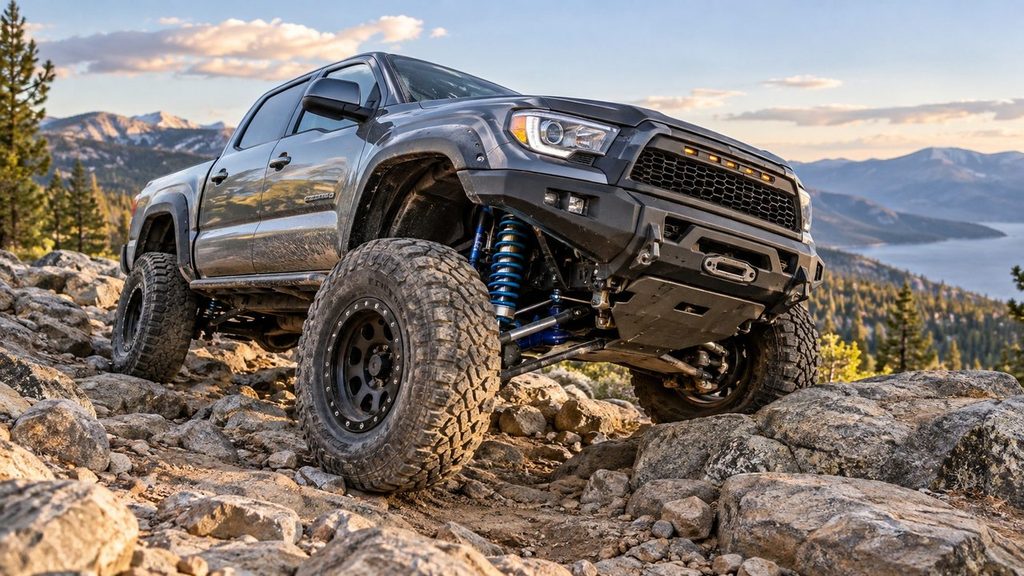
That level of hardware is unnecessary for many daily-driven trucks, but it demonstrates an important buying lesson: as off-road speed, articulation and tire size increase, a suspension build becomes less about “adding lift” and more about controlling geometry, wheel movement and durability as a complete system.
Basic Kit vs. Complete Suspension System
| Package level | Typical components | Best suited to |
|---|---|---|
| Basic | Spacers, basic springs or shocks | Mild use, stance changes and limited budgets |
| Mid-level | Matched shocks/struts, springs and selected correction hardware | Daily driving plus regular trail use |
| Complete | Front and rear dampers, springs, control arms and application-specific geometry parts | Frequent off-road use and more demanding builds |
| High-performance | Large-body or remote-reservoir dampers plus extensive geometry, steering and protection upgrades | Fast rough-road driving, severe terrain or specialized builds |
More parts do not automatically make a kit better. The goal is to include the parts your vehicle and intended use actually require. Paying for race-level hardware on a lightly used daily driver can be just as poor a decision as installing a spacer-only kit on a truck expected to handle repeated high-speed impacts.
Off-Road Suspension Kit vs. Lift Kit
The terms overlap, but they are not always interchangeable. A lift kit is primarily defined by increasing ride height. An off-road suspension kit should be evaluated by how well it controls the vehicle and supports the intended terrain, load and wheel travel.
Many excellent off-road suspension kits also lift the vehicle, because additional tire clearance and usable ground clearance are valuable. The mistake is assuming that the kit with the most lift automatically provides the best off-road suspension performance.
How Much Should You Spend on an Off-Road Suspension Kit?
The useful way to budget is by system complexity rather than a single average price. Basic truck kits can cost only several hundred dollars, while integrated coilover systems with control arms and matched rear components commonly move well into four figures. Premium packages with large remote-reservoir shocks and extensive supporting hardware can cost several thousand dollars before installation.
Also budget for everything outside the box. Labor, alignment, tire changes, wheel fitment, ADAS calibration on some modern vehicles and additional correction parts can materially change the final cost.
Do You Need an Alignment After Installing a Suspension Kit?
In most cases where suspension height or geometry changes, plan on an alignment after installation. Toe, caster and camber can change, and even kits designed with correction components still need the final settings checked on the vehicle.
For a deeper breakdown by component, see our guide to when an alignment is needed after suspension work.
Common Mistakes When Buying an Off-Road Suspension Kit
- Buying by lift height alone: height does not tell you anything about shock quality, travel or geometry correction. If you are still deciding how much modification you actually need, compare the leveling kit vs lift kit differences before choosing a complete off-road system.
- Ignoring exact trim and factory options: electronically controlled suspension, special off-road trims and different rear spring designs can change fitment.
- Assuming every kit is complete: check whether shocks, springs, control arms and correction parts are actually included.
- Forgetting added vehicle weight: bumpers, winches and camping equipment can change ride height and spring requirements.
- Choosing tires before checking the whole system: tire clearance depends on wheel offset, articulation and body clearance, not just advertised suspension lift.
- Skipping the post-install alignment: poor geometry can undo much of the handling benefit you paid for.
- Buying a competition-level setup for a mild daily driver: more expensive and more aggressive is not automatically more suitable.
Should You Choose the Kit or the Brand First?
Choose the application and required components first. A respected suspension manufacturer can offer an excellent product for one vehicle while another company may offer a more complete package for a different platform or use case.
If your question is specifically which manufacturers have the strongest off-road product ranges, that is a different decision. See our separate guide to the best off-road suspension brands for trucks and Jeeps.
Which Off-Road Suspension Kit Is Best for You?
For mild trails and a daily-driven truck, start with a vehicle-specific kit that includes fresh dampers and any geometry parts required for its modest increase in height. For regular technical trails or faster rough-road driving, step up to better-tuned shocks or coilovers, stronger control arms and a more integrated front-to-rear package.
For an overland build, prioritize suspension designed around the vehicle’s loaded weight rather than maximum lift. And for serious off-road use, look beyond the headline lift number toward wheel travel, shock heat management, steering and suspension geometry, serviceability and protection of vulnerable components.
The best off-road suspension kit is ultimately the one engineered for your exact vehicle and actual use—not the kit with the biggest number on the box.
Frequently Asked Questions
What is the best off-road suspension kit for a daily-driven truck?
For a daily driver, prioritize a vehicle-specific system with matched front and rear damping, moderate ride-height change and the geometry hardware required for that application. Extreme lift and race-oriented damping are usually unnecessary unless the truck also sees demanding off-road use.
Are complete suspension kits better than buying separate parts?
A well-engineered complete kit can reduce compatibility guesswork because the shocks, springs and supporting components are intended to work together. Separate parts can still produce an excellent setup, but the buyer needs to verify travel, spring rate, shock length and geometry compatibility independently.
Do off-road suspension kits improve ride quality?
They can, but improvement depends on shock tuning, spring rate, vehicle weight and terrain. A suspension designed for the vehicle and load can improve control without becoming unnecessarily harsh. A poorly matched lift can make ride quality worse even if it increases ground clearance.
Do I need new upper control arms with an off-road suspension kit?
Not every kit requires them. On some independent-front-suspension vehicles, additional lift can make factory alignment ranges or ball-joint angles less favorable, so aftermarket upper control arms are included or recommended. Follow the requirements for the exact vehicle and kit rather than applying a universal rule.
Are remote-reservoir shocks worth it for off-roading?
They become more useful when repeated rough-terrain impacts generate significant shock heat, such as fast desert driving or sustained hard trail use. For occasional low-speed trails and normal commuting, a good conventional shock may provide better value.
Can I install an off-road suspension kit myself?
Some modest bolt-on kits are realistic DIY projects for experienced owners with the correct tools, while more complex systems can involve spring work, control arms, steering components, torque-critical fasteners and calibration requirements. If the installation procedure exceeds your equipment or experience, professional installation is the safer choice.