Drop Pitman Arm: Do You Need One? Fitment & Lift Height
A drop pitman arm lowers the point where the steering gearbox connects to the drag link. On certain lifted Jeeps and solid-axle trucks, that change is part of a matched steering correction. On others, it creates a problem that was not there before. Do not buy one simply because your vehicle has a 3-inch, 4-inch, or 6-inch lift. Check how the drag link works with the track bar, the steering kit, and the suspension’s actual movement first.
Quick answer: a drop pitman arm makes sense when the lift or steering system specifically calls for it, the arm fits the steering box and drag-link joint, and the corresponding axle-location geometry is addressed. If the factory pitman arm already works with your track bar and drag link, lowering only the steering end can introduce bump steer. A product’s advertised lift range is a fitment condition, not proof that it belongs on every vehicle in that range.
That distinction gets lost in shopping results. A Jeep TJ owner can read one catalog that recommends a dropped arm and another suspension manufacturer’s instructions that say to keep the original. Both may be correct for their own complete configurations. The job is to identify which configuration you actually have before comparing part numbers.
Do You Need a Drop Pitman Arm After a Lift?
Maybe—but not automatically. Lift height changes the static position of the axle and the steering linkage. It does not tell you by itself whether the drag link needs to be lowered at the steering gearbox. A changed track-bar mount, a drag-link flip, a crossover steering conversion, or an existing aftermarket arm can reverse what looks like an obvious choice from the ride-height number alone.
A useful first check is to compare the installed steering with the lift kit’s instructions. If the kit lists a particular pitman arm and matching track-bar hardware, investigate that combination. If it specifies the stock arm, do not replace it just because an online retailer suggests that lifted Jeeps need a drop.
| What you find on the vehicle | What it suggests | Next buying decision |
|---|---|---|
| Stock pitman arm, original track-bar mounts, no documented steering correction | The existing link relationship may be intentional | Inspect geometry and follow the lift manufacturer’s plan before changing anything |
| Lowered frame-side track-bar mount in an engineered kit | Steering-link height may also need a matched change | Identify the exact arm and track-bar combination specified for that kit |
| Raised axle-side track-bar bracket with drag-link flip | A high-steer arrangement may already provide the required correction | Do not add a drop arm unless the high-steer kit explicitly allows it |
| Previously installed dropped arm with a stock track-bar mount | Possible mismatch of steering and axle-locating arcs | Inspect the complete setup rather than buying another drop arm |
| Worn pitman/drag-link connection without a geometry change | A repair may be needed, not a lift modification | Identify the original required part and inspect the joints |
When a Dropped Arm Is Part of the Designed System
Some manufacturers build a lift or steering package around a lowered drag-link connection and a corresponding track-bar arrangement. In that situation, an application-specific drop arm can help restore the intended working relationship between the links. The important phrase is part of the system; the arm alone is not the suspension system.
MetalCloak offers a 3-inch TJ/LJ drop pitman arm intended for use with its Front Long Arm Durotrak Track Bar. Its own information also says not to use that arm with its 3.5-inch short-arm arrangement because the track bar is not relocated to match. That is a particularly useful real-world illustration of why a 3.5-inch lift cannot answer the question on its own.
When the Original Arm Is the Better Choice
If an existing stock arm and track bar have compatible movement through the suspension’s useful travel, a drop may make the relationship worse. Moving one end of the drag link down while leaving the track bar’s chassis-side pivot where it was can create additional unintended steering input as the axle moves.
A stock arm also avoids unnecessary changes to drag-link joint angle, clearance, and steering linkage position. Keeping it is not a lesser upgrade if the geometry is already correct. Sometimes the best answer after reading a suspension parts catalog is to put the credit card away.
Why a Four-Inch Lift Is Not a Universal Threshold
Search results often present 4 inches as the dividing line between needing and not needing a drop pitman arm. That shorthand omits vehicle architecture and other changes. A leaf-sprung YJ, coil-sprung TJ, XJ Cherokee, and later JK Wrangler should not all be treated as one suspension simply because each has a steering box.
The same lift height can be paired with a stock drag link, a modified tie-rod arrangement, a dropped track-bar bracket, or a high-steer conversion. Look at the complete build sheet and the installed linkage, not a number repeated in a forum answer.
What a Drop Pitman Arm Changes—and What It Does Not
A pitman arm is a lever on the steering gearbox output shaft. Its outer end connects to the steering linkage, commonly the drag link on a solid-front-axle Jeep. A dropped version places that outer connection lower than the reference arm, changing the position from which the drag link operates.
It is not a replacement for every steering or suspension part beneath the vehicle. The pitman arm versus idler arm guide explains the distinct jobs of those components; here the question is whether changing the pitman arm’s offset is appropriate for a modified vehicle.
The Steering Gearbox, Sector Shaft, and Drag Link
Turning the steering wheel rotates the steering gearbox’s sector shaft. The pitman arm is fitted to that shaft through a specific splined connection, while its other end connects to the linkage through an approved joint. A drop arm changes the geometry between those points; it does not change the steering gearbox ratio or generate a stronger steering box.
That also means the shape of a replacement arm cannot be judged in isolation. The splined end must suit the exact gearbox, and the drag-link end must accept the right joint taper or other approved attachment. A part that looks similar in a listing may be wrong at either end.
Drag-Link Angle Is Only Part of the Geometry
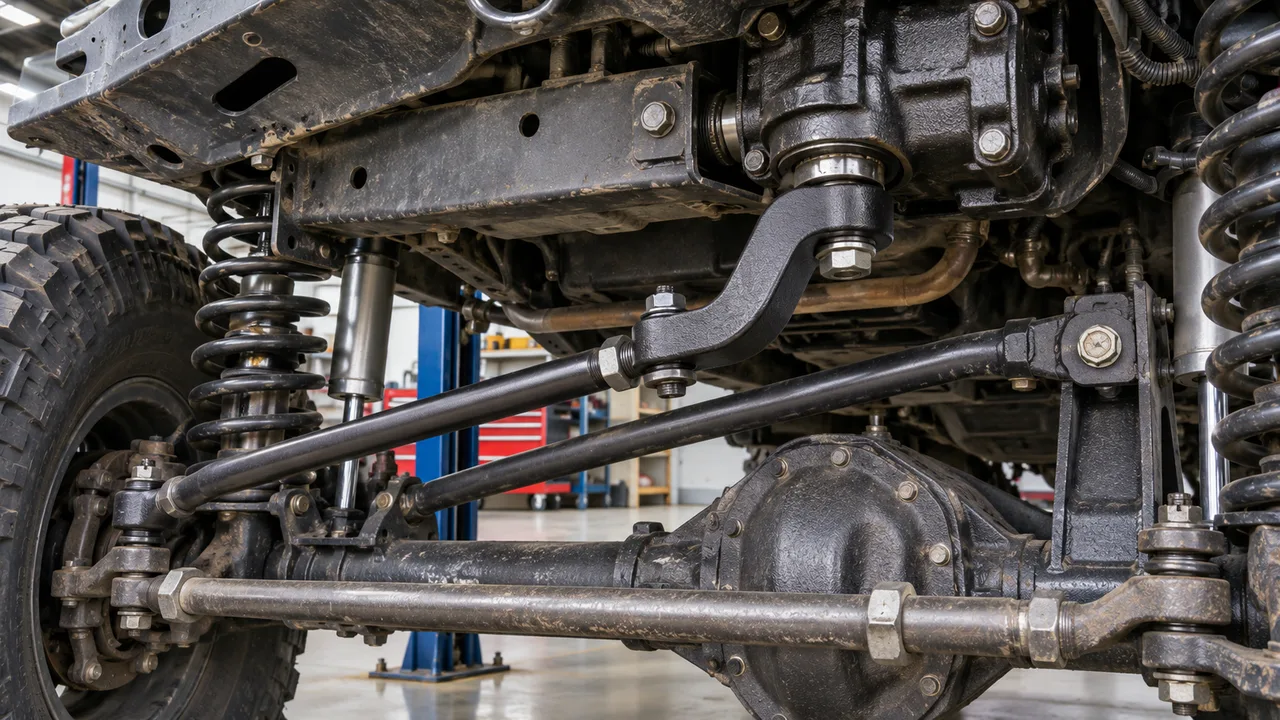
Imagine a solid front axle rising over a bump. The track bar controls lateral axle movement, while the drag link transmits steering position. Each moves on an arc established by its length and pivot locations. If those arcs are poorly matched, suspension movement can steer the wheels without a corresponding command from the driver.
Lowering the pitman-arm end changes the drag link’s arc. It may help when it is coordinated with the rest of the system, or hurt when done alone. Our bump steer explanation addresses how the symptom feels and the wider range of causes; this guide focuses on whether the replacement arm itself is a suitable purchase.
Parallel Links Are a Clue, Not the Whole Test
In a common Panhard-located solid-front-axle setup, the track bar and drag link should have compatible working geometry. People often say the two bars must be parallel. Their angles are indeed important, but so are effective lengths, pivot positions, and what happens through bump and droop. Two links that look similar at a parked ride height can still follow different arcs.
A front track bar is not a second steering rod. It laterally positions the axle while permitting vertical travel. If you are still identifying that component, our track bar function guide explains its operation separately.
It Does Not Cure Steering Wear or Death Wobble
A dropped arm does not rebuild a loose steering gearbox, repair a worn drag-link end, tighten a moving track-bar bracket, or correct bent components. Nor is it a universal cure for violent steering shake sometimes called death wobble. Geometry should be evaluated, but mechanical play and mounting damage need their own diagnosis.
The same goes for a wandering Jeep that needs constant corrections. If an arm is worn, find out whether the replacement should be stock height or dropped before ordering. Changing the offset in the middle of a routine repair can introduce an unrelated handling issue.
Jeep XJ, TJ, YJ, and JK: Fitment Is Not Interchangeable
These Jeep names dominate the keyword variations because they share a reputation for suspension lifts—not because a single arm fits them all. Steering gearbox details, original link layouts, lift packages, and the presence of high-steer hardware vary. Use the model and the installed steering as the starting point, then verify the individual part number.
The differences below are shopping checkpoints, not an interchange chart. They help narrow what to ask a manufacturer before you order an arm.
| Vehicle family | Common search issue | What must be verified |
|---|---|---|
| Cherokee XJ / Comanche MJ | Lifted vehicle with original or converted linkage | Existing track-bar mount, steering linkage, gearbox and kit-specified lift range |
| Wrangler TJ / LJ | Conflicting advice about stock versus dropped arms | The exact short-arm or long-arm package and the paired front track-bar arrangement |
| Wrangler YJ | Leaf-spring geometry and power/manual steering variants | Steering-box fit, original linkage, track-bar equipment and manufacturer exclusions |
| Wrangler JK | Drop arm versus drag-link flip or high-steer correction | Knuckle-side drag-link position, raised track-bar mount and complete kit instructions |
| Older Jeep / solid-axle truck | Similar-looking arms sold by drop amount | Actual gearbox, shaft, taper, suspension design and approved steering package |
Jeep Cherokee XJ and Comanche MJ
An XJ or MJ with a stock-style steering linkage may be sold a drop pitman arm for a particular lift range. For instance, Rough Country lists its 6605 for selected XJ/MJ applications with 4.5–6.5 inches of lift. That catalog condition tells you about the manufacturer’s proposed application; it does not confirm that the arm will suit every XJ already fitted with aftermarket steering.
XJ builds frequently accumulate steering changes over time. A different track-bar mount, a high-clearance tie rod, or a crossover conversion can make the original parts-chart assumptions obsolete. Before using an XJ search term to buy a new arm, identify what is already installed on both sides of the axle.
Jeep Wrangler TJ and LJ
The TJ is where generic lift-height advice causes the most confusion. Some TJ suspension packages retain the factory pitman arm. Others use a matched dropped arm and relocated track-bar arrangement. Both kinds are sold for lifted TJs, and the choice depends on the actual parts combination.
A useful manufacturer example is MetalCloak’s TJ/LJ 3-inch drop pitman arm. The listing requires its matching front Durotrak track bar, while the manufacturer expressly advises against the dropped arm with a different 3.5-inch short-arm configuration. The same Jeep family, two different answers: that is why a standalone lift number is not sufficient.
Jeep Wrangler YJ
The leaf-sprung YJ has different axle-locating behavior from the later coil-sprung TJ. YJ steering correction may be built around dropped-arm hardware in a way that does not carry over directly to TJ advice. Also, not every YJ pitman arm sold for power steering is suitable for a manual-steering application.
Rough Country’s 6605 fitment, for example, includes selected power-steering YJ applications with a stated lift range. Do not assume a compatible year is enough. Check the steering gear, drag-link joint and the complete suspension arrangement, including whatever factory or aftermarket track-bar equipment remains on the vehicle.
Jeep Wrangler JK
The JK introduced other common combinations, including raised front axle-side track-bar brackets and drag-link flip kits. A setup that moves the drag link connection upward at the knuckle and raises the corresponding track-bar mount may already address the change that a dropped pitman arm would otherwise attempt from the opposite end.
JK drop arms also exist, and some are expressly sold for particular 3.5–6-inch lift applications. Their existence is not a reason to add one to a JK with an engineered high-steer package. Confirm the complete kit instructions and any exclusions before changing the gearbox-side connection.
Other Jeeps and Trucks Need Their Own Catalogs
ZJ, WJ, older CJ models, Ford solid-front-axle pickups, and certain Ram trucks also appear in drop-arm searches. Even where the steering principle is similar, the pitman arm geometry and compatibility can be different. A part listed for a power-steering XJ should never be treated as a universal solution for a full-size truck.
The same caution applies to niche searches such as Suzuki Samurai drop pitman arm. Similar off-road use is not evidence of interchangeable splines or joints. For less common vehicles, use a manufacturer drawing and application list instead of copying a Jeep part number.
Drop Amount, Lift Height, and Steering System: How to Read Listings
Three numbers can be mixed together on a parts page: suspension lift height, a stated pitman-arm drop, and a part identifier. None should be interpreted without the manufacturer’s definition and reference point. A product sold for a 4-inch lift is not necessarily a 4-inch drop arm.
Advertised Drop Is Not the Same as Suspension Lift
The drop dimension describes a difference in the drag-link attachment location according to the seller’s stated reference. A 4.5-inch drop specification is not a promise that the vehicle needs exactly 4.5 inches of suspension lift. Some catalogs describe an arm by its profile; others use lift ranges or the change from a particular stock arm. Confirm how the measurement was taken.
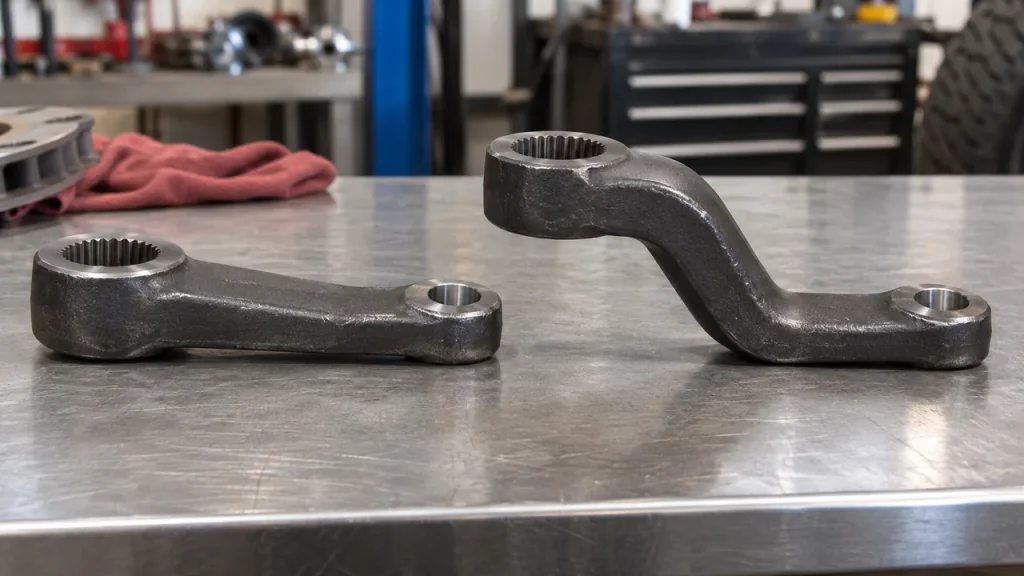
For example, Zone Offroad lists a 4.5-inch drop pitman arm for certain YJ and TJ applications, while other suppliers show different drop amounts and narrower application conditions. If the product page does not explain the reference arm and intended system, the impressive number is not enough to make a safe selection.
Does a Bigger Drop Always Improve Drag-Link Angle?
A bigger drop lowers the gearbox-side connection farther. That might reduce the visual slope of the drag link on one vehicle, but it also changes the arc, joint articulation and clearance. It may put the drag-link end into a poorer relationship with the track bar—or cause interference elsewhere through full suspension and steering movement.
There is no useful rule that says more lift requires the largest available drop. Once an engineered system specifies an arm, follow that specification. If the setup differs from the kit, have its geometry checked rather than scaling the drop from ride height by eye.
Body Lift vs. Suspension Lift
A body lift raises the body relative to the frame on vehicles designed for that modification. It does not raise the chassis relative to the front axle in the same way as a suspension lift. Adding a 1-inch body lift to a 3-inch suspension lift does not automatically create the steering geometry of a 4-inch suspension lift.
This is easy to miss when a listing says “fits 4-inch lift” without defining the modification. Manufacturers usually intend suspension lift height for steering-correction hardware. If your build combines body and suspension lift, report them separately when asking about fitment.
What a Matched Steering Package Can Change
A complete steering upgrade might alter the drag link, tie rod, knuckle connection, and track-bar mounting positions. In that context, buying an arm by nominal suspension height alone can undo a deliberate design choice. The steering kit’s documentation—not the number on a generic accessory listing—should establish whether the factory pitman arm remains.
A changed drag-link joint style can be just as important as ride height. Some systems use special taper adapters or different ends; do not assume that the factory joint can be made to fit a different hole through force or improvised machining.
Matching a Drop Pitman Arm With the Track Bar
The most consequential compatibility check is often not the steering box spline; it is the relationship between the modified drag link and the track bar on a track-bar-located front axle. One misplaced pivot can make a vehicle steer as the suspension compresses and extends. The parts need to be considered as a system.
Frame-Side Drop Brackets
Some lifted-truck and Jeep systems lower the frame-side track-bar attachment to coordinate with a lowered drag-link connection. That bracket may be a specified companion to a drop pitman arm. Other systems do not use it, and fitting an extra drop bracket can upset a different intended layout.
This article is not a second guide to buying brackets. Our track bar relocation bracket guide compares frame-side drops, axle-side raises and the requirements of matching steering changes. Use it when the bracket itself is the component you’re selecting.
Raised Axle Brackets and Drag-Link Flips
A high-steer arrangement commonly raises the drag-link connection at the steering knuckle and coordinates that change with a raised axle-side track-bar mount. This is a different path to a similar broad goal: controlling the relationship of the two links as the axle travels. A lowered pitman arm is not automatically the companion to a raised-knuckle setup.
Before buying, identify whether your drag link attaches above or below its designated steering-arm connection, and whether the kit supplied a matching track-bar bracket. Do not combine separately advertised “steering correction” parts without explicit compatibility approval.
Adjustable Track Bars Do Not Automatically Fix Link Angles
An adjustable track bar can recenter an axle by changing effective length. That is useful, but it does not necessarily place its pivots at the correct heights or make its arc match a modified drag link. “I installed an adjustable bar” is not the same as “the steering geometry has been corrected.”
Track-bar bushings, joint type and mounting integrity also matter. If a vehicle wanders after a lift, look for shifting brackets or a loose joint before assuming the pitman arm’s drop is the root cause.
The Check Has to Include Bump, Droop, and Steering Lock
A static photograph can conceal problems. As the axle rises, drops, and articulates, the drag link changes position relative to the tie rod, track bar, frame and wheels. Joint articulation limits and contact points must remain acceptable. A setup that appears level in the driveway can still bind or interfere at full travel.
If the vehicle lacks a documented steering combination, use a suspension specialist who can verify the actual geometry and clearances safely. Do not use the pitman arm as a temporary adjustment to see whether steering improves; it is a structural steering component, not a tuning knob.
Choosing the Correct Replacement Arm
Once a specific lowered arm has been confirmed as necessary, the shopping task becomes mechanical fitment. Material, finish and price matter, but they come after the two ends of the arm and the system configuration. A forged part with the wrong shaft connection is still the wrong part.
Steering Box Splines and Shaft Details
Confirm the steering gearbox model, sector-shaft dimensions, spline pattern and any indexing features specified for the exact vehicle. Some Jeep arms are advertised for a particular Saginaw steering-box family, yet that does not mean every Jeep or converted steering box uses the same fit.
An aftermarket box, swapped steering gear or right-hand-drive configuration can defeat a normal year/make/model lookup. The catalog should identify the relevant exclusions. Do not grind splines, alter an indexing feature, or assume an arm can be rotated to an arbitrary position on the shaft.
Drag-Link Stud Taper and Joint Orientation
The outer hole needs to match the approved drag-link end. Taper dimensions and insertion direction matter; an incorrectly seated stud can loosen even if a nut appears tight. A joint intended for one steering linkage cannot be made universal by substituting washers or a different castle nut.
If the product specifies a changed drag-link end, tapered sleeve, or a different steering kit, those are essential fitment conditions. Check that the connection retains the required joint travel and that the dust boot will not be pinched or torn.
Forged Steel, Finish, and Claimed Strength
Manufacturers commonly advertise one-piece forged steel arms. That can be a sound construction approach, but a “heavy-duty” label says little about the correctness of the shaft fit or steering geometry. Look for a traceable manufacturer, application-specific design, and documented installation requirements.
Protective coatings matter on a part exposed to road spray, but corrosion resistance does not override basic fit. A brightly painted arm should not win over a correctly specified OEM-style replacement simply because it looks tougher under a lifted Jeep.
Right-Hand Drive, Power Steering, and Existing Modifications
Retail listings sometimes exclude manual-steering vehicles, restrict left- or right-hand drive, or apply only to particular steering boxes. Treat those notes as hard boundaries. A visually similar part may have different indexing or an incompatible joint connection.
Modified vehicles need extra scrutiny. Ask what steering box, drag link, track bar, axle brackets, and lift kit are actually present. If the prior owner cannot identify the equipment, the safer first purchase may be an inspection rather than an arm.
Buying Checklist Before You Order
Take the current parts list, manufacturer instructions and photographs of the installed linkage to the same page. These checks prevent the most common misorders:
- Vehicle identity: year, chassis, 2WD/4WD where applicable, steering-box type, and left- or right-hand drive.
- Lift details: suspension lift height, not a combined body-lift figure, and the exact lift-kit maker and revision.
- Current steering: stock or aftermarket drag link, tie rod, knuckle connection, and any high-steer or crossover components.
- Track-bar setup: factory mounts, frame-side drop, axle-side raise, adjustable bar, and the kit’s required pairing.
- Arm dimensions: documented drop relative to the specified reference, sector-shaft splines, indexing and drag-link-end taper.
- Clearance: manufacturer requirements through steering lock and suspension travel, including bump and droop.
- Included hardware: specified retaining nut, cotter pin or other locking hardware, and a current installation sheet.
- Condition: no damaged steering box, loose linkage joints, cracked mounts or unverified modifications that need repair first.
If a listing answers only “fits lifted Jeep,” it has not answered enough. Ask the manufacturer for the part number applicable to your exact steering package instead of trying to identify a component from its shape.
Installation and Post-Fit Checks That Matter
Removing a pitman arm can require a dedicated puller, access to a tightly fitted splined joint, and attention to steering gearbox and linkage components. This is not a universal step-by-step replacement procedure. The goal here is to identify what a competent installation must account for before the part is purchased.
A Puller Is Not a Compatibility Test
The fact that an arm comes off a steering box with a pitman-arm puller says nothing about whether the replacement belongs there. Forcing an ill-fitting arm onto the shaft can damage the steering gearbox. Likewise, a drag-link joint that will not seat properly is a reason to stop, not to machine parts until they appear to fit.
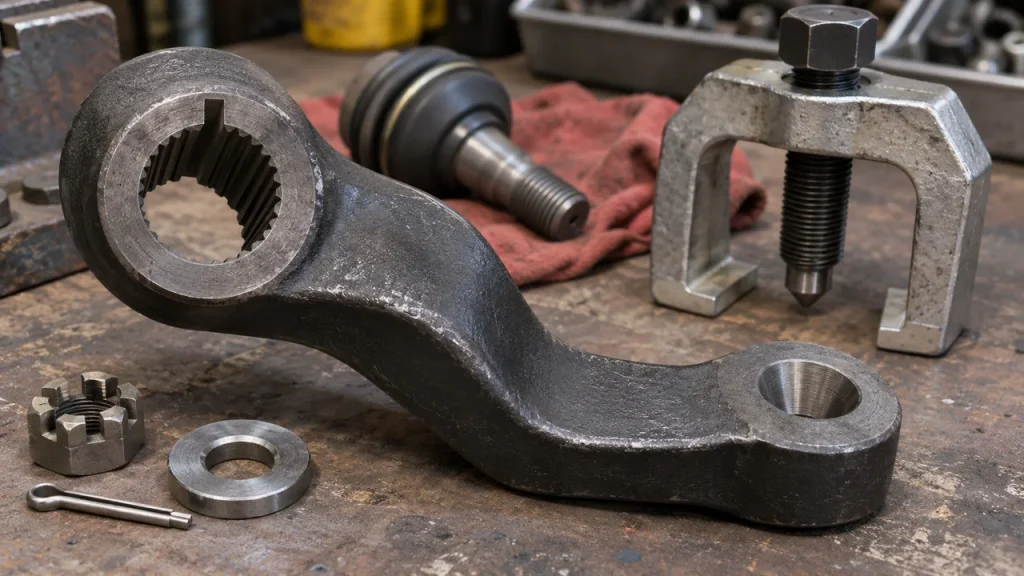
Use the correct vehicle and arm-manufacturer procedure. Support the steering linkage appropriately, identify required replacement fasteners, and avoid hammering loads into the gearbox or an assembled steering joint.
Tightening, Indexing, and Steering Center
Pitman-arm retaining hardware and drag-link studs are safety-critical. The relevant torque, locking method and indexing arrangement depend on the vehicle and part. Borrowing a torque value from a different Jeep or steering box is not a substitute for the service manual.
After a change, the steering must be checked for proper center, full left/right travel, and absence of binding or contact. A crooked steering wheel should not be corrected by removing and reinstalling an indexed arm at a guessed position if the system calls for adjustment elsewhere.
Alignment and Steering Checks After Modification
A geometry-changing arm may require the complete front-end setup to be checked, including steering-wheel center, drag-link adjustment where permitted, axle position, and toe. A vehicle that drove straight before the lift does not prove the post-lift steering relationship is correct.
If the steering changes sharply over bumps, pulls unexpectedly, or binds, do not keep driving to see whether it settles in. Have the relevant joints, mounts and geometry inspected before road use continues.
Common Problems When the Wrong Drop Arm Is Installed
Not every problem after a lift is caused by the pitman arm, but certain symptoms justify revisiting the parts combination. The useful approach is to identify what changed and what the manufacturer’s intended geometry was—not to replace more parts randomly.
New Bump Steer After a Pitman Arm Swap
A Jeep that steers left or right as its front axle moves through a bump may have mismatched drag-link and track-bar movement. If that behavior appeared immediately after an arm change, inspect the linkage and track-bar mounting positions as a system. A steering stabilizer may change what the driver feels without correcting the mismatch.
An existing vehicle may have had acceptable steering with its original arm. Do not assume the newly installed dropped arm is better simply because it lowered the drag link’s visible angle.
Binding, Contact, or Lost Steering Travel
A dropped connection may put a drag-link end near the tie rod, differential cover, frame component or other hardware at certain steering and suspension positions. Some joints can also approach their articulation limit earlier than expected. Clearances need checking across the system’s permitted movement, not only with the wheels straight.
The solution is not to bend the arm or grind clearance into a structural steering component. Verify the specified part and its supporting hardware.
Steering Wheel Off-Center or Wandering
A pitman-arm replacement may expose incorrect steering centering or linkage adjustment. Wandering can also involve tires, ball joints, bushings, steering gearbox play, or axle location. A wheel that sits off-center after the work is a prompt for proper setup, not evidence that a larger drop is required.
Check whether the problem was present before the lift or developed when a particular steering component was replaced. The timeline helps avoid blaming the wrong part.
Worn Joints and Loose Hardware
A clicking or clunking connection needs inspection of the drag-link end, mounting nut, taper fit, sector-shaft attachment and adjacent components. Loose steering hardware is a safety issue, not something to compensate for by fitting a stronger-looking arm.
If a vehicle was purchased with a mystery drop arm, document the existing part and find its manufacturer before ordering a replacement of the same shape. The previous owner’s choice may not have been right.
Drop Pitman Arm Price and Buying Value
A lower-cost arm is not automatically a bargain if using it requires another track-bar bracket, drag-link end or steering correction package. Conversely, a well-matched arm in an already-engineered system may be a modest part of a larger build. Compare the cost of completing the system correctly rather than the isolated piece.
Bare Arm vs. Complete Steering Correction Package
Some listings supply only the pitman arm. Others offer it with a track-bar bracket or as part of a lift package. Read the kit contents and exclusions before comparing prices. A low advertised cost for the arm alone may not include fasteners, steering-joint changes, installation or post-installation checks.
For repair bills rather than accessory selection, our pitman arm replacement cost guide discusses parts and labor. This article keeps the focus on whether the replacement geometry is the right one.
When Spending More Does Not Buy Better Steering
A premium finish, a claimed larger drop and a high-strength description can be useful product attributes, but none makes an incompatible combination work. If your suspension system specifies the factory arm, an expensive aftermarket drop can be a downgrade.
Prioritize verified compatibility, proper documentation, and a reputable parts source. The best value may be a stock-style replacement or no replacement at all.
Drop Pitman Arm FAQ
The same questions appear repeatedly in U.S. parts listings and Jeep discussions, usually without enough information about the full suspension setup. These answers keep the buying decision separate from installation instructions and unrelated steering repairs.
Does a 3-inch lift need a drop pitman arm?
Not by default. Some 3-inch-lift configurations retain the factory arm, while a specific steering kit may require a correction. Check the track-bar and drag-link arrangement and the lift maker’s documentation rather than deciding by lift height alone.
Do you need a drop pitman arm for a 4-inch lift?
There is no universal 4-inch rule. Some catalog arms are sold for that range, but other suspension packages specify a stock arm or a different high-steer solution. Identify the exact kit and steering geometry before purchasing.
Will a drop pitman arm fix bump steer?
It can help when it restores the intended relationship between the drag link and track bar in an approved arrangement. Installed without the necessary matching changes, it can create or worsen bump steer. Diagnose the actual cause rather than assuming that a lowered arm is the cure.
Is a drop pitman arm the same as a pitman arm?
Both connect a steering gearbox to the steering linkage, but a dropped version changes the outer attachment position relative to a designated reference arm. A factory arm is not automatically a drop arm simply because it has a curved shape. The correct distinction is application and geometry, not appearance.
Do Jeep TJ and XJ drop pitman arms interchange?
Some aftermarket listings cover multiple Jeep families, but that does not make every TJ and XJ part interchangeable. Steering gear, power-steering details, drag-link taper, year range and lift system must all match the specific part number.
Can I run a drop pitman arm with a stock track bar?
Only if that exact vehicle and steering arrangement is engineered to work that way. On many track-bar-located solid-front-axle Jeeps, lowering the drag-link end without the corresponding track-bar geometry change risks bump steer. Don’t assume the stock bar and stock mounts are an acceptable pairing.
Is a drop pitman arm needed with a drag-link flip?
Often not; a drag-link flip and raised track-bar mount may already be the intended high-steer correction. Adding a dropped pitman arm can change the geometry again. Follow the approved steering package, not a generic rule that each lift needs more steering correction parts.
Can a drop pitman arm fix death wobble?
Not as a universal repair. Severe steering oscillation can involve loose or worn components, tires, mounting hardware and suspension geometry. A drop arm should be considered only if the approved correction requires it, after a proper diagnosis of the actual problem.
Does a drop pitman arm change the turning radius?
It changes the steering-link connection location, but turning radius is not guaranteed to improve. Steering stops, linkage travel, clearances and joint articulation all constrain available movement. A poorly matched arm can reduce usable travel or cause interference.
Is a drop pitman arm safe for highway driving?
Only when the part is correct for the exact steering system, fitted according to manufacturer requirements and verified for secure joints, clearance and steering behavior. A vehicle with unexplained bump steer, binding or loose linkage should be inspected rather than used normally at road speed.
Bought a Lifted Jeep With an Unknown Pitman Arm?
A secondhand Jeep can arrive with a dropped steering arm, a different track bar and no build sheet explaining why either was fitted. That is not unusual, but it makes ordering by appearance risky. A previous owner’s part choice is not proof that the combination is correct, even if the vehicle has been driven that way for years.
Start by identifying the steering box and the markings on the existing arm. Photograph the drag-link joint, the track-bar mounts at both ends and any raised knuckle-side steering connection. Check whether the lift is a named kit, a mixture of components, or something that has been revised since installation. A matching manufacturer’s diagram is more useful than a guess about how many inches the arm drops.
If the parts cannot be identified, or the Jeep has unexpected steering movement over bumps, arrange a professional inspection before buying a replacement. Once the actual steering package is known, you can choose the specified stock or dropped arm with confidence—and avoid paying to reproduce somebody else’s geometry mistake.