Add-a-Leaf Kits: Types, Lift Height & Ride Quality
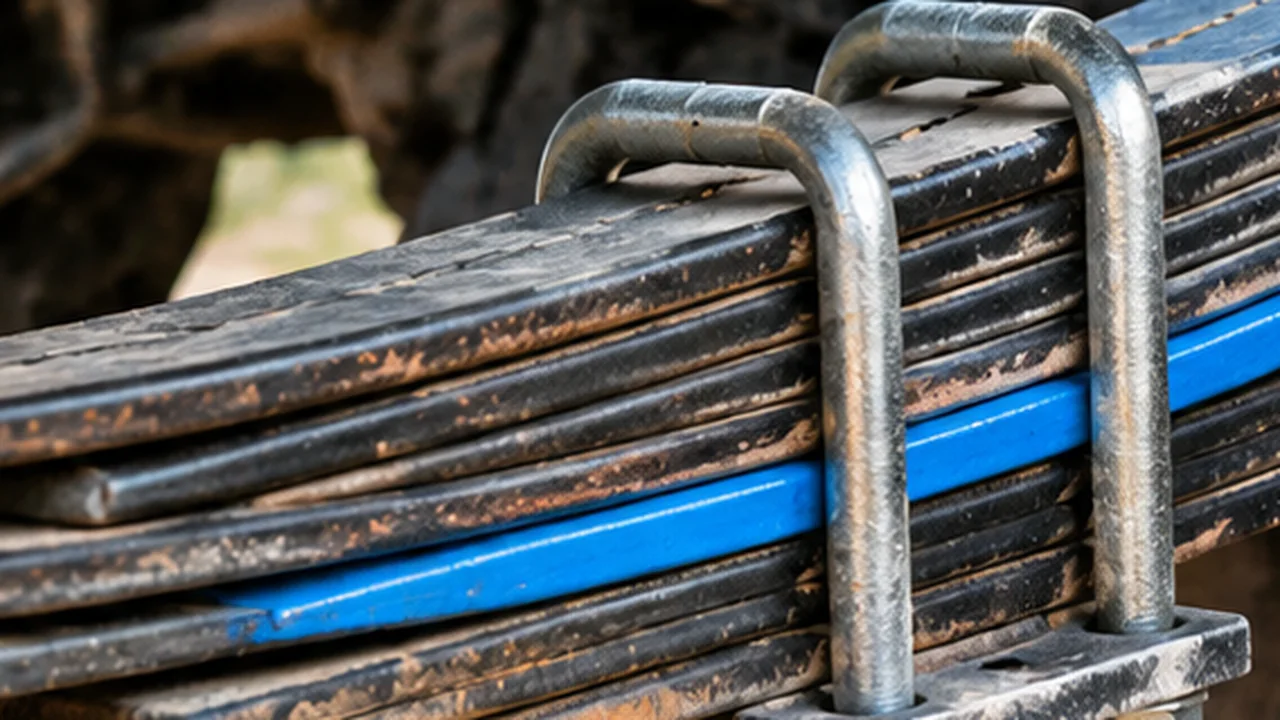
An add a leaf kit (also written add-a-leaf kit) puts one or more extra steel leaves into a truck’s existing leaf spring pack. On healthy springs, it can provide a modest lift, reduce rear-end squat and make the suspension firmer. It is a good budget option when you want a little more rear ride height and can accept a stiffer empty-bed ride. It is a poor fix for a cracked, badly fatigued or rust-damaged spring pack. The extra leaf works with the springs you already have; it does not turn them into new ones.
How much lift? Many truck-specific kits are advertised in roughly the one- to two-inch neighborhood, while some manufacturers list wider ranges. The number depends on the truck, the leaf pack already under it, the kit design and the weight it carries. More importantly, an add-a-leaf does not increase the vehicle’s official payload, GVWR, axle ratings or towing limit. It changes how the suspension supports a load within those limits, not what the manufacturer permits you to carry.
Before spending money, answer three questions: Is your current pack structurally sound? Are you trying to lift an unloaded truck or control sag with cargo aboard? And how much firmness are you willing to live with when the bed is empty? Those answers are more useful than the biggest lift figure in a product listing.
Should You Buy an Add-a-Leaf Kit?
The right use case is fairly narrow, and that is not a criticism. A reasonably priced extra leaf can be exactly what a daily-driven pickup needs after a mild front lift or when a modest, mostly consistent load makes the rear feel soft. Trouble starts when the same part is expected to repair broken springs, carry an overloaded trailer or behave like an adjustable air suspension.
Use the following as a first filter, not a substitute for checking the actual vehicle and manufacturer’s approved fitment.
| What you want | Is an add-a-leaf a sensible starting point? | Why |
|---|---|---|
| Small rear lift on sound factory springs | Often yes | Changes the existing pack without buying full replacement springs |
| Less squat with a predictable legal cargo load | Possibly | Adds spring support, but usually also changes the unloaded ride |
| Soft factory-like ride with an empty bed | Usually not the first choice | An engaged extra leaf can make small bumps more noticeable |
| Fix for cracked leaves, damaged eyes or severe rust | No | Additional steel cannot make a failed spring safe |
| Higher official payload or tow rating | No | Suspension upgrades do not change vehicle certification limits |
| Large, precisely tuned lift with permanent heavy equipment | Usually look at complete packs | A purpose-built pack can match both the new working weight and desired height |
If the second column sounds cautious, that is deliberate. “Adds support” is a real mechanical benefit, but it says little about how the truck will feel Tuesday morning with nothing in the bed.
First, Find Out Whether the Original Leaf Pack Is Healthy
Inspect the main leaf around both spring eyes, the smaller leaves near their ends, the center of the pack at the axle and the areas covered by clamps. Cracks, broken tips, severe scaling, displaced leaves and a spring that has permanently flattened all point toward a repair decision rather than a lift accessory. Check the bushings, hangers and shackles too; a rear end sitting crooked is not automatically a spring-rate problem.
A truck can lose some unloaded height over time without a visible fracture. Measure both sides on level ground and compare the result with known-good specifications, not just another owner’s photographs. If the stock packs are tired, our leaf spring replacement cost guide explains why replacing the assembly may be the more sensible expense.
What an Add-a-Leaf Is Not Going to Fix
An extra leaf will not repair a torn spring eye, restore an elongated axle locating hole or strengthen a rusted frame hanger. It also will not cure trailer sway caused by incorrect tongue weight, poor loading or unsuitable hitch equipment. The rear may sit taller, but a better-looking stance is not proof the original problem has gone away.
Think of the kit as a change to the spring package, not a universal cure for rear suspension complaints. That simple distinction prevents a surprising number of wasted purchases.
How an Extra Leaf Changes the Spring Pack
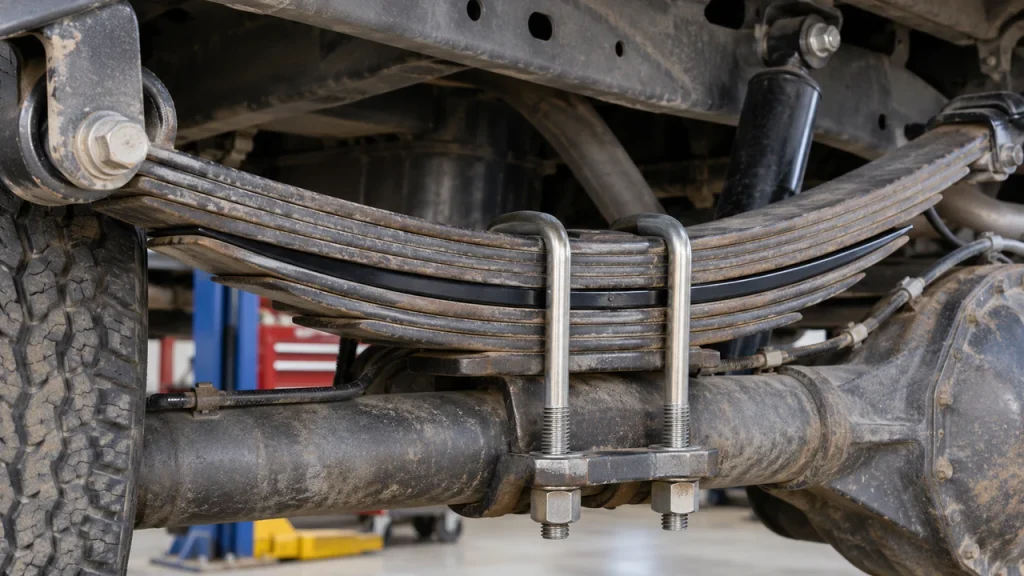
A conventional leaf-sprung pickup uses several curved steel strips held together as one pack. The longest, or main, leaf normally has eyes at its ends. Shorter leaves underneath contribute stiffness and help distribute load. Adding another leaf changes the way those strips bend together, and that is why one relatively small piece of steel can alter both stance and feel.
An Add-a-Leaf Is Different From a Bolt-On Helper
The usual add-a-leaf is installed within the existing stack, secured by the pack’s center pin and retained by the proper spring hardware. A separate bolt-on overload helper may sit above or beneath the stock pack and use its own clamps, with an engagement gap or adjustment mechanism. Retail listings sometimes call both products “helper leaves,” which is not enough information to tell them apart.
For this guide, add-a-leaf means an extra leaf integrated into the original spring pack. The distinction matters because it generally participates in spring action much of the time, rather than waiting for a separate helper to contact the pack under heavier loading.
Spring Rate, Arch and Support Are Related—but Not Identical
An extra leaf usually increases resistance to suspension compression. Depending on its shape, thickness and the way it interacts with adjacent leaves, it may also change the assembled pack’s arch. That combination can raise the rear ride height and reduce how far the truck settles when loaded. It does not necessarily restore the original unloaded geometry of fatigued steel.
A taller stance, a firmer spring rate and an actual improvement in usable suspension travel are three different things. If the truck sits higher but has very little droop available, for example, the advertised lift is not the whole story. Look at the suspension as a system, including shocks, bump stops and the spring’s moving end.
The Main Leaf and Factory Overload Have Their Own Jobs
The main leaf carries the mounting eyes and establishes much of the suspension’s geometry. Many packs also have a short, thick overload leaf or a separate factory overload arrangement. An add-a-leaf should go only where the kit instructions specify; it is not automatically another overload and should not be slipped below a factory overload leaf simply because there is room there.
Some replacement leaves are intentionally asymmetrical, with the center hole closer to one end. Their forward and rearward orientation matters. Some systems use anti-friction inserts or replacement wear pads, while others specify removal or retention of existing pieces. Treat the exploded diagram in the kit instructions as part of the fitment information.
Short vs Long Add-a-Leaf Kits
You will see short add-a-leaf, long add-a-leaf and full-length add-a-leaf in US truck catalogs. These names refer to how much of the factory pack the added spring spans. Length alone does not determine the final lift or ride quality, but it changes how the extra support is distributed.
Here is the practical difference worth considering before comparing specific truck applications.
| Design | Typical character | Main trade-off |
|---|---|---|
| Short add-a-leaf | Concentrates extra spring support nearer the axle | Often economical and effective, but may feel more abrupt when unloaded |
| Long or full-length add-a-leaf | Extends farther toward the pack ends | May distribute its contribution more gradually, with fitment still critical |
| Tapered or multi-leaf system | Uses end shape or several leaves to tune engagement | Potentially more refined, but not guaranteed soft or universally compatible |
These are tendencies, not laboratory ratings. Leaf thickness, initial arch, tip shape and the original pack can matter as much as the added length.
Why a Short Add-a-Leaf Can Feel More Abrupt
A short leaf often places extra stiffness near the center of the pack, where the axle is clamped. If that leaf is thick or sharply arched, the stock springs may have to work against a substantial additional force even with little cargo aboard. On sharp potholes, an empty pickup may feel more abrupt than it did with the same tires and shocks before the change.
That does not make every short kit a bad choice. If the truck frequently carries a known load and the product is engineered for that exact pack, the increase in firmness may be useful. The problem is buying a short leaf purely because the advertised lift number matches the front leveling kit.
What You Gain With a Longer Leaf
A longer add-a-leaf extends its support over more of the spring assembly. Well-designed versions may blend their contribution into the pack more gently than a short, stiff insert. They can still make the truck noticeably firmer, especially if the factory leaf pack was already on the heavy side or the vehicle spends most of its time empty.
Do not mistake “long” for “universally compatible.” The ends must clear the original clips, contact points and any factory overload arrangement throughout the working travel. Long add-a-leaf kits for one truck generation are not interchangeable just because the spring packs have similar widths.
Tapered Ends and Anti-Friction Inserts Are Worth Noticing
A tapered leaf becomes thinner toward its ends. Some manufacturers also use low-friction tip inserts to manage rubbing between leaves. For example, Ironman 4×4 describes tapered replacement leaves with anti-friction inserts and new center bolts in one of its add-a-leaf packages. Those details tell you something about the intended design, though they do not establish the ride quality on an unrelated truck.
If a kit calls for liners, anti-friction pads or a particular clamp configuration, include them in the purchase and installation plan. Leaving them out can change contact between leaves or introduce noises that get blamed on the shock absorbers.
How Much Rear Lift Can an Add-a-Leaf Give?
For a mild pickup lift, the common buying question is whether the rear will come up one inch, two inches or more. There is no honest single answer for all add-a-leaf kits. A manufacturer’s figure applies to a particular product and testing assumptions, not every truck with a leaf spring.
Published Lift Figures Vary Even Among Established Manufacturers
BDS markets several vehicle-specific add-a-leaf packages with a broad one- to three-inch range depending on the factory spring configuration. ReadyLIFT’s published information for its compact and midsize universal add-a-leaf says actual rear lift can vary from 0.75 to 1.5 inches according to the truck. Both are manufacturer figures for their own parts; neither is a rule you can apply to an arbitrary spring pack.
A nearly empty pickup, one with a heavy canopy and drawers, and the same model carrying a permanent service body can finish at very different heights with the same nominal kit. Worn springs, aftermarket shackles, previous lift blocks and existing changes to spring arch complicate it further.
Measure the Truck Before You Decide What Height You Need
Park on level pavement with the tires correctly inflated and the truck loaded as it will normally be used. Measure vertically from each rear wheel’s hub center to the same point on the fender opening; record both sides. Unlike a ground-to-fender measurement, this largely removes tire diameter from the comparison. Then measure the front the same way if your goal is to preserve a particular amount of factory rake.
Write down the load in the bed when you measure. A photograph with a full fuel tank, heavy tools and a trailer attached does not make a fair before-and-after comparison with an empty truck. The number you want is the change at the same load, measured from the same reference points.
Rear Rake Is Not a Defect to Erase Blindly
Most pickups sit somewhat higher at the rear when unloaded so they can settle closer to level when carrying an appropriate load. Add too much spring height and the truck may look nose-down with no cargo. Raise the front without considering rear rake and you may instead find the bed low when loaded. Neither photograph tells you whether the axle weights are safe.
Choose a target stance for the way the vehicle is actually used. A truck built mainly for occasional light trails needs a different compromise from one that wears a heavy steel bumper, bed rack and recovery gear every day.
Will an Add-a-Leaf Make the Truck Ride Rough?
It can. The ride-quality trade-off is one of the most useful things a buyer can know, and it often gets buried beneath lift-height claims. Adding spring material usually raises the force needed to compress the rear suspension. Whether that feels slightly controlled or unpleasantly harsh depends on the existing pack, the tire and shock setup, and how much weight is normally carried.
An Empty Bed Makes Extra Rear Spring Rate Easy to Feel
With little weight over the axle, a stiffer pack does not compress as readily over small bumps. Expansion joints, washboard roads and pothole edges may be transmitted more sharply through the chassis. Tire pressure and shock valving can make that sensation better or worse, but they do not erase an unsuitable spring rate.
A heavy-duty add-a-leaf bought for a dramatic unloaded lift can therefore be the wrong match for a commuter truck. If comfort is the priority, look for application-specific testing and realistic owner reports from the same model and configuration, rather than treating all add-a-leafs as equivalent.
The Same Kit Can Feel Better Under the Load It Was Chosen For
Now put a consistent, properly rated load in the bed. The stock springs compress farther, and the extra leaf can help control sag and reduce the tendency to hit the suspension’s compression stops. The truck may feel more settled with that particular load than it did on its soft factory pack. That does not make it safe to exceed the vehicle’s rated limits.
This explains why two owners can give opposite opinions of the same part. One uses the truck empty most days; the other has a canopy, tools and a water tank installed year-round. They are not actually evaluating the same working spring condition.
A Higher Rear End Also Changes the Shock’s Starting Position
An add-a-leaf can shift the normal ride position upward without automatically extending the shocks, brake hoses or other parts. That affects how much extension and compression travel remain around the new static position. A damper that was correct at stock height is not guaranteed to be correct after a meaningful change in ride height.
Check full droop, full bump, shock mount clearances and the manufacturer’s recommended supporting parts. Our shock length calculator explains how to check extended and compressed dimensions rather than assuming every inch of lift calls for an inch of longer shock.
Fitment Checks That Matter More Than the Product Photo
“Fits pickup trucks” is not enough. Before ordering, match the actual spring arrangement, the manufacturer’s stated application and the included hardware. A kit can have the right leaf width and still be wrong for the truck because of leaf length, center-hole offset, factory overload position or an incompatible modification.
Year, Model, Drive Type and Spring Package Come First
A compact 4WD pickup and its 2WD sibling may use different springs or a different rear suspension package. Heavy-duty options and special chassis models can also change leaf count and stiffness. Verify the exact model years and suspension option, not just a broad name like Ranger, Tacoma or Silverado.
Some modern pickups do not have conventional rear leaf packs at all, so they cannot accept a traditional add-a-leaf. Other vehicles have a mixture of front and rear spring designs depending on generation. Start by inspecting what is under the truck rather than assuming a kit fits because the model name appears in a search result.
Spring Width Is Only One Dimension
Confirm the spring width, the approximate length and contour of the intended added leaf, the center-pin arrangement and its position within the stack. Leaf width alone does not show whether the extra spring will clear the rebound clips or behave correctly near the tips of the neighboring leaves. A kit designed for a factory three-leaf pack may not work as intended with a modified or replacement pack.
Look for an actual application drawing or instructions. If the product is called universal, read the exceptions carefully. Even a reputable universal listing can require different hardware or approved trimming for certain vehicles, and that is not permission to improvise a fit on another application.
Factory Overload Leaves and Existing Lift Parts Can Change the Answer
Many truck packs have a thick bottom overload leaf or an additional top overload arrangement that engages as weight increases. The kit may instruct you to retain those pieces, move another leaf or avoid a certain package altogether. Do not assume that more layers are always better; an incorrectly stacked set can introduce unwanted contact or reduce travel.
Existing lift blocks, rear shackles, traction bars and modified spring clamps should also be disclosed when checking compatibility. A new leaf might work with some of those components, but compatibility should come from the kit manufacturer, not a guess based on available physical space.
Front Add-a-Leaf and Rear Add-a-Leaf Are Not Interchangeable
Most shoppers mean the rear springs, but some older four-wheel-drive trucks have leaf-sprung front axles too. Front spring changes can have different consequences for steering geometry, ride height, driveline angles and braking components. A rear add-a-leaf does not become a front-suspension part because it has the same width.
Use a front-specific approved kit if the truck has front leaf springs. For ordinary rear-lift shopping, keep the front-axle question separate instead of mixing a specialized steering and alignment guide into the purchase decision.
What Should Come in the Box?
A product photo might show only two curved leaves; the installation needs more than that. Some add-a-leaf kits include new center pins and spring clips. Others omit replacement axle U-bolts, extra washers or the hardware required for a particular factory pack. Checking the contents before taking the truck apart prevents a frustrating half-finished job.
Use the seller’s actual component list—not the number of shiny parts in a promotional image—to confirm what you will receive.
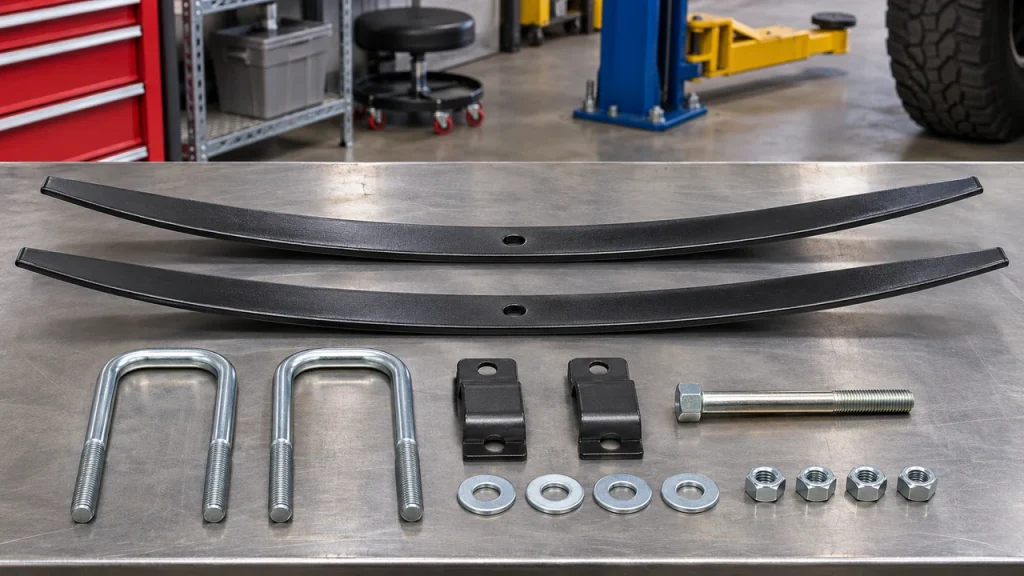
- Added leaves: usually one matched leaf for each side of a rear axle, unless the kit is a multi-leaf design.
- Center pins: the correct diameter, locating-head shape and enough usable length for the thicker assembled stack.
- Spring clamps or retaining clips: new pieces where the design calls for them, with the required clearances.
- Axle U-bolts and nuts: verify whether new, correctly sized fasteners are required and included.
- Wear pads or anti-friction inserts: include them if the manufacturer specifies them.
- Application instructions: a clear leaf order, orientation, torque specifications and final inspection procedure.
Do not treat this as a universal shopping checklist with universal sizes. An axle-under-spring layout, a spring-over-axle layout and a pack with factory overload hardware can need different fasteners and spacing.
Center Pin Length and Locating-Head Fit
The center pin holds the leaves in alignment during assembly and its head locates the pack relative to the axle seat. Adding another leaf can make the old bolt too short, but selecting a longer bolt by thread diameter alone is not enough. Head dimensions, shank fit and the final assembled stack height still have to match the application.
Our leaf spring center bolt guide covers the sizes and locating-head details. The add-a-leaf decision is simpler: if the kit does not supply a verified correct pin, obtain one before disassembling the pack.
Axle U-Bolts Are Not a Reusable Afterthought
U-bolts provide the clamp load that holds the axle and leaf pack together. A thicker pack can alter the required leg length, and some procedures prohibit reusing previously tightened hardware. Do not assume the original bolts are long enough just because their threads are still visible with the old pack.
BDS explicitly notes that U-bolts are not included in certain add-a-leaf packages, so check the specific kit. For fitment and clamp requirements, see our leaf spring U-bolts guide. An incorrectly clamped axle is a serious issue; the spring center pin is not a substitute for proper U-bolt clamping force.
Spring Clips and Contact Pads Are Small Parts With Real Jobs
Rebound clips keep the leaves properly grouped while allowing the movement intended by the design. They should not be crushed tight around every leaf unless the kit explicitly requires that arrangement. Worn or missing friction pads can increase squeaks and make adjacent steel surfaces wear faster.
Check whether the new leaf changes where the old clips fit. A spring shop can confirm the correct style and placement for the assembled pack if the supplied instructions do not cover an unusual factory arrangement.
How Difficult Is Add-a-Leaf Installation?
This is more involved than bolting a helper spring onto the outside of an intact pack. Before you add a leaf spring to a truck, understand that the traditional installation requires supporting the vehicle and axle, releasing the spring pack’s clamping hardware, controlling stored spring tension and rebuilding the stack in the prescribed order. That is a meaningful workshop job, even though the finished part looks simple.
For a vehicle-specific guide, the exact manufacturer instructions take priority. A normal professional workflow includes these checkpoints:
- Confirm the part and current pack condition before removing fasteners or committing to the modification.
- Secure the vehicle and support the axle and spring safely using the correct lifting and restraint procedure.
- Control the leaf pack with suitable clamping equipment before loosening the center pin or separating the leaves.
- Arrange the leaves exactly as specified, including the added leaf’s position, orientation, spacers and clamps.
- Use approved pins, U-bolts and tightening procedures to locate the pack correctly on the axle seat.
- Verify the finished ride height and suspension movement including shocks, brake lines, tire clearance and axle position.
Those are inspection points rather than an at-home step-by-step tutorial; the safe order and torque values vary by truck and kit. They also explain why the cheapest leaf on a catalog page is not necessarily the cheapest completed modification.
The Hazard Is Stored Spring Energy, Not Just Heavy Parts
A leaf pack can contain significant stored tension, particularly if one leaf is arched differently from its neighbors. Removing the center bolt without correctly restraining the stack can let the leaves separate suddenly. Axle and vehicle support must also remain independent when their attachment hardware is released.
If the spring is rusted, distorted or previously modified, a qualified suspension shop is the safer choice. Improvised clamps, makeshift fasteners and a universal online torque number are poor substitutes for the vehicle and kit instructions.
Final Checks Matter More Than the First Drive Around the Block
After assembly, the axle locating feature must seat properly and the required U-bolt clamp load must be achieved. The shop should inspect shackle movement, clearances at full compression and droop, brake-line routing, shock travel, wheel position and any new interference. The kit maker may specify a follow-up inspection or recheck after initial driving.
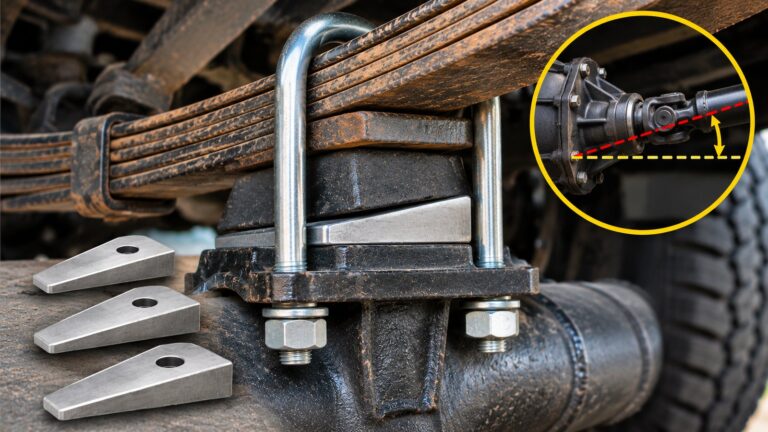
A rear ride-height change can also affect headlamp aim, driveline angle and axle alignment. Do not automatically install wedges or spacers to cure a suspected vibration; diagnose the actual geometry and follow an approved correction method. If you want a wider view of labor and related costs, our lift kit installation cost guide covers those extra expenses.
When New Leaf Springs Are a Better Buy
A budget add-a-leaf is tempting when the rear is low, but it relies on the structural health of the original pack. A replacement assembly costs more up front because it supplies a complete spring package. Sometimes that is exactly what the truck needs, and there is no value in carefully adding steel to springs that should be removed.
Cracks, Serious Corrosion and Damaged Eyes End the Discussion
A broken main leaf near the spring eye, deeply pitted steel near the center clamp or a pack with one displaced and fractured leaf is a repair problem. So are seriously damaged frame attachments. Raising the body above the axle does not make the failed material strong again. It can make the truck look improved while the hazard remains.
If the rear is uneven left to right, inspect the spring assemblies and mounting points individually. A bolt-on cosmetic fix cannot reliably restore symmetry when one pack has lost arch or has a broken part.
Permanent Heavy Equipment May Deserve a Purpose-Built Pack
A service truck carrying tools, a camper that stays installed or an overland vehicle fitted with substantial permanent accessories has a consistent new working weight. A replacement spring pack designed for that weight can provide more deliberate control over rate, arch and ride position than adding a generic extra leaf to the stock pack.
The same consideration applies when the truck needs a much larger lift than the specific add-a-leaf manufacturer offers. That is a suspension-system decision involving shocks and geometry as well as springs, not a reason to keep stacking individual leaves.
Do Not Use an Add-a-Leaf to Hide a Bad Bushing or Mount
A worn spring-eye bushing can let the axle shift under braking or acceleration, making the truck feel vague even if the springs are sound. A cracked hanger or damaged shackle can create a similar symptom. Adding spring rate will not correct the loose joint.
Inspection may reveal a perfectly serviceable spring pack with a smaller, separate problem. Fix the actual fault first; otherwise the truck could finish with a stiffer ride and the original clunk still there.
Other Rear Suspension Options—and Where They Differ
The alternatives are worth mentioning because they solve nearby problems, but they are not just three labels for the same product. Keep the original goal in view: more unloaded ride height, less loaded squat, or a more comfortable truck. Each goal leads to a different mechanical compromise.
Rear Lift Blocks Change Height Without Adding a Spring Leaf
A properly designed rear lift block on a compatible spring-over-axle truck changes the separation between the axle and spring pack. It does not directly change the spring pack’s rate. That may be attractive when height is the main concern, but a block does not rehabilitate weak springs, and increased axle-to-spring leverage can affect axle wrap and driveline behavior.
Block placement and restrictions are application-specific; stacking blocks or assuming a rear block is appropriate on a front axle is not safe. Our rear lift blocks guide covers sizes, net lift height, fitment and axle-wrap risks in detail.
Adjustable Air Bags or Bolt-On Helpers Target Load Support
If the truck tows a trailer twice a month and runs empty the rest of the time, adjustable air helper springs may suit that variable load better than a permanent increase in leaf-pack stiffness. Separate mechanical helpers can also be designed to engage more progressively under load. Neither should be mistaken for the leaf that gets installed inside the pack.
We already compare those choices in our airbags vs helper springs guide. This page stays focused on selecting an integrated add-a-leaf, not choosing every type of load-leveling system.
Longer Shackles Move a Mounting Point Rather Than Rebuild the Pack
A longer shackle can change ride height on some leaf-sprung layouts by altering the position of a spring eye. It does not add spring support in the same way an extra leaf does, and it can change shackle angle or other geometry. The right decision depends on the suspension design, not which part happens to be cheaper.
Our leaf spring shackles guide covers the mounting link itself. Avoid combining multiple height-changing parts without checking that the full setup has been engineered to work together.
Questions Worth Answering Before You Order
These are the details that still cause confusion after a buyer has chosen a leaf length and found a listing that names the right truck.
Does Adding a Leaf Increase Payload or Towing Capacity?
No. It can make a properly loaded truck sag less, but official payload, GVWR, GAWR, tire ratings and manufacturer towing limits do not increase. A trailer that exceeds the truck’s legal or mechanical rating remains unsuitable even if the new springs keep the tailgate level.
Check the door-jamb certification label, owner’s manual and applicable trailer and hitch ratings. Spring support affects how the truck behaves with weight; it does not authorize more weight.
Do I Need Longer Rear Shocks?
Not automatically. A small approved lift may retain the stock shocks, while another setup may require different lengths or mounts. The relevant check is whether the damper allows the full intended suspension motion without topping out or bottoming out. Lift height on its own is not a complete shock-length specification.
Also check the brake hoses, ABS wiring, sway bar links and any other parts that move as the axle droops. A lift kit that installs without contact at ride height can still have a problem when a wheel hangs in a deep rut.
Can I Put an Add-a-Leaf on Only One Side to Fix a Lean?
Normally, a kit intended for a rear axle is fitted as a matched pair. Adding extra rate to one side just to mask a lean can create asymmetric behavior and conceal a worn spring, bent mount or uneven cargo distribution. Diagnose the lean before buying a pair of new leaves or installing only one.
Some specialized leveling repairs have their own approved procedures, but those are not permission to split an ordinary two-side add-a-leaf kit.
Can It Be Combined With an Existing Rear Lift?
Sometimes, yes, but the combination has to be approved for the vehicle. An add-a-leaf used with factory blocks, aftermarket rear blocks, altered shackles or replacement springs can produce a different height and travel range from the kit’s standalone description. A manufacturer’s “fits stock suspension” claim does not establish compatibility with everything already installed.
List the current parts before calling the supplier. Include the front lift height, rear blocks or shackles, current spring pack and shocks. That is much more informative than saying only that the truck has a two-inch lift.
Will It Help If My Truck Sags When Towing?
It may reduce rear squat when tongue weight is applied, provided the vehicle and trailer remain within their ratings and the suspension is otherwise sound. But an add-a-leaf cannot correct excessive tongue weight, poor cargo distribution, a wrong hitch setup or a trailer that is too heavy for the truck. Those problems require different decisions.
For occasional towing with frequent empty driving, consider the comfort penalty before choosing a permanently stiffer leaf pack. A setup that feels reassuring with the trailer attached may feel unnecessarily hard for the other 300 days of the year.
Before Buying, Inspect the Springs You Already Own
The best add-a-leaf purchase starts under the truck, not in a shopping cart. Confirm sound spring leaves, check the mounts and bushings, record the normal loaded and unloaded stance, then decide how much additional height or support you actually need. With that information, the kit’s leaf design, published fitment, center pins, U-bolts and travel requirements become concrete things to verify rather than hopeful guesses.
If you have a healthy factory pack and want a modest lift with a firmer rear, a properly matched add-a-leaf can be a practical solution. If you want a soft unloaded ride, need a substantial engineered lift or are dealing with damaged springs, buying the cheapest extra leaf is unlikely to be the best answer. Choose the repair or upgrade that suits the truck’s real working weight and intended suspension movement.