Rear Lift Blocks: Sizes, Fitment & Safety Guide
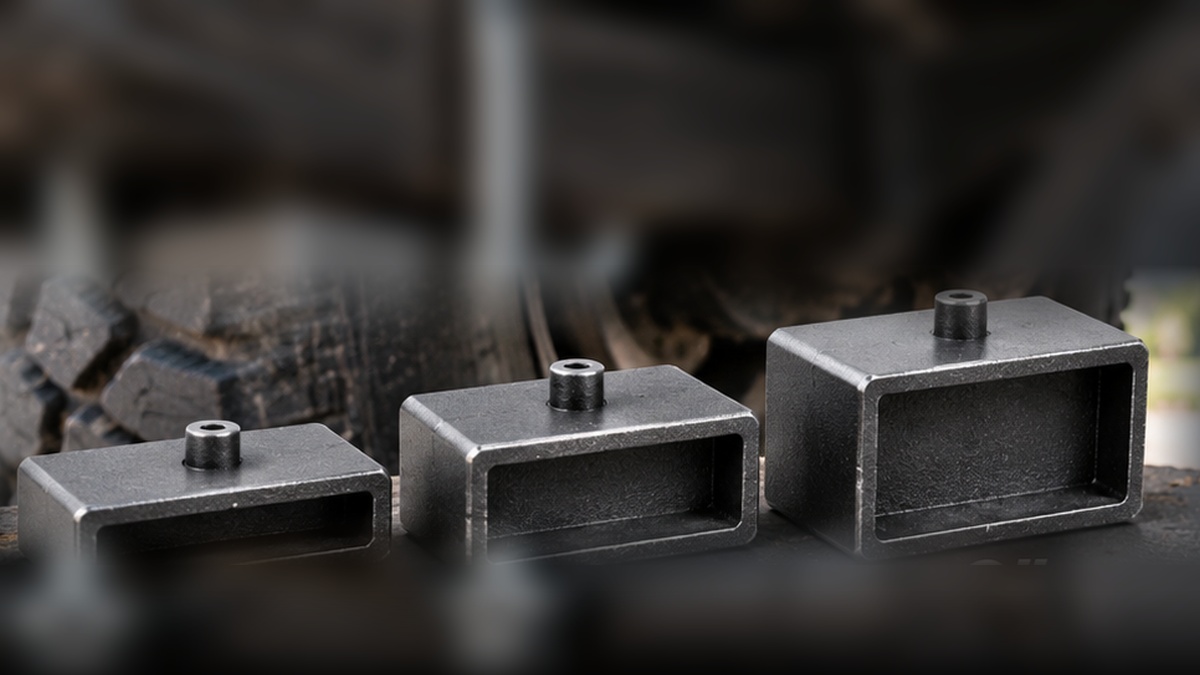
Rear lift blocks raise the back of a leaf-sprung truck by spacing the rear axle and spring pack farther apart. For a mild change in stance, a vehicle-specific replacement block kit can be a straightforward solution. But choose it by actual added rear height, spring and axle fitment, and the complete mounting hardware—not just by the number printed on the block.
The catch is easy to miss: a 3-inch block replacing a factory 1-inch block adds about 2 inches, not 3. Blocks also leave the spring rate and vehicle load ratings unchanged. If your truck squats badly with a trailer or has worn-out springs, a taller spacer may change how it looks without fixing why it sits low. And the taller the block, the more attention axle wrap, driveline angle, and the axle-to-spring clamp deserve.
Which Rear Lift Blocks Should You Buy?
Start with what you want to change. These are sensible shopping directions for a conventional rear leaf-spring/solid-axle pickup—not a universal safe-height chart or a substitute for the kit manufacturer’s application notes.
| Your situation | Best starting point | Important catch |
|---|---|---|
| Need roughly 1 inch more rear height | Truck-specific low-profile replacement block kit | Subtract any factory block height from the new block height |
| Want about 2 inches more rear height | Approved 2-inch net-lift kit, often a taller replacement block | A “3-inch block” may provide only 2 inches if it replaces a 1-inch OEM block |
| Looking at 3 inches or more | Complete rear-lift system engineered for the specific truck | Greater leverage, droop and driveline checks become more important |
| Rear sags under cargo or tongue weight | Diagnose springs and loading before choosing blocks | Blocks do not increase spring support or legal load capacity |
| Truck has rear coils, independent suspension or a composite mono-leaf | Use a design-specific solution approved for that suspension | A generic steel-leaf block kit may not fit at all |
If you take away only one rule, make it this: buy the kit that produces the intended net change on your exact truck. A box labeled “2-inch rear lift blocks” is not proof of two inches of added height.
What a Rear Lift Block Actually Does
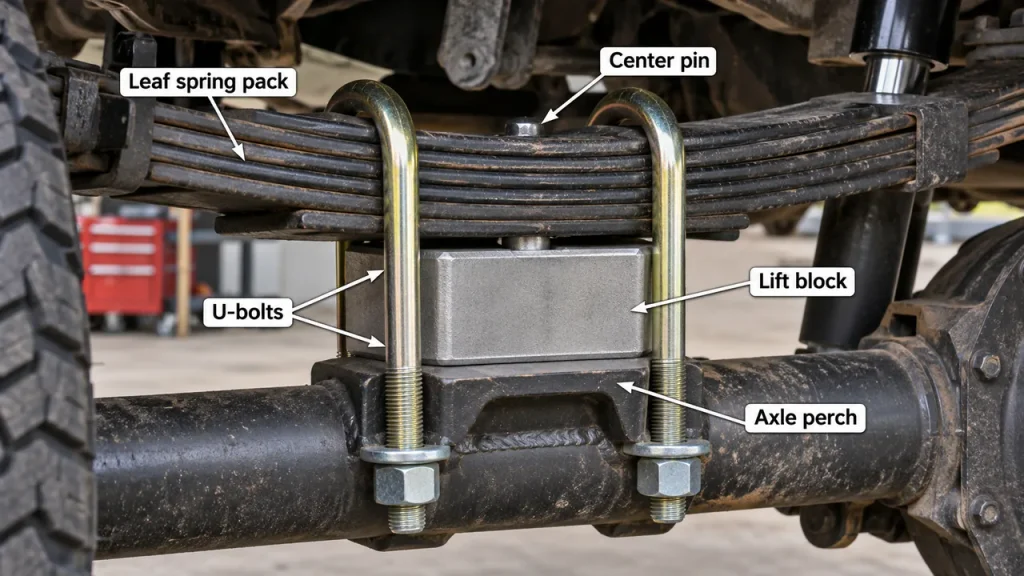
On a common spring-over-axle pickup, the rear leaf pack rests above the axle seat. The lift block fits between the pack and that seat. Its locating features keep the parts aligned, while correctly sized U-bolts clamp the whole assembly together. Raising the spring relative to the axle raises the truck’s frame and body at the rear.
It does not make the differential housing farther from the ground. Tire radius still controls clearance under the axle’s lowest point. Nor does the spacer itself add spring rate, carrying capacity, suspension travel, or a more comfortable ride. It changes where the chassis sits relative to the axle; everything else has to be checked around that new position.
Factory Rake, Leveling and the Wrong Reason to Lift the Rear
Most pickups leave the factory higher at the rear when empty. That nose-down stance, called rake, leaves room for the back to settle under a permitted load. A front leveling kit can remove some of it; a small rear block change can bring some back. Neither approach should be judged from an unloaded side-view photograph alone.
Measure front and rear hub-center-to-fender heights on level ground at your normal load, then decide what rake you actually want. If you are still comparing the overall stance rather than choosing a specific rear component, our leveling kit vs. lift kit guide covers that bigger decision.
1-, 2-, 3- and 4-Inch Rear Lift Blocks: What the Sizes Mean
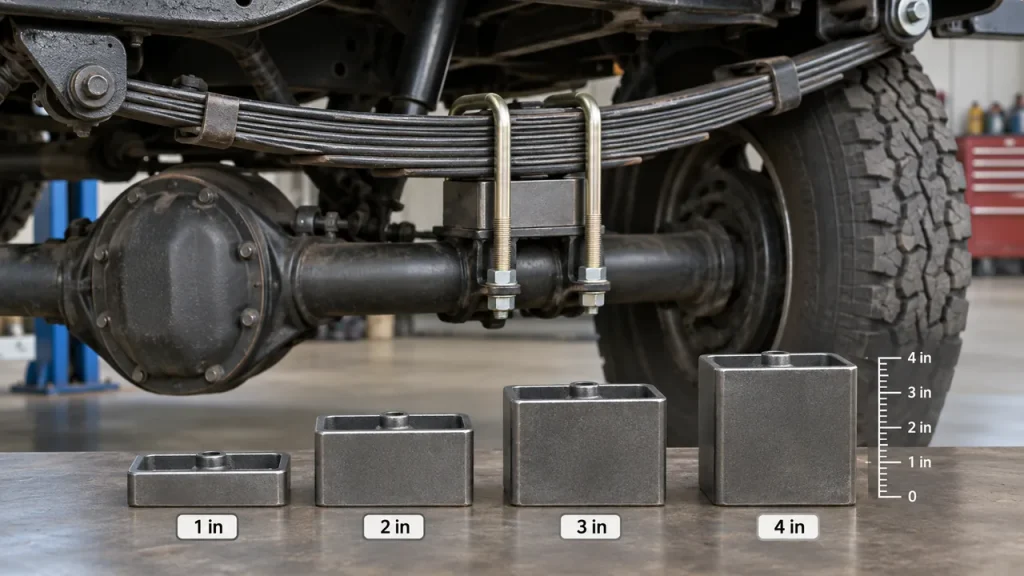
US catalogs commonly show 1-, 1.5-, 2-, 2.5-, 3-, 4- and even 5-inch blocks. The size range is real; the implication that every height suits every truck is not. A taller listed part may be an OEM-style replacement, a component of a full suspension kit, or a block designed around a particular factory axle seat.
One to Two Inches: The Mild-Lift Territory
For a truck that needs only a little more rear height, an appropriately designed low-profile replacement is usually the simplest category to investigate. Less added separation between spring and axle means less of the extra torque leverage associated with very tall blocks. You still need the correct locating pin, full clamping hardware, and usable shock travel.
A “2-inch block kit” can describe block height or advertised net rear lift. Those are not interchangeable terms. Read both the actual block dimensions and the fitment note before comparing prices.
Three-Inch Blocks: Often a Two-Inch Lift in Practice
Consider a truck with a 1-inch factory block. Replacing it with one measuring 3 inches generally changes the spring-to-axle separation by 2 inches. In a conventional arrangement, that works out to approximately 2 inches of additional rear ride height, assuming the rest of the suspension and load are unchanged.
This is not hypothetical marketing math. ReadyLIFT lists a 3-inch rear block kit for a specific 2025 GM 1500 application that replaces a factory block and produces 2 inches of added rear lift. The same product also carries a rear mono-leaf compatibility exclusion. Both details matter more than the product name.
Four- and Five-Inch Blocks: Do Not Shop by Height Alone
Tall blocks appear in retail catalogs, sometimes as part of matched lift systems. Availability does not make a universal 4- or 5-inch spacer a sensible stand-alone choice. More separation creates greater leverage through the clamped joint during acceleration and braking, and it can expose shock, brake-hose and driveline limitations that were invisible at stock height.
If your target is a substantial rear lift, compare the complete engineered setup, not just the least expensive pair of blocks. A rear lift that looks right in the driveway but hops under throttle or pulls a shock to full extension is not finished.
How to Calculate the Extra Rear Height Before Ordering
The useful number is the change in effective spacer height at the same axle and spring interface. This simple comparison applies only when the manufacturer approves replacing the existing block with the new one in an otherwise compatible arrangement.
Approximate added rear lift = new effective block height − existing effective block height.
For example, replacing a 1.25-inch factory block with a 2.25-inch approved block generally adds about 1 inch. Replacing a 2-inch block with a 3-inch block likewise adds about 1 inch. A truck without a factory spacer may have a different starting arrangement, and a tapered block can have different front and rear heights. Use the manufacturer’s stated net-lift figure whenever one is supplied.
Before and after the modification, measure from the wheel hub center to the same point on the fender with the truck on level ground and carrying the same load. That removes tire-size changes from most of the comparison. Allow for real-world variation in spring condition and how the vehicle settles; it is not a precision ride-height guarantee.
Rear Lift Block Fitment: Check These Details, Not Just the Truck Model
“Fits F-150” or “universal truck lift blocks” is far too broad. Production changes, two- versus four-wheel drive, axle rating, factory ride-height packages and previous modifications can change what sits between the spring and axle. Use this checklist before placing an order.
- Vehicle configuration: year, make, model, drivetrain, axle/spring package and any existing lift.
- Rear spring design: conventional steel multi-leaf, steel mono-leaf, composite mono-leaf, coil spring or another layout.
- Spring and axle arrangement: identify the actual axle perch and whether the kit is intended for that spring-over-axle configuration.
- Existing spacer: measure its height and determine whether the new kit replaces it.
- Block footprint: confirm spring width, block bearing surfaces, axle-seat shape and any anti-rotation feature.
- Center location: verify the block’s locating pin and mating hole dimensions, shape and placement.
- Clamp hardware: confirm the complete, approved U-bolt kit for the new stack height and axle geometry.
- Travel and clearances: check shocks, bump stops, brake hoses, ABS wiring, parking-brake routing and driveshaft at the new ride height.
A fitment listing should answer these questions or point to an installation drawing that does. If it cannot, do not fill the gaps with a similar-looking part from another truck generation.
Steel Leaf Packs Are Not the Same as Composite Mono-Leaf Springs
This is one of the most consequential catalog exclusions on newer pickups. Certain GM 1500 configurations use a composite rear mono-leaf, and some aftermarket kits designed for traditional steel leaves explicitly exclude it. Even the shape of the U-bolt arrangement may differ. Do not assume “Silverado 1500” alone identifies the suspension.
Inspect what is actually fitted and use the manufacturer’s compatible part number. A product advertised for one model year or six-lug configuration does not automatically transfer to a different body style, axle package or mono-leaf design.
Block Width, Locating Pin and Hole Size Have to Agree
A block may be the right height but still wrong for the axle seat. Manufacturers specify details such as 2.5-inch block width, locating-pin diameter, receiving-hole diameter and wedge angle on individual products. That data is not decoration: the block must sit squarely, support the intended contact area and positively locate the axle and spring without rocking.
Do not grind a locating pin, enlarge an unknown perch hole or use an improvised shim to make a mismatched block appear to fit. If the original locating head is worn or broken, the problem is deeper than block selection. Our leaf spring center bolt guide explains why the locating feature and the axle clamp must be inspected together.
Flat vs. Tapered Rear Lift Blocks: When Pinion Angle Matters
Flat blocks maintain their designed top-to-bottom face relationship. Tapered or angled blocks incorporate a wedge so the axle seat and spring do not remain parallel in quite the same way. That can alter the rear differential’s pinion angle relative to the driveshaft. It is a driveline decision, not a cosmetic feature. If you need angular correction rather than additional lift height, our pinion angle shims guide explains how to determine the required degrees and check compatibility.
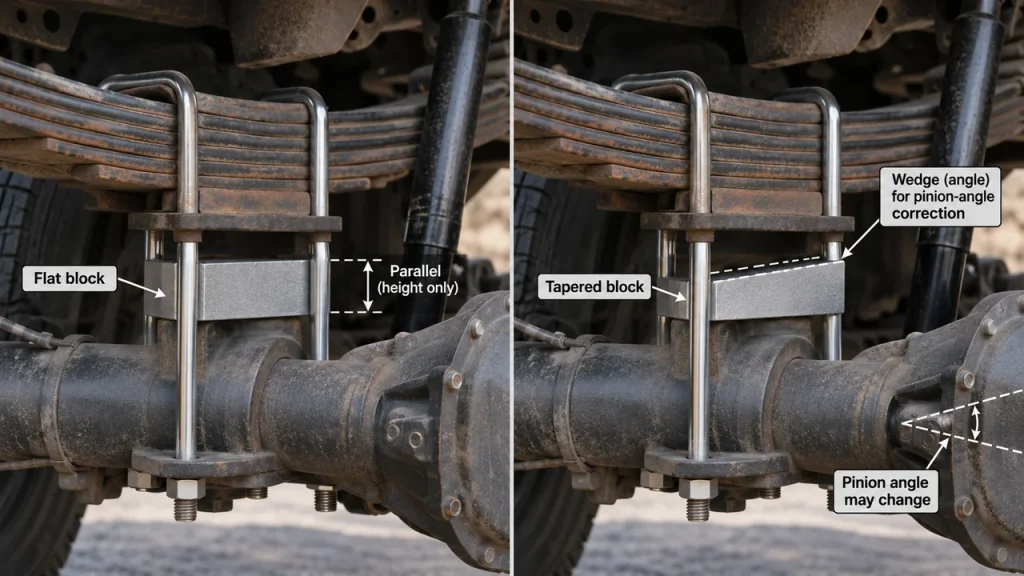
A Taper Is Not Automatically Better
A truck may have a factory driveline angle that works well with a flat block, or a lift design that calls for a particular taper. Other setups need a carefully specified change after ride height and load are considered. Adding a random 3-degree or 5-degree wedge because it seems more “off-road” can introduce vibrations rather than remove them.
Pinion-angle requirements also depend on driveshaft and joint arrangement. A conventional single-cardan shaft and a double-cardan/CV-style shaft may have different intended operating relationships. The correct target comes from the truck’s driveline design and the lift manufacturer’s instructions, ideally verified under normal operating load.
Which Way Does the Tall End Face? Read the Exact Kit Instructions
There is no reliable universal “thick side always forward” rule. Different lift systems specify orientation for their geometry, and an apparently similar tapered block can be wrong when reversed. The supplied diagram must identify front, rear, axle and spring contact surfaces.
If you are fighting a new acceleration vibration or takeoff shudder after a lift, investigate actual pinion and driveshaft operating angles, U-joints and axle location instead of stacking extra wedges beneath the existing hardware.
Cast Iron, Steel or Aluminum: Which Block Material Makes Sense?
Material matters, but the label alone cannot prove a part is suitable. Established truck kits use cast-iron blocks, engineered steel constructions and, in some applications, properly designed aluminum components. The important question is whether that specific product is approved for the vehicle, axle, height and intended loads.
Cast-Iron OEM-Style Blocks
Cast iron is common in model-specific rear block kits because a solid shape can incorporate locating features and anti-rotation ears. That does not mean every casting is equal. The block still needs sound geometry, clean contact surfaces and the hardware specified for that exact design.
Fabricated Steel and Aluminum Blocks
A properly engineered steel block may be appropriate for its listed application; an anonymous piece of welded box section with uncertain locating features is a different proposition. The same applies to aluminum. Light weight can be attractive, but not at the expense of bearing area, resistance to deformation or manufacturer approval.
Avoid choosing a taller block simply because its material sounds stronger. Increased height also changes the forces and geometry around the axle, none of which can be solved by a premium-sounding alloy name.
Are Rear Lift Blocks Safe? Axle Wrap, Wheel Hop and Stacking
A properly matched rear block kit can be part of a safe, roadworthy truck suspension. The risk comes from treating a clamped, torque-loaded axle joint as if it were an ordinary body spacer. Tall or incorrectly located blocks can amplify problems that a short OEM-style arrangement manages more easily.
Why Taller Blocks Can Increase Axle Wrap
When the rear wheels deliver torque, the axle housing reacts by trying to rotate against the leaf springs. A taller block increases the distance between the axle and spring, giving that reaction more leverage through the assembly. On a susceptible truck, the spring can wind up and release, producing axle wrap and sometimes wheel hop.
The result depends on torque, tire grip, spring design, block height, axle position and whether the truck has appropriately engineered traction control hardware. Not every truck with a small rear block will hop. But repeated hopping, a sharp clunk on throttle changes or visible movement at the axle seat should never be dismissed as normal lifted-truck behavior.
Traction Bars Are Not a Substitute for Correct Block Fitment
A properly designed traction bar system can help control housing rotation while allowing the rear suspension to move through its intended arc. That may be worth evaluating on a high-torque diesel or other truck that already shows axle wrap. It does not make a cracked block, poorly seated locating pin or loose U-bolts acceptable.
Also keep a traction bar distinct from a lateral track bar. They do different jobs. If you are considering additional axle-control hardware, assess its mounting points and motion with the full suspension rather than bolting on a part that binds as the axle articulates.
Do Not Stack Rear Lift Blocks
Do not put one aftermarket block on top of another to make up a missing inch. A stack introduces extra interfaces and more opportunities for movement and locating-pin failure. Major manufacturers market taller replacement blocks specifically to avoid stacking factory and aftermarket spacers.
There may be application-specific factory designs or engineered systems that look different from a simple one-piece block; follow the manufacturer rather than generalizing from a photograph. For an ordinary aftermarket rear lift, the correct answer is a single approved configuration, not a homemade tower.
Can Rear Lift Blocks Help With Towing or a Sagging Truck?
They can restore a more useful unloaded stance after a front lift or raise the rear body position before cargo is added. That is different from giving the springs more ability to resist compression. Under the same tongue weight, the same healthy leaf pack will still deflect by broadly the same amount unless some other suspension component or geometry has changed.
A rear block does not increase GVWR, GAWR, payload rating, tire capacity, hitch rating or the manufacturer’s towing limit. It also cannot repair a cracked or fatigued spring. A truck that appears level after adding blocks can still exceed an axle or tire rating when loaded.
If your real concern is squat, changing cargo loads or keeping the truck stable with a trailer, compare load-support solutions instead. Our airbags vs. helper springs comparison explains what those systems can—and cannot—change within the vehicle’s rated limits.
What Should Be Included in a Rear Lift Block Kit?
Some listings sell a pair of blocks only. Others include the axle clamps, nuts and washers needed for the application. Do not assume the photograph shows everything you are buying, especially when a low price is attached to the word “universal.”
For a typical two-sided solid rear axle installation, a complete kit may include two matched blocks, four new U-bolts, specified nuts and washers, plus any required vehicle-specific pieces. The approved count and design can differ with the axle and kit. Check for a clear part number, application table, installation instructions and manufacturer support.
Old U-bolts should not simply be reused to accommodate a thicker block. Their bend, width, length, threads and clamp method must suit the finished stack, and there is no universal torque number for all trucks. For measuring and torque considerations, use our separate leaf spring U-bolts guide. This page is about choosing the block assembly, not substituting an online torque chart for the correct service procedure.
Before Installation: Check the Rest of the Rear Suspension
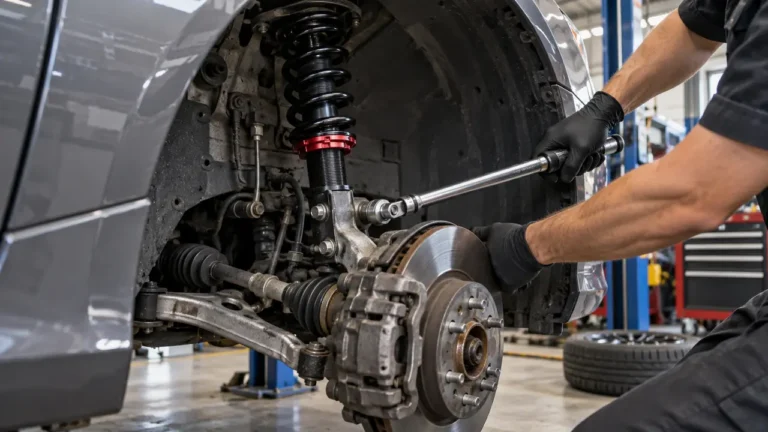
A block kit may be mechanically simple, but the work temporarily separates an axle-location joint that carries real road and driveline loads. The frame and axle must be supported independently with suitable rated equipment, and the installer’s procedure must follow the exact vehicle and kit instructions. Never work beneath a truck supported only by a hydraulic jack.
Before approving the modification or driving afterward, these checks matter as much as the blocks themselves:
- Inspect the spring pack and axle seat. Stop for broken leaves, corrosion damage, shifted center pins, worn locating holes or a bent saddle.
- Confirm the block orientation and engagement. Both sides must sit fully flat with their designed locating features seated; a tapered block must face the direction the manufacturer specifies.
- Use the specified new axle-clamp hardware. Tighten by the vehicle/kit procedure and complete the instructed follow-up inspections or retorque.
- Check the full suspension travel. Shocks must not become limiting straps or bump stops; inspect brake hoses, ABS wiring, parking-brake cables and moving clearances.
- Verify driveline and road behavior. Look for vibrations, wheel hop, changing axle position, tire interference, headlamp aim and any required alignment or driver-assistance-system checks.
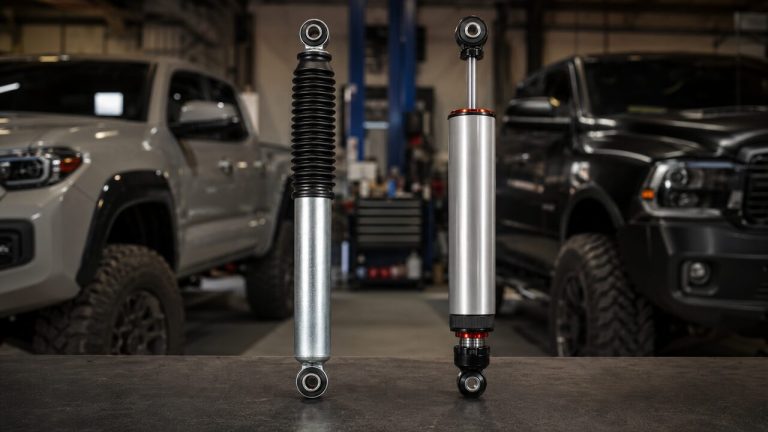
Some vehicles need lift-compatible shocks or approved shock extensions; others retain the original dampers. It depends on the actual compressed and extended travel, not a shortcut such as “rear blocks always need longer shocks.” Our lifted-truck shock fitment guide covers that separate selection.
Ford, Chevy/GMC, Toyota: Why Universal Fitment Is Misleading
The same search for “lift blocks for trucks” can bring back listings for an F-150, F-250 Super Duty, Silverado 1500, Silverado 2500HD, Tacoma or Tundra. Those vehicles do not share one rear axle, spring seat, center-pin size or factory block height. Even within a model family, a redesign can change the rear spring construction.
F-150 and Super Duty Pickups
Check the precise year and rear suspension package first. A block/U-bolt kit marketed for an older F-150 cannot be treated as an F-250 or later-generation fitment merely because both have rear leaf springs. The Super Duty spring and axle hardware can be substantially different, and a heavy-duty badge is not permission to improvise taller spacers.
Silverado and Sierra 1500/HD Models
This is where the factory-block subtraction and composite mono-leaf exclusions become particularly important. A catalog may use nearly identical product names for two model generations but specify different net lift, factory block removal or leaf-spring compatibility. Confirm the truck’s current suspension visually and match the kit part number, not just “Chevy/GMC 1500.”
Tacoma, Tundra and Other Leaf-Sprung Trucks
Look beyond an all-purpose “Toyota truck” fitment tag. Spring width, axle perch, center pin, rear shock travel and the vehicle’s existing modifications determine whether a generic block is appropriate. If you cannot find a correct engineered application, a vehicle-specific rear lift package or spring solution is preferable to forcing universal pieces into place.
Rear Lift Blocks vs. Add-a-Leaf Kits and Other Options
Both can raise the rear, but they solve different problems. A block spaces the spring and axle apart without intentionally changing the spring pack’s stiffness. An added leaf changes how the pack supports weight and often makes the unloaded ride firmer. Longer shackles alter spring-end geometry, while replacement leaf packs can be built around a more substantial target height and working load.
For a sound, normally loaded truck that only needs modest extra rear height, a properly fitted replacement block may be the least disruptive choice. If the springs have sagged, the truck regularly carries a near-constant permitted load, or the rear needs a larger engineered change, compare spring-based solutions. Our add-a-leaf kit guide examines the lift-height and ride-quality tradeoffs without conflating spring support with spacer height.
Trying to fix a soft or broken spring with a taller block is usually choosing a neat-looking answer to the wrong problem. Get the original suspension healthy first; only then decide where you want the truck to sit.
Rear Lift Block Questions Worth Answering Before You Buy
These are the situations in which a product listing often leaves too much unsaid. The answers assume a conventional rear leaf-sprung pickup and still depend on the manufacturer’s exact application.
Are 2-inch rear lift blocks safe for daily driving?
They can be when an approved kit fits the truck, uses correct new mounting hardware and passes the suspension and driveline checks. Two inches is not an automatic safety certification. A nominal 2-inch block could also replace an existing block and provide less than 2 inches of added height.
Do 3-inch rear lift blocks actually lift the truck 3 inches?
Not always. If you remove a factory 1-inch block and replace it with a 3-inch block, the added rear lift is generally about 2 inches. Product descriptions should distinguish physical block height from net lift for the exact vehicle.
Can I put lift blocks on the front axle?
Do not install ordinary rear lift blocks on a front steering axle. Front-axle suspension and steering loads introduce different risks, and a rear spacer is not a universal front suspension solution. Use only a properly engineered, expressly approved front-lift method for that vehicle.
Will rear lift blocks make the ride stiffer?
Not by increasing spring rate: the block does not add another leaf or change the original spring steel. But the whole truck can feel different because ride height, shock position, center of gravity, driveline angles and axle behavior may change. A harsher or more unsettled ride after installation deserves inspection rather than an assumption that all blocks ride rough.
Will I need longer rear shocks?
Possibly. Some mild vehicle-specific kits retain stock shocks, while others specify longer dampers or extensions. Check full compression and extension, mounting geometry and the lift maker’s requirements. Do not determine shock length by adding the block’s advertised inches to the original shock length.
Can rear lift blocks fix a low rear end when towing?
They raise the starting position but do not increase spring support, payload or tow capacity. If the rear settles too far with a permitted load, diagnose actual axle weights, tongue weight, springs and compatible support systems. Correcting the stance without correcting the load problem can hide a dangerous setup.
The Rear Lift Block Setup That Makes Sense
For most owners considering a mild rear lift, the best purchase is not the tallest block or the one advertised for the most truck brands. It is one vehicle-specific replacement setup that delivers the net height you need, seats securely on your axle and spring, includes the correct new clamping hardware and preserves workable shock, brake-line and driveline geometry.
Measure what is already under the truck, identify the spring material and factory spacer, and read the exclusions before ordering. If the spring pack is damaged, the rear needs real load support, or the build calls for a large lift, stop shopping for a taller spacer and choose a suspension solution designed around the actual problem. That is how a small change in stance stays a controlled modification instead of becoming a rear-axle headache.