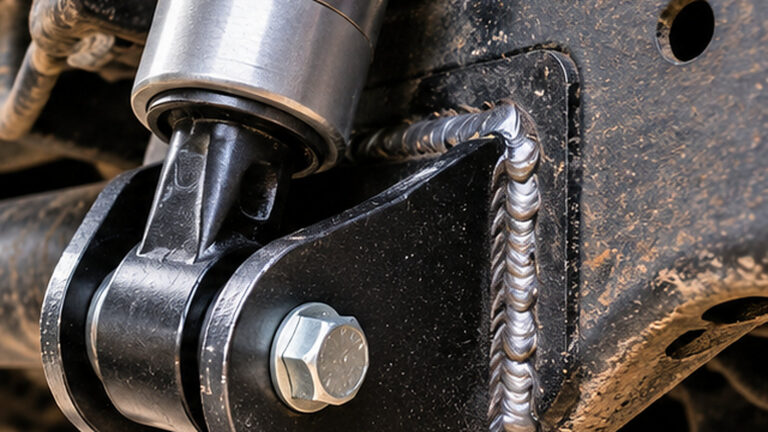
Nissan Frontier Lift Kit: Heights, Tires & Fitment by Year
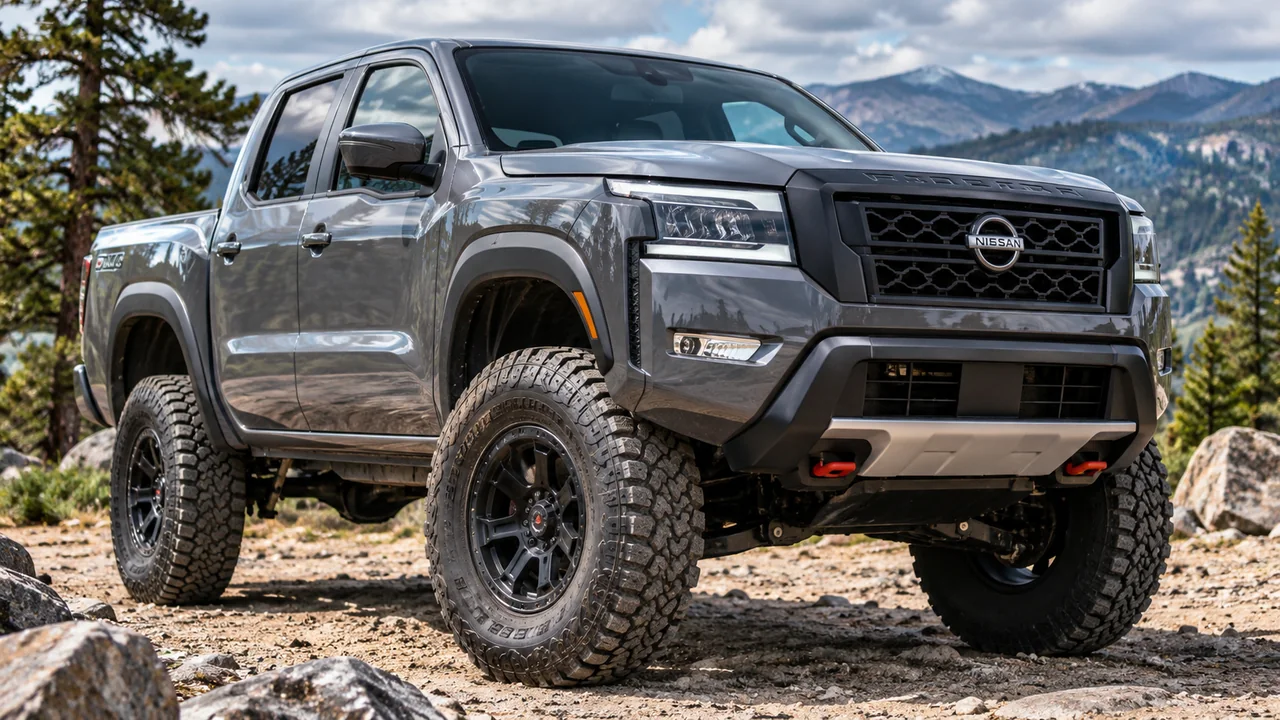
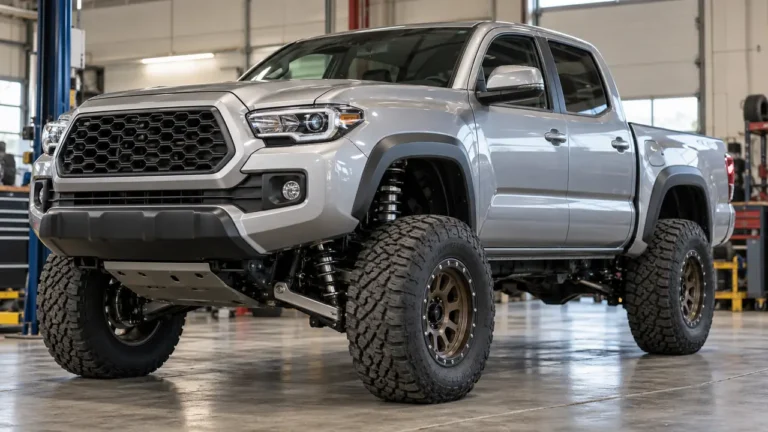
For most 2005-and-newer trucks, the best Nissan Frontier lift kit is a 1.5–2-inch level for everyday use or a matched 2–3-inch suspension system for trail driving. Start with a smaller, trim-approved kit if you own a PRO-4X and want to keep its factory Bilstein dampers. A six-inch lift is a much bigger project, and a Titan swap is a different kind of modification altogether. If your Frontier is a 2000 or 2004 model, none of those modern recommendations is a useful starting point: the early truck uses torsion bars.
There is one issue worth settling before you order any tall spacer for a modern Frontier: will the upper control arm hit the coil bucket when the suspension extends? That question, along with alignment range and the wheel position, can matter more than the number of inches in the product name. Here is how to narrow down the choices for U.S.-market trucks.
Choose the Frontier Lift by What You Want the Truck to Do
The table separates the three U.S. generations and the most common build goals. Heights describe the approximate additional lift relative to the applicable factory suspension, not a guarantee of final fender height or tire fitment. A heavily loaded truck, a worn spring or a factory off-road package can change the result.
| Truck and intended use | Lift worth comparing | Main buying check |
|---|---|---|
| 1998–2004 D22, mild daily-driver upgrade | Small torsion-bar height correction or D22-specific suspension package | Engine, 2WD/4WD and existing front travel |
| 2005–2021 D40, street and occasional trails | 1.5–2-inch front level or mild spring-and-shock package | Coil bucket clearance, alignment hardware and wheel position |
| 2022–2026 D41, standard S/SV/SL | Approximately 1.5–2.5 inches, if approved for the trim | Drive type, spring load and tested wheel/tire combination |
| PRO-4X, retain original dampers | Trim-approved mild leveling system | Control-arm clearance and remaining shock travel |
| D40/D41, frequent rough-road use | Matched 2–3-inch system with appropriate arms and rear springs | Usable compression and droop, permanent accessory weight |
| D40/D41, tall street or show build | Application-specific six-inch crossmember system | New wheels, steering clearance, cutting and exact trim approval |
| D40/D41, wider long-travel-style build | Engineered Titan swap package | Track width, CV shafts, steering links and damper travel |
A truck that only needs to sit less nose-down does not need to be built like a dedicated off-road vehicle. Conversely, if the front bumper carries a winch and the bed carries a camper, a spacer chosen for its unloaded appearance may leave you with the same overloaded springs and tired damping you started with.
Should you level it or lift both ends?
Measure from the center of each wheel to the fender directly above it on level ground. Note the difference between front and rear with the truck empty and, if practical, with its usual cargo. A front-only lift removes some of the rake Nissan provides for carrying weight. It is not always desirable to remove all of it. For the general differences in hardware and handling, see our leveling kit versus lift kit comparison.
1998–2004 Nissan Frontier: Start With the Torsion Bars
The D22 is the compact Frontier that preceded the midsize redesign. Its independent front suspension uses longitudinal torsion bars and separate shocks, including the ordinary four-cylinder 2WD configuration. At the back is a leaf-sprung axle. A coilover spacer advertised for a 2005 Frontier therefore has no business in a 2000 Frontier shopping cart.
2000 Frontier 2WD: four-cylinder or V6?
Early 2WD trucks came in different chassis and engine configurations. The KA24DE 2.4-liter four-cylinder and the VG-series V6 are particularly relevant when looking for older suspension parts. Older catalogs have listed separate three-inch 2WD systems by engine. Treat those listings as a fitment clue, not as proof of current availability or that a particular used kit contains all the correct hardware. Ask the seller for an exact application and a complete parts inventory before buying.
On a truck of this age, start by inspecting the original torsion bars, anchors, adjusters and control-arm joints. Check steering play as well. A higher front end may disguise sag at first glance without fixing its cause. A small ride-height adjustment within the factory service limits is a different job from installing a complete suspension lift.
2001–2004 4WD and the raised 2WD models
The appearance of a raised 2WD truck is not a reliable guide to its suspension hardware. Compare the actual chassis, engine and drive type, and make sure the kit covers the specific model year. The front differential and CV axles on 4WD trucks introduce limits absent from a rear-wheel-drive truck. A 4WD kit must address those components rather than merely copy a 2WD height change.
Three-inch D22 systems may use revised upper arms, torsion-bar hardware and rear spring components. What matters is whether the installed system leaves enough alignment adjustment and suspension movement. Increasing front height by winding the adjusters toward their limit can leave little extension travel. Our torsion bar ride-height adjustment guide explains the relationship between static height, droop and alignment; use the Nissan service limits for the actual adjustment.
Buying a discontinued or incomplete D22 kit
The age of the platform changes the buying decision. A used package without the matching brackets or instructions may not be a bargain, especially when replacement parts cannot be ordered individually. Inspect frame attachment points for damage and corrosion, and establish whether the steering and brake components are serviceable. Do not improvise a structural bracket to make an incomplete lift fit. A smaller upgrade using supported components is often the more sensible choice for an old work truck.
2005–2021 D40: The Lift Most Frontier Owners Are Shopping For
The 2005 redesign replaced the torsion-bar arrangement with a coil spring around the front damper. The rear stayed leaf-sprung. D40 kits are widely available, and several products also cover the related Xterra. Shared chassis parts do not mean a complete Xterra rear suspension kit fits the Frontier pickup; the rear axle and spring arrangement still have to match.
S, SV and ordinary 2WD or 4WD trucks
A modest spring or spacer package can be enough for a truck that sees pavement most of the week. Many buyers aim for the 31–33-inch tire class rather than a dramatic increase in body height. A specific example is the Rough Country 865-series 2.5-inch front leveling kit, whose application covers 2005–2026 Frontier models but excludes PRO-4X and Desert Runner. The exclusions are just as useful as the long year range. A 2019 Frontier owner should read both before deciding that the product is compatible.
Do not judge a replacement front assembly by the advertised lift alone. A spacer can keep a perfectly healthy original damper in service, whereas a complete spring-and-damper setup may make more sense if the original shocks are worn. For washboard roads, a properly matched damper and spring can improve the way the truck deals with successive bumps without the truck needing to be particularly tall.
NISMO Off-Road, PRO-4X and Desert Runner
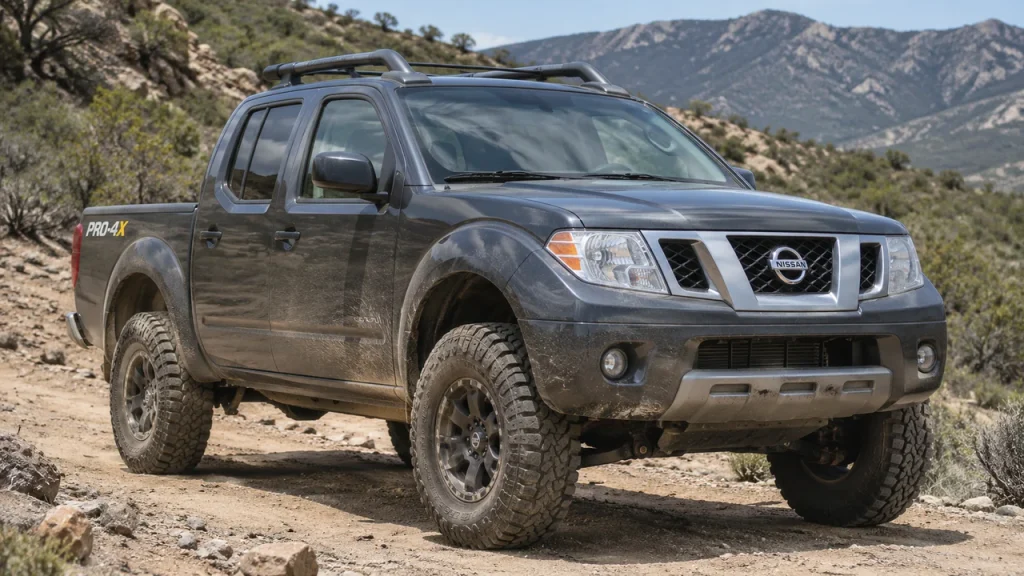
The second-generation NISMO and later PRO-4X packages are not merely different badges on the same shopping list. Check the original suspension and the kit maker’s exclusions. The Desert Runner is another configuration worth identifying explicitly. Do not assume a kit that fits a standard 2WD truck also covers its factory off-road suspension. If retaining the original Bilstein shocks is important, establish whether a kit is designed to work within their travel limits.
2020 and 2021: still D40, but not identical to 2019
Nissan introduced the 3.8-liter V6 and nine-speed automatic for the final two D40 model years. The truck did not become the D41 until 2022. This matters when shopping for a 2020 or 2021 lift: many conventional parts carry over, but steering and axle details changed. In particular, do not order a wide-track conversion from an older D40 parts list without checking the 2020-on CV and steering components. The Titan swap section below explains why.
2022 and Newer D41: What Changes With the PRO-4X?
For a 2022, 2023, 2025 or 2026 Nissan Frontier lift kit, start with the trim, drivetrain and factory equipment. The third-generation truck shares some suspension architecture with the D40, and individual aftermarket components are sold across both generations. This does not establish that all shocks, brackets, or tall systems interchange. The 2025 front-end refresh also makes photos from an earlier model a poor substitute for an actual tire-clearance check.
S, SV and SL: everyday leveling and suspension upgrades
If your main complaint is the factory rake, a small approved level may be all you need. Nissan itself sells a NISMO Off Road 1.5-inch lift under part number 52004FRLFT for listed 2005–2026 Frontier applications. It is a spacer-and-rear-block package with matching installation hardware, rather than a set of replacement performance dampers. The fact that the product is Nissan-branded does not remove the need to check the vehicle and the installation requirements.
For a truck driven hard on gravel or carrying a permanent front bumper, compare a matched spring and damper system instead. Spring selection matters more when the truck has hundreds of pounds of equipment that never come off. A spring intended for a bare front end may settle lower with that weight; an unnecessarily stiff spring may ride poorly when unloaded.
PRO-X versus PRO-4X: not the same drivetrain
The PRO-X is rear-wheel drive, while the PRO-4X is four-wheel drive. Nissan equips both modern trims with off-road Bilstein suspension components and, in the 2025 specifications, 265/70R17 all-terrain tires. The PRO-4X also brings four-wheel-drive-specific equipment. Do not interpret the similar appearance as proof that their lift packages or front driveline hardware interchange.
There is no need to assume the PRO-4X has an arbitrary two-inch factory lift simply because other brands sell factory-raised off-road pickups. Work from the actual Nissan configuration and the height reference in the kit documentation. Rough Country, for example, lists a dedicated 1.5-inch front leveling product (82014) for 2022–2026 PRO-4X 4WD trucks, while its general 2.5-inch level excludes that trim. Read the selected application rather than assuming that the larger number is the better buy.
2025–2026 fitment and the long-bed option
The updated front bumper and fascia are especially relevant when choosing a tire that swings close to the plastic liner. A six-foot bed, cab configuration and permanent cargo can also influence the rear spring choice. Match the kit to the actual vehicle, including wheelbase if the supplier makes that distinction. Owners of newer model years should obtain current approval rather than rely on a 2022 product description that has not been updated.
Coil Bucket Contact: The Frontier-Specific Problem to Check First
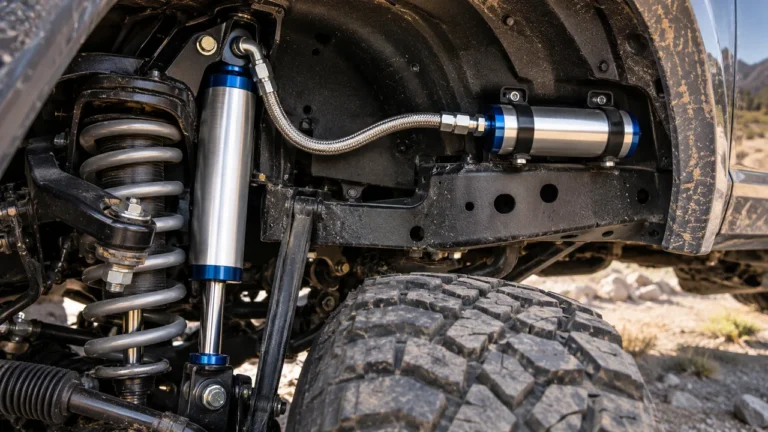
A common term in Frontier suspension discussions is coil bucket contact (CBC). The coil bucket is the chassis-side structure supporting the upper end of the front spring-and-damper assembly. At suspension extension, the factory upper control arm can come close to, or physically touch, its edge. A lift can expose this interference in a way that is not obvious when the truck is parked.
Why a spacer lift can produce a clunk
A top-mounted spacer changes the installed position of the assembly relative to the frame. Depending on the geometry and shock extension, the arm can reach the bucket before the suspension reaches its intended extension limit. A metallic knock as the wheel unloads over a dip is one possible symptom. That noise is not a diagnosis by itself: loose hardware, worn ball joints and a damper topping out can also produce noises.
Z1 Off-Road specifically discusses this issue in its D40 leveling kit application notes. Its warning is particularly relevant to PRO-4X trucks retaining original arms, and it also acknowledges that ordinary models can differ. The important takeaway is to verify the combination of arm, spacer and damper rather than assume every truck has the same clearance.
Do you need aftermarket upper control arms?
Not automatically. A correctly matched high-clearance upper control arm (UCA) may provide more room around the bucket and improve the ball-joint operating angle. An adjustable arm may also help the installer obtain alignment. But an arm with a different shape does not make an overly long shock safe, and it cannot compensate for a CV axle or brake hose being pulled beyond its working range. On a small lift that retains sufficient clearance, replacing the upper arms may not be necessary.
Ask the supplier whether its recommendation is for the stock-width Frontier suspension or a wider Titan-based configuration. Those are different applications. The arm must have the correct geometry, joint and mounting hardware for the actual suspension. Have clearance verified throughout the usable range by a qualified installer, with the truck properly supported. Never rely on a photo of the truck at normal ride height.
Camber bolts are not just an alignment-shop upsell
Some D40 and D41 trucks have fixed lower-control-arm mounting bolts rather than the eccentric hardware needed for meaningful camber and caster adjustment. After lifting, an alignment shop may find that toe is adjustable but the necessary camber or caster correction is not. A vehicle-specific eccentric bolt set at the lower arm pivots can provide useful adjustment. First check what is already installed and whether the frame tabs and mounting slots are intact.
The Frontier arrangement is not the universal two-bolt MacPherson strut camber-bolt setup. Our camber bolt fitment guide distinguishes that hardware from the lower-arm eccentric kits used on pickups like the Frontier. Use the correct lower-arm hardware for this double-wishbone chassis. If the required alignment still cannot be achieved, the solution may be a different ride height or appropriately engineered arms, not more force on the adjusters. Ask for the actual before-and-after camber, caster and toe readings.
How Much Lift Is Enough for 31s, 33s or 35s?
Frontier owners often use the same rounded tire diameter to describe quite different tires. A 285/75R16 and a wide 33×12.50 tire do not occupy the same space in the front wheel opening. The nominal sizes below help explain the difference; actual tire dimensions depend on the manufacturer, construction and measuring rim.
| Tire size | Nominal diameter | Nominal width |
|---|---|---|
| 235/75R15 | 28.9 in | 9.3 in |
| 265/75R16 | 31.6 in | 10.4 in |
| 265/70R17 | 31.6 in | 10.4 in |
| 285/75R16 | 32.8 in | 11.2 in |
| 285/70R17 | 32.7 in | 11.2 in |
| 285/75R17 | 33.8 in | 11.2 in |
| 33×12.50R18 | 33 in (labeled) | 12.5 in |
| 35×12.50R17 | 35 in (labeled) | 12.5 in |
31–32 inches: often the better everyday choice
The modern PRO-4X example with 265/70R17 tires already sits near the 32-inch class. If you move to a tire only an inch larger in overall diameter, the theoretical gain under the rear axle is half an inch. That may be worthwhile for the tread pattern and sidewall you want, but it is not a reason by itself to buy a six-inch lift. On the smaller D22, compare the original tire and wheel dimensions before borrowing recommendations from the larger D40.
Can a 2.5-inch Frontier lift clear 33s?
It can on some configurations. The Rough Country 865-series level lists 285/75R16 on the original 16-inch wheel with minor trimming, for example, and also lists a wider 33×12.50R20 on selected aftermarket wheels. Those entries are alternatives for the specific approved application, not a statement that every factory 17-inch wheel or PRO-4X fits the same tire. A 285/70R17 is another common 33-inch-class target, but it needs its own fitment check.
Look at where the tire travels while steering. A wider tire can catch the rear portion of the front liner or the bumper corner even if it has plenty of room directly above it. Moving the wheel outward may help at the control arm while making the outside of the opening harder to clear. That is why a tire test on the proposed wheel is more valuable than a parked photo with the steering straight.
A six-inch lift does not guarantee 35-inch tires
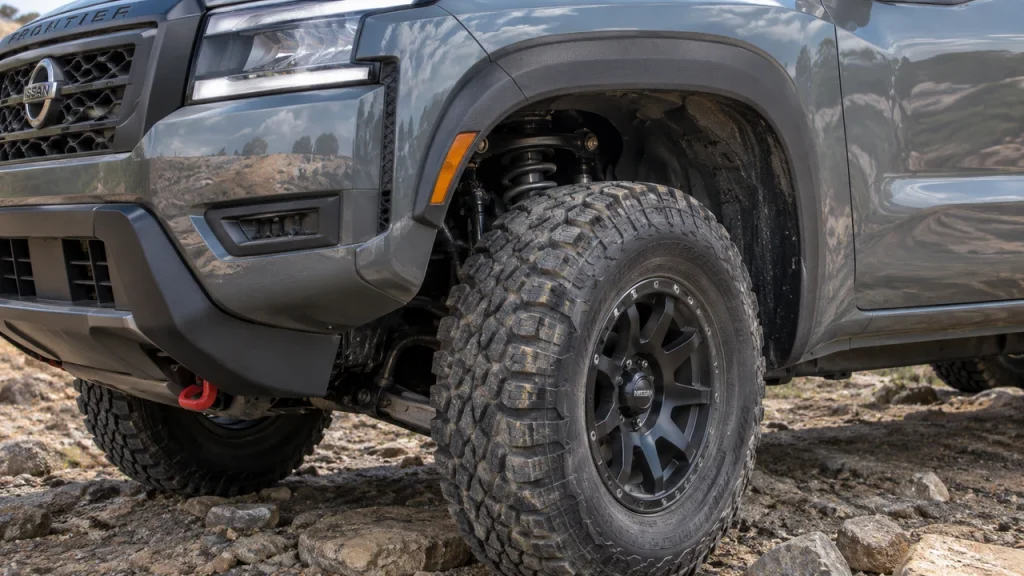
One counterintuitive example is Rough Country’s six-inch D41 suspension system. Its wheel chart includes 33×12.50 tires on specified 18- or 20-inch aftermarket wheels. The product requires a wheel of at least 18 inches with five inches of backspacing, excludes factory wheels, and calls for some drilling and cutting. The manufacturer also distinguishes the spacer version 83730, which excludes PRO-4X, from the replacement-strut version 83731, which supports that trim on 4WD trucks.
The height alone does not establish clearance for 35s. A 35-inch build may require a different suspension and wheel package plus body-clearance work, and could affect steering, braking and gearing. Do not remove crash-related or structural parts simply to make an oversized tire fit. If the build requires changes beyond the kit’s approved application, have it evaluated as a complete engineering project rather than an ordinary tire upgrade.
The unusual Frontier bolt pattern matters
The D40 and D41 use a 6×114.3 mm (6×4.5-inch) wheel bolt pattern, not the more common 6×139.7 mm pattern found on many earlier D22 trucks and other pickups. Confirm the exact pattern on an older truck, and verify the hub bore, lug seats, wheel load rating and brake clearance. A six-lug Titan wheel is not automatically a Frontier wheel, even if the truck has Titan-based suspension arms.
Wheel offset and backspacing are separate from the bolt pattern. Our wheel offset and backspacing guide explains how to compare the measurements when the kit maker gives one and the wheel seller gives the other. The six-inch example above is a good illustration: a wheel with the correct bolt pattern can still be wrong if its inner lip or spokes interfere with the replacement steering hardware.
Titan Swap vs. Conventional Nissan Frontier Suspension Lift
If you spend time researching Frontier suspension, you will eventually come across the Titan swap. It is not simply the installation of taller Nissan Titan springs on a Frontier. It uses wider front suspension geometry, generally involving Titan-based lower arms and matching upper arms, plus the necessary steering and driveline components. It is usually chosen for a wider track and more usable wheel movement, not just the tallest appearance.
What changes with a wide-track conversion?
A complete package may add several inches to the overall front track width. For example, Z1 describes its D41 Titan swap packages as producing roughly 3.5–4 inches of front height with appropriate springs and about six inches of additional front track. That is a product-specific example, not a target for every conversion. Damper travel, bump-stop engagement, steering links and the actual axle lengths all need to be matched. A truck with standard-width arms cannot be made equivalent by installing wheel spacers alone.
The wider front stance affects the entire build. Tires may sit farther outside the fenders, the rear track may no longer match the front, and a narrow trail or parking space may become harder to negotiate. Verify legal tire coverage and clearance to the body. A wider front suspension is not necessarily an advantage for a truck used almost exclusively on the street.
The 2020-on CV and tie-rod differences
One reason to avoid buying a collection of used parts from an old swap recipe is that the D40 changed before the D41 appeared. In its technical account of a 2022 Frontier conversion, Alldogs Offroad identified a different inner CV spline count for the R180 front differential beginning in 2020: 30 rather than the earlier 27. It also reported a change to the inner-to-outer tie-rod thread connection. These details concern the specific drivetrain and steering hardware, not just the front spring height.
Use a current package that expressly supports the model year and differential configuration. The Titan swap does not automatically require a Titan differential, and a different differential conversion changes the axle requirements again. A supplier should be able to specify the matching CV shafts for a 4WD truck, steering hardware and compatible dampers. Do not use improvised steering extensions or mismatched shafts to finish a conversion.
When a conventional kit is a better purchase
For a Frontier that commutes, tows a small trailer and visits forest roads on weekends, a stock-width spring-and-shock package may accomplish more of the practical goals for less money. It can preserve the original wheel-track relationship and avoid the wide-track steering and axle work. A Titan swap makes more sense when extra front suspension movement is a genuine priority and the owner accepts the additional parts, alignment and body-clearance checks.
Build the Rear Suspension Around the Load, Not the Front Height
A Frontier with a rooftop tent, drawers and recovery equipment has a different rear spring requirement from an empty pickup. The rear leaf springs support that load; the lift height advertised for the front does not tell you how high the loaded rear will sit. Decide how much permanent weight the truck carries before ordering the rear components.
Shackles, add-a-leaf kits and replacement leaf packs
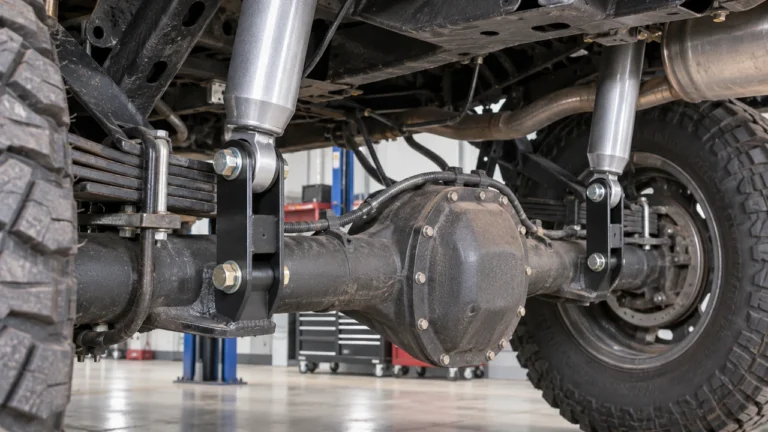
A longer shackle changes the position and angle of the leaf spring. An add-a-leaf can increase spring rate as well as height; a complete replacement pack offers a chance to choose a spring for the expected load. A rear block raises the frame relative to the axle without adding spring rate. These options do not produce the same loaded behavior. Where blocks are used, the locating hardware and U-bolts must be suitable for the kit.
Check the rear damper’s compressed and extended lengths, particularly when changing spring arch or shackle length. A shock should not become the unintended suspension travel stop, and the bump stops must remain effective. An unloaded rear-high appearance is not necessarily a defect on a truck intended to carry camping equipment or a trailer tongue load.
What to expect when towing or carrying cargo
No suspension lift increases Nissan’s published payload or trailer rating. Heavier wheels, bumpers and other accessories consume part of the available payload. Larger tires can also change effective gearing and braking response. Preserve the loaded stance, verify the trailer hitch height, and choose tires with the correct load capacity. A truck that feels good during an unloaded test drive may behave quite differently with a trailer attached.
Brands, Budget and the Questions That Belong on Your Quote
There is no single brand that covers every Frontier build equally well. Rough Country is useful for comparing basic leveling hardware with taller systems; Nissan NISMO offers vehicle-specific parts; Z1 Off-Road and Alldogs Offroad specialize in Frontier geometry, matched kits and wider conversions. Bilstein, Old Man Emu and other spring-and-damper suppliers are worth considering if damping and load support matter more than the advertised maximum lift. Compare exact applications and included hardware rather than brand reputations alone.
The advertised kit price versus a finished truck
Simple leveling components can be around a hundred dollars, whereas a full six-inch kit can start above a thousand before labor, wheels and tires. A matched suspension or Titan swap can cost considerably more depending on the selected dampers and supporting parts. A price for the kit alone tells you little about whether you can reuse your original wheels or whether alignment hardware is included. Our lift kit installation cost guide covers the broader U.S. labor and budget ranges.
Send the installer the complete configuration
Before committing to a particular part number, send the supplier the details below. It is easier to catch a PRO-4X exclusion or a steering incompatibility in a written quote than after the truck has been disassembled.
- Model year, U.S. generation, trim, engine, 2WD or 4WD, and cab/bed or wheelbase where requested.
- Original suspension components and any existing lift, including factory Bilstein dampers if fitted.
- Current wheel width, offset and tire size, plus the exact proposed tire and wheel combination.
- Whether the front suspension will retain its stock width or use a Titan swap, and whether the factory differential remains.
- Upper-arm and coil-bucket clearance provisions, correct lower-arm alignment hardware and required shock travel.
- Permanent front and rear accessory weight, usual cargo and towing use.
- Any required cutting, replacement wheels, steering or brake hardware, alignment and post-installation checks.
After the work, obtain the alignment report and have the installer verify clearance at both steering limits and through suspension movement, brake hose and ABS-wire routing, CV operation on 4WD models, and bump-stop and damper travel. Follow the specified fastener reinspection schedule. Check headlight aim and any required driver-assistance or speed-related recalibration. New knocking, vibration or pulling should be investigated before the truck is driven hard.
Nissan Frontier Lift Kit FAQs
These answers are intended to help narrow a purchase decision. The exact manufacturer application, tire chart and installation instructions take priority over a general height recommendation.
What lift kit fits a 2000 Nissan Frontier 2WD?
Choose a D22 torsion-bar suspension application for the correct engine and 2WD chassis. Four-cylinder and V6 listings can differ. A small factory-range height correction or an approved complete suspension kit may be appropriate, depending on the truck’s condition. A spacer made for the coil-sprung 2005-and-newer Frontier is not compatible.
What is the best lift for a 2025 Nissan Frontier PRO-4X?
For an everyday truck retaining its original Bilstein dampers, a mild PRO-4X-specific level is a sensible first choice. A matched suspension package is more appropriate for frequent rough-road driving or significant accessory weight. Check the actual upper-arm clearance and damper travel, and do not assume a kit for a standard SV fits the PRO-4X.
Can I put a three-inch lift on a 2022 Frontier?
Yes, if the selected package is explicitly designed for the configuration. A three-inch system is not necessarily just a taller spacer. The control arms, shock travel, lower-arm alignment hardware and 4WD axle angles must all work together. The rear spring selection should reflect the load you carry and the desired stance.
Will a two-inch lift fit 33-inch tires?
Some Frontier combinations can accommodate 33-inch-class tires with a modest lift, but tire width and wheel position determine the result. A 285/70R17 differs from a 33×12.50 tire. Check the exact tested wheel and tire pairing for your trim, and confirm clearance when steering and when the suspension compresses.
Can I keep the factory upper control arms?
Sometimes. A mild system with sufficient coil-bucket clearance, correct ball-joint operation and achievable alignment may work with stock arms. Where a kit specifies high-clearance or revised arms, follow that requirement. Do not accept repeated metal-to-metal contact at full extension as normal.
Do I need camber bolts with a Frontier lift?
Check the lower control arm pivots first. Trucks with non-adjustable mounting bolts may need the appropriate eccentric hardware to obtain the specified camber and caster after lifting. If the factory adjustment already provides the required range, additional parts may not be necessary. The alignment measurements should determine the decision.
Will a 2005–2021 Frontier lift fit a 2022-and-newer truck?
Some individual components and certain complete mild kits are listed across both generations. Others, especially tall systems, are application-specific. The long D40 year range also spans steering and axle changes from 2020. Buy only the part number expressly approved for the D41 configuration rather than assuming the related front suspension makes everything interchangeable.
Does a Titan swap automatically let me fit 35s?
No. A wider suspension and additional travel do not guarantee clearance around the bumper, liner or fender. The tire width, wheel position, suspension movement and body configuration still determine whether 35s fit. Choose a matched conversion for the intended terrain and verify the actual tire package separately.