Leaf Spring Shackles: How to Choose and Replace Them
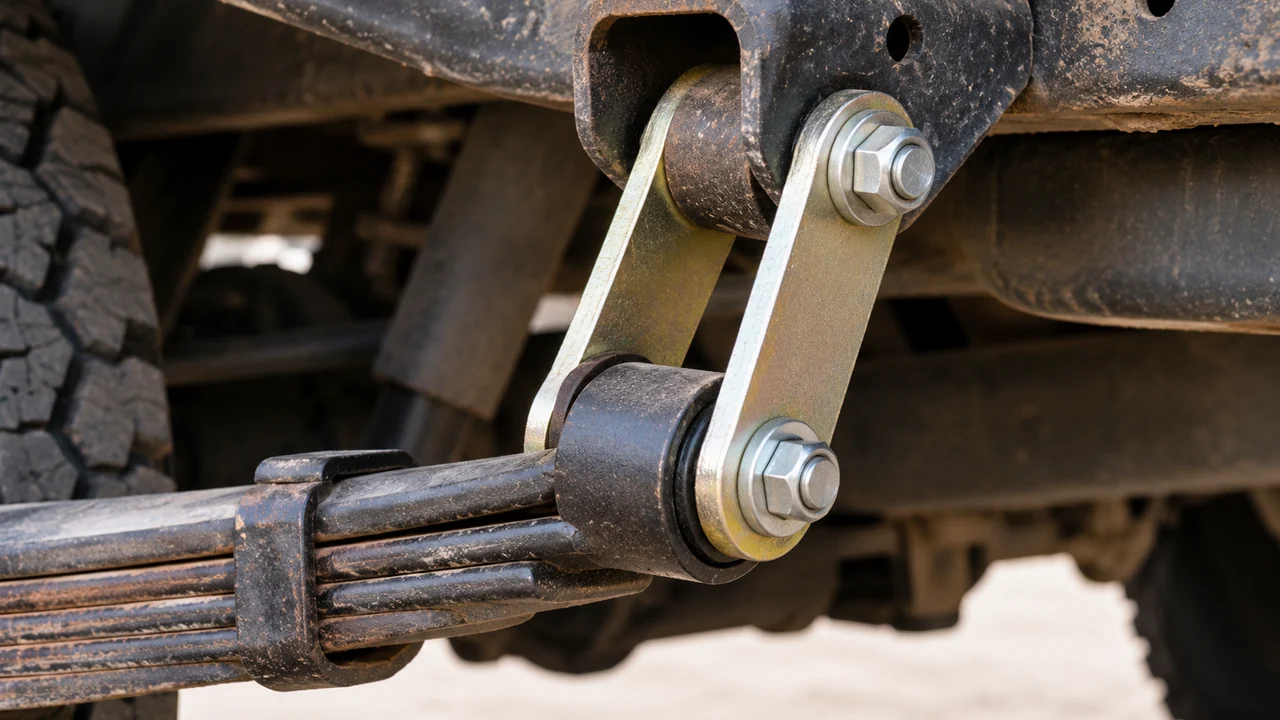
A leaf spring shackle is the hinged link between a leaf spring eye and a frame-mounted hanger on many trucks, SUVs and older vehicles. As the spring flattens over a bump, the distance between its eyes changes slightly; the shackle swings to make room for that movement. If you’re replacing leaf spring shackles, start with the exact vehicle and suspension position, then match pivot-to-pivot length, width, bolt sizes, bushing design and mounting orientation. A part that looks close on the bench can still bind or strike the frame under load.
For a stock truck, a vehicle-specific replacement is usually the clearest choice. Inspect the hanger (the bracket attached to the frame), the spring-eye bushings and both pivot bolts before ordering. A rusty or bent shackle needs more than new rubber; a sound shackle with a worn bushing may not need new steel at all. If the link or its frame attachment is cracked, separating or no longer retaining the spring, don’t drive the vehicle until the connection has been repaired.
What Leaf Spring Shackles Do—and Why the Spring Needs One
Picture the back of a pickup moving over a driveway hump. The spring bends, its arc changes, and the rear eye wants to move in a small fore-and-aft path. A shackle gives that eye a controlled swing rather than fixing both spring ends rigidly to the frame. It is a load-bearing part, not merely a noise isolator.
The Two Pivot Points Have Different Jobs
On a common rear-spring arrangement, the upper pivot connects the shackle to a frame hanger and the lower pivot connects it to the rear spring eye. Some vehicles reverse the orientation or use a shackle at a different end, so “upper” and “rear” are descriptions of common layouts, not universal rules.
Both joints must remain located laterally while allowing the rotation the design calls for. The movement may be taken up by flexing bonded rubber, by a lubricated sleeve or by a different specified bearing arrangement. You cannot tell which just by seeing two bolts.
Fixed Hanger, Moving Shackle: Don’t Order the Wrong Metal Part
The frame hanger is a bracket secured to the chassis, often with factory rivets or bolts. The shackle is the swinging member attached to that bracket. A replacement listing may say shackle and hanger kit, rear of rear spring hanger or shackle bracket; read the drawing before deciding which piece is in the box.
A shackle can be perfectly good while the hanger rusts through at its frame flange. Replacing the swinging link alone will not restore a weakened attachment point. Conversely, an intact hanger normally stays in place during an ordinary shackle swap.
The Spring Can Have a Fixed Eye at Either End
Many pickups have a fixed front spring-eye mount and a rear shackle. Some older, front-leaf-spring or modified suspensions put the swinging connection elsewhere. The correct replacement follows the actual suspension layout, not a diagram of a different truck.
That distinction also matters when someone searches for “rear leaf spring shackles” and is offered a front-spring kit. Front and rear suspensions can use different lengths, bolts, bushing types and directions of travel even on the same vehicle.
How to Choose Leaf Spring Shackles That Actually Fit
The quickest way to buy the wrong set is to match the outside silhouette alone. Catalog photos rarely show enough detail to prove that the pivots, spring eye and frame bracket will line up. These are the checks worth making before clicking Buy.
| Fitment check | What to confirm | What a mismatch can cause |
|---|---|---|
| Vehicle and position | Exact year, model, axle/spring option and front/rear mounting location | A kit that fits the truck name but not that suspension |
| Pivot-center spacing | Center-to-center distance between the two shackle bolt holes | Incorrect ride position, swing path or clearance |
| Inside width and plate shape | Spring-eye/bushing width, hanger width and straight, offset or formed shackle design | Side loading, pinched bushings or a plate that won’t seat |
| Pin and bolt specification | Diameter, usable length, thread, approved nuts and retaining hardware | Loose joints, incorrect clamping or damaged bracket holes |
| Bushing arrangement | Pressed rubber, separate inserts, sleeves or greaseable pins as specified | Binding, rapid wear or incompatible lubricant |
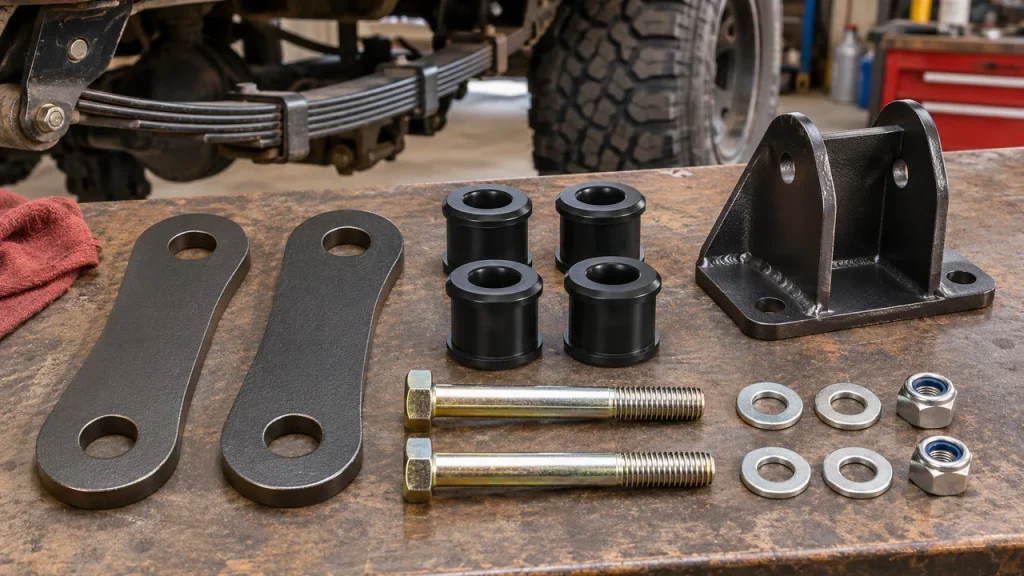
| Complete kit contents | One shackle or pair, bolts, nuts, bushings, sleeves and any brackets | Discovering missing hardware after disassembly |
Measure Between Pivot Centers, Not From Plate End to Plate End
Shackle length is commonly described as the distance from the center of one pivot hole to the center of the other. A pair of plates that are six inches tall overall may have a much shorter effective length. Check the seller’s dimension diagram because generic “length” labels are not always consistent.
When the old assembly is distorted or modified, simply copying its size may reproduce a bad setup. Vehicle build information, the spring manufacturer’s measurements or a vehicle-specific kit should take priority over an unverified old part.
Match Spring Width, Shackle Offset and Bolt Clearance
Some shackles consist of two flat straps; others are stamped into a U-shaped piece or have formed offsets, spacers or bushings built into the assembly. Check the inside space between the sides where the spring eye fits. The bracket at the other end may require a different width or a particular shoulder and sleeve arrangement.
If you have to spread the steel plates apart, pinch them together with the nuts or enlarge a bolt hole to get the part in, stop. Those are fitment warnings, not normal installation adjustments. The shackle must also clear the frame, exhaust, bed crossmembers and brake hardware throughout its expected swing.
One-Piece, Two-Plate and Greaseable Shackles
TruckSpring’s hardware catalog distinguishes stamped assemblies, older cast designs and separate-strap shackles. Those categories are useful when comparing part photos, but neither the most substantial-looking plate nor the one with the most fittings is automatically a better replacement.
A greaseable shackle may use drilled pins, a grease fitting and bushings designed to accept lubricant. That can be useful where the manufacturer designed the joint for servicing. It is not a reason to grease bonded rubber or substitute a greasable pin that doesn’t match the original sleeve and hanger.
Check Whether You’re Buying a Single Side or Both Sides
Listings can describe a shackle kit even when the box supplies one shackle position. Others include two complete rear shackles, sleeves and bolts for an axle pair. The number of plates shown in a photograph is not a reliable quantity count.
Before ordering, verify the number of shackle locations being serviced and which pieces are included. Don’t assume new nuts, bushings or hanger brackets come with a pair of steel straps. If a locking fastener is designated one-time-use, the correct replacement belongs on the parts list.
Vehicle Fitment Still Wins Over a Generic “Heavy-Duty” Label
Steel thickness and a high strength rating can matter, but the shackle is part of a designed suspension system. Extra-thick plates do not repair elongated hanger holes or increase the truck’s payload rating. They may even interfere with nearby brackets or the spring-eye assembly.
For an original suspension, choose by exact application and compare the supplied dimensions. For a swapped axle, aftermarket spring pack or fabricated hanger, ask the suspension supplier or a qualified spring shop to verify the entire pivot arrangement rather than trusting a universal fitment claim.
Shackle, Hanger, Bushing or Bolt: Which Part Needs Repair?
A rear-end clunk can lead to four different invoices. Looking closely at the joint often prevents a perfectly good shackle from being replaced while the damaged part stays on the vehicle.
Replace the Shackle When Its Steel Is No Longer Sound
A cracked strap, a fractured stamped body, a visibly bent link, severe loss of metal from corrosion or elongated shackle holes calls for proper replacement. Compare the left and right sides: an odd angle by itself is not proof of failure, but a link that is distorted or contacting the frame deserves prompt investigation.
Do not weld a crack in an unknown shackle material, hammer it straight or drill a wallowed-out hole to accept a larger random bolt. These parts carry repeated loads while the vehicle moves.
Replace a Hanger When Its Frame Connection Is Compromised
Rust often collects where a hanger wraps around the frame or where old rivets meet the steel. A hanger can look solid from the side but have thin metal at the mounting flange. Check for rust perforation, cracks, loose attachments and bolt holes that have become oval.
Repairing a hanger may involve removing factory rivets and fitting the manufacturer’s approved bracket hardware. If the frame itself has lost structural metal, simply bolting on a new hanger is not an adequate repair. That distinction is especially important on older trucks from regions that salt roads.
A Worn Bushing Isn’t Automatically a Bad Shackle
If the rubber is split but the shackle plates and bracket holes remain sound, an approved bushing-only repair may be possible. The pivot might instead have a seized bolt sleeve or worn pin that also needs attention. Our leaf spring bushings guide explains how to tell a serviceable rubber insert from a damaged spring eye.
This article focuses on selecting, inspecting and replacing the shackle assembly. It does not duplicate the detailed methods for pressing out spring-eye bushings or identifying every bushing material.
Bad Leaf Spring Shackles: Symptoms Worth Taking Seriously
There is no sound that belongs only to shackles. The combination of what you hear, what has moved and what the metal looks like is much more useful than a symptom checklist by itself.
A Heavy Clunk From the Back When Braking or Hitting a Bump
A loose pivot, broken shackle strap or displaced hanger may let metal shift and strike a neighboring component. The noise can change when you accelerate, brake or cross a sharp bump. Shiny witness marks around the pivot or a new contact point at the frame strengthen the case for a mounting problem.
Shock mounts, exhaust brackets, spring-eye bushings and axle-to-spring clamps can make similar sounds. If inspection doesn’t reveal damaged shackle hardware, use our guide to suspension clunks and rattles rather than ordering shackles to see whether the noise disappears.
Rust Flakes, Splitting Steel or a Shackle Hanging at an Odd Angle
Surface rust on a sound, coated part is not the same thing as rust that has eaten a strap thin. Look for layered, swelling corrosion, cracks near the holes, missing sections of steel and mounting brackets separating from the frame. A spring eye that appears to have moved out of its intended position is also a serious clue.
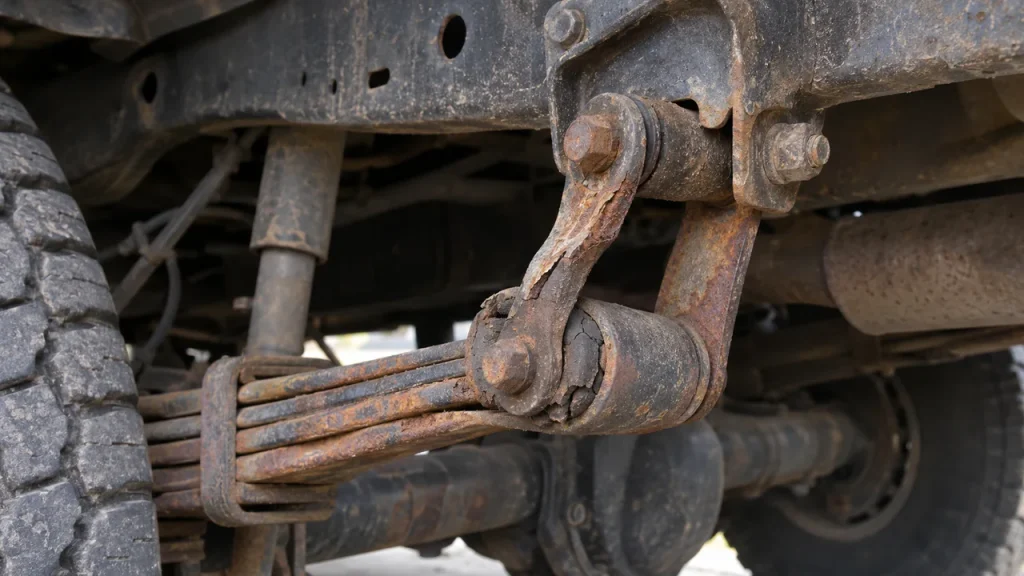
Shackle angle varies with ride height and load. One side appearing different can reflect uneven loading, a sagging spring or a previous modification rather than a bent shackle. Structural damage or a visibly displaced spring, however, is not something to investigate by taking the truck for another drive.
A Rear Corner Sits Low or the Truck No Longer Tracks Normally
A broken mount can change where a spring end supports the vehicle. A worn or displaced pivot can also contribute to unwanted axle movement. A permanent lean might instead come from a tired spring, overloaded vehicle or incorrectly fitted parts.
If the rear axle appears crooked, inspect both ends of the spring and the axle-to-spring connection. The U-bolts that secure the axle are a separate system; our leaf spring U-bolts guide covers that clamp and its required fitment. Tightening shackle nuts will not fix an axle seat that has slipped on the spring.
Squeaking With Suspension Movement Doesn’t Prove the Plate Is Bad
A dry or deteriorated pivot can squeak as the body settles or the rear axle articulates. So can spring-tip contact, a shock bushing or another rubber mount. What matters is whether the shackle swings normally, its bushings are intact and the hardware remains centered.
Do not spray whatever lubricant is handy onto all the rubber and call the diagnosis finished. Some pivots are designed to twist through bonded rubber, while others use a lubricated sleeve. Their maintenance requirements differ.
Inspecting Shackles With the Vehicle Parked
You can learn quite a lot without undoing a single nut. Begin with the vehicle on level ground, safely parked and unloaded as the manufacturer recommends for visual inspection. A flashlight and a comparison between the two sides are often more useful than trying to move a joint by hand.
Check Both Pivot Holes and the Bracket Behind Them
Look at the steel surrounding the upper and lower pivot positions. Distorted washers, rubbed paint, rust powder, cracks and holes that are no longer round can indicate unwanted motion. Follow the upper connection back to the frame bracket instead of stopping at the outer shackle plate.
If a bolt appears to have rotated inside a hanger hole that should hold it securely, the bracket may be worn. Replacing the nut or bushing will not restore a damaged hole. A shop may need to remove the link to assess how much metal is left.
Watch for Shackle Inversion and Contact Marks
An incorrectly matched spring, shackle or hanger can leave the link in an awkward position at rest. Some suspension layouts can allow a shackle to swing past its intended range and jam against a frame or crossmember. That is sometimes described as shackle inversion or a flipped shackle.
Check for fresh witness marks where the link could strike the frame, and compare the loaded angle with the correct vehicle design. Do not assume a universal 45-degree target: the appropriate angle depends on spring length, travel, mounting position and the kit design.
Don’t Test Play Under an Unsupported Vehicle
Testing movement in a spring pivot can require changing axle support and ride height. The spring locates and carries part of the vehicle’s load, and its mounting points are not safe to disconnect casually. Never go underneath a vehicle held only by a jack or place your hands between a spring and bracket while another person rocks the body.
An experienced technician can unload the joint in the prescribed manner and distinguish normal rubber compliance from a bolt sliding through worn steel. The acceptable movement and inspection position come from the relevant service information, not an arbitrary gap measurement borrowed from another truck.
How Leaf Spring Shackles Are Replaced
Shackle replacement may be fairly contained on a clean stock truck, or it may turn into a hanger and frame repair once an old rusty pivot is opened. Here is the workshop sequence at a high level; it is not a vehicle-independent set of jack-point or lifting instructions.
The normal checkpoints are:
- Identify the exact assembly. Confirm front/rear position, shackle orientation, vehicle-specific part number, both pivot fasteners, bushings, sleeves and any hanger condition before removing hardware.
- Support the frame and axle as prescribed. The spring end must be controlled while the suspension load changes. Chock the vehicle and use approved stands and support points; the axle must not be left free to drop or rotate.
- Deal with the old pivot hardware. Remove the affected bolts under the correct procedure. Corrosion may lock a bolt to its inner sleeve; do not use uncontrolled heat or cut near fuel, brake and electrical lines.
- Inspect the steel at both ends. Check the spring eye, frame hanger, mounting holes and shackle contact faces. Replace damaged parts rather than using new bolts to pull a deformed bracket into shape.
- Fit the specified shackle and joint components. Confirm the correct orientation, sleeve and washer arrangement, and sufficient clearance. Do not force the new assembly between incorrectly spaced mounts.
- Tighten by the approved method. Apply the applicable torque, ride-position and nut-reuse instructions. Check that the link can move as designed without a pinched or loose joint.
- Verify the finished suspension. Recheck hardware, compare side-to-side position, examine brake-hose and shock clearances, and complete any kit-specific test-drive or follow-up inspection.
Rusted Bolts Often Turn a Small Job Into a Bigger One
On an older truck, the nut may come off while the bolt remains rusted into the bushing sleeve. That’s a different problem from a bolt merely being tight. Trying to drive it out without supporting the joint can damage the hanger or spring eye, and heating the surrounding steel or rubber introduces other hazards.
A shop may have to cut a seized fastener and renew the sleeve or bushing. Ask whether the estimate accounts for that possibility and whether replacement pivot bolts are included. Simply reinstalling a damaged old fastener defeats the point of fitting a sound new link.
The New Link Must Not Be Twisted Into Position
A correctly specified shackle should align with the two intended pivots when the spring and axle are positioned according to the service procedure. If its holes are far out of line, inspect the setup: the spring may be unsupported at the wrong height, a hanger may be bent or the part may be for another application.
Do not enlarge the holes, bend the shackle sides or omit a sleeve to make the bolts slide through. A shackle needs its intended bearing surfaces and correct plate spacing to carry load without damaging the rubber or steel.
One Side at a Time Is Common, Not a Universal Rule
Keeping the opposite spring connection intact can help preserve axle location on some vehicles, but the correct method depends on how the frame, axle, shocks and springs are supported. Follow the actual vehicle or kit instructions instead of assuming a step shown on a different truck applies to yours.
If a bracket is rusted through, a main spring eye is cracked or the frame is compromised, this is no longer a routine shackle replacement. Structural assessment comes before further disassembly or a road test.
Shackle Bolt Torque, Ride Height and Final Checks
A bolt can be tight and still be assembled incorrectly. The nut, sleeve, bushing, shackle plate and bracket must work together so that the pivot stays secure while the intended movement remains available.
Why There Isn’t One Safe Shackle Torque Specification
Torque depends on the vehicle and fastener design. Some joints clamp an inner sleeve while rubber deflects around it; others use special pins, greaseable components or application-specific locknuts. A torque figure for a trailer wet bolt or a Jeep lift kit is not a substitute for a pickup’s OEM shackle bolt specification.
Use the service procedure for your exact assembly or the replacement kit’s written instructions. Don’t tighten until the sides visibly bow inward, and don’t leave a nut loose in the hope that the shackle will swing more freely. Both approaches can damage the joint.
Tightening at Normal Ride Height Depends on the Bushing
Bonded-rubber pivots commonly require final tightening at a specified normal ride position to avoid holding the rubber in a twisted state when the truck is parked. Greaseable designs or other bearing arrangements can have different instructions. Final tightening with the axle hanging freely is not a safe universal shortcut.
A shop should also check the spring and shackle through the required movement range for the exact vehicle. Clearance at rest does not guarantee clearance when the rear axle compresses or droops.
Recheck Only When and How the Instructions Specify
Some replacement kits specify a follow-up inspection or fastener check after initial driving. Others set different intervals or require new prevailing-torque hardware. Record the kit’s actual requirement rather than borrowing a mileage figure from a different design.
A shackle that has shifted, hit the frame or damaged its hanger shouldn’t simply be retightened and ignored. Find the reason for the unwanted movement first.
Longer Shackles, Adjustable Kits and Lift Geometry
An extended shackle can change ride height because it changes where one end of the spring sits relative to the frame. It also changes the arc through which that spring end travels. Those effects are related but not identical, which is why choosing by advertised lift alone can disappoint.
A Two-Inch-Longer Shackle Does Not Give a Two-Inch Lift
As a rough starting point for certain conventional layouts, raising one spring eye with a longer shackle may change axle ride height by considerably less than the increase in shackle pivot spacing. A frequently cited rule of thumb is roughly half the added shackle length, but the actual result depends on geometry, loaded angle, spring arch and mounting position. It is not an installation specification.
Check how the manufacturer measured the shackle. An extra inch of total plate length is not necessarily an extra inch between pivot centers. A shackle intended to lower a pickup in one configuration may act differently on an axle or spring arrangement that mounts another way.
Shackle Angle Is a Travel Problem, Not a Cosmetic Angle
The shackle needs room to rotate as the spring straightens and returns to its arch. Too little swing can cause binding; an extreme angle can allow the link to contact the frame or go over-center. Performance spring suppliers discuss shackle angle because it can also influence effective suspension behavior.
There is no universal best angle for every pickup, Jeep and trailer. Evaluate the loaded position and suspension path against the actual spring and hanger arrangement. Moving a frame hanger merely to imitate a photograph can make the system worse.
Lift Shackles Can Affect Pinion Angle and Clearance
Changing where a spring eye sits can rotate the axle relative to the chassis and alter driveline angles. On a front leaf-sprung axle, geometry changes can also affect steering caster. Check shocks, brake hoses, tires, bump stops and any nearby crossmember over the suspension’s intended travel.
If you’re budgeting an entire suspension change rather than a stock shackle repair, our lift kit installation cost guide covers the broader parts and labor. A shackle is only one piece of that project.
Adjustable Shackles Need a Verified Hole Position
Multiple bolt holes do not make a shackle universally compatible. Each selected position changes pivot distance, loaded geometry and sometimes available clearance. Both sides must use the application-approved configuration, and the kit must permit that adjustment.
Never move a bolt to a different hole simply to correct a truck that leans because a spring has sagged or a hanger is bent. The apparent ride-height improvement may hide the actual defect.
Trailer Leaf Spring Shackles: Similar Name, Different Hardware
Search results for leaf spring shackles often mix pickup parts with trailer suspension kits. On tandem-axle trailers, a shackle strap can connect a spring eye to an equalizer that distributes movement between axles. That’s a different set of pivot locations from the common rear shackle on a pickup.
Equalizers, Wet Bolts and Shackle Straps Belong to Trailer Fitment
Trailer parts catalogs may list equalizer links, bronze bushings, greaseable wet bolts with zerk fittings, or heavy-duty shackle strap kits. The strap length, bolt diameter, equalizer geometry and hanger spacing all have to match that trailer suspension. A truck shackle is not a drop-in replacement simply because two bolt holes look similar.
Some trailer kits specify particular nut types, lubrication and periodic checks. Follow the trailer axle or kit manufacturer’s documents rather than copying a truck repair procedure. If your search is specifically about tandem-axle equalizers, this truck-focused article is not a comprehensive trailer service manual.
An Over-Center Trailer Shackle Is Not Fixed by Guessing a Longer Strap
A trailer shackle that has flipped, locked against a hanger or settled into the wrong angle may indicate incorrect spring length, equalizer geometry, worn bushings or a suspension installed outside its intended range. Changing one strap length can affect both axles’ movement.
Confirm the loaded trailer’s actual configuration and the manufacturer’s shackle orientation before replacing parts. Never rely on a generic fixed-angle rule in place of the approved layout.
Repair Cost, Replacement Pairs and What a Quote Should Include
A straightforward shackle-only repair and a rusted frame-hanger repair should not be compared as though they are the same service. The cost of the steel links can be modest; access, corrosion and the number of joints being renewed often decide the labor bill.
Shackle-Only Versus Shackle-and-Hanger Work
A clean replacement may involve one pivoting link, approved bolts and perhaps separately serviceable bushings. A corroded hanger can require removing rivets or brackets and inspecting the frame. A spring pack with a cracked eye is a larger repair still.
If the leaves themselves need replacing, our leaf spring replacement cost guide covers the complete spring job and related hardware. Keep the quote itemized so you can see whether you’re paying for a shackle, bushings, a hanger, a spring pack or several of them.
Do Both Rear Shackles Have to Be Replaced Together?
Not automatically. One broken shackle requires repair, but the other side should be inspected for the same corrosion, wear and previous modifications. Replacing a pair can make sense on an older truck when both sides are similarly deteriorated or a matched kit is specified. It is not a reason to discard a sound assembly without a technical justification.
Ask the shop to show the condition of both sides and explain why the planned hardware is being renewed. The same applies to the hangers: replacing one shackle doesn’t automatically mean removing every original bracket from the frame.
Questions Owners Ask Before Ordering Shackles
A few details tend to come up only after an owner has searched a catalog or looked under the truck. They are worth settling before the suspension is taken apart.
Can You Drive With a Broken Leaf Spring Shackle?
No—not with a confirmed broken or separating shackle or hanger. The spring may no longer be retained correctly at the frame, and the axle’s position and vehicle stability can be affected. Arrange professional recovery and repair rather than driving slowly to see whether the spring stays in place.
A squeak without a verified structural problem still needs diagnosis, but it should not be treated as proof the shackle has fractured.
Are Shackles Supposed to Be Straight Up and Down?
Not necessarily. Their normal angle depends on spring arch, mounting design and the vehicle’s loaded ride height. A shackle can lean at rest and still follow its intended swing; another one can look vertical yet have insufficient clearance. Compare against the correct design, not an internet photograph of a different vehicle.
Do Shackles Change Ride Height or Ride Quality?
A non-stock shackle length can change the mounting position and therefore ride height. The geometry may also affect travel, the way the spring works and the axle or driveline angles. Stock-length replacement shackles should not be expected to correct worn spring arch or increase payload rating.
Will New Shackles Fix a Rear-End Clunk?
Only if the shackle assembly, pivot hardware or hanger is actually responsible. A worn bushing, loose shock mount, shifted axle seat or exhaust contact can sound much the same. Diagnose visible movement and the condition of the joints before buying parts.
Does Shackle Replacement Require Wheel Alignment?
A like-for-like rear shackle replacement on a properly located solid axle does not automatically require a conventional front-wheel alignment. If a bracket was damaged, the axle moved, a lift shackle changed geometry or the vehicle now dog-tracks, verify axle position and thrust angle. Our alignment after suspension repairs guide covers when a geometry check makes sense.
Can I Replace a Shackle Without Removing the Leaf Spring?
On some designs, yes, with the frame and axle supported according to the exact service procedure. Other designs need additional disassembly or access to a press or seized hardware. Do not treat a short video of one truck as proof the same operation is safe on another.
Before Final Torque, Check the Shackle’s Full Swing
The final fit check isn’t whether both bolts slide through the new shackle while the axle hangs from a jack. It’s whether the correct springs and hangers place the shackle where it belongs at the specified ride height, with the proper sleeves, washers and pivot hardware installed and without contact through the intended range of suspension movement.
If a plate bows inward, the link hits the frame, the spring eye sits crooked or a bolt hole has been worn oval, more torque will not make the joint right. Correct the part mismatch or structural damage first. A properly fitted shackle should let the spring change shape while keeping its connection to the vehicle secure.