Coilover Helper Springs: What They Do & When You Need Them
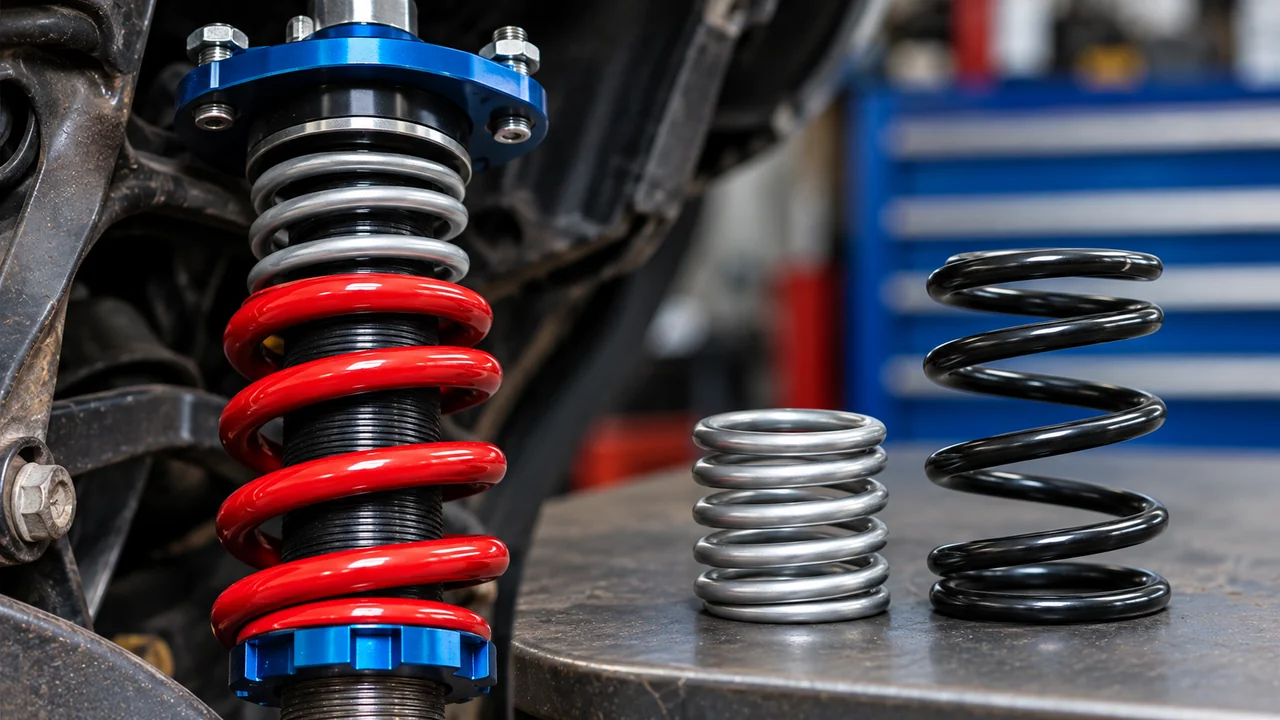
Coilover helper springs keep the main spring seated when the suspension reaches full droop. They are the short, low-load springs sometimes stacked above or below the main coil on an adjustable damper. At normal ride height, a conventional helper is usually compressed nearly flat; when the wheel drops, it opens up to take up the space that would otherwise let the main spring rattle or lift off its perch.
You need one only if the finished suspension would leave the main spring loose at its intended extension limit, and the coilover manufacturer approves the stacked-spring arrangement. A helper does not make the main spring stiffer, support extra cargo or create more shock travel. Those distinctions matter more than the color of the spring or the number of coils in the kit.
Do You Actually Need Helper Springs on Your Coilovers?
Start by asking what happens to the main spring when the damper reaches its permitted full-extension position. If the main coil remains securely captured between its seats through the suspension’s intended travel, there may be nothing to fix. A second spring is not a performance upgrade by default.
These are the situations where a purpose-built coilover helper deserves consideration. They are reasons to inspect the system, not proof that a particular helper will fit.
- The main spring becomes loose at full droop. With the suspension safely supported, an approved full-extension check reveals axial play or an unseated spring. This is the classic helper-spring application.
- You are using a shorter main spring. A short racing spring may clear components or suit a particular stroke, yet leave extra room in the extended assembly.
- Ride-height adjustment has reduced spring capture. On some perch-adjusted coilovers, the desired height cannot be maintained while keeping the main spring snug at extension.
- The kit was engineered with a helper or spacer. If the supplied configuration includes a helper, do not assume it is decorative or safe to omit.
- You are planning a custom travel setup. Extra droop can expose a spring-seating problem, but any helper must still fit the compressed assembly and the damper’s safe operating envelope.
If your coilover is a sealed, factory-preloaded strut or its instructions prohibit altering the spring stack, do not retrofit a helper based on a generic sizing chart. The spring can retain dangerous stored energy even when the vehicle is raised. Confirm the correct configuration with the kit manufacturer before disassembly.
What a Helper Spring Does at Ride Height and Full Droop
The main spring provides the corner’s normal supporting force. The helper has a much lower rate in a conventional spring-capture arrangement and moves mainly when the damper extends far enough to unload the main coil. Think of it as a way to keep the spring stack in contact, not a way to get free wheel travel.
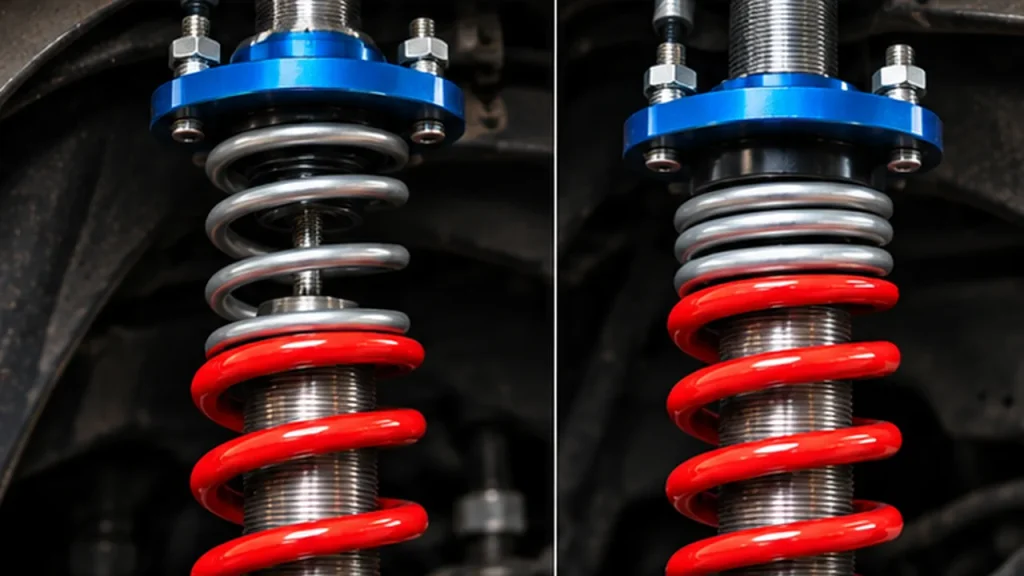
At Ride Height: Usually Fully Compressed
Under the vehicle’s weight, a typical low-rate helper reaches its solid height—the short stacked height it occupies when its coils are closed. At that point the main spring largely determines the working rate. That is why properly specified helpers generally have little effect on normal ride stiffness. You will often see a flat-wire helper that looks like a thin metal ring with the car on its wheels; that can be entirely normal.
Not every short secondary spring is designed to behave this way. Swift, for example, distinguishes helper springs from higher-load assist springs. Manufacturer labels and data sheets matter more than appearance. Swift’s helper and assist specifications list free length, stroke, fully compressed height and load, allowing you to distinguish the two by actual operating behavior.
At Full Droop: It Extends to Keep the Main Spring Captive
Imagine the chassis supported in a workshop while the wheel hangs at the designed droop limit. The distance between the spring seats increases as the damper extends. Without enough spring length or proper retention, the main coil can become loose. A helper expands into that additional space and keeps the main spring pressed against its seat, provided it has adequate usable extension and the correct adapter hardware.
The objective is spring seating. The helper must not be asked to become a droop stop, hold a heavy load it was not designed to carry or compensate for a damper that is the wrong length. The intended limit straps, external stops and suspension geometry establish the permitted droop; the damper must be compatible with those limits.
Why a Loose Main Spring Is More Than an Annoying Rattle
A spring that moves off-center at extension may not settle back onto its perch cleanly when load returns. That can damage the seat, coating or surrounding hardware. A clunk when a wheel drops is one clue, but worn upper mounts, loose collars and suspension links can make similar sounds. Inspect the actual spring position before buying parts to chase a noise.
Helper vs. Tender vs. Assist Springs: The Important Difference
“Helper” and “tender” are often used loosely in online listings, even though they describe different jobs. A helper primarily keeps the main spring in place at extension. A tender is chosen to make the spring stack behave differently while both springs are active. Some brands use assist for a third, intermediate category.
Use this comparison as a way to read specifications rather than as a universal naming rule. The rate and the point where the small spring becomes fully compressed tell you more than the product name alone.
| Spring type | Purpose | Typical behavior at normal ride height |
|---|---|---|
| Main coilover spring | Supports the vehicle and establishes the principal suspension spring rate | Working through its designed compression range |
| Low-rate helper spring | Keeps the main spring seated at full droop | Normally at or near solid height; minimal effect on working rate |
| Tender spring | Creates a softer initial combined rate and a transition as it closes | May still be active over part of the working travel |
| Assist spring (brand-specific term) | Can add a deliberate rebound/secondary-rate characteristic | Depends on the manufacturer and the chosen part number |
Why Two Springs Can Produce a Softer Initial Rate
When a tender and main spring are both free to move in series, the effective rate of the combination is lower than either spring alone. Once the tender reaches its solid height, the main spring takes over. That two-stage behavior is intentional tuning. A conventional helper, by contrast, is selected to collapse before the suspension reaches its usual loaded operating range.
Eibach explains the distinction in its ERS race spring system guidance: a main-and-helper setup addresses spring retention, while a main-and-tender setup can alter the initial spring response. Do not substitute one for the other simply because the outside diameter looks right.
Why the Stated Spring Rate Is Not a Reliable Label by Itself
Hyperco describes many conventional helpers as extremely low rate, yet other manufacturers market higher-rate springs under the helper name. Check how much load it takes to close the spring and whether it is supposed to be solid at ride height. A “helper” that remains active under normal corner weight can affect the effective spring system in ways a basic spring-retainer design would not.
Measure the Droop Gap Before Choosing a Helper Spring
A spring catalog cannot tell you whether there is a gap on your particular car. That depends on the installed main-spring length, damper extension, spring-seat positions and any existing retainers. The reference point should be the completed suspension at the manufacturer-approved extension limit—not a wheel hanging against a brake hose or a joint that has run out of articulation.
What to Record on the Existing Assembly
Before making adjustments, identify the exact coilover model, main-spring part number, upper and lower seats and whether the damper has a separate ride-height mount. With the suspension safely unloaded according to the manufacturer’s procedure, a qualified installer can establish how securely the main spring is captured and whether any axial gap exists at the intended maximum extension.
If the spring is already compressed against both seats at full extension, note that. An extra helper does not become necessary just because you see one on a race car. Conversely, if the spring becomes loose, record the actual gap and inspect why it occurs. The answer may be a wrong main-spring length, incorrect hardware or a coilover adjusted outside its approved range.
A Gap Example: Why Free Length Alone Is Not Enough
Suppose the existing main spring has 20 mm of free space at the intended extension limit. A candidate helper lists a 70 mm free length and a 25 mm solid height. Its nominal available compression/extension range is 45 mm (70 − 25). In isolation, that is more than the observed 20 mm gap. It is not a fitment approval: the divider, seat geometry, installed stack length and spring force all change how the parts sit in the real assembly.
At the opposite end of travel, the collapsed helper still occupies its solid height, and the divider occupies additional space. Those parts must fit without consuming the main spring’s required compression travel or causing coil bind. The manufacturer may have a prescribed installed stack height and specific hardware, so a simple gap-minus-free-length calculation should never be used as an order specification.
Full Droop Is a Controlled Limit, Not Unlimited Wheel Hang
A long-travel coilover can allow a large difference between ride-height spring length and full-extension spring length. That does not give permission to extend a CV joint, ball joint or brake line beyond its safe range. Our long-travel suspension guide explains why wheel travel, droop limits and shock movement must be treated as one engineered system, not as independent numbers.
Four Specifications That Decide Whether a Helper Will Fit
The shopping listings can look deceptively simple: diameter, length and a spring-rate number. The dimensions that matter are the ones that describe the spring at both extremes, plus the hardware used to connect it to the main spring. Write down the complete part number before comparing catalogs.
Here is the shortlist worth checking with the coilover or spring manufacturer. Imperial and metric listings can use nominal size families, so do not assume a close-looking conversion means two parts are interchangeable.
| Specification | Why it matters | What to verify |
|---|---|---|
| Inside diameter (ID) | Must suit the spring-seat and divider geometry | Matching nominal spring family and actual mating dimensions |
| Free length | Indicates how much space the helper can occupy when extended | Coverage of the required droop gap without dislodging the stack |
| Solid height / fully compressed height (FCH) | Remains in the stack when the helper is fully closed | Clearance and available space at full bump and normal ride height |
| Usable deflection / stroke and load | Describe how far and with what force the helper can operate | That it stays seated at droop and behaves as designed at ride height |
Inner Diameter: 2.25, 2.5, 60 mm and 65 mm Are Not the Same Number
Coilover springs are sold in common inch-based and metric size families. For reference, 2.25 inches equals 57.15 mm, and 2.5 inches equals 63.5 mm. That does not mean a supplier’s nominal 60 mm assembly automatically fits every 2.25-inch seat, or that a nominal 65 mm helper is a universal replacement for any 2.5-inch main spring. Consult the specific product and adapter compatibility chart instead of mixing components on arithmetic alone.
Solid Height Can Be More Important Than a Long Free Length
A tall helper can look attractive if the spring goes loose by a large amount, but what remains when it is compressed also matters. Flat-wire helpers are popular partly because they can close into a short stack. A taller solid height, a thick divider or a different seat profile can alter the working position of the main spring and reduce clearance elsewhere. Do not set ride height and assume the bump side will take care of itself.
The Spring Divider Is Part of the System
Stacked springs commonly need a correctly matched intermediate divider, sometimes called a coupler, guide or stack adapter. It helps locate the two spring ends and keep them aligned around the damper. Match its inside and outside support surfaces, clearance, orientation and strength to the specific pair of springs. A random washer or improvised ring is not a safe substitute.
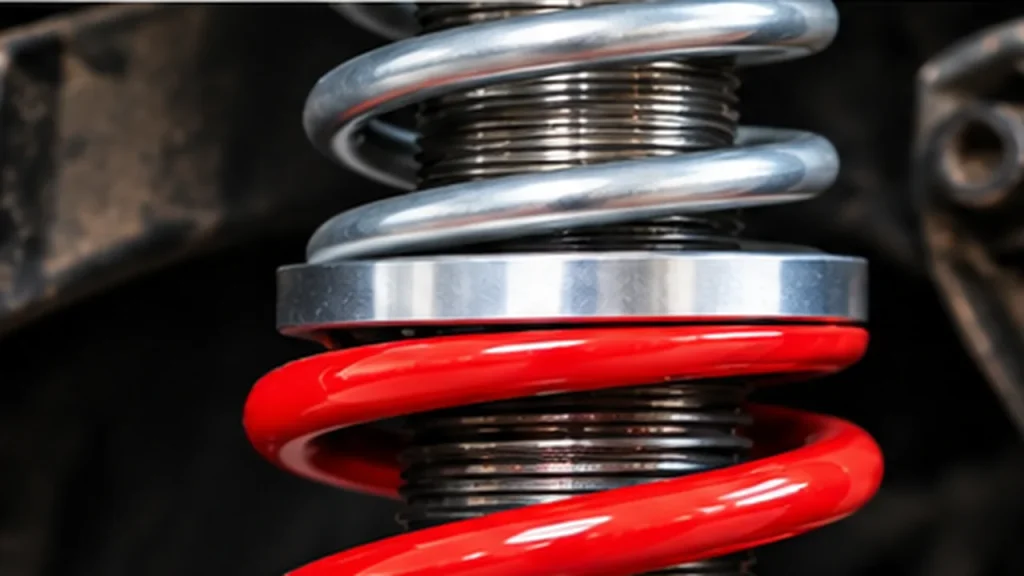
Should a Coilover Helper Spring Go Above or Below the Main Spring?
There is no single “always on top” or “always on bottom” rule. You will find legitimate assemblies with the small spring at either end. The correct position depends on where the manufacturer designed the divider and spring seats, the available clearance around the threaded body and the way the assembly is guided through the full stroke.
On a kit supplied with helpers, copy the installation drawing rather than the photograph on a generic retailer page. A top-mounted helper that is misaligned or rubs the upper mount is not better than a correctly engineered lower arrangement, and the reverse is equally true.
What a Correctly Captured Spring Stack Looks Like
At approved full extension, both springs should remain located, with the helper taking up the space the main spring would otherwise leave. At normal ride height, a conventional low-rate helper is typically closed and the main spring supports the corner. At full compression, there must be enough room for the closed helper, divider and main spring without contact or binding beyond the design limits.
Changing that assembly may require a spring compressor and safe control of substantial stored energy. Never loosen the damper shaft nut, remove a loaded top mount or try to force the spring stack into position with an unsupported vehicle. When the kit instructions do not explicitly cover the modification, have a suspension specialist confirm the parts and installation method.
Do Helper Springs Change Ride Height, Spring Rate or Shock Travel?
A correctly sized spring-capture helper is not meant to make a street car feel dramatically softer or stiffer. Its visible work happens mostly as the suspension unloads. But adding a physical stack of parts can still affect the installed geometry, and that is why an apparently harmless modification needs a full-travel check.
Spring Rate and Ride Quality
Once a conventional helper has reached solid height, the main spring largely determines the spring rate through normal loaded travel. The helper does not turn an 8 kg/mm main spring into a 10 kg/mm main spring. If the ride is harsh, changing to a helper is unlikely to solve excessive damping, insufficient bump travel or the wrong main-spring rate.
For a different main-spring stiffness, use our suspension spring rate calculator as a starting point for the appropriate rate and motion ratio. That calculation is deliberately separate from choosing a helper to retain the spring at extension.
Ride Height and Preload
On coilovers with a separate threaded lower mount, ride height and spring preload may be independently adjustable within the specified ranges. On perch-only designs, turning the spring seat can influence both. Adding a helper changes the stack geometry either way, so the installer must re-establish the intended spring condition and ride height rather than blindly returning the collars to the old positions.
If the question is how to set the collar or measure compression of the main spring, our guide to setting coilover preload covers that procedure. The present guide focuses on whether a secondary spring is needed and how to evaluate the hardware around it.
Shock Stroke and Available Suspension Travel
A helper cannot increase the damper’s fully extended length, shorten its compressed length or make a bump stop disappear. It can prevent a spring from going loose during travel the suspension already has, but it cannot create a larger travel envelope by itself. Added solid height can even create a packaging issue if the stack was already tight at full compression.
Before accepting a custom combination, verify both ends of movement. The shock length calculator can help compare measured mount distances with the proposed damper’s extended and compressed dimensions, while physical spring-stack and vehicle clearances still need their own inspection.
Common Helper Spring Problems and How to Recognize Them
When a new helper arrangement is wrong, the symptoms may appear only while the suspension is unloading or after an aggressive bump. Rather than adding more preload in response, inspect the spring stack and return to the manufacturer’s dimensions.
These warning signs deserve a closer look before the car is used normally:
- A main spring still rattles at full extension. The helper may not have enough usable extension, the adapter may be incorrect, or the spring may be mismatched to the damper.
- A divider sits crooked or binds. The coupler, guide, spring ID or seat profile may not match; forcing it together risks damage.
- The helper stays visibly open at normal ride height when it should be solid. Verify whether it is actually a tender or assist spring, or whether the chosen load/rate is wrong.
- The assembly hits something in compression. Check solid height, divider thickness, main-spring travel, bump-stop behavior and body clearance.
- Ride height shifts after installation. The stack dimensions or spring-seat reference may have changed; do not correct this by guessing collar turns.
- A new metallic knock appears after reassembly. Confirm collar locking, top mounts, divider alignment and spring seating before blaming the helper spring itself.
A helper that becomes loose, rotates out of its guide or strikes another suspension component is a reason to stop and inspect the vehicle, not to keep driving until the noise disappears.
Coilover Helper Spring Questions Before Ordering
A few small details tend to decide whether the purchase is straightforward or becomes a second round of disassembly. Here are the questions worth answering while you still have the exact coilover part number in front of you.
Should Helper Springs Be Fully Compressed at Ride Height?
For a conventional, low-rate helper designed only for spring retention, usually yes. It normally closes under the vehicle’s static load. A tender or higher-load assist spring may be intended to remain active longer. Check the maker’s load, deflection and fully compressed height figures; the product name is not enough.
Can You Remove Helper Springs From Coilovers?
Not safely as a general rule. If the manufacturer fitted one to maintain spring capture, removing it may let the main spring move out of position at full droop. A different main spring or an approved alternative stack may solve the packaging requirement, but that needs verification rather than simply deleting the small spring.
Will a Helper Spring Fix a Clunk Over Bumps?
Only if the actual fault is a loose main spring at extension and the new stack is properly engineered. A worn strut mount, sway bar link, loose collar or other joint can sound similar. A helper cannot repair failed suspension hardware or make an overextended shock safe.
Do Coilovers With Helper Springs Need More Preload?
Not automatically. The purpose of a low-rate helper is often to maintain spring seating without adding arbitrary compression to the main spring. The coilover manufacturer still determines the correct preload or spring-seat setting, and stacked springs can change how it is measured. Do not apply a generic 3 mm or 5 mm rule.
Are Coilover Helpers the Same as Truck Helper Springs?
No. Truck load-support helper springs are intended to carry additional weight or reduce loaded sag, often through auxiliary leaves, coils or other rear-suspension products. Coilover helper springs in this guide are primarily for main-spring retention at droop. Our airbags vs. helper springs for trucks comparison addresses that separate hauling and towing intent, rather than coilover spring capture.
Before Buying: Confirm Spring Capture at Both Travel Limits
A good purchase starts with a simple observation: is the main spring properly seated at the allowed full-droop position? If it is, do not add a helper just to copy someone else’s setup. If it is not, the next move is to identify why—main spring length, ride-height setting, missing guide hardware or an application that genuinely requires a helper.
Once that is clear, have the coilover manufacturer or qualified installer confirm the complete stack: spring ID, free length, usable extension, solid height, divider, seat compatibility and safe clearances at full bump and droop. A correctly chosen helper should be almost unremarkable on the road. Its value is that the main spring is still exactly where it belongs when the suspension extends again.