Trailing Arm Bushings: Symptoms, Types & Fitment
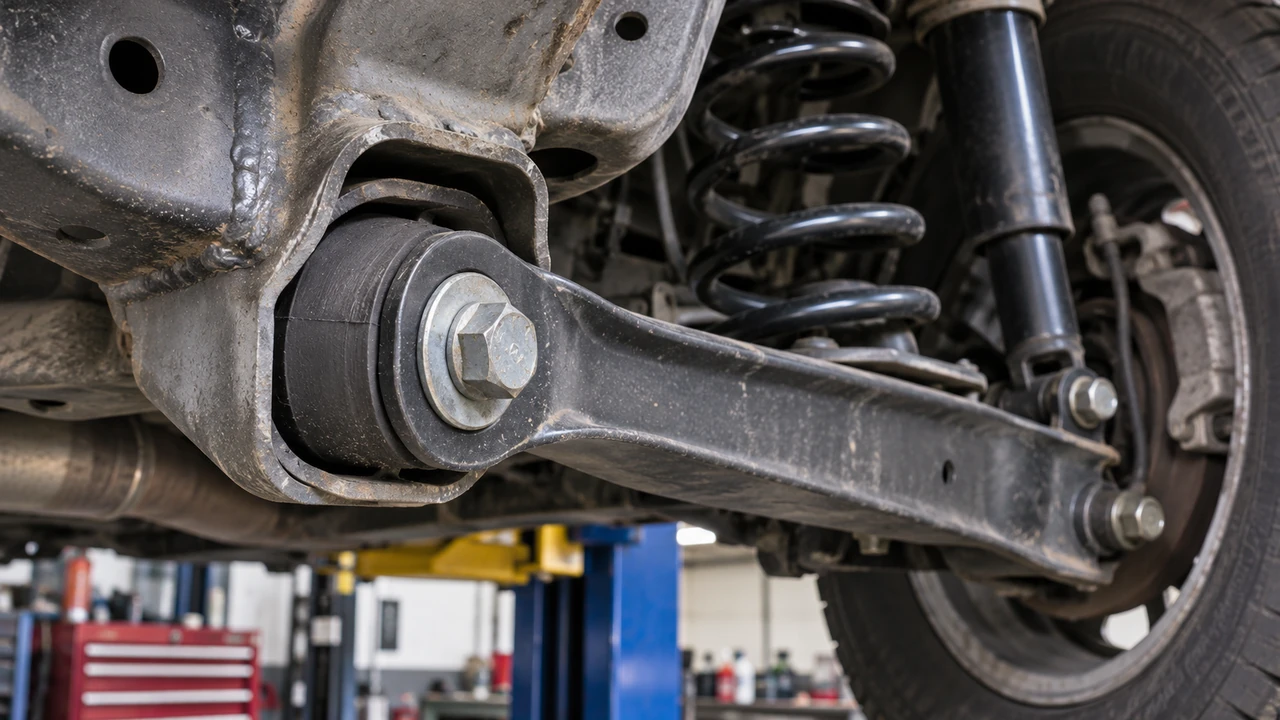
Trailing arm bushings are the flexible pivots that connect a trailing arm to the body, subframe, or axle mounting points. They let the suspension move while limiting unwanted wheel or axle movement. If the rear of the vehicle feels loose, clunks under load, or keeps wearing tires despite an alignment, a worn bushing is one possibility—but the right replacement depends on the exact suspension and mounting position.
Shopping for a set? Start with the vehicle year, make, model, trim, and drivetrain, then confirm which trailing arm, which end of that arm, and how many bushings the listing actually covers. A part labeled “rear trailing arm bushing” is not interchangeable across every rear suspension.
What Is a Trailing Arm Bushing?
Think of the trailing arm as a link that helps hold the wheel or axle in its intended fore-and-aft position. At its pivot, a rubber or other compliant bushing separates metal parts and allows the arm to move as the wheel rises and falls. Without that controlled flexibility, ordinary road impacts would travel more harshly into the body, and the joint could not work as designed.
Many conventional bushings have an inner metal sleeve for the mounting bolt and rubber bonded to a surrounding sleeve or housing. Other designs use split polyurethane pieces, a different sleeve arrangement, or a specialized joint. The construction matters when choosing a replacement—not just when installing it.
“Trailing arm” also describes more than one rear-suspension layout. A Honda-style independent arm, a BMW semi-trailing or multi-link arrangement, and a compact car’s twist beam can use quite different pivot designs. For the architecture rather than the service part itself, see our guide to trailing arm suspension
How to Find the Correct Trailing Arm Bushings
Most wrong-part orders happen before anyone touches a wrench. A parts page may show the correct-looking circular bushing, yet list a different mounting point or a kit for only one side. Match the location first, then the construction and hardware.
Check the Arm and Bushing Position
“Front” and “rear” on a listing may describe the position of the bushing on a rear trailing arm, not whether it belongs to the front or rear axle. Similarly, upper and lower trailing links on a solid-axle suspension are not automatically equivalent to the large pivot bushing on a passenger car’s rear arm.
Before ordering, identify these details from the vehicle service information or a trustworthy parts diagram:
- Exact vehicle: year, make, model, body style, drivetrain, and trim when they affect rear suspension
- Mounting location: left or right; inner, outer, front, rear, upper, or lower, as applicable
- Suspension layout: independent trailing arm, semi-trailing arm, torsion/twist beam, or a longitudinal link on a solid axle
- Kit contents: one bushing, a pair, an axle set, sleeves, washers, retaining clips, and any required bolts
- Serviceability: individual press-in bushing, insert that reuses a shell, or complete arm/beam assembly
If a seller calls a part an axle beam bushing or rear axle pivot bushing, do not dismiss it as unrelated. On some twist-beam designs those terms refer to the same pivot area buyers search for as a trailing arm bushing. Still, confirm the vehicle-specific part number rather than relying on the nickname.
Check Dimensions, Shape, and Orientation
A matching-looking bushing is not enough. The outer diameter must suit the housing, the inner sleeve must match the fastener, and the installed width must fit the bracket without forcing it. Flanges, voids in the rubber, offset centers, and orientation marks can also be deliberate parts of the design.
The table below explains what to check in a listing or before accepting a part as a direct replacement.
| Check | Why It Matters |
|---|---|
| OE or cross-reference part number | Helps confirm the application instead of guessing by appearance |
| Front/rear or inner/outer position | The same arm may have different bushings at different ends |
| Outer shell, inner sleeve, and width | Controls press fit, bolt fit, and bracket spacing |
| Voids, arrows, or offset center | May specify load direction or a geometry-correction design |
| Pieces and hardware in the package | A “kit” may service one pivot, one side, or both sides |
| Rubber, polyurethane, or bearing construction | Changes ride isolation, movement, and sometimes installation method |
If the old bushing has a directional pattern, take a clear reference photo before removal and check the manufacturer’s procedure. A voided or offset replacement may need a specific orientation. The fact that a bushing physically fits into a bore does not prove it will locate the suspension correctly.
Know the Vehicle-Specific Names
A few search terms are useful when catalogs seem inconsistent. BMW E36/E46 owners often encounter RTAB, short for rear trailing arm bushing. Older Honda Civic and Acura Integra listings frequently use “rear trailing arm bushing.” Some Volkswagen twist-beam applications refer to “rear axle beam” or “axle pivot” bushings. Those are examples of catalog language, not proof that parts fit across models, generations, or suspension variants.
When the rear axle design itself is uncertain, identify that first. A twist beam and an independent multi-link rear suspension are not the same assembly, as explained in our torsion beam vs. multi-link comparison
Symptoms of Bad Rear Trailing Arm Bushings
A failed bushing can let a rear wheel or axle shift under forces it was meant to resist. That can show up in the way the vehicle tracks before it produces an obvious noise. None of the signs below proves the bushing is bad on its own.
The Rear End Feels Loose or Steers Slightly Under Load
You may notice the back of the car taking a moment to settle after a lane change, feeling as though it moves sideways over a mid-corner bump, or following a slightly different line when you lift off the throttle. On some designs this is a change in rear-wheel toe caused by excess bushing movement, often described as compliance steer. Tires, other rear links, loose mounts, and alignment faults can feel similar.
Clunks When Braking, Accelerating, or Crossing Bumps
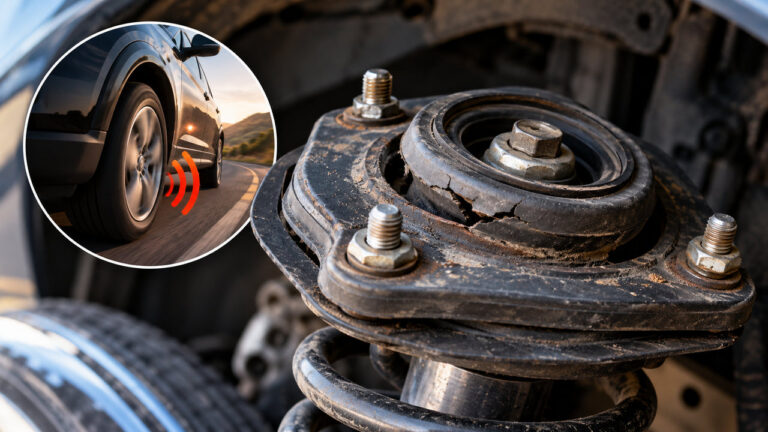
A dull knock near the rear floor or wheel area can occur as a badly worn pivot changes load direction. It is worth noting whether the sound appears on takeoff, when braking, on a driveway ramp, or only over small bumps. A loose exhaust, shock mount, sway bar link, or subframe mounting point can make a convincing imitation, so noise alone is not a reason to order bushings.
Uneven Rear Tire Wear or Alignment That Will Not Stay Put
A bushing that no longer holds its pivot position can affect rear toe or thrust angle on certain suspensions. The result may be irregular rear-tire wear or a car that still feels unsettled after alignment. But tire pressure, a bent arm, wheel damage, other links, and a shifted subframe need to be ruled out before blaming a single pivot.
How to Tell Whether the Bushing Is Actually Worn
The best evidence comes from the pivot itself: damaged rubber, separation around a sleeve, or movement beyond what that joint is designed to allow. A quick visual check is helpful; confirming the fault often requires a technician to support the vehicle and load the suspension appropriately.
Look for Separation, Displacement, and Contact
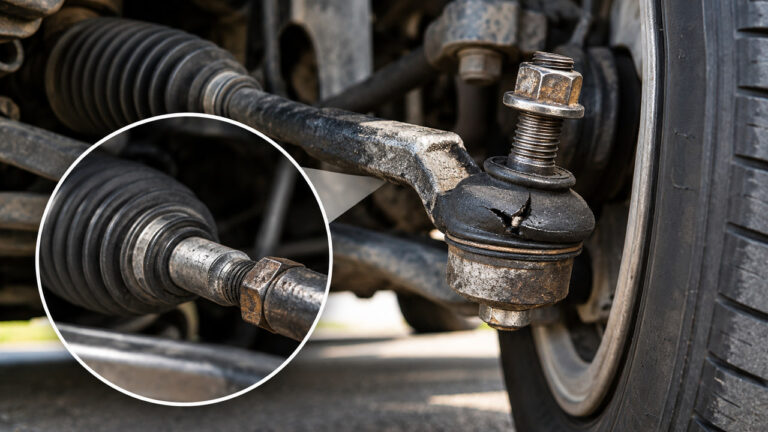
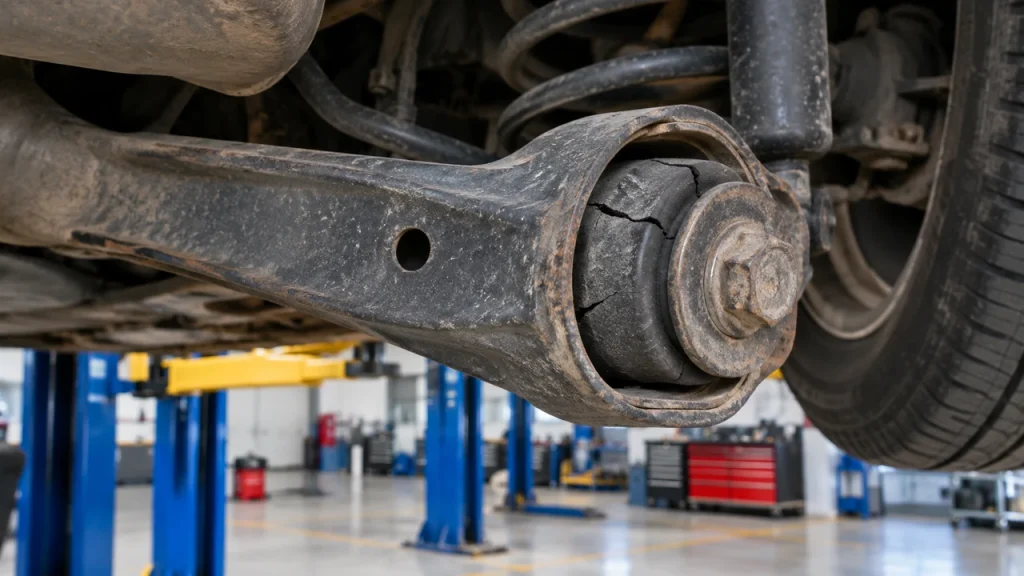
A failing bonded-rubber bushing may have a gap between rubber and metal, deep tears through a load-bearing section, an inner sleeve that sits visibly out of position, or marks where metal components have been contacting one another. Oil contamination, distorted brackets, or an oval mounting eye deserve attention too. A small amount of superficial aging on exposed rubber is not the same as a failed bond.
Compare Movement With the Other Side
With the vehicle safely supported according to its service procedure, a technician can check whether the pivot shifts abnormally as the arm is loaded. Comparing left and right can help, but the healthy-looking side is not an absolute specification. Some rubber movement is normal and engineered into the bushing; free play at a separated sleeve or mounting bolt is not.
Do not crawl under a car held up only by a jack, and do not loosen a loaded suspension link just to test it. If the wheel or axle can move unexpectedly, the safest option is a professional inspection before further driving.
OEM Rubber vs. Polyurethane Trailing Arm Bushings
For a daily-driven vehicle that rides well in stock form, replacement rubber matching the original design is usually the safest starting point. Polyurethane can be a useful choice for a supported performance application, but firmer does not automatically mean better for every road car or every pivot.
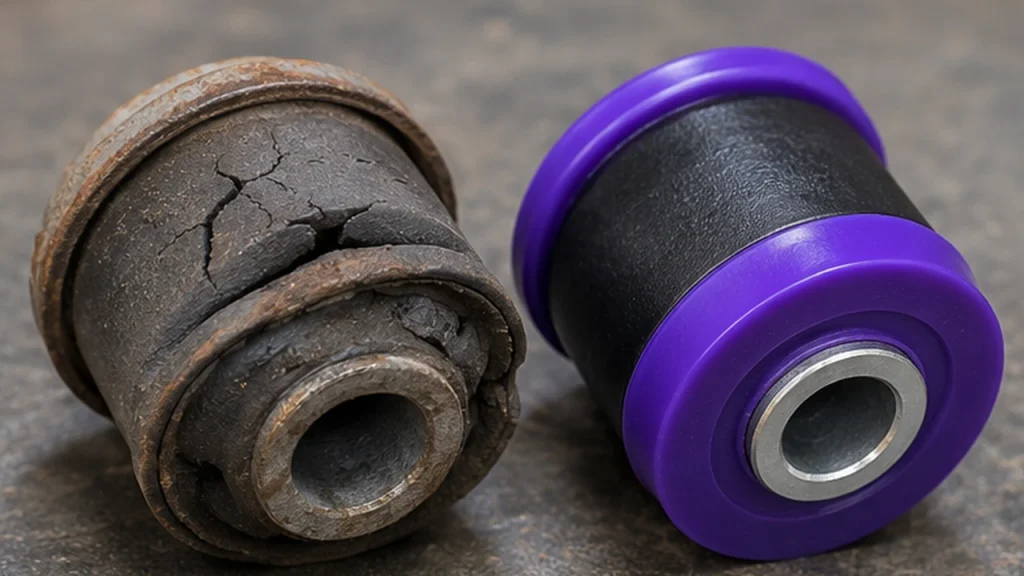
These are the practical differences to weigh before choosing a material.
| Option | Main Advantage | Main Trade-Off |
|---|---|---|
| OE-style rubber | Original-style compliance and noise isolation | Can deteriorate with age and contamination |
| Polyurethane | Often reduces unwanted deflection; performance choices available | May add noise or harshness; some designs need specified lubrication |
| Spherical bearing / monoball | Very precise pivot control in suitable performance applications | Typically more noise, vibration, maintenance, or exposure concerns |
A voided original bushing may also be tuned to move more in one direction than another. Replacing that behavior with a uniformly stiff insert can change the way the rear suspension responds to bumps. Consider the complete vehicle setup, not just the promise of a “stiffer” part.
Rubber for Factory-Like Ride Quality
Choose an OE or reputable OE-equivalent rubber bushing when comfort, low noise, and predictable stock geometry matter most. Look for the correct bonding arrangement and void pattern. Avoid assuming an inexpensive universal rubber insert will behave like a vehicle-specific factory part.
Polyurethane for a Specific Handling Goal
Polyurethane bushings come in different designs and durometers, a measure of material hardness. A split kit with a sleeve can be quite different from a pressed-in shell design; some require a manufacturer-approved grease at the rotating surfaces. A hard track-focused bushing may feel unnecessarily busy on a commuter car, particularly when other mounts are already stiff.
For a concrete example of how manufacturers distinguish kit contents and mounting positions, Whiteline lists its vehicle-specific trailing arm bushing products
Offset Bushings and Spherical Joints Are Not Universal Upgrades
Offset bushings are sometimes sold for correcting a particular alignment condition, while spherical joints are aimed at applications that benefit from less compliance. Neither belongs on a vehicle solely because a parts search shows it as an upgrade. Match the exact suspension, intended geometry, and installation instructions before changing the original pivot design.
Buy the Bushing, a Kit, or the Complete Trailing Arm?
A single worn pivot does not automatically mean the metal arm must be discarded. Conversely, buying a cheap bushing makes little sense if the arm is bent, cracked, badly corroded, or its bore is damaged. Some manufacturers also supply the bushing only as part of an arm or axle assembly.
Before placing the order, weigh the available repair options against the actual condition of the mounting area:
- Individual bushing: reasonable when the arm is sound and the manufacturer permits separate service
- Pair or multi-piece kit: useful when more than one bushing is worn or when the kit supplies the required sleeves and hardware
- Complete arm assembly: may be preferable if the bushing is not serviced separately, the arm is damaged, or a preassembled part saves substantial pressing labor
- Complete axle/beam service: only when required by the vehicle design or damage; not the default answer for one worn pivot
Ask whether a listing includes both rear sides, and inspect the opposite pivot rather than automatically replacing every bushing on the vehicle. On an older car, replacing the paired pivots may be practical, but the scope should follow the condition and service guidance.
What to Confirm Before a Replacement Job
The correct part is only half the repair. A bushing can wear prematurely, squeak, or leave the rear alignment wrong if the installation procedure ignores its orientation, suspension position, or joint design. These are checks to discuss with the shop or confirm in the factory service information—not a universal step-by-step removal procedure.
Press Fit and Orientation
Many bonded-rubber bushings require a properly supported press operation; pressing against the wrong shell or damaging the trailing arm’s mounting bore can make a good replacement unsafe. Some polyurethane kits use existing metal shells and a completely different method. If you are comparing extraction methods, our separate guide covers bushing removal without a shop press
Final Torque at the Specified Suspension Position
On many bonded-rubber pivots, final tightening is done at normal ride height or at a manufacturer-defined suspension position. Locking the inner sleeve while the suspension hangs at full droop can leave the rubber twisted during ordinary driving. This rule is not universal for every polyurethane or bearing design, so use the instructions for the exact bushing and vehicle.
Rear Alignment After the Work
A rear trailing arm or beam pivot is part of wheel location. Removing it can disturb rear toe, thrust angle, or a factory adjustment point. Have the relevant wheel alignment checked after the repair and adjusted where the design allows. For the broader rules on which repairs affect alignment, see alignment after suspension replacement
Trailing Arm Bushing FAQs
These are the points most worth clearing up before purchasing parts or approving a repair.
Are rear trailing arm bushings the same as rear control arm bushings?
Sometimes a parts catalog groups trailing arms under the broader control-arm category, but the terms are not interchangeable across every suspension. Rear multi-link systems can contain several other control-arm bushings that do completely different jobs. Identify the physical arm and its pivot before buying.
Can bad trailing arm bushings change wheel alignment?
Yes. Depending on the suspension design, wear can allow the rear wheel or axle to shift under load and change toe or thrust angle. A static alignment reading may not reveal all the movement, which is why the pivot itself needs checking.
Do you have to replace both rear trailing arm bushings?
Not as an automatic rule. Inspect both sides, compare their condition, and follow any model-specific service recommendation. Replacing a pair is often sensible when both are similarly worn or labor access makes a second job likely, but a healthy side does not need replacement solely because its partner failed.
Are polyurethane trailing arm bushings better than rubber?
They can be better for a particular performance goal, especially where reducing unwanted deflection matters more than isolating road noise. For many daily drivers, OE-style rubber is the better balance. Fitment, construction, hardness, and the rest of the suspension matter more than material alone.
Can you keep driving with a torn trailing arm bushing?
Do not ignore a confirmed torn or separated bushing. If the vehicle feels unstable, a wheel or axle is moving abnormally, or the mounting point is damaged, avoid driving it and arrange a professional assessment or tow. If the concern is only light surface checking with no excess movement, a technician can assess whether replacement is actually needed.