Upper Control Arm Replacement Cost: Parts & Labor
Upper control arm replacement typically costs about $300 to $800 per side on a mainstream vehicle in the United States. Trucks, SUVs, premium vehicles, expensive OEM assemblies, difficult access, or aftermarket performance arms can push the installed price toward $1,000 or more per side.
The final bill depends on much more than the metal arm itself. Some upper control arm assemblies include new bushings and a ball joint, while others require those components to be serviced separately. Labor time, corrosion, alignment, and the exact suspension design can also change the price substantially.
Upper Control Arm Replacement Cost at a Glance
| Job | Useful U.S. Planning Range | What to Confirm |
|---|---|---|
| One upper control arm | About $300–$800+ | Parts included and labor |
| Both upper control arms | About $600–$1,400+ | Whether both sides actually need replacement |
| Truck or SUV upper control arm | About $400–$1,000+ per side | OEM vs. aftermarket or upgraded arm |
| Wheel alignment | Often about $90–$200 | Whether it is included in the estimate |
These are planning ranges rather than fixed quotes. A simple aftermarket arm on a common passenger vehicle can cost considerably less than an OEM aluminum assembly or an upgraded control arm designed for a lifted truck.
What Is an Upper Control Arm?
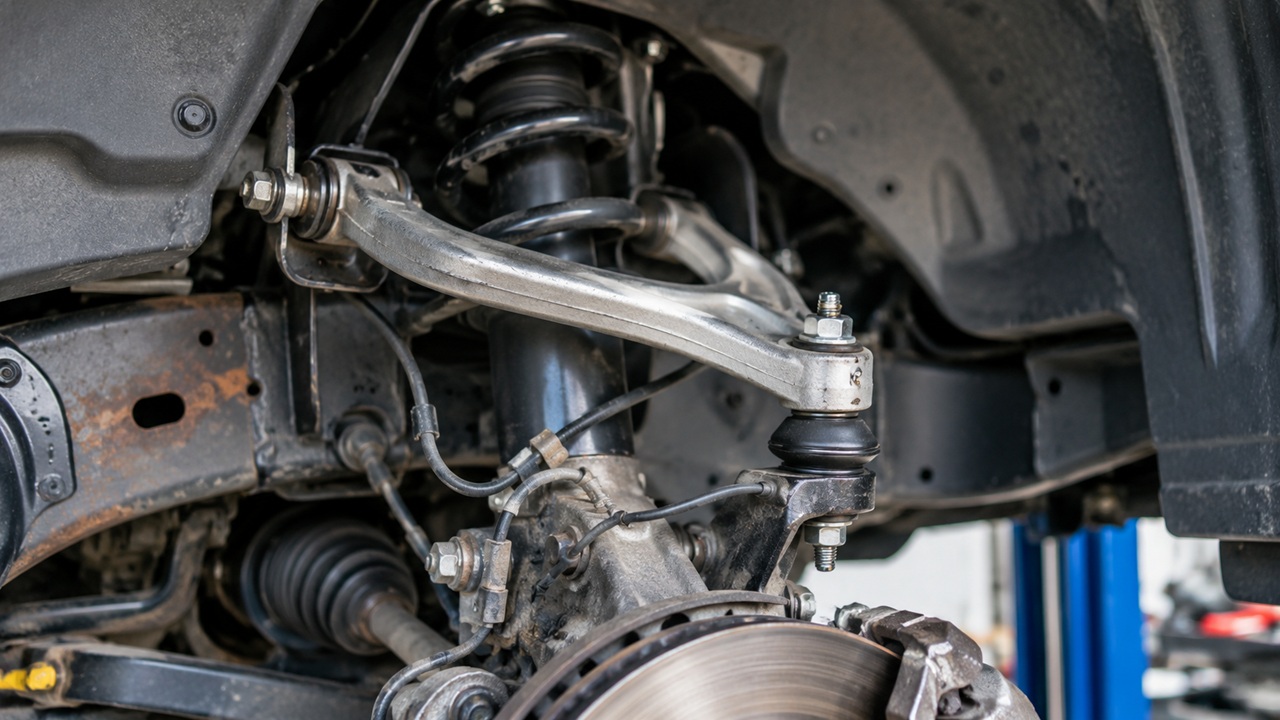
An upper control arm connects the upper part of the steering knuckle or wheel carrier to the vehicle’s frame or body. Together with the lower control arm and other suspension components, it helps control wheel movement while maintaining the wheel’s position through suspension travel.
Upper control arms are common on double-wishbone and short-long-arm suspension designs, particularly on trucks, SUVs, some performance vehicles, and older passenger cars. Many modern MacPherson-strut front suspensions do not use a conventional upper control arm at all.
If your repair estimate simply says “control arm” without identifying whether it is upper or lower, start with our broader control arm replacement cost guide.
Upper vs. Lower Control Arm Replacement Cost
Upper and lower control arms should not automatically be priced as though they are the same repair. The components can differ substantially in size, design, access, ball-joint arrangement, and labor requirements.
On many trucks and SUVs, the upper arm is smaller and easier to access than the lower arm. In other applications, access to mounting bolts or nearby suspension components can make the upper-arm job surprisingly labor-intensive.
If the diagnosis specifically calls for the lower arm, use our dedicated lower control arm replacement cost guide rather than applying upper-arm prices to that repair.
Parts vs. Labor Cost
Upper control arm replacement usually combines the price of the assembly with one to several hours of labor, depending on the vehicle.
| Cost Item | Typical Effect on the Bill |
|---|---|
| Upper control arm | Often about $80–$400+, with OEM and performance arms costing more |
| Labor | Often about $150–$450+ depending on access and shop rate |
| Ball joint | May be included in the arm assembly or serviced separately |
| Bushings | Often preinstalled in a complete replacement arm |
| Hardware | Corroded or specified single-use fasteners can add cost |
| Alignment | Commonly checked or performed after replacement |
A quote with a higher parts price is not necessarily worse value. A complete assembly containing new bushings and a ball joint may eliminate the cost of replacing those components separately.
How Much Does One Upper Control Arm Cost to Replace?
For one side, approximately $300 to $800 is a useful planning range for many vehicles. Straightforward mainstream applications can fall below that range, while trucks, luxury vehicles, OEM parts, performance arms, or difficult installation can push the total above $1,000.
Before judging a quote, check whether it includes only the arm or also includes the ball joint, bushings, new hardware, labor, and alignment.
How Much Does It Cost to Replace Both Upper Control Arms?
Replacing both sides commonly costs about $600 to $1,400 or more. Trucks and SUVs using expensive OEM or upgraded arms can exceed that range.
The cost is not always exactly twice a one-side repair. Some labor setup and the wheel alignment may only be charged once when both sides are completed during the same visit.
However, replacing both sides is not automatically required. If one upper control arm is damaged and the opposite side remains in good condition, replacing only the failed side may be appropriate.
Should Upper Control Arms Be Replaced in Pairs?
No universal rule requires upper control arms to be replaced in pairs. They are different from shocks and struts, where matching damping behavior across an axle is an important consideration.
The opposite upper arm should still be inspected carefully. If both sides have similar mileage and both show deteriorated bushings, loose ball joints, corrosion, or other measurable wear, replacing both during the same service can make sense.
If only one arm is bent after an impact or has an isolated failed joint, there may be no technical reason to replace a healthy arm on the opposite side.
Does an Upper Control Arm Include the Ball Joint?
Many complete upper control arm assemblies include a new ball joint, especially on trucks and SUVs, but this is not universal.
Some designs use a ball joint that can be replaced independently. Others integrate or permanently attach the joint to the arm, making replacement of the complete assembly the normal repair.
This difference can make two quotes appear hundreds of dollars apart. Ask whether the replacement arm includes the ball joint before comparing prices.
What About Upper Control Arm Bushings?
Most complete replacement upper control arms come with new bushings already installed. That makes the assembly easier to replace as a unit and eliminates the need to press new bushings into the old arm.
On some vehicles, however, the bushings are separately serviceable. Replacing only the bushings can reduce the parts cost but may add significant labor because the arm still has to be removed and the old bushings pressed or driven out.
That means bushing-only replacement is not automatically cheaper. This page focuses on replacement of the complete upper control arm; a diagnosis specifically calling for upper control arm bushings represents a different repair scope.
Do You Need an Alignment After Upper Control Arm Replacement?
A wheel alignment should generally be checked after replacing an upper control arm, and many vehicles will require an alignment afterward. The arm helps determine the wheel’s position, and some upper-control-arm mounting points directly affect camber and caster.
On trucks and SUVs, alignment becomes especially important when aftermarket upper arms are installed to correct geometry after a suspension lift.
Ask the repair shop whether alignment is included in the quoted total. Our guide to alignment after suspension replacement explains when suspension work changes wheel geometry and when an alignment is needed.
Front Upper Control Arm Replacement Cost
Most upper control arm searches refer to the front suspension. Trucks, SUVs, and double-wishbone passenger vehicles commonly use an upper arm on each front corner.
A front upper control arm can commonly cost around $300 to $800 per side installed, but vehicle-specific differences are substantial. Heavy-duty trucks, premium SUVs, performance vehicles, and aftermarket off-road suspension setups can cost more.
Do not judge a front-upper-arm estimate using only a national average. The exact assembly, ball joint design, bushings, labor procedure, and required alignment matter much more.
Rear Upper Control Arm Replacement Cost
Some independent rear suspension systems use upper control arms or upper links, but rear layouts vary greatly between vehicles.
A rear upper control arm replacement can range from a few hundred dollars to more than $1,000 depending on the vehicle, the number and design of rear links, access, parts cost, and alignment requirements.
Because manufacturers use different terminology for multilink rear suspension components, always confirm the exact part number before applying a generic upper-control-arm cost estimate to a rear repair.
Why Upper Control Arms Are Common on Trucks and SUVs
Many pickups and SUVs use double-wishbone or short-long-arm front suspension designs with both upper and lower control arms. This allows the suspension geometry to be controlled through a large range of travel while handling the vehicle’s weight and operating conditions.
As a result, upper control arms are especially common replacement or upgrade items on trucks used for towing, off-road driving, larger tires, or suspension lifts.
Those applications can also cost more because the replacement arm may be forged, boxed, tubular, adjustable, or designed to correct ball-joint angle and alignment geometry.
Stock Replacement vs. Aftermarket Upper Control Arms
Parts choice can have a major impact on upper control arm replacement cost.
A stock-style aftermarket control arm is generally intended to restore factory suspension geometry and ride characteristics. It is often less expensive than an OEM part.
Performance and off-road upper control arms can cost considerably more. They may use stronger materials, larger or serviceable ball joints, upgraded bushings, adjustable geometry, or additional clearance for lifted suspension systems.
That means a $250 replacement arm and a $700 aftermarket upper control arm may serve very different purposes. Compare the intended application rather than assuming the cheaper component is directly equivalent.
Upper Control Arms on Lifted Trucks
A suspension lift can change upper control arm and ball-joint angles. On some trucks, an aftermarket upper control arm is installed not because the original arm has failed, but because the new suspension height requires different geometry or additional clearance.
This is an upgrade rather than a straightforward stock repair, so pricing can be much higher than a normal replacement arm. Premium aftermarket upper control arms can cost several hundred dollars each before installation and alignment.
If your quote is associated with a lift kit or off-road suspension setup, make sure you are comparing it with similar upgraded arms rather than factory-style replacement parts.
OEM vs. Aftermarket Upper Control Arms
OEM upper control arms are designed to match the manufacturer’s original specification and can be significantly more expensive than aftermarket replacements.
Aftermarket choices range from inexpensive stock-style assemblies to premium adjustable or off-road arms. Build quality, bushings, ball-joint design, warranty, serviceability, and materials can vary substantially.
When comparing quotes, ask for the brand and part number rather than accepting a vague line item such as “upper control arm.” The component selected can explain a large portion of the price difference.
Why an Upper Control Arm Quote Can Exceed $1,000
A quote above $1,000 per side should be examined carefully, but it is not automatically unreasonable.
- expensive OEM control arm assemblies
- premium adjustable or off-road upper control arms
- integrated ball joints and bushings
- truck, SUV, luxury, or performance applications
- seized or heavily corroded mounting hardware
- difficult access around struts, coilovers, or body structures
- additional suspension repairs performed at the same time
- alignment after installation
- higher dealership or regional labor rates
If your estimate includes several suspension components in addition to the upper arm, use our car suspension repair cost guide to evaluate the broader repair scope.
How to Compare Two Upper Control Arm Quotes
- Confirm the exact arm. Check front or rear, left or right, and make sure the estimate specifically identifies an upper control arm.
- Check the quantity. Determine whether the total covers one arm or both sides.
- Ask whether the ball joint is included. Complete assemblies often include it, but not universally.
- Check the bushings. Find out whether they are already installed in the replacement arm.
- Identify the part type. A stock replacement arm and an adjustable off-road arm are not equivalent.
- Get the brand and part number. This lets you compare OEM and aftermarket components properly.
- Review labor and additional hardware. Rust or difficult access can add legitimate labor time.
- Check the alignment. Determine whether it is required and already included in the quote.
A higher quote may represent better value if it includes a complete quality arm, new ball joint and bushings, necessary hardware, labor, and alignment while the cheaper estimate leaves several of those items out.
Symptoms of a Bad Upper Control Arm
Upper control arm problems can come from a damaged arm, worn bushings, or excessive play in the ball joint.
- clunking or knocking over bumps
- steering that feels loose or inconsistent
- vehicle wandering or pulling
- uneven or rapid tire wear
- visible cracking or separation in control-arm bushings
- excessive movement at the upper ball joint
- a visibly bent control arm following an impact
Those symptoms are not unique to an upper control arm. Tires, lower control arms, tie rods, wheel bearings, ball joints, and alignment problems can create similar complaints.
If the vehicle feels unstable, wanders, or requires constant steering correction, our guide to a car that feels loose or wanders while driving covers the broader causes.
Can You Drive With a Bad Upper Control Arm?
The answer depends on what has failed and how severe the wear is. Mild bushing deterioration is very different from a severely loose ball joint, cracked arm, or damaged mounting point.
Because the upper control arm helps locate the wheel, severe failure can affect steering, alignment, tire contact, and vehicle control. Significant play, visible structural damage, unstable steering, or a badly worn ball joint should be inspected promptly.
Can You Replace an Upper Control Arm Yourself?
Upper control arm replacement can be an intermediate-to-advanced DIY repair depending on the suspension design.
The vehicle must be safely raised and supported, the upper ball joint separated from the steering knuckle correctly, and mounting hardware removed and reinstalled to the manufacturer’s specified torque.
Access can be difficult on some vehicles because the upper-arm bolts may sit close to the body, strut tower, engine bay, brake lines, wiring, or other components.
Bonded rubber control-arm bushings may also require tightening at the specified suspension position rather than with the suspension hanging at full droop. Incorrect preload can shorten bushing life.
Professional replacement is usually the safer option if you cannot safely support the vehicle, separate suspension joints correctly, follow the factory procedure, or arrange the required wheel alignment afterward. Never work underneath a vehicle supported only by a jack.
Frequently Asked Questions
How much does it cost to replace an upper control arm?
About $300 to $800 per side is a useful planning range for many U.S. vehicles. Trucks, SUVs, premium vehicles, OEM parts, aftermarket performance arms, difficult labor, and alignment can push the installed price toward $1,000 or more.
How much does it cost to replace both upper control arms?
Replacing both sides commonly costs approximately $600 to $1,400 or more. Premium trucks, SUVs, and upgraded suspension systems can cost significantly more.
Should upper control arms be replaced in pairs?
Not automatically. The opposite arm should be inspected, particularly if both sides have similar age and mileage, but a good upper control arm generally does not need replacement solely because the other side has failed.
Does an upper control arm come with a ball joint?
Many complete upper control arm assemblies include a new ball joint, but others do not. Check the exact replacement part before comparing repair quotes.
Do upper control arms come with bushings?
Most complete replacement upper control arms include new bushings already installed, although some suspension designs allow bushings to be serviced separately.
Do you need an alignment after replacing an upper control arm?
Alignment should generally be checked after upper control arm replacement, and many vehicles will require adjustment because the arm influences wheel position and alignment geometry.
How long does upper control arm replacement take?
Many straightforward jobs require roughly one to three labor hours per side, but corrosion, difficult mounting-bolt access, surrounding components, and suspension design can increase the time.
Compare the Complete Repair, Not Just the Arm Price
For many mainstream vehicles, approximately $300 to $800 per side is a useful starting budget for upper control arm replacement. Trucks, SUVs, premium vehicles, and upgraded suspension systems can cost more.
Before deciding whether a quote is expensive, confirm which upper control arm is being replaced, whether the estimate covers one side or both, whether the ball joint and bushings are included, what brand and type of arm will be installed, how much labor is included, and whether alignment is part of the final price. Once those details match, comparing upper control arm replacement quotes becomes much more meaningful.