Wheel Balancing Cost: Per Tire & All Four Wheels
Wheel balancing typically costs about $10 to $25 per tire, or roughly $40 to $100 for all four wheels in the United States. You may pay less when balancing is included with new tire installation, while larger wheels, difficult tire combinations or road-force balancing can push the bill higher.
The price is usually small compared with most suspension repairs, but paying for balancing only makes sense if imbalance is actually causing the vibration. An alignment problem, bent wheel, defective tire or worn steering component will not be fixed by adding wheel weights.
Wheel Balancing Cost Per Tire and for All Four
| Balancing Service | Useful U.S. Planning Range |
|---|---|
| Standard balance, one tire | About $10–$25 |
| Standard balance, four tires | About $40–$100 |
| Road-force balance, four tires | About $80–$160 |
| Large, performance or off-road tires | May cost more |
| Balancing with new tire purchase | May be bundled into installation |
| Alignment | Separate service |
This is why comparing a $15 balancing charge with a $100 invoice can be misleading. One price may be per wheel while the other covers the entire vehicle, and one shop may bundle balancing with rotation or tire installation.
What Wheel Balancing Actually Corrects
A tire and wheel assembly is never perfectly uniform. One area can weigh slightly more than another because of variations in the tire, wheel, valve stem and other components.
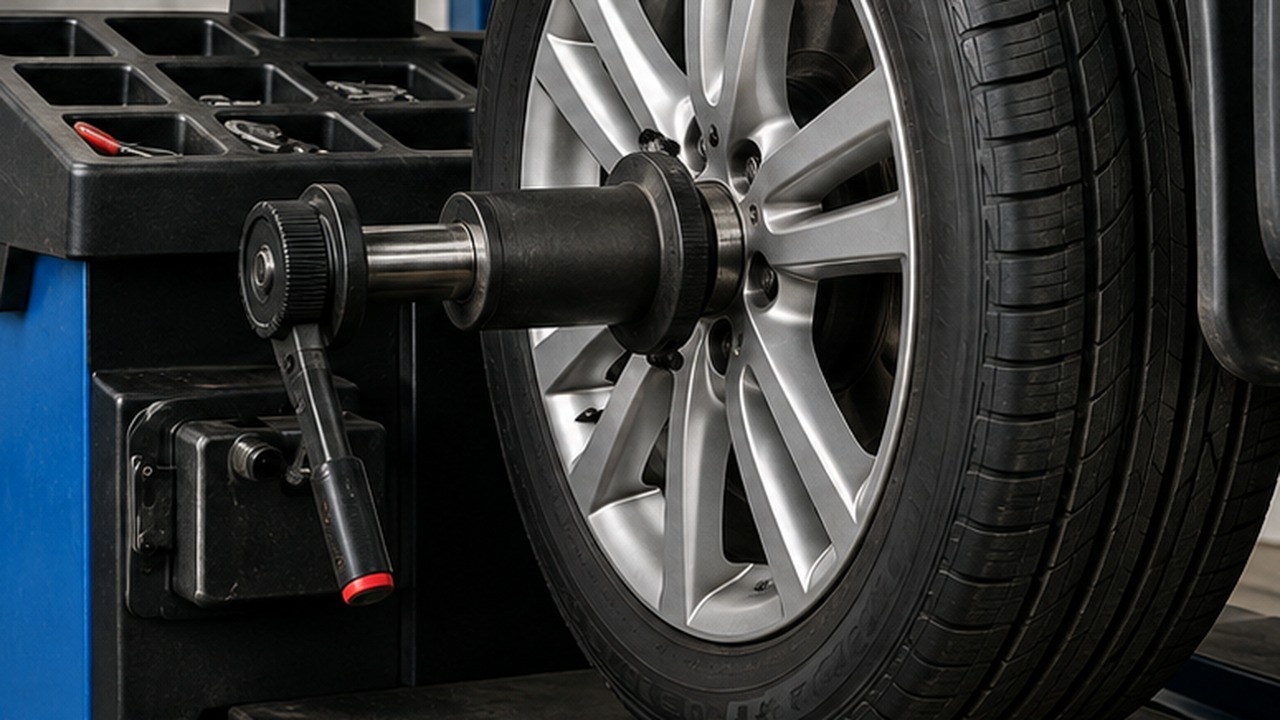
During balancing, the technician places the wheel-and-tire assembly on a machine and spins it. The machine identifies where weight needs to be added so the assembly rotates more evenly.
Small clip-on or adhesive weights are then installed on the wheel. The assembly is spun again to verify the correction.
The goal is not to change where the wheel points. It is to reduce the centrifugal forces created by uneven weight distribution as the wheel rotates.
Why a Small Imbalance Feels Much Worse at Highway Speed
An imbalance that is barely noticeable around town can become obvious as vehicle speed increases.
The faster the wheel rotates, the more strongly an uneven mass can shake the assembly. That is why a common complaint is a vehicle that feels smooth at 30 or 40 mph but develops a steering-wheel or body vibration around highway speeds.
If the entire vehicle feels unstable rather than simply vibrating at a certain speed, there are other possibilities. Our guide to a car that feels wobbly while driving covers suspension and steering causes that balancing cannot correct.
Steering Wheel Vibration vs. Seat or Floor Vibration
Where you feel the vibration can provide a useful clue, although it is not a perfect diagnostic test.
An imbalance at a front wheel is often felt strongly through the steering wheel because the front wheels are connected directly to the steering system.
A rear-wheel imbalance may be felt more through the seat, floor or body of the vehicle.
But vibration can travel through the chassis, and tire condition, suspension design and vehicle speed all influence what the driver feels. A shop should still inspect all four assemblies rather than diagnosing one wheel solely by the location of the shake.
Why Wheels Become Unbalanced
A wheel can lose its balance even if nobody has recently changed the tire.
- A wheel weight can fall off.
- Tire wear gradually changes the distribution of rubber around the assembly.
- A tire can move slightly on the wheel after installation.
- Mud, ice or debris can collect unevenly inside or on the wheel.
- A wheel can become bent after a pothole or curb impact.
- A tire can develop internal runout or structural variation.
The last two examples are especially important because adding more weights may reduce the measured imbalance without solving the underlying mechanical problem.
A Bent Wheel Is Not the Same as an Unbalanced Wheel
A balancing machine corrects differences in mass. It does not straighten a wheel that no longer rotates in a true circle.
A bent rim can have lateral or radial runout, meaning the wheel moves from side to side or up and down as it rotates. The machine may still ask for balancing weights, but the driver can continue to feel vibration afterward.
If a wheel requires an unusual amount of weight or repeatedly refuses to balance smoothly, checking wheel runout is more useful than endlessly adding weights.
A Tire Can Balance Correctly and Still Cause a Vibration
This is another reason balancing is not a universal vibration cure.
A conventional balancer mainly detects mass imbalance while the tire spins freely. It cannot fully reproduce how the tire behaves when supporting vehicle weight against the road.
A tire can have excessive radial force variation, internal construction variation or runout even when the machine shows that its weight distribution is technically balanced.
That is where road-force testing can become useful.
When Road-Force Balancing Is Worth Paying For
Road-force balancing uses a machine with a roller that presses against the tire while it rotates. The roller simulates some of the load the tire experiences on the road.
This allows the equipment to identify problems that a basic spin balance may miss, including excessive force variation and certain wheel-and-tire matching issues.
A road-force balance commonly costs around $80 to $160 for four tires, making it more expensive than a standard balance.
It is most useful when:
- a vibration remains after conventional balancing
- new tires produce an unexpected highway-speed vibration
- a performance or low-profile tire is particularly sensitive to variation
- the shop suspects wheel or tire runout
- the tire may need to be repositioned on the wheel for a better match
There is usually little reason to pay for road-force balancing first if an ordinary balance solves the problem completely.
Wheel Balancing vs. Wheel Alignment
These services solve fundamentally different problems.
| Wheel Balancing | Wheel Alignment |
|---|---|
| Corrects uneven rotating mass | Corrects wheel and suspension geometry |
| Uses balancing weights | Adjusts toe, camber or caster where possible |
| Often associated with speed-related vibration | Often associated with pulling, off-center steering or tire wear |
| Wheel removed and placed on a balancing machine | Vehicle placed on an alignment rack |
| Typically $40–$100 for four | Typically more expensive |
If the problem involves alignment geometry rather than rotating imbalance, see our wheel alignment cost guide for typical 2-wheel and 4-wheel prices.
Do New Tires Need to Be Balanced?
Yes. A new tire should normally be balanced after it is mounted to the wheel.
Even a high-quality new tire and an undamaged wheel have normal manufacturing variations. Once they are combined into one rotating assembly, the shop balances them together.
This is why balancing is commonly bundled into the installation price when you buy tires. A receipt may show a separate balancing charge, or the service may be included under a broader mounting-and-installation package.
Mounting and Balancing Is a Different Price From Balancing Alone
If a shop has to remove an old tire, mount a replacement tire and then balance the finished wheel assembly, you are buying more than balancing.
A mounting-and-balancing package can also include valve or TPMS-related service, tire disposal and other shop charges.
When comparing tire balancing cost between shops, make sure one quote is not for balance only while another includes complete tire installation.
Should All Four Wheels Be Balanced at the Same Time?
Not necessarily every time one wheel has a problem.
If a single tire was repaired or a wheel weight clearly fell off one corner, balancing that individual assembly may be enough.
Balancing all four is more sensible when:
- all four new tires were installed
- the vibration source is unclear
- several wheels have not been checked for a long time
- the vehicle recently developed a new highway-speed vibration
Because balancing is relatively inexpensive, the difference between checking one wheel and checking the full set may also be smaller than expected.
Does Tire Rotation Require Rebalancing?
No. Simply moving a balanced wheel-and-tire assembly from one position on the vehicle to another does not change its balance. If you are comparing the service itself, see our tire rotation cost guide.
However, some shops sell rotation and balancing together as a maintenance package, and rebalancing can make sense if vibration has developed or the tires have accumulated significant wear.
If the vehicle was smooth before rotation and begins vibrating immediately afterward, the wheels should also be checked for proper installation, torque, debris between mounting surfaces and other issues rather than assuming all four suddenly became unbalanced.
Uneven Tire Wear Is Not Proof of an Imbalance
Severe imbalance can contribute to abnormal tire wear, but tread patterns should not be diagnosed from one cause alone.
Incorrect pressure, alignment problems, worn shocks, damaged suspension components and tire defects can all change the way the tread wears.
If unusual wear is the main reason you are investigating the vehicle, our guide to suspension problems and uneven tire wear covers the broader set of possible causes.
When a Wheel Bearing Should Enter the Diagnosis
Wheel bearing problems and wheel imbalance can both produce complaints that become more noticeable with vehicle speed, but the symptoms are not identical.
A bad wheel bearing more commonly produces humming, growling or roughness that can change with cornering load. Severe bearing wear can also create play at the wheel.
Balancing weights cannot repair a worn bearing. If inspection points toward the hub or bearing assembly, our wheel bearing replacement cost guide covers that repair separately.
How Often Should Wheels Be Balanced?
There is no universal mileage interval that every vehicle must follow.
Balancing makes sense when new tires are installed, after certain tire repairs, when a wheel has lost a balance weight or when a speed-related vibration develops.
Some tire shops include periodic rebalancing in lifetime tire-service packages, which can make preventive checks inexpensive.
A vehicle that remains completely smooth does not need constant rebalancing simply because a calendar interval has passed.
Can You Balance Wheels at Home?
Basic static balancing tools exist, but modern automotive shops normally use computerized dynamic balancing equipment.
A professional machine can measure imbalance in multiple planes and identify the amount and position of corrective weight much more accurately than trial-and-error methods.
Considering that professional balancing often costs only a few tens of dollars per wheel, buying specialized equipment rarely makes financial sense for an occasional home repair.
If Balancing Does Not Fix the Vibration
A successful balance should produce a measurable improvement when imbalance was actually the cause.
If the vibration remains, the next step is not automatically to balance the wheels again. The shop may need to investigate:
- bent wheels
- tire runout or internal tire variation
- improper wheel mounting
- worn wheel bearings
- steering or suspension play
- driveline vibration
- brake-related vibration that occurs specifically while braking
Road-force testing can be a logical next step when the evidence still points strongly toward the tire-and-wheel assemblies.
Common Wheel Balancing Cost Questions
How much does wheel balancing cost?
Standard wheel balancing commonly costs about $10 to $25 per tire, or roughly $40 to $100 for all four wheels. Prices can be higher for large wheels, specialty tires or road-force balancing.
How much does tire balancing cost for four tires?
A standard four-tire balance commonly costs around $40 to $100. The service may cost less or be included when you purchase and install new tires from the same shop.
Is wheel balancing the same as tire balancing?
Yes, in normal automotive service terminology both usually refer to balancing the complete mounted tire-and-wheel assembly.
How much does road-force balancing cost?
Road-force balancing commonly costs about $80 to $160 for four tires. It is most useful when a persistent vibration remains after conventional balancing or when the shop suspects tire or wheel variation.
Can unbalanced wheels cause steering-wheel vibration?
Yes. Front-wheel imbalance commonly produces steering-wheel vibration that becomes more noticeable as vehicle speed increases.
Does wheel balancing fix pulling to one side?
Usually not. Pulling is more commonly associated with alignment, tire differences, brake drag or other steering and suspension issues. Balancing corrects uneven rotating mass.
Do new tires come balanced?
New tires need to be balanced after they are mounted onto the vehicle’s wheels. Many tire retailers include that service in the installation package rather than charging for it separately.
Do Not Keep Adding Weights to a Mechanical Problem
Wheel balancing is inexpensive and very effective when uneven rotating mass is actually causing the vibration. But a balance machine cannot straighten a bent rim, repair a defective tire, tighten a worn bearing or correct suspension geometry.
If a properly balanced wheel still shakes the vehicle, the useful next step is diagnosing why—not repeatedly paying to rebalance the same assembly. That distinction is what separates a $60 tire service from an expensive sequence of repairs that never addresses the original vibration.