Grease for Polyurethane Bushings: Best Types & How to Apply
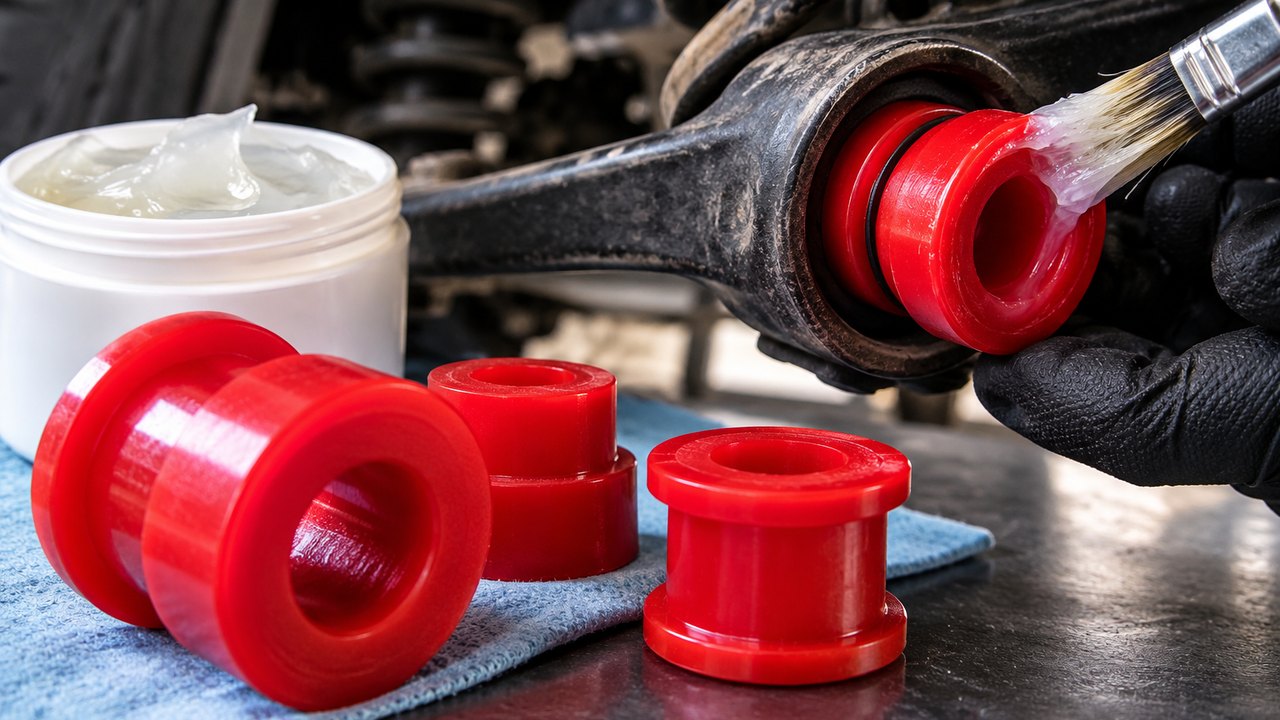
The best grease for polyurethane bushings is usually the lubricant supplied or approved by the bushing manufacturer. Many aftermarket kits use a tacky, water-resistant silicone-based grease, sometimes with PTFE to reduce friction. Energy Suspension recommends its Formula 5 Prelube, while other manufacturers specify their own formulations. There isn’t one grease that’s automatically correct for every polyurethane bushing.
If you’re buying grease separately, look for a product specifically approved for polyurethane suspension bushings, with good water resistance and the ability to stay on the contact surfaces. More importantly, check where your particular bushing needs lubrication. Some designs require grease between the polyurethane and an inner metal sleeve; others have additional contact points or are designed to run dry in certain areas.
This guide covers which greases are worth considering, how to apply them, why polyurethane bushings squeak, and what to do when the noise comes back after lubrication.
Best Grease for Polyurethane Bushings: Quick Comparison
Before choosing a tube, identify the manufacturer and part number of your bushings. That’s particularly important with performance control arms, aftermarket sway bars, and suspension kits that use several different bushing designs.
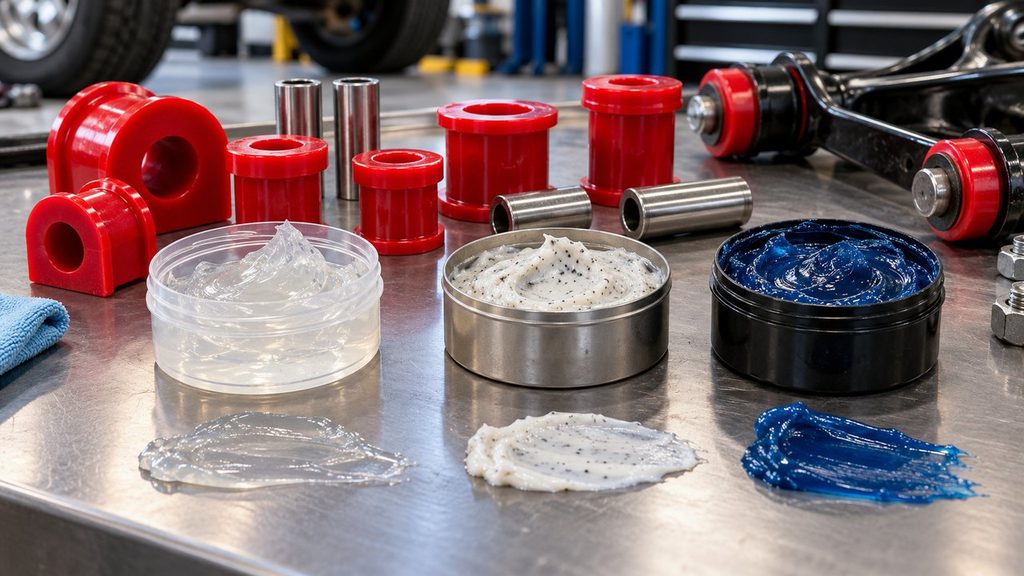
| Grease type | When it makes sense | What to watch for |
|---|---|---|
| Manufacturer-supplied polyurethane bushing grease | Best starting point for a compatible aftermarket kit | Use the grease and application instructions for the exact part. |
| Silicone-based grease with PTFE | Common choice for polyurethane bushings when specified or approved | Confirm compatibility and whether the product is intended for loaded suspension pivots. |
| Water-resistant synthetic grease | Alternative for kits whose manufacturer explicitly permits it | “Synthetic” alone doesn’t establish polyurethane compatibility. |
| Marine-grade grease | Potential alternative when the bushing manufacturer approves the formulation | Marine grease isn’t a single chemistry or universal substitute. |
| Lithium or lithium-complex grease | Only for designs whose manufacturer approves it | Do not assume ordinary chassis grease is suitable. |
| Silicone spray or penetrating lubricant | Not a reliable long-term replacement for specified bushing grease | May not reach the loaded surfaces and can attract contamination. |
For most owners, the decision is simpler than that table might suggest: if your polyurethane kit came with grease, use it according to the supplied instructions. If the packet is missing, identify the kit and obtain its approved lubricant before substituting something already sitting on the garage shelf.
Why Do Polyurethane Bushings Need Grease?
Polyurethane bushings often replace softer factory rubber bushings because they can limit unwanted movement and provide a more direct suspension response. But the way they accommodate movement isn’t always the same.
Many original-equipment rubber control arm bushings have rubber bonded between metal sleeves. As the control arm moves, the rubber twists and deforms rather than freely sliding around its inner sleeve. Those bushings generally aren’t designed for routine greasing.
A typical aftermarket polyurethane pivot bushing may instead allow controlled movement between its bore and a metal sleeve. That creates a sliding interface. Without the intended lubricant, the surfaces can develop friction and produce the familiar squeak or creak associated with some polyurethane suspension setups.
The noise often comes from stick-slip friction: the contacting surfaces resist movement momentarily, then release. During slow suspension articulation, that repeated sticking and slipping can produce an audible squeak.
A suitable grease forms a lubricating film between the designated moving surfaces. It helps them articulate smoothly, reduces friction and can limit wear. Good grease retention matters because suspension bushings experience vibration, pressure, road spray, dirt and repeated changes in load.
Not every polyurethane product needs periodic grease, though. Some use self-lubricating additives, molded grease-retaining grooves, special sleeves or different operating principles. A black bushing isn’t automatically self-lubricating, and a red one isn’t automatically in need of constant maintenance. Color and material hardness don’t replace the manufacturer’s instructions.
Silicone, PTFE, Synthetic or Lithium: Which Works Best?
Online advice often treats these as competing categories, but grease formulations are more complicated. Silicone describes a possible base oil, PTFE is a solid lubricating additive, and lithium refers to a thickener system. A grease’s performance depends on the complete formulation, not one ingredient printed prominently on the packaging.
Silicone-Based Polyurethane Bushing Grease
Silicone-based grease is a popular option because suitable formulations can offer good material compatibility, water resistance and lubrication at the sliding surfaces found in many polyurethane bushing assemblies.
Polyurethane-specific greases are often deliberately tacky. That’s helpful when the lubricant must remain between a sleeve and bushing despite repeated movement and exposure to road spray.
However, a general silicone lubricant isn’t necessarily equivalent to a grease formulated for heavily loaded suspension components. A thin product intended for household seals or light-duty mechanisms may not have the retention characteristics required by your bushing kit.
Look for documented compatibility with polyurethane and the actual automotive application, rather than relying on the word “silicone” alone.
PTFE-Fortified Grease
PTFE, short for polytetrafluoroethylene, is used in some specialty lubricants to reduce friction between contacting surfaces. You’ll also see it described as Teflon, a familiar trade name.
Several polyurethane suspension manufacturers use PTFE-containing grease in their products. Prothane, for instance, describes its Super Grease as a waterproof lubricant developed for its urethane bushings.
Still, PTFE content doesn’t make any grease universally suitable. The carrier, additives, consistency and long-term retention all matter. Treat it as a useful characteristic of an approved formulation, not a reason to disregard the part manufacturer’s recommendations.
Synthetic and Marine-Grade Grease
Energy Suspension provides a helpful example of why manufacturer guidance should come first. Its preferred lubricant is Formula 5 Prelube, but its published guidance also suggests a synthetic, water-resistant marine-grade grease if Formula 5 cannot be used.
That gives owners of applicable Energy Suspension components a documented alternative. It does not mean every manufacturer approves marine grease for every polyurethane formulation.
Marine-grade grease generally emphasizes resistance to water exposure, but products in that category can contain different oils, thickeners and additives. A cartridge intended for boat trailer bearings isn’t automatically compatible with a polyurethane control arm bushing.
Check both the lubricant specification and the bushing manufacturer’s instructions before using one as a substitute.
Can You Use Lithium or Moly Grease?
Some polyurethane bushing applications permit lithium-based or moly-containing lubricants. Others specifically recommend different products. A lithium chassis grease that works well in a greaseable ball joint may not have the desired properties for a polyurethane sleeve interface.
Molybdenum disulfide, often called moly, can provide useful boundary lubrication under load. But the presence of moly doesn’t establish compatibility with every polyurethane compound, nor does it guarantee that the grease will remain in place.
Don’t automatically transfer lubrication advice from ball joints to bushings. They’re different components with different contact surfaces. Our ball joint grease guide explains the specifications used for greaseable ball-and-socket joints.
Likewise, blanket claims that every petroleum-containing grease immediately destroys polyurethane are too broad. Polyurethane compounds and lubricant formulations vary. The sensible approach is to use the approved product instead of guessing at chemical compatibility.
What Do Polyurethane Bushing Manufacturers Recommend?
Specific recommendations are more useful than a generic list of “top five greases.” Here are several well-known aftermarket suspension manufacturers and what their published instructions tell us.
| Manufacturer | Grease guidance | Practical takeaway |
|---|---|---|
| Energy Suspension | Formula 5 Prelube; water-resistant synthetic marine-grade alternative in its published guidance | Use Formula 5 for kits that require it, or verify the approved alternative. |
| Prothane | Super Grease formulated for its polyurethane components | Use the supplied specialty lubricant according to the kit instructions. |
| Powerflex | Supplies grease with its bushing kits; published descriptions of the grease chemistry differ between its guidance pages | Follow the documentation accompanying the exact kit and confirm any uncertain substitution. |
| SuperPro | Application-specific grease supplied with relevant kits | Follow the specified contact surfaces and lubrication quantity; some surfaces are intentionally left dry. |
The Powerflex example is worth noting. Its U.S. FAQ describes the grease supplied in a silver pouch as copper-based, while another published product-guidance page describes PTFE-silicone grease. Those descriptions shouldn’t be treated as interchangeable instructions for every kit. Use the documentation supplied with your part, and confirm the correct lubricant with the manufacturer if anything conflicts.
SuperPro provides another useful reminder that application matters as much as chemistry. Instructions for certain control arm assemblies call for grease inside the bushings and on specified outer faces, while leaving other faces dry to avoid attracting dirt.
There’s a lesson in both examples: don’t copy someone else’s lubrication pattern just because the bushings look similar. The surfaces designed to slide on one kit may be held stationary on another.
Where Should You Apply Grease on Polyurethane Bushings?
The right location depends on which parts are meant to move against each other. A polyurethane bushing may have an inner metal sleeve, a separate outer shell, split halves, thrust faces or molded grease grooves.
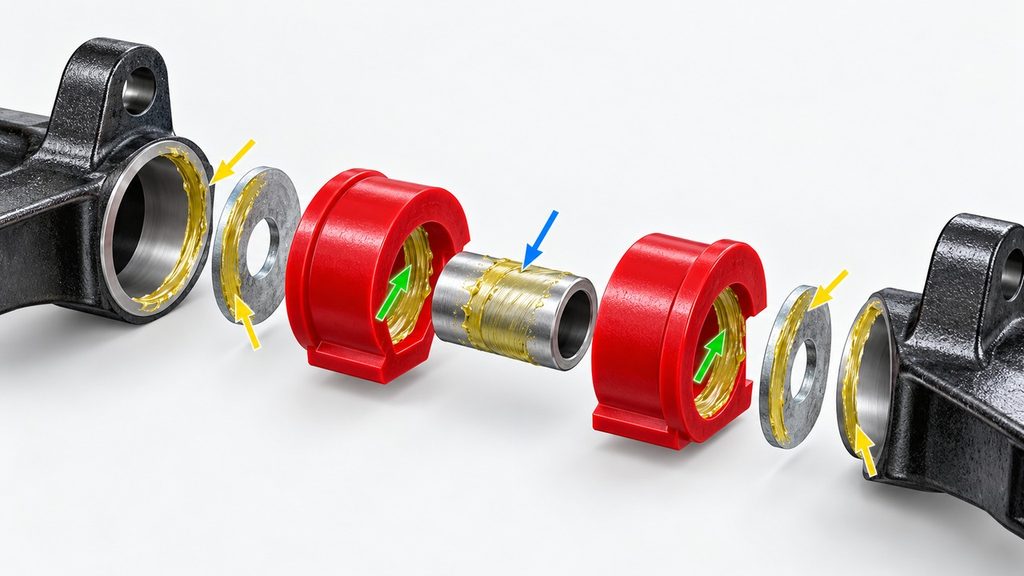
For many conventional aftermarket pivot bushings, the inner bore and mating sleeve are important lubrication points. Some also require grease on selected end faces where the polyurethane contacts adjacent metal surfaces.
| Surface | Should it be greased? | Why it matters |
|---|---|---|
| Polyurethane inner bore | Usually, when specified for a rotating or sliding sleeve design | Reduces friction at the intended pivot interface. |
| Metal pivot sleeve exterior | Often, according to the kit instructions | Provides lubrication where the sleeve contacts the polyurethane. |
| Molded grease grooves | Fill as instructed | Can help retain lubricant at the working surface. |
| Bushing thrust or end faces | Only on the faces identified by the manufacturer | Some faces slide under load; others are meant to remain dry. |
| Outer press-fit surface or metal shell | Not automatically | Some designs rely on that interface staying securely located. |
| Exposed bracket and surrounding chassis | Generally no, unless instructed | Unnecessary grease collects road dirt and doesn’t lubricate the intended pivot. |
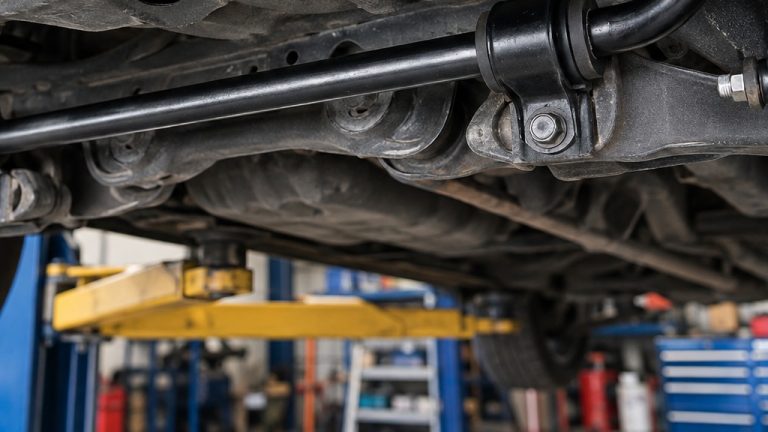
Consider a typical split sway bar bushing. Its inner bore may sit around a steel stabilizer bar that twists during suspension movement. If the kit requires grease, the bar-contacting surface is usually the relevant area. The outside of the bushing, held tightly by its mounting bracket, may have different requirements.
A two-piece control arm bushing with a separate inner sleeve is different. The manufacturer may specify grease on the sleeve, the polyurethane bore, internal grooves and particular thrust faces.
These distinctions explain why spraying the outside of a squeaky bushing so often fails. The noise-producing contact surface may be hidden inside the assembly, nowhere near the exposed rubber-like material you can see under the car.
How to Grease Polyurethane Bushings Properly
The following process applies to a conventional serviceable polyurethane bushing with accessible components and a manufacturer-approved grease. It is not a complete control arm removal or suspension replacement procedure.
Safety: Follow the vehicle manufacturer’s lifting and support instructions. Never work under a vehicle supported only by a hydraulic jack. Control arms, sway bars and springs can carry substantial loads, and loosening the wrong component can cause sudden movement. If reaching the bushing requires removing a loaded suspension joint, lowering a subframe or disturbing spring restraints, use the appropriate professional service procedure.
1. Confirm the Bushing Design and Lubricant
Start with the part number, not the grease gun. Check whether the bushing is designed to operate with lubricant, which surfaces require it, and whether the kit includes an approved product.
Also check whether the assembly has an actual grease fitting. Some aftermarket control arms include service fittings, but many ordinary polyurethane bushings do not.
If the instructions call for dry installation, don’t add grease just because the part is polyurethane. And if the bushing has a dedicated service fitting, use the manufacturer’s approved grease and fill procedure rather than assuming it works like a ball joint.
2. Inspect the Bushing Before Lubricating It
Look for cracks, tearing, deformation, enlarged bores, worn sleeves, rust around the mounting point and evidence that the bushing has moved out of position.
A noisy but structurally sound polyurethane bushing may benefit from correct lubrication. A split or badly distorted one may need replacement. Grease won’t rebuild missing material, restore a loose sleeve fit or repair damaged mounting hardware.
Check nearby components, too. It’s easy to blame a polyurethane control arm bushing for a noise coming from a ball joint, sway bar link or loose bracket.
3. Clean the Relevant Contact Surfaces
When the assembly is safely accessible according to its service procedure, remove accumulated dirt and old lubricant from the surfaces designated for servicing. Use a cleaning product compatible with the polyurethane, any coatings and nearby seals.
Old grease mixed with road grit is not something you want trapped between the bushing and its sleeve. Even if it still feels slippery, embedded abrasive material can increase wear.
Inspect the metal sleeve for scoring, deep corrosion or distortion. Don’t grind away metal to make a badly worn sleeve look better, and don’t use an aggressive solvent simply because it removes grease quickly.
Let the cleaned parts dry as required before applying the new lubricant. If you’re changing between grease formulations, follow the manufacturer’s cleaning and compatibility guidance rather than mixing unknown products.
4. Apply Grease to the Specified Interfaces
Coat the contact areas identified in the bushing instructions. On many sleeve-type designs, that means the polyurethane bore and the outside of the metal pivot sleeve. Work the grease into any molded grooves when the manufacturer directs you to do so.
The amount varies. Some manufacturers call for a small, even smear; others specify a more generous application to fill internal grooves or voids. There is no universal quantity for every polyurethane bushing.
Follow the instructions for the end faces as well. Apply lubricant where required, but leave intentionally dry surfaces alone.
Don’t pack an exposed bracket cavity with grease in the hope of preventing future squeaks. Excess grease in the wrong place tends to collect dirt without improving lubrication at the actual pivot.
5. Reassemble and Check for Binding
Refit the sleeve, bushing halves, washers and mounting hardware in the exact order and orientation specified by the kit. If grease squeezes out during assembly, remove unnecessary excess without disturbing the lubricant retained at the intended working surfaces.
Use the correct fastener torque and tightening condition for the vehicle and the aftermarket assembly. Some suspension pivots must be tightened at a specified ride height or under a particular loading condition; others have different requirements.
Do not assume every polyurethane bushing follows the same tightening procedure as an original bonded rubber bushing. Check the instructions rather than transferring a torque or installation method from another design.
Once everything is correctly assembled, check for interference, abnormal movement and signs of binding using the specified inspection procedure. A short, cautious road test can then help confirm whether the original squeak has disappeared.
If you’re working specifically on sway bar mounting bushings, our sway bar bushing replacement guide covers bracket removal, bushing sizing, reinstallation and fastener tightening in more detail.
Can You Grease Polyurethane Bushings Without Removing Them?
Sometimes, but not always effectively.
If the assembly has a manufacturer-designed grease fitting, an approved service method may allow lubrication without dismantling the bushing. That can be convenient on certain aftermarket control arms or suspension links.
For a conventional bushing with no service fitting, the loaded friction surfaces may be hidden behind a metal sleeve or mounting bracket. Applying lubricant to the visible outside doesn’t guarantee that any reaches the area producing the noise.
Some owners try silicone spray for this reason. It may temporarily reduce a noise if it reaches the relevant interface, but that isn’t the same as applying the correct grease properly. Spray products can migrate, wash away or contaminate nearby components, and they should never be applied where they could affect brake friction surfaces.
Don’t drill into a bushing housing or install your own grease fitting without an approved modification procedure. You could damage the bushing, compromise the mounting structure or create a passage that doesn’t reach the correct contact surface.
If proper lubrication requires removing a control arm or another loaded suspension component, the job may be better handled by a qualified technician. A persistent squeak doesn’t justify improvising a potentially unsafe disassembly.
Polyurethane Bushings Still Squeaking? Check These Causes
You’ve used the specified grease, put everything back together and driven around the block. The squeak is still there. Before applying more lubricant, work out whether the noise is actually coming from the bushing—and whether the bushing is moving as designed.
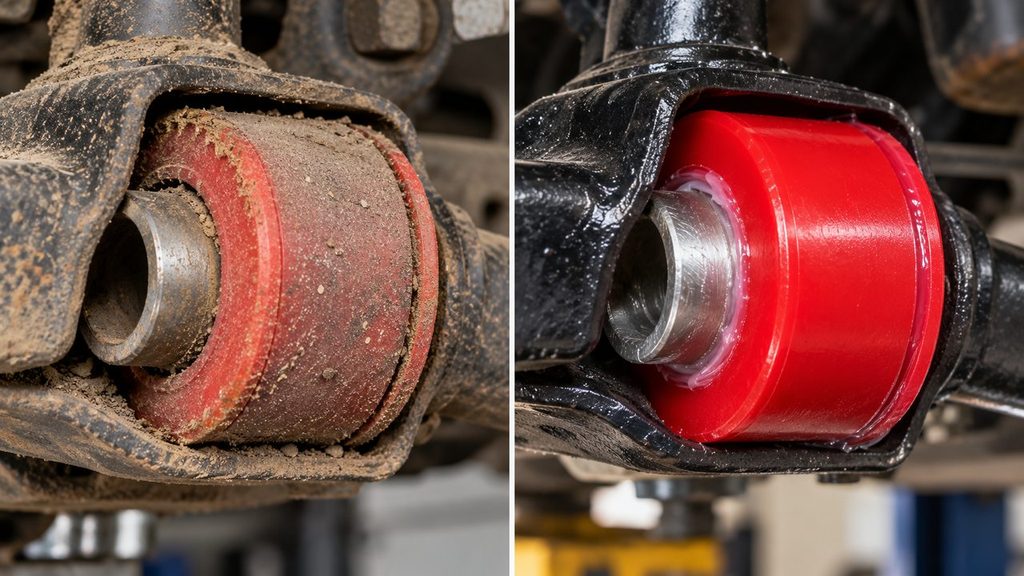
| What you’re noticing | Possible explanation | What to inspect |
|---|---|---|
| Squeak began immediately after installation | Insufficient or misplaced grease, incorrect fit, or assembly error | Manufacturer lubrication points, sleeve fit and bushing orientation |
| Noise returns after wet or muddy driving | Grease loss, contamination or an exposed friction interface | Lubricant retention, dirt intrusion and the specified maintenance procedure |
| Creak during slow suspension movement | Stick-slip friction or binding at a pivot | Bushing contact surfaces, sleeve condition and mounting alignment |
| Squeak together with a clunk | Worn bushing, loose hardware or another suspension component | Mounting integrity, clearances and adjacent joints |
| One corner is noisy after the repair | Incorrect part orientation or localized installation issue | That side’s fitment, hardware and contact points |
| Noise persists despite correct lubrication | Mechanical binding, damaged parts or an unrelated noise source | Suspension movement, joint condition and professional diagnosis |
The Grease Isn’t Reaching the Sliding Surface
This is common when someone tries to cure an internal bushing squeak from outside the assembly. The visible outer surface may be covered in lubricant while the sleeve-to-polyurethane contact remains dry.
Correcting that may require accessing the bushing through its intended service procedure rather than adding more spray.
The Bushing or Sleeve Doesn’t Fit Correctly
A bushing that’s too tight, installed at an incorrect angle or paired with the wrong sleeve can bind during suspension movement. Lubrication cannot compensate for incorrect dimensions or mounting geometry.
Check the kit’s application, part numbers, sleeves, washers and bracket arrangement. Some suspension assemblies also use specific locating features that prevent the bushing from moving where it shouldn’t.
The Noise Isn’t Coming From Polyurethane
A squeak heard while entering the vehicle or driving over a driveway lip may come from a spring isolator, strut mount, ball joint, rubber bushing or even brake hardware.
Before dismantling a freshly installed polyurethane kit, check our guide to suspension creaking when getting out of a car. It explains how to distinguish different noise sources when the vehicle’s weight shifts.
How Often Should Polyurethane Bushings Be Greased?
There is no maintenance interval that applies to every polyurethane bushing.
Some performance suspension kits include grease-retaining grooves and may operate quietly for a long time after correct installation. Other designs, especially those exposed to dirt, water or frequent suspension articulation, may require more attention.
Instead of assuming that polyurethane bushings must be greased at every oil change, use the schedule supplied with your kit. If no interval is specified, inspect the bushings during routine suspension maintenance and investigate any new noise or visible deterioration.
More frequent inspection makes sense after repeated off-road driving, heavy contamination or exposure to road salt. That doesn’t mean indiscriminately adding grease after every muddy trip.
If the bushing is structurally damaged, lubrication is not a substitute for replacement.
Common Mistakes When Lubricating Polyurethane Bushings
Using the Same Grease on Every Suspension Component
It is tempting to use one cartridge for everything underneath the vehicle. But ball joints, tie rod ends, polyurethane bushings and conventional bonded rubber bushings don’t necessarily have the same lubrication requirements.
A product approved for a greaseable steel ball-and-socket joint is not automatically suitable for a polyurethane sleeve. Use the correct lubricant for each component.
Greasing Surfaces That Should Stay Dry
Some mounting interfaces are intended to remain stationary or dry. Greasing them can change how the component locates in its housing and attract dirt unnecessarily.
Follow the specific diagrams for the bushing kit. Don’t automatically grease every surface that touches metal.
Applying More Grease Instead of Fixing the Fitment
A wrongly sized sleeve, distorted bracket, loose bolt or misaligned bushing can produce noise even when there is plenty of lubricant present. Adding more may temporarily alter the sound without correcting the mechanical issue.
Check the installation, especially if the noise appeared immediately after the bushings were fitted.
Mixing Unknown Greases
Different grease formulations aren’t always compatible. Mixing them may affect consistency, oil separation or how well the resulting lubricant stays in place.
If you don’t know which grease was used previously, identify the part and use the manufacturer’s approved cleaning and relubrication process. Don’t assume adding a new formulation on top of the old one will produce the intended result.
Frequently Asked Questions
What grease should you use on polyurethane bushings?
Use the grease supplied or approved by the manufacturer of the specific bushings. Many kits recommend a tacky, water-resistant polyurethane-specific lubricant, often silicone-based or PTFE-containing. The correct formulation and application surfaces vary by product.
Is silicone grease good for polyurethane bushings?
Yes, when the formulation is approved for the bushing and its operating conditions. Silicone-based greases are widely used for polyurethane suspension applications, but a generic silicone spray or light-duty paste is not necessarily equivalent to a manufacturer-specified assembly grease.
Can you use white lithium grease on polyurethane bushings?
Only if the bushing manufacturer approves that specific type of lubricant. White lithium grease isn’t a universal substitute for polyurethane bushing grease, and some manufacturers specifically recommend avoiding it for their products.
Can you use Super Lube on polyurethane bushings?
Some Super Lube formulations may be appropriate for particular polyurethane applications, but the brand offers products with different compositions. Check the exact product specification and confirm that the bushing manufacturer permits it. Don’t assume all products sold under the same brand name are interchangeable.
Do polyurethane sway bar bushings need grease?
Many aftermarket polyurethane sway bar bushings require grease on the bar-contacting surface during installation. Others may have different instructions or specialized designs. Check the kit before applying lubricant, particularly to the outer surface held by the bracket.
How do you stop polyurethane bushings from squeaking?
First confirm that the bushings are the source of the noise. Inspect for wear, incorrect fitment and binding. If they require lubrication, clean and grease the specified sliding surfaces using an approved product. A squeak caused by a damaged bushing or incorrect installation may need mechanical correction rather than more lubricant.
Can you grease polyurethane bushings without removing them?
Yes, if the design provides an approved service fitting or another manufacturer-specified access method. For bushings without a grease port, the relevant surfaces may be inaccessible without partial disassembly. Spraying the outside usually isn’t a reliable substitute for properly lubricating the internal contact surfaces.
Do polyurethane bushings need grease more often than rubber bushings?
Some polyurethane designs need periodic lubrication because they allow movement at a sliding interface. Many factory bonded rubber bushings do not require routine grease. However, modern polyurethane kits differ significantly, and certain designs retain their initial lubricant for long periods. Follow the actual product’s maintenance instructions.
Choose the Grease for the Bushing, Not Just the Material
If your polyurethane bushings came with a small packet of grease, don’t throw it aside in favor of whatever happens to be in the garage. That packet may be an important part of how the kit is intended to work.
For a kit without grease, identify the manufacturer and check its recommendation. A suitable silicone-based or PTFE-containing lubricant is common in aftermarket suspension applications, but some products have different requirements.
Just as importantly, apply the grease where the bushing is designed to move. A correctly lubricated sleeve can make the difference between a quiet suspension and an irritating squeak. Grease smeared across the outside of an incorrectly installed bushing usually won’t solve anything.