Ball Joint Grease: Best Types, Ratings & What to Use
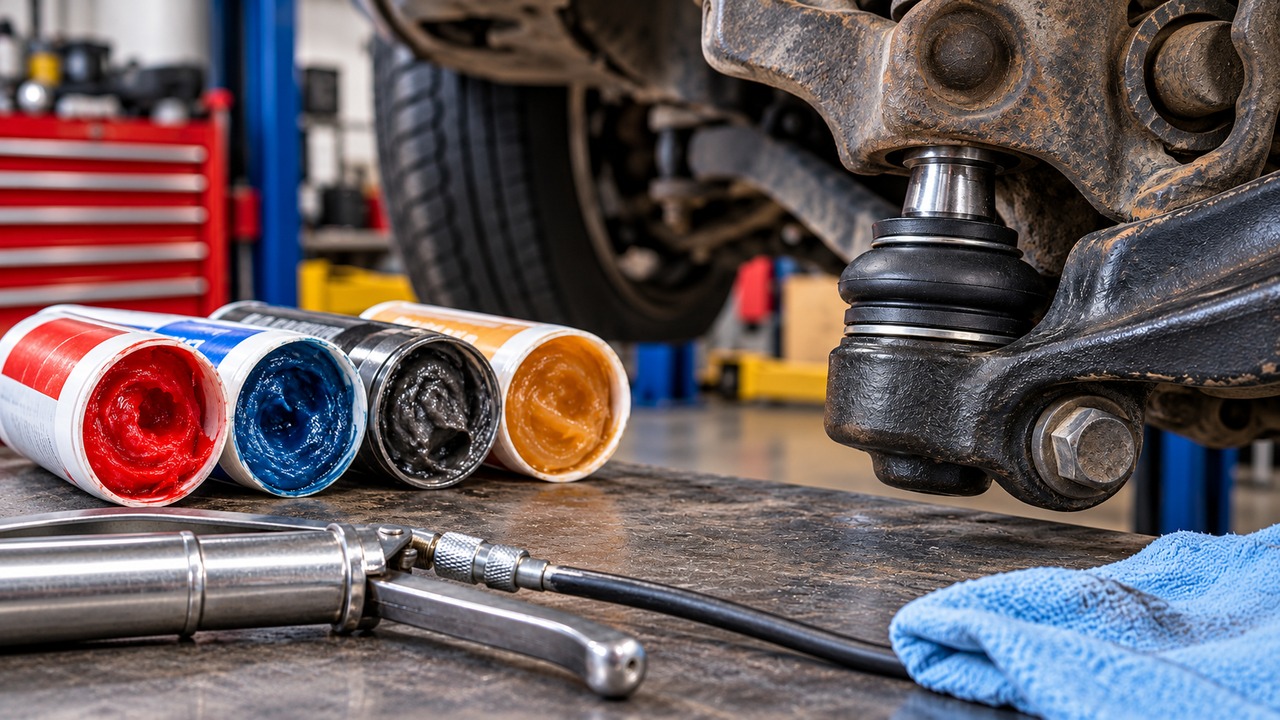
The best ball joint grease for most serviceable car and light-truck suspension joints is a premium NLGI Grade 2 chassis grease with an LB or GC-LB service rating, provided it meets the ball joint manufacturer’s requirements. Lithium-complex grease is a dependable choice, and some synthetic formulations work equally well. For certain aftermarket joints, though, a specific moly-fortified grease is required.
That last distinction matters. A grease can be excellent for ordinary chassis lubrication and still be the wrong product for a particular ball joint. And if your vehicle has sealed, maintenance-free joints, you may not need to buy grease at all.
What Is the Best Grease for Ball Joints?
For a typical greaseable ball joint, start with NLGI #2, an automotive chassis rating of LB or GC-LB, and the grease specification supplied with the joint. Those three details are more useful than a brand name, color, or claim that a product is “heavy duty.”
| Ball joint or driving situation | Grease to look for | Important detail |
|---|---|---|
| Typical greaseable ball joint | NLGI #2 lithium or lithium-complex chassis grease | Look for LB or GC-LB and check the part maker’s instructions. |
| MOOG greaseable steering or suspension joint | Premium NLGI #2 lithium or synthetic grease | Follow the requirements for the installed MOOG part. |
| SPC aftermarket ball joint covered by its moly specification | NLGI #2, Grade LB grease containing 3–5% molybdenum disulfide | A grease without the required moly content is not an equivalent substitute. |
| Wet, muddy, or high-mileage service | Manufacturer-approved chassis grease with strong water resistance and EP protection | Water resistance alone does not establish ball-joint suitability. |
| Factory-sealed, non-serviceable joint | No routine grease addition | Do not puncture the protective boot to add lubricant. |
If you’re standing in an auto-parts store comparing two cartridges, choose the one with clearly documented chassis specifications that match your joint. An expensive synthetic product with an impressive temperature range is not automatically a better choice than a conventional lithium-complex grease that meets the correct requirements.
NLGI #2 vs. GC-LB: What the Grease Label Actually Means
These ratings are easy to confuse because they often appear next to each other on the same cartridge. They describe different things.
NLGI Grade 2 describes consistency
Think of NLGI #2 as a measure of how firm the grease is. It has a familiar, peanut-butter-like consistency and is widely used in automotive chassis components. It stays where it’s needed while remaining workable through a suitable grease gun.
But NLGI #2 does not, by itself, tell you whether a grease protects a loaded ball-and-socket joint. Two products can have the same consistency grade while using different base oils, thickeners, and anti-wear additives.
LB and GC-LB describe automotive service suitability
The LB classification covers automotive chassis lubrication under ASTM D4950. GC is a wheel-bearing service classification. A grease marked GC-LB satisfies both categories.
That makes GC-LB a convenient label to look for when buying a multipurpose grease for compatible chassis components. An LB-only grease can also be appropriate for ball joints if it meets the relevant manufacturer specification. Conversely, a GC-only rating is not evidence that the grease meets chassis-service requirements.
The National Lubricating Grease Institute’s LB specification covers more than consistency. Its tests include wear protection, extreme-pressure performance, rust protection, oil separation, and compatibility with specified elastomer materials.
EP protection and water resistance matter, too
A ball joint does not spin continuously like a conventional wheel bearing. Its ball stud moves through relatively small angles while the suspension absorbs bumps and steering loads change direction. That combination makes protection under high contact pressure important.
Extreme-pressure (EP) and anti-wear additives help protect contact surfaces when the lubricating oil film becomes thin. Good water resistance and corrosion protection are also useful because the joint lives close to road spray, salt, and dirt.
None of those properties makes a damaged dust boot harmless. Even excellent grease has limits once abrasive grit and water have a way inside.
Lithium, Synthetic, or Moly Grease?
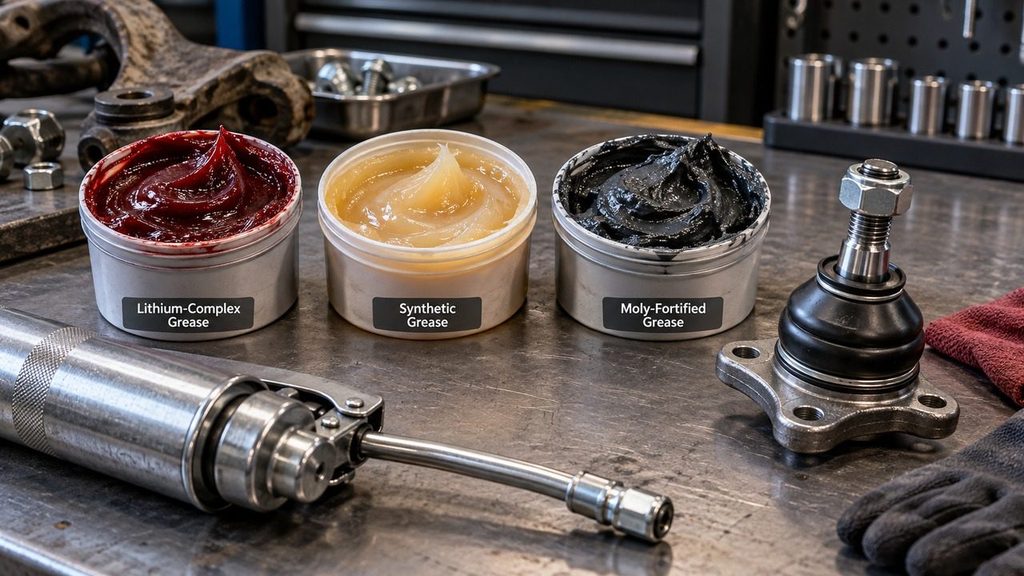
There’s a small problem with this comparison: the three terms don’t describe the same characteristic. Lithium refers to a thickener system, synthetic describes the base oil, and moly is an additive. A single grease may incorporate more than one of them.
Lithium and lithium-complex grease
Lithium-based chassis greases are common for a reason. Properly formulated products provide useful mechanical stability, wear protection, and resistance to moisture. Lithium-complex formulations are especially popular in multipurpose automotive products because they can handle demanding operating conditions.
For an ordinary greaseable suspension joint that specifies NLGI #2 lithium grease, there’s usually little reason to chase a more exotic formulation. A correctly rated product from a reputable manufacturer is a sensible starting point.
Synthetic grease
Synthetic base oils can offer advantages in temperature performance, oxidation resistance, and lubricant life. Whether those advantages matter depends on how the vehicle is used and how the complete grease formulation performs.
Here’s the catch: “synthetic” is not a complete ball joint grease specification. The product still needs the right consistency, service rating, additives, and compatibility for the installed component. Synthetic grease also isn’t necessarily free of lithium, nor does it automatically contain moly.
MOOG, for example, recommends premium heavy-duty NLGI #2 lithium or synthetic grease for its serviceable chassis parts. That’s a useful recommendation, but it shouldn’t be extended to every aftermarket ball joint made by every company.
Moly grease (molybdenum disulfide)
Molybdenum disulfide, often abbreviated MoS2, is a solid lubricant added to certain greases to improve protection during heavily loaded or boundary-lubrication conditions. It can be particularly useful where metal surfaces move slowly or oscillate under pressure.
That doesn’t mean every ball joint needs moly. Some manufacturers specify it; others recommend different formulations.
A useful real-world example comes from Specialty Products Company (SPC). Its published approved grease guidance calls for NLGI #2, Grade LB grease containing 3–5% moly for the serviceable ball joints covered by that document. It specifically excludes Mobil 1 synthetic grease from its approved choices because it lacks the required moly content.
That is a more meaningful distinction than arguing whether synthetic or conventional grease is universally better. For an SPC joint covered by that requirement, moly content is part of choosing the correct lubricant. For another joint, the manufacturer’s instructions may be different. Always check the current instructions for your exact part number.
What about marine grease?
Marine grease attracts attention because it is designed to resist water. That sounds appealing for a truck driven through puddles, but “marine” tells you about the intended environment, not whether a formulation meets your ball joint’s requirements.
Some marine greases also carry appropriate automotive chassis ratings. Others may use different thickeners or additives. Check the technical data sheet and the joint manufacturer’s requirements before making a switch. A water-resistant grease isn’t a substitute for an intact protective boot.
Ball Joint Grease Options Worth Comparing
Product recommendations make more sense when they’re tied to specifications rather than an arbitrary winner. The following are real examples with manufacturer-published information, not a claim that we’ve independently wear-tested them in identical ball joints.
Valvoline Multi-Vehicle High Temperature Red Grease
This is a straightforward example of the type of automotive chassis grease many owners should consider first. Valvoline lists its Multi-Vehicle High Temperature Red Grease as an NLGI #2, GC-LB lithium-complex EP grease, intended for applications including suspension systems, steering linkages, and chassis components.
It’s a logical candidate for a greaseable ball joint that permits this specification. Its value is not simply that it’s red or advertised for high temperatures; it’s the documented combination of consistency, chassis rating, and application.
Lucas Oil Red ‘N’ Tacky Grease
Lucas Red ‘N’ Tacky is another widely recognized automotive grease with an NLGI #2 consistency and GC-LB certification. There’s an important wrinkle when comparing recommendations online, however: Lucas has announced an updated formulation.
According to the manufacturer, the earlier formulation used a lithium-complex thickener, while the newer version uses calcium sulfonate. Lucas states that the updated product retains its GC-LB certification and NLGI #2 consistency, with changes intended to improve performance.
Why care? Because an older review describing Red ‘N’ Tacky as lithium-complex grease may be referring to a different formulation from the cartridge you’re holding today. Check the current label and product information, particularly if your ball joint manufacturer calls for a specific thickener chemistry.
Moly-fortified grease for specified aftermarket joints
For components with an explicit moly requirement, a general-purpose red chassis grease may not be the right purchase, even when its GC-LB rating looks reassuring.
SPC’s approved-grease document names examples including Chevron Delo ESI HD 3% and 5% Moly, Mystik JT-6 with Moly EP #2, and certain Lubriplate moly products. That document dates from 2016, so it should be treated as a guide to the required specification rather than proof that every historical formulation or part number is unchanged or currently available.
If your ball joint requires 3–5% moly, look for that concentration in the current technical data sheet. Don’t assume that every cartridge labeled “with moly” contains the specified amount.
Which would we choose? For an ordinary serviceable joint calling for NLGI #2 lithium chassis grease, a documented GC-LB lithium-complex product such as the Valvoline example is a straightforward option. For a joint with a mandatory moly specification, we’d follow that requirement instead. And if a manufacturer approves a different chemistry, the part-specific instruction takes priority over either preference.
Match the Grease to the Part and Driving Conditions
Imagine two trucks parked next to each other. Both have grease fittings on their front suspension. One has replacement MOOG joints; the other has aftermarket adjustable control arms with their own ball joint requirements.
They may take different grease, even if they’re driven on the same roads. The part specification comes first; the driving environment helps you choose among suitable products.
| What you need | What to prioritize |
|---|---|
| Everyday commuting | Correct OEM or replacement-part specification, NLGI grade, and chassis service rating. |
| Frequent rain, road salt, or muddy conditions | Approved grease with good water-washout and corrosion resistance. |
| Heavy-duty or off-road suspension | Approved EP protection, mechanical stability, and any required moly content. |
| Unusual temperature conditions | Manufacturer-approved operating-temperature range and appropriate base-oil performance. |
| Unknown grease already in the joint | Identify the installed part and seek manufacturer guidance before changing formulations. |
There is no useful universal rule that a lifted truck must use moly, or that a daily driver should always use synthetic grease. A heavy-duty vehicle may have a very specific lubrication requirement, while an ordinary passenger car may have sealed joints that aren’t meant to be serviced at all.
Before Buying Grease, Check Whether the Ball Joint Is Serviceable
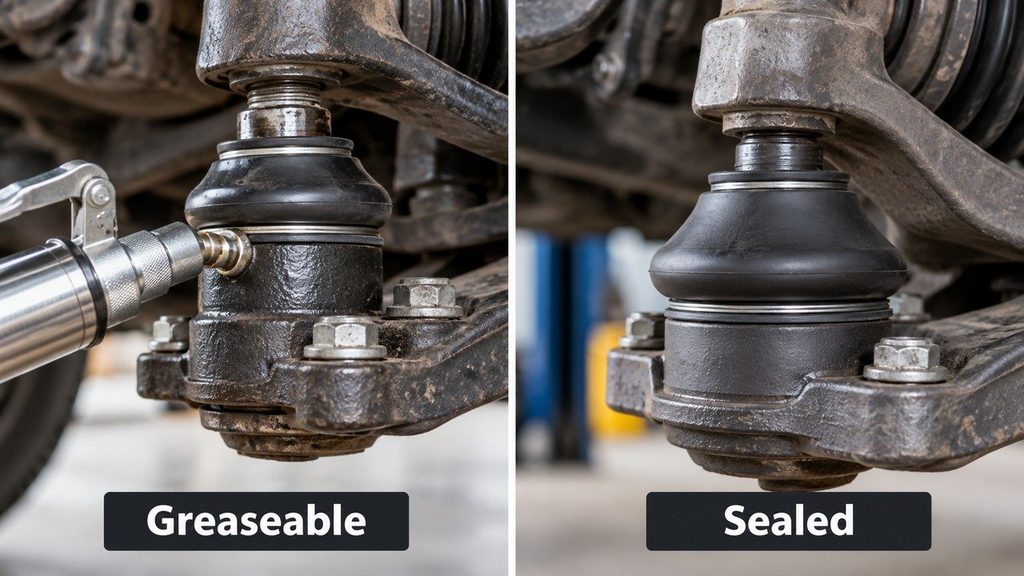
Many modern vehicles use factory-sealed ball joints. These are assembled with lubricant and protected by a boot, but they aren’t designed for routine grease replenishment. A replacement aftermarket joint may be different, even on the same vehicle.
A serviceable joint usually has a designated grease fitting, often called a Zerk fitting. Some replacement joints use a low-profile fitting or an application-specific service arrangement. The presence of a suitable service point matters far more than whether the dust boot feels soft when pressed.
If the joint is sealed and has no approved grease inlet, don’t assume you can convert it into a serviceable design by piercing the boot or forcing lubricant into a gap. That can damage the seal and introduce contamination.
Similarly, a new greaseable aftermarket joint may require attention at installation even if it contains some factory lubricant. MOOG’s published guidance, for example, explains that its greaseable components come lubricated but should also be serviced during installation. Follow the instructions supplied with the replacement part rather than relying on a blanket rule for all new ball joints.
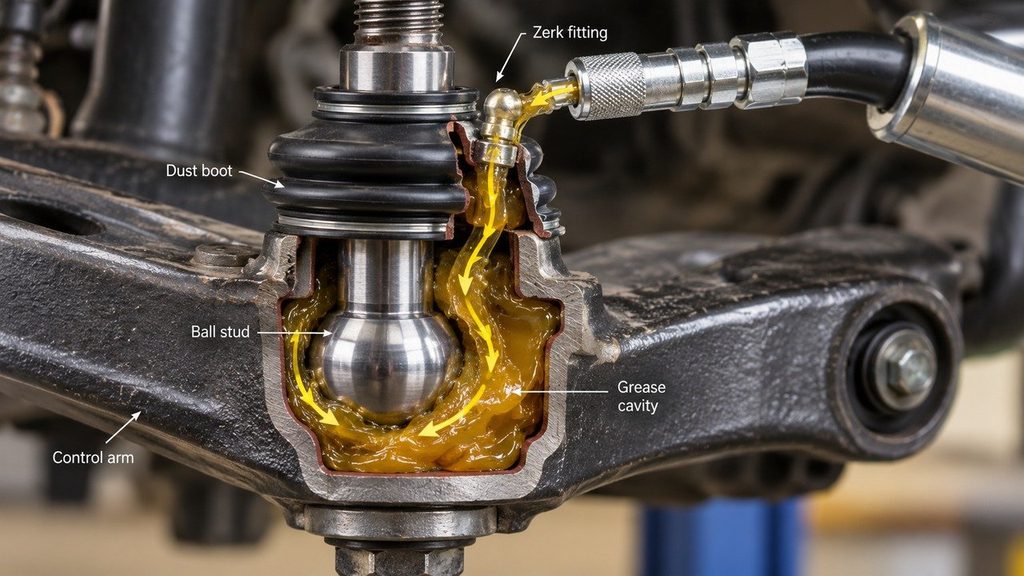
The separate questions of where the fitting is located, how to use a grease gun, and how much grease to apply depend on the joint’s design and servicing instructions. Our step-by-step guide to greasing ball joints covers the procedure, from preparing the fitting to avoiding an overfilled dust boot.
What if a lower ball joint is leaking grease?
A little grease escaping through a manufacturer’s intended relief path during servicing is not necessarily a failure. Grease spreading from a torn dust boot, however, is a different matter. Once the seal is compromised, water and road grit can reach the joint.
If there’s a split boot, looseness, or obvious deterioration, adding a thicker grease is not a proper fix. Have the joint inspected and replace damaged components as required. Our ball joint replacement cost guide explains what affects the repair bill when lubrication is no longer enough.
Can You Mix Two Different Ball Joint Greases?
Not without checking compatibility. Different grease formulations can behave unpredictably when mixed. The resulting blend may soften, harden, separate oil, or lose some of the characteristics each original product was designed to provide.
That doesn’t mean every combination of different brands is automatically incompatible. Grease compatibility depends on the full formulations, including thickener systems and additives. Lucas, for example, has published compatibility information alongside its Red ‘N’ Tacky formulation change, while still recommending a proper changeover.
There is a practical difference between replacing a grease in a serviceable assembly and trying to force new lubricant into a sealed joint. The latter is not an acceptable workaround for uncertainty about the existing grease.
When the original grease is unknown, consult the component manufacturer’s instructions. Use an approved service or changeover procedure where applicable. Simply pumping an unfamiliar product into the joint until something emerges isn’t a reliable way to establish chemical compatibility.
Ball Joint Grease Mistakes That Are Easy to Make
Choosing by grease color
Red, blue, amber, gray, and black greases are familiar sights in an automotive workshop. None of those colors is a universal rating for ball joint protection. Coloring can help distinguish products within a manufacturer’s range, but different manufacturers do not follow one consistent color code.
Gray or black grease may contain moly, but color does not reliably establish its concentration. If your joint calls for a specific percentage, verify the actual product specification.
Treating wheel-bearing grease as automatically interchangeable
A grease labeled for both wheel bearings and chassis service can be suitable for both applications. That’s the convenience of a properly specified GC-LB product. But a wheel-bearing-only label is not enough to prove suitability for a ball joint.
Check for the chassis classification and any additional part-specific requirements rather than assuming that every automotive grease cartridge is interchangeable.
Using ball joint grease on every suspension bushing
Ball joints and suspension bushings serve different mechanical purposes, and their lubrication requirements can be quite different. For example, polyurethane bushings may call for a compatible silicone-based lubricant, while bonded rubber bushings generally are not routinely greased.
Don’t use leftover chassis grease on polyurethane or rubber components merely because they sit next to the ball joint. Follow the material and component manufacturer’s requirements.
Expecting grease to repair a worn joint
Fresh lubricant can reduce friction in a healthy serviceable joint. It cannot restore a worn ball stud, damaged bearing surface, or excessive mechanical clearance.
If the front end clunks, squeaks, or feels loose, lubrication shouldn’t replace a proper inspection. Our guide to suspension clunks and rattles covers other components that can create similar noises.
Overlooking the grease boot
Even the correct grease can become a problem if it is applied in a way that ruptures the dust boot. Some serviceable joints have relief paths for displaced grease; others require particular care when filling. Excess pressure is not extra protection.
Inspect the boot and use the service instructions for your joint. If you’re paying a shop to lubricate multiple suspension points, our suspension lubrication cost guide explains what that service may include.
Ball Joint Grease FAQs
Is lithium grease good for ball joints?
Yes, when the product has the appropriate NLGI grade, chassis-service properties, and manufacturer approval. Premium NLGI #2 lithium or lithium-complex chassis grease is a common choice for serviceable automotive ball joints. Ordinary white lithium spray grease should not be treated as equivalent to a specified heavy-duty chassis grease.
Is synthetic grease better than conventional grease?
Not automatically. Synthetic base oils can provide useful performance advantages, but the final grease formulation and the ball joint manufacturer’s specifications determine suitability. A correctly approved conventional grease is preferable to an incompatible synthetic product.
Do ball joints need moly grease?
Some do, others don’t. Certain SPC aftermarket ball joints explicitly require 3–5% moly, while MOOG’s general guidance calls for premium NLGI #2 lithium or synthetic grease. Verify the instructions for your installed part rather than assuming moly is always required or always unnecessary.
Can you use wheel-bearing grease on ball joints?
Yes, if it also meets the necessary chassis lubrication specification and your ball joint manufacturer’s requirements. An NLGI #2 GC-LB wheel-bearing and chassis grease can cover both applications. Wheel-bearing suitability by itself is not sufficient.
What color grease is best for ball joints?
There is no universally best color. Red, blue, and other dyes do not establish a grease’s NLGI classification or additive content. Read the label and technical data sheet instead.
Do new ball joints need grease?
It depends on the design and instructions. Factory-sealed replacement joints generally aren’t intended for routine greasing, while some greaseable aftermarket joints require servicing during installation even when they arrive pre-lubricated. Check the component documentation.
Can the wrong grease damage a ball joint?
Potentially. A grease with unsuitable consistency, poor protection for the application, incompatible chemistry, or missing required additives may shorten service life. Mixing incompatible products or damaging the boot during servicing can create additional problems.
Can grease stop a squeaking ball joint?
It may quiet a dry but otherwise healthy serviceable joint. Persistent squeaking, torn boots, or noticeable play call for inspection rather than repeated lubrication. A worn ball joint remains a safety concern even if the noise temporarily disappears.
The Right Grease Is the One Your Ball Joint Calls For
For most ordinary greaseable ball joints, a premium NLGI #2 chassis grease carrying an LB or GC-LB rating is the place to start. Lithium-complex products are familiar, well-supported options, and suitable synthetic formulations can work just as well.
Before picking a cartridge, identify the actual joint. Check whether it is serviceable, read the manufacturer’s lubrication requirements, and make sure the grease’s current specifications match. If the joint requires moly, buy the specified moly grease. If it’s factory-sealed, don’t create a grease inlet that wasn’t designed to be there.
That approach may be less exciting than crowning one tube the best grease for every vehicle, but it is a much better way to protect an expensive suspension component.