Symptoms of a Bad Strut Mount: Noise, Steering & Tests
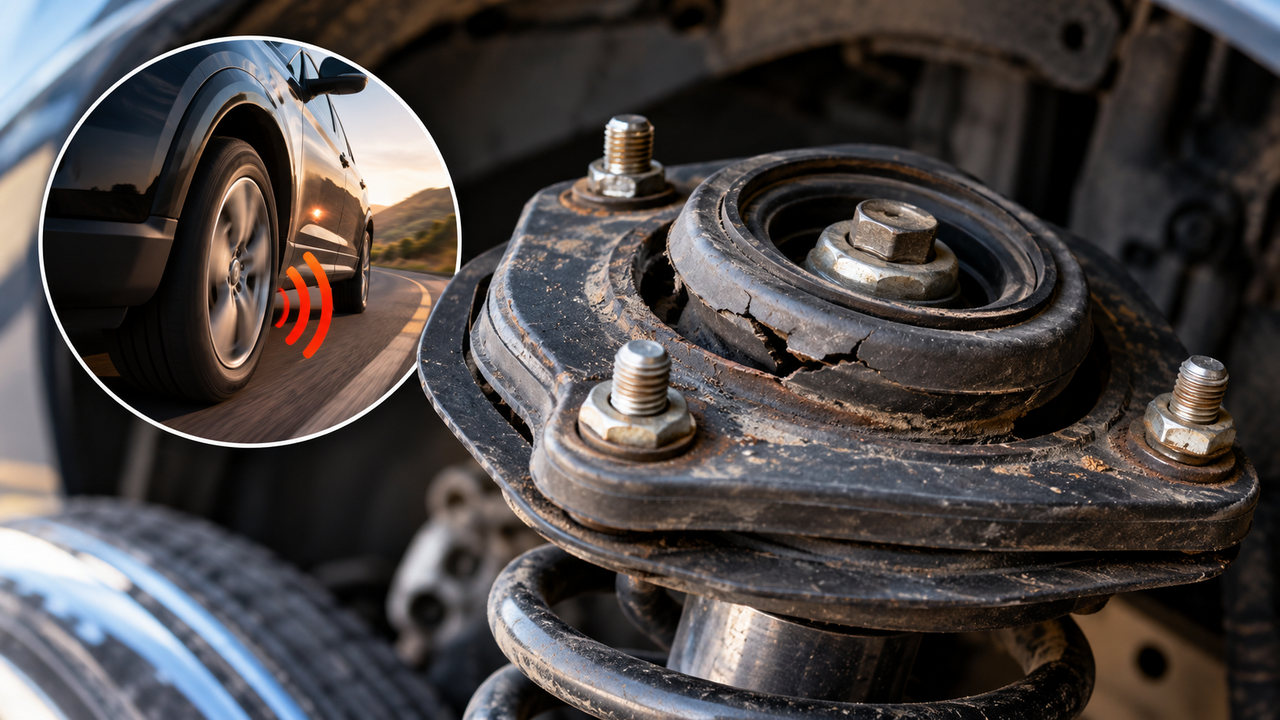
The most common symptoms of a bad strut mount are clunking over bumps, creaking or popping when you turn the steering wheel, and extra noise or vibration coming from the upper suspension. If the mount’s bearing is worn or binding, the steering may also feel notchy, resist smooth movement, or produce a sudden pop as the coil spring releases built-up tension.
Where and when the noise happens matters. A heavy knock as a wheel crosses a pothole suggests a different problem from a springy pop while maneuvering into a parking space. The first makes the mount’s rubber isolator and hardware worth checking; the second raises more suspicion about the upper strut bearing.
Neither symptom proves the mount is bad. Sway bar links, control arm bushings, ball joints, spring seats, and loose hardware can produce surprisingly similar noises. Before replacing anything, you want to establish whether the unwanted movement or resistance actually comes from the top of the strut assembly.
Important: If the steering binds, a front wheel seems displaced, or the upper strut attachment is visibly separating from the vehicle body, don’t continue driving to reproduce the noise. Arrange a professional inspection or towing.
Bad Strut Mount Symptoms: What to Look for First
Not every failing mount produces every symptom. The rubber, bearing, spring seat, and mounting hardware have different jobs, so the driving conditions that expose a problem can help narrow down which part deserves attention.
| What you notice | Possible upper strut problem | What to check next |
|---|---|---|
| Clunk or knock over bumps | Worn rubber mount, excessive upper movement, or loose mounting hardware | Upper mounting plate, rubber isolator, fasteners, and nearby suspension joints |
| Creaking while turning at low speed | Rough strut bearing, binding spring seat, or rubber movement | Whether the strut and spring rotate smoothly |
| Pop or snap as the steering wheel turns | Upper bearing sticking and releasing; possible spring wind-up | Spring movement, upper bearing, and seating of the coil spring |
| Notchy steering or poor return to center | Possible upper bearing resistance | Steering system, alignment, tires, and strut bearing operation |
| More vibration or harshness inside the cabin | Deteriorated rubber isolator transmitting road vibration | Mount condition, tires, and damper performance |
| Visible cracking, separation, or unusual movement | Rubber-to-metal separation or damaged upper mount | Actual movement and vehicle-specific mount condition |
| Uneven tire wear or unstable alignment | Possible severe mount displacement affecting suspension geometry | Entire steering and suspension system before alignment |
The most useful clues usually come in pairs. A clunk accompanied by visible movement at the strut tower is more convincing than a clunk alone. Likewise, a pop during steering combined with visibly irregular spring rotation makes an upper bearing problem more plausible.
Symptoms such as tire wear, vibration, and vague handling deserve attention, but they’re far less specific. A vehicle can have all three while the upper strut mounts are perfectly healthy.
What Does a Bad Strut Mount Sound Like?
There isn’t one sound that belongs exclusively to a strut mount. The same assembly can produce a dull thud, a creak, or a sharp pop depending on which component has deteriorated and how it’s being loaded.
A Clunk From the Strut Tower Over Bumps
Imagine driving down a familiar residential street. The car rides normally on smooth pavement, but every time the front wheel drops into a shallow pothole, you hear a solid knock that seems to come from high inside the wheel well.
The upper strut mount helps secure the strut to the body while isolating road impacts. If its rubber separates from the surrounding metal or the mounting hardware allows unwanted movement, the assembly can shift under changing suspension forces.
That movement may produce a clunk as the suspension compresses or rebounds. Depending on the design, you may hear it only when the wheel encounters a substantial bump, or repeatedly across broken pavement.
The apparent location is useful but not definitive. A worn sway bar link or lower suspension joint can send noise through the strut assembly and make it sound as though something is knocking directly beneath the hood.
Creaking or Groaning When Turning the Steering Wheel
This pattern deserves particular attention on a conventional front MacPherson-strut suspension.
When you steer, the steering knuckle and strut assembly must rotate. An upper bearing allows that movement while the vehicle’s upper mounting structure remains secured to the body.
If the bearing becomes rough, contaminated, corroded, or otherwise damaged, rotation may no longer be smooth. You might hear a creak or groan while backing out of a parking space, turning slowly into a driveway, or moving the steering wheel with the vehicle stationary.
But steering-related noise can also come from tie rod ends, other ball joints, spring isolators, or steering-system components. A creak near the top of the strut makes the upper bearing worth inspecting; it doesn’t establish the diagnosis on its own.
A Springy Pop, Twang, or Sudden Snap
Some drivers describe this as a spring being wound up and released. That’s a helpful description because, on certain suspensions, it’s close to what’s actually happening.
If the upper bearing resists rotation, the steering system can continue applying force to the strut assembly. The coil spring and its seat may twist slightly instead of rotating smoothly. When the resistance is overcome, the spring can move suddenly and produce a pop or snapping sound.
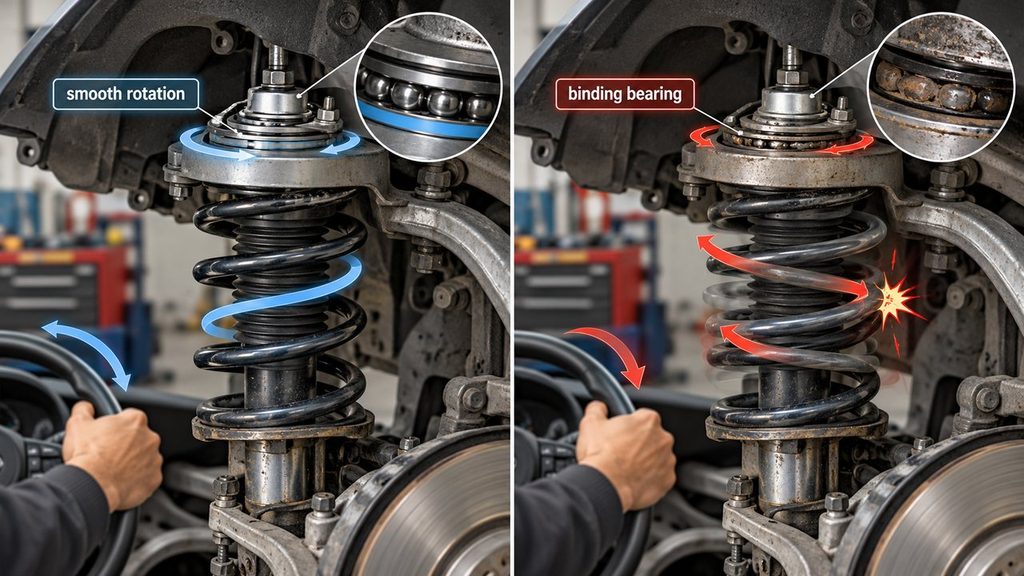
This behavior is often called spring wind-up or spring binding. It can occur during slow steering movements, when turning into a parking space, or as steering and suspension loads change together.
A spring that doesn’t sit correctly in its upper or lower seat can also make a popping noise. A cracked or damaged spring may create similar symptoms, so the bearing isn’t the only component to investigate.
Don’t try to correct spring wind-up by repositioning the coil spring yourself. The assembled spring stores substantial energy and requires proper equipment and service procedures for disassembly.
Grinding or Rough Steering Movement
A deteriorated upper bearing can sometimes make a rough, grinding, or scraping sound as it rotates. The steering may feel less fluid than it used to, particularly at parking speeds.
Listen for whether the sound follows steering movement rather than vehicle speed. A continuous growl that increases as you drive faster is more characteristic of certain wheel-bearing or tire problems than an upper strut bearing.
Grinding also calls for checking surrounding parts for contact, damage, or incorrect installation. You don’t want to replace an upper bearing only to discover that the coil spring or a metal shield was rubbing elsewhere.
What Actually Goes Bad in a Strut Mount?
People often use the terms strut mount, top mount, upper strut bearing, and strut bearing plate as though they’re interchangeable. Parts catalogs don’t always make the distinction obvious, either.
They’re related, but they don’t necessarily describe the same component.
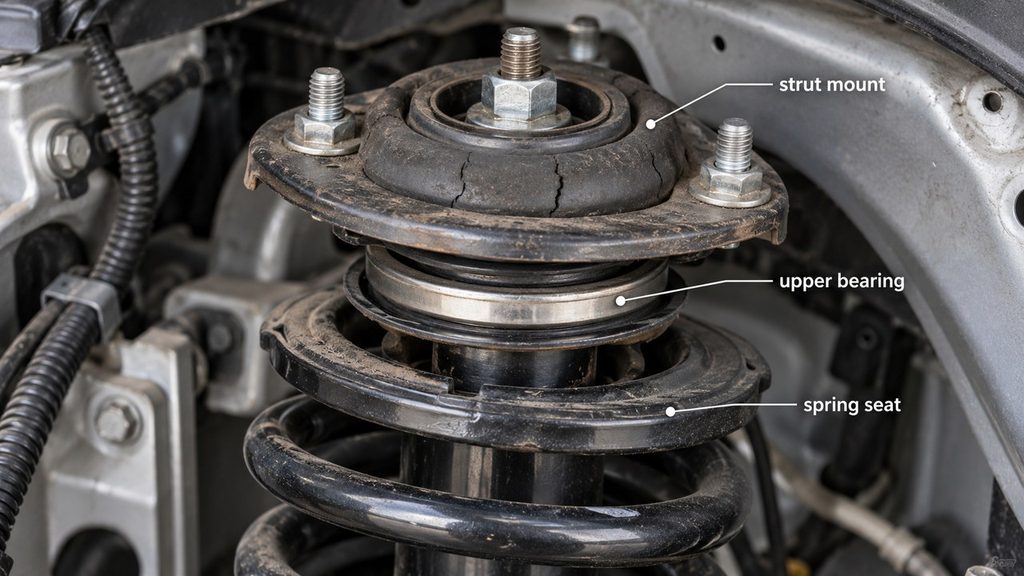
The Rubber Isolator and Mounting Plate
The mount connects the upper end of the strut assembly to the vehicle body or chassis. It commonly combines metal mounting hardware with rubber or another resilient material that helps isolate noise and vibration.
Over time, the rubber may harden, tear, collapse, or separate from its bonded metal surfaces. Corrosion or impact damage can also affect the mounting structure.
When the mount no longer holds the assembly correctly, its upper attachment may move more than intended under suspension forces. A knock over bumps, visible separation, or unusual movement at the strut tower can be the result.
Small cosmetic cracks aren’t automatically proof of failure. The amount of separation, distortion, and actual movement matters more than simply noticing that the rubber no longer looks new.
The Upper Strut Bearing
Many front strut assemblies incorporate a bearing at or near the upper mount. Its purpose is to allow the strut and spring assembly to rotate as the wheels steer.
The bearing may be integrated into the mount, supplied as part of a kit, or available separately. Some suspension layouts don’t use the same type of bearing at all.
As the bearing deteriorates, rotation may become noisy or irregular. Creaking, popping, spring wind-up, and a notchy steering sensation can follow.
The key difference is that a bad bearing can interfere with rotation even when the rubber mount is still structurally sound. A worn rubber isolator, meanwhile, may clunk over bumps while the bearing continues turning smoothly.
Spring Seats, Isolators, and Mounting Hardware
Not every upper-strut noise comes from the mount or bearing itself.
The coil spring rests against shaped seats, often with rubber isolators that help cushion contact. If the spring isn’t seated correctly, an isolator is missing or deteriorated, or the hardware has been assembled incorrectly, the upper strut area can make noise during steering and suspension travel.
Mounting fasteners can also create problems. Damaged, incorrect, or inadequately secured hardware may allow movement where the assembly should be firmly located.
That possibility becomes especially relevant when a noise begins immediately after suspension work. A newly installed strut doesn’t eliminate the chance of an installation-related problem.
Bad Strut Mount vs. Bad Strut Bearing vs. Worn Strut
Before deciding what needs replacement, separate the three main jobs involved: the mount attaches and isolates the assembly, the bearing allows rotation on applicable designs, and the strut’s internal damper controls suspension movement.
Those different jobs help explain why a car can have a perfectly functional damper and still make a terrible noise from the top of the assembly.
| Component | Main function | Typical warning signs | Most useful diagnostic evidence |
|---|---|---|---|
| Upper strut mount | Secures the assembly and isolates vibration | Clunks over bumps, increased noise, excessive upper movement | Abnormal movement, rubber separation, or damaged mounting hardware |
| Upper strut bearing | Allows steering-related rotation | Creaks, pops, grinding, spring wind-up, notchy steering | Confirmed rough, restricted, or irregular rotation |
| Strut damper | Controls spring and suspension motion | Excessive bouncing, poor ride control, fluid leakage | Damping-related symptoms and evidence of damper failure |
| Coil spring or spring seat | Supports load and locates the spring | Popping, rubbing, ride-height changes, impact noises | Incorrect spring seating, damaged isolator, or fractured spring |
A common misdiagnosis is to blame the strut itself because a noise began near the strut tower. But replacing a damper won’t repair a worn bearing or separated mount unless the new assembly includes those components.
Likewise, a vehicle that bounces excessively over several road undulations may have a damping problem, even if its upper mounts are quiet and secure.
It isn’t unusual to find more than one worn component on an older vehicle. The diagnosis should identify each actual failure instead of assuming the most obvious symptom explains everything.
How to Check a Strut Mount Without Guessing
You can gather useful information before a shop touches the suspension. The goal is to identify the circumstances of the problem, inspect what is safely accessible, and determine whether the upper assembly actually shows abnormal movement or resistance.
Safety: Perform basic observations only with the vehicle safely parked on level ground. Keep your hands, tools, clothing, and hair away from moving steering and suspension parts. Never reach between coil spring turns while another person operates the steering. Do not loosen the center strut shaft nut, spring seat, or upper mount retainers to investigate a noise. Removing these components without correctly securing the spring can cause severe injury.
1. Write Down Exactly When the Noise Happens
Start with something simple: does the noise happen when the car is moving up and down, when you turn the steering wheel, or only when both actions occur together?
A clunk over a speed bump calls attention to mounting movement and other suspension joints. A creak while turning the wheel with the vehicle stationary makes the upper bearing, spring seat, and other steering-related components worth investigating.
Also note whether the symptom appeared gradually or immediately after a particular event, such as striking a pothole or replacing the struts.
If the vehicle remains stable and safe to operate, these observations can be made during ordinary driving. There’s no need to drive over severe potholes or force the steering to reproduce a dangerous symptom.
2. Locate and Inspect the Upper Strut Tower
On many cars, the front strut towers are visible beneath the hood, near the left and right sides of the engine compartment. You may see the upper mounting plate, mounting studs, nuts, or a cover over the central portion of the assembly.
Some vehicles conceal most of the mount beneath plastic cowl trim or other components. Access can vary considerably.
With the engine off and the vehicle parked, look for obvious corrosion, cracked or separated rubber where visible, damaged mounting brackets, missing hardware, or unusual displacement of the mount.
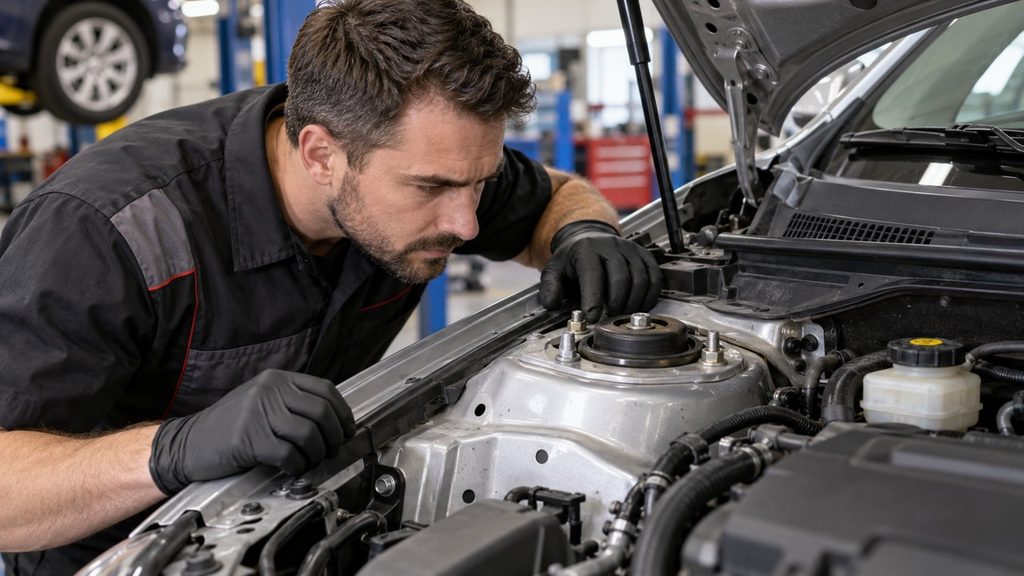
Compare the left and right sides if they use matching assemblies. Obvious differences may justify further investigation, but slight design-dependent movement or differences in visible hardware do not automatically mean a mount has failed.
Don’t attempt to loosen the upper mounting nuts or central shaft nut to see whether the parts move. The mount must remain properly secured during diagnosis.
3. Listen During Slow Steering Movement
If steering operation is otherwise normal and the vehicle can be safely observed, an assistant may slowly turn the steering wheel through a modest range while you listen from a safe position outside the vehicle.
Keep clear of the tires, coil springs, steering linkages, and other moving components. Do not place your fingers on the spring or upper mount while the steering is being operated.
Listen for a creak, click, groan, grinding sound, or sudden pop that seems to originate at one upper strut assembly.
If the noise occurs only during steering, a binding upper bearing becomes a reasonable suspect. If you hear nothing while steering but the car knocks on bumps, the rubber mount, mounting hardware, or another suspension component may be more relevant.
These observations don’t replace a full inspection. Steering systems transmit force through several joints, and an isolated sound near a strut tower can still originate elsewhere.
4. Watch for Spring Wind-Up or Jerky Rotation
On a steering strut design where the spring is visible from a safe position, observe its movement while an assistant slowly operates the steering.
Depending on the suspension, the spring and strut should move in a controlled way as steering loads change. If the upper bearing binds, the spring may appear to twist slightly and then move abruptly when the resistance releases.
A pop occurring at the same moment as that release is useful evidence. However, the amount and pattern of normal rotation vary by vehicle, and a spring-seat problem can mimic a faulty bearing.
Do not touch or attempt to restrain the spring to confirm what you’re seeing. A technician can evaluate the bearing and spring seat more accurately using the vehicle’s service procedure.
5. Check for Excessive Mount Movement
A technician can inspect whether the upper strut assembly moves abnormally relative to its mounting structure when appropriate, controlled suspension loads are applied.
Some mounts are designed to deflect slightly, and the visible portion of the strut shaft may move as the suspension or steering operates. Neither observation establishes a failure without knowing what is normal for that vehicle.
The important findings are excessive displacement, loose attachment, rubber-to-metal separation, damaged mounting surfaces, or movement that reproduces the complaint and exceeds the manufacturer’s acceptable limits.
Support conditions matter. An assembly may behave differently with the vehicle at normal ride height than with the wheels hanging freely. A proper inspection accounts for this instead of treating any visible movement as a failed mount.
6. Inspect Related Components Before Condemning the Mount
If the upper mount appears secure and the bearing seems to operate normally, the investigation shouldn’t stop there.
A technician should look for worn sway bar links, loose control arm bushings, ball joint clearance, damaged spring seats, loose strut hardware, and other faults that may transmit noise through the strut tower.
Our suspension clunking and rattling guide covers the broader diagnostic process when the sound hasn’t been isolated to the upper strut assembly.
The goal isn’t to identify the first part that looks aged. It’s to find the actual source of the movement or resistance that explains the complaint.
A Clunk After New Struts? Don’t Assume the Damper Is Faulty
Here’s a situation that frustrates a lot of drivers: the car gets new struts, the ride improves, but there’s still a clunk—or a completely new noise—when crossing bumps or turning into a parking space.
It doesn’t necessarily mean the replacement strut is defective.
The mount, bearing, spring seat, and associated hardware may have been reused. If one of those components was already worn, installing a new damper doesn’t automatically correct the problem.
There are also installation-related possibilities: incorrect hardware, a spring that isn’t seated properly, a damaged isolator, loose mounting fasteners, or a mount installed in the wrong orientation on an application where positioning matters.
Monroe and KYB both identify mounting problems as important suspects when a vehicle develops or retains clunking after shock or strut work.
That doesn’t mean you should start tightening random nuts under the hood. A strut’s central shaft nut and the surrounding mounting fasteners perform different functions, and incorrect handling of the spring-loaded assembly can be dangerous.
If the noise started immediately after a repair, return to the installer and explain exactly when it occurs. Ask the shop to verify the component fitment, spring seating, mount and bearing condition, and application-specific fastening procedures before replacing more parts.
What Else Can Mimic Bad Strut Mount Symptoms?
The upper strut area is particularly good at fooling your ears. A noise originating lower in the suspension can travel through the spring, strut body, and vehicle structure until it seems to be coming from the top of the wheel well.
The following components deserve consideration before an upper mount is replaced solely because a sound seems to come from that corner.
| Possible fault | Overlapping symptom | What helps distinguish it? |
|---|---|---|
| Upper strut mount | Clunk over bumps; possible increased cabin vibration | Confirmed abnormal upper-mount movement or rubber separation |
| Upper strut bearing | Creak, pop, roughness during steering | Restricted rotation or spring wind-up traced to the upper assembly |
| Sway bar end link | Sharp knock or rattle on uneven pavement | Excessive movement at the stabilizer link joints |
| Lower control arm bushing | Dull knock over bumps or during braking | Abnormal movement at the arm’s inner mounting points |
| Lower ball joint | Knocking, popping, or unstable wheel location | Excessive play at the steering-knuckle connection |
| Coil spring or spring seat | Popping, rubbing, or metallic noise | Incorrect spring seating, fracture, or damaged isolator |
| Tie rod or steering linkage | Knock during steering, free play, wandering | Movement isolated to a steering joint |
| Damper or lower strut mounting | Impact noise or poor ride control | Damper malfunction, damage, or loose lower mounting hardware |
A good example is a sway bar link with a worn ball-and-socket joint. It may knock as one wheel climbs a driveway entrance, and the sound can seem to originate from the same corner as the strut tower. Our guide to bad sway bar link symptoms explains why uneven pavement tends to reveal that problem and how it can be confirmed.
A damaged lower control arm bushing can produce another convincing imitation, particularly if the knock happens when braking force changes rather than when the steering wheel turns.
On the other hand, a distinct springy pop while steering, accompanied by visibly irregular spring rotation, makes the upper bearing more suspicious than a typical loose end link.
These are clues for directing an inspection, not shortcuts that make physical confirmation unnecessary.
Can a Bad Strut Mount Cause Uneven Tire Wear or Alignment Problems?
It can, but this symptom is often overstated.
On a structural strut suspension, the upper mount helps establish the position of the strut assembly relative to the body. If the mount becomes severely displaced or its mounting structure is damaged, the suspension’s geometry may no longer remain where it was intended.
In that situation, camber or caster behavior can be affected, and unusual wheel movement may contribute to handling or tire-wear problems.
But a slightly noisy bearing doesn’t automatically change the car’s alignment. And tire wear is far more commonly investigated through tire condition, inflation pressure, toe and camber settings, and wear in steering or suspension joints.
If your only symptom is uneven tread wear, there isn’t enough evidence to blame the upper mount.
Similarly, an alignment machine may show acceptable static measurements while a badly worn component allows the wheel to move under road loads. That’s why mechanical looseness should be addressed before treating alignment adjustment as the solution.
When replacement becomes necessary, our guide to alignment after suspension repairs explains when strut-related work calls for checking or adjusting wheel geometry.
Front vs. Rear Strut Mount Symptoms
The location of the mount changes which symptoms are possible. In particular, not every strut mount includes a steering bearing.
Bad Front Strut Mount Symptoms
Front MacPherson struts commonly have an upper bearing because the strut assembly participates in steering movement. A worn bearing may therefore produce creaking, spring wind-up, popping, or notchy steering.
The front upper mount’s rubber portion can also deteriorate and allow impact noises or additional vibration to reach the cabin.
Not every front suspension uses a MacPherson strut, however. Double-wishbone systems can use different spring, shock, and steering arrangements, with different upper mounting and bearing requirements.
Bad Rear Strut Mount Symptoms
Rear strut mounts can also wear, crack, separate, or develop loose mounting connections. The result may be knocking from the rear suspension or additional road noise entering the passenger compartment.
Conventional rear wheels don’t steer in the same way as the front wheels, so many rear strut mounts do not use a steering-rotation bearing. You therefore shouldn’t expect the same stationary steering test to reveal a bad rear mount.
A noise that seems to come from the trunk area may also involve rear shock mounts, sway bar links, cargo-area hardware, or other rear suspension components.
The vehicle’s actual suspension layout matters more than whether the noise comes from the front or back.
Why Do Strut Mounts and Bearings Fail?
Upper mounts live in a difficult environment. They experience repeated suspension loads, vibration, temperature changes, and exposure to moisture and road contamination over years of driving.
Several factors can contribute to premature deterioration:
- Rubber aging: Heat, repeated flexing, and time can harden or weaken the mount’s isolating material.
- Corrosion and contamination: Moisture, dirt, and road salt can damage metal components and bearings.
- Rough roads and repeated impacts: Potholes and road damage increase the loads acting on the suspension assembly.
- Worn or damaged bearings: Internal wear can make steering-related rotation rough or restricted.
- Incorrect assembly: Spring positioning, mount orientation, unsuitable components, or incorrect fastener handling can create noise and premature wear.
- Collision or curb damage: A significant impact can damage the mount, strut, steering knuckle, or vehicle structure.
- Changes to suspension setup: Nonstandard ride height or incompatible components can affect the operating conditions of upper mounts and bearings.
There isn’t a universal replacement mileage for every strut mount. A car that spends years on smooth highways may put its components through a different workload from an otherwise similar vehicle driven regularly over broken city streets.
Age and mileage are useful context, but the actual condition and function of the mount should determine the diagnosis.
Can You Drive With a Bad Strut Mount?
That depends on how the mount has failed.
A mild noise from an otherwise secure mount is not the same as a mount whose rubber has separated severely, whose upper attachment has become unstable, or whose bearing interferes with steering.
A deteriorated mount can progress from an annoyance to a more serious problem if it no longer holds the strut assembly correctly. A binding bearing can also create steering concerns that shouldn’t be dismissed as an ordinary suspension creak.
There is no reliable number of miles or weeks you can safely continue driving based solely on the sound the mount makes.
When You Should Stop Driving
Arrange towing or professional assistance rather than continuing to drive if you notice any of these conditions:
- The steering binds, suddenly becomes difficult to move, or behaves unpredictably.
- The upper strut mount or its attachment appears severely displaced or structurally separated.
- The wheel or strut assembly looks unusually tilted or out of position.
- A broken coil spring, damaged mount, or loose component appears likely to contact the tire or another critical part.
- The vehicle develops major instability or a significant change in steering after hitting a pothole or curb.
- A technician identifies a safety-critical problem with the mount, spring, or surrounding suspension.
For less severe symptoms, have the vehicle inspected promptly. A mount that is only mildly noisy may still be serviceable temporarily, but a professional needs to establish its condition before that judgment can be made.
What Happens When the Strut Mount Is Confirmed Bad?
Once the problem has been isolated to the upper mount or bearing, the repair depends on how the vehicle’s strut assembly is constructed.
Some applications allow the bearing to be replaced separately. Others supply a combined mount-and-bearing unit. A complete strut assembly may include the mount, spring, bearing, and damper, but that depends on the exact replacement product.
Before ordering parts, confirm what the replacement assembly actually includes. The same general term, strut assembly, doesn’t guarantee the same components are supplied by every manufacturer.
If the existing damper is still in good condition, replacing only the confirmed failed mount or bearing may be appropriate. If the strut is also leaking or no longer controlling suspension movement correctly, the shop may recommend addressing both problems while the assembly is apart.
Our strut mount replacement cost guide explains the labor involved, why the bearing may affect the parts quote, and when it makes financial sense to replace more than the mount itself.
One repair detail is especially important: on many conventional strut assemblies, the coil spring must be safely compressed before the upper mount can be disassembled. A spring under compression stores enough energy to cause severe injury if handled incorrectly.
Replacing a mount is therefore not a job to approach by removing the center nut while the spring remains uncontrolled. Use professional spring-handling equipment and the vehicle-specific service procedure, or have a qualified technician perform the work.
After the repair, the shop should verify correct installation, steering operation, and whether wheel alignment needs to be measured. The original noise should also be checked under the conditions that previously produced it.
Frequently Asked Questions
What are the first signs of a bad strut mount?
Common early complaints include a clunk over bumps, creaking during low-speed steering, or more noise coming through the upper suspension. Some problems are identified during inspection before the driver notices any change. The first symptom depends on whether the rubber mount, bearing, or associated hardware is deteriorating.
What does a bad strut mount look like?
Visible clues can include rubber separating from metal, unusually distorted or displaced mount material, severe corrosion, damaged fasteners, or obvious movement where the strut attaches to the body. However, not every faulty bearing has visible external damage, and minor surface cracks don’t automatically establish that a mount is unsafe.
Can a bad strut mount cause noise when turning?
Yes. On front strut designs with a steering bearing, wear or binding may produce a creak, groan, pop, or grinding noise during steering. A spring that winds up and releases because the bearing is resisting rotation can also create a noticeable snap. Other steering and suspension faults must still be ruled out.
Can a bad strut bearing make the steering wheel hard to turn?
A binding upper bearing can add resistance to steering movement or cause a notchy, jerky feeling. But heavy steering can also come from power steering problems, tires, steering linkage faults, or other causes. If the steering becomes difficult or unpredictable, stop driving and arrange an inspection rather than assuming the bearing is the only issue.
Can a bad strut mount cause vibration?
Yes. Deteriorated mount rubber can allow additional road vibration and noise to enter the vehicle body. However, a constant vibration at a particular highway speed is often more characteristic of a tire or wheel issue. Mount condition should be assessed together with the rest of the suspension.
Can a bad strut mount cause uneven tire wear?
A severely displaced mount may affect suspension geometry and contribute to alignment-related problems, but tire wear alone is not a reliable strut mount symptom. Tires, toe and camber settings, control arm bushings, ball joints, and other parts should be inspected before attributing the wear to the upper mount.
Can a strut mount be bad even if the strut is new?
Yes. The mount or bearing may have been reused during strut replacement, or an installation issue may have affected the new assembly. Confirm which parts were installed, whether the spring is correctly seated, and whether the mounting hardware meets the vehicle’s service requirements. A new damper does not guarantee a healthy upper mount.
Do bad strut mounts always make noise?
No. Rubber deterioration, early bearing wear, or corrosion may be detected during inspection before a noticeable sound develops. Some faults also make noise only when the suspension reaches a particular position or load. Physical condition and correct operation are more reliable indicators than noise alone.
Do you need to replace both strut mounts at the same time?
Not automatically. Both sides should be inspected because they usually have similar age and mileage, and some manufacturers recommend replacing mounts in pairs. But a sound mount doesn’t necessarily need replacement solely because the opposite side failed. Follow the component manufacturer’s guidance and the actual condition of the vehicle.
Is the strut mount the same as the strut bearing?
No. The mount secures and isolates the upper strut assembly, while the bearing allows steering-related rotation on designs that use one. The bearing may be integrated into the mount, available separately, or supplied as part of a replacement kit. The distinction matters when identifying the failed component and ordering parts.
Find the Failed Component, Not Just the Familiar Noise
A clunk from the upper suspension is easy to blame on the strut mount. So is a creak while turning the steering wheel. But the two noises can come from different parts of the same assembly, and either can be transmitted from somewhere else entirely.
Start with what the car does. A knock as the suspension compresses makes the mount and its hardware worth examining. A springy pop or roughness during slow steering raises suspicion about the upper bearing and spring seat. Excessive bouncing, meanwhile, points you toward a different part of the strut’s job.
Once you have physical evidence of the actual fault, the repair decision becomes straightforward. Until then, replacing the whole assembly just because the sound seems to come from the strut tower is an expensive way to guess.