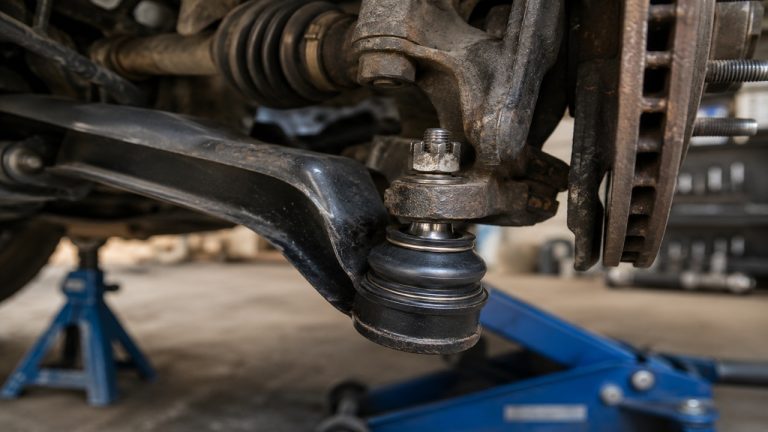
Symptoms of a Bad Tie Rod: Warning Signs and How to Check
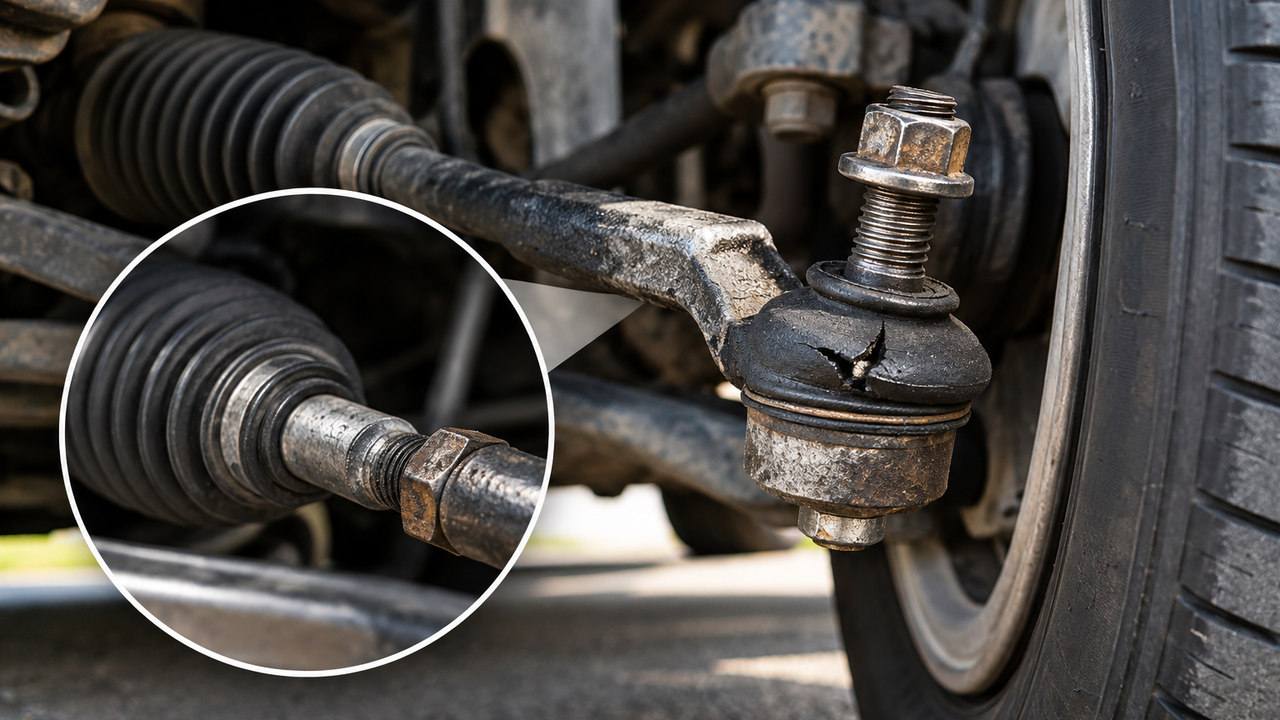
The most common symptoms of a bad tie rod are loose or wandering steering, clunking when turning, steering wheel vibration, uneven front tire wear, and a delay between moving the steering wheel and the tires responding. A badly worn tie rod can also make the car feel unstable at highway speeds. However, none of these symptoms alone proves that a tie rod has failed.
To check whether a tie rod is bad, inspect its rubber boots for damage and look for unwanted movement at the inner or outer joint. With the vehicle safely supported according to the manufacturer’s instructions, a controlled side-to-side check at the wheel’s 3 and 9 o’clock positions can help reveal steering looseness. The important part is identifying exactly which component moves, rather than assuming every loose-feeling wheel needs a new tie rod.
Safety first: If the steering suddenly develops significant free play, the car changes direction unpredictably, or a tie rod appears close to separating, stop driving and arrange professional inspection or towing. A failed steering connection can cause a loss of directional control.
Bad Tie Rod Symptoms at a Glance
| Warning sign | What you may notice | How useful is the clue? |
|---|---|---|
| Loose steering | Extra steering wheel movement before the car responds | Strong reason to inspect steering linkage |
| Wandering | Frequent small corrections to stay in your lane | Possible tie rod wear, but also tires or alignment |
| Clunking or knocking | A knock while turning slowly or changing steering direction | Possible joint looseness; not specific to tie rods |
| Steering wheel vibration | Shimmy or shaking that changes with road speed | Check tires and wheels as well |
| Uneven tire wear | Rapid shoulder wear or feathered tread blocks | May indicate changing or incorrect toe |
| Damaged joint boot | Split rubber, missing seal, or grease escaping | Evidence of contamination risk, not proof of play |
| Measurable joint movement | One tie rod joint shifts independently of the connected parts | Important physical evidence requiring specification-based inspection |
The most convincing finding is not a noise or vibration. It’s excessive movement at the joint itself, verified using the appropriate inspection procedure. A tire can shake because it’s out of balance; a steering wheel can sit crooked because of an alignment error. Neither condition automatically means the tie rod is worn out.
What Does a Tie Rod Do, and Why Does It Wear Out?
A tie rod is part of the mechanical connection that turns steering wheel movement into a change in the direction of the front wheels. On a typical rack-and-pinion system, each side has an inner tie rod connected to the steering rack and an outer tie rod end attached to the steering knuckle.
The inner and outer joints allow the linkage to move as the suspension travels and the wheels steer. They’re small components doing a fairly demanding job: they need to articulate freely while holding the wheel’s steering position accurately.
Over time, the ball-and-socket bearing surfaces can wear. The protective boot can also split, allowing moisture and abrasive dirt to enter. Road salt, corrosion, pothole impacts, and bent steering components can make the situation worse.
Older steering-box systems and some trucks use a different arrangement, with components such as a center link, drag link, and adjusting sleeves. The basic diagnostic principle remains the same: identify unwanted movement in the steering linkage rather than relying on the symptom alone.
7 Common Symptoms of a Bad Tie Rod
1. Loose Steering or Excessive Steering Wheel Play
Picture a small steering correction on a straight road. You turn the wheel slightly, but the car doesn’t respond as promptly as it used to. Then, after a little more movement, the front wheels seem to catch up.
That dead or vague feeling can happen when a worn tie rod joint allows movement before the steering force is fully transferred to the knuckle. Drivers sometimes describe it as sloppy steering, steering wheel play, or a front end that no longer feels connected.
It’s a useful warning sign, but there are alternatives. Wear in the steering rack, steering gearbox, intermediate shaft, or other linkage components can create a similar delay. A proper inspection needs to locate where the extra movement occurs.
2. The Car Wanders or Needs Constant Steering Corrections
Another complaint is a car that won’t settle into a straight line. You may find yourself making repeated small corrections, particularly on the highway or where the pavement has grooves.
A loose tie rod can let the affected wheel’s toe angle change slightly as road forces act on it. Instead of tracking consistently, the wheel may respond differently to bumps, braking, or lateral load.
Don’t confuse wandering with a steady pull. A car that consistently pulls to one side may have an alignment problem, unequal tire pressure, tire conicity, brake drag, or another suspension issue. Worn tie rods belong on the inspection list, but the direction of the pull doesn’t identify which tie rod has failed.
3. Clunking or Knocking When Turning
A worn tie rod end can make a dull clunk when steering load changes direction. You might hear it while maneuvering into a parking space, turning slowly at an intersection, or moving the steering wheel left and right near the straight-ahead position.
The noise can come from excessive clearance inside the joint as the load shifts from one side of the worn bearing surface to the other.
But front-end knocks are notoriously difficult to identify by ear. A sway bar link, ball joint, control-arm bushing, steering rack mount, or intermediate steering shaft can produce a similar sound. A tie rod is more suspicious when the knock occurs alongside actual steering looseness.
A clicking sound only during a tight turn, particularly while accelerating, may point toward a CV axle rather than a tie rod. Grinding or humming that changes with road speed suggests checking the wheel bearing and tires, too.
4. Steering Wheel Vibration or Shimmy
Can bad tie rods cause a shaking steering wheel? Yes. Excessive joint play may allow unwanted wheel movement, and that disturbance can travel back through the steering linkage.
Some drivers notice the shake most at higher speeds; others feel it when crossing rough pavement or changing steering direction. The pattern depends on the vehicle and how badly the joint has worn.
Still, vibration alone is a weak diagnostic clue. An imbalanced tire, bent wheel, damaged tire belt, brake rotor variation, or worn wheel bearing can also cause shaking. If the vibration occurs in a narrow speed range without any measurable steering play, start by checking the tires and wheels before condemning a tie rod.
5. Uneven Front Tire Wear and Feathering
Tie rods influence the front wheels’ toe alignment. When a joint becomes loose, the wheel may no longer hold its intended steering angle consistently. Even a small error can make the tread scrub sideways instead of rolling cleanly.
One classic sign of excessive toe is feathered tire wear. The tread blocks feel relatively smooth when you run your hand across them in one direction and sharper in the opposite direction. Some vehicles develop rapid shoulder wear as well.
The catch is that perfectly tight tie rods can still accompany incorrect alignment settings. Tire wear shows that something needs investigating; it doesn’t establish that the joint itself has failed. Our toe-in vs. toe-out guide explains how those angles affect tire scrub and steering behavior.
6. An Off-Center Steering Wheel or Alignment That Doesn’t Hold
Imagine having the front wheels aligned, only to find that the steering wheel starts sitting crooked again or the car begins tracking differently a short time later.
A worn joint that allows the steering linkage to shift under load can contribute to inconsistent toe. A bent tie rod after a curb strike can also affect the alignment even if the joint itself has no excessive play.
However, an off-center steering wheel is common for other reasons, including an incorrectly centered alignment adjustment, rear thrust-angle issues, or tire-related pull. If a shop says the alignment won’t hold because a tie rod is loose, ask them to demonstrate the movement rather than relying on the steering wheel position alone.
7. Torn Dust Boots, Grease Loss, or Visible Damage
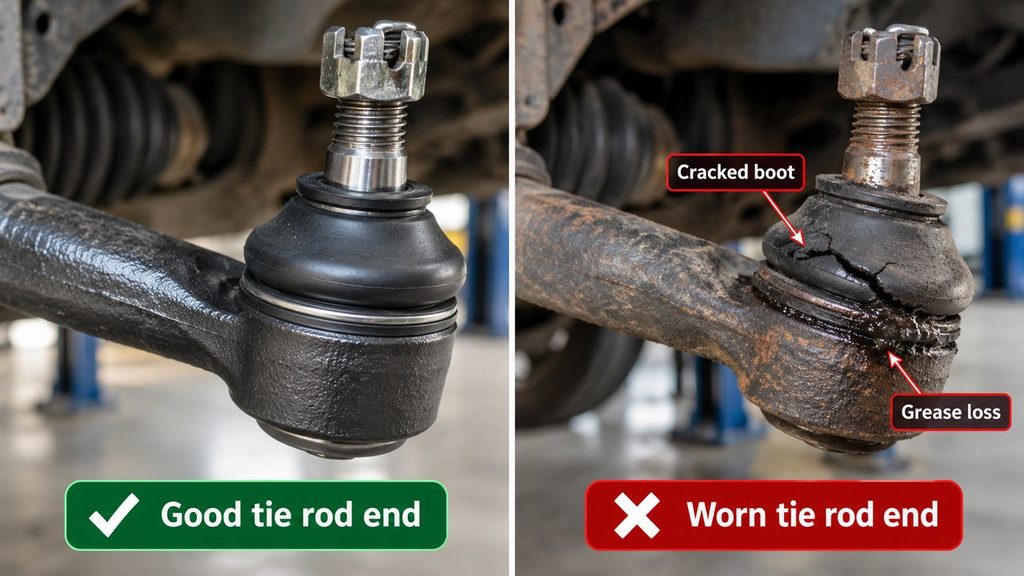
The outer tie rod end usually has a small rubber dust boot covering its ball-and-socket joint. The boot keeps grease in and contamination out. If it splits, moisture, salt, and grit can accelerate wear inside the joint.
A torn boot is a reason to inspect the part promptly, but it isn’t automatically proof that the bearing already has excessive clearance. Likewise, grease on the outside of a joint may come from a recent lubrication service, a relief opening, or an actual seal failure.
Look for the complete picture: boot condition, corrosion, bent metal, loose mounting hardware, and measurable joint movement. A visibly bent tie rod after an impact should be professionally assessed even if you haven’t noticed a clunk.
How to Tell if a Tie Rod Is Bad: Practical Checks
If you’re wondering how to know if a tie rod is bad, the most useful distinction is between symptoms you feel while driving and movement you can confirm during an inspection. The checks below help explain what a technician looks for, and which observations are possible for a careful DIY inspection.
Steering systems are safety-critical. Follow the manufacturer’s lifting, suspension-loading, and inspection procedures. Do not crawl beneath a vehicle supported only by a jack, and keep hands clear of joints and linkages whenever another person is moving the steering wheel.
Check 1: Inspect the Outer Tie Rod End Visually
With the vehicle parked securely and the steering system at rest, look behind the front wheel toward the steering knuckle. The outer tie rod end is generally the joint where the steering linkage attaches to the knuckle.
Look for a boot that’s split, missing, or pulled away; escaping grease; significant corrosion; and obvious bending after a curb or pothole impact. Check for loose or missing hardware without disturbing it.
Many faults are not visible externally. A clean-looking joint can still be worn internally, while a damaged boot may be discovered before measurable play develops.
Check 2: Understand the 3 and 9 O’Clock Wheel Test
A common workshop test involves gripping the tire at the left and right edges—roughly the 3 and 9 o’clock positions—and applying gentle alternating push-pull pressure.
For this check, the vehicle must be securely lifted and supported in the manner required by its manufacturer. Some designs also have specific suspension loading requirements. Never improvise support points or perform the test on an unstable jack.
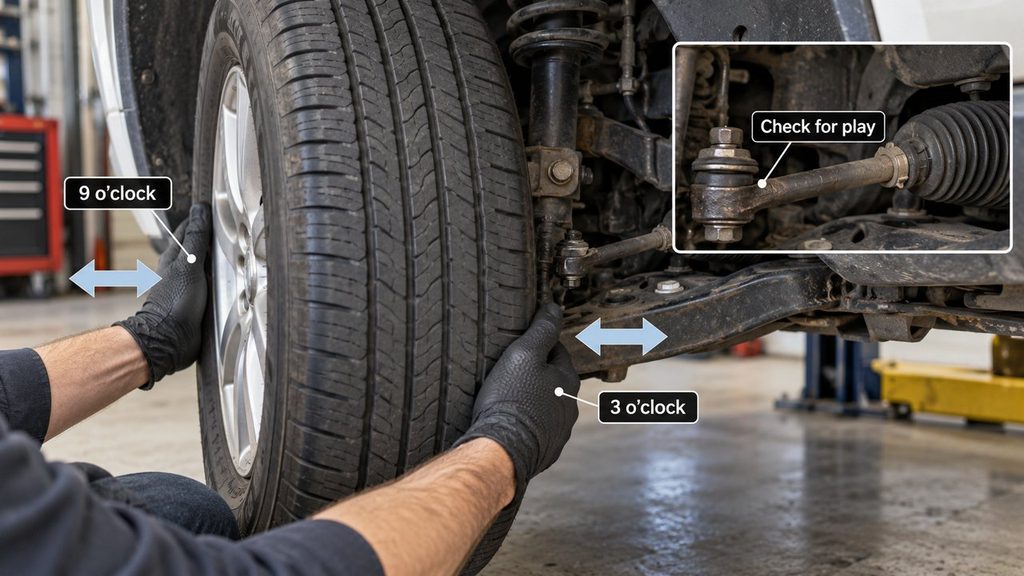
Unwanted side-to-side movement can indicate looseness somewhere in the steering or wheel assembly. The important limitation is that the test doesn’t identify a bad tie rod by itself. Normal steering movement, steering rack play, wheel-bearing looseness, and other faults can influence what you feel.
A second person or technician needs to observe the relevant joints safely and determine whether the movement is occurring at the inner tie rod, outer tie rod, rack, or another component. Compare the result with the vehicle manufacturer’s acceptable-play criteria.
Check 3: Watch for Delayed Movement Between Connected Parts
Professional technicians often use a controlled steering-linkage check, sometimes called a dry park test. With the vehicle properly secured, a helper makes small steering inputs while the technician observes the steering linkage from a safe inspection position.
What matters is the relationship between parts. If the steering linkage moves but a tie rod stud or connected steering knuckle doesn’t immediately follow because of clearance inside the joint, that is meaningful evidence. Merely seeing the rubber boot flex as the joint articulates is not the same thing.
Don’t put fingers around a moving joint, reach into the steering linkage, or position yourself under an unsupported vehicle. If you can’t observe the connection safely, leave this check to a qualified technician with the correct lift and equipment.
Check 4: Locate the Movement Before Replacing Anything
Once looseness is found, follow the steering load path rather than jumping straight to a part number.
- Movement at the outer ball-and-socket joint: Suspect an outer tie rod end if clearance is confirmed between the joint stud and housing.
- Movement at the inner joint near the rack: Suspect an inner tie rod when the joint itself has excess play.
- Rack housing shifting at its mounts: Inspect the steering rack mounting system before replacing tie rods.
- Wheel or hub movement without matching tie rod movement: Check the wheel bearing, ball joints, and related mounting components.
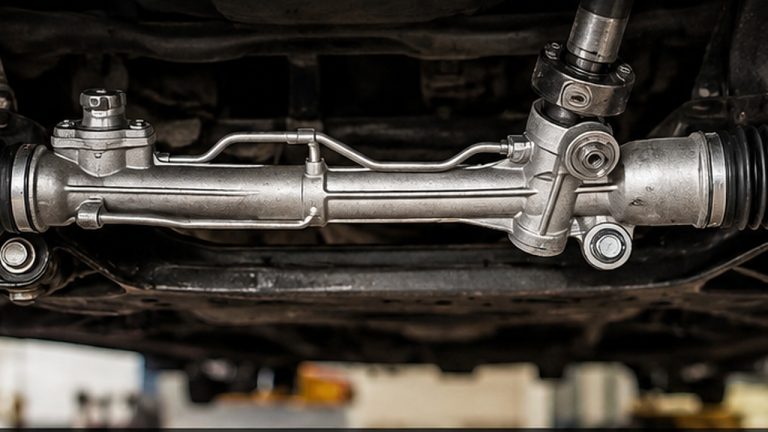
On rack-and-pinion systems, the inner joint is usually covered by an accordion-style steering rack boot. You may need a professional inspection to distinguish inner-joint clearance from normal rack motion or wear inside the steering gear. Don’t cut, puncture, or remove the boot simply to investigate without the appropriate service procedure.
Bad Inner Tie Rod Symptoms vs. Bad Outer Tie Rod Symptoms
One question comes up repeatedly: can you tell whether the inner or outer tie rod is bad just from how the car drives?
Usually not with confidence. Both components transmit steering force and both can develop unwanted play. The more reliable difference is where the looseness is physically located.
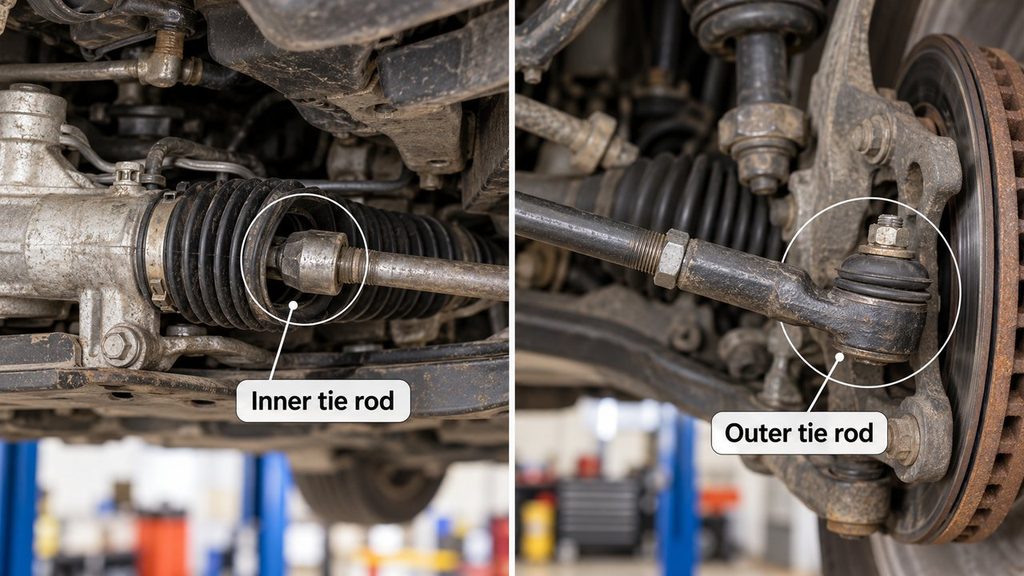
| Feature | Inner tie rod | Outer tie rod |
|---|---|---|
| Typical location | Next to the steering rack, usually beneath a rack boot | At the steering knuckle, close to the wheel |
| Common driving symptoms | Steering play, wandering, vibration, possible knocking | Steering play, wandering, vibration, possible knocking |
| Most useful diagnostic clue | Excess play isolated at the inner joint | Excess play isolated at the outer joint |
| Visible boot | Usually protected by the steering rack bellows | Small individual dust boot around the joint |
| Inspection difficulty | Often less accessible | Usually easier to observe |
| Can noise alone distinguish it? | No | No |
Bad Inner Tie Rod Symptoms
An inner tie rod connects the steering rack to the outer tie rod on many modern vehicles. It contains an articulating joint that accommodates suspension and steering movement.
When worn, it can cause a vague steering response, a knock when steering direction changes, wandering, or vibration. Some drivers feel the looseness through the steering wheel, but there is no dependable “inner tie rod noise” that distinguishes it from all other components.
During inspection, the technician looks for movement at the inner joint rather than assuming the steering rack itself has failed. This is worth checking carefully: replacing a complete steering rack when only a serviceable inner tie rod is worn can mean a much larger repair than necessary.
The boot covering this area is often called a rack boot, steering rack bellows, or inner tie rod boot. Its condition matters because damaged bellows can admit contamination to the protected components.
Bad Outer Tie Rod Symptoms
The outer tie rod end attaches directly to the steering knuckle. Its ball stud pivots as the wheel steers and the suspension moves.
When this joint becomes loose, you may hear a clunk during low-speed steering, notice a small delay in response, or experience wandering and abnormal tire wear. A damaged outer boot can make the problem easier to spot, especially if grease has escaped or the joint has visible corrosion.
But the phrase bad outer tie rod symptoms at slow speeds shouldn’t be treated as a unique diagnosis. Sway bar links, strut mounts, ball joints, and other steering parts can also knock during slow maneuvers. Confirm the outer joint’s movement before deciding to replace it.
In short, inner and outer tie rods share most driving symptoms. Location and physical inspection—not the pitch of a clunk or the speed at which it occurs—are what separate the diagnoses.
Bad Tie Rod vs. Wheel Bearing, Ball Joint, or Alignment Problem
A surprising number of front-end problems feel similar from the driver’s seat. Before ordering a tie rod, it helps to understand which clues point toward other parts.
| Possible problem | More characteristic clue | What helps distinguish it |
|---|---|---|
| Worn tie rod | Steering play, wandering, clunk when steering load changes | Excess movement confirmed at inner or outer tie rod joint |
| Wheel bearing | Humming, growling, or rumbling that changes with speed or loading | Bearing inspection and wheel/hub checks |
| Suspension ball joint | Knocking with suspension or steering movement | Correct load-specific ball joint inspection |
| Incorrect wheel alignment | Pulling, crooked steering wheel, feathered tire wear | Alignment measurements with steering components verified tight |
| Tire or wheel fault | Speed-related vibration, visible damage, imbalance | Tire inspection, pressure, balance, and wheel runout checks |
| Steering rack or mounting fault | Free play, knocking, or rack movement | Inspect rack, internal play, and mounting points |
Here’s one useful example. If the steering wheel shakes at roughly the same road speed every time, but the linkage has no measurable play, a tire or wheel problem may be more likely than a worn tie rod. If the car clunks on bumps but the steering remains precise, a suspension joint or bushing deserves attention too.
Likewise, a wheel that shows movement during a basic shake test doesn’t tell you which part is bad. A technician must separate steering linkage movement from bearing clearance and suspension-joint play.
For cases where the whole vehicle feels unstable rather than showing a clearly identifiable steering-joint fault, our guide to a car that feels loose while driving covers the broader possibilities.
Is It Safe to Drive With a Bad Tie Rod?
A confirmed bad tie rod is not a repair to put off. Its job is to maintain a controlled mechanical connection between the steering system and the wheel. Excessive wear can worsen, and a severely damaged joint may separate.
There is no trustworthy universal answer to “how many miles can you drive with a bad tie rod?” A slightly worn joint discovered during an inspection is different from one with severe play, a loose mounting connection, or obvious impact damage. Neither mileage nor the absence of noise guarantees that a damaged joint will remain intact.
When to Stop Driving Immediately
- The steering wheel suddenly has much more free play than normal.
- The vehicle changes direction unpredictably or becomes difficult to keep in its lane.
- A front wheel visibly changes angle, wobbles, or no longer follows steering input correctly.
- A technician identifies severe tie rod looseness, separation risk, or unsafe mounting hardware.
- The symptoms begin immediately after a serious pothole, curb, or collision impact and steering control is affected.
In those situations, don’t try to find out whether the car will make it to the repair shop. Stop in a safe location and arrange towing.
If the symptoms are mild but unexplained, arrange a prompt inspection before routine driving continues. Avoid using a highway test drive to investigate a suspected steering-joint problem. The faster the car is moving, the less room there may be to recover from a sudden steering failure.
What Happens if a Tie Rod Is Confirmed Bad?
A worn or damaged tie rod joint generally needs replacement. Adding grease, tightening an adjustment sleeve, or requesting a wheel alignment won’t restore worn bearing surfaces.
The repair should address the specific failed component. On many rack-and-pinion vehicles, the inner and outer tie rods are separate service parts, so a complete steering rack replacement isn’t automatically necessary.
Before approving work, ask the technician to identify the faulty joint, show the excessive movement or damage, and check the remaining steering and suspension components. It is entirely possible for one tie rod to be worn while the other remains serviceable.
Our tie rod replacement cost guide covers the price differences between inner and outer tie rod repairs, labor, and what should be included in a workshop estimate.
Do You Need an Alignment After Replacing a Tie Rod?
Yes. Replacing an inner or outer tie rod affects the effective length of the steering linkage, which directly influences the wheel’s toe angle.
Counting exposed threads or measuring the old part can help approximate the original setting during assembly, but it cannot replace a proper alignment measurement. Manufacturing tolerances and differences between old and new parts matter.
The completed repair should include a check of front toe and steering wheel centering, with the appropriate overall alignment procedure for the vehicle. Our alignment after suspension replacement guide explains when different steering and suspension repairs require an alignment.
An alignment should be performed after the faulty component is repaired, not used to compensate for a joint that still has excessive play.
Frequently Asked Questions
What is the first sign of a bad tie rod?
Loose or imprecise steering is a common early complaint, sometimes accompanied by a knock when changing steering direction. However, some worn tie rods cause few noticeable symptoms. A physical inspection is needed to confirm excessive joint play.
How do you know if your tie rod is bad without lifting the car?
You can look for a torn outer tie rod boot, escaping grease, visible bending, and changes in steering response while the vehicle is stationary. These observations can raise suspicion but usually cannot confirm internal wear. Proper inspection may require lifting and supporting the vehicle according to its service procedure.
What noise does a bad tie rod make?
A worn tie rod may cause a dull clunk, knock, or rattle when steering direction changes or when road forces shift the load on the joint. It doesn’t have one unique sound. A whining, humming, or clicking noise may have another source, and some bad tie rods make no obvious noise.
Can a bad tie rod cause shaking at low speeds?
It can contribute to looseness or vibration at low speeds, especially while steering, but low-speed shaking is not specific to tie rods. Tire damage, wheels, brakes, steering components, and suspension joints should also be considered. The joint needs to be checked for excessive movement.
How can you tell which side has a bad tie rod?
The direction the car pulls or the side where a noise seems loudest doesn’t reliably identify the faulty tie rod. A technician must inspect both steering linkages and isolate the joint with excessive play or damage. Left and right sides can wear at different rates.
Can a bad tie rod cause tire wear?
Yes. Excessive tie rod play can allow the wheel’s toe angle to change and cause abnormal tire scrub or feathering. Incorrect alignment can produce similar wear even with healthy tie rods, so tread damage alone isn’t enough for diagnosis.
Will a wheel alignment fix a bad tie rod?
No. Alignment adjusts wheel angles; it doesn’t repair worn joints or damaged hardware. A loose tie rod should be repaired before the final alignment, or the settings may remain inconsistent under road loads.
Are bad track rod end symptoms the same as bad tie rod symptoms?
Yes, in ordinary automotive usage, “track rod end” is a term commonly used in British English for what U.S. drivers usually call an outer tie rod end. The relevant signs—steering play, clunking, wandering, and tire wear—are essentially the same. The component’s physical condition determines the diagnosis.
The Best Clue Is Where the Looseness Comes From
A bad tie rod can explain several frustrating symptoms: a steering wheel that feels vague, a knock during parking maneuvers, tires wearing faster than expected, or a car that won’t track straight. But those clues overlap with other steering and suspension faults.
Instead of choosing a replacement part based on a noise or a feeling, have the inner and outer joints inspected and identify where excessive movement occurs. That’s the difference between fixing a genuine steering problem and replacing a perfectly serviceable tie rod while the real fault remains.
And if the steering is already unstable or a joint has significant play, treat it as a safety issue. The cost of a proper inspection is a much better risk than finding out how far a failing steering connection can go.