Linear vs. Progressive Springs: How They Differ and Which to Choose
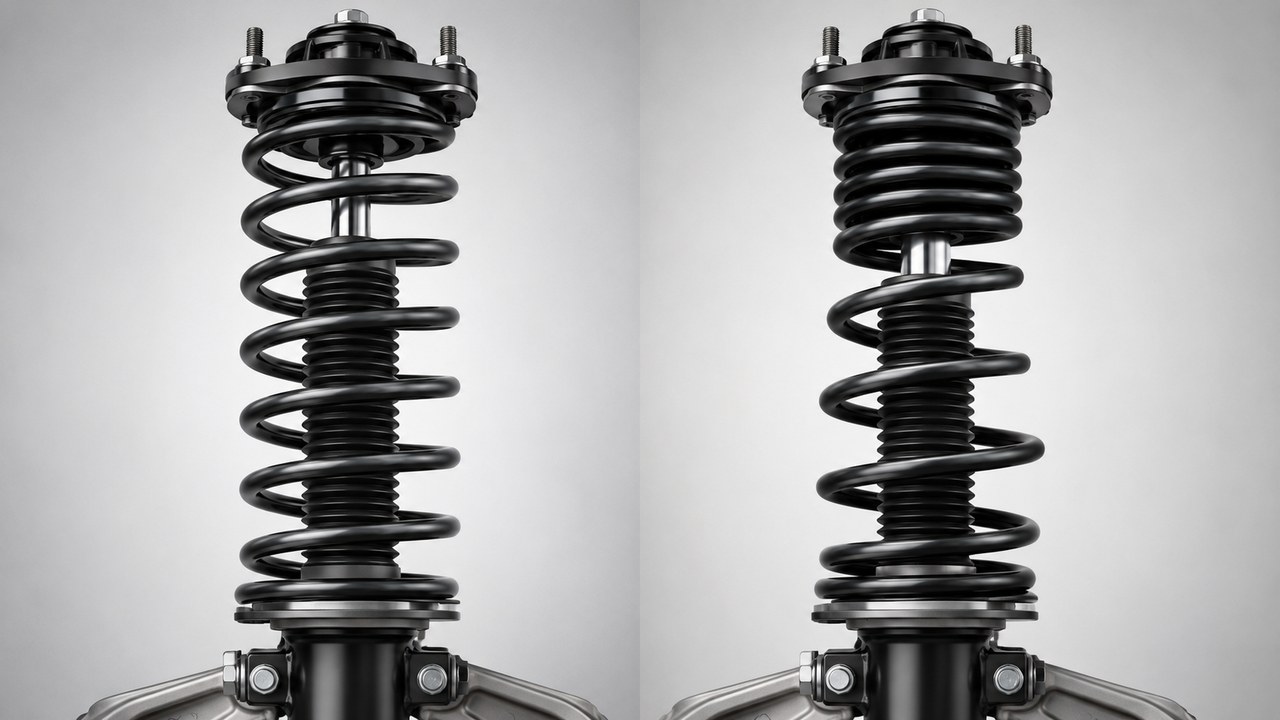
The main difference between linear and progressive springs is how their spring rate changes as they compress. A linear spring maintains approximately the same rate through its normal working range, so each additional inch of compression requires a similar increase in force. A progressive spring becomes stiffer as it compresses, allowing the suspension to respond differently to small movements and larger loads.
Neither design is automatically better. Linear springs are valued for predictable behavior and straightforward suspension tuning, while progressive springs can provide a broader range of response when a vehicle needs compliance during normal driving but more resistance deeper into suspension travel.
The right choice depends on the vehicle, suspension geometry, available travel, dampers, tires, normal load, and whether the priority is everyday comfort, performance consistency, changing payload, or a combination of those goals.
What Does Linear Spring Rate Mean?
A linear spring has a substantially constant spring rate through its intended working range.
If a linear spring is rated at 300 lb/in, approximately 300 pounds of additional force are required to compress it the first inch. Another approximately 300 pounds of additional force are required for the next inch, assuming the spring remains within its designed range and has not reached coil bind.
The total force increases as the spring compresses, but the rate of increase remains approximately constant. That distinction is important: a linear spring does not produce the same total force at every position.
Linear behavior makes suspension response easier to model and repeat. If engineers or tuners change from one known linear rate to another, the effect on wheel stiffness can be easier to predict than with a spring whose rate changes throughout its travel.
What Is a Progressive Spring?
A progressive spring has a spring rate that increases as the spring compresses.
For example, the spring may initially react at a relatively low rate during small suspension movements, then require progressively more force per additional inch of compression deeper into its travel.
Manufacturers can create this behavior in several ways, including changes in coil spacing, coil diameter, wire diameter, or the number of active coils as the spring compresses.
Some progressive designs transition gradually between rates. Others behave more like two distinct rate ranges with a transition between them. For that reason, the word “progressive” does not describe one universal force curve.
Linear vs. Progressive Springs at a Glance
| Characteristic | Linear Springs | Progressive Springs |
|---|---|---|
| Spring rate | Approximately constant | Increases with compression |
| Response | Consistent and predictable | Changes through travel |
| Setup changes | Generally easier to quantify | Can require more detailed rate information |
| Small suspension movements | Depends on chosen rate | Can use a softer initial rate |
| Deeper compression | Same basic rate continues | Rate increases |
| Track tuning | Common because behavior is predictable | Can also work when designed for the application |
| Street use | Can be comfortable or firm | Can provide a broad operating range |
| Changing loads | One rate must cover the range | Increasing rate can help manage larger loads |
| Complexity | Simpler force relationship | More complex force curve |
This comparison describes the spring itself. What the driver feels at the wheel and body depends on much more than spring type alone.
Why Progressive Springs Get Stiffer as They Compress
One common progressive-spring design uses coils with different spacing. Some coils begin relatively close together while others remain farther apart.
As the closely spaced coils touch one another during compression, they effectively stop acting as active coils. With fewer active coils remaining, the spring becomes stiffer.
Spring designers can also change other dimensions to shape the rate curve. The result can be a gradual increase in stiffness or a more noticeable transition between stages.
This is why two progressive springs should not be assumed to behave identically just because both use the same label. Their initial rate, final rate, transition point, usable travel, and load range may be very different.
A Progressive Spring Is Not Simply a Soft Spring
One of the most common misunderstandings is that progressive automatically means soft.
A progressive spring can have a relatively compliant initial rate and a much firmer rate later in its travel, but the actual numbers matter. A progressive spring could still begin at a higher rate than a particular linear spring.
Likewise, a linear spring can be very soft, moderately firm, or extremely stiff. “Linear” describes how the rate behaves through travel, not how high that rate is.
The useful comparison is therefore not simply linear versus progressive. It is the complete rate curve of one spring versus the complete rate or curve of another.
Why Linear Springs Are Popular for Performance Tuning
Linear springs are common in performance suspension because their predictable rate simplifies setup changes.
If a car uses a known 400 lb/in spring and the tuner changes it to 450 lb/in, the rate change can be quantified across most of the spring’s working range. That makes it easier to evaluate the effect alongside damping, anti-roll bars, tire behavior, alignment, and front-to-rear balance.
This consistency is useful when lap times, driver feedback, data logging, and repeatability matter. A suspension engineer can change one known variable and observe the result without also dealing with a spring rate that varies substantially according to compression position.
That does not mean progressive springs are unsuitable for performance driving. Progressive and multi-rate designs are also used in performance applications when their changing rate matches the suspension’s objectives.
Why Progressive Springs Make Sense on Street Cars
A road car operates across a wide range of conditions. It may encounter small pavement imperfections during a normal commute, larger dips and bumps, passengers, luggage, braking, cornering, and occasional heavy compression events.
A progressive spring gives designers another tool for managing that range.
The initial portion of travel can be tuned for normal driving, while a higher rate deeper in compression can provide additional resistance as suspension movement increases.
This can be useful when designers want compliance without allowing excessive body movement or frequent use of the bump stops under larger loads.
But good ride quality still requires appropriate damping, suspension travel, tire stiffness, bushings, and geometry. A progressive spring cannot compensate for a poorly matched shock absorber or insufficient bump travel.
Which Is Better for Ride Comfort?
Progressive springs can offer an advantage when a softer initial response and firmer deeper travel suit the vehicle, but progressive does not automatically mean more comfortable.
A car riding mostly within a stiff section of a progressive spring may feel firmer than another car using a lower-rate linear spring. Likewise, a properly selected linear spring can provide excellent comfort if its rate and damper tuning match the vehicle.
Ride comfort also depends on how quickly suspension motion is controlled. Springs determine the force required for displacement, while dampers resist the speed of suspension movement. Our guide to what damping does in suspension explains why those two functions should not be confused.
Which Is Better for Handling?
Neither spring type guarantees better handling.
Linear springs are attractive for performance tuning because their predictable behavior makes chassis changes easier to understand. A known rate can simplify balancing the front and rear suspension and matching damper settings.
Progressive springs can provide additional stiffness as cornering load compresses the suspension further, but the actual benefit depends on where the suspension operates within the spring’s rate curve.
Tire grip, wheel rate, suspension geometry, anti-roll bars, damping, alignment, aerodynamic load, bump stops, and road surface all influence handling. Choosing a spring solely because it is linear or progressive ignores most of the chassis.
Spring Rate Is Not the Same as Wheel Rate
The spring rate printed on a spring does not necessarily equal the stiffness acting at the tire.
Suspension arms and mounting positions can create leverage between the wheel and spring. If the spring moves less than the wheel, the effective wheel rate will be lower than the spring rate.
Motion ratio therefore matters when comparing setups, especially when the spring is mounted inboard on a control arm rather than close to the wheel.
Our suspension spring rate calculator explains spring rate, wheel rate, motion ratio, and ride frequency in more detail. The calculator is intended for establishing a theoretical baseline and does not model progressive springs.
Even a Linear Spring Can Produce Progressive Wheel Stiffness
This is another reason not to judge an entire suspension only by the spring label.
A suspension can use a linear spring while its motion ratio changes as the wheel moves. If suspension leverage changes through travel, the effective wheel rate can also change even though the spring itself remains linear.
Bump stops can add another progressive element near the end of compression, increasing resistance as the suspension approaches its travel limit. Tires, anti-roll bars, bushings, and other elastic components also contribute to the forces acting between the road and vehicle body.
The complete suspension can therefore become progressively stiffer through travel without using a progressive main spring.
Can You Identify a Progressive Spring by Looking at It?
Sometimes, but not reliably enough to determine its exact behavior.
Closely spaced coils at one end are often associated with progressive springs because some coils become inactive as they contact each other. Variable coil spacing can therefore be a useful clue.
However, spring rate also depends on wire diameter, mean coil diameter, number of active coils, material, and geometry. A spring with an unusual shape or changing diameter is not automatically progressive.
The safest way to determine the intended rate behavior is to use the manufacturer’s specifications or a measured load-versus-deflection curve rather than relying only on appearance.
Are Lowering Springs Linear or Progressive?
Lowering springs can be either linear or progressive.
Many street-oriented lowering springs use progressive characteristics because manufacturers want to balance normal-road compliance with greater resistance during larger suspension movements. Other applications use linear rates for predictable performance behavior.
The fact that a spring lowers the car does not tell you whether its rate is linear or progressive.
Lowering also changes available suspension travel and can affect alignment and damper operation. If the main decision is whether to use springs alone or a height-adjustable suspension package, see our lowering springs vs. coilovers comparison.
Do Coilovers Use Linear or Progressive Springs?
They can use either.
A coilover simply packages a coil spring around or together with a damper assembly. The word “coilover” does not specify the spring’s rate curve.
Many motorsport-oriented coilovers use standardized linear springs because changing rates is straightforward and replacement springs are widely available in known increments.
Street-oriented coilover systems may use progressive or specially shaped springs when the manufacturer wants a broader compromise between comfort, travel, packaging, and handling.
Always use springs compatible with the specific coilover hardware, available travel, seats, free length, and damper calibration rather than assuming any spring with the correct diameter is appropriate.
What About Dual-Rate Springs?
Dual-rate systems add another variation to the discussion.
A dual-rate spring or spring arrangement can provide two distinct operating regions rather than one continuously changing curve. The suspension may initially operate at one effective rate and transition to another as travel increases.
Some coilover applications achieve multiple rates by stacking separate springs with a divider or slider, while other springs are manufactured with different working sections in one component.
The terms progressive and dual-rate are sometimes used loosely in marketing, so the actual manufacturer’s rate-versus-deflection information is more useful than the label alone.
Which Is Better When Vehicle Load Changes?
Progressive springs can be useful when a suspension must operate across a broad load range because the increasing rate provides greater resistance as compression increases.
That does not mean installing progressive springs increases the vehicle’s payload rating. Maximum payload and axle ratings are established by the manufacturer based on the complete vehicle, including tires, wheels, brakes, bearings, chassis, cooling, and other components.
A linear spring can also be selected successfully for changing loads if its rate, available travel, and the complete suspension setup are appropriate. The trade-off is that one constant rate must cover the full operating range.
Which Is Better for Track Use?
Linear springs are often preferred when precise, repeatable chassis tuning is the priority.
A consistent known rate simplifies comparisons between setup changes and makes it easier to coordinate spring changes with dampers, anti-roll bars, aerodynamic load, tire behavior, and front-to-rear balance.
Progressive and multi-rate springs can still be effective in competition when the changing rate is deliberately designed around the vehicle’s operating range. There is no rule that a serious performance car must use linear springs.
The more important requirement is knowing the actual force curve and ensuring that the spring, damper, bump stop, motion ratio, and available suspension travel work together.
Which Is Better for a Daily Driver?
For a normal street car, either design can be appropriate.
Progressive springs can make sense when the manufacturer wants different behavior across small and large suspension movements. That flexibility is useful when a vehicle must handle commuting, passengers, luggage, uneven pavement, and occasional harder driving.
A correctly chosen linear spring can be just as suitable if the suspension has been designed around its rate. There is no reason to avoid a road car solely because it uses linear springs.
The actual ride and handling of the vehicle should matter more than whether the specification sheet says linear or progressive.
Can You Replace Progressive Springs With Linear Springs?
Not safely based only on free length or physical fit.
A replacement spring must provide the correct load capacity, installed height, usable travel, inside and outside diameter, end shape, and compatibility with the suspension and damper.
Replacing a progressive spring with a linear spring also changes the force curve throughout suspension travel. Matching only one point on the progressive spring’s curve does not reproduce how it behaves everywhere else.
For a road vehicle, use application-specific components or obtain vehicle-specific guidance from the spring or suspension manufacturer rather than selecting a replacement from rate alone.
Can You Mix Linear and Progressive Springs Front and Rear?
A vehicle can be engineered with different spring characteristics at the front and rear, but this should be treated as a complete chassis setup rather than a simple rule.
Front and rear axles normally carry different loads, use different suspension geometries, and require different spring and wheel rates. Their motion ratios and damping may also differ.
Changing only one axle from linear to progressive, or the reverse, can alter ride frequencies, pitch behavior, roll balance, and how the chassis responds as suspension travel increases.
Use combinations designed and tested for the vehicle rather than trying to make the spring labels match front to rear.
Linear Spring Advantages
- Predictable rate through the normal working range
- Easy to compare known rates during suspension tuning
- Useful for repeatable performance setup
- Wide availability in standardized motorsport and coilover sizes
- Simpler spring-rate calculations
- Can be comfortable or firm depending on the selected rate
Linear Spring Disadvantages
- One constant rate must cover the intended operating range
- A rate chosen for high loads may be firmer than desired during lighter use
- May require other suspension elements to provide additional stiffness deeper in travel
- Choosing too high a rate can reduce compliance on rough surfaces
Progressive Spring Advantages
- Spring rate can increase as suspension compression increases
- Can cover a wider range of suspension loads and movements
- Potential for a compliant initial response with greater resistance deeper in travel
- Useful for some street and variable-load applications
- Rate curve can be designed around specific vehicle requirements
Progressive Spring Disadvantages
- Behavior cannot be described accurately by one spring-rate number
- Setup changes can be harder to quantify
- Different progressive designs can have very different rate curves
- The suspension may behave differently depending on where it operates in the travel
- Visual appearance alone does not reliably reveal the exact rate characteristics
How to Choose Between Linear and Progressive Springs
Start with the suspension system rather than choosing a spring type in isolation.
- Define the vehicle’s real use. Daily driving, track use, towing, changing passenger load, and smooth or rough roads create different requirements.
- Verify the actual spring data. For progressive springs, look for the rate range or force-versus-deflection curve rather than one headline number.
- Check available suspension travel. The spring must work with the bump stops, shock travel, droop, and clearance without reaching coil bind.
- Consider wheel rate. Motion ratio can make the effective stiffness at the tire very different from the spring’s published rate.
- Match the dampers. A major spring-rate change may require different damping characteristics to control the suspension correctly.
- Use vehicle-specific parts. Dimensions and rate alone do not establish safe compatibility.
For most road-car owners, an engineered spring kit designed for the exact vehicle is a better starting point than deciding in advance that linear or progressive must be superior.
Frequently Asked Questions
What is the difference between linear and progressive springs?
A linear spring maintains approximately the same spring rate through its normal operating range. A progressive spring increases its rate as it compresses, so additional suspension movement requires progressively greater force.
Are progressive springs better than linear springs?
Not universally. Progressive springs can provide different behavior at different suspension positions, while linear springs provide consistent and predictable rates. The better choice depends on the vehicle, suspension design, available travel, dampers, load range, and intended use.
Are linear springs stiffer?
Not necessarily. Linear describes a constant rate, not a high rate. A linear spring can be softer or stiffer than a progressive spring depending on the actual rates being compared.
Are progressive springs more comfortable?
They can be when their initial rate and transition are designed for comfort, but the label alone does not guarantee a softer ride. Dampers, tires, suspension travel, bushings, and the actual rate curve all influence comfort.
Are lowering springs progressive?
Some are and some are not. Manufacturers use both linear and progressive lowering springs depending on the intended vehicle and suspension behavior. Check the specifications for the exact spring kit rather than assuming based on ride height.
Do progressive springs get stiffer over time?
The term progressive refers to the spring becoming stiffer as it compresses, not as it ages. A spring that has sagged, corroded, cracked, or otherwise deteriorated has a condition problem rather than normal progressive-rate behavior.
Are linear springs better for racing?
Linear springs are common in racing because their known constant rate simplifies setup changes and makes suspension behavior easier to predict. Progressive and multi-rate springs can also be used successfully when their rate curves suit the specific vehicle and event.
The Spring Type Is Only One Part of the Setup
Linear springs provide a consistent relationship between force and compression, making them predictable and straightforward to tune. Progressive springs deliberately change that relationship, giving suspension designers another way to balance smaller movements, larger loads, and deeper suspension travel.
Neither approach is inherently more comfortable, more aggressive, or more sophisticated. The useful question is whether the spring’s actual rate behavior matches the vehicle’s geometry, dampers, suspension travel, load, tires, and intended use.