Coilover Conversion Kit: Types, Fitment & What You Need
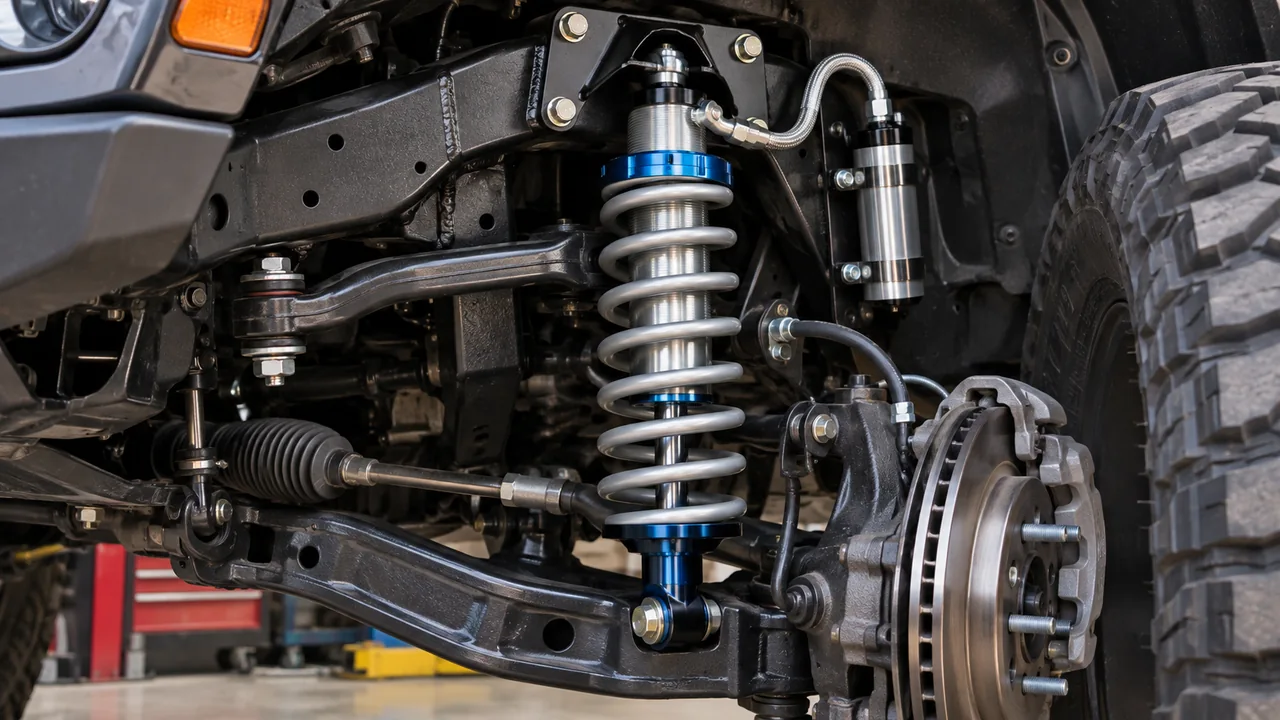
A coilover conversion kit changes how a suspension carries spring load and controls wheel movement. The right kit can make ride-height adjustment easier and improve the way a car or truck is set up. The wrong one can put vehicle weight through a shock mount that was never designed to hold it. Before shopping by price or lift height, establish what your vehicle currently uses: separate coil springs, torsion bars, leaf springs, or a factory strut assembly.
The short answer: buy a vehicle-specific, documented bolt-on conversion when it is designed for your exact front or rear suspension and includes the structural parts it needs. Treat a universal bracket kit as a fabrication project, not a shortcut. On 1999–2006 Silverado and Sierra 1500 trucks, the difference between a coil-spring 2WD front end and a torsion-bar-equipped front end is especially important. A kit made for one does not automatically fit the other.
A product page may show a beautiful pair of adjustable shocks and barely mention the lower control arms, sway bar, spring load path, or welding. Those are not minor accessories. They determine whether the assembly can carry the vehicle safely. Use this guide to identify the conversion you are actually buying and the questions the manufacturer should answer before taking your money.
Which Coilover Conversion Kit Do You Actually Need?
The term covers more than one mechanical job. Some kits replace a separate factory spring and shock with a combined spring-over-damper assembly. Others remove torsion bars, transform the entire axle-locating system, or simply add threaded sleeves to an existing strut. Identical search terms do not make those installations interchangeable.
If you are looking at a listing right now, this is the first sorting step. Find the suspension type on the truck itself, not just the year and make shown in the retailer’s dropdown.
| Factory spring layout | Typical conversion | Critical fitment question |
|---|---|---|
| Separate coil spring + shock | Combined spring and damper; sometimes new control arms | Are new mounts and arms rated for spring load? |
| Torsion bar + shock | Delete torsion spring; add coilover support structure | What replaces the original torsion-bar load path? |
| Leaf springs on solid axle | Coilovers plus engineered axle-locating hardware | What now controls axle position and wrap? |
| Existing strut / sleeved conversion | Compatible threaded spring seat and spring hardware | Is the specific strut and upper mount approved? |
Factory Coil Spring and Separate Shock
This is often the more straightforward conversion on an older street car or a 2WD pickup with conventional front coils. The spring currently sits in a separate pocket, while a shock connects between mounting points. A designed coilover assembly can replace that combination, provided the kit moves spring load through suitable mounting structure and suspension arms.
The phrase bolt-on is credible only when the manufacturer specifies the exact parts and suspension configuration it tested. If a conversion requires its own lower control arm, the factory arm is not an acceptable substitute just because its old shock bolt happens to fit.
Torsion Bar to Coilover
A torsion bar is already the vehicle’s spring. Deleting it means the replacement coilover must now support a load previously carried along the torsion bar into its anchor and crossmember. The original shock location may have been designed for damping forces rather than continuous spring force.
That is why a torsion bar to coilover conversion kit usually calls for more than a new shock and coil. It may include reinforced upper mounts, lower-arm attachments, crossmembers, braces, and instructions for the specific chassis. Our torsion bar versus coil spring guide covers the two spring systems themselves; here the issue is choosing a conversion that transfers their loads correctly.
Leaf Spring to Coilover or Linked Suspension
A leaf spring can do more than hold up a vehicle. In many solid-axle suspensions, the leaf pack also helps locate the axle longitudinally and resists axle rotation. Remove it and you may lose several functions at once. A coilover provides springing and damping, but it does not automatically locate an axle.
For a Jeep YJ, older 4×4, or custom rear truck conversion, expect a complete axle-location plan: properly engineered links, appropriate lateral location where required, brackets, clearances, driveshaft geometry, and sometimes substantial frame work. A pair of coilovers is not a leaf-to-link conversion package.
Threaded Sleeve and Strut Conversions
Search listings also use coilover conversion for threaded spring sleeves that fit around a compatible damper or strut. These can create adjustable spring-seat hardware on a layout that already carries spring load at the strut mounting points. They are a different product from a full, engineered coilover and are not a way to make an ordinary shock mount suddenly support the chassis.
If the listing contains only sleeves, locking collars and springs, ask which exact strut body, upper spring seat and top mount it requires. A loose sleeve that happens to slide over a tube is not evidence of secure fitment, spring retention or an approved ride-height range.
What the Conversion Changes Under the Vehicle
A coilover is not simply a shock with a spring wrapped around it. In a conversion, the spring’s load path may change. That affects what the upper and lower attachments must carry, how the suspension moves through travel, and which other parts remain compatible. This matters more than paint color or the number of damping-adjustment clicks.
Spring Load Must Reach a Rated Mount
With separate coils, much of the vertical load may travel through a factory spring pocket in the frame or control arm. Move the spring onto a damper and the upper and lower coilover mounts become load-bearing. A factory shock tower may have adequate strength for its original function without being approved for the much larger or differently directed spring forces.
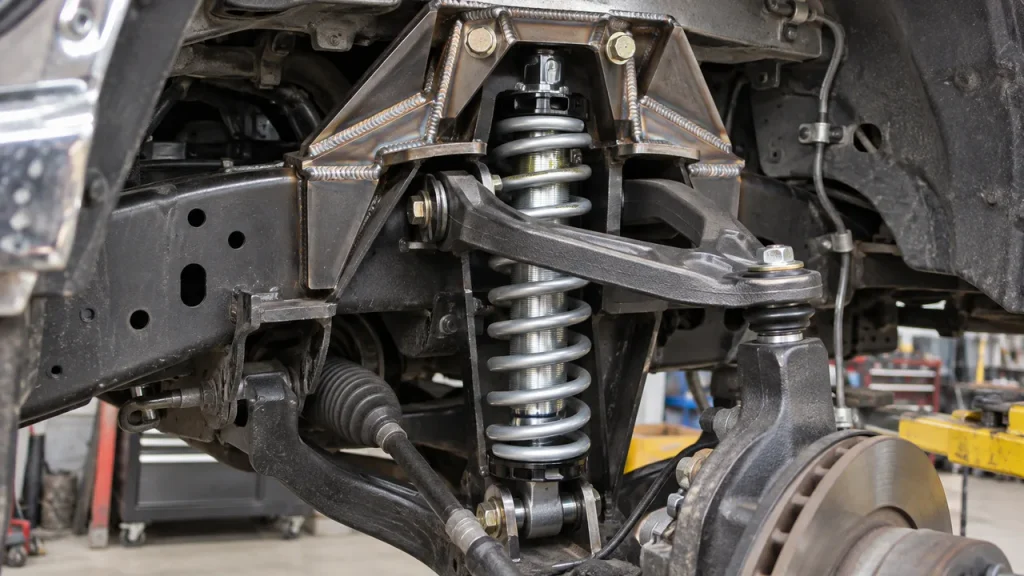
An engineered conversion accounts for those forces through reinforcements, purpose-made arms or properly designed bracketry. It also defines the hardware and mounting orientation. Do not infer structural capacity from a bracket’s thickness or the fact that a photograph shows the conversion on another truck.
Axle Location and Steering Still Need to Work
The shock and spring control vertical movement; control arms, links, ball joints, track bars and other suspension members guide it. Converting an independent front suspension does not remove the need for appropriate control-arm geometry, alignment adjustment or steering clearance. Converting a leaf-sprung solid axle may require redesigning its axle-location system altogether.
Changing where a spring acts can also change body roll and handling balance. Good conversion packages take account of the entire layout rather than promising that a threaded collar will solve steering wander, axle wrap and poor ride quality at the same time.
Coilover Angle Alters Effective Springing
A coilover tilted relative to wheel movement does not move through the same distance as the wheel. Its attachment position on the control arm creates a motion ratio, and that affects the wheel rate felt by the chassis. Two kits using identical springs can behave differently if their lower mounts sit at different distances from the control-arm pivot.
This is why copying a spring rate from a forum build can go badly wrong. Vehicle corner weight, motion ratio, available stroke and desired ride height must be considered together. A claimed spring rate in pounds per inch describes the spring, not automatically the effective rate at the tire.
Travel and Ride Height Are Separate Measurements
A threaded spring seat can move the vehicle’s static position within the designed range, but it cannot create unlimited bump or droop travel. The damper’s collapsed length, full extension, control-arm angles, brake-hose slack, CV angles, tire clearance and bump stops all impose limits.
If a product says it lowers a truck 1 to 3 inches, that statement belongs to that kit’s specified geometry, not every vehicle that shares its wheelbase. More lowering is not always available by simply spinning the collar until the spring is loose.
1999–2006 Silverado and Sierra: Do Not Mix the Front Ends
The strongest model-specific demand in the U.S. keyword data is for 1999–2006 Silverado coilover conversion kits in both 2WD and 4WD forms. That search looks deceptively simple because the trucks share a family name. They do not all share the same front spring arrangement, control arms or conversion requirements.
A Coil-Spring 2WD Kit Is Not a Torsion-Bar Kit
Consider QA1’s 52626-D700 front system: it is listed for 1999–2006 Silverado/Sierra 1500 2WD models with coil front suspension and includes its matched tubular upper and lower control arms. The manufacturer explicitly excludes trucks originally equipped with torsion bars. Its fitment notes also require a particular QA1 sway bar rather than the factory unit.
That is a concrete example of what a complete product listing should tell you. A buyer with a torsion-bar-equipped truck cannot use the advertised model years and the word Silverado to override those exclusions. Check the spring type physically before ordering, including on 2WD vehicles and trucks that may have been modified.
4WD Torsion-Bar Conversion Takes a Different Route
Many GMT800 four-wheel-drive 1500 trucks used torsion-bar front suspension. Manufacturers such as Atomic Fabrication sell specific 1999–2006-era torsion-bar-to-coilover solutions for applicable GM 1500 platforms. Their options and hardware choices are not the same as a street-oriented 2WD coil-spring conversion; some upper-mount configurations require welding and fabrication.
Deleting a torsion bar also changes how the vehicle carries its front weight. The correct coilover load capacity, mount strength, drivetrain clearance and usable travel must be engineered for that truck. The new shock’s bolt diameter is a tiny part of the fitment equation.
Check 1500 vs. 2500, Model-Year Breaks and SUV Variants
A search for Silverado 2500 coilover conversion kit or 99–06 Tahoe 4WD coilover conversion should not be answered with a generic 1500 kit. A 2500HD may have different loads, chassis and suspension hardware. SUVs also have platform and body-style transitions around those years. Manufacturer application notes can exclude configurations that look very similar in a product photo.
Look for exact chassis generation, GVWR category, engine/drivetrain restrictions, factory spring type and frame-mount differences. A catalog that says fits GM 1500 trucks with torsion bars does not thereby include every Chevrolet, GMC or Cadillac built during those calendar years.
Lowering and Off-Road Travel Are Not the Same Goal
A coilover conversion for a lowered street Silverado may prioritize ride-height adjustment and handling with particular control arms and spindles. A four-wheel-drive off-road conversion may prioritize sustained travel, protected mounts and front-drivetrain clearance. Neither is inherently superior; they solve different problems.
Do not combine a lowered-truck kit with a long-travel lift concept merely because both list coilovers. Changes to spindles, ball joints, steering geometry or axle clearance can take the installation far outside the supplier’s intended application.
Jeep, Ranger, S10, Mustang and Classic-Car Fitment
The long-tail searches are valuable, but they are not interchangeable mini versions of the same project. Some vehicles have separate coil springs already. Others use torsion bars, leaf springs, or mixed front and rear layouts. Use the model-specific phrases below to identify the type of job; then let the actual part number and manufacturer drawing determine fitment.
The table is a quick checkpoint, not an interchange chart. It cannot confirm compatibility for a specific model year or modification history.
| Search variation | Check first | Do not assume |
|---|---|---|
| 99–06 Silverado/Sierra 1500 2WD | Actual front coils vs torsion bars; matched arms | Every 2WD uses the same kit |
| 99–06 Silverado/Sierra 4WD | Torsion-bar mounts, driveline, structural brackets | A coil-spring 2WD kit will fit |
| Jeep YJ / CJ | Leaf-to-link design, axle location, fabrication | Coilovers alone replace leaf springs |
| Jeep XJ / TJ / JK | Existing front/rear spring and link layouts | Front and rear conversions are alike |
| Chevy S10 / Ford Ranger | Year, drivetrain, factory front spring type | All trims share the same frame mounts |
| F-250 / Super Duty | Generation, axle, load and stock spring type | An engine badge establishes fitment |
| G-body / C10 / Fox-body | Control arms, spring-load paths, reinforcement | Original shock mounts are load-rated |
Jeep YJ, CJ and Leaf-Sprung Builds
A Jeep YJ coilover conversion kit is often a major suspension redesign. GenRight’s YJ Legend package, for example, pairs coilover hardware with front and rear link systems, mounting components and significant cutting and welding. Its documentation describes an advanced build, not a simple replacement for leaf packs.
Some CJ and custom solid-axle projects have similar requirements. If the goal is articulation, decide how the axles will be located, how track width and wheelbase will be managed, and whether the vehicle must remain road legal in its jurisdiction. The coilovers are only one element of that system.
Jeep XJ, TJ and JK: Front and Rear Are Different Jobs
An XJ Cherokee commonly starts with front coils and rear leaf springs. A front shock-to-coilover project therefore differs fundamentally from a rear leaf-to-coilover conversion. The latter needs a new approach to locating and supporting the rear axle. A TJ or JK already uses coil springs and links, but moving the spring onto a coilover may still require engineered mount changes and travel checks.
Treat Jeep XJ front coilover conversion kit, Jeep XJ rear coilover conversion kit, and Jeep JK coilover conversion kit as three separate searches. The words Jeep and coilover do not tell you whether the existing mounts can carry the new spring loads.
Chevy S10 and Ford Ranger: Inspect the Actual Front Suspension
A Chevy S10 coilover conversion kit can refer to front conversion hardware or a much more involved rear project. S10 variants and years can have different drivetrains and front-spring arrangements. The same caution applies to 1998–2011 Ford Ranger coilover conversion kits, where drivetrain and trim can affect the factory front suspension design.
Do not assume every 2WD Ranger shares one front setup or that a bracket advertised for 4WD transfers to a coil-sprung 2WD truck. Confirm the current spring, lower-arm configuration and chassis brackets before comparing kits. If the seller cannot state the specific compatible configuration, keep shopping.
Ford F-250 and Super Duty: Generation Matters
Searches for 1999–2004 F-250 coilover conversion kit, 7.3 coilover conversion kit and newer F-250 conversions can lead to very different products. Earlier 4WD Super Duty trucks commonly use front leaf springs, while later generations use other spring and axle-location layouts. A front coilover swap in a leaf-sprung truck involves more than selecting damper length.
Higher axle loads and towing or hauling duties raise the stakes. A conversion should be designed for the actual axle, spring-load path, steering, frame and weight rating; it does not increase the manufacturer’s payload or tow rating. Do not borrow parts or installation advice across generations on the basis of the engine badge alone.
G-Body, C10 and Fox-Body Mustang
On a G-body or classic C10, some coilover conversion kits replace factory separate springs and dampers using matched arms and brackets. Others include much broader front or rear suspension changes. The intended lower ride-height range, control-arm compatibility and reinforcement details are more useful than a generic promise of better handling.
A Fox-body Mustang creates another important load-path question. A rear coilover conversion can move spring forces toward locations that originally served as shock attachments; front strut conversions also need kit-specific structural consideration. A manufacturer-approved package and any required reinforcement are essential. The same holds for Mustang II front suspension conversions used in hot-rod chassis: they must match the actual crossmember and arms, not simply the words Mustang II.
Bolt-On, Weld-On and Universal Kits: Read the Fine Print
A manufacturer can legitimately describe a conversion as bolt-on if the vehicle-specific mounts, control arms and hardware have been engineered for that installation. Another supplier can sell brackets as a universal conversion and expect the buyer to build the supporting structure. Both can be good products within their intended uses, but they ask very different things of the installer.
What a Genuine Bolt-On Kit Should Identify
Look for an explicit model and chassis range, factory suspension prerequisite, included components, compatible factory parts, allowable ride-height range, and a published installation procedure. Good fitment notes also say what the system will not fit: torsion-bar models, certain sway bars, aftermarket spindles or modified frame mounts.
A bolt-on kit may still require specialist setup and a post-install alignment. It is not a promise that every fastener comes off easily, that old bushings are serviceable, or that a previously modified truck will accept the kit without corrections.
Why Universal Brackets Are Not Universal Suspension Geometry
A universal coilover conversion kit usually supplies flexible mounting hardware, not a verified solution for every chassis. The fabricator must establish safe bracket locations, weld quality, load paths, shock angle, available stroke and clearances. What works on one custom frame may interfere with steering or exhaust on another.
If a bracket listing names only tubing diameter, hole size and steel thickness, it may be useful fabrication material. It is not evidence that a stock shock tower, axle tube or control arm is approved to support vehicle weight through a coilover. Our shock mount bracket selection guide covers the bracket details separately.
Welding, Cutting and Reinforcement Can Change the Budget
Some advanced conversions require removing original mounts and welding replacement structures into the chassis. On a leaf-to-link conversion, new link brackets, crossmembers and frame modifications may also be required. Shop time includes more than the visible welding bead: measurement, fixturing, access, corrosion protection and verification through full suspension travel all matter.
A product that says weld-on is not necessarily poor. It may be the right way to achieve the intended geometry. The important distinction is whether the owner has suitable fabrication capability and whether the vehicle’s use, condition and legal requirements allow the modification.
Beware of Kits That Borrow the Stock Shock Mount
Shock mounting points were not all designed for spring load. A supplier may have tested a reinforced conversion that uses part of the original mount structure, while an unverified universal kit relies on a thin factory perch. Those are not equivalent installations even if the coilover appears in roughly the same location.
Ask where the spring force goes and what supports it at full compression. If that question has no documented answer, the correct reaction is to stop the purchase rather than assume an extra washer or thicker bolt solves the problem.
What Must Be in a Complete Coilover Conversion Kit?
The product photograph rarely tells the whole story. One box contains everything needed for a particular factory suspension; another contains only shocks and brackets; a third offers major chassis components without the coilovers themselves. Before deciding that one price is better, compare complete parts lists for the same axle and vehicle.
Coilovers, Springs and the Correct Upper Hardware
A complete spring-and-damper assembly normally needs the damper, correctly specified spring, upper and lower spring seats, retention hardware and appropriate mounting ends. Some packages supply the coilovers assembled, while others require the installer to choose springs or mounts separately. A coilover without its correct top spring retainer cannot simply be completed with a generic washer.
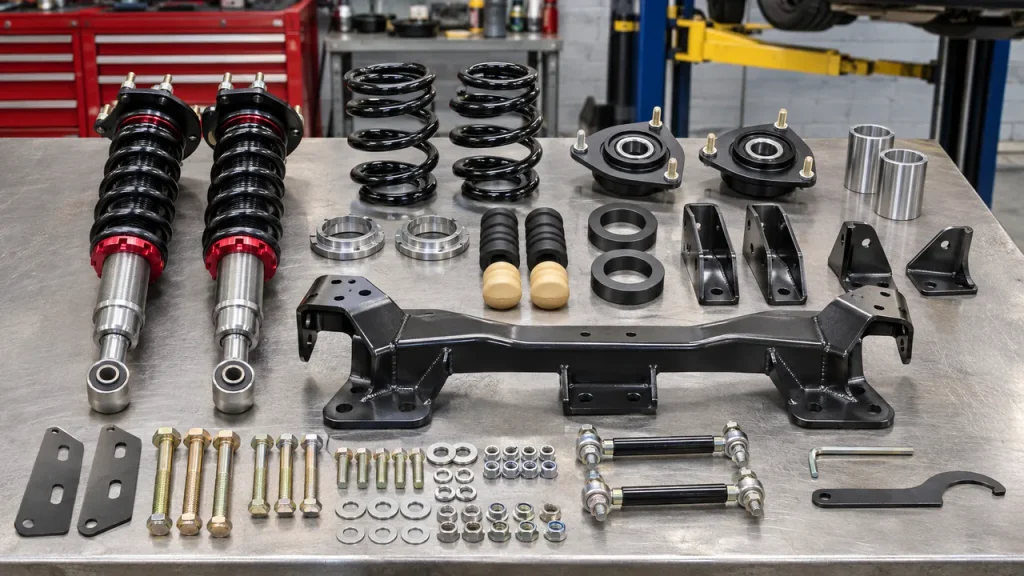
Read the spring’s rate, free length and fitment as carefully as the shock’s name. If the supplier offers spring-rate choices, ask what corner weights and installation geometry those choices assume. A spring selected for a light weekend car may be unsuitable for an engine-heavy street truck even when the shock body is identical.
Control Arms, Crossmembers and Structural Brackets
For certain front suspension conversions, purpose-built lower arms are essential because they contain the correct coilover attachment and distribute spring load as designed. Other systems need upper brackets or reinforcements, and linked-axle projects may require a new crossmember or extensive control-arm hardware. These are not optional cosmetic upgrades.
Check whether the kit fits factory ball joints, steering knuckles and spindles, or whether it requires its own pieces. The word front kit can still exclude control arms, and an attractive coilover pair may be only one item on a much longer build list.
Sway Bars, Brake Lines and Nearby Components
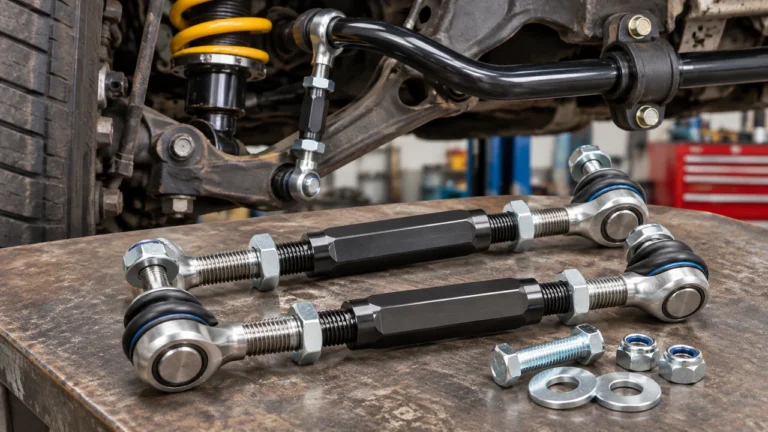
A change to lower control arms can shift sway-bar attachment points or create interference with the original bar. Brake hoses may need different routing or length at the new full-droop position. Tires, exhaust, steering shafts, CV axles and driveshafts can all compete for space around a new coilover.
Some manufacturers explicitly require a matching sway bar or end-link package. Others warn that oversized aftermarket arms or certain wheels have not been tested. Those notes matter more than a vendor’s generic assurance that the kit fits all versions of the model.
Bump Stops, Droop Limits and Alignment Parts
A coilover must not become an accidental hard bump stop or the only component preventing the axle from hanging beyond its safe travel. Proper bump stops, limiting hardware where specified, and suspension geometry control the ends of movement. An old shock may have hidden these requirements by limiting motion in a different place.
Lowering or lifting also affects alignment range. Depending on the suspension, the project may need approved alignment hardware, revised arms or a different spindle setup. Plan for these checks instead of treating the installation as complete when the truck first sits on its new springs.
The Parts-List Checklist to Send the Seller
A useful retailer can answer specific fitment questions without relying on product photos. Gather the build details before contacting the manufacturer, especially when the vehicle already has suspension modifications.
- Vehicle and suspension: Year, model, drivetrain, original spring type, installed axle and control arms.
- Conversion scope: Front or rear, shock pair or complete kit, bolt-on or weld-on requirements.
- Load-bearing structure: Approved upper/lower spring mounts, reinforcement and compatible control arms.
- Spring and damper: Required rates, free length, shock stroke, mounts and maker-specified ride height.
- Interference: Sway bar, steering, tires, exhaust, brake hoses, CV shafts and full travel.
- Missing parts: Spindles, links, bushings, fasteners, bump stops, alignment hardware and service parts.
- Installation support: Current instructions, qualified installer, local approval and service options.
If the seller cannot confirm the coilover’s spring-load mounts, factory suspension prerequisites and included parts for your exact configuration, the listing has not established compatibility. This is especially important for universal and fits 2WD/4WD advertising.
Spring Rate, Shock Stroke and Adjustability: The Real Fitment Work
It is tempting to sort conversion kits by spring color, shock diameter or the advertised number of adjustments. Those details can matter, but only after the system is known to fit. Three measurements determine much of the result: how much force the springs need to support, how far the suspension will move, and where the vehicle sits within that movement.
Start With Corner Weight and Motion Ratio
Vehicle weight is not distributed evenly among four corners, and a wheel-mounted spring does not necessarily move the same distance as the damper. A heavier engine, battery relocation, aftermarket bumper or permanently loaded cargo area can alter what a particular spring must support. The effective wheel rate depends on the mounting motion ratio as well as the spring itself.
A manufacturer-provided rate should be treated as the default only for its stated application and assumptions. For an engineered custom build, our suspension spring-rate calculator can help establish a baseline from weight and motion ratio. It cannot certify bracket strength or replace the conversion maker’s vehicle-specific engineering.
Verify Compressed and Extended Length at Both Ends
The distance between mounts at full bump and full droop must work with the coilover’s specified collapsed and extended dimensions. Changing a lower bracket or moving the upper mount can affect both numbers. The suspension should be physically cycled safely according to the designer’s procedure, with the springs removed or otherwise controlled only by a qualified installer.
Our shock length calculator provides a dimensional check for extended, compressed and required stroke. It does not determine the correct coilover spring or establish whether a fabrication project is structurally sound. That distinction prevents the common mistake of assuming that the longest shock which fits is the best one.
Ride-Height Range Is Not a Promise of Extra Suspension Travel
A threaded spring seat can establish a designed ride height by changing the spring’s installed position and, depending on the setup, preload. It does not change the spring’s inherent rate, and it is not an unlimited lift or lowering mechanism. At an extreme setting, the vehicle may have too little bump travel or inadequate spring retention at full droop.
Read whether the maker specifies the height change from factory, from a particular spindle, or from a different reference suspension. A two-inch lowering statement has a different meaning if the truck already uses drop spindles or modified arms. Avoid mixing published ranges from separate components as though they were automatically additive.
Damping Adjusters Cannot Repair a Bad Spring Choice
Single-adjustable and double-adjustable coilovers can let an owner tune how the damper resists motion. A single adjustment may target rebound, compression, or a linked change, depending on model. A double-adjustable assembly can provide more independent control, but it is not necessarily more comfortable out of the box.
If the truck sits too low with the correct collar setting, bounces because the spring rate is unsuitable, or bottoms out on a travel limit, twisting the damping knob is not a substitute for correcting the hardware. Match the spring, damper and geometry first; adjust only according to the specific product instructions.
Cost: Why a Cheap Conversion Kit Can Become Expensive
The difference between a bracket-only price and a complete engineered system can be dramatic. So can the difference between a job that bolts onto a standard street car and one that requires a welder, jigging, custom axle links and replacement mounts. Compare the complete work needed to make the vehicle roadworthy, not just the cart total.
The Box Price May Exclude Most of the Build
A basic listing may show a pair of coilovers but exclude springs, brackets or lower arms. A bracket kit may omit the actual dampers. A full suspension package may include the major mechanical pieces but still require fabrication, brake-line changes, reinforcement or an alignment. None of these exclusions is automatically dishonest if they are clearly stated; they are simply costs you must identify before purchasing.
A classic-car handling kit sold as complete can have a different scope from an off-road complete axle conversion. Put the included components side by side and calculate the cost of obtaining the missing pieces from compatible sources.
Labor Is Defined by the Suspension, Not the Product Name
Installing designed bolt-on coilovers into approved mounts is a different labor category from cutting off torsion-bar brackets or building link geometry under a Jeep. Corroded fasteners, prior chassis repairs and undocumented modifications can add work even to a nominally bolt-on system. Welding and alignment expertise may be essential rather than optional extras.
For a separate explanation of normal fitting, adjustment and alignment charges, see our coilover installation cost guide. A major conversion with structural modifications needs its own itemized quotation; it should not be estimated using only the hours for an ordinary strut replacement.
Allow for Setup, Replacement Parts and Service
The project may need professional corner-weighting, spring exchanges, alignment components, upgraded mounts or corrective work discovered during cycling. Adjustable or rebuildable shocks may have different service needs and parts availability. Document whether replacement springs, joints, top mounts and dampers will still be available several years after the original kit purchase.
That is part of why a well-supported application-specific kit can be good value even when its initial price is higher. A cheaper collection of unrelated parts may leave the installer responsible for every fitment and maintenance decision.
Plan the Installation Before Removing Any Factory Spring
There is no single safe installation sequence for every coilover conversion. Factory springs and torsion bars store substantial energy, and the method for unloading one vehicle cannot be borrowed casually from another. This section is a preparation guide, not instructions for cutting mounts, unloading spring force or welding load-bearing structures.
Establish the Starting Condition and Intended Result
Record the vehicle’s model, axle and drivetrain configuration, current suspension layout, existing modifications, measured ride height and the actual goal. Lowering for a street-truck stance, improving track handling and adding off-road articulation can require very different packages. Photographs of the mounts and control arms are particularly useful when the truck’s history is unclear.
A conversion is a poor first response to worn bushings, loose ball joints or a bent frame mount. Fix known safety problems and confirm the chassis is sound before building new geometry around them. The original suspension’s condition also affects alignment once the conversion is complete.
Ask the Installer About Load Paths and Full-Cycle Checks
Before scheduling the work, ask how the upper and lower coilover mounts carry spring loads, how the suspension will be checked for interference through bump and droop, and whether steering lock changes any clearance. For linked solid axles, the installer must also account for axle location, driveshaft angles, articulation and brake-line travel.
A capable shop should be able to explain what is bolt-on, what requires fabrication, what requires verification, and which parts are manufacturer-approved. Avoid treating a low parts-only quote as an answer to those questions.
Finish With Alignment and Road-Use Verification
After a conversion, appropriate torque and locking procedures, ride-height settling, suspension travel checks and alignment are essential. Steering components, joints, hoses, tires and the vehicle’s body must have safe clearances. If the steering pulls unexpectedly, hardware makes contact or spring retention is uncertain, the vehicle should not be used normally until the cause is corrected.
Regulations and inspection requirements for modified suspensions differ by location. Confirm them before ordering parts for a street-driven vehicle, especially when the project involves welding frame components or changing how the axles are located.
Coilover Conversion Kit FAQ
These are the practical questions behind many of the model-specific search variations. The answer usually depends on the original suspension and what the proposed kit actually includes—not simply whether the car or truck has enough room for a coil spring.
What does a coilover conversion kit do?
It changes an existing suspension to use a spring-around-damper assembly, sometimes with revised control arms, brackets or axle links. Depending on the design, it may provide adjustable ride height and damping or enable different travel and packaging. It does not automatically improve every aspect of handling, and it must direct spring loads through suitable mounting structure.
Can you install a coilover conversion kit on any car?
No. Some vehicles have engineered, vehicle-specific packages; others would need extensive custom work. A universal coilover or bracket does not guarantee compatible geometry, spring support or clearance. Use the vehicle’s exact model, chassis, suspension design and the manufacturer’s application list, not just wheelbase or shock length.
Do 1999–2006 Silverado 2WD and 4WD kits interchange?
Not as a general rule. A coil-spring-equipped 2WD front end and a torsion-bar 4WD front end require different solutions. Some 2WD trucks also have configuration differences. QA1 explicitly excludes torsion-bar front suspension from its coil-spring 2WD kit, while torsion-bar conversion suppliers design different mounting hardware. Always verify the exact vehicle rather than the drivetrain badge alone.
Can I delete torsion bars and install coilovers in the stock shock mounts?
Not merely because a coilover physically fits. The upper and lower mounts must be approved to take continuous spring load, not only damping forces. Some engineered conversions reuse portions of the original structure with specific brackets or reinforcements. Follow a documented kit; do not improvise a load-bearing attachment from an ordinary shock bracket.
Is a rear coilover conversion the same as a rear four-link kit?
No. Coilovers provide springing and damping. A four-link or another appropriate arrangement locates and guides a solid axle. Some projects require both, particularly when factory leaf springs formerly performed axle-location duties. Other rear coilover packages work with existing factory links. The original layout determines what else must change.
Is a universal coilover conversion kit cheaper than bolt-on?
The purchase price may be lower because it supplies fewer application-specific parts. Fabrication, reinforcement, measurement and alignment can make the completed installation more expensive. A bolt-on kit costs more up front in some cases but may reduce design uncertainty when used on its exact approved application. Compare total fitted cost and support, not only hardware price.
Will a coilover conversion give me more lift or lower my truck farther?
Only within the engineered operating range of the system. Some kits are explicitly designed for lowering; others support different ride height or travel. Raising a spring seat cannot compensate for insufficient bump or droop travel, and a lowered stance can introduce alignment or clearance problems. The maker’s published range takes priority over a collar’s remaining threads.
Do I need new upper and lower control arms?
Some kits include or require them; others work with specified factory arms. Check the coilover’s spring-load attachment, required sway bar, steering-knuckle and ball-joint compatibility. A seller’s part number and installation sheet should resolve this. Do not assume that an OEM shock mounting hole makes the OEM arm coilover-compatible.
Are coilover conversion kits legal for road use?
That depends on local regulations and the modification. Road approval or inspection may be required, particularly if suspension mounting points, chassis structure or axle-locating geometry change. A product being sold online is not proof that an altered vehicle complies with the rules where it will be driven.
When a Coilover Kit’s Fitment Listing Is Too Vague
Before choosing between brands, write down the exact suspension that is currently under your vehicle. A 2004 Silverado 1500, for example, is still not a complete fitment description until you establish whether it uses coil springs or torsion bars at the front and what parts have already been changed. The same discipline applies to a YJ with leaf springs, an XJ with two different axle layouts, or a Fox-body Mustang with separate factory spring locations.
Then compare the package against that hardware: spring-load-rated mounts, correct control arms or links, realistic shock stroke and spring rate, clearance, and a documented installation plan. A good supplier will help you rule out the wrong kit as clearly as it explains the right one. If a listing cannot answer those points, it is not ready for checkout—no matter how persuasive the product photo looks.