Stock vs. Performance Suspension: What’s the Difference?

Stock suspension is the factory-engineered setup installed or specified by the vehicle manufacturer. Performance suspension changes components, geometry or settings to prioritize a particular result, such as sharper handling, adjustable ride height, better track consistency, increased off-road travel or improved load control.
Performance suspension is not automatically better. A properly matched street setup can improve steering response and body control, but an excessively stiff, low or poorly tuned suspension may reduce comfort, usable travel and even tire grip on rough roads. The best choice depends on the vehicle, road conditions and how it is actually driven.

Stock vs. Performance Suspension: Quick Comparison
| Feature | Stock Suspension | Performance Suspension |
|---|---|---|
| Primary goal | Balance comfort, safety, durability, cost and predictable handling | Prioritize a defined handling, height, load or terrain goal |
| Ride comfort | Usually calibrated for broad everyday use | May be softer, firmer or adjustable depending on its purpose |
| Ride height | Factory height, geometry and clearance | May be lowered, raised or adjustable |
| Handling | Predictable behavior across many conditions | Can provide quicker response and greater body control when properly matched |
| Adjustability | Usually limited, except on factory adaptive systems | May offer height, damping, camber or anti-roll-bar adjustment |
| Suspension travel | Engineered around the vehicle’s intended roads, loads and tires | Depends on the components and intended application |
| Cost | No initial modification cost; worn parts still require replacement | Parts, installation, alignment and future servicing may be required |
| Best use | Daily driving and retaining original vehicle capability | Street performance, track, towing, stance or off-road goals |
What Is Stock Suspension?
Stock suspension—also called factory, standard, OEM or original-equipment suspension—is the suspension configuration specified by the vehicle manufacturer. It includes the springs, dampers, bushings, links, control arms, anti-roll bars, mounts and suspension geometry used for that model and trim.
A car can remain at stock specifications even after its original parts have been replaced. An aftermarket manufacturer may sell shocks, struts, springs or bushings designed to restore the original ride height and behavior rather than modify them.
The factory system is developed around factors including:
- Vehicle weight and weight distribution.
- Original wheel and tire sizes.
- Expected passenger, cargo and towing loads.
- Ground clearance and usable suspension travel.
- Braking, steering and stability-control calibration.
- Ride comfort, road noise and durability.
- Manufacturing cost and the vehicle’s intended market.
Stock does not necessarily mean soft, simple or nonadjustable. A sports car can leave the factory with high spring rates, adaptive dampers and aggressive alignment, while a luxury vehicle may use electronically controlled air suspension to combine comfort and body control.
Advantages of stock suspension
- The components and geometry are engineered to work together.
- It provides predictable behavior across different roads and weather conditions.
- Factory ground clearance and suspension travel are retained.
- Replacement procedures and alignment specifications are documented.
- Electronic safety and driver-assistance systems retain their intended configuration.
- There are fewer modification-related warranty, inspection or insurance concerns.
Limitations of stock suspension
- It may allow more body movement than a performance-focused driver wants.
- Factory compromises may not suit frequent track driving or specialized off-road use.
- Nonadjustable components offer limited tuning options.
- It may not be calibrated for significantly different tires, added weight or other modifications.
What Is Performance Suspension?
Performance suspension is a broad term for components or systems intended to change how a vehicle rides, responds, handles or uses its available suspension travel. It can include shocks, struts, springs, coilovers, anti-roll bars, control arms, bushings, air suspension and alignment hardware.
The word “performance” only becomes useful when the goal is defined. A setup developed for a smooth racetrack may perform poorly on broken pavement. An off-road suspension may need more travel and compliance rather than simply being stiffer.
Street-performance suspension
A street-performance setup usually aims for quicker steering response, reduced body movement and a more controlled feel while retaining reasonable comfort, ground clearance and suspension travel. Vehicle-specific spring-and-damper packages should be designed as a matched combination.
Track suspension
Track-focused suspension prioritizes repeatability, adjustability and body control during high cornering and braking loads. It may use higher spring rates, firmer damping, adjustable camber and a lower ride height.
A track setup can be uncomfortable and less effective on uneven public roads. Adjustable or rebuildable components may also require more frequent inspection and servicing.
Off-road performance suspension
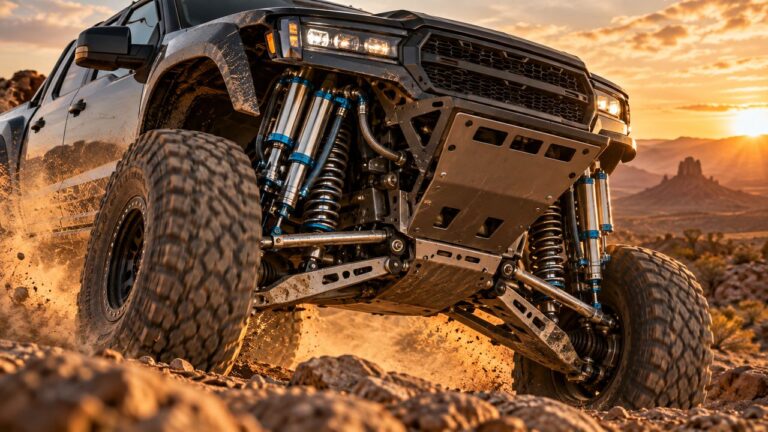
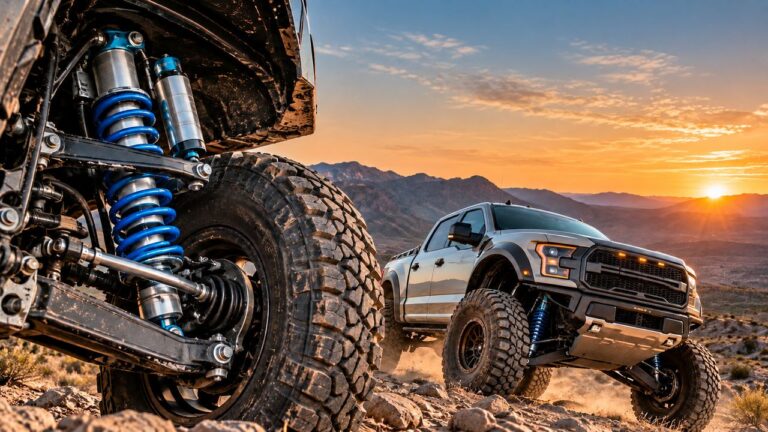
Off-road performance may require additional wheel travel, ground clearance, heat-resistant dampers and the ability to absorb repeated impacts. It is not simply a raised or extremely stiff version of the stock system.
In many conditions, an off-road suspension needs enough compliance to let the wheels follow uneven terrain while maintaining tire contact.
Towing and load-control suspension
Performance can also mean controlling a truck or SUV while towing or carrying cargo. Application-specific shocks, helper springs or air springs may improve loaded stability and ride height, but they do not increase the vehicle’s legal payload, axle or towing ratings.
Stock Suspension vs. Coilovers
Stock suspension normally uses a fixed ride height and factory-selected spring and damping characteristics. Coilovers combine a coil spring and damper in one assembly and may provide adjustable ride height, damping or both.
Coilovers can be useful when a driver needs repeatable height adjustment, track-oriented spring rates or more control over damping. However, a low-cost or poorly configured coilover kit can ride and handle worse than a well-developed factory suspension.
For a daily driver, stock suspension is often the better choice when comfort, clearance, quiet operation and low maintenance matter most. Coilovers become more valuable when the driver has a specific handling or ride-height goal and is prepared to set up and maintain them correctly. Our guide comparing coilovers with conventional shocks and springs explains the component differences in more detail.
Which Performance Suspension Components Make a Difference?
Performance shocks and struts
Shocks and struts control the speed of suspension movement. Performance versions may use different compression and rebound valving, greater heat capacity or external adjustment.
Firmer damping can improve body control when correctly matched, but excessive damping may prevent the wheel from following rough pavement. Read our explanation of compression and rebound damping.
Performance springs
Springs support the vehicle’s weight and contribute to ride height and roll, pitch and heave stiffness. Performance springs may use a higher or progressive rate and may lower the vehicle. Our guide to linear vs. progressive springs explains how those two spring-rate behaviors differ and where each makes sense.
Replacement springs must be compatible with the dampers and preserve adequate bump and rebound travel. A shorter spring installed with unsuitable shocks can produce poor control or frequent contact with the bump stops.
Coilovers
Coilovers package a coil spring and damper together and may offer adjustable height, damping or both. Their value depends heavily on engineering quality, suitable spring rates, available travel and careful setup.
Anti-roll bars
A thicker or more effective anti-roll bar can reduce body lean by increasing roll stiffness. It can change cornering behavior without producing exactly the same result as fitting much stiffer springs.
Changing front or rear roll stiffness also affects handling balance. A poorly chosen bar can increase understeer or oversteer and reduce independent wheel movement on uneven surfaces.
Bushings and suspension joints
Firmer bushings reduce unwanted movement and can make steering response feel more immediate. The usual tradeoff is additional noise, vibration and harshness. Solid joints may be suitable for competition but inappropriate for many daily-driven cars.
Alignment components
Adjustable control arms, camber plates and related components can provide alignment ranges unavailable with the stock hardware. More aggressive alignment may improve a particular type of cornering performance but can also increase tire wear or straight-line sensitivity.
Wheels and tires
Tires often have a greater effect on usable grip than suspension parts. Larger, heavier wheels and shorter tire sidewalls can make the ride harsher and increase unsprung mass. Suspension components should therefore be selected with the wheel and tire package in mind.
Restoring Stock Suspension vs. Modifying It
A vehicle that feels loose, bouncy, noisy or unstable does not necessarily need performance suspension. Its original shocks, struts, springs, bushings, ball joints or mounts may simply be worn or damaged.
Restoration means replacing worn components with parts designed to return the vehicle to its original ride height and behavior. Modification means deliberately changing characteristics such as spring rate, damping, geometry, travel or ride height.
Inspect and repair faults before judging the factory design. Installing stiffer parts can mask one symptom while leaving worn joints, damaged mounts, poor alignment or unsuitable tires unresolved.
Does Performance Suspension Improve Handling?
A well-engineered setup can improve steering response, body control and consistency for its intended conditions. However, the label “performance” does not guarantee more grip or safer handling.
A suspension that is too stiff for the road can cause the tires to skip over bumps. Excessive lowering can reduce travel and create unfavorable geometry. Incorrect damping can make the car bounce, pack down or react harshly.
Performance comes from matching springs, dampers, tires, alignment, travel and vehicle use—not from maximizing stiffness. Our guide to stiffening or softening suspension safely explains these relationships.
Stock vs. Performance Suspension Ride Quality
Stock suspension usually provides the most predictable comfort for the conditions anticipated by the manufacturer. It is calibrated around the vehicle’s original tires, mass, suspension travel and intended customers.
Performance suspension does not always have to be uncomfortable. A high-quality street kit can provide better-controlled movement without an extreme increase in harshness. Adjustable or adaptive dampers may also offer a useful range between comfort and sport settings.
Ride quality becomes poor when components are mismatched, the spring rate is unsuitable, damping is excessive, suspension travel is lost or the vehicle repeatedly contacts its bump stops.
Is Performance Suspension Worth It for Daily Driving?
It may be worthwhile when the driver has a specific, measurable goal that a healthy stock setup cannot meet. Examples include:
- Reducing excessive but normal body movement.
- Improving control during regular autocross or track use.
- Adapting the vehicle after a significant change in weight or wheel and tire mass.
- Adding appropriate ground clearance and travel for off-road use.
- Obtaining useful damping or ride-height adjustment.
Keeping or restoring the stock system is often better when comfort, low maintenance, factory clearance and predictable all-weather behavior are the priorities. Replacing worn parts with quality stock-specification components can make a larger improvement than modifying a healthy suspension without a clear goal.
How to Choose Between Stock and Performance Suspension
1. Define the problem
Identify whether you want to reduce bouncing, body roll, bottoming, ride height, steering delay or loaded sag. Each symptom or goal points toward different components.
2. Inspect the stock suspension
Worn shocks, broken springs, deteriorated bushings, damaged mounts, unsuitable tire pressure and poor alignment can make a factory suspension feel worse than intended. Repair faults before evaluating upgrades.
3. Decide how the vehicle will be used
A daily driver, track car, towing vehicle and off-road truck require different combinations of spring rate, damping, travel and ground clearance. Avoid buying parts solely because they are described as racing or heavy duty.
4. Choose a matched, vehicle-specific system
Verify the model year, trim, drivetrain, axle configuration, electronic suspension and current ride height. Springs and dampers should be designed to work together and provide suitable travel.
5. Consider the complete cost
Budget for installation, mounts, hardware, alignment and possible future servicing—not only the advertised price of the kit. Some adjustable dampers require periodic rebuilding.
6. Check road-use requirements
Suspension modifications can affect inspection compliance, insurance, warranty coverage, headlight aim and driver-assistance calibration. Requirements vary by location and vehicle, so confirm them before installation.
Do You Need an Alignment After Upgrading Suspension?
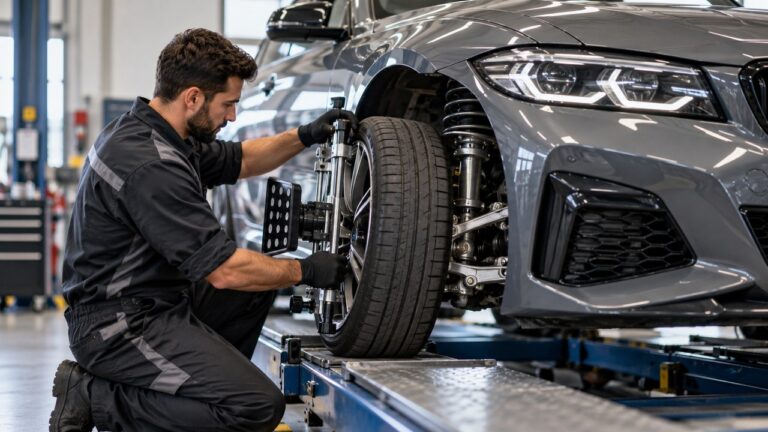
An alignment is normally required when ride height or wheel-locating components change. Lowering can alter toe, camber and suspension geometry even when the new parts bolt directly into place.
Replacing a conventional shock without disturbing alignment points may not require adjustment, but a check is sensible when tire wear, steering pull or other suspension work is involved. Read when an alignment is needed after suspension replacement.
Stock and Performance Suspension FAQ
What does stock suspension mean?
Stock suspension is the factory configuration specified for the vehicle. Replacement parts can retain stock specifications even when they are manufactured by an aftermarket company.
Is stock suspension better than coilovers?
Stock suspension is usually better for drivers who prioritize factory comfort, clearance and low maintenance. Properly selected coilovers may be better when adjustable ride height or more specialized handling is required. Product quality and setup matter more than the label alone.
Can you lower a car on stock suspension?
Lowering springs may work with some stock-style dampers, but compatibility cannot be assumed. The dampers must be suitable for the spring rate and reduced travel, and the vehicle must retain adequate clearance and bump travel. If you are deciding between a fixed spring drop and an adjustable setup, see our lowering springs vs. coilovers comparison. Cutting or heating stock springs is unsafe.
Can you adjust camber on stock suspension?
Some vehicles provide limited factory camber adjustment, while others require approved bolts, plates or control arms. The available range depends on the exact suspension design. Do not enlarge mounting holes or improvise adjustment hardware.
How long does stock suspension last?
There is no universal replacement mileage for the complete suspension. Shocks, struts, bushings, joints and springs wear at different rates depending on roads, loads, climate, mileage and vehicle design. Inspect the system when handling, ride height, noise, leakage or tire wear changes instead of replacing every component on one arbitrary schedule.
Is performance suspension always stiffer?
No. Street and track systems are often firmer than comfort-focused factory setups, but off-road performance can require greater compliance and travel. Adaptive systems can also vary damping according to conditions.
Is lower suspension always better for handling?
No. A moderate, correctly engineered reduction in ride height may lower the center of gravity, but excessive lowering can reduce travel, alter geometry and make the suspension contact its bump stops.
Can performance shocks be used with stock springs?
Some performance dampers are specifically designed for stock springs and ride height. Others are intended for particular lowering springs or lifts. Compatibility must be confirmed through the manufacturer’s application information.
How can I tell if a car has stock suspension?
Check the VIN-specific equipment, compare part numbers with the manufacturer’s catalog and inspect for branded dampers, adjustable collars, nonfactory springs or altered control arms. Appearance alone is not always conclusive because original components may have been replaced with equivalent aftermarket parts.
Are shocks and struts the same performance upgrade?
Both can provide damping, but a strut is also a structural suspension member. Your vehicle requires the component type and dimensions designed for its suspension. See our struts vs. shocks comparison.
The Right Suspension Depends on the Goal
Stock suspension is a factory-developed compromise between comfort, control, durability, clearance and cost. Performance suspension changes that compromise to prioritize a particular result, such as sharper street handling, track adjustability, towing control or off-road travel.
A matched performance system can improve the characteristics it was designed to address, but it is not automatically superior in every condition. Define the goal, repair existing faults and choose vehicle-specific components that preserve safe suspension travel, tire contact and alignment.