Car Suspension Clunking and Rattling: Causes and Fixes

A clunk or rattle from your car’s suspension usually means that a component has developed excessive movement, a rubber mount or bushing has deteriorated, or some mounting hardware is no longer holding a part securely. Common causes include worn sway bar links, control arm bushings, ball joints, strut mounts and shock absorber mounts.
The sound alone cannot identify the failed part. Note whether it occurs over small bumps, while turning, during braking or when changing between acceleration and deceleration. That information helps separate a suspension problem from loose cargo, brakes, steering or drivetrain components.
Is a Suspension Clunk Safe to Drive With?
Do not continue driving normally if the noise is accompanied by loose steering, pulling, a wheel that appears out of position, severe vibration, grinding, reduced braking control or a sudden change in ride height. A damaged ball joint, tie rod or control arm can affect the driver’s ability to steer and control the vehicle.
A light rattle caused by a loose heat shield is very different from a heavy clunk caused by movement in a suspension joint. If you cannot distinguish between them, arrange an inspection rather than assuming the noise is harmless.
What Does the Timing of the Noise Suggest?
| When You Hear It | Possible Causes |
|---|---|
| Over small, repeated bumps | Sway bar links, sway bar bushings, loose brake hardware or a loose underbody panel |
| Over a large bump or pothole | Strut mount, shock mount, control arm bushing, ball joint, broken spring or suspension bottoming out |
| While turning at low speed | Tie rod end, ball joint, strut bearing, steering rack mount or CV joint |
| When braking | Control arm bushing, ball joint, brake caliper hardware or another component shifting under load |
| When accelerating or lifting off the throttle | Control arm bushing, engine or transmission mount, driveshaft joint or differential mount |
| When entering drive or reverse | Engine mount, transmission mount, driveshaft joint or brake movement rather than the suspension |
| After suspension work | Incorrectly torqued hardware, reused mounts, incorrectly seated spring or installation error |
| From the trunk or rear interior | Loose spare wheel, jack, tools, cargo, seat latch or exhaust component |
These are diagnostic clues, not proof. Different faults can produce similar noises, and a vehicle may have more than one worn component.
Most Common Causes of Suspension Clunks and Rattles
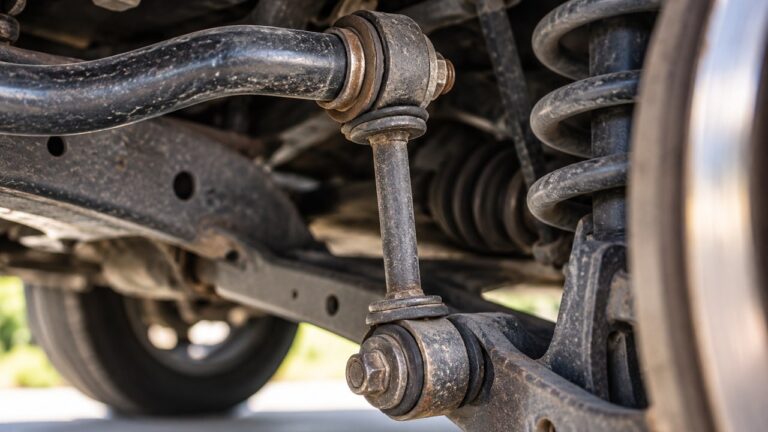
1. Worn Sway Bar Links
Sway bar links connect the anti-roll bar to the suspension. Their small ball joints or bushings can develop play, allowing the link to knock as one wheel moves over a bump. If you suspect this is the source, our guide to bad sway bar link symptoms explains what to inspect and how to distinguish a worn end link from other suspension faults.
A worn link commonly produces a metallic clunk or rattle over broken pavement and small, repeated bumps. The vehicle may also feel less controlled during turns. MOOG identifies clunking over bumps as one of the most common symptoms of a worn sway bar link.
Typical fix: Replace the worn link, normally on both sides if their age and condition are similar. Tighten the new hardware according to the vehicle or component manufacturer’s procedure. Overtightening can damage some link designs. If you have already confirmed the links are the problem, see our sway bar link replacement cost guide for typical parts and labor prices.
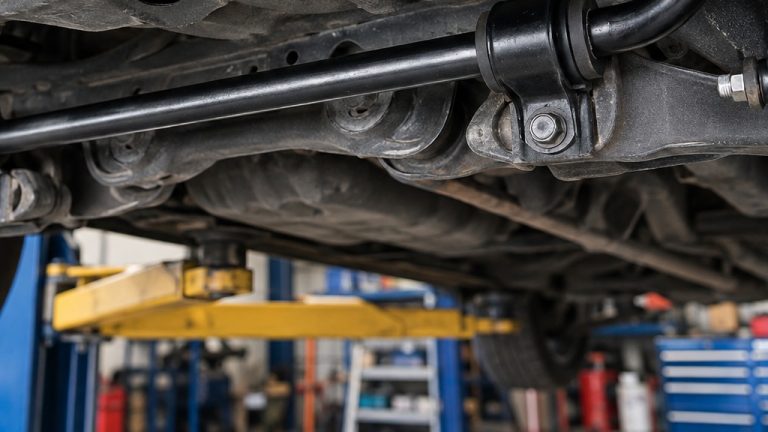
2. Worn Sway Bar Bushings
Rubber bushings secure the sway bar to the body or subframe while allowing it to rotate. As the bushings harden, split or wear, the bar can move inside its mounts and knock against surrounding parts.
This often sounds like a dull knock from the front or rear when both wheels do not move together, such as when crossing an angled driveway or uneven road.
Typical fix: Replace worn bushings with the correct size and type. Our guide to replacing sway bar bushings explains the procedure step by step. Do not apply a random petroleum-based lubricant, which can damage some rubber compounds. Use only the product and procedure approved for that bushing material.
3. Damaged Control Arm Bushings
Control arm bushings isolate noise while allowing controlled suspension movement. When the rubber tears or separates from its sleeve, the control arm can shift as the vehicle brakes, accelerates or travels over a bump.
Possible symptoms include a heavy clunk, wandering steering, pulling under braking, and changes in wheel alignment. On vehicles with an upper control arm, worn bushings can produce symptoms similar to a failing upper ball joint. Our guide to bad upper control arm symptoms explains how to distinguish the two. Impact damage and corrosion can also affect the control arm itself.
Typical fix: Replace the worn bushing or complete control arm, depending on the vehicle and how the part is supplied. The fasteners on many bonded-rubber bushings must receive their final torque at the specified ride position. Tightening them with the suspension hanging can preload and prematurely damage the new bushings.
4. Worn Ball Joints
Ball joints allow the steering knuckle and suspension to move while supporting significant loads. Wear inside the joint can cause a faint intermittent clunk that becomes louder over bumps, dips or turns.
A badly worn ball joint may also cause loose steering, wandering or an abnormal wheel position. This is a safety-critical component. MOOG notes that a clunk from one corner can be an early sign of ball-joint wear.
Typical fix: Measure the joint according to the vehicle manufacturer’s inspection procedure and replace it if it exceeds specification. Do not rely on sound or visible boot condition alone.
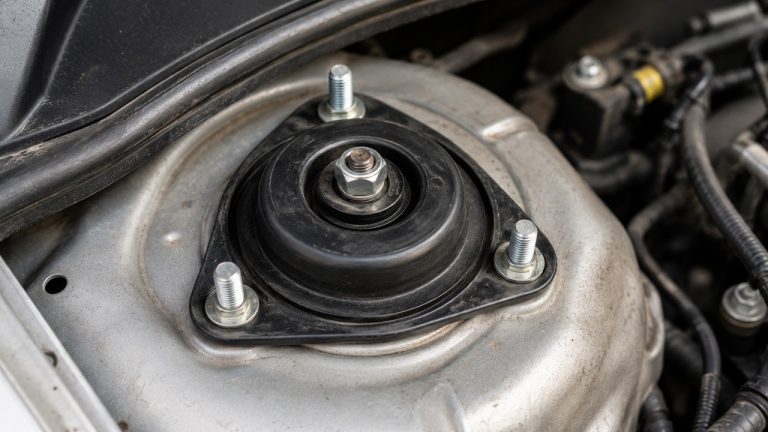
5. Worn Strut Mounts or Bearings
The upper strut mount connects the strut assembly to the body and helps isolate vibration. On many front suspensions, an upper bearing also allows the strut to rotate with the steering. These components can fail in different ways, so our guide to bad strut mount symptoms explains how to distinguish clunking over bumps from bearing-related popping, creaking, and spring binding.
A deteriorated mount can create a clunk over bumps. A damaged bearing may produce popping, binding or noise while turning the steering wheel. Monroe explains that metallic clunking around a shock or strut commonly points to worn or loose mounting hardware.
Typical fix: Replace the damaged mount or bearing and inspect the complete strut assembly. Working with a compressed coil spring requires proper equipment and training; an uncontrolled spring can cause severe injury.
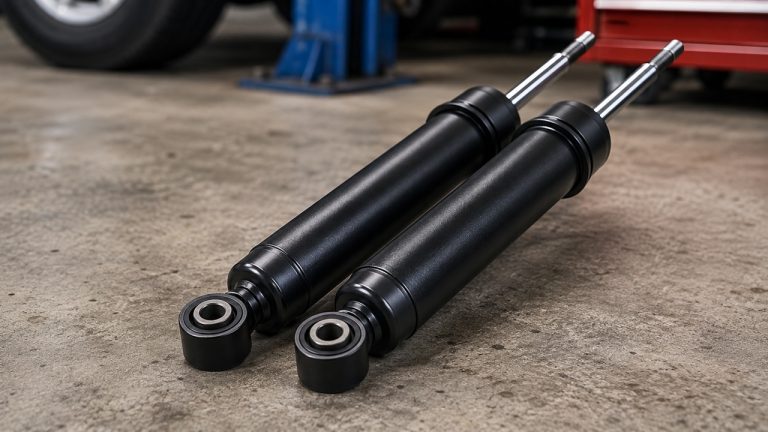
6. Worn Shocks, Struts or Their Lower Mounts
Worn dampers more commonly cause poor body control and repeated bouncing than a simple rattle. However, internal damage, bottoming out or worn mounting bushings can produce a knock over bumps.
Inspect for physical damage, severely deteriorated mounting rubber and active hydraulic fluid running down the component. A light film of oil does not automatically prove failure.
Typical fix: Replace the failed damper and any worn mounting components. Shocks or struts are normally replaced in pairs on the same axle to preserve balanced damping. Our shocks versus struts guide explains why these components are not interchangeable.
Do not spray lubricant onto a shock absorber or strut as a repair. Lubrication will not restore worn internal damping or repair a damaged mount, and overspray can contaminate brakes or rubber parts.
7. Broken or Incorrectly Seated Coil Spring
A coil spring can crack near its upper or lower end, where the broken section may be difficult to see. The remaining spring can shift in its seat and make a metallic clunk, particularly while turning or driving over a bump.
A spring may also make noise if it was installed in the wrong orientation or without the correct rubber isolator.
Typical fix: Replace damaged springs in axle pairs unless the vehicle manufacturer specifies otherwise. Inspect the spring seats, isolators, bump stops and dampers at the same time.
8. Loose or Damaged Tie Rod Ends
Tie rods connect the steering rack or linkage to the steering knuckles. Wear can cause a clunk while turning at low speed, steering-wheel vibration or excessive steering play.
Typical fix: Replace the worn inner or outer tie rod and perform a wheel alignment. A loose steering joint should be treated as a safety concern rather than merely a noise problem.
9. Loose Subframe, Crossmember or Suspension Hardware
A subframe, crossmember or suspension component that moves against its mounting point can produce a deep clunk. This is particularly important when the noise appeared after repair work, an impact or a collision.
Typical fix: Inspect the attachment points for movement, corrosion, damaged threads, stretched bolts or missing hardware. Fasteners must be tightened using the correct procedure and torque specification. Simply tightening every visible nut can damage parts or conceal the real fault.
10. Bump Stops or Suspension Bottoming Out
A heavy impact noise over large bumps may mean the suspension has reached the end of its travel. Possible causes include damaged bump stops, weak or broken springs, worn dampers, excessive load or an incorrectly lowered vehicle.
Typical fix: Identify why the suspension is using all its travel. Replacing a bump stop alone will not solve weak springs, overloading or incorrect ride height.
The Noise May Not Be the Suspension
Sounds travel through a vehicle’s structure, so a noise heard near a wheel may originate elsewhere. Check simple non-suspension causes before replacing parts.
- Loose spare wheel, jack or tools
- Unsecured cargo or a rattling rear-seat latch
- Loose exhaust hanger or heat shield
- Brake pads or caliper hardware moving in their mounts
- Loose wheel cover or underbody splash shield
- Engine or transmission mount movement
- CV joint, driveshaft universal joint or differential mount wear
- Loose wheel fasteners
If a wheel fastener may be loose, stop driving and have the vehicle checked immediately.
How to Narrow Down a Suspension Clunk Safely
1. Remove Loose Items
Empty unsecured items from the trunk and cabin. Confirm that the spare wheel, jack and tools are secured. This simple check prevents interior rattles from being mistaken for suspension faults.
2. Record When the Noise Occurs
At low speed in a safe area, note whether the sound occurs when one wheel crosses a bump, both wheels cross together, the steering turns, the brakes are applied or the direction of load changes.
Do not deliberately hit potholes, drive aggressively or reproduce a severe noise repeatedly.
3. Check Tires and Wheel Fasteners
Inspect the tires for bulges, damage and abnormal wear. Set pressure to the specification on the vehicle’s tire-information label, not the maximum shown on the tire sidewall.
Have wheel-fastener torque checked immediately if a wheel was recently removed or the noise appeared after tire service.
4. Perform a Ground-Level Visual Inspection
With the vehicle parked on firm, level ground, look through the wheel openings for:
- A broken or displaced coil spring
- A disconnected sway bar link
- Split rubber bushings or boots
- Fresh contact marks where two components have been striking
- Loose underbody panels
- Hydraulic fluid running down a shock or strut
- A corner of the vehicle sitting lower than the others
5. Have the Suspension Checked Under Load
Many joints cannot be assessed correctly while the suspension hangs freely. A professional may use a drive-on lift and an assistant to move the steering while checking for movement in tie rods, ball joints, control arms and rack mounts.
MOOG describes this as a dry park test. The acceptable movement and correct unloading procedure vary by vehicle, so a generic wheel-wiggle test cannot conclusively diagnose every joint.
Never crawl beneath a vehicle supported only by a jack. Use the specified lifting points and properly rated stands, or have the inspection performed on professional lifting equipment.
How Suspension Clunks Are Fixed
The correct repair is to identify and replace or secure the actual failed component. There is no safe universal product that can be sprayed onto a suspension to eliminate every noise.
| Confirmed Problem | Normal Repair | Additional Work |
|---|---|---|
| Sway bar link | Replace worn link | Inspect the opposite side and bar bushings |
| Sway bar bushing | Replace correct-size bushings | Inspect the bar for corrosion or wear |
| Control arm bushing | Replace bushing or control arm | Alignment check normally advisable |
| Ball joint | Replace joint or control-arm assembly | Alignment and steering inspection |
| Strut mount or bearing | Replace mount or complete assembly as appropriate | Inspect spring, strut and alignment |
| Shock or strut | Replace in axle pairs | Replace worn mounts and inspect tires |
| Broken coil spring | Replace springs in axle pairs | Inspect seats, isolators, dampers and alignment |
| Tie rod | Replace worn inner or outer joint | Wheel alignment required |
| Loose mounting hardware | Inspect and torque using the correct procedure | Replace damaged or stretched hardware |
After replacing components that influence wheel position, follow the guidance in our article about wheel alignment after suspension repairs.
Can Lubrication Stop Suspension Clunks?
Lubrication is appropriate only for components specifically designed with grease fittings or for a manufacturer-approved assembly procedure. It does not repair a worn ball joint, torn bushing, damaged strut mount, broken spring or loose fastener. If a greaseable ball joint is still in good condition and due for routine maintenance, use the lubricant specified for that component. Our ball joint grease guide explains how to choose between lithium, synthetic, and moly formulations.
Spraying a general lubricant around the suspension can temporarily mask a squeak, attract dirt, degrade incompatible rubber and contaminate brake components. Diagnose the cause before applying anything. If the ball joint is still in good condition and designed for servicing, our guide on how to grease ball joints explains the correct procedure without damaging the dust boot.
Why a Clunk Can Remain After New Shocks or Struts
If the noise began or remained after replacement, the new damper may not be the cause. Check for:
- A reused or worn upper mount
- Incorrectly seated spring or isolator
- Loose rod nut or mounting hardware
- Incorrect part number or assembly orientation
- Hardware tightened in the wrong suspension position
- An unrelated sway bar link, ball joint or control arm fault
Monroe recommends inspecting mounts and mounting hardware because movement at these attachment points can create a metallic clunk even when the shock or strut itself is new.
When to Stop Driving and Call a Mechanic
- The steering feels loose, stiff or unpredictable.
- The car pulls strongly or changes direction over bumps.
- A wheel appears tilted or displaced.
- The noise followed a severe pothole, curb strike or collision.
- You hear grinding or feel vibration through the steering wheel.
- A spring, control arm, ball joint or tie rod appears damaged.
- The vehicle sits noticeably lower at one corner.
- Braking stability has changed.
- A wheel may be loose.
If the car feels loose or unstable in addition to making noise, read our guide to loose suspension symptoms while driving.
Frequently Asked Questions
What is the most common cause of clunking over small bumps?
Worn sway bar links and sway bar bushings are common causes, but strut mounts, control arm bushings, ball joints and loose brake hardware can sound similar. The component must be inspected before replacement.
Can bad shocks cause a clunking noise?
Yes. A damaged shock or strut can knock when it bottoms out, but clunking near a damper often comes from its upper or lower mount rather than internal wear.
Why does my front suspension clunk when turning?
Possible causes include a strut bearing, ball joint, tie rod end, control arm bushing, steering rack mount or CV joint. Steering looseness or binding requires prompt inspection.
Can underinflated tires cause suspension clunks?
Low pressure can worsen handling and cause tire damage, but it does not normally create a metallic suspension clunk. Inspect the tire and set pressure correctly, then continue diagnosing the noise.
Will an alignment fix a suspension clunk?
No. An alignment adjusts wheel angles; it does not repair a loose joint, damaged bushing or broken mount. The worn part must be repaired first, followed by an alignment when the work affects suspension geometry.
Can I tighten loose suspension parts myself?
Only if you can identify the component, safely support the vehicle and follow the exact fastener, torque and ride-position procedure for that model. Guessing or overtightening can damage hardware and safety-critical components.
Getting the Noise Diagnosed Correctly
A suspension clunk is evidence of movement, but it does not identify the source by itself. Start by removing loose cargo, recording exactly when the sound occurs and checking for obvious damage. Then have the steering and suspension inspected under the correct load conditions.
Replacing the loudest-looking component without confirming the fault can waste money and leave a safety problem unresolved. The correct repair restores the component’s secure mounting and intended movement—it does not merely silence the symptom.