Traction Bars for Trucks: Types, Axle Wrap & Fitment Guide
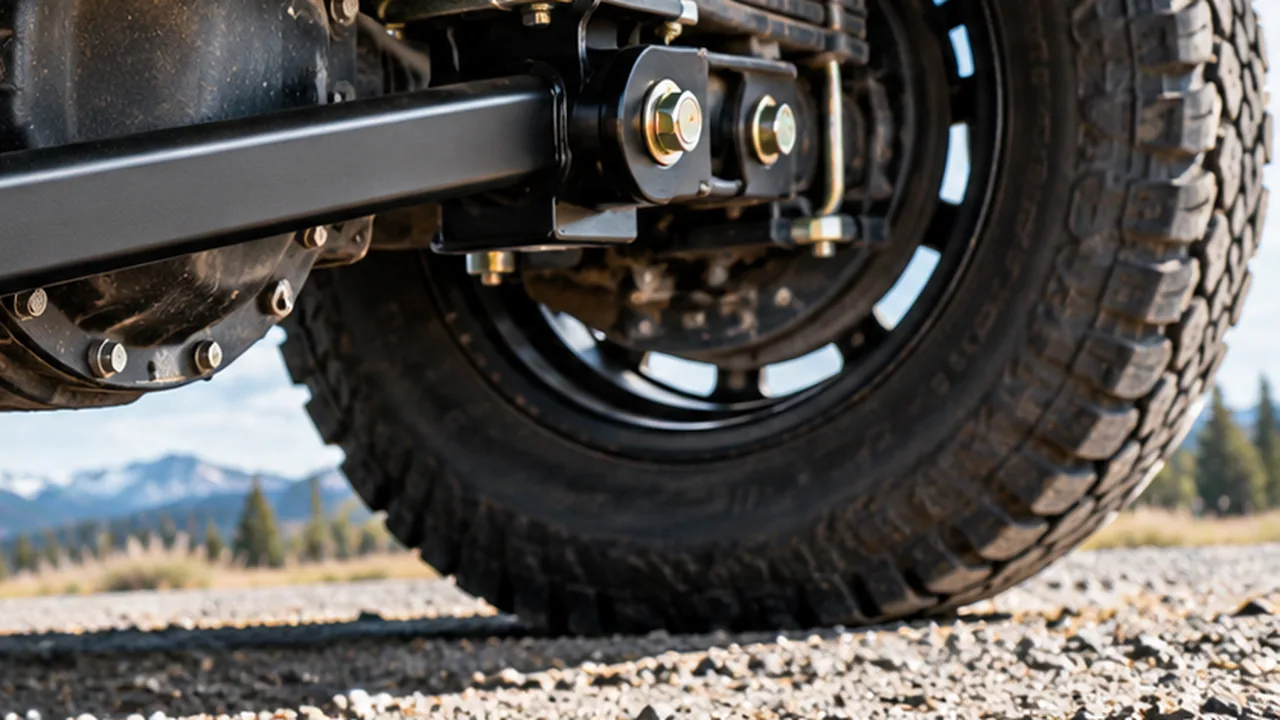
A pickup that hops violently when you accelerate does not necessarily need stiffer shocks. If its rear axle is twisting against the leaf springs, traction bars for trucks can control that movement and help the tires maintain more consistent contact with the road. The right kit depends on the rear suspension, axle mounts, lift height and how much articulation you need—not simply whether the bars look heavy-duty.
Which should you buy? For a leaf-spring truck that tows or spends time off-road, start with an application-specific anti-wrap design that allows the axle to move through its intended suspension travel. A high-power street or drag-oriented truck may benefit from a different, more launch-focused setup. If the truck doesn’t have axle wrap or wheel hop, traction bars may not be necessary at all. Check the symptoms before ordering.
This guide covers the common rear traction bars used on F-150s, Super Duty pickups, Silverado/Sierra, Ram and other leaf-sprung trucks. It explains fixed and floating designs, fitment traps, how lift blocks change the equation, and what to inspect before drilling a frame or tightening an adjustable link. It is not a guide to replacing a lateral track bar or redesigning an entire rear suspension.
Traction Bars for Trucks: Which Type Should You Buy?
Catalogs group a lot of unrelated hardware under traction bars. A conventional leaf-spring truck, a drag-strip pickup and a coil-linked off-road truck can all appear in the same search results, yet need very different solutions. This comparison is the fastest way to narrow the category before you look at part numbers.
| Truck and driving situation | Sensible starting point | Check before ordering |
|---|---|---|
| Stock leaf-spring pickup with no hop or wrap symptoms | Keep the existing suspension; inspect it normally | Do not buy bars for appearance alone |
| Lifted leaf-spring truck with axle wind-up on throttle | Vehicle-specific anti-wrap bars | Rear lift range, axle mounts and suspension travel |
| Diesel or heavy-duty truck that hops under load | Heavy-duty wrap-control design rated for that application | Axle tube diameter, tow accessories, bed and frame layout |
| Street/strip leaf-spring truck focused on launches | Launch-oriented traction system such as an application-specific CalTracs-style kit | Spring-eye configuration, adjustments and ride compromises |
| Rock-crawling or highly articulated leaf-spring build | Articulation-friendly anti-wrap system | Joint movement, axle rotation and mounting geometry |
| Rear coil-spring, multi-link or independent suspension | Diagnose the suspension; use only a system designed for it | Do not adapt a generic leaf-spring kit |
| Suspected lateral axle movement or body roll | Diagnose the correct locating or anti-roll component | Traction bars are not track bars or sway bars |
Two things matter more than a promising product title: what motion the bar is designed to resist and whether it can accommodate the other movement the suspension must still make. A bar that holds the axle steady during a hard launch but binds during articulation is the wrong choice for a trail truck. The reverse is also true: a very compliant off-road anti-wrap link may not offer the precise launch adjustment a drag-focused owner expects.
How Traction Bars Stop Axle Wrap and Wheel Hop
A leaf spring supports the truck and also helps locate its axle. That gives it two jobs. Under a sudden burst of driveline torque, those jobs can conflict, particularly when a lift or larger tires have changed the axle’s leverage on the spring pack.
The axle housing tries to twist as the tires push forward
Imagine the truck stopped on dry pavement. The engine turns the driveshaft and pinion, the ring gear drives the axle shafts, and the tires push against the ground. The axle housing experiences a reaction to that torque. On a leaf-sprung rear axle, the housing can try to rotate relative to the springs, bending the forward portions of the spring packs rather than simply moving the wheels forward.
This spring wind-up is called axle wrap. It can momentarily change the pinion’s angle and store energy in the leaf pack. When the tire slips or the spring releases that energy, the process can repeat. A traction bar creates an additional load path between the axle and chassis, limiting unwanted housing rotation while the suspension continues to support the vehicle.
Wheel hop is a symptom, not a diagnosis by itself
Wheel hop can feel like the rear of the truck is hammering the road under acceleration. Sometimes it is plainly visible in the bed or rear-view mirror. On a leaf-spring truck, axle wrap may be the cause, but worn dampers, loose spring mounts, damaged bushings and tire behavior can also contribute. Don’t use a traction bar as a substitute for finding a broken component.
One useful clue is when the problem appears. A repeated shudder only as power comes on, especially when traction alternates between gripping and slipping, warrants an axle-wrap inspection. A clunk on every bump, vibration at constant highway speed or a rear end that wanders sideways points toward other checks first. Our leaf spring bushing guide covers one common source of unwanted play.
Axle wrap and static pinion angle are different problems
A bar limits dynamic housing rotation while the axle is under torque. It does not automatically set the correct resting angle between the pinion, driveshaft and transmission or transfer-case output. If a lifted truck has a persistent driveline vibration at steady speed, inspect the existing U-joints, shaft arrangement and measured operating angles before ordering anti-wrap hardware.
A wedge installed at the spring seat changes a different aspect of geometry; our pinion angle shims guide explains that separate adjustment. On some builds both a properly selected shim and traction bars may be useful, but one should not be assumed to replace the other.
Types of Traction Bars: Fixed, Floating, CalTracs and Ladder Styles
The photos on a retailer page can make every option look like a long black tube beneath the bed. The behavior is defined by the pivot points, bushings, link arrangement and any sliding or spring-loaded mechanism. Read the installation drawing before deciding that two similar-looking kits do the same thing.
Fixed-length bars: straightforward wrap control
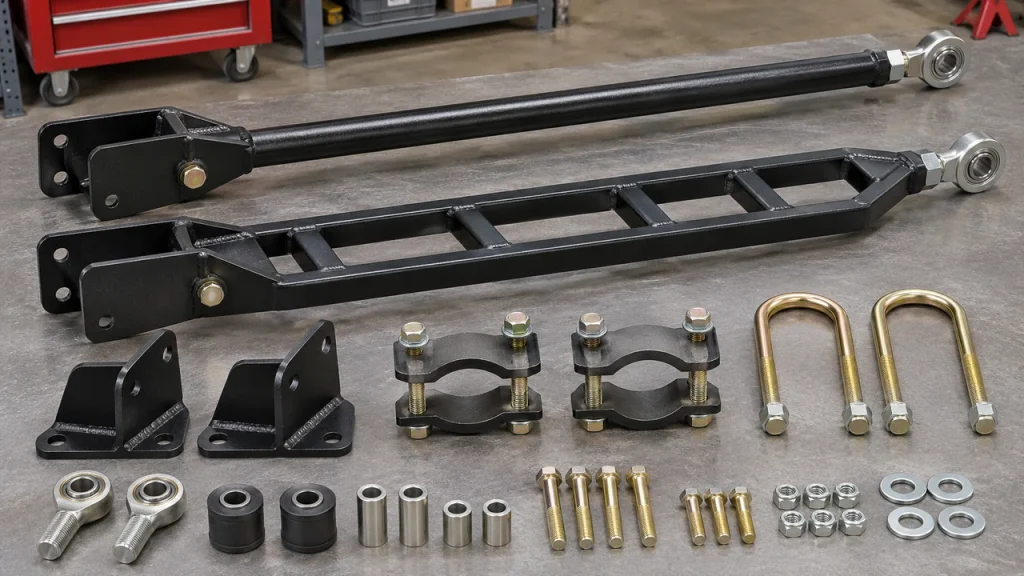
A common truck kit uses a steel tube connecting an axle-mounted bracket to a frame bracket farther forward. Its ends may incorporate polyurethane bushings, rubber, spherical rod ends or some combination. With compatible geometry, the bar resists the housing’s tendency to rotate under power. Manufacturers often sell vehicle-specific mounting packages to keep the brackets in the intended locations.
The trade-off is that a rigid-length link adds another constraint to a suspension whose leaf springs already move in arcs. A well-engineered installation may accommodate that through the joint types and bracket locations. A poorly chosen one can load the spring mounts or resist axle movement in roll. Fixed-length does not automatically mean unsuitable off-road, but it makes the full-travel check especially important.
Floating and spring-loaded traction bars: movement with resistance
Some modern designs deliberately include a moving or compliant section so they can oppose wrap without acting like an immovable extra suspension link. BDS Suspension’s Recoil design, for example, uses internal springs and a floating arrangement, with adjustable resistance and dedicated mounting hardware. Its official Recoil traction bar product information also makes clear that the so-called universal bars require a separate model-specific mounting kit.
That last detail is easy to miss when comparing prices. A pair of bars advertised as universal may not include the axle and frame brackets needed to install it on your truck. And the word floating is not permission to ignore fitment: the actual spring, joint, lift range and bracket geometry still determine whether the system works as intended.
CalTracs-style systems and traditional slapper bars
CalTracs-style systems are strongly associated with leaf-spring drag racing and hard launches. Rather than simply bolting a tube between generic frame points, a purpose-built assembly uses a pivot arrangement at the front spring-eye area and a force-transfer link to influence spring loading under acceleration. The objective includes consistent tire loading as well as controlling wind-up.
Traditional under-spring slapper bars work differently. They use a contact point or snubber that engages the leaf spring when the axle begins to rotate. There may be a gap during normal driving, depending on the design and setup. These are not interchangeable with a floating long-bar system for towing or trail articulation, and their adjustment instructions should never be transferred to a different type of bar.
Ladder bars and link suspensions: names overlap, geometry doesn’t
Sellers sometimes call a triangular, two-tube traction assembly a ladder bar, while another catalog uses that term for a dedicated rear locating system. A true race-style ladder-bar suspension uses axle mounting points and a forward pivot to control axle motion within its designed chassis arrangement. Simply adding a rigid ladder link to a street truck’s stock leaf springs can create competing movement paths if the system was not engineered for both.
Similarly, a coil-spring rear axle commonly relies on control arms or links to locate it. It may have wheel hop, but it does not need a generic leaf-spring anti-wrap product by default. Diagnose those links and their bushings instead of treating the word traction as a universal mechanical prescription.
Traction Bars for Ford F-150, F-250 and F-350
The Ford searches are popular because the trucks cover everything from short-bed daily drivers to high-torque work rigs. A kit for one generation is not a safe match for another, even when the general suspension layout looks familiar.
F-150: check model year, rear suspension and lift range
A 2015–2020 F-150 kit may not share the same brackets with a 2021–2026 truck. For instance, Rough Country lists its 1070A F-150 traction bar kit for 2015–2020 4WD models with at least five inches of lift; it is not presented as an all-height or all-year solution. BDS publishes distinct older and newer F-150 Recoil applications, with their own mounting hardware and exclusions.
That should change how you shop. Don’t begin with “F-150 traction bars” and pick the longest bar in the results. Begin with the exact model year and cab/bed layout, then inspect the supplier’s approved rear lift range and axle configuration. If you have factory special suspension equipment, verify it by part number rather than assuming a regular F-150 listing covers your truck.
F-250 and F-350: axle details matter as much as the badge
Super Duty owners often look for bars after adding diesel power, larger tires, a rear lift or a towing setup. There are credible application-specific kits, but F-250 and F-350 do not identify one universal axle and mounting package. BDS, for example, lists separate Recoil applications for 1999–2016 and 2017–2026 Super Duty trucks, and some later applications are differentiated by axle tube diameter.
A dually, different rear axle, replacement spring pack or previously installed suspension system can change the mounting hardware required. Before paying, compare the exact build and axle measurements with the current manufacturer’s instructions. If the rear of the truck already carries an airbag bracket or auxiliary suspension hardware, confirm that the traction-bar axle mounts occupy compatible space.
Bolt-on does not mean no drilling
A bar may be sold as bolt-on because its brackets attach with fasteners rather than welding, yet the frame side can still require carefully located holes. Rough Country and BDS both describe products in this category that require drilling. The appropriate installation is determined by the specified frame section, available clearance and factory or aftermarket modifications.
A universal bracket cannot simply be drilled wherever the tube happens to reach. A frame rail is a structural component with manufacturer restrictions. Follow the approved hole size and position, and do not modify a reinforced area, wiring route or existing frame attachment to make an incompatible product fit.
Silverado, Sierra, Ram and Toyota Traction Bar Fitment
A diesel pickup and a half-ton gas truck may both use rear leaf springs, but the axle tubes, spring plates, frame rails and clearances can be very different. The safer approach is to treat each application as its own installation, not as another variation of a universal “truck traction bar.”
Silverado and Sierra: 1500 versus HD is the first split
GM half-ton listings should not be treated as fitment instructions for a 2500HD or 3500HD. Different rear axle, chassis and suspension packages can require different mounts. Rough Country lists a specific 2019–2026 Silverado/Sierra 1500 traction-bar family, while other suppliers divide heavy-duty applications into their own product ranges. An online title spanning multiple generations can be less precise than the actual fitment sheet.
Check the truck’s rear suspension, current lift, U-bolt and spring-plate arrangement, and the nearby fuel and exhaust components. On some kits, the axle bracket uses space close to an existing clamp; on others it attaches differently. A bolt hole that lines up in a product photo is not enough to establish the correct load path.
Ram 2500 and 3500: identify the rear spring system first
The distinction between Ram 2500 and 3500 is especially important across model years. Some heavy-duty Ram trucks have conventional rear leaf springs; others use rear coil springs with separate locating links. A coil-sprung link suspension does not develop leaf-spring axle wrap through a spring pack that isn’t there. Its axle movement and unwanted hop require a different diagnosis.
For a leaf-sprung Ram, verify whether the proposed bars clear the spring plates, brake hoses and any aftermarket air-suspension assistance. Don’t assume a kit labeled for a 2008 Ram 2500 is appropriate for a much newer 2500 just because both trucks tow substantial loads. The rear axle architecture must match before the engine or tire size enters the decision.
Tacoma and Tundra: not every truck needs a long-bar system
A leaf-spring Toyota pickup can experience axle wind-up, particularly after torque, tire or lift changes, but that does not make every Tacoma or Tundra an automatic candidate. Some owners see no wheel hop and have no reason to add hardware below the frame. Others use their trucks in settings where axle control becomes a genuine issue.
There are Tundra-specific traction systems from established suspension suppliers, but Toyota generations differ. Identify the truck’s axle and rear spring architecture and check whether the product suits the existing bump stops, shock placement and off-road travel. In tight trail conditions, a long or low-mounted bar deserves a ground-clearance check before anything is drilled.
Do Lifted Trucks Need Traction Bars?
A lift can make axle-wrap complaints more noticeable, but lift height alone does not answer the question. Two trucks with the same advertised suspension lift can have different spring rates, shock travel, tire diameter, axle mounts and driveline behavior. A lift block also introduces a mechanical effect that a replacement spring does not replicate in exactly the same way.
Why taller rear blocks can make axle wind-up worse
On many spring-over-axle rear setups, a block places more distance between the axle housing and the spring pack. Torque acting at the housing then has greater leverage to disturb the spring’s position. Taller tires and increased engine torque can add to the tendency. That is one reason a truck that behaved normally before a block lift may begin to hop or shudder under a hard launch.
The correction is not automatically “install the longest traction bars.” Check whether the blocks are approved for the truck, whether the axle is securely located and whether the spring clamps remain correct. Our rear lift blocks guide covers block height, spring seats and related safety limits; this article stays focused on selecting axle-wrap control.
Spring lifts, bigger tires and off-road articulation
A rear lift achieved with springs can also change wrap behavior, particularly when the spring packs are designed for greater movement or carry different loads. Larger tires increase the torque demand at the contact patch and can magnify symptoms. Neither is enough evidence to order a particular bar without checking what is actually moving.
Off-road trucks add another constraint. The rear axle needs to articulate, the leaf springs need to change shape, and the shocks need to work across their intended travel. A bar that forces one rigid path may oppose those motions. A genuinely articulation-friendly traction system matters more here than a marketing claim about how thick the tubing is. If the build is moving toward a wider suspension redesign, the long-travel suspension guide covers that larger system separately.
Towing, Diesel Torque and Daily Driving: Set Your Priorities
Truck owners often shop for traction bars after a practical annoyance: a rough launch from a stoplight, rear-end shudder when pulling onto a road with a trailer, or repeated hopping on a loose incline. Those use cases deserve different expectations from a drag-focused weekend build.
Towing: control wrap, not payload or trailer sway
An anti-wrap system may help a leaf-sprung tow truck keep its axle orientation more stable under acceleration. It does not raise the truck’s legal tow rating, increase the rear axle weight rating or repair an overloaded spring pack. It also is not a dedicated trailer-sway control device. If the combination moves unpredictably in crosswinds or the rear squats excessively, inspect loading, tires, hitch setup and suspension condition instead of assuming traction bars will solve it.
Ask about clearance to air-helper springs and their brackets before buying. An axle clamp or frame bracket that shares space with the airbag mount can turn an otherwise straightforward fit into an incompatible combination. A product labeled “works with towing” doesn’t settle that packaging question.
Diesel launches and daily comfort require a compromise
A high-torque diesel can generate substantial axle reaction even without a dramatic lift. The more important observation is whether that motion causes tire hop, uncontrolled pinion movement or repeated loss of grip. Heavier tubing alone is not proof of the right solution. The end joints and how the bar engages can matter just as much.
For daily use, consider noise, vibration, grease requirements and how the system reacts over uneven pavement. A lightly loaded pickup may feel a bar’s added restraint differently from the same truck carrying cargo. Some adjustable designs let the user set resistance within the manufacturer’s limits, but an aggressive drag-style setting should not become the default for a truck that spends its week on rough roads.
Fitment Checklist: Axle Tube, Frame and Spring Hardware
This is where buying mistakes become expensive. A generic kit might list the correct truck family but still lack the brackets or measurements needed for your axle. Before ordering, get the manufacturer’s current installation sheet and compare it with the suspension actually installed, not the truck as it left the factory.
The checks below are especially useful when the truck has a lifted rear end, aftermarket leaf packs or other bolt-on accessories.
- Rear spring design: conventional leaf pack, mono-leaf, coil-linked axle or independent rear suspension; do not substitute parts across architectures.
- Axle and clamp details: tube diameter, spring-plate arrangement, axle-seat area, U-bolt routing and available bracket space.
- Frame and body layout: model year, cab/bed configuration, frame attachment restrictions and the exact location of the intended forward mount.
- Lift range: actual rear lift height and the supplier’s approved minimum and maximum, not the height of the front leveling kit.
- Travel: safe movement at full bump, full droop and one-wheel articulation, with suitable joint misalignment.
- Interference: fuel tank, exhaust, driveshaft, spare tire, brake hoses, ABS wiring, air-helper spring brackets and parking-brake cables.
- Kit completeness: one or two bars as specified, axle brackets, frame brackets, joints, replacement fasteners, required sleeves and any separately sold mounting package.
- Service requirements: approved preload method, lubrication, fastener torque and the manufacturer’s inspection or recheck schedule.
Axle tube diameter is not a minor detail
A tube-clamping bracket must match the supported axle. Different F-150 and Super Duty products can specify different axle tube sizes; an apparently similar bar may be sold with a totally different mounting kit. The bar’s overall length will not compensate for a clamp that cannot seat correctly on the housing.
Measure where the manufacturer tells you to measure, and identify any existing welding, brackets or housing features before selecting the clamps. Don’t stack washers or insert homemade shims to force a wrong-size bracket around the tube. A traction-bar axle connection transmits meaningful torque reaction, so the manufacturer’s designed contact area matters.
Leaf spring U-bolts and spring plates remain critical
Some bars clamp near the leaf-spring U-bolt area, while other kits use a separate axle bracket. An accessory that changes how the spring plate is retained may require new, specifically sized fasteners. The spring-to-axle connection must remain secure and correctly located; the traction bar cannot be allowed to substitute for weak or loose axle clamps.
If a kit changes the clamp stack or requires replacing the U-bolts, use the correct new hardware and torque procedure. Our leaf spring U-bolt guide explains the sizing and clamping issues without treating any generic torque chart as universal.
How much length and ground clearance do you need?
Longer bars are not inherently better. They alter the path between the frame and axle, and the best length depends on where the design expects its joints and brackets to sit. A bar extending far under the truck can conflict with the fuel tank, frame brackets or trail obstacles, while a short arrangement may place different demands on articulation and bushing movement.
On an off-road truck, check the lowest exposed point after installation. A clean-looking tube can become the first part to scrape a rock. On a street truck, the greater concern might be interference with the driveshaft or exhaust through suspension movement. Either way, fitment drawings beat guessing from a side-on photo.
Bolt-On vs. Weld-On Traction Bars: Installation Reality
The work involved depends more on the mounting design than the bar itself. A pair of tubes with preassembled rod ends might look simple on a bench, but the axle connection and forward frame location determine whether this is a routine accessory installation or a chassis-fabrication job.
Bolt-on kits still need accurate mounting points
A genuine vehicle-specific bolt-on kit is the best starting point for most owners. It should tell the installer exactly where the brackets attach, which bolts and sleeves are used and whether holes must be drilled. On some designs the axle bracket shares existing suspension hardware; on others it uses its own clamp or mount. These differences affect how the load enters the axle and frame.
Do not loosen or replace spring-to-axle hardware without following the service procedure. Likewise, never use the assembled bar to pull the axle or frame into an unnatural alignment so its bolts will pass through. The suspension should sit at the position specified for installation, and the mounts should meet without forcing parts into place.
Welding to an axle housing isn’t a cosmetic job
A custom build may need weld-on axle tabs or fabricated frame mounts. Welding introduces concerns about housing material, alignment, heat, contamination and proximity to brake lines, seals and other components. An axle tube or differential housing should not be treated like an ordinary piece of scrap steel. A qualified suspension fabricator must evaluate the proposed attachment method and location.
Universal bars often assume that sort of fabrication. The term universal can mean the tube itself is adaptable, not that the package safely fits every axle without engineering work. If you don’t already know how the brackets will be designed and installed, a direct-fit kit usually offers a much clearer path.
Check the truck before the first drive—and after use
Once installed to specification, the system needs an inspection through its permitted suspension movement. Look for contact with the driveshaft, exhaust, tank, spare tire, brake lines and parking-brake cables. Verify that joints have sufficient angular range and that the bars are not being used as suspension travel stops. The bar must not preload or pull the axle into an unintended resting position.
Manufacturers may require an early fastener recheck and ongoing lubrication or inspection. Follow the actual instructions for the kit, rather than adopting a torque or mileage interval from a different brand. A loose frame bracket, worn spherical joint or cracked mount is a reason to stop driving and inspect the installation.
How to Adjust Traction Bars Without Creating Suspension Bind
Adjustable bars are attractive because you can change the way a truck reacts under load. But adjustable can refer to several unrelated features: overall rod length, joint alignment, spring resistance or launch preload. Turning a threaded end without understanding which of those you are changing can make the truck worse.
Preload settings depend on the bar’s mechanism
A CalTracs-style setup may use a specific force-transfer adjustment intended to alter how the springs react during acceleration. A floating anti-wrap bar may adjust internal spring resistance. A fixed-length link may only offer enough adjustment to position the ends correctly at the designated ride height. There is no useful universal number of turns, thread exposure or snubber gap that applies across those systems.
Begin with the supplied baseline for the exact part number. If the manufacturer provides street, towing and competition settings, use the appropriate documented starting point. Don’t copy a drag-racing preload recommendation onto a work truck with a long-travel suspension. Make only approved adjustments, keeping proper thread engagement and locking hardware.
Articulation, bushing deflection and joint limits
At full bump and droop, axle and frame mounting points rarely move in a perfectly straight line. During one-wheel articulation the two sides also travel differently. The traction-bar joints, bushings or floating mechanism must accommodate those changes without twisting the mounts or trying to pull the leaf springs away from their intended movement path.
A truck that starts lifting a tire earlier, creaking over diagonal bumps or striking a bracket after the bars are installed deserves a mechanical inspection. More restraint is not automatically more traction when the suspension can no longer keep the tires on uneven ground. Verify the full travel range with properly supported equipment and the kit’s stated limits.
Rattles, harshness and maintenance aren’t always adjustment problems
Some rod-end or launch-oriented systems can make more noise than stock rubber-isolated suspension parts. That doesn’t make every rattle harmless. Inspect jam nuts, bolts, grease fittings, spherical bearings and frame brackets before adjusting anything. A change in sound after a fastener loosens is different from a predictable noise explicitly described by the manufacturer.
Beware of “tighten it until the hop disappears” advice. If a setting adds harshness, reduces articulation or causes a joint to reach its travel limit, it should not be masked with further preload. Use the manufacturer’s service procedure and have the underlying suspension checked where necessary.
What Traction Bars Will Not Fix
It is worth separating traction problems from other rear-suspension complaints before committing to new hardware. A bar that controls axle wrap cannot compensate for defective springs, unsafe mounting hardware or a driveline assembled at the wrong geometry.
Worn springs, loose U-bolts and damaged mounts
Broken leaf sections, displaced spring center pins, ovalized eyes and loose axle U-bolts can all allow unwanted movement. Those defects must be repaired first. A traction bar is designed to help manage torque reaction, not to hold together an axle whose primary spring clamps are insecure. Adding extra brackets to a weakened assembly can make diagnosis harder while the original hazard remains.
The same principle applies to a cracked frame hanger or a badly worn shackle pivot. Repair the structural mounting fault, then decide whether axle wrap still needs additional control. Do not treat persistent clunks as a reason to buy an adjustable kit without inspecting the existing hardware.
Trailer sway, body roll and side-to-side axle location
A traction bar typically does not replace a track bar (Panhard rod), which locates certain solid axles laterally. It is also not the same as a sway bar, which resists body roll. Despite the similar-sounding names, the loads and mounting geometry differ. Buying traction bars because the rear axle shifts sideways on bumps can leave the actual fault untouched.
Likewise, bars don’t increase spring capacity, correct an overloaded trailer, replace a failed shock or guarantee a quiet driveshaft. If a vibration persists with constant throttle, don’t assume controlling axle wind-up will solve it. A proper diagnosis may point to tires, driveshaft joints, pinion geometry or suspension wear instead.
Traction Bars for Trucks: Questions Worth Asking Before Ordering
Online listings often answer the easiest questions—finish, diameter and advertised strength—while leaving the important ones to the installation instructions. These are the practical distinctions to settle before a kit arrives.
Are traction bars worth it on a stock truck?
Only if there is a reason for them. A sound stock leaf-spring truck without wheel hop or noticeable torque-induced axle movement may gain little from additional links. Hard launches, higher engine torque, frequent towing or a modified rear suspension can change the calculation. Diagnose what the axle is doing before deciding the upgrade is necessary.
Will traction bars stop wheel hop completely?
They can reduce hop caused by axle wind-up, sometimes substantially, but the symptom has other causes. Tires, dampers, worn spring mounts, available grip and launch technique all matter. A bar selected for the wrong vehicle or adjusted improperly may add another problem instead of eliminating the original one.
Can I use traction bars on a lifted F-150 or F-250?
Yes, when the specific kit is approved for that model, rear suspension, axle and actual rear lift range. For example, one product can be intended for a highly lifted F-150 while another covers stock-height and mildly lifted Super Duty applications. A front leveling height does not tell you the rear lift range. Read the application notes and any cab or axle exclusions.
Are traction bars the same as ladder bars or track bars?
No. Product catalogs sometimes use ladder-style to describe traction-bar shapes, but a true ladder-bar locating suspension is a different design. A track bar controls side-to-side axle location where the suspension requires one. Traction bars for leaf-spring pickups primarily address torque-induced axle rotation. Match the mechanism to the movement you need to control, not the label alone.
Do traction bars help when towing a trailer?
They may help manage axle wrap under power on a compatible leaf-sprung truck, especially one carrying substantial torque. They do not raise towing or payload ratings and do not replace proper tongue weight, hitch setup or trailer-sway control. Inspect fitment with any airbags, helper springs or other towing hardware already fitted.
Will traction bars hurt suspension flex or ride quality?
They can if the link geometry or joints restrict travel, and some designs transmit additional noise or harshness. Other systems are engineered to permit articulation while resisting wrap. The answer depends on the actual bar and mounts, not on the fact that it is made from thick steel. Check full-travel compatibility before buying a kit for trails or rough roads.
Can I install universal traction bars without welding?
Sometimes, but the word universal does not guarantee it. Some suppliers sell bar assemblies separately from the vehicle-specific bracket kits; others include tabs that require welding or drilling. Confirm the complete parts list and the specified frame and axle mounting method. If those details are missing, choose a supported vehicle-specific application or consult a qualified suspension shop.
Before you buy, take one more look at the truck rather than the product photo: identify the rear spring design, the actual source of any hop, the axle tube and clamp hardware, and how far the suspension has to move. The best traction bar is the one that controls unwanted axle rotation without fighting the rest of the suspension.