Toe-In vs. Toe-Out: Differences, Handling & Tire Wear
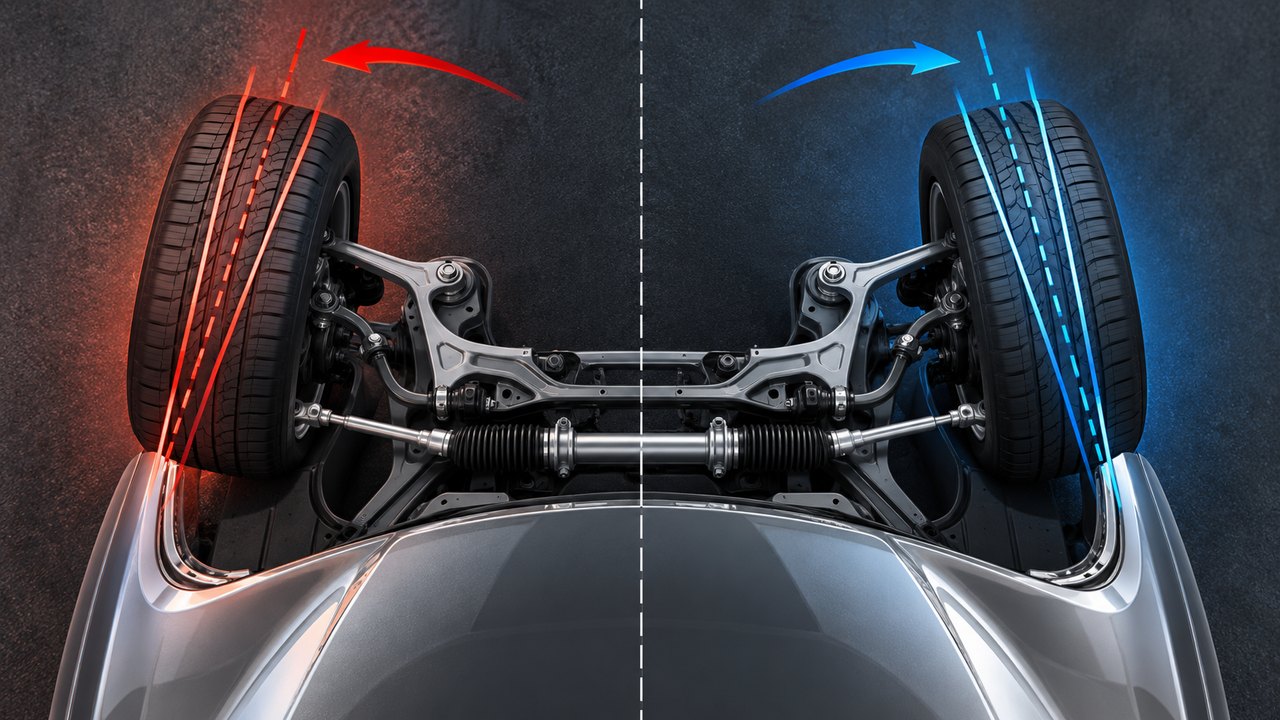
Toe-in means the front edges of two tires on the same axle point slightly toward each other; toe-out means they point slightly away from each other when viewed from above. A small amount of either can be intentional. Too much toe in either direction makes the tires scrub sideways as they roll, which can hurt tire life, increase drag and change how quickly or calmly the vehicle responds to steering input.
In general, more toe-in tends to favor straight-line stability, while more toe-out tends to sharpen initial turn-in. But neither is automatically “better.” The correct setting depends on the axle, suspension design, drivetrain, tire behavior and—most importantly for a street vehicle—the manufacturer’s alignment specification.
The biggest misconception is that toe is simply a choice between stability and cornering. Toe is also one of the alignment settings most capable of wearing tires quickly when it is wrong, even when the wheels look almost straight to the eye.
Toe-In vs. Toe-Out at a Glance
| Toe setting | Viewed from above | Typical handling tendency | If excessive |
|---|---|---|---|
| Toe-in | Front edges point toward each other | More straight-line stability, calmer response | Tire scrub, feathering, slower turn-in |
| Zero toe | Wheels point parallel | Low static scrub in a simplified model | Not automatically the correct specification |
| Toe-out | Front edges point away from each other | Quicker initial response and turn-in | Tire scrub, feathering, nervous straight-line feel |
Those are tendencies, not universal setup rules. A tiny amount of toe that works well on one front suspension may be wrong for another vehicle or inappropriate on its rear axle.
What Does Toe Measure?
Toe describes the horizontal direction each wheel points relative to the vehicle’s reference or thrust line when viewed from above.
Imagine looking straight down at the front axle:
- If the leading edges of the tires are closer together than the trailing edges, the wheels have toe-in.
- If the leading edges are farther apart, the wheels have toe-out.
- If both wheels point exactly parallel in the simplified static view, that is zero toe.
Toe is normally a very small angle. A setting that looks almost impossible to see by eye can still create a meaningful amount of lateral tire scrub over thousands of miles.
Toe-In
With toe-in, the front of each tire points slightly toward the vehicle centerline. It is sometimes called positive toe, although sign conventions are not perfectly universal across every manufacturer, alignment machine and motorsport reference.
For that reason, toe-in and toe-out are clearer terms than relying only on a plus or minus sign.
Toe-Out
With toe-out, the leading edges point slightly away from one another. It may be described as negative toe under a common convention, but again, always check how the actual specification or alignment equipment defines the sign.
Toe-In vs. Toe-Out: How Handling Changes
Toe changes the way the tires react before the steering wheel has moved very far, which is why small adjustments can noticeably alter vehicle feel.
Toe-In and Straight-Line Stability
Increasing toe-in generally makes an axle feel calmer and more resistant to small directional disturbances.
On the front axle, that can translate into:
- more settled highway tracking;
- less immediate response to tiny steering inputs;
- a slightly less aggressive initial turn-in;
- less nervousness over road grooves or small disturbances.
This does not mean adding extra toe-in is a free stability upgrade. Once the setting moves beyond what the suspension and tires require, the wheels increasingly fight one another as they roll.
Toe-Out and Steering Response
More front toe-out usually makes the vehicle respond more eagerly when the driver starts turning the steering wheel.
That sharper response is one reason small amounts of front toe-out are used in some performance and motorsport setups.
The trade-off is that excessive toe-out can make the front end feel:
- nervous on the highway;
- more sensitive to pavement grooves;
- less settled during straight-line driving;
- more demanding of continuous small steering corrections.
The useful amount can be extremely small. More is not automatically better.
Toe-In vs. Toe-Out Tire Wear
Excessive toe in either direction can wear tires very quickly because the tread is dragged slightly sideways instead of rolling cleanly in the direction the vehicle is traveling.
The classic toe-related wear pattern is feathering, sometimes described as sawtooth wear.
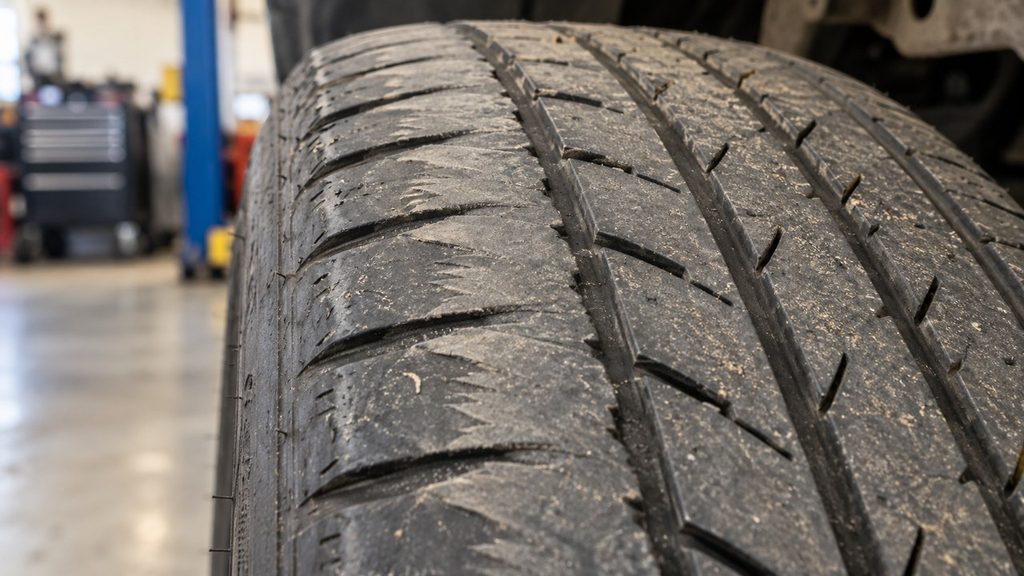
Run your hand laterally across the tread blocks. With feathering, one edge of a tread block can feel relatively smooth while the opposite edge feels sharp or raised. Moving your hand the other direction reverses the sensation.
That happens because the tread blocks are continually being loaded sideways as the tire rolls.
| Condition | Typical clue | What the tire is doing |
|---|---|---|
| Correct toe | No abnormal toe-related feathering | Rolling near the intended direction |
| Excessive toe-in | Feathering / lateral scrub | Each tire continually tries to roll slightly inward |
| Excessive toe-out | Feathering / lateral scrub | Each tire continually tries to roll slightly outward |
| Large toe error | Rapid wear, drag and possible instability | Tire is being scrubbed across the road on every revolution |
Does Toe-In Wear the Outside and Toe-Out Wear the Inside?
You will often see this simplified to “toe-in wears the outside edge and toe-out wears the inside edge.” That can describe some real-world wear patterns, but it is not a reliable universal diagnostic rule by itself.
The more characteristic sign of incorrect toe is tread-block feathering caused by lateral scrub.
Which shoulder ultimately looks worst can also be influenced by:
- camber;
- vehicle load;
- cornering behavior;
- tire construction;
- inflation pressure;
- suspension compliance;
- how far the toe is out of specification.
For example, a vehicle with substantial negative camber plus excessive toe-out may destroy the inner portion of a tire particularly quickly. The inner wear is not proof that toe-out alone caused the entire pattern.
That is why a proper alignment measurement is more useful than diagnosing toe only from which shoulder looks bald.
Front Toe vs. Rear Toe
Toe affects both axles, but changing front and rear toe can produce very different handling consequences.
Front Toe
Front toe strongly influences initial steering response and straight-line feel because the front tires are responsible for changing the vehicle’s direction.
As a general tuning tendency:
- more front toe-in tends to calm steering response;
- more front toe-out tends to sharpen initial turn-in.
But a street car should not be given arbitrary toe-out simply because sharper response sounds desirable. Factory specifications also account for suspension compliance, tire wear, braking behavior and stability at speed.
Rear Toe
Rear toe has a major effect on how stable the back of the vehicle feels as load transfers during braking, corner entry and acceleration.
Many road-car suspension designs use some rear toe-in because it can promote a stable rear axle. Rear toe-out can make a vehicle rotate more readily, but it can also make the rear more sensitive and less forgiving.
That does not mean every vehicle should receive the same rear setting. Some rear suspensions also change toe dynamically as they compress, so the manufacturer’s specification and suspension design matter more than a generic rule.
Is Zero Toe Best?
Not necessarily.
In a simple static model, zero toe minimizes the sideways conflict between two tires pointing in different directions. That makes it tempting to assume zero is automatically best for tire life and efficiency.
But a real vehicle does not maintain perfectly rigid geometry while driving.
Bushings deflect, tire forces load the steering linkage, suspension moves and driven wheels generate longitudinal forces. Engineers can therefore specify a small static toe angle so that the wheels behave as intended under actual road loads.
For a street vehicle, the correct baseline is the manufacturer’s specified range—not an arbitrary target of exactly zero.
How Toe Is Measured
Toe can be reported in several ways, which is a common source of confusion when comparing alignment specifications.
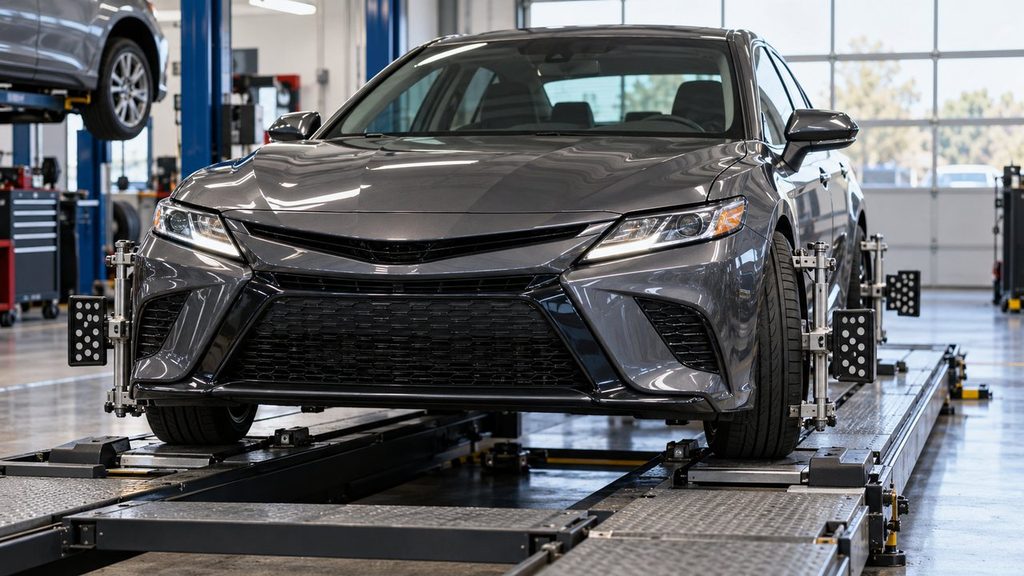
Degrees
Alignment equipment can report the angular direction of each wheel in degrees or fractions of a degree.
This is an angular measurement, so it does not depend on measuring the distance between two particular points on the tire tread.
Millimeters or Inches
Toe can also be expressed as the difference between front and rear measurements across a wheel or tire diameter.
That means a linear value such as 2 mm cannot always be compared directly with another vehicle unless the measurement convention and reference diameter are known.
Individual Toe vs. Total Toe
Individual toe describes one wheel’s direction relative to the alignment reference.
Total toe is the combined toe of both wheels on the same axle.
For example, an alignment report may show a small individual toe value on each side plus a total toe value for the axle. Always check whether a specification refers to per-wheel or total toe before comparing numbers.
How Much Toe-In or Toe-Out Should a Street Car Have?
There is no universal toe setting that should be applied to every street car.
The correct value depends on:
- front and rear suspension design;
- driven axle;
- bushing and steering compliance;
- tire size and construction;
- vehicle weight;
- ride height;
- manufacturer handling targets;
- whether the specification is individual or total toe.
A few millimeters or fractions of a degree may sound insignificant, but toe settings are intentionally small. Copying a performance setup from another chassis is therefore a poor substitute for starting from the specification for your exact vehicle.
Tire Rack’s alignment guidance likewise notes that toe has a major effect on tire wear and that changing toe beyond manufacturer recommendations to tune handling comes with trade-offs in wet behavior and tire life.
Toe-In vs. Toe-Out for Street vs. Track Use
Street and track setups have different priorities.
| Priority | Street vehicle | Performance / track setup |
|---|---|---|
| Stability | High priority | Balanced against response |
| Tire life | High priority | May be traded for handling |
| Turn-in | Predictable response | May favor more aggressive response |
| Toe target | OEM specification is the baseline | Can be tuned around vehicle and tire data |
| Rear stability | Usually important for safety and predictability | May be tuned for rotation, but with greater consequences |
A competition car may accept additional tire scrub and heat in exchange for faster response during a short session. A daily driver that travels thousands of highway miles has a completely different cost-benefit calculation.
This is why generic internet charts listing a single “best” toe number for FWD, RWD or AWD vehicles should be treated as starting ideas at most—not specifications.
Toe-In vs. Toe-Out vs. Toe-Out on Turns
These terms sound similar but describe different things.
Static toe-in or toe-out describes the direction the wheels point near the straight-ahead position.
Toe-out on turns describes the intentional difference between the inside and outside front steering angles while cornering. The inside wheel must normally turn more sharply because it follows a smaller-radius path.
That relationship belongs to Ackermann steering geometry and should not be confused with setting static front toe-out on an alignment rack.
Static Toe vs. Bump Steer
Static toe also needs to be separated from dynamic toe change caused by suspension travel.
A wheel can be perfectly within its static toe specification while the vehicle is sitting at ride height, yet change direction as the suspension compresses or rebounds.
That unwanted change is bump steer, not simply “bad toe.”
The distinction matters because adjusting tie-rod length to correct static toe does not necessarily repair an incompatible steering and suspension arc.
What Causes Toe to Go Out of Alignment?
Toe can change because the steering or suspension geometry has physically moved, worn or been adjusted.
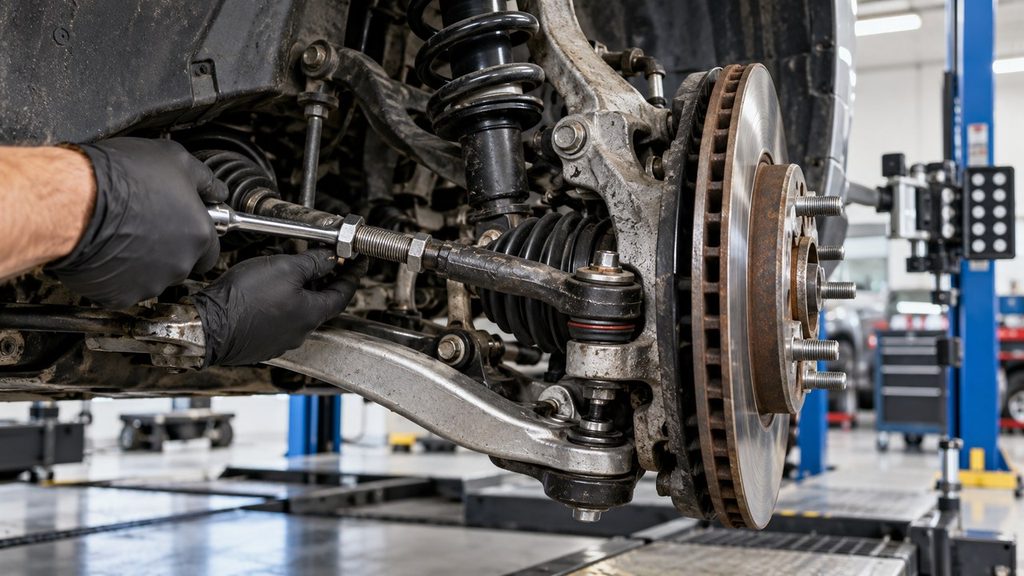
Common causes include:
- pothole or curb impacts;
- worn tie-rod ends;
- loose steering components;
- worn control-arm bushings;
- damaged steering knuckles or suspension arms;
- ride-height changes;
- spring sag;
- subframe movement;
- incorrectly installed replacement parts;
- suspension or steering repairs performed without a subsequent alignment.
If suspension components have recently been changed, our guide to alignment after replacing suspension parts explains which repairs are most likely to disturb alignment settings.
Can Toe Cause a Car to Pull to One Side?
Toe can contribute to directional problems, but a simple equal total-toe error is not always the classic cause of a constant pull.
If both front wheels are equally toe-in or equally toe-out relative to the intended reference, the vehicle may feel unstable, scrub tires or require steering corrections without necessarily producing a strong constant pull to one side.
A pull can instead involve:
- unequal camber or caster angle;
- tire conicity or radial pull;
- unequal tire pressure;
- brake drag;
- rear thrust angle;
- road crown;
- damaged suspension;
- asymmetric individual toe combined with other geometry errors.
So a car pulling right does not automatically mean “too much toe on the right.” A complete alignment and tire inspection is more useful than adjusting one tie rod based on the symptom alone.
Can Toe Make the Steering Wheel Off-Center?
Yes. The steering wheel can sit off-center even when total front toe is close to the desired value if the individual left and right toe settings are not balanced correctly relative to the steering center and thrust line.
For example, one front wheel can point slightly too far left while the other is adjusted to compensate enough that the combined total toe looks reasonable.
The vehicle may travel straight only when the steering wheel is held at an angle.
A proper alignment therefore considers individual toe, steering-wheel center and rear thrust direction—not just one total number.
What Is Thrust Angle and Why Does It Matter to Toe?
The thrust angle describes the direction the rear axle or rear wheels effectively push the vehicle relative to its geometric centerline.
If rear individual toe is unequal, the thrust line can point slightly left or right even when the vehicle body appears straight.
The driver may then compensate at the steering wheel to make the front wheels follow that rear thrust direction. This can contribute to an off-center steering wheel or a vehicle that appears to “dog track.”
This is one reason modern alignment work often evaluates all four wheels rather than adjusting front total toe in isolation.
What Does Toe Feathering Feel Like?
Toe feathering can often be felt before the tire looks obviously damaged.
With the vehicle safely parked, run a hand lightly across the tread from the inner shoulder toward the outer shoulder, then back in the opposite direction.
A feathered tread can feel:
- smooth in one direction;
- sharp or rough in the other;
- like small ramps across individual tread blocks;
- similar to a fine sawtooth pattern.
Severe feathering can also create tire noise even after the alignment has been corrected because the tread blocks have already worn into an irregular shape.
Feathering suggests lateral scrub, but it still makes sense to inspect the complete alignment and suspension rather than assuming toe is the only problem.
Can You Measure Toe at Home?
Basic toe can be estimated at home with strings, toe plates, measuring tapes or purpose-built alignment tools, but repeatability matters more than the apparent precision of one measurement.
For useful results, the vehicle should be:
- on a flat surface;
- at normal operating ride height;
- using correct tire pressures;
- with steering centered;
- with suspension settled after movement;
- free of loose steering or suspension joints.
A string setup can be useful for motorsport checks or identifying a large error, but a professional alignment rack makes it much easier to reference all four wheels, establish thrust angle and measure very small individual values accurately.
If the vehicle is used on public roads, the safest target after repair is the manufacturer’s specification rather than a guessed setting based on tread measurements alone.
Toe-In vs. Toe-Out FAQ
Which is better, toe-in or toe-out?
Neither is universally better. Toe-in generally favors stability while toe-out generally favors initial response, but the correct setting depends on the vehicle, axle and intended use. For a street car, use the manufacturer specification as the baseline.
Does toe-out improve cornering?
A small amount of front toe-out can sharpen initial turn-in, which is why it is sometimes used in performance setups. Excessive toe-out can reduce straight-line stability and increase tire scrub.
Does toe-in make a car more stable?
Increasing toe-in generally tends to calm directional response and improve straight-line stability, but excessive toe-in creates its own tire-wear and handling problems.
Does toe cause feathered tires?
Yes. Excessive toe is a common cause of feathering because the tire is continually scrubbed laterally as it rolls. One side of each tread block can feel sharper than the other.
Can bad toe cause vibration?
Toe misalignment more commonly causes tire scrub, feathering, instability and steering changes than a true speed-specific vibration. However, severely feathered tires produced by long-term misalignment can eventually contribute to noise or an uneven road feel. Wheel balance, tire damage and runout should also be checked when vibration is the main complaint.
Is toe measured with the wheels straight?
Static toe is measured near the straight-ahead steering position with the vehicle set up according to the alignment procedure. Steering-angle differences during a turn are a separate measurement associated with Ackermann geometry.
Does changing ride height affect toe?
It can. Raising or lowering a vehicle changes suspension position, and many suspension designs produce some toe change as the control arms and steering links move through their arcs. The amount depends on the geometry.
Should toe be checked after replacing tie rods?
Yes. Tie-rod length directly affects front toe on most steering systems, so replacing or disconnecting a tie rod normally requires the toe setting to be measured and corrected afterward.
Use the Specification, Then Diagnose the Behavior
Toe-in and toe-out are simple to visualize, but their real-world effects depend on more than whether the fronts of the tires point inward or outward.
More toe-in generally trades some response for stability. More toe-out generally trades some stability for sharper turn-in. Too much of either creates lateral scrub that can quickly damage tires.
For a street vehicle, start with the factory specification and investigate why the setting changed if it is out of range. A pothole, worn tie rod, suspension repair or ride-height change can all move toe away from where it belongs.
And when the symptom appears only during steering or suspension movement, make sure you are diagnosing the correct geometry: static toe, Ackermann toe-out on turns and bump steer are related steering concepts, but they are not the same problem.