Nissan Armada Lift Kits: Best Heights, Tires & Fitment by Year
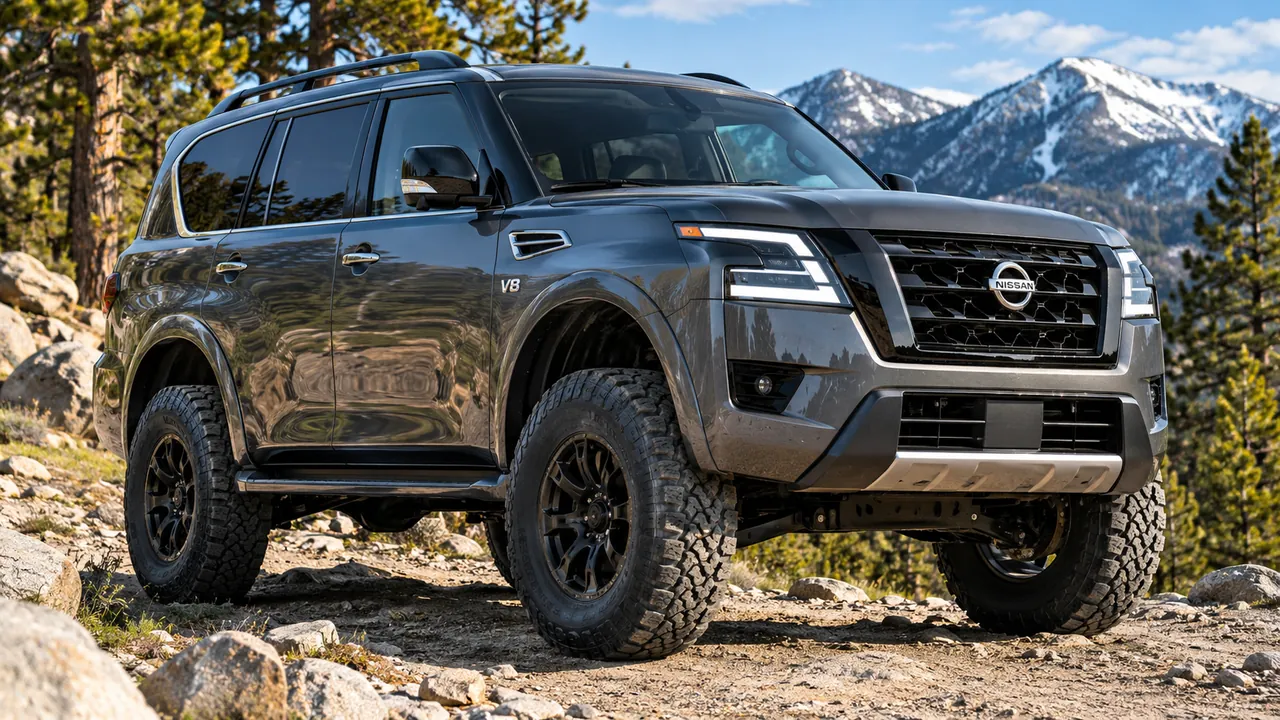
The best Nissan Armada lift kits for most family SUVs are modest, generation-specific systems: around 1.5–2 inches for a daily driver, or a properly matched 2–3-inch suspension package for regular trail use on a 2004–2015 or 2017–2024 Armada. On a 2025-and-newer Armada, identify whether the truck has steel coil springs or four-corner adaptive air suspension before buying anything. A lift link sold for a PRO-4X with air springs is not a spacer for an SL with coil springs.
If you own an older Armada, there is another decision to make before choosing the height: do you want to retain the factory rear automatic leveling? Some kits are built around that feature; others replace the air-assisted rear dampers entirely. That difference can be more important to a family that tows than the difference between a two-inch and a three-inch lift.
Which Armada Lift Kit Should You Buy?
Use the application table to find the right category of hardware before comparing brands. These are U.S. model years and representative kit listings, not a blanket approval for every trim, drivetrain or tire combination. The heights are advertised suspension changes, not guaranteed measurements at the fender.
| Armada application | Option to compare | What to establish before buying |
|---|---|---|
| 2004–2015 TA60, mild front level | Traxda 707020: 2-inch front | Existing front suspension, 2WD/4WD, rear leveling equipment |
| 2004–2015 TA60, front and rear lift | Armada-specific coil-spring or spacer system | Rear coil and shock arrangement; reject pickup leaf-spring blocks |
| 2017–2024 Y62, modest lift | Traxda 707040: 2-inch front; SUV-specific rear system if needed | Confirm complete Armada-specific hardware and rear leveling provisions |
| 2017–2024 Y62, retain rear leveling | High Road Suspension 3-inch retain-air package | Rear subframe and air-shock extensions; exact SUV application |
| 2017–2024 Y62, rough-road performance | Matched coil springs and replacement dampers; FOX or Bilstein-based packages | Whether rear air shocks must be removed; exact year and spring load |
| 2017–2024 Y62, tall custom build | Armada-specific bracket or subframe system | Rear independent suspension, alignment, CV geometry and parts availability |
| 2025 onward Y63, coil springs | Only a system expressly approved for the coil-spring Y63 | Do not buy a Y62 or adaptive-air lift by appearance |
| 2025–2026 Y63, factory adaptive air | Switch Suspension EDMNISARLIFT height links, advertised up to 2.5 inches | Four-corner air suspension only; usable travel, calibration and wheel clearance |
For a healthy older SUV that only needs a little more room for all-terrain tires, start near two inches, not six. For a vehicle that already rides poorly or sits unevenly, diagnose that problem first. Raising a tired suspension does not restore the original damping or load support.
Start With the Right Generation, Not the Nissan Badge
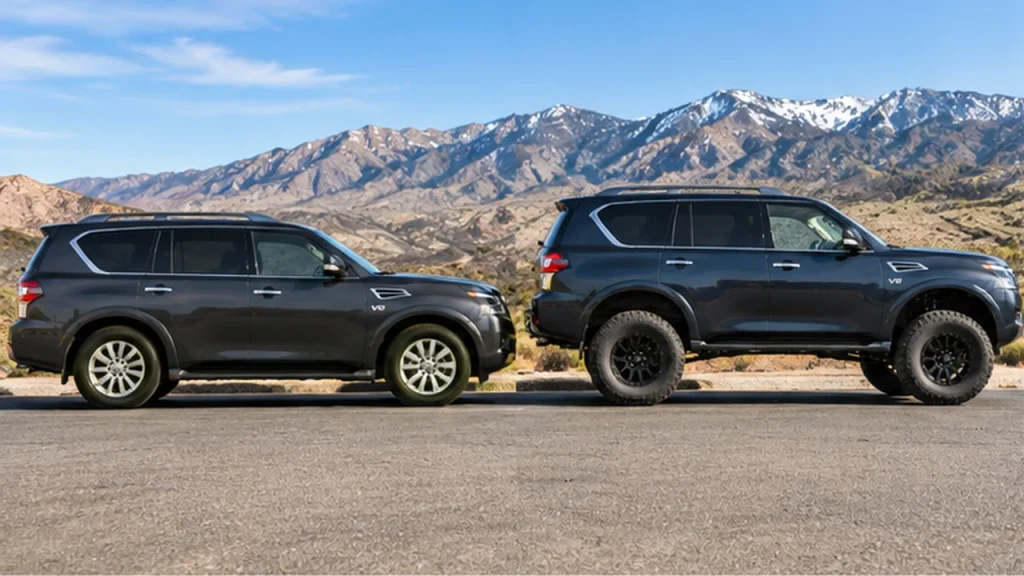
The U.S. Armada has gone through three distinct generations. The first two use V8 engines and the third uses a twin-turbo V6. All three have independent rear suspension, but the chassis, suspension hardware and leveling technology are not identical. A broad online title such as 2004–2024 can refer to a particular front part rather than a complete interchangeable suspension.
2004–2015: TA60, the Titan-related Armada
The first Armada arrived for the 2004 model year and shares its F-Alpha roots with the first-generation Titan. The key difference for a lift is behind the second row: the Armada uses an independently suspended rear end with coil springs instead of the Titan pickup’s leaf-sprung solid rear axle. A Titan front component may have an Armada application, but a pickup rear lift block or longer leaf-spring shackle is not the solution for an Armada.
If a seller offers a discounted Titan package, ask for the actual Armada part numbers and instructions. Our Nissan Titan lift kit guide covers the pickup’s own applications. The two vehicles should not share a complete shopping list just because the front suspension looks familiar.
2017–2024: Y62 or P61G
The second U.S. generation is related to the global Y62 Patrol and the Infiniti QX80. In the U.S., it begins with model year 2017; there was no U.S. 2016 Armada model between the two generations. The independent rear suspension remains, and the rear leveling equipment is now a particularly important part of a lift decision. A 2017, 2018 or 2019 Armada owner may find many of the same options as a 2023 owner, but the exact year and factory equipment still have to appear in the application record.
Be careful with global Patrol spring kits. Engines, vehicle weight, trim packages and suspension control equipment can differ. For example, a spring catalog entry that lists a Y61 Patrol is not proof that it fits a Y62 Armada. Ask for a U.S. Armada application rather than inferring one from the Nissan name or a retailer’s combined title.
2025 and newer: Y63, including the Patrol PRO-4X
This redesign changes the lift question substantially. Conventional coil springs remain on some grades, while others use electronically controlled air springs at all four corners. The NISMO introduced for 2026 also has its own chassis tuning. Nissan’s 2027 U.S. information identifies the off-road grade as Patrol PRO-4X beginning with November 2026 production. That is still an Armada, not permission to order a kit for an older overseas Patrol.
A 2027 badge or a shared platform does not automatically extend a 2025–2026 aftermarket fitment claim. The newer vehicle deserves its own confirmation from the kit manufacturer, particularly if electronics or air-height sensors are involved.
Lifting a 2004–2015 Armada Without Chasing Old Parts
A first-generation Armada can be a sensible base for a mild off-road build, but its age changes the calculation. Check the spring seats, dampers, control-arm bushings, ball joints, wheel bearings and frame mounting points. If one side is already lower than the other, find the cause before using new spacers to hide it.
Front-only leveling or a small lift at both ends?
A front level reduces nose-down rake while leaving the original rear spring arrangement in place. It can suit a truck that spends its life on the road with occasional unpaved access. If you tow or routinely carry passengers and cargo, measure the loaded stance too. An empty SUV that looks perfectly level may sit rear-low when the family and luggage are on board.
The Traxda Nissan application catalog lists 707020 as a two-inch front option for the 2004–2015 Armada, and its individual product page identifies front strut spacers. However, the front-and-rear 707057 listing also names the Armada while describing rear blocks and U-bolts intended for a leaf-sprung pickup. That is a catalog conflict, not an approved rear solution for this independently sprung SUV. Do not order that complete package on the strength of the Armada model name alone.
If you are deciding whether to raise both ends at all, our leveling kit versus suspension lift comparison explains the general trade-off. On the Armada, the rear independent suspension and the need to carry people and luggage make preserving usable rear travel particularly valuable.
When the original rear air levelizer still works
Nissan offered rear automatic leveling on earlier Armadas, with equipment depending on year and grade. For example, its 2015 information identifies self-leveling rear air suspension on SL and Platinum. Earlier towing packages could also include a rear air levelizer. Check the actual vehicle; an older used SUV may already have been converted to conventional shocks by a previous owner.
A healthy self-leveling system is worth preserving if it is part of the reason you bought the vehicle. Confirm the new spring or spacer geometry, damper lengths and the height sensor arrangement. If a kit simply raises the rear spring seat without accommodating the leveling system, the control system may attempt to return the body to its previous reference height or work outside the intended damper range.
Is a used six-inch kit a bargain?
Only if you can establish its exact Armada application and obtain every structural component, fastener and installation instruction. Tall independent-suspension systems can require brackets or relocated mounting points at both ends of the vehicle. A bag of front crossmembers and Titan rear blocks is not a complete Armada kit. Older systems may be discontinued, and replacement proprietary brackets are not necessarily available.
A tall build can also require different wheels, revised steering hardware and considerable labor. Do not substitute fabricated brackets or omit structural parts because an older catalog photograph appears similar. For many first-generation owners, the practical choice is a supported smaller lift and a tire that fits it, especially if the truck is also a daily driver.
2017–2024 Armada: Keep the Rear Air Shocks or Replace Them?
This is the shopping decision that distinguishes a Y62 Armada from many other full-size SUVs. Nissan lists automatic rear self-leveling for the 2024 Armada, and its parts catalog includes rear air-assisted shock absorbers and separate coil springs. It is not the same system as the four-corner air springs on the new Y63. The rear coils carry spring load; the air assistance helps maintain the intended rear height as load changes.
A two-inch lift with the factory system retained
Traxda lists 707040 as a two-inch front option for the 2017–2024 Armada. The catalog also lists 707045 and 707050 under the SUV, but the individual 707050 description specifies rear blocks and U-bolts, which do not belong on an Armada’s independent rear suspension. Treat the front-and-rear listings as unresolved fitment conflicts rather than recommendations. For the rear, choose hardware expressly designed for the SUV and its leveling equipment.
A retain-air package may need provisions for rear damper mounting length and the level sensor’s operating range. These must be designed as a system. An extension bracket does not make a worn air shock good again, and arbitrary sensor adjustment is not a substitute for checking full compression and extension. If the compressor is running excessively, or the rear drops while parked, repair or diagnose the existing system before modifying it.
For a concrete taller retain-air alternative, the High Road Suspension three-inch retain-air package combines front spacers and revised upper arms with a Garage 23 rear subframe lift and rear shock extension brackets. It also lists brake-line and alignment hardware. The package is intended to preserve the rear air shocks, unlike a conventional shock conversion. Confirm the exact U.S. model year and configuration; its broad catalog range should not override a generation or suspension exclusion.
A three-inch Armada suspension lift with replacement shocks
If your objective is more controlled travel over rough roads, replacement springs and dampers can be a better investment than stacking spacers on the originals. A concrete example is the Alldogs Offroad Y62 FOX package. Its listed contents include front FOX coilovers, rear FOX shocks and replacement coil springs. It expressly requires removal of the rear air suspension. Its detailed applications name 2017–2023, while the fitment field includes 2024, so a 2024 owner should confirm the specific package before ordering.
Alldogs also catalogs a Y62 system using Bilstein 6100 front dampers, 5100 rear dampers and its own springs. That is another route to comparing damping and spring selection rather than height alone. Confirm the rear conversion requirements and the exact expected lift with the supplier. Front preload settings, rear spring load and optional arms are part of the package decision, not universal settings for every Armada.
What you lose when you delete rear automatic leveling
A conventional shock-and-coil conversion can be a reasonable choice on an older SUV whose air system has become costly to maintain. But removing automatic leveling removes a useful load-compensation feature. A truck that tows frequently may benefit more from repairing and retaining the system than from deleting it solely to fit a particular lift. A replacement coil spring must be selected for the actual weight carried, not simply to produce a taller unloaded stance.
Have the installer explain how the conversion handles the original electrical system and any warning messages, and whether it is compatible with the vehicle’s remaining control systems. Do not treat unplugging a compressor or suppressing a dashboard warning as a finished suspension conversion. Verify the loaded rear height and bump-stop clearance with the trailer or cargo attached.
Do QX80 and Patrol HBMC parts fit the Armada?
Hydraulic Body Motion Control (HBMC) is a hydraulic body-control arrangement found on certain related overseas Patrol and Infiniti applications. It is distinct from rear air-assisted leveling. Alldogs’ Bilstein package specifically excludes HBMC-equipped vehicles and describes additional hardware needed if that system is removed. The relevant lesson for an Armada shopper is to identify the donor vehicle and its actual suspension, not to assume that every QX80, Patrol and Armada shares the same dampers and arms.
The typical U.S. Y62 Armada should be evaluated using its own specification, not described as having HBMC merely because a product listing also mentions a Patrol. Ask for VIN-based confirmation if you are buying imported or used suspension components.
A 2025 or Newer Armada Needs a Different Lift Strategy
The new Y63 can look like a straightforward candidate for a mild suspension lift, but its equipment changes from grade to grade. Choose a kit only after identifying whether the vehicle uses coil springs or the Adaptive Electronic Air Suspension system. The differences are not just a matter of spring stiffness.
SV, SL and Platinum with conventional coils
For model year 2026, Nissan identifies the SV, SL and Platinum as coil-spring grades. A conventional suspension kit must explicitly match the Y63’s geometry, damping and travel. Do not assume that a spacer sold through 2024 will fit because the newer truck also has double-wishbone suspension. The 2027 range no longer lists the SV in the U.S. press kit, so identify the actual year and grade rather than relying on a generic trim list.
Leave a coil-spring Y63 at stock height rather than improvise with older-platform components if no suitable documented kit is available for its exact configuration. For a mild tire upgrade, first investigate clearance at stock height. A taller suspension is not automatically required to gain a little more tread or sidewall.
PRO-4X, Platinum Reserve and NISMO with adaptive air
The 2025 redesign introduced four-corner adaptive air suspension on PRO-4X and Platinum Reserve. Nissan’s 2026 Armada specifications also identify air suspension on NISMO, but with NISMO-specific chassis tuning and a lower published minimum ground clearance than PRO-4X. The PRO-4X has a published maximum ground clearance of 11.6 inches in that model year. The air system therefore already provides a useful change of height in the appropriate driving conditions.
A factory high setting is not equivalent to a permanent two-inch mechanical lift. It operates within the manufacturer’s control strategy. For the 2027 model, Nissan continues to identify air springs on Patrol PRO-4X, NISMO and Platinum Reserve in its U.S. specifications and press information. That establishes the suspension type, not an aftermarket part-number approval.
How an adjustable air suspension lift link changes ride height
An aftermarket height link changes the relationship between suspension movement and the sensor reading. The controller then seeks its programmed height using that altered input. The air springs and dampers are not automatically longer, and the physical limits of the control arms and suspension travel do not increase just because the body rests higher.
Switch Suspension offers EDMNISARLIFT, a set of four adjustable links advertised for up to 2.5 inches of lift on 2025–2026 Armadas with factory four-corner adaptive air suspension. It is not an application for a steel-coil SL. Confirm the specific grade, including NISMO, and do not assume a 2027 application until it is explicitly listed or approved by the manufacturer.
The maximum advertised adjustment is not necessarily the best setting for a daily-driven SUV. Raising the normal position can reduce available extension travel and affect the relationship between the factory height modes and the physical limits. A qualified installer should verify sensor travel, clearance at the lowest and highest commanded positions, compressor operation, alignment and any required calibrations. Do not override the vehicle’s protective limits or use an air leak or warning as an acceptable consequence of a lift.
Is a Six-Inch Armada Lift Worth the Work?
Six-inch Nissan Armada lift kits have appeared in specialist catalogs, including historical CALMINI listings for the Y62. Those listings are a starting point for investigating a supported system, not proof that a complete kit is currently available for every model year. A serious inquiry needs the exact part number, a parts inventory and an installation drawing for the front and rear suspension.
A tall Armada has more to address than simply getting the body above a 35-inch tire. Its independent rear differential, half-shafts, control arms and mounting structure must remain within their operating geometry. A system that relocates subframes or other suspension mounting points may preserve some angles but can also leave low brackets beneath the raised chassis. The net improvement in usable ground clearance is not necessarily six inches.
Ask about wheel diameter and offset, steering clearance, CV articulation, brake and ABS routing and alignment correction. If the system requires cutting or permanent structural work, include that in the buying decision. A smaller, well-supported lift is usually a better family-SUV choice than an incomplete tall kit assembled from several unrelated listings.
33s and 35s: Tire Fitment on an Armada
A 33-inch tire is not a single physical size. Two tires of similar diameter can have very different widths and shoulder profiles. The table compares nominal dimensions calculated from the sidewall markings. These examples are not fitment approvals; the actual tire manufacturer’s dimensions and the selected wheel position determine clearance.
| Tire size | Nominal diameter | Nominal width | Comparison context |
|---|---|---|---|
| 265/70R18 | 32.6 in | 10.4 in | Common factory-size example |
| 275/60R20 | 33.0 in | 10.8 in | Y63 PRO-4X factory example |
| 275/50R22 | 32.8 in | 10.8 in | Y63 22-inch factory-size example |
| 285/70R17 | 32.7 in | 11.2 in | 33-inch class on a suitable 17-inch wheel |
| 285/65R18 | 32.6 in | 11.2 in | Wider 33-inch-class target |
| 285/60R20 | 33.5 in | 11.2 in | 33.5-inch class |
| 295/70R18 | 34.3 in | 11.6 in | Narrower alternative to a wide 35 |
| 285/75R18 | 34.8 in | 11.2 in | Near-35-inch diameter |
| 35×12.50R20 | 35 in (labeled) | 12.5 in | Wide 35-inch class |
Can a two-inch Armada lift fit 33-inch tires?
A modern Armada can already have tires close to 33 inches without any lift. The 275/60R20 supplied on a Y63 PRO-4X is nominally 33 inches tall. On an older Armada with 265/70R18 tires, a change to 285/65R18 adds little nominal diameter but increases width. The front tire may contact the liner or upper arm even when there is plenty of vertical fender gap.
Begin with the manufacturer’s approved wheel-and-tire combination for your actual kit. For 17-inch wheels, check brake clearance first; some Armada brake and wheel combinations may not support a small rim. The size example in the table is not a recommendation to install a 17-inch wheel on a new PRO-4X.
Will a three-inch lift clear 35s?
Some Armada builds use them, but three inches of advertised lift does not establish clearance for a wide 35. A 285/75R18 and a 35×12.50R20 are similar in nominal height but significantly different in width. When the front wheels steer, the tire sweeps near the rear of the wheel opening, the bumper corner and suspension components. With independent rear suspension, rear tire clearance also changes through compression and articulation.
The height of a parked vehicle with straight wheels is a poor clearance test. Ask the installer to check steering and usable suspension movement with the actual tires, including the low ride-height setting on an adaptive-air vehicle. Do not cut structural or crash-related components merely to obtain a desired tire size.
Wheel offset, brake clearance and the spare
An outward wheel position can gain room near an upper arm while making the tire’s outer sweep worse. Our wheel offset and backspacing guide explains how wheel width affects the comparison. Confirm the correct bolt pattern, hub bore, lug seat and load rating for the exact Armada. A wheel that physically bolts to a hub still may not clear the caliper or the suspension.
Also check whether the planned spare tire fits its storage location and clears the modified front brakes. On four-wheel-drive models, follow Nissan’s requirements for compatible tire sizes and rolling circumference. A greatly different spare can create driveline problems, and a temporary spare is not a substitute for a compatible full-size off-road recovery plan.
Keep the Armada Useful for Towing and Family Travel
A lifted SUV still has to carry passengers, luggage and potentially trailer tongue weight. On a vehicle with three rows, the difference between a driver-only measurement and a full family trip can be substantial. Rear automatic leveling can restore ride height within its intended range, but it cannot increase the certified payload, gross axle weight ratings or towing limit.
Check travel at normal driving weight
A larger rear spacer or a stiffer coil can make an empty SUV appear ready for towing while leaving it poorly matched to the actual load. Measure loaded ride height and check bump-stop engagement. A damper should not bottom internally before the suspension reaches its intended stop, or act as an unintended extension limit. Our shock length calculator can help compare the documented mount-to-mount measurements with candidate damper dimensions. Have the physical clearance and air system limits verified separately.
A lift also changes trailer ball height. Use suitable rated hitch equipment and check the trailer attitude with the actual load. Larger tires and heavier wheels consume payload and change effective gearing and braking behavior. They do not increase the original vehicle ratings. If the lift manufacturer imposes towing restrictions, treat those as part of the kit application rather than an optional footnote.
What should a complete installer quote include?
A modest spacer package may cost a few hundred dollars in parts, whereas a matched spring-and-damper system can easily reach four figures before installation. An air-system conversion or tall subframe lift can add considerable labor and supporting hardware. Our lift kit installation cost guide covers general U.S. budget ranges. For an Armada, obtain a quote that explicitly accounts for the rear suspension and any height-control work.
Send the following information to the supplier or shop before ordering. It is easier to resolve an air-leveling or model-year exclusion now than after the original suspension is disassembled.
- Model year, VIN, U.S. generation, grade and 2WD or 4WD configuration.
- Existing front and rear suspension hardware, including rear air-assisted shocks or four-corner adaptive air springs.
- Desired lift height and whether the factory leveling or adaptive height functions must be retained.
- Actual wheel diameter, width, offset, load rating and proposed tire size and model.
- Normal passengers, cargo, accessories, trailer tongue weight and garage height limits.
- Included alignment parts, damper or sensor provisions, structural work, and required calibration and reinspection.
After installation, obtain the alignment report, verify steering and suspension clearance, brake hose and ABS-wire routing, headlight aim and any required camera, radar or height-system calibration under Nissan’s procedures. Follow the fastener reinspection instructions. New suspension warnings, rubbing, knocking or unstable steering need investigation before normal driving or towing.
Nissan Armada Lift Kit FAQs
These answers narrow the choices for U.S. Armada owners. A model-year-specific manufacturer application and a safe, verified wheel-and-tire combination take priority over a generic lift-height rule.
What is the best lift kit for a 2005 Nissan Armada?
A mild TA60-specific front level or small front-and-rear lift is a sensible starting point on a healthy daily driver. Traxda lists a first-generation front-only option, but verify the rear air-leveling equipment and select independent-suspension-specific parts if lifting the rear. Inspect the original suspension before raising a vehicle of this age.
What is a good lift kit for a 2017 Nissan Armada?
A two-inch front level or mild front-and-rear system is worth comparing for road use. For regular trails, consider a matched coil-and-damper package with appropriate geometry provisions. Decide whether you need to preserve rear automatic leveling before selecting the kit.
Can a 2018 or 2019 Armada use a 2023 lift kit?
Some Y62 applications span those years, but not every kit or individual damper does. Check the exact part number and the rear leveling requirements. A broad product family title is not a substitute for the detailed vehicle fitment list.
Can I lift a 2025 Armada PRO-4X with its air suspension?
There are adjustable height-link products marketed for 2025–2026 four-corner air-equipped Armadas. Verify grade approval and safe operating range, and have the system checked in its different height modes. A height link does not create additional mechanical suspension travel.
Will a Titan lift kit fit an Armada?
Certain front parts have shared applications, but a complete Titan pickup kit should not be assumed to fit. The Armada’s independently suspended rear end uses different hardware. Buy parts expressly approved for the exact Armada generation and configuration.
Do I have to delete the rear air shocks to lift a Y62?
Not necessarily. Some packages are designed around retaining automatic leveling, while others expressly require a conventional rear conversion. Decide whether the feature matters for towing and carrying cargo, then select a compatible complete system.
Can I run 35-inch tires with a three-inch lift?
Some custom builds can, but the tire width, wheel offset, brake clearance and suspension movement must all be checked. A narrow near-35-inch metric tire and a wide 35×12.50 are not interchangeable fitment examples. Do not buy tires solely on the advertised lift height.
Does lifting an Armada increase its towing capacity?
No. The original certified vehicle ratings still apply, and the modification may change handling, braking and hitch geometry. Added wheel and accessory weight uses available payload. Check the loaded truck and trailer rather than judging suitability from the empty stance.