Remote Reservoir Shocks: Are They Worth It? Pros & Cons
Remote reservoir shocks are worth paying for when your truck or Jeep works its suspension hard enough for heat and repeated impacts to affect damping. Think long stretches of washboard, fast rocky tracks, rough desert miles, or a heavily equipped vehicle driven briskly over broken ground. For a daily driver that visits a trail a handful of weekends each year, a well-matched conventional monotube shock is usually the more sensible purchase.
The short answer: The external canister gives the damper more room for oil and pressurized gas, helping it manage heat and maintain consistent performance under sustained use. It does not automatically soften the ride, lift the vehicle, or make a shock adjustable. Whether you feel the benefit depends on the driving you actually do, the shock’s valving, and the rest of the suspension.
There is a catch in the word better. A premium remote-reservoir shock can feel less comfortable on a nearly empty pickup than a properly tuned non-reservoir model. It may also cost substantially more, need dedicated mounting space, and eventually require specialized service. The right buying question is not whether reservoirs are advanced technology. It is whether your present shocks have reached a real limitation that the additional capacity can address.
Are Remote Reservoir Shocks Worth It for Your Driving?
Start with how often the suspension cycles and how long the punishment continues. A sharp pothole on a commute is a single event. Thirty miles of washboard is thousands of events with little recovery time. Both can feel harsh, but only the latter is likely to expose the thermal limits that a larger reservoir system is designed to manage.
Here is a practical starting point before comparing any brands. These are use-case judgments, not a substitute for evaluating the exact vehicle and shock model.
| Your real use | Reservoir value | What to consider first |
|---|---|---|
| Mostly pavement, occasional gravel | Usually low | Correctly valved OE-style or quality monotube shocks |
| Slow trails and occasional rock crawling | Conditional | Travel, articulation, clearance, and appropriate valving |
| Long washboard roads at sustained speed | Often meaningful | Heat capacity, damping consistency, secure reservoir mounting |
| Loaded overlanding on rough routes | Sometimes meaningful | Actual vehicle weight, spring support, terrain, and sustained speed |
| Fast desert trails, repeated big hits, competition | Often high | Properly tuned larger-body reservoirs and a complete suspension setup |
A Street-Driven Truck Rarely Needs the Extra Canister
If your commute is smooth enough that the shocks have time to cool between impacts, you may never approach the conditions where a reservoir pays for itself. A worn factory shock can make a truck feel uncontrolled, but replacing it with almost any properly matched quality damper can produce a dramatic improvement. That improvement alone does not prove the reservoir was responsible.
A sensible comparison is a good conventional shock against a good reservoir shock tuned for the same vehicle and use. Comparing a tired original shock with an expensive racing-derived unit tells you very little about what the canister adds. Tires, tire pressure, spring rates and mounting geometry can have an equally obvious effect on comfort.
Washboard Roads and Fast Trails Change the Calculation
Repeated small corrugations are particularly demanding. The wheel is moving up and down continuously, the damper converts that motion into heat, and the next impact arrives before much heat can escape. When a shock’s temperature and working conditions push it outside the range where its damping stays consistent, the truck may begin to feel loose or less settled farther down the trail.
That is the use case where extra oil volume and heat-dissipating area matter. The goal is not to make the first bump softer. It is to have the truck respond predictably to the thousandth bump much as it did to the first. How large the improvement is depends on the complete shock design, not the reservoir alone.
Slow Rock Crawling Is Not the Same as Desert Running
A rock crawler can demand extreme articulation while traveling at walking speed. That puts a premium on correct shock length, body clearance, joint angles and controlled end-of-travel loads. But the dampers may not generate the sustained heat seen on a fast desert route. A reservoir can still be useful in a long-travel package; it simply is not an automatic requirement because the Jeep has large tires and flexes well.
Repeated hard drops or fast approaches to obstacles are different. Then energy and heat increase, and stronger damping capacity may become relevant. Judge the motion, frequency and speed rather than describing every off-road trip as equally hard on shocks.
Heavily Loaded Overland Trucks Need the Whole Setup Checked
A steel bumper, recovery gear, drawer system, water and a rooftop tent all change the operating weight. Yet the correct answer is not necessarily to order the largest reservoir shock available. Springs must carry the static load; shock valving manages the movement. A reservoir adds capacity to cope with sustained damper work, but it does not replace a suitable spring or increase the truck’s rated payload.
For a slow-moving touring vehicle on occasional gravel, conventional dampers may still make excellent sense. A similarly loaded truck driven for hours across corrugated tracks is a more plausible reservoir candidate. Two vehicles carrying identical equipment can have very different needs because they are driven differently.
What Is a Remote Reservoir Shock, and How Does It Work?
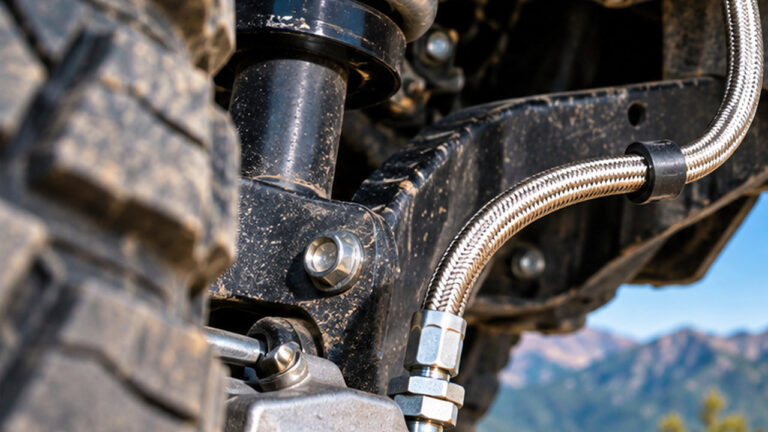
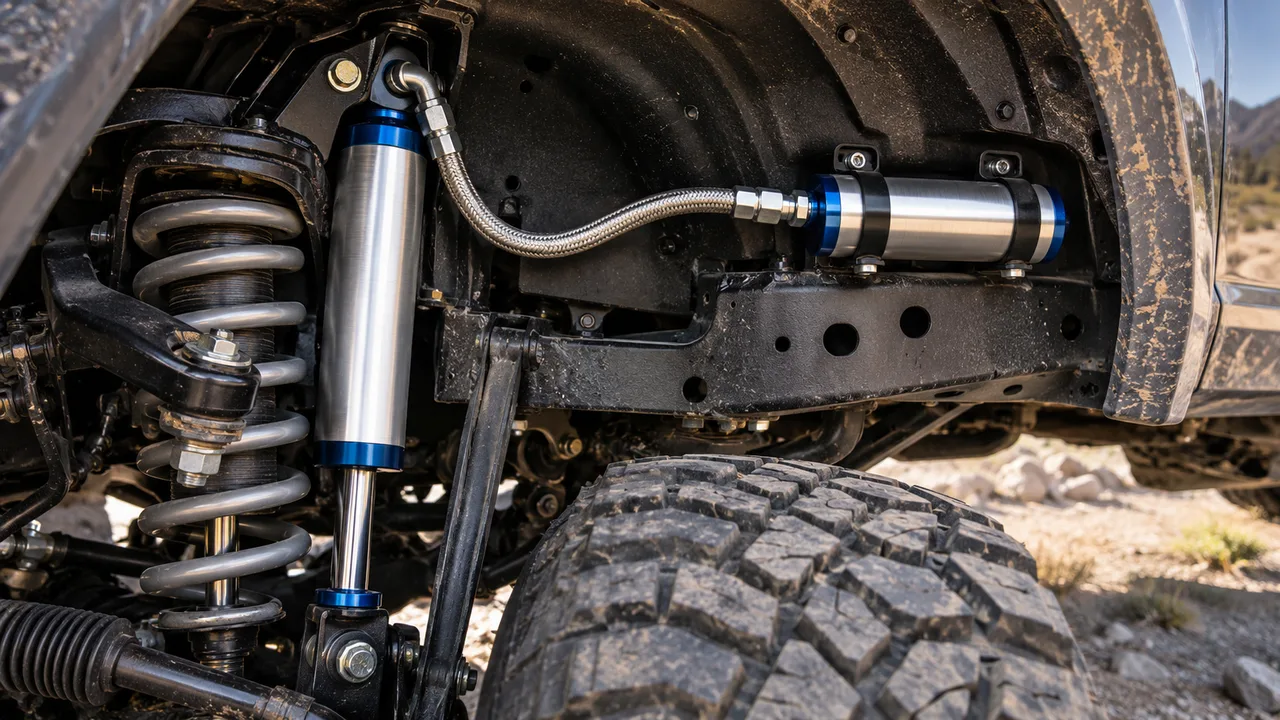
At its core, a remote-reservoir damper still controls suspension movement by forcing hydraulic oil through valves. The distinct feature is an external canister connected to the main shock body by a high-pressure line. That canister accommodates additional working volume and, in many designs, the gas chamber that would otherwise occupy space inside the main body.
The reservoir is not a second shock absorber or a tank that simply pours oil into a worn damper. It belongs to a sealed, pressurized hydraulic system engineered as one assembly.
The Main Piston Still Does the Damping
As the wheel moves upward and downward, the shock shaft and piston move through hydraulic oil. Valve passages and flexible shims meter flow and generate resistance on compression and rebound. This converts suspension energy into heat. The spring supports the vehicle; the damper controls how the spring and unsprung components move.
A reservoir does not replace that piston, nor does it make the shock position-sensitive by default. A conventional performance shock with a remote canister can have straightforward, fixed damping throughout its stroke. That distinction matters when a product listing uses racing language without explaining what the internal valves actually do.
Oil, Nitrogen and the Floating Piston
Many remote-reservoir designs place an internal floating piston (IFP) inside the external canister. It separates the hydraulic oil from pressurized nitrogen. As the shock shaft enters the main body, the shaft displaces volume and oil flows into the reservoir, moving the floating piston against the gas. During extension, the process reverses.
The gas helps maintain pressure so the oil can flow as intended without readily forming vapor cavities. The floating piston keeps gas and oil separated. Reservoir sizes, gas pressures, piston locations and hydraulic circuits vary by product, so there is no universal reservoir pressure worth copying from a forum post. Charging and opening the system are service jobs for qualified personnel.
Why Shock Fade Happens on Rough Roads
Every damper produces heat while it works; a reservoir does not change that basic physics. Sustained cycling raises oil and component temperatures. Changes in fluid behavior, internal pressure conditions and gas or vapor formation can affect damping consistency. Drivers commonly call a noticeable heat-related decline in control shock fade.
Added oil volume can slow temperature rise, and an external canister offers more surface area through which heat may escape. The benefit is greater thermal capacity and potentially improved cooling, not immunity from overheating. Very demanding use can still exceed a reservoir shock’s design and tune. Good fluid, valving and shock-body size matter alongside the external chamber.
Remote Reservoir Versus Piggyback Reservoir
In strict product language, a remote reservoir is linked by a hose and mounted away from the shock body. A piggyback reservoir is attached directly to the damper with a rigid connection or integrated bridge. Both are reservoir-type designs, but the packaging differs considerably.
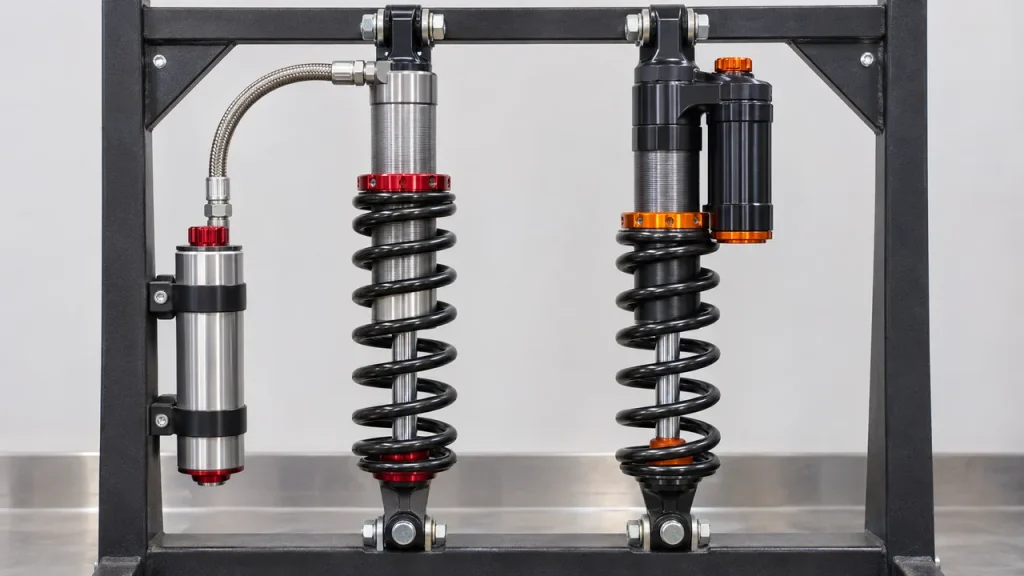
The hose-mounted version offers flexibility in where the canister goes, useful on crowded truck suspensions when an appropriate bracket location exists. A piggyback avoids routing a long external hose but requires space around the shock itself. Neither design wins on performance simply by being labeled remote or piggyback. The actual reservoir volume, valving, construction and fitment remain decisive.
Benefits That Matter—and Claims That Need Qualification
Manufacturers emphasize cooling, consistency and available performance features. Those are legitimate engineering goals, but marketing can blur what comes from the reservoir and what comes from a larger piston, different valving or an entirely different suspension package. It helps to separate the claims before making an expensive decision.
More Consistent Damping Under Sustained Load
The strongest reason to buy a reservoir shock is predictable control when the damper has been working for a while. A high-quality non-reservoir monotube can be excellent on its first mile of rough road and throughout many ordinary journeys. The reservoir earns its keep when a similar-size design approaches a heat or capacity limitation under repeated hard use.
Consistency is easier to recognize as less change during a punishing drive than as instant comfort on a test ride. If the truck feels composed at the start of a route but progressively less controlled after a long washboard section, the shock’s duty cycle deserves investigation. Worn bushings, tire issues and load setup can create confusingly similar symptoms, so diagnose before assuming thermal fade.
More Packaging Freedom for Oil and Gas
Moving the gas chamber away from the main cylinder can give designers more freedom to allocate internal space. Certain reservoir shocks offer additional stroke within a given package or combine a larger piston with greater oil capacity. That is a design opportunity, not a promise that bolting on a reservoir will increase wheel travel.
BILSTEIN, for example, describes its B8 5160 remote-reservoir series as offering added oil capacity for heat dissipation and increased travel on many applications. The wording is important: many, not every vehicle and every part number. Actual travel depends on the selected shock’s lengths, mounts and the suspension’s safe limits.
External Adjusters Can Be Useful, but Are Optional
Some reservoir shocks provide an external compression adjuster near the canister. Others have no adjustment knob at all. High-end systems may allow separate changes to low-speed and high-speed compression behavior. The adjuster is part of a specific valving architecture; the reservoir itself is not an adjustment feature.
For a truck alternating between empty commuting and loaded rough-road trips, a well-calibrated adjuster can be useful. You still need to understand what each setting controls, stay within the manufacturer’s range and avoid assuming that one click fixes an unsuitable spring or shock length. Many excellent fixed-valving shocks require no owner adjustment whatsoever.
Rebuildability and Tuning Are Model-Specific
Performance reservoir shocks are often associated with serviceable seals, replaceable oil and custom valving. For a vehicle that sees thousands of hard off-road miles, that can make long-term ownership attractive. A rebuild may restore a costly damper instead of requiring the whole unit to be discarded.
But the canister is not a guarantee of rebuildability, local service support or inexpensive parts. Confirm service arrangements, parts availability, warranty terms and expected intervals for the exact series. A premium shock that must be shipped away for every service is a different ownership proposition from one supported by a nearby specialist.
Remote Reservoir Shock Disadvantages
More hardware also means more decisions. The disadvantages are not limited to a larger invoice, and they are worth considering before deciding that the most elaborate shock in a brand’s catalog must be the best one.
Higher Price, Especially With Adjustable Valving
A reservoir body, hose, fittings, mounts and specialized assembly add manufacturing cost. Some product families also bundle larger pistons, more elaborate valving and high-end materials, so the price jump reflects several upgrades at once. The premium can be substantial even before installation or servicing.
Avoid comparing only a single shock’s advertised price. You may need two or four units, application-specific mounting kits and professional fitting. If a conventional damper already meets your needs, the extra money might improve your truck more when spent on tires, worn suspension parts or appropriate springs.
Hoses, Brackets and Canisters Need Protected Space
A canister mounted beside the frame looks tidy in a product photograph. Under a real truck, that position might also be close to an exhaust, tire, brake hose, steering component, suspension arm or flying trail debris. The high-pressure connecting line must be routed with enough allowance for suspension movement but without rubbing or snagging.
Poor routing can turn an otherwise excellent shock into a liability. A hose that rubs against a bracket at every bump may eventually wear through; a reservoir that contacts a tire at full articulation can damage more than the damper. Correct fitment is about the entire assembly, not just whether the shock eyes bolt into place.
Service Can Be More Demanding Than Replacement Shocks
Some premium dampers are designed for periodic rebuilding, which may involve seal replacement, fresh oil, gas charging and inspection of the shaft and piston. That maintenance is a benefit if you want a long-lived, tunable unit and have competent service support. It is a drawback if you expected to install a shock and forget about it for years.
Maintenance intervals vary with model and operating conditions. Racing, heavy dust, salt and repeated hard use may shorten them. Never open a pressurized reservoir or attempt a nitrogen recharge with ordinary compressed air; incorrect handling can be dangerous and can damage the shock.
A Harsh Ride Is Still Possible
A reservoir shock can be firm, soft, controlled, nervous or poorly matched. The result comes from its damping calibration, spring setup, tires and vehicle weight. A shock intended for a loaded desert truck may make an unloaded road vehicle feel busy over small imperfections, while a suitably tuned reservoir system can be remarkably composed.
A common buying mistake is treating better heat resistance as synonymous with better comfort. If ride harshness is your only complaint, first check tire pressures, spring rates, ride-height modifications and the valving of the current dampers. A reservoir is not a universal comfort upgrade.
Remote Reservoir vs. Standard Monotube, Piggyback and Coilover
A few similar-sounding terms describe different parts of shock design. Mixing them up is how buyers end up comparing products that do not perform the same job. The following distinctions are deliberately brief; choosing between twin-tube and monotube architecture is a separate question.
| Design or term | What it describes | What it does not guarantee |
|---|---|---|
| Conventional IFP monotube | Gas and oil separated by a floating piston within the main body | Poor performance just because it lacks a hose |
| Remote-reservoir shock | External canister connected through a high-pressure line | Added lift, owner-adjustable damping or softer ride |
| Piggyback-reservoir shock | Canister attached directly to the shock body | Better cooling than a well-designed remote unit |
| Coilover with reservoir | A spring-over-damper assembly that also has an external reservoir | More spring capacity or extra wheel travel by default |
| Bypass shock with reservoir | Position-sensitive hydraulic valving plus reservoir packaging | That every reservoir shock has bypass circuits |
Remote Reservoir vs. Conventional Monotube
A conventional IFP monotube already separates gas and oil and can handle demanding driving when sized and valved appropriately. The reservoir version reallocates space and may add thermal capacity, but that does not turn the former into a low-grade design. Body diameter and oil volume also differ among non-reservoir models.
For the broader engineering tradeoffs between shock architectures, see our monotube vs. twin-tube shocks guide. This article is specifically about the value of adding external reservoir capacity once the basic damping requirements are understood.
A Reservoir Is Not the Same Thing as a Coilover
A coilover places a coil spring around a shock body so the assembly supports the vehicle and damps movement. Some coilovers have remote reservoirs; others do not. Likewise, a rear shock with a remote canister can sit beside a separate leaf spring or coil spring without being a coilover.
If you are shopping for a replacement rear damper, the presence of a reservoir does not turn it into a load-bearing spring assembly. If you are shopping for a front coilover, the spring rate, spring-seat range and vehicle-specific mounting are separate selection questions from reservoir design. The two features can coexist, but neither substitutes for the other.
A Reservoir Alone Does Not Make a Bypass Shock
Bypass valving uses additional oil paths to alter damping according to piston position, sometimes with externally adjustable tubes. A reservoir can be present on a bypass damper because the system needs oil and gas capacity, but the reservoir does not produce those position-sensitive damping zones by itself.
The difference is covered in our guide to bypass shocks. If a listing says only “remote reservoir,” assume neither internal nor external bypass technology is included unless the manufacturer explicitly specifies it.
Why a Larger Non-Reservoir Shock May Be Enough
Manufacturers offer conventional performance shocks with larger bodies and more oil than basic replacement units. That can improve capacity without adding a separate hose and canister. A well-tuned 2.5-inch non-reservoir design may be the more practical option than a smaller reservoir shock for some uses, although neither diameter alone predicts the result.
This is a useful comparison when your priorities are strong damping, simple packaging and no additional reservoir mounting points. Look at the actual application, piston dimensions, valving and service needs, not just the dramatic appearance of an external canister.
Which Vehicles and Trips Actually Benefit?
The same reservoir model can be a sensible purchase on one build and a waste of money on another. Weight, wheel and tire package, road speed, terrain and suspension movement all change the duty cycle. Consider the complete vehicle rather than looking for a blanket answer by nameplate.
Jeeps and Lifted SUVs
Jeep Wrangler TJ, JK and JL builds commonly appear in reservoir-shock catalogs. A mild-lift Jeep used for commuting and relaxed trail runs may be well served by correctly sized conventional shocks. A Jeep that spends long days on washboard, repeatedly hits rough sections at speed or runs a carefully designed long-travel package presents a stronger case.
For a heavily modified solid-axle Jeep, check the suspension’s actual bump and droop travel before deciding the reservoir shock is an upgrade. Longer shock stroke is beneficial only if the axle, springs, driveshaft, steering and related hardware can move safely through the corresponding range.
Toyota Tacoma, 4Runner and Similar Overland Builds
A Tacoma or 4Runner loaded for a week of camping has different suspension demands from the same vehicle running empty through town. Weight and rough-road miles can make a larger-capacity damper worthwhile, especially on sustained corrugations. But these vehicles also have front independent suspension, packaging constraints and specific spring requirements.
The reservoir should not become the first answer to a sagging rear end or excessive nose dive. Check actual vehicle weight and spring support, then choose shocks valved for that working load. Confirm clearances around upper control arms, tires and full steering lock if the proposed reservoir is mounted near the front suspension.
Heavy-Duty Trucks That Tow
A trailer can make a poorly controlled truck feel unsettled, but towing does not automatically justify remote-reservoir shocks. The truck’s suspension, load placement, tire pressures and weight ratings still determine much of its behavior. Shocks can control oscillation; they do not raise payload, axle or towing capacity.
Reservoirs become more compelling when a loaded truck also runs long, uneven roads that work the dampers continuously. On ordinary highways, a suitable application-specific conventional or adjustable shock may be a better investment. For buyers choosing complete dampers rather than deciding on reservoir technology, our lifted-truck shock buying guide addresses the broader selection.
Desert Running and Faster Off-Road Driving
Speed changes everything. Suspension movement that is gentle at 5 mph can become a continuous, heat-producing series of impacts at higher speeds. Larger, professionally tuned reservoir shocks are common here because consistent damping and serviceability matter over a long, demanding session.
That still does not mean a universal 2.5-inch reservoir shock is automatically right for every fast-moving vehicle. The required damping forces, travel, suspension motion ratio and cooling needs must suit the finished build. A racing-style damper installed with incorrect mounts or valving can perform worse than a modest, properly matched one.
Fitment: The Questions to Settle Before Ordering
The shock’s main body has to fit the vehicle, and the reservoir must fit the space around it. These are different checks. A part can have the right eyelet size and still put its canister in the path of a tire or leave the hose rubbing the frame at full droop.
Match Compressed and Extended Length, Not Just Lift Height
Start with the exact application and manufacturer part number. For a modified suspension, verify the published compressed length, extended length, mounting style and intended ride-height range against the actual vehicle. “For 3-inch lift” is not enough if mounts, arms or travel limits have changed.
Our shock length calculator helps compare the mount-to-mount requirements at full bump and full droop with the catalog dimensions. It does not approve a shock’s valving, reservoir position or vehicle fitment, but it can rule out an obviously incorrect length before any money changes hands.
Check Front and Rear Independently
Front and rear shocks are not interchangeable simply because their bodies have the same diameter. A truck may use a front coilover with a reservoir and a conventional rear shock, or the opposite. Upper mounts, brake lines, exhaust routing, control arms and usable travel differ by location.
Even within the rear axle, a canister that clears the frame on the driver’s side may require a different bracket or routing on the passenger side. Use the manufacturer’s side-specific instructions, not a generic photograph of a reservoir strapped to a frame rail.
Reservoir Mounting Brackets and Clamps
Searches for remote shock reservoir mounting brackets, clamps and mounts reflect a real practical problem: where does the canister safely go? Many vehicle-specific kits include dedicated brackets; some universal shocks require hardware chosen for the chassis. Clamp diameter and mounting surfaces must suit the supplied reservoir without crushing or damaging it.
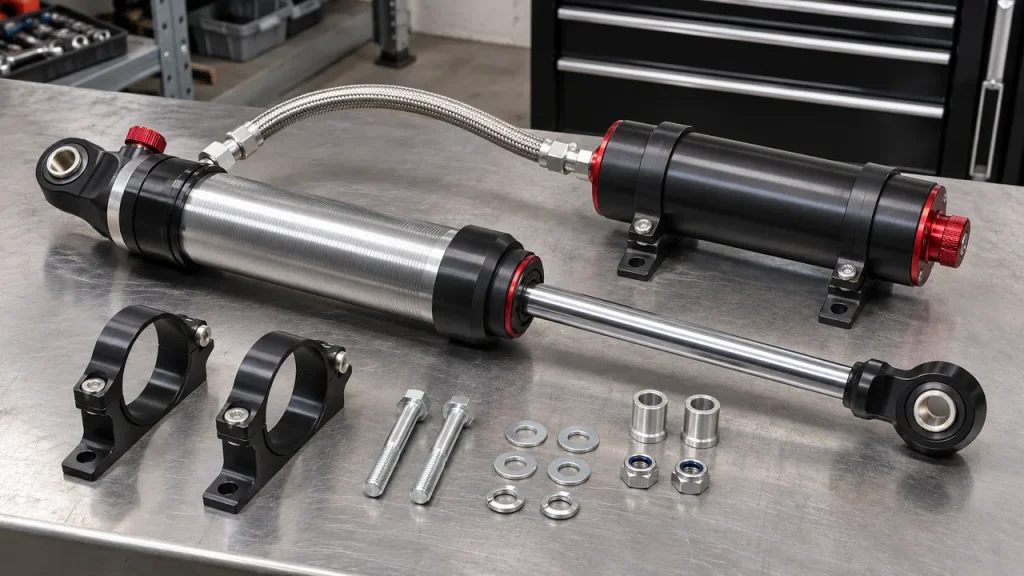
The bracket should keep the canister secure and accessible without placing it against exhaust heat, a tire, moving link or sharp edge. Follow the product’s mounting orientation and fastener instructions. Do not drill, weld or mount into safety-critical structure without an approved procedure; a qualified installer is the right choice when the vehicle has no documented bracket location.
Hose Routing Through Full Bump, Droop and Steering Lock
The hose between shock and canister is a pressurized hydraulic connection, not a flexible cable that can be tied wherever it looks convenient. It needs the bend radius, slack and protection specified by the manufacturer while the suspension moves between its limits. Allow for the tire at full lock, movement of the axle or control arm, and changes as the steering and suspension articulate together.
Avoid rubbing, tight bends, twisting and contact with the exhaust. A reservoir positioned farther from the shock is not always safer if the line has to cross moving components to reach it. Some designs have adjustable or swiveling fittings, but these are product-specific and must be handled only as instructed.
Bump Stops Still Protect the Damper
An expensive shock can still be damaged if it bottoms out internally before the suspension reaches its intended compression limit. Equally, an axle dropping farther than the shock or joints allow can damage extension hardware. A reservoir may provide an opportunity for more stroke, but the suspension must be designed to use that stroke safely.
Our explanation of bump stops and full-compression limits covers the protection side of the calculation. On custom or long-travel vehicles, full-cycle testing should also establish a safe droop limit; the damper is not automatically intended to serve as the extension stop.
A Six-Point Compatibility Check Before You Buy
A proper listing or manufacturer’s application sheet should let you answer all six questions. If one answer is missing, ask before ordering rather than hoping the part will fit once it reaches the workshop.
- Exact application: Does the part number match your year, model, suspension configuration and intended ride height?
- Mounts and stroke: Are upper and lower attachments, compressed length and extended length correct for the actual build?
- Reservoir location: Is there an approved bracket or clamp position with enough clearance around the canister?
- Hose movement: Can the specified line routing remain clear through bump, droop, articulation and steering lock?
- Damping specification: Are valving, body size and any adjusters suitable for the vehicle’s weight and use?
- Support after purchase: Are warranty terms, service options and replacement hardware documented for this exact series?
Having these details in writing is far more useful than trying to identify a shock from its paint color or reservoir shape.
Reading FOX, Bilstein, King and Other Listings
Brand names appear heavily in U.S. searches because buyers use them as shortcuts for capability. They are useful reference points, but none identifies a universal ride quality. Each manufacturer sells different body sizes, mounts, adjuster options and vehicle tunes. Compare the exact series and part number before treating a product family as one shock.
Bilstein 5160: A Clear Example of the Reservoir’s Job
The Bilstein B8 5160 is a vehicle-specific performance monotube with an external reservoir. Bilstein describes its 46 mm design, application-specific valving and increased oil capacity for heat dissipation. It also supplies reservoir mounting hardware for listed applications. This is a useful example because the reservoir is not marketed as an automatic ride-height adjustment knob.
A B8 5160 should not be selected merely because someone liked it on another truck. Confirm vehicle fitment, front or rear application, the required matching suspension and the part’s actual travel. Even within a well-known model line, catalog details determine whether the shock works on your build.
FOX 2.0 and 2.5: Look Beyond the Family Name
“FOX 2.0” can mean a conventional internal-floating-piston shock, a remote-reservoir model or a different application-specific assembly. “FOX 2.5” likewise covers more than one configuration. Some offer external compression adjustment; others do not. A larger body and a reservoir are distinct features that may appear together or separately.
Read the product specification for body size, valving, reservoir type, adjusters, service requirements and included brackets. FOX’s Performance Series and more specialized Factory offerings need to be compared by actual product, not by assuming every item with the same logo shares the same tuning or hardware.
King 2.5 and Other Serviceable Performance Shocks
King’s 2.5-inch reservoir products are often considered for off-road setups where damping capacity, service access and tuning are important. That does not make a King 2.5 interchangeable with any 2.5-inch FOX or ICON product. Body diameter is only one measurement; shaft, piston, stroke, valving, joints and installation hardware differ.
For a custom suspension, the ability to specify an appropriate tune and obtain professional service may matter more than the initial brand preference. For a direct-fit replacement, verify that the exact SKU is intended for your model and weight range rather than adapting a universal race shock based on length alone.
ICON, Budget Reservoir Shocks and Unfamiliar Brands
ICON, Rough Country and other manufacturers offer reservoir-equipped suspension products with different design priorities. Ubersuggest also shows searches for lower-priced options and brands such as TCMT. There is not enough basis to call a product good or bad simply from its name or the presence of a remote canister.
For a safety-critical part, look for documented vehicle fitment, verified dimensions, material and seal information, mounting instructions, warranty coverage and realistic service support. If a cheap listing does not identify those details, the saving is difficult to evaluate. A reputable non-reservoir shock is often a smarter purchase than an unknown reservoir design with vague specifications.
Cost, Ownership and How to Tell Whether You Need an Upgrade
Cost is best considered over the life of the shock rather than the day you order it. Reservoir-equipped systems can be priced much higher than standard replacement dampers, particularly when adjusters, large bodies or custom tuning are included. Actual prices change across vehicles and retailers, so a single “average price per shock” can mislead more than it helps.
Compare Complete Installed Cost
Get an application-specific quote for the shock or pair, any required spring or coilover parts, reservoir clamps, fitting labor, alignment where appropriate and expected service. Check whether listed prices refer to one unit, an axle pair or a complete kit. A seemingly affordable rear reservoir shock is not a fair comparison against an entire conventional four-shock package.
Ask what happens if a hose or damper leaks. Is the unit rebuildable, does the manufacturer supply parts, and who performs service locally? Those answers make a big difference if the truck is a daily vehicle and cannot be left off the road for an extended repair.
Recognize Real Shock Fade, Not Just a Bad Ride
A truck that becomes noticeably less controlled after a long stretch of rough driving, then behaves better when the dampers cool, may be showing signs consistent with heat-related fade. That pattern is more relevant than a truck that has always felt stiff at low speed or wanders on every trip. It is still not a diagnosis by itself.
Before replacing shocks, inspect leakage, damaged mounts, bushings, tires, springs and suspension alignment. If the vehicle handles poorly on the first mile, a reservoir is unlikely to be the missing ingredient. If the problem develops only during sustained high-frequency work, a correctly specified higher-capacity damper deserves consideration.
When a Good Non-Reservoir Shock Is the Better Buy
Sometimes the right upgrade is simply a quality monotube with appropriate valving, correct length and sound mounts. It avoids an extra canister and hydraulic hose while meeting the performance demands of a daily-driven truck or Jeep. The money left over can address the suspension issues that actually affect the vehicle every day.
There is no penalty for buying less hardware when less hardware does the job. The strongest reason to step up is a documented need for sustained damping capacity, not the fear of choosing a part that looks too ordinary in photographs.
Remote Reservoir Shocks FAQ
Buyers often have one very specific question that gets buried beneath broad claims about off-road performance. These answers focus on what a reservoir changes, what it does not, and where vehicle fitment takes priority.
Do remote reservoir shocks make the ride smoother?
Not automatically. They can keep damping more consistent when heat builds up, which may make a rough journey feel better controlled later in the drive. Initial ride comfort depends heavily on valving, springs, tires and vehicle load. A poorly tuned reservoir shock can ride worse than a well-matched conventional one.
Are remote reservoir shocks better for daily driving?
Usually not enough to justify the cost solely for commuting. A good conventional monotube can provide excellent control without the extra brackets and hoses. Choose a reservoir only when the specific product’s tuning also suits the vehicle and its actual use, rather than assuming a race-style design must be superior on pavement.
Do remote reservoir shocks increase wheel travel?
Some designs can make more internal stroke possible by relocating gas volume outside the main body. But the actual shock length, compressed length, mounts and suspension limits determine usable wheel travel. A reservoir is not a lift kit, and a different canister alone does not make the wheels move farther.
Can you add a remote reservoir to any shock?
No. The hydraulic circuit, gas separation, fittings and internal dimensions are designed together. A conventional sealed shock cannot safely be converted by attaching a canister or drilling an oil passage. Buy a manufacturer-approved reservoir model rather than improvising a conversion.
Do all remote reservoir shocks have adjustable damping?
No. Many are fixed-valving shocks with an external canister used for capacity and packaging. Other models provide one or more external compression controls. The manufacturer’s product sheet must state exactly which adjusters are present and how they work.
Remote reservoir shocks vs. coilovers: which is better?
They are not competing categories. A coilover includes a spring around the damper, while a remote reservoir describes where part of the damper’s fluid and gas volume is housed. A coilover can have a reservoir, and a separate shock alongside a spring can have one too. Choose the correct suspension layout first.
Are remote reservoir shocks worth it for towing?
Only in some cases. A loaded truck driven for hours on rough roads may benefit from higher thermal capacity. Ordinary highway towing may be better served by correct springs, tires, proper weight distribution and an appropriate conventional or adjustable shock. Reservoirs do not raise towing or payload ratings.
How often do remote reservoir shocks need servicing?
There is no universal mileage interval. It depends on the exact product, whether it is rebuildable, and how hard the vehicle is used. Follow the shock manufacturer’s service schedule and inspect for leaks, loose clamps, hose abrasion and damaged mounts. Do not open or recharge a pressurized unit without the required training and equipment.
Can the reservoir be mounted anywhere on the frame?
No. The position must be approved for the product and allow safe hose routing, clearance, cooling and secure attachment through all suspension and steering movement. A convenient-looking bracket beside an exhaust or rotating tire is not an acceptable mounting location. Use the correct installation instructions and hardware.
Are remote reservoir shocks useful on motorcycles?
Motorcycle applications, including Harley touring models, also use reservoir dampers, but suspension geometry and model-specific fitment are different from truck and Jeep shocks. This guide concerns automotive off-road and truck applications. Motorcycle reservoir choices should be evaluated against the motorcycle manufacturer’s and damper manufacturer’s specifications, not a truck shock catalog.
Three Checks Before Spending More on Reservoir Shocks
First, be specific about the limitation: repeated rough-road driving, temperature-related loss of control, or a genuinely demanding vehicle build. If the problem is ordinary harshness on a morning commute, investigate tires, springs and current damping before paying for another canister.
Second, compare two correctly specified products for the same vehicle and duty cycle. Ask what you gain beyond the reservoir: body size, piston, valving, adjustability, travel and service support. A well-designed non-reservoir damper may solve the problem without additional routing or maintenance.
Finally, confirm that the complete installation works. Match mount dimensions and suspension limits, locate the canister safely, and make sure the hose cannot rub or bind through travel. A reservoir shock earns its price when it delivers controlled, repeatable damping on the roads you actually drive—not when it merely looks more sophisticated beneath the truck.