Coil Spring Retainers: Types, Fitment & When You Need Them
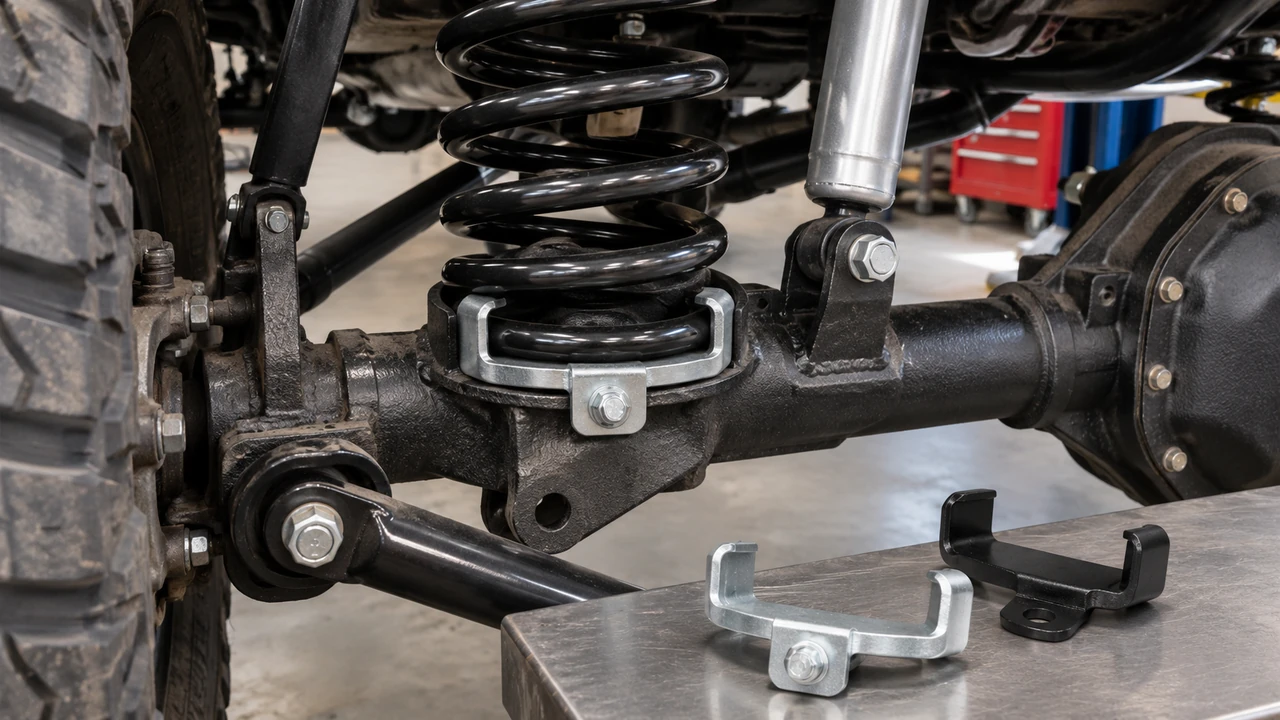
Coil spring retainers are clips, brackets, or bolted plates that keep a suspension coil from leaving its intended spring seat when an axle drops or the suspension articulates. If you are shopping for a Jeep, the important question is not just whether the kit says “spring retainer.” It is which spring, which end of that spring, and which vehicle-specific mounting point the hardware is designed to secure.
You may need them after fitting longer shocks, replacing missing factory spring clips, or increasing off-road droop. You may not need an extra kit if the original spring remains properly located through the suspension’s approved travel. Start by identifying the spring seat that can lose contact; then match the correct front-lower, rear-upper, rear-lower, or complete retention kit. A retainer is not permission to run more droop than the rest of the suspension can safely handle.
Which Coil Spring Retainer Do You Need?
The product names in Jeep catalogs sound similar, but they attach to different locations. This quick comparison is a better starting point than buying the first inexpensive clip that looks close to your factory hardware.
| What the listing says | What it typically secures | What to check first |
|---|---|---|
| Front lower retainer clip | The front coil at its axle-side spring seat | Factory clip style, axle bracket, hole condition, exact vehicle and year |
| Rear lower spring retainer | The rear coil against its lower axle perch | Spring diameter and seat, bolt access, available mounting hole |
| Rear upper retainer | The top of a rear coil at the chassis-side seat | Upper cup, rubber isolator, bump-stop tower, kit-specific hardware |
| Upper-and-lower kit | Both ends of a specified coil spring | Whether the kit is for the front or rear axle and the complete suspension setup |
For example, TeraFlex lists separate JK Wrangler kits for front lower (4951300), rear upper (4951400), and rear lower (4954300) positions. JKS1600 is a JK rear-lower design, while RockJock CE-9807RRK retains both ends of the rear coils. They are not interchangeable just because they all appear under “coil spring retainers.”
When Are Coil Spring Retainers Actually Necessary?
A spring is normally held between its upper and lower seats by the suspension’s geometry and load. The situation changes as a wheel hangs farther down: the distance between those seats increases, and the spring may no longer be compressed enough to stay located. That is where retention becomes a real fitment and safety question.
Longer Shocks and Maximum Droop
A longer-extended shock can let an axle hang lower than it did with the stock dampers. At that position, the coil may become loose, tip off its locating perch, or drop away from one end. A lift height by itself does not tell you whether that will happen; two Jeeps with the same advertised lift can have very different shock extension and spring lengths.
The correct check is at the suspension’s approved full-droop limit, with the coil, shocks, mounts, brake hoses, and sway-bar arrangement the vehicle will actually use. Never let a brake hose, ABS wire, joint, or spring retainer become the component that stops uncontrolled axle extension. For the separate job of establishing a safe extension limit, see our suspension limit straps guide.
Off-Road Articulation and Missing Factory Clips
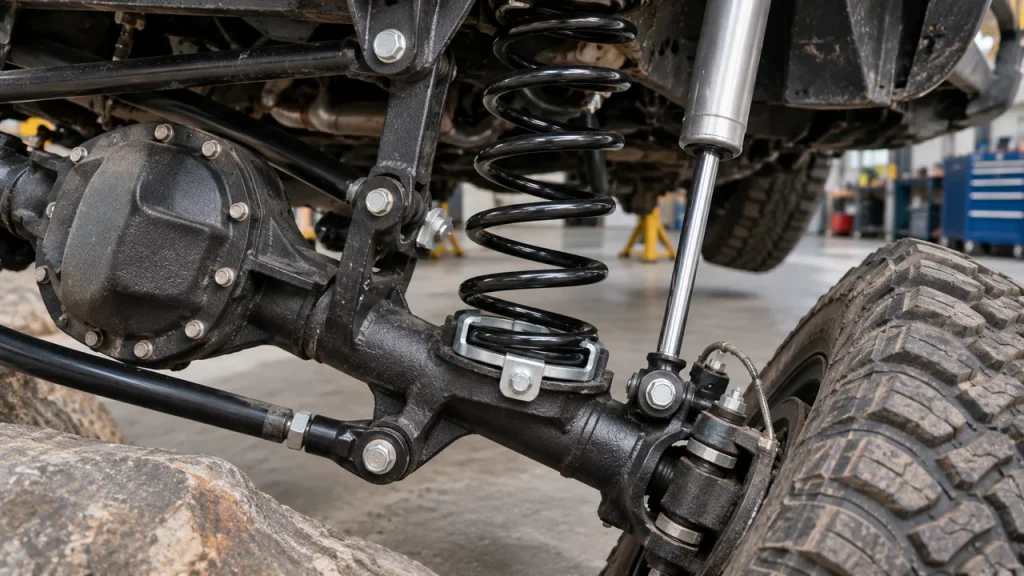
A coil that remains seated on the road may behave differently when one wheel drops into a rut while the other side compresses. If a Jeep had an OE retainer clip that has rusted away, been left off during a spring replacement, or no longer fits after a modification, restoring the intended spring retention should be part of the repair plan.
Not every factory configuration used the same clips. Some applications rely on the spring’s compression and the shape of the seats; others have specific clips at the axle. Inspect the original parts diagram rather than assuming every Jeep should have four identical retaining brackets.
When Adding a Retainer Is Not the Answer
If the spring is already captured through the designed travel and its mounts are sound, extra retention may offer no benefit. More importantly, a metal plate cannot compensate for a shock that overextends, a mismatched spring, an incorrectly seated isolator, or a droop limit that puts the driveshaft, brake lines, or control-arm joints at risk.
Some engineered off-road systems deliberately allow a coil to separate slightly from one seat while a guide keeps it aligned for compression. That is different from an uncontrolled loose spring. Follow the suspension manufacturer’s design; do not add a rigid clamp to a system that was designed to guide and reseat the coil without one.
Spring Retainer Clips, Plates, and Upper/Lower Kits
There is no single universal hardware shape. A small clip may be correct on an older front axle; another vehicle may use a broad retaining washer, a curved clamp, or a kit that anchors both ends. Each design needs a compatible perch and load path.
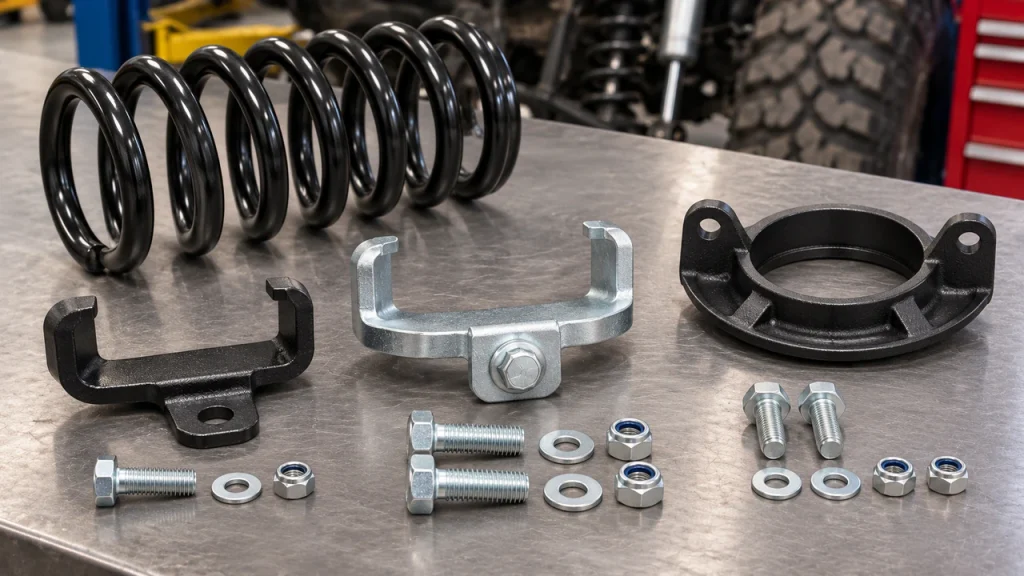
OEM-Style Front Spring Retainer Clips
An OE-style coil spring retainer clip catches part of the lower coil at the axle seat. Clayton Off Road’s COR-1100108 is a concrete example: its stainless-steel front-lower clips target specified Jeep TJ/LJ, Cherokee XJ, and Grand Cherokee ZJ applications, with axle-specific fitment notes. The mounting hole matters as much as the vehicle badge.
A rusted, stripped, or enlarged hole can make an otherwise correct replacement clip insecure. If the original fastener cannot hold, the answer is the repair specified for that mount, not an improvised longer screw or a clip wedged under the coil.
Bolt-On Retainer Plates and Rear Spring Clamps
Other kits use a plate or washer that overlaps the spring end, then fastens through the spring perch. JKS1600, for instance, uses a bolted rear-lower retainer on the Jeep Wrangler JK axle seat. A similar-looking disc sold for a different Jeep may have the wrong diameter, fastener, or contact surface.
Do not confuse a retaining plate with a lift spacer. The retainer is meant to control spring location; it is not supposed to add a measured amount of ride height. Our separate rear coil spring spacers guide covers the products designed to raise the spring-seat position.
Rear Upper Retainers and Complete Front/Rear Sets
Upper retainers work at the frame-side coil cup, sometimes around the bump-stop tower or isolator. Kits that include both upper and lower retention can secure the spring at two points, but only if the hardware fits the original mounts and any modified spring seats. For the JK, RockJock’s CE-9807RRK is an example of a rear upper-and-lower system rather than a single-clip replacement. The exact hardware is shown on the official RockJock CE-9807RRK product page.
Read the component list carefully. A pair of upper brackets does not necessarily include the lower retainers, and “front and rear” can refer to a combined package with different hardware for each axle. There is no safe universal orientation for an unfamiliar bracket.
Jeep Fitment: TJ, LJ, XJ, ZJ, WJ, JK, JL, and JT
The highest-value fitment information is the kit’s own axle position and model generation. Catalogs may surface the same keyword for quite different Jeeps, and an XJ front clip should not be assumed to fit a WJ or a Wrangler JL.
TJ/LJ, Cherokee XJ, and Grand Cherokee ZJ
For earlier solid-axle Jeeps, the familiar small spring retainer clip is often an axle-side part. Clayton’s COR-1100108 front-lower kit is listed for selected TJ/LJ/XJ/ZJ front axles; its fitment notes specify factory-style locations. On the TJ/LJ rear, Clayton offers a different product, COR-1200508, with retaining plates and its own mounting requirements. The front clip is not a substitute for that rear kit.
Check the axle housing as well as the body code. A modified axle, replacement spring bucket, or damaged factory hole can change what hardware fits even when the vehicle itself is within the advertised model years.
Jeep Wrangler JK: Most Retainer Positions Are Sold Separately
The 2007–2018 Wrangler JK is strongly represented in spring-retainer catalogs. TeraFlex 4951300 targets the front lower seat; 4951400 targets the rear upper; 4954300 targets the rear lower. JKS1600 is a rear-lower alternative. RockJock CE-9807RRK includes hardware for the rear upper and lower seats.
These part numbers are examples to make the search understandable, not an instruction to combine products from different manufacturers. Also distinguish a 2018 JK from a 2018 JL: both names appear in that model year, but their suspension parts are not automatically interchangeable.
Jeep JL, Gladiator JT, and Grand Cherokee WJ
Do not extend a JK fitment claim to a newer Wrangler JL or Gladiator JT. The JT has application-specific rear retention options: TeraFlex 4954000, for example, is a rear upper-and-lower retainer kit listed for the Gladiator. Check the current manufacturer fitment, model year, and any suspension changes before buying.
For a 1999–2004 Grand Cherokee WJ, searches such as “WJ front upper coil spring retainers” can mix actual retaining hardware with spring-seat cushions and isolators. Those parts do not do the same job. Verify an actual WJ-specific spring-retention product or factory part number before treating a generic clip as a match. If the part you are replacing is a rubber pad that cushions the spring, our coil spring insulator guide covers that different component.
How to Choose a Retainer Kit That Will Actually Fit
Start with the suspension on the vehicle, not just its year in a parts-store dropdown. A previous lift owner may have replaced the springs, shocks, isolators, spring buckets, or axle itself. A perfectly good factory-fit clip can be the wrong piece for that combination.
Before checkout, compare the following details with the manufacturer’s drawing or installation sheet. This is especially important when a listing says “universal,” “all lift heights,” or “works with stock and lifted coils.”
- Exact vehicle and axle: model generation, front or rear, spring-seat design, and whether the axle or brackets have been changed.
- Retention point: front lower, rear upper, rear lower, or a matched upper-and-lower kit; verify how many pieces are supplied.
- Coil and seat fit: spring outside diameter, lower tail shape, isolator location, and available clearance inside the cup.
- Mounting hardware: existing hole size and condition, included bolts/nuts, backing plates, and whether the job requires drilling or tapping.
- Other modifications: longer shocks, lift spacers, bump-stop extensions, aftermarket spring buckets, or relocated suspension links.
- Documentation: a usable instruction sheet with application-specific torque values, orientation, and post-installation inspection points.
Do not transfer torque specifications between brands. A bolt supplied with one retainer kit may differ in thread, grade, length, or how it fastens to the spring seat. If the instructions are missing, obtain them before installing the kit.
What the Product Photos Often Leave Out
A catalog photo can make two kits look identical because both are small steel brackets. What you cannot see in that image is the original spring bucket’s shape, whether the bolt lands in a threaded insert, or whether the hardware clears the coil as it compresses. The drawing and the specified vehicle position are usually more useful than the product photograph.
Also check whether the kit is sold as one side, a pair, or a set for two ends of the suspension. “Two retainers included” might be correct for one axle, but it does not mean both upper and lower spring seats are covered.
Coil Spring Retainers vs. Spacers, Isolators, and Limit Straps
Several unrelated products sit near the same spring, which is why search results can be confusing. They solve different problems, and buying one does not replace checking the others.
| Part | Primary job | What it does not do |
|---|---|---|
| Coil spring retainer | Holds or guides a coil at its designated seat | Does not create lift or establish a safe droop limit |
| Coil spring spacer | Changes spring-seat height to raise the vehicle | Does not automatically retain a loose spring |
| Spring insulator/pad | Cushions and locates the coil at the seat | Is not necessarily a lifting or retaining device |
| Limit strap | Restricts maximum suspension extension | Does not clamp a spring to its seat |
| Bump stop | Controls the end of compression travel | Does not hold a spring during droop |
These components sometimes need to work together. A spring spacer can alter the available installed spring length, while longer shocks can increase droop and make retention more important. At the other end of travel, bump-stop clearance still matters. Our bump stops explainer deals with that compression-side protection.
Why a Retainer Cannot Fix an Overextended Suspension
Imagine the axle hanging on long shocks while the spring is secured only at its lower seat. The retainer may keep the coil from falling onto the trail, but the top of the spring can still drop away from the upper cup. That separation may be acceptable only when the complete system is engineered to guide the spring back into place.
More droop can also change brake-hose and ABS-wire clearance, driveshaft angles, and the operating range of the control arms. Retention prevents one specific spring-location problem; it cannot authorize travel that exceeds the rest of the vehicle’s limits. The wider relationship between geometry and articulation is explained in our long travel suspension guide.
Installation and Inspection: What Matters Before the First Trail Ride
A small retainer bracket is not always a small job. Some kits bolt to existing holes; others need drilling, tapping, or access around the spring bucket. The suspension must be supported safely and the stored energy in the coil managed according to the vehicle service manual. Never undo spring-seat or retaining hardware while a coil is loaded in an uncontrolled way.
As an example of why the exact manual matters, the manufacturer’s instructions for JKS1600 describe a specific hole in the JK rear lower spring mount and its own hardware arrangement. Clayton’s TJ/LJ rear kit has different mounting requirements. Neither set of instructions should be generalized to another Jeep or copied from an unrelated tutorial.
A qualified installer should check the spring at normal ride height, maximum approved droop, and full compression; make sure the ends remain correctly located or guided as designed; and verify that the retainer and its bolts cannot contact or damage the coil. The fasteners must be tightened exactly as the kit maker specifies, and the brake hoses, wires, shocks, bump stops, and sway-bar links need clearance throughout the travel range.
Signs a Spring Retainer or Spring Seat Needs Attention
A coil that has rotated out of its pocket, a bent clamp, a missing spring clip, fretting around a bolt hole, or fresh witness marks where a spring end has moved are reasons to inspect. A metallic clunk after a wheel drops may be another clue, but noises alone cannot identify the retainer as the cause.
If the spring is visibly displaced or no longer seated, do not assume it will straighten itself on the next bump. Stop using the vehicle until the spring and related suspension parts have been inspected and secured. After fitting retention hardware, recheck the mounts and hardware at the intervals specified by the manufacturer, particularly after off-road use.
Coil Spring Retainer FAQs
These are the decisions that still cause confusion after you have narrowed the search to a particular Jeep and axle.
Do I need coil spring retainers with a lift kit?
Not automatically. They are needed when the spring could leave its intended seat at the allowed droop limit, when the kit explicitly requires them, or when an OE retainer is missing. A suspension lift alone does not establish whether the spring is adequately captured.
Are coil spring retainer clips universal?
No. Clip shape, mounting holes, spring-seat dimensions, and front/rear location vary. An inexpensive factory-style clip can be correct for one Jeep axle and completely wrong for another, even if the spring diameter looks similar.
Can a rear coil spring retainer work on the front?
Only if the manufacturer explicitly lists that exact part for the front position. A rear upper bracket and a front lower clip are different mounting solutions; do not swap them based on appearance.
Will coil spring retainers stop a spring from falling out at full droop?
A properly selected system is designed to keep the spring captured or guided as specified. Whether a lower-only retainer is sufficient depends on the upper seat, spring length, and permitted extension. Some systems need both ends retained; others use an approved guide and reseating arrangement.
Do spring retainers add lift or change spring rate?
No. Their primary job is spring location. They do not increase coil spring rate or vehicle weight ratings, and they are not a substitute for a spring spacer or a correctly selected replacement spring.
What if my factory spring retainer bolt hole is stripped?
Do not rely on a loose fastener to hold the coil. Consult the vehicle or retainer manufacturer for an approved mount repair or alternative retaining arrangement. The correct remedy depends on the perch material, hole condition, and kit design.
Should I buy upper and lower retainers together?
Choose a complete kit when the manufacturer calls for retention at both ends of that spring, or when the finished suspension would otherwise leave an end uncontrolled. Buying both by default is not a substitute for checking how your particular springs and seats work through the full travel range.