Leaf Spring Bushings: Symptoms, Types & Replacement
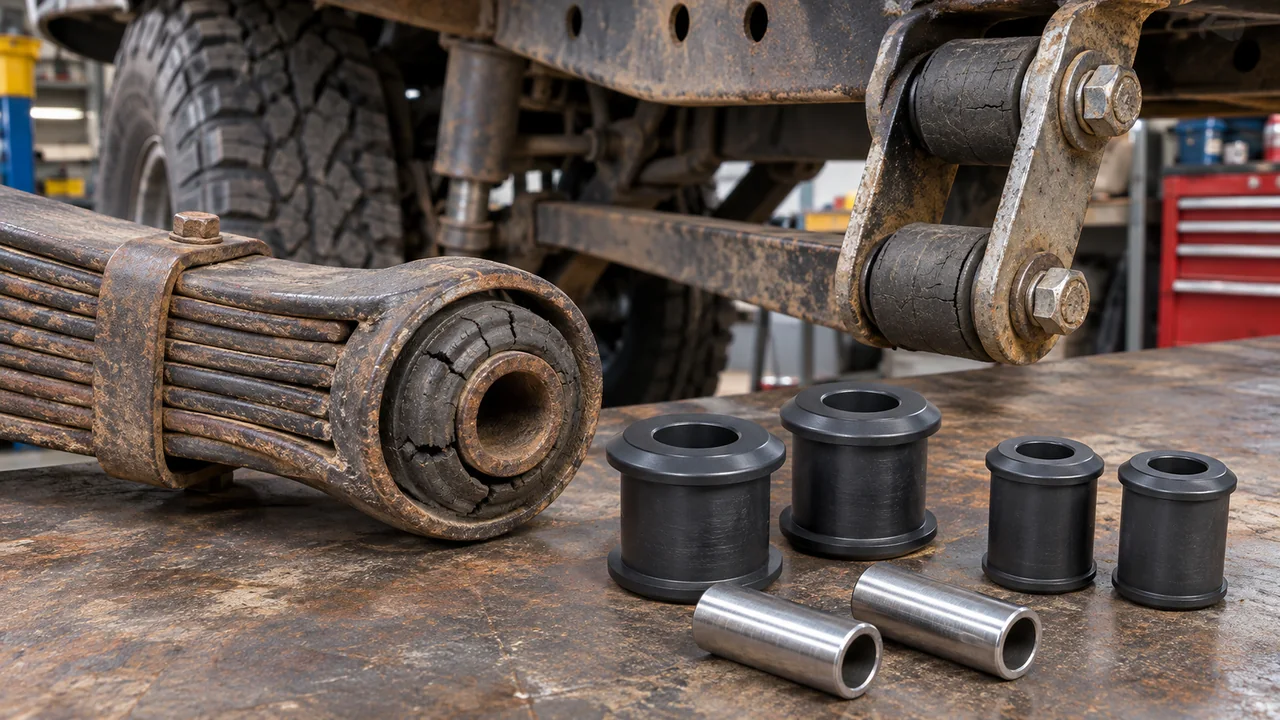
Leaf spring bushings are the cushions or bearing surfaces inside the spring eyes and, on some suspensions, the shackle or frame-side pivots. They let the spring change angle as it flexes while keeping the axle properly located. When the rubber tears, a sleeve shifts or a pin wears loose, the truck may clunk over bumps, squeak at low speed or feel as though the rear axle is moving sideways. The important clue is visible play or deterioration at a mounting point, not noise by itself.
You can often replace leaf spring bushings without buying new leaf springs. That works when the spring eye, shackle, hanger and mounting pins are still sound and the bushing is separately serviceable. A broken main leaf, an oval spring eye or a rusted-through hanger is a different repair. Identify the exact position and bushing design before ordering: the front fixed eye and rear shackle end of the same spring may not use matching parts.
Which Leaf Spring Bushing Do You Need? Start at the Mounting Point
Stand beside a typical leaf-sprung pickup and look at how the spring attaches to the frame. One end is usually a fixed pivot; the other commonly uses a shackle, a short hinged link that accommodates the spring’s change in effective length as it flattens and arches. The bushings are not interchangeable just because both mounts have bolts through them.
Use this location guide before searching by diameter. It describes common layouts, not a guarantee that every pickup, SUV or commercial truck has the same hardware.
| Location on the vehicle | What it does | Check before ordering |
|---|---|---|
| Fixed spring eye, often the front eye of a rear leaf spring | Allows angular movement while locating the spring at a fixed frame point | Spring-eye bore, bushing construction, bolt or pin diameter and installed width |
| Rear spring eye at the shackle | Lets the spring pivot as the shackle changes angle | Exact eye size, sleeve length, shackle width and whether it uses a different material |
| Upper shackle-to-frame pivot | Allows the shackle to swing relative to the frame | Whether the bushing sits in the shackle, frame hanger or a separate bracket |
| Specialized pins, threaded joints or bar-style hardware | Provides a vehicle-specific pivot or bearing surface | Manufacturer’s part number, lubrication method and service procedure |
The Fixed Spring Eye Carries More Than a Bolt
On many rear-leaf trucks, the forward eye is captured by a rigid frame hanger. It does not need to slide fore and aft, but it must rotate slightly as the spring bends. A rubber bushing accommodates that movement through controlled deformation. A pressed-in metal-shelled design may look almost solid from the outside, even though rubber separates its inner and outer sleeves.
If the center sleeve is visibly off-center, the surrounding rubber has broken away or the eye has begun striking the hanger, simply tightening the pivot bolt will not restore the original geometry. Check the metal eye itself before buying a new insert.
The Shackle End Must Move Through Suspension Travel
A leaf spring changes its shape under load. The shackle lets the end of the spring swing instead of forcing it to remain at one fixed distance from the other mounting point. Bushings can be fitted at the spring-to-shackle joint and at the shackle-to-frame joint, depending on the assembly.
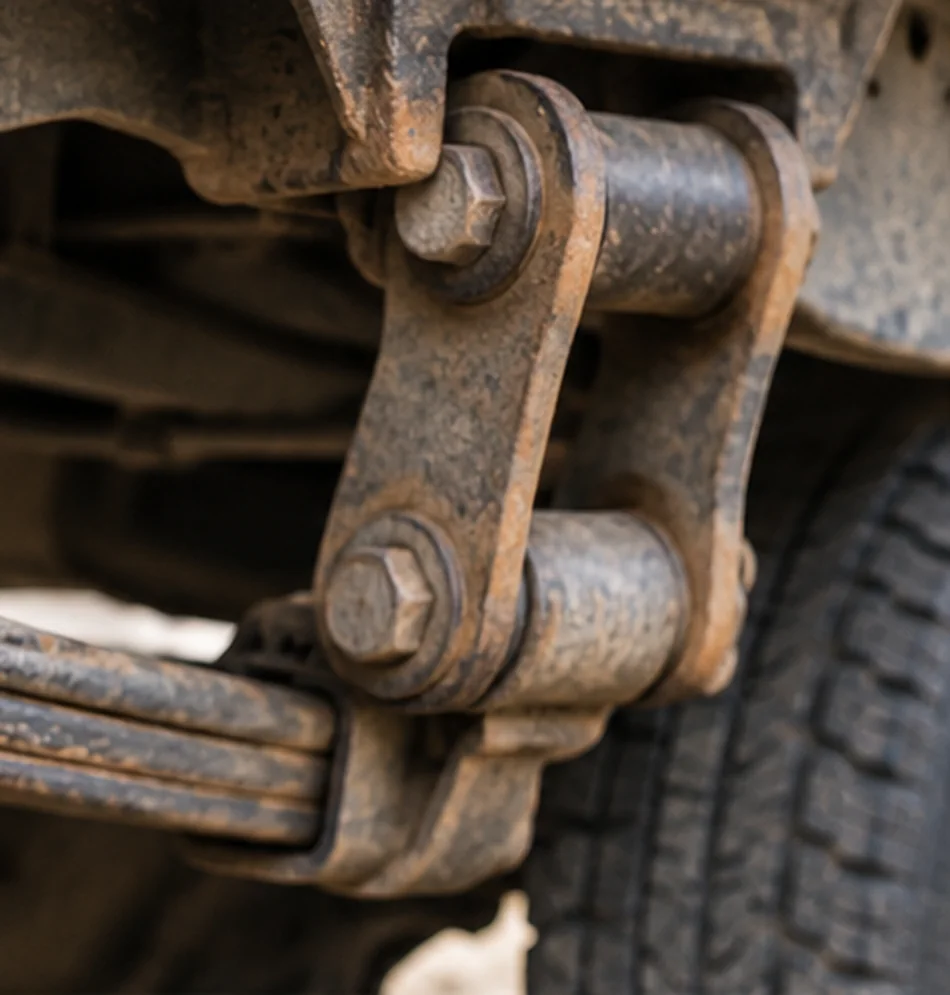
This distinction matters at the parts counter. A listing for a rear leaf spring bushing may mean the rear spring eye, not the upper shackle pivot. And a shackle bushing kit may supply enough inserts for two pivot points but no replacement shackle plates or bolts. Read the position diagram and package contents.
The Shackle, Hanger and Bushing Are Three Different Parts
The bushing provides the pivot interface. The shackle is the link or set of plates around that pivot. The hanger is the bracket secured to the frame. Corrosion or elongated bolt holes in either metal part cannot be corrected with fresh rubber. Conversely, a solid, straight shackle does not need replacing merely because its bushing is worn.
If you are still learning how the spring itself differs from a coil-spring suspension, our leaf spring vs. coil spring comparison covers the wider layout. This guide stays with the small parts that locate the spring eyes.
Symptoms of Bad Leaf Spring Bushings: Look for Movement, Not Just Noise
A tired bushing can make an old truck sound like someone is tapping a wrench against the frame. It can also stay relatively quiet while the spring eye starts moving where it should not. The diagnosis is stronger when a symptom and a physical defect occur at the same pivot.
A Rear Clunk When Braking, Accelerating or Hitting a Bump
A loose spring eye may shift when the axle loads change. That can produce a single knock as the truck starts moving, a dull thud when the rear wheels cross a sharp bump or a second knock when the body settles. A severely worn bushing can allow the mounting sleeve to contact the hanger directly.
Those are clues, not a sound signature unique to leaf springs. Loose U-bolts, a damaged spring center bolt, a shock mount, an exhaust hanger or even an unsecured spare tire can create similar noises. For a broader comparison, use our suspension clunks and rattles guide rather than replacing every rubber part near the sound.
Squeaking at Low Speed or Over Uneven Ground
Rubber separating from its sleeve, a dry serviceable pivot or metal rubbing against a bracket can squeak as the shackle swings. You may hear it backing out of a steep driveway or crossing an uneven parking lot. A squeak that follows spring movement is a reason to inspect the eyes and shackle, not proof that either has failed.
Also inspect interleaf contact, spring-tip liners and shackle hardware. Grease on the outside of a permanently bonded rubber bushing usually does not restore it; using the wrong lubricant may only hide the noise temporarily.
A Loose Rear End, Dog-Tracking or a Spring Eye Sitting Sideways
Leaf springs help locate a solid axle as well as support weight. If a mounting eye can shift excessively, the rear axle may no longer follow the intended line. Drivers sometimes describe the truck as steering slightly from the rear or needing small corrections on a straight road. In heavy-duty service, sideways tracking is sometimes called dog-tracking.
This is more serious than an isolated squeak, but wandering has many possible causes, including tires, steering joints and axle damage. On a front leaf-sprung vehicle, a worn pivot can influence steering behavior more directly. Do not use tire wear or a crooked steering wheel alone to identify the bushing.
Cracked Rubber, Sleeve Separation and Bushing Walkout
The most convincing evidence is often visible: rubber torn away from a sleeve, a bushing displaced sideways out of its eye, a bolt no longer centered or polished scrape marks where the spring has been hitting the hanger. Bushing walkout describes a bushing that has migrated laterally from its intended position. On some designs this can bring the spring eye into abrasive contact with a shackle or hanger.
A few tiny surface cracks are not the same as missing rubber or uncontrolled movement. Examine how the original part is meant to sit; some bushings have molded voids or flanges that can look unusual if you have only seen a generic catalog picture.
The table below helps separate inspection priorities. It is not a way to diagnose a moving vehicle without checking the hardware.
| What you notice | Inspect first at the spring mount | Other problems to exclude |
|---|---|---|
| Short clunk as rear wheels cross a bump | Spring-eye sleeve, shackle pivots, loose pins and contact marks | Shock mounts, U-bolts, exhaust or loose cargo |
| Squeak when body rises or settles | Split rubber, binding pivot, spring-tip liners | Interleaf friction, worn shackles, other dry mounts |
| Rear axle feels as though it steers | Lateral play, bushing walkout, bent shackle or hanger | Tire condition, axle location, alignment and steering faults |
| Bushing visibly off-center | Sleeve separation, deformation, incorrect installation | Damaged spring eye or bracket hole |
| One rear corner sits low | Inspect mount and spring for damage | Sagging or broken leaves, incorrect load or spring specification |
Can You Replace Leaf Spring Bushings Without Replacing the Springs?
Often, yes. A spring with normal arch, intact leaves and round eyes does not automatically need replacement because a rubber insert has worn out. But the bushing is only one part of the load path from spring to frame, so its surrounding metal needs an equally careful look.
When Bushing-Only Replacement Is the Right Job
A separate bushing is a sensible repair when the manufacturer permits removal, the correct replacement is available and the spring eye has not been worn or distorted. The shop should also verify that the bolts or pins are not necked down, the shackle is straight and the hanger is structurally sound.
This can be a focused repair on a truck with good springs and a single badly deteriorated eye bushing. On a vehicle already being dismantled for another confirmed fault, renewing other worn, accessible bushings may save labor. That is an opportunity, not a rule to replace every intact insert.
When New Rubber Will Not Save a Damaged Spring Eye
If the main leaf is cracked near the eye, the steel eye is spreading open, or the bore is worn oval from a loose pin, an insert cannot make the metal safe again. Likewise, a hanger rusted thin or a shackle with elongated holes needs a structural repair, not a thicker polyurethane bushing to take up the gap.
When the spring pack itself must be replaced, pricing belongs to the leaf spring replacement cost guide. The focus here is what you can replace without buying that assembly.
Why Serviceability Varies by Spring and Vehicle
Some bushings are simple removable inserts. Others have an outer steel shell press-fitted tightly into the spring eye; still others are bonded or installed as a non-serviceable part of the spring assembly. Heavy-duty and older systems may use greasable pins, bronze bearings or threaded bushings instead of the familiar passenger-vehicle rubber design.
A parts catalog showing a replacement bushing is helpful, but it does not replace the service manual’s instructions for that spring. Check whether the component is listed as separately replaceable and whether the spring must come off the vehicle for proper tooling access.
How to Inspect Spring Eyes and Shackles Safely
You can identify many visible problems while the vehicle remains parked. Measuring actual looseness, however, may require unloading and supporting parts in a specific way. A leaf spring helps position the axle; it is not harmless hardware to disconnect while the vehicle rests on it.
What You Can See With the Truck Parked
On level ground, use a flashlight to look at both ends of each visible spring. Compare the left and right shackles, check whether one bushing is protruding farther from the spring eye, and look for torn rubber, fresh metal scuffing, cracked leaves and severe corrosion. Photograph any area that appears displaced so a technician can see exactly what you noticed.
Do not put your hands between a spring, shackle and bracket while someone rocks the truck. Do not crawl under a vehicle supported only by a jack, and never loosen a leaf-spring pivot merely to see whether it moves.
What a Shop Needs to Confirm Under the Correct Load
The technician checks how the spring eye, bushing center sleeve and frame bracket move relative to each other. Normal rubber deflection is not the same as a bolt sliding through an elongated hole. Depending on the vehicle, the inspection may be performed with the axle supported at a specified height or with the suspension loaded; acceptable movement is design-specific.
The shop should look for lateral migration, distorted confinement washers, worn pins and a shackle swinging outside its intended range. Manufacturers of heavy-duty suspensions explicitly identify frayed rubber, excessive movement and bushing walkout as conditions that warrant service. Do not apply an arbitrary millimeter limit from a different truck.
Rust, Seized Bolts and a Hidden Broken Main Leaf
The mounting bolt may rust into the inner sleeve even when its head and nut look serviceable. That can turn a small bushing job into a cutting and hardware-replacement job. It also makes inspection of the hanger and spring-eye steel especially important.
Check the main leaf near the rolled eye. On certain multi-leaf designs, a secondary leaf can partially retain a broken main leaf, disguising the fault at a glance. If an eye or mounting bracket is cracked or separating, the vehicle needs a proper suspension repair before it is driven normally.
Rubber, Polyurethane and Other Leaf Spring Bushing Types
The best material is the one specified for the suspension’s intended movement and use. A quiet unloaded pickup, a classic muscle car and a heavy commercial truck do not necessarily want the same pivot behavior.
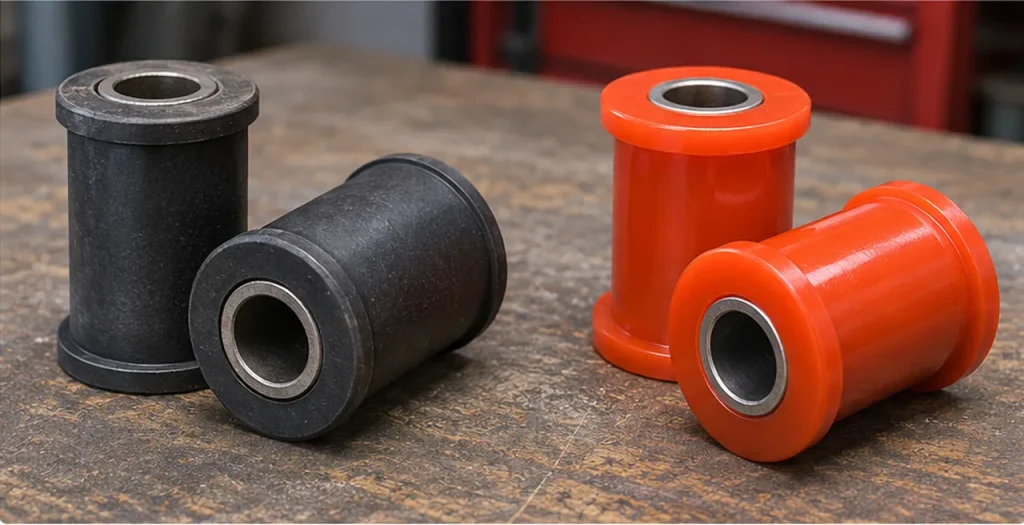
Steel-Encased RB Bushings vs. All-Rubber HB Bushings
EATON Detroit Spring describes two traditional constructions: RB for a steel-encased rubber bushing with inner and outer metal shells, and HB for an all-rubber type. In its applications, RB bushings are commonly used at the front spring eye, while HB styles may appear at the rear eye. These are useful catalog terms, not universal codes every manufacturer uses.
The metal shell changes how a bushing is installed and retained. It may require a controlled press fit in the spring eye. A rubber-only insert can use a different interference fit or separate sleeve. Do not substitute one construction for another simply because their outside diameters seem close.
Two-Piece Polyurethane Bushings and Their Trade-Offs
Many aftermarket polyurethane kits use two flanged halves and a separate inner sleeve. They can be easier to assemble on certain applications and may appeal to owners who want firmer axle location, but material stiffness varies substantially. The trade-off can be greater road vibration or squeaking if the kit is wrong for the mount or assembled without the specified lubricant.
Polyurethane is not automatically a longer-lived or quieter upgrade over original rubber. Some performance-oriented kits permit rotation around a lubricated sleeve rather than relying on bonded rubber twist. Other designs do not. Use the maker’s instructions for that exact kit and check that it is approved for the vehicle’s spring-eye geometry.
Bronze, Threaded and Greasable Designs
Older light trucks and many heavy-duty suspensions may use bronze or threaded bushings with dedicated pins and lubrication provisions. A grease fitting belongs to a system designed to be serviced, not to an ordinary sealed rubber bushing. Worn pins can be as important as the bearing surface itself.
If a parts listing uses spring pin bushing, threaded spring eye bushing, silent block or anti-walk bushing, verify the specific construction. These terms point to real product families, but a similar-looking part from a trailer or commercial-vehicle catalog may be completely unsuitable for a pickup.
Leaf Spring Bushing Sizes: Four Measurements That Prevent Wrong Orders
A vehicle lookup is useful for factory springs. It becomes less reliable after an axle swap, a lift, an aftermarket spring pack or decades of previous repairs. When the installed hardware is uncertain, match the actual spring and pivot—not only the year and model printed on the truck’s registration.
Outer Diameter, Inner Diameter and Installed Width
The outer diameter (OD) must match the spring-eye bore or mating housing as the manufacturer specifies. The inner diameter (ID) generally relates to the pin or bolt passing through the sleeve. You also need the bushing’s working width and, when fitted, the inner sleeve length, which may establish how tightly the bracket can clamp the assembly.
For a shell-type bushing, record whether the measurement is across the outside metal shell or the rubber. For a flanged or two-piece design, the flange dimensions and how far the sleeve protrudes matter. Don’t order a “3/4-inch leaf spring bushing” without knowing which dimension the seller means.
Before purchasing by size, ask the seller or spring manufacturer to confirm the following measurements against the part number. The parts can differ at the two ends of one spring.
- Spring-eye bore: the diameter of the opening intended to receive the bushing or outer shell.
- Pin or bolt diameter: the fastener that fits the inner sleeve, not the outside of the shackle washer.
- Bushing body width: the section that fits through the eye, including any required interference or shoulders.
- Inner sleeve overall length: the clamping dimension between mounting faces, where a sleeve is used.
- Spring width and hanger/shackle clearance: the available space for the assembled joint and its flanges.
- Exact spring and kit identification: OE spring reference or actual aftermarket manufacturer and part number.
Front and Rear Eyes May Not Match
One leaf spring can have different eye diameters at its fixed and shackle ends. A lift spring or replacement pack may also use another bushing arrangement from the stock spring it replaced. The shackle-to-frame pivot can be a third size. Measure or verify each position separately, even when the seller describes the parts as a complete rear spring bushing kit.
Avoid mixing near-matching inch and metric sizes. The bolt may pass through a loose sleeve, yet the assembly can still be wrong in width or outside fit. A bushing that can be pushed in with almost no effort when a press fit is specified deserves investigation, not a larger washer.
Spring Eye Bushings by Size vs. VIN Catalog Fitment
For a stock suspension, start with the exact year, make, model, drivetrain, GVWR or suspension package where relevant, and any applicable OE number. For modified vehicles, the actual spring pack and hanger kit may matter more than the VIN. A shop familiar with leaf springs can identify an old part from measurements if its markings have disappeared.
Where the old bushing is damaged beyond measurement, the spring-eye bore, bracket width and intact mounting hardware may provide the necessary references. The final fit must still be checked against a specification; guessing from a product photo is an expensive way to discover a mismatch.
Leaf Spring Bushing Replacement: What the Job Involves
Replacing the insert sounds straightforward until a seized pivot bolt refuses to move or the old shell grips the spring eye. On many trucks, getting the spring out and supporting the axle safely accounts for more effort than pressing the new part. The outline below explains the professional sequence, not a universal DIY dismantling procedure.
The vehicle manufacturer’s service method controls the order of work and whether components must be replaced rather than reused.
- Confirm the worn location and correct part. Identify whether the fault is in the fixed eye, rear spring eye, upper shackle pivot or nearby metal hardware. Check the main leaf for cracking.
- Support the frame and axle independently as specified. Account for the vehicle’s weight and the force retained in the suspension; never release a pivot without controlling the parts it locates.
- Remove the necessary mounting hardware. Follow the model-specific sequence, document the shackle orientation and replace seized or one-time-use hardware where required.
- Remove the old bushing using the specified method. A steel-shelled press fit may need an appropriate hydraulic press and support tooling. Other kits use removable two-piece inserts.
- Inspect and prepare the spring eye and brackets. Check for a round undamaged bore, burrs, corrosion, cracks and correct sleeve or pin fit. Do not conceal structural damage with new rubber.
- Install the correct bushing and sleeve. Follow the maker’s direction for orientation, interference fit, permitted lubricant and any required adhesive or retainer.
- Reassemble, torque and verify. Apply the vehicle-specific fastener procedure, often including a specified suspension or ride position, then check articulation, clearance and tracking.
Pressed-In Bushings Need the Right Supports
A rubber-and-steel bushing can be difficult to remove without distorting the rolled spring eye. The press must support the surrounding steel correctly; forcing a crooked outer shell can damage the bore or destroy the new bushing. A rusted sleeve may require specialist removal equipment. A torch or uncontrolled hammering is a poor substitute for a documented service procedure.
Some bushings can be serviced with the spring in place using vehicle-specific tools. Others require spring removal for safe access and alignment in the press. Neither method should be claimed as universal based on a short online video.
Two-Piece Kits Still Need Correct Sleeves and Lubrication
A two-piece insert may slide into an empty eye more easily, but that does not make it a fit-anything part. The sleeve must match the bolt and bracket; the flanges must seat correctly, and a greasable design may need its specified lubricant on a particular interface. Random chassis grease can be incompatible with some kit materials or instructions.
If the bushing is designed to twist through bonded rubber, its installation logic differs from a kit designed to pivot around a greased sleeve. That distinction is why the part number and instructions matter more than an internet rule about “grease every bushing.”
Final Torque at Ride Height: Follow the Actual Design
Many bonded-rubber suspension pivots must receive final torque at a specified normal ride position so the rubber is not wound up at rest. Some greasable pins, sleeved polyurethane mounts or heavy-duty joints have different requirements. The right procedure may specify an axle position, fastener torque, shackle angle or later reinspection.
Tightening a rubber joint while the suspension hangs freely can shorten its life where the manufacturer requires loaded-position tightening. But blindly applying that instruction to every metal-sleeved or greased joint is also wrong. The service information decides.
Leaf Spring Bushing Replacement Cost: The Part Is Not the Whole Quote
Small rubber inserts can cost relatively little, particularly for common pickups. The installed repair can cost much more if both springs must be dropped, bushings pressed out, or bolts cut out of rusted sleeves. It is more useful to ask for an itemized estimate than to rely on a single national price for every truck.
What Makes One Bushing Job More Expensive Than Another
Labor changes with access to the front eye, shackle design, corrosion, whether a press is required and whether the spring pack needs removal. The bill can also include new bolts, shackles, hangers or related repair of mounting holes. An inexpensive kit is not an inexpensive job if the spring eye has been damaged beyond reuse.
A quote for bushings only should not quietly turn into a quote for two new spring assemblies without an explanation. Ask the technician to show where the old rubber failed and whether the steel eye is still serviceable. Conversely, insist that a badly corroded hanger or cracked main leaf be addressed rather than simply silenced.
When Combining Repairs Saves Real Labor
If the spring is already removed for a confirmed broken leaf, replacing worn shackle bushings at that stage may save access time. If only one serviceable eye bushing has failed on an otherwise healthy spring, doing the full spring job might be unnecessary. The economically sensible choice depends on the amount of dismantling both repairs share.
Also ask whether the estimate covers one eye, both ends of one spring, both sides of the axle or a complete shackle kit. Different shops may use “bushing replacement” for very different scopes.
Spring Eye Bushings Are Not Interleaf Pads or Trailer Suspension Kits
The word bushing appears in catalogs covering cars, pickups, heavy trucks and trailers. A result can have the right diameter in its title and still be the wrong kind of component.
Spring Eye Bushing vs. Anti-Squeak Tip Liner
An interleaf tip liner or friction pad sits between leaves in a multi-leaf pack, often near their ends. It can reduce friction noise as the leaves slide relative to one another. It is not the pivot bushing inside the rolled spring eye. A truck that squeaks can have a healthy shackle bushing and a worn interleaf liner, or the reverse.
A spring center bolt and axle U-bolts are different again: they help hold or locate the spring pack and axle. Do not substitute bushing work for inspection of loose axle clamps or a broken spring center pin.
Why a Trailer Spring Bushing Needs Its Own Fitment Check
Trailer suspensions often use equalizers, different shackle arrangements and axle-specific bushing kits. Their spring eyes, bolts and greaseable pin systems may look like truck hardware without sharing dimensions or load requirements. A trailer-specific result in the SERP does not establish fitment on a roadgoing pickup.
This guide covers vehicle leaf-spring mounts. For a trailer, use the trailer and axle manufacturer’s component diagram, load specification and servicing procedure rather than borrowing a truck part number.
Common Questions About Leaf Spring Bushings
These are the questions worth resolving before you authorize the repair or order a set of replacement inserts.
Can I Drive With Worn Leaf Spring Bushings?
A slight squeak without visible movement may allow time to arrange an inspection, but sound alone does not establish safety. If the spring eye or shackle moves abnormally, the axle appears displaced, a hanger is cracked, or steering and stability have changed, stop driving and get professional help. A loose spring mounting can damage the metal around it and affect axle location.
Do I Have to Replace Both Sides at the Same Time?
Not automatically. Inspect both sides because age, mileage and exposure may be similar. Replace parts that fail inspection or that the manufacturer requires to be serviced together. If the same labor will already expose both old bushings, replacing another deteriorated insert may be economical; a healthy bushing is not defective solely because the opposite side failed.
Do New Leaf Spring Bushings Need Grease?
Only if that construction and its manufacturer call for it. Sealed bonded-rubber bushings typically are not periodic grease-service items. Certain polyurethane kits specify assembly lubricant, and traditional bronze or threaded systems may have grease fittings and maintenance intervals. Greasing the wrong interface will not fix separated rubber.
Can Leaf Spring Bushings Be Replaced Without Removing the Spring?
Sometimes, with the right vehicle-specific extraction equipment and enough access. Many pressed-in designs are more safely and accurately serviced after spring removal. A two-piece kit does not eliminate the need to support the frame and axle properly. Never assume an in-place method works because another truck appears similar.
Will I Need a Wheel Alignment After Replacing Them?
A leaf-sprung rear axle often has no conventional toe or camber adjustment, but the springs help locate it. If worn bushings allowed the axle to move or if mounting points were disturbed, checking thrust angle and tracking is sensible. A front leaf-sprung steering axle requires particular attention to its suspension and steering geometry. Our alignment after suspension repairs guide explains the difference between measuring a problem and adjusting angles.
How Long Do Leaf Spring Bushings Last?
There is no mileage at which all bushings are due. Age, load, towing, dirt, corrosion, material, mounting geometry and previous installation quality matter. Some survive through the working life of the spring; others wear early because a pin seized or the joint was incorrectly assembled. Inspection findings are more useful than an arbitrary replacement interval.
An Oval Spring Eye Changes the Repair Completely
The expensive mistake is fitting a new insert into a spring eye that has already been hammered out of shape by the old one. Rubber cannot restore a round, sound mounting bore or replace steel lost to rust. Before approving a bushing-only repair, make sure the shop has checked the spring eye, shackle plates, frame hanger and pivot bolt—not merely found a cracked rubber part in a catalog.
A properly matched bushing in intact metal should allow the spring to articulate without unwanted sideways motion or hard contact. If the vehicle still clunks or tracks poorly afterward, the answer is another inspection of the actual mounting and axle location, not a tighter bolt or an improvised thicker bushing.