What Is Thrust Angle Alignment? Symptoms, Causes & Fixes
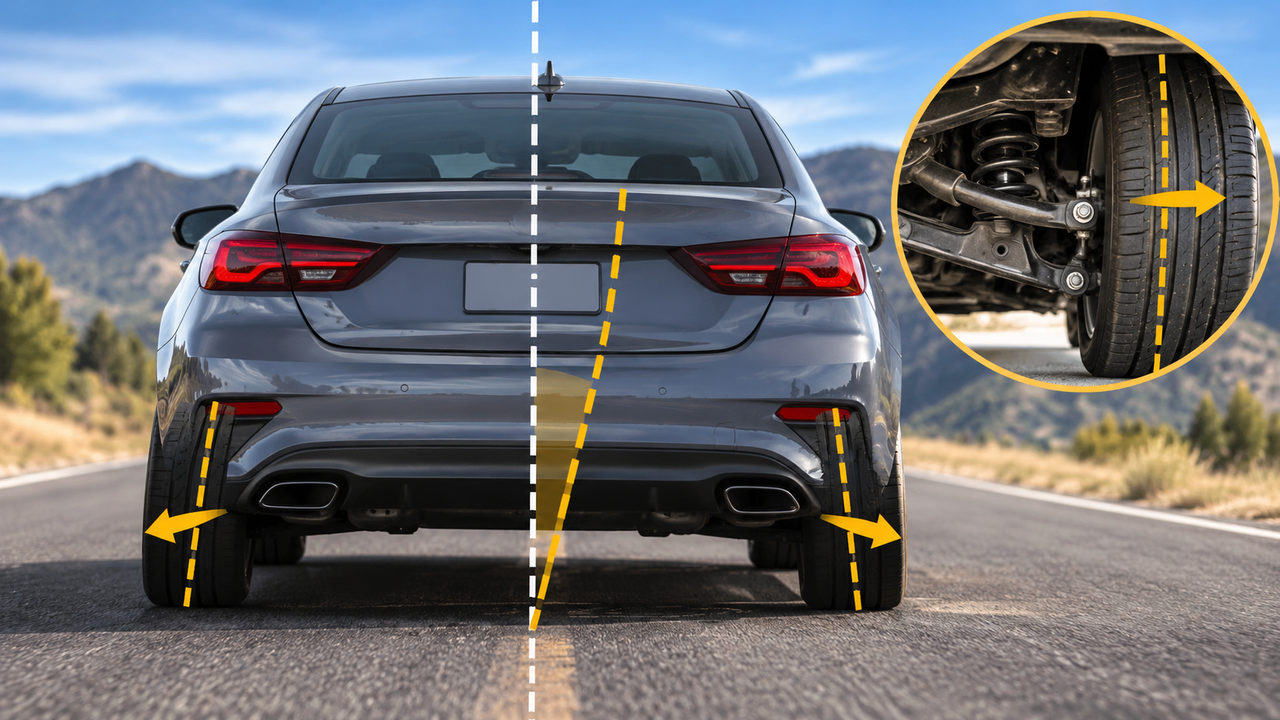
A thrust angle alignment uses the direction of the rear wheels to align the front wheels so the vehicle tracks straight and the steering wheel stays centered. The thrust angle itself is the angle between the vehicle’s geometric centerline and the direction its rear wheels are pointing. Ideally, those two directions are nearly identical.
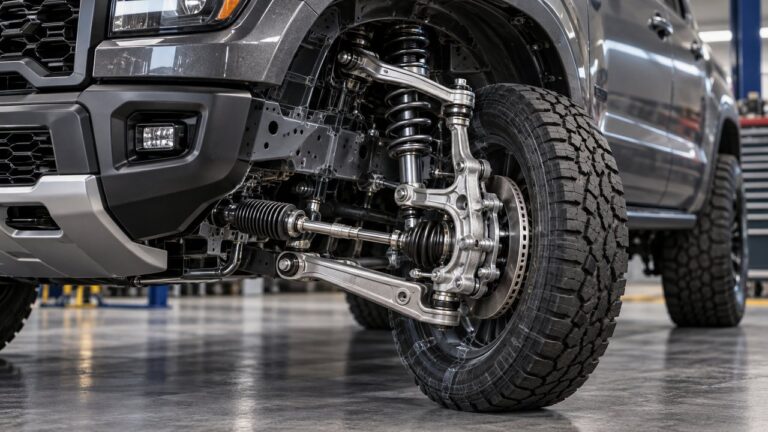
There’s an important distinction, though. On a car with adjustable rear suspension, a technician can often correct the rear toe and thrust angle before aligning the front wheels. On a truck with a nonadjustable solid rear axle, a thrust-line alignment may only compensate for the existing rear-wheel direction. It cannot straighten a bent axle or repair displaced suspension mounts.
An incorrect thrust angle can contribute to an off-center steering wheel, unusual vehicle tracking and tire wear. Sometimes the car appears to travel slightly sideways, a condition called dog tracking or crab walking. Other times the driver notices nothing until an alignment printout reveals a problem.
What Is Thrust Angle in Wheel Alignment?
Picture a car from directly above. Draw an imaginary line down the middle of its body, from the center of the rear axle toward the center of the front axle. That’s the geometric centerline.
Now look at where the two rear wheels are actually pointing. Their individual toe angles establish another imaginary line representing their combined rolling direction. Alignment technicians call it the thrust line.
When the thrust line and geometric centerline point in the same direction, the thrust angle is approximately zero. When they diverge, the rear wheels are trying to guide the vehicle along a slightly different path from the one suggested by its body.
The word “thrust” can be misleading. Even on a front-wheel-drive car, where the rear tires aren’t driven by the engine, their rolling direction still helps determine how the vehicle tracks. This is a geometry measurement, not a measurement of engine power.
Thrust angle is expressed in degrees, usually as a very small positive or negative value. The sign convention can differ between alignment systems, so the direction shown on the machine’s vehicle diagram is more useful than assuming that positive always means left or right.
Thrust Angle Alignment vs. Four-Wheel Alignment
This is where alignment terminology becomes confusing. A shop may offer a thrust-angle alignment, a front-end alignment and a four-wheel alignment as separate services. Another shop may use slightly different names for essentially the same measurement procedure.
The meaningful difference is which wheels are measured, which angles can be adjusted and what reference is used to center the steering.
| Service | What happens | Typical application |
|---|---|---|
| Basic front-end alignment | Front-wheel angles are measured and adjusted; rear geometry may not be fully evaluated | Front-only service, depending on equipment and procedure |
| Thrust-angle / thrust-line alignment | Rear-wheel direction is measured and used as the reference for front-wheel alignment | Vehicles with little or no normal rear adjustment |
| Four-wheel alignment | All four wheels are measured; adjustable rear angles are corrected before final front-wheel alignment | Many modern cars, crossovers and vehicles with adjustable rear suspension |
For example, a pickup with a correctly positioned solid rear axle may need only front adjustments, but measuring the rear thrust line still helps the technician set the steering wheel accurately.
A sedan with independent rear suspension is different. If the rear toe is adjustable and out of specification, correcting it before the front alignment can bring the thrust line closer to the car’s centerline instead of merely making the front wheels follow an incorrect rear direction.
Les Schwab’s explanation of two-wheel and four-wheel alignment uses “thrust angle alignment” for a front-adjustment service commonly performed on vehicles with nonadjustable rear axles. The terminology is worth checking when comparing workshop quotes.
Neither an AWD badge nor a 4WD transfer case determines which alignment service is appropriate. The rear suspension layout and manufacturer-approved procedure do.
Can Rear Total Toe Be Correct While Thrust Angle Is Wrong?
Yes. A car can have rear total toe within specification and still have an incorrect thrust angle. That’s one of the most useful things to understand when reading an alignment report.
Rear total toe combines the toe readings of the left and right rear wheels. Thrust angle depends on how those individual wheel directions compare with one another.
Suppose a vehicle has a hypothetical rear total toe target of +0.10°. The alignment machine reports these measurements:
| Measurement | Before correction | After correction |
|---|---|---|
| Left rear toe | +0.20° | +0.05° |
| Right rear toe | -0.10° | +0.05° |
| Rear total toe | +0.10° | +0.10° |
| Thrust angle magnitude | Approximately 0.15° | Approximately 0.00° |
Both setups have the same total rear toe. The difference is how that total is distributed between the wheels.
Before correction, one rear wheel has substantial toe-in while the other has toe-out. Their individual directions create a thrust line that is no longer centered on the vehicle. After correction, the toe is shared evenly between the two wheels, bringing the thrust angle close to zero without changing the total.
For small angles, a simplified calculation under a consistent individual-toe convention is:
Thrust angle magnitude ≈ |Left rear toe − Right rear toe| ÷ 2
In our example, the difference is 0.30°, giving a thrust angle magnitude of approximately 0.15°. The alignment equipment determines the signed direction using its own reference convention.
These are illustrative numbers, not specifications for a real car. An individual toe reading can be outside its permitted range even when the total is acceptable. Always compare the complete report with the correct vehicle data.
For more about how the direction of each wheel affects handling and tire scrub, see our toe-in vs. toe-out explanation. Here, the concern is specifically how rear-wheel toe establishes the vehicle’s thrust direction.
Symptoms of an Incorrect Thrust Angle
A noticeable tracking problem after a curb strike or suspension repair is a good reason to request a four-wheel measurement. But thrust-angle problems aren’t always obvious from the driver’s seat.
The Car Appears to Drive Sideways
Dog tracking is the most recognizable example. Viewed from behind, the car’s body appears slightly angled relative to its direction of travel. The rear wheels don’t follow quite the same path as the front wheels.
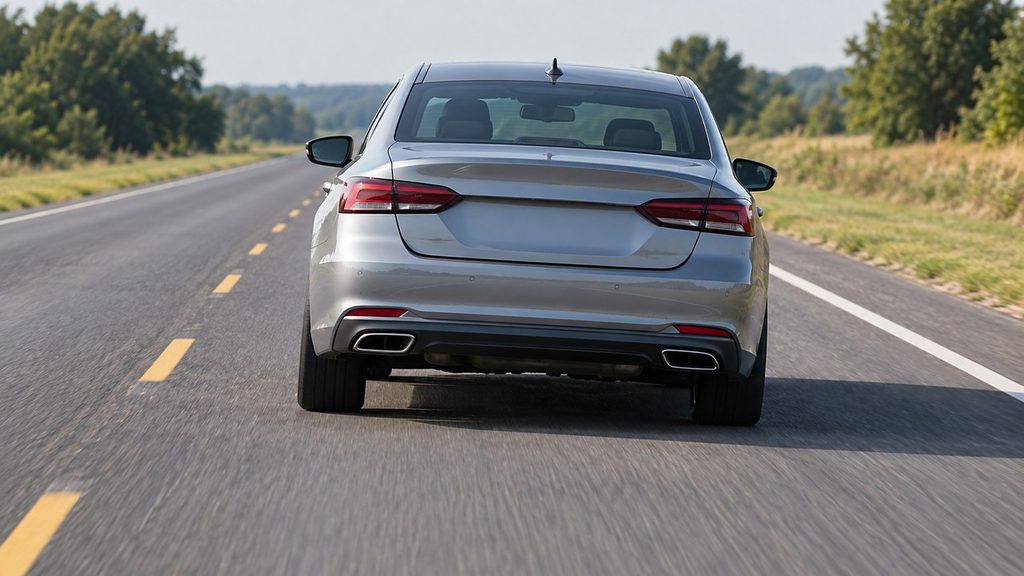
People sometimes describe the car as crabbing down the road. The effect can be difficult to recognize from inside the vehicle because the driver naturally corrects the steering to maintain a straight path.
Not every vehicle with a small nonzero thrust angle will visibly dog track. The severity depends on the geometry, and an apparent sideways stance can also involve axle offset or structural damage. Measurements are needed to distinguish them.
The Steering Wheel Is Crooked When Driving Straight
Imagine the rear wheels pointing slightly toward the right relative to the car’s centerline. The front wheels must follow the vehicle’s actual direction of travel, so the steering wheel may need to sit slightly off-center.
If a technician adjusts front toe relative to the geometric centerline without accounting for the rear thrust direction, the steering wheel can remain crooked even though the front total toe looks fine.
A thrust-line alignment can center the steering wheel around the measured rear direction. However, a centered steering wheel does not prove that the rear axle is correctly positioned.
Pulling, Wandering or Uneven Tire Wear
Some vehicles with abnormal rear geometry feel reluctant to travel straight, particularly on uneven roads. Others need frequent steering corrections or develop irregular wear on the rear tires.
Those symptoms are not unique to thrust angle. Tire conicity, mismatched tire pressures, cross-camber, cross-caster, worn bushings, brake drag and road crown can produce similar complaints.
Thrust angle itself is not a tire-wear setting in the same way toe is. But when an incorrect thrust line comes from excessive or unequal rear toe, the tire-scrubbing forces can shorten tread life. A car may also have near-zero thrust angle while both rear wheels have excessive toe and wear their tires prematurely.
What Causes Thrust Angle to Go Out of Alignment?
A vehicle usually doesn’t develop a large thrust-angle error for no reason. Sometimes the cause is as simple as an incorrect rear toe adjustment. Other times, something has physically moved.
Consider a car that drives normally until its rear wheel strikes a curb. There may be no dramatic noise afterward. The wheel still turns freely and the bodywork looks undamaged, yet a lower suspension link could now be a few millimeters away from its intended position.
That small change can be enough to alter rear toe and the thrust line.
- Incorrect rear toe adjustment: left and right settings are not balanced as required by the vehicle’s specifications.
- Bent rear toe link or control arm: an impact changes the direction of one rear wheel.
- Worn suspension bushings: unwanted movement allows the wheel position to vary, sometimes under load.
- Shifted rear subframe: the suspension mounting structure moves relative to the vehicle body.
- Damaged trailing arm or axle beam: the rear wheels no longer sit at their intended angles.
- Mislocated solid axle: damaged locating links, leaf-spring hardware or mounting points can skew the axle assembly.
- Collision or structural damage: suspension hardpoints may be displaced even after the visible body damage has been repaired.
- Incorrect replacement parts or installation: parts with the wrong dimensions, or components not seated correctly, can affect rear geometry.
Ride height and vehicle loading also matter. Alignment measurements should be taken under the conditions specified by the manufacturer. A vehicle sitting unevenly because of a suspension fault may produce readings that don’t represent its intended operating geometry.
If the alignment changes noticeably between repeated measurements, the technician should investigate suspension movement, worn joints, loose hardware or measurement errors before treating the numbers as a stable adjustment problem.
How Is a Thrust Angle Alignment Performed?
A proper thrust-angle check involves measuring the rear wheels, not just attaching gauges to the front axle and adjusting the steering wheel until it looks straight.
Professional alignment systems typically use sensors or optical targets at all four wheels. The machine calculates each wheel’s orientation and establishes the relationship between the vehicle centerline and the rear thrust line.
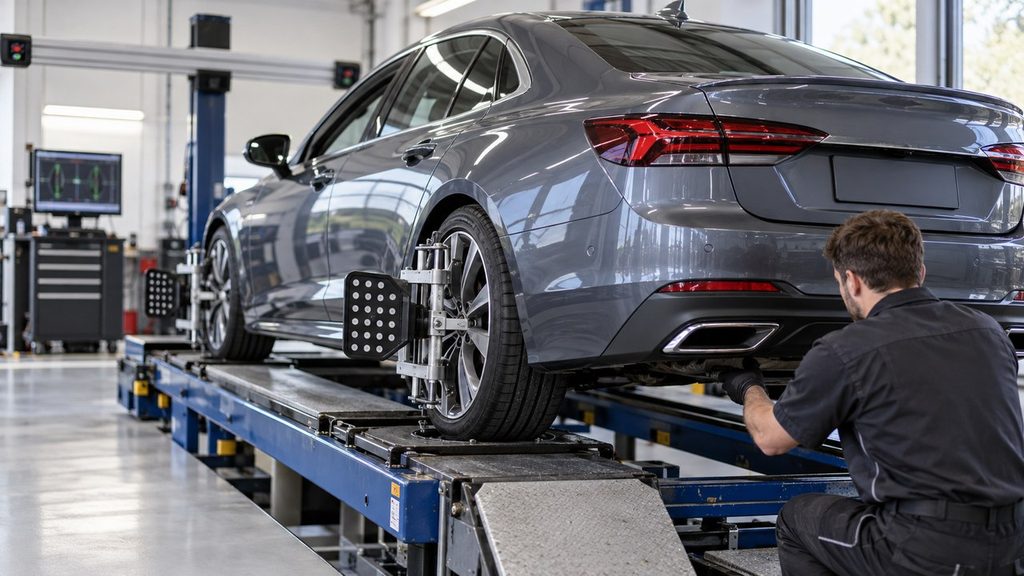
- Inspect the vehicle. Check tire pressures, tire condition, ride height, steering components, rear suspension joints and obvious damage. Measurements are unreliable when a wheel can move excessively.
- Set up the alignment equipment. Select the correct vehicle specification, install targets or sensors, perform the required compensation and prepare the alignment rack.
- Measure the rear geometry. Record left and right rear toe, rear total toe, camber and thrust angle. Compare the values with the specified limits.
- Correct the rear where adjustments are provided. On an adjustable rear suspension, set the applicable camber and toe values using the manufacturer’s procedure. Recheck thrust angle afterward.
- Align the front to the resulting thrust line. Set the available front camber and caster adjustments, center the steering system and adjust front toe with the correct rear reference.
- Verify the result. Repeat measurements where required, confirm the steering wheel is centered, review the before-and-after printout and road-test the vehicle when appropriate.
On a vehicle without normal rear adjustments, step four changes. The technician may leave the rear settings untouched and align the front wheels to the measured thrust line, provided the rear geometry is acceptable and no damaged component requires repair.
That’s compensation, not necessarily correction. The distinction becomes important when the thrust angle is substantially outside specification.
How to Adjust or Correct Thrust Angle
Whether thrust angle is adjustable depends almost entirely on how the rear wheels are located. There isn’t a universal thrust-angle adjustment bolt.
Independent Rear Suspension
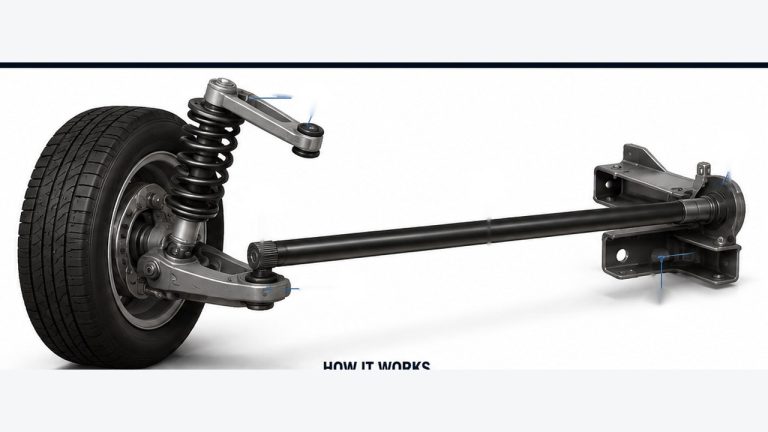
Many independent rear suspensions use adjustable toe links, eccentric bolts or other factory-provided adjusters. These allow a technician to change each rear wheel’s direction independently.
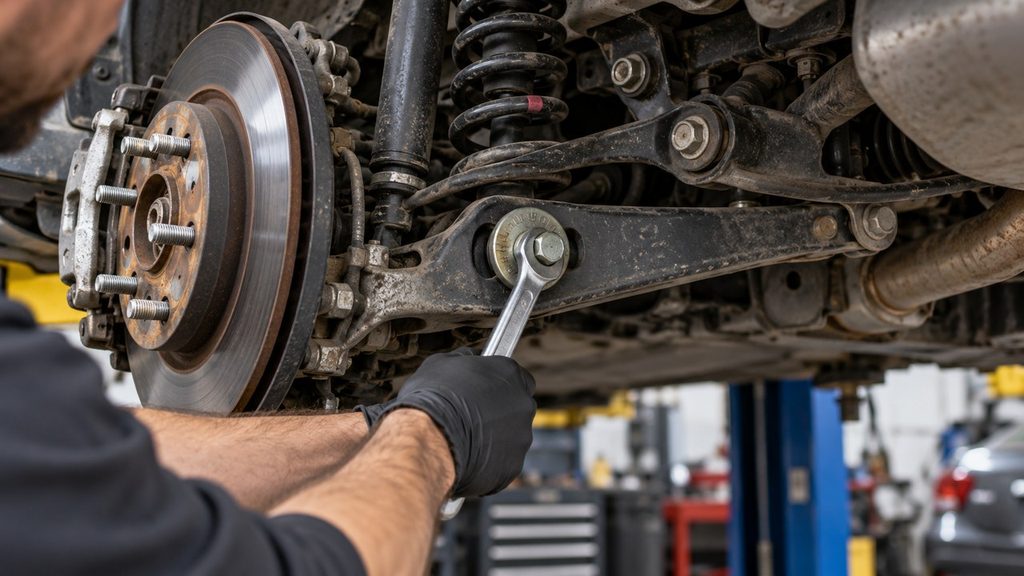
Usually the goal is to bring both rear toe values into their specified ranges while also reducing thrust angle toward the specified target. Adjusting only one side until the thrust number looks acceptable is not enough if rear total toe or individual toe remains incorrect.
Camber and toe adjustments can interact on some suspension designs. The correct adjustment order and hardware-tightening procedure must follow the vehicle’s service information.
Solid Rear Axle on a Truck or SUV
A traditional solid rear axle often has no routine individual rear-toe adjustment. Both wheels are located by the axle housing and its mounting arrangement.
If the axle is properly located and the thrust angle is acceptable, the front wheels can be aligned relative to its measured thrust line. This is a common reason a shop recommends a thrust-angle alignment instead of a conventional adjustable-rear four-wheel service.
But if the axle is skewed because of a damaged locating arm, broken spring center pin, shifted mounting point or bent housing, adjusting the front wheels will not restore the rear geometry.
Correcting a substantial fault may require repairing or replacing the affected component and then performing another alignment. Axle repositioning is only appropriate where the manufacturer provides an approved procedure.
Torsion-Beam and Other Nonadjustable Rear Suspensions
Some passenger cars use a torsion-beam rear suspension with little or no factory rear-toe adjustment.
If rear toe or thrust angle is outside specification after an impact, the problem may involve the beam, its bushings, a stub axle or an attachment point. Depending on the vehicle, a manufacturer-approved correction shim or specific repair component may be available.
That doesn’t mean generic shims should be installed on every axle. An application-specific correction must be compatible with the suspension design, and structurally damaged parts may need replacement rather than adjustment.
How to Read Thrust Angle on an Alignment Printout
When the shop hands over an alignment report, don’t look only for a green box beside “thrust angle.”
Ask to see the rear measurements together. A useful report should let you compare at least the following:
| Reading | What to check |
|---|---|
| Left rear toe | Whether the wheel points within its specified individual range |
| Right rear toe | Whether the opposite wheel is also correctly directed |
| Rear total toe | Whether the combined toe is acceptable |
| Thrust angle | Whether the combined rear-wheel direction matches the vehicle centerline |
| Rear camber | Whether wheel tilt is also abnormal or may affect the adjustment sequence |
| Setback, if reported | Whether there is a front-to-rear position difference between wheels on the same axle |
Look at the before-and-after columns too. If the thrust angle was outside specification before the service and remains there afterward, ask why. The answer could be that the rear suspension has no normal adjustment, an adjuster is seized, or a component needs repair.
One practical warning: green does not necessarily mean perfect. Alignment machines show acceptable ranges, not proof that every component is undamaged. A vehicle may also have an unevenly worn tire, a bent wheel or a problem that only appears under load.
What Is a Normal or Acceptable Thrust Angle?
For most conventional passenger vehicles, a thrust angle close to 0.00° is desirable because it means the rear wheels’ combined direction is nearly parallel to the geometric centerline.
However, there is no universal thrust-angle tolerance that applies to every car and truck. The permitted range depends on the manufacturer, suspension layout and measurement procedure.
A reading of +0.10° or -0.10° is not automatically acceptable or unacceptable without the correct vehicle specification. The sign alone also doesn’t establish which physical part is at fault.
If a shop identifies a problem, ask whether the reading is outside the published tolerance and whether it repeats after the vehicle has been correctly prepared and measured.
Thrust Angle vs. Axle Setback: Are They the Same?
No. These measurements describe different aspects of how the wheels and axles sit beneath the vehicle.
Thrust angle describes the combined rolling direction of the rear wheels compared with the geometric centerline. Setback describes a fore-and-aft difference in wheel position, such as one rear wheel sitting farther forward than the other.
A skewed rear axle can create both a setback condition and an unusual thrust angle, but the two readings are not interchangeable. A setback measurement alone does not establish the rear wheels’ combined toe direction.
After collision damage, a technician may also examine wheelbase differences, track width, axle offset and structural reference points. A normal thrust-angle reading does not certify that the vehicle’s body or suspension mounts are geometrically perfect.
Can a Thrust-Line Alignment Hide a Rear Suspension Problem?
It can make the steering wheel straight without eliminating the original cause of an incorrect rear thrust direction.
Suppose the rear axle points slightly away from the car’s centerline. A technician may align the front wheels to that existing thrust line. The driver can then travel straight with the steering wheel centered, even though the rear axle is still not square with the body.
For a small, permitted deviation on a vehicle without adjustable rear geometry, that may be the correct service procedure. It is not automatically a shortcut or a poor repair.
The concern is when the underlying rear condition is outside specification, produces tire wear or follows a collision. In that situation, front-wheel compensation should not be presented as proof that the rear damage has been repaired.
After replacing a component that locates a wheel or axle, another geometry check may be required. Our guide to alignment after suspension repairs covers when those follow-up checks are appropriate.
Can You Check Thrust Angle at Home?
Experienced enthusiasts sometimes use strings, toe plates, hub stands or a carefully established chassis centerline to estimate rear-wheel direction. Such setups can be useful for identifying a substantial discrepancy or checking a motorsport alignment between events.
The hard part is establishing reliable reference points. Body panels aren’t always symmetrical, wheel offsets may differ, and the front and rear track widths may not match.
A small measurement error over a long string can create a misleading angle. Suspension must also be settled at the correct ride height, with the vehicle safely supported where required.
For a road car with suspected collision damage, unexplained tire wear or an off-center steering wheel after an alignment, a professional four-wheel measurement is more useful than judging whether the tires look parallel from behind.
How Much Does Thrust Angle Alignment Cost?
The price depends on what the shop actually performs. A front-adjustment service that references the rear thrust line may be priced differently from a four-wheel alignment involving adjustable rear toe and camber.
Repairing a bent axle, replacing worn links or freeing seized adjustment hardware is a separate expense from measuring the angles. Ask whether the quote includes all-wheel measurements, rear adjustments where possible and a before-and-after report.
For typical United States prices and the differences between services, see our wheel alignment cost comparison.
A Few Questions Worth Asking Before You Leave the Shop
Can a car drive straight with a bad thrust angle?
Yes. The front steering can compensate for a rear thrust line that differs from the body centerline. The car may appear to drive straight and even have a centered steering wheel after a thrust-line alignment, while an out-of-spec rear geometry condition remains.
Does a negative thrust angle mean something is bent?
No. Positive and negative signs describe direction according to the alignment system’s convention. An actual fault is determined by the value relative to specification, the other rear measurements and a physical inspection.
Does every four-wheel alignment include thrust angle?
A proper four-wheel geometry measurement normally includes rear-wheel direction and a thrust-angle calculation. That doesn’t guarantee every rear angle can be adjusted. Ask which measurements were recorded and which adjustments were completed.
Can adjusting front toe fix thrust angle?
No. Front toe changes where the front wheels point. It can help center the steering relative to the measured rear thrust line, but it does not change the rear wheels’ actual combined rolling direction.
Should thrust angle be checked after hitting a curb?
Yes, particularly if the impact involved a rear wheel or the vehicle now tracks differently. A curb strike can bend a link, damage an axle component or shift a mounting point without leaving obvious external damage. Inspection and alignment measurements help determine whether repair is needed.
The Number That Tells You Where the Rear Wheels Are Pointing
A thrust-angle reading answers a straightforward question: are the rear wheels guiding the vehicle in the same direction as its geometric centerline?
On an adjustable rear suspension, an alignment technician can often correct the rear-wheel directions and then align the front to the updated thrust line. On a nonadjustable axle, the front can be set to follow the measured rear direction, but significant rear geometry errors still need their underlying cause investigated.
Before accepting an alignment as finished, look beyond whether the steering wheel is straight. Check the individual rear toe readings, total rear toe and thrust angle on the final report. Together, those measurements give a much clearer picture of whether the vehicle is actually tracking as intended.